


Community hub
Recent from talks
Contribute something
Nothing was collected or created yet.
Line (heraldry)
View on Wikipedia
The lines in heraldry used to divide and vary fields and charges are by default straight, but may have many different shapes. Care must be taken to distinguish these types of lines from the use of lines as charges, and to distinguish these shapes from actual charges, such as "a mount [or triple mount] in base," or, particularly in German heraldry, different kinds of embattled from castle walls.
In Scotland, varied lines of partition are often used to modify a bordure (or sometimes another ordinary) to difference the arms of a cadet from the chief of the house.[1]
Different shapes of lines
[edit]Indented and dancetty
[edit]
An ordinary indented is bounded by small zigzags like a triangle wave or the teeth of a saw, with peaks on one side matching peaks on the other. An ordinary dancetty is similar, but with peaks matching troughs, so that the width is constant; it also typically has fewer points than indented. In early armory these were not distinguished. In the arms of the 55th Electronic Combat Group of the United States Air Force the indented is "edged wider on the back angle (sinister) than on the face (dexter) of each angle".[2]
Dentilly is a modern invention, similar to indented, but with one of the sides of the points perpendicular and the other angled, as in a sawtooth wave.[citation needed]
Rayonné (also rayonne, rayonny; from French rayonner) may be considered a variant of indented, but with wavy instead of straight lines, as in the conventional representation of rays of the sun. Rayonne palewise appears in the arms of the 172d Support Battalion of the United States Army.[3] A chief enarched rayonné on a gold field appears in the arms of Sechelt, British Columbia, forming the appearance of a sun.[4]
The arms of the Worshipful Company of Security Professionals contain an example of indented acute, a form of indented with higher peaks.[5]
The number of peaks in indented is almost never specified, but an exception is the arms of Arthur D. Stairs: Per bend sinister indented of six steps Gules and Sable, and Westville, Natal, South Africa bears Sable, issuant from behind a fence of spears in base Argent, a fig tree in leaf Or; on a chief indented of four points to base, also Or, three lion's faces Sable.[citation needed]
In South Africa there are a number of examples of dancetty inverted. While the number of peaks in dancetty are three unless otherwise specified, the arms of Wagland show dancetty of two points[6] and the arms of Baz Manning show a chief "dancetty of two full points upwards".[7] The arms of the Matroosberg Transitional Representative Council in South Africa give an example of dancetty… in the shape of a letter W. The arms of the French department of Côtes d'Armor show émanché, which would be equivalent to the English per fess dancetty of two full points upwards. The arms of Baron Griffiths of Fforestfach are Paly of four Vert and Argent per fess enhanced indented of two points upwards each point double barbed throughout issuing in base a pile double barbed throughout all counterchanged.[8] The arms of Alaric John Martin Woodrow show an example of barry dancetty each point double barbed, used to represent a line of fir trees as a play on the surname.[9] The arms of the Free State in South Africa show "a chief dancetty, the peaks terminating in merlons",[10] and so might be called a combination of dancetty and embattled; a similar hybrid can be seen in the arms of the Agricultural Gymnasium. Hoerskool Hangklip provide an example of dancetty with points flattened, and Blouberg of dancetty the peaks couped.[11] It is difficult to know whether to characterise the "wall-like extremity with five merlons and four embrasures" in the arms of the Kurgan Oblast in Russia as a divided field or a charge.[1]
The arms of Ernest John Altobello show a chevron with the upper edge grady (this is identical in appearance to indented) "and ensigned of a tower Argent".
Wavy and nebuly
[edit]
A line wavy (also called undy)[12] is a sine wave, often used to represent water; a line nebuly is similar but with more exaggerated meanders, representing clouds. There are confusing, ambiguous and non-standard uses of a wavy in the military heraldry of the United States to refer to irregularly wavy lines.[13]
The wavy chief in the arms of Lord Nelson was blazoned as undulated.[14]
The field of the arms of the 40th Finance Battalion of the United States Army is blazoned per fess wavy (in the manner of a Taeguk).[15]
In wavy crested the waves appear like pointed breakers.[16] The arms of James Hill show an example of barrulets wavy crested to the sinister on the upper edge.[17] The chief in the arms of Professor S.W. Haines is wavy of one crest and depressed in the centre of one point.[18]
There are examples of even greater complexity and specificity in the wavy line, such as the arms of "Baron Nolan ... [which include] three 'bars wavy couped composed of two troughs and a wave invected of one point on the upper edge and engrailed of one point on the lower edge'".[19]
Specification of the number of "undulations" in nebuly can be seen by Jochen Wilke's roundel, with ten.[20] (It is uncommon for lines of partition to modify a charge other than an ordinary.)
The Blount family of Worcestershire, England, whose members held the titles of Baron Mountjoy and two baronetcies, bore Barry nebuly of six or and sable. Nebuly lines also appear in the arms of the former borough councils of Fleetwood (Lancashire) and Hyde (Cheshire).
Engrailed and invected
[edit].svg)
These lines consist of a series of circular arcs curving in the same direction, meeting at angles, forming points outward (engrailed) or inward (invected). When these terms are applied to a partition rather than to an ordinary, the first part of the field is the "interior".
The arms of Liverpool Hope University include a Cross engrailed of one point on each limb.[21] The Flag of Flintshire is Argent a cross engrailed sable between four Cornish choughs proper.

The arms of the Pretoria Philatelic Society show a chief engrailed and couped, having the appearance of the edge of a perforated postage stamp. The arms of Kutlwanong Dorp in South Africa provide an example both of the specification of the number of lobes in invected, and those lobes being trefly.[22]
Embattled and variants
[edit]

A line embattled is a square wave, representing the battlements of a castle.
When a fess is embattled, only the topmost edge is altered (as in the arms of Muri bei Bern). If both edges are to be embattled, the term embattled-counter-embattled (or counter-embattled, as in the arms of Sir Cecil Denniston Burney) is used. In this case the lines are parallel. If gaps face gaps, the term bretessé is used. There is at least one emblazonment suggesting that the orle is only embattled on its outer edge.
Italian armory has a variant, Ghibelline battlement, with notched merlons.
In a line raguly the extensions are oblique rather than orthogonal, like the stumps of limbs protruding from a tree-trunk.
Dovetailed is as in carpentry. Unlike embattled, gaps face gaps.
Potenty may be considered a variant in which the points are extended to T-shapes ("potent" means a crutch).
A line embattled grady[23] or battled embattled[24] consists of series of two or three steps, as if each merlon has a smaller merlon atop it. Parker's glossary says that double-embattled may be the same as this.
The arms of Schellenberg in Liechtenstein provide an example of embattled "with three battlements".[25] The bordure in the arms of Boissy l'Aillerie, in Val d'Oise, France, has nine battlements (the bordure is also masoned and contains door-like openings).
A very unusual occurrence of embattled occurs in the arms of the 136th Military Police Battalion of the United States Army: Sable, a fesse enhanced and embattled Or, overall a magnifying glass palewise rim Argent (Silver Gray), the glass surmounting and enlarging the middle crenel between two merlons, the handle Gules edged of the second bearing a mullet Argent.[26]
The arms of Baron Kirkwood show two chevronels round embattled (the merlons are rounded rather than squares). There are also examples of embattled pointed[11] and embattled in the form of mine dumps.
James Parker cites the arms of Christopher Draisfield: "Gules, a chevron raguly of two bastons couped at the top argent."
The arms of Zodwa Special School for Severely Mentally Handicapped Children show a chevron dovetailed, the peak ensigned with a potent issuant.

Some examples also exist of urdy, where the line is in the shapes of the upside-down and rightside-up "shields" of vair (this is to be distinguished from couped urdy, in which the couping takes a pointed form[27]). The arms of Winfried Paul Reinhold Steinhagen are Per chevron, the peak in the form of a merlon round urdy of four, Gules and Or, in chief a horse forcene and a goat clymant respecting one another, Argent, and in base a bull's head Sable armed Argent; a chief per fess in the form of a wall with three watchtowers, Azure and Argent, the latter charged with a strand of barbed wire throughout, Sable. The "unusual, if not unique" arms of Lourens Du Toit are Per fess of three pallets urdy Sable and Or.[28]
The arms of the Royal Australasian College of Dental Surgeons[29] have a bordure emblazoned "dentate", although this appears to be quite similar to dovetailed.
Embowed, nowy and variants
[edit]A line embowed consists of a single arch.
A line nowy contains a semicircular protuberance in the middle. A line with an angular protuberance in the middle, like a battlement, is called escartelly.[12]
The arms of Laerskool Bosveld in South Africa have a field Per chevron embowed trefly, Azure and Argent.
The arms of Léopold-Henri Amyot [2] show "per fess ogivy"; this is based on the ogive or pointed arch.
Chiefs, fesses and palar dividing lines are sometimes seen arched and double-arched (and there is an example of triple-arched), though there is some debate as to whether or not these are lines of partition. That arched can be combined with partition lines can be seen from the arms of South Lanarkshire in Scotland. Arched can also be reversed.
Rarer lines and recent inventions
[edit]
The rare line bevilled modifies the bendlets in the arms of Thomas Roy Barnes[30] and the pairle in the arms of Rovaniemi, Finland. This lightning-bolt type of line with one zigzag is to be distinguished from angled, in which the line takes a pair of 90° turns before continuing parallel to and in the same direction as the old line. There is a South African example of bevilled to sinister, and a bend double bevilled can be seen in the arms of Philip Kushlick School.
A line trefly shows protuberances in the form of trefoils.
The arms of Saint Paul's Cathedral in Regina, Saskatchewan contain a bordure its inner line looping in foils of poplar of the field within the bordure at each angle and at regular intervals between.[31]
The arms of Carmichael show a fess "wreathy", which may or may not be strictly speaking a line of partition, but does modify the fess; the coat is not blazoned as a "wreath in fess". James Parker calls this "tortilly".
The 20th century saw some innovations in lines of partition. Erablé, a series of alternating upright and inverted maple leaves, is a typically Canadian line of partition, though the College of Arms in London has used it in a few grants (but compare the cross nowy erablé in the arms of Katherina Fahlman Selinger Schaaf.[32] A Finnish line of partition, invented by Kaj Cajander and called kuusikoro, which is called fir-tree topped in Britain, and which the Canadian Heraldic Authority coined the term sapiné to blazon, resembles fir trees; in the arms of Guy Selvester[33] this is called sapinage. A line resembling fir twigs, and so called in British blazon, is called sapinagé in Canada (English and French),[34] and havukoro in Finland.[35] Other 20th-century examples of lines, or things akin to lines, include the 1990 grant to Albersdorf-Prebuch in Austria, in which the upper line of the fess takes the form of fruit, the bottom of vine-leaves. (It is debatable what the distinction is between such lines, and examples such as the arms of Bierbaum am Auersbach,[36] a town in Styria, in which three pears grow from a pall.)
The South African Bureau of Heraldry has developed the line of partition serpentine (which has also been called ondoyant), which is rather like wavy, but with only one "wave", one complete cycle of a sine wave; the serpentine in the arms of the Mtubatuba Primary School is defined as "dexter to chief and sinister to base". (Similar is the German im Schlangenschnitt (snake-wise).) It has also developed the uniquely South-African lines of division (which can also form the ends of a charge) nowy of a Cape Town gable (now called just nowy gabled),[35][37] and nowy of an Indian cupola. Similarly, the fess line in the arms of the Council for Social and Associated Workers is nowy of a trimount inverted, the fess in the arms of Mossel Bay is nowy of two Karoo gable houses, the chief in the arms of the Lenasia South-East Management Committee is nowy of an Indian cupola, the chief in the arms of the Genealogical Society of South Africa is double nowy gably and that of Frederick Brownell is gably of three.[38] The arms of the Reyneke Bond (i.e. Reyneke Family Association) are Per fess, in each flank double nowy fitchy to base, Azure and Or, a lion rampant per fess of the second and Gules, a chief Or. The plain chief identifies these as the arms of a family association. The arms of Itsokolele, South Africa include a chief double fitchy inverted.
Broad fitchy couped is a line of South-African origin similar in appearance to a mine-dump or escartelly with sloping sides.[11]
Chevrons can be topped with a fleur-de-lys, and ordinaries with non-straight edges (particularly if they are dancetty or engrailed) can have the points topped with demi fleurs-de-lys. It has sometimes been said that in some reference works flory-counter-flory (and flory) is treated like a line of partition, even though strictly speaking it is not – though it has been used for centuries that way in the royal arms of Scotland blazoning the double tressure (Public Register of Arms, Lyon Court, Edinburgh) and used by the College of arms in blazoning coats like that of Sutherland of Dunstanburgh Castle (Gules, a chevron flory-counterflory between in chief three mullets and in base a lymphad all or) and is used by the South African Bureau of Heraldry blazoning the coat of Huis Tankotie of the University of Pretoria (Per fess, flory counter-flory, Argent and Azure, in base within the flower an annulet Sable; a bordure counterchanged) and Emmanuel-Opleidingsentrum in the South African Bureau of Heraldry's online database. (Flory is sometimes varied with other shapes than the fleur-de-lys, when it is blazoned as flory of.[39])
A vague and unhelpful blazon of the 27th Air Division of the United States Air Force provides for a "bordure of distinctive outline".[40]
Gallery of different lines of partition
[edit]Each shield is Per fess _______ argent and gules, but some of these lines have no common English name.
-
 invected
 -
 engrailed
 -
 embattled
 -
 wavy or undy
 -
 nebuly
 -
![fir-tree topped, a recent Finnish innovation (also known as Sapiné in Canada)[41]](//upload.wikimedia.org/wikipedia/commons/thumb/a/a3/Kuusikoro.svg/120px-Kuusikoro.svg.png) fir-tree topped, a recent Finnish innovation (also known as Sapiné in Canada)[41]
fir-tree topped, a recent Finnish innovation (also known as Sapiné in Canada)[41] -
![fir-twigged, a recent Finnish innovation (also known as Sapinagé in Canada)[42]](//upload.wikimedia.org/wikipedia/commons/thumb/a/a7/Havukoro.svg/120px-Havukoro.svg.png) fir-twigged, a recent Finnish innovation (also known as Sapinagé in Canada)[42]
fir-twigged, a recent Finnish innovation (also known as Sapinagé in Canada)[42] -
 indented as it is commonly shown
 -
 dancetty, limited to three indentations
 -
 indented very much deeper than is usual
 -
 enarched
 -
 per chevron
 -
 trefly-counter-trefly
 -
 embattled in crosses, Finnish heraldry
 -
 potenty
 -
![palissado, Finnish heraldry[43]](//upload.wikimedia.org/wikipedia/commons/thumb/5/5a/Hakulikoro.svg/120px-Hakulikoro.svg.png) palissado, Finnish heraldry[43]
palissado, Finnish heraldry[43] -
![bastionné, Finnish heraldry[44]](//upload.wikimedia.org/wikipedia/commons/thumb/a/a3/Vallikoro.svg/120px-Vallikoro.svg.png) bastionné, Finnish heraldry[44]
bastionné, Finnish heraldry[44] -
![spaded[45]](//upload.wikimedia.org/wikipedia/commons/thumb/7/79/Lehmuskoro.svg/120px-Lehmuskoro.svg.png) spaded[45]
spaded[45] -
 lilyous, Finnish heraldry
 -
 indented pommetty
 -
 rayonny
 -
 embattled grady
 -
 rayonny (variant)
 -
 dovetailed
 -
 bevilled
 -
 thorny, Finnish heraldry
 -
 raguly
 -
 nebuly
 -
 rayonné
 -
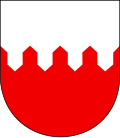 urdy
urdy -
 angled
 -
 épiné (acacia thorned), also known as dovetailed indented
 -
![Érablé, Canadian heraldry[46]](//upload.wikimedia.org/wikipedia/commons/thumb/d/d8/%C3%89rabl%C3%A9.svg/120px-%C3%89rabl%C3%A9.svg.png) Érablé, Canadian heraldry[46]
Érablé, Canadian heraldry[46]


![fir-tree topped, a recent Finnish innovation (also known as Sapiné in Canada)[41]](https://en.wikipedia.org/wiki/File:Kuusikoro.svg)
![fir-twigged, a recent Finnish innovation (also known as Sapinagé in Canada)[42]](https://en.wikipedia.org/wiki/File:Havukoro.svg)


![palissado, Finnish heraldry[43]](https://en.wikipedia.org/wiki/File:Hakulikoro.svg)
![bastionné, Finnish heraldry[44]](https://en.wikipedia.org/wiki/File:Vallikoro.svg)
![spaded[45]](https://en.wikipedia.org/wiki/File:Lehmuskoro.svg)


![Érablé, Canadian heraldry[46]](https://en.wikipedia.org/wiki/File:%C3%89rabl%C3%A9.svg)
See also
[edit]
Notes
[edit]- ^ Mark Harden. "Beginners Heraldry". The Heraldry Society of Scotland. Archived from the original on 2008-10-13. Retrieved 2011-06-06.
- ^ "55th Electronic Combat Group". Retrieved 2010-10-10.
- ^ "172 Support Battalion". The Institute of Heraldry. Retrieved 2011-05-10.
- ^ "District of Sechelt". Public Register of Arms, Flags and Badges of Canada. The Governor General of Canada. 14 June 1996. Retrieved 11 June 2018.
- ^ "June 2008 Newsletter (No. 17) – College of Arms". Retrieved 2013-09-01.
- ^ "Wagland". The White Lion Society. Archived from the original on 2011-07-22. Retrieved 2011-06-06.
- ^ "The Call to Arms – Baz Manning". Society of Heraldic Arts. Retrieved 2011-06-06.
- ^ Peter Ll Gwynn-Jones (December 2007). "Heraldry of New Life Peers" (PDF). The Heraldry Gazette. New (106): 10–11. Retrieved 2011-06-06.
- ^ "Alaric John Martin Woodrow". The Canadian Heraldic Authority. Retrieved 2011-06-06.
- ^ "Free State Coat of Arms". Archived from the original on 2004-01-03.
- ^ a b c "Design elements - South African heraldry". Archived from the original on 8 July 2011.
- ^ a b Mackinnon of Dunakin, Charles (1968). The Observer's Book of Heraldry. Frederick Warne and Co. Ltd. pp. 48–50.
- ^ "Air Forces Cyber". www.afcyber.af.mil. Archived from the original on October 8, 2018.
- ^ "The FEUDAL HERALD - July 2000". www.baronage.co.uk.
- ^ "TIOH - Heraldry - 40 Finance Battalion". Archived from the original on 2011-06-10.
- ^ "Grant of Arms". Archived from the original on 2007-09-28. Retrieved 2007-03-06.
- ^ "The Heraldry Society of Scotland - HSS Members' - Scots Arms/Johnson". heraldry-scotland.com.
- ^ "The Arms, Crest and Badge of Professor S. W. Haines - College of Arms". Retrieved 2019-04-28.
- ^ "Historical trends in choice of ordinaries and charges". www.grsampson.net.
- ^ "American Heraldry Society | Armorial / Jochen Wilke". Archived from the original on 2011-07-21.
- ^ "The Arms, Crest, Supporters and Badge of Liverpool Hope University - College of Arms". College of Arms. Retrieved 1 July 2017.
- ^ "Club and Society Heraldry". South African Heraldry. Archived from the original on 27 October 2009. Retrieved 1 July 2017.
- ^ "The Arms of Steven Richard Moore - The Armorial Register". www.armorial-register.com.
- ^ "The Heraldry Society - members' arms". Archived from the original on 24 December 2003.
- ^ "Schellenberg - Heraldry of the World". www.heraldry-wiki.com.
- ^ "136th Military Police Battalion Insignia Page". Archived from the original on 7 May 2006.
- ^ "231st Military Police Battalion". Archived from the original on 7 May 2006.
- ^ "Personal Coats of Arms - South Africa". Archived from the original on 8 July 2011.
- ^ "Royal Australasian College of Dental Surgeons - College Arms". Archived from the original on 19 August 2006.
- ^ "Arms of Thomas Roy Barnes". Archived from the original on 2004-04-09.
- ^ General, The Office of the Secretary to the Governor (12 November 2020). "Saint Paul's Cathedral [Civil Institution]". reg.gg.ca.
- ^ General, The Office of the Secretary to the Governor (12 November 2020). "Schaaf, Katherina Fahlman Selinger [Individual]". reg.gg.ca.
- ^ "The Heraldry Society - members' arms". Archived from the original on 30 August 2004.
- ^ The Governor General of Canada (15 August 2017). "Arms of Paul Philip Clarke". reg.gg.ca.
- ^ a b David B. Appleton. "New Directions in Heraldry [But there really is "nothing new under the sun"]" (PDF).
- ^ "Bierbaum am Auersbach - Wappen von Bierbaum am Auersbach / Coat of arms (crest) of Bierbaum am Auersbach". Retrieved 2019-04-28.
- ^ "Introduction to South African Heraldry - Cultural Heraldry". South African Heraldry Website. October 2007.
- ^ "Who's who in South African Heraldry". Archived from the original on 8 July 2011.
- ^ "The Heraldry Society - members' arms". Archived from the original on 27 December 2004.
- ^ "Factsheets: 27 Air Division". Archived from the original on 24 October 2012.
- ^ General, The Office of the Secretary to the Governor (12 November 2020). "Green College of the University of British Columbia [Civil Institution]". reg.gg.ca.
- ^ General, The Office of the Secretary to the Governor (12 November 2020). "The Corporation of the City of Port Coquitlam [Civil Institution]". reg.gg.ca.
- ^ "DevFinto: HERO: Palissado".
- ^ "DevFinto: HERO: Bastionné".
- ^ "DevFinto: HERO: Spaded".
- ^ Patterson, Bruce. "Canadian Innovations in Heraldic Charges". The Royal Heraldry Society of Canada. Royal Heraldry Society of Canada. Retrieved 6 February 2020.
- ^ Fearn, Jacqueline (1980). Discovering Heraldry. Shire Publications Ltd. p. 18. ISBN 0-85263-476-5.
References
[edit]- Burke's Peerage and Baronetage, 105th edition.
External links
[edit] Media related to Lines in heraldry at Wikimedia Commons
| Types | |||||||||||||||
|---|---|---|---|---|---|---|---|---|---|---|---|---|---|---|---|
| Topics | |||||||||||||||
| Achievement | |||||||||||||||
| Charges | |||||||||||||||
| Tinctures |
| ||||||||||||||
| Applications | |||||||||||||||
| Related | |||||||||||||||
| |||||||||||||||


Line (heraldry)
View on Grokipedia- Embattled: Resembling the crenellations of a castle wall, with square projections and indentations; often evokes fortifications.[2][4]
- Engrailed: Formed by a series of concave semicircles or scallops pointing inward, typically with four to six arcs per ordinary; historically linked to the edge of a chalice in Old French origins.[3][1]
- Wavy: Gentle, undulating curves simulating water; used sparingly to avoid confusion with other fluid lines.[2][4]
- Nebuly: Deeper, cloud-like waves composed of opposing semicircles, suggesting mist or nebulous boundaries.[2][1]
- Indented: A zigzag pattern of right-angled steps, narrower and sharper than similar variants.[2][1]
- Dancetty: Broader zigzags with deeper indentations, creating a more pronounced dance-like rhythm.[2][1]
Fundamentals of Heraldic Lines
Definition and Purpose
In heraldry, a line is defined as the edge or boundary that partitions the field of a shield into sections of different tinctures or outlines the contours of charges such as ordinaries.[6] These partition lines, blazoned using terms like "per fess" or "per pale," serve as structural elements to create distinct areas on the escutcheon, enabling the combination of colors (tinctures) in a visually balanced manner.[1] By default, such lines are assumed to be straight unless a specific variation is described in the blazon, providing a simple and neutral baseline for heraldic composition.[7] The primary purposes of heraldic lines include dividing the shield's field to accommodate multiple tinctures, which allows for more intricate designs while generally respecting the rule of tincture (avoiding color on color or metal on metal).[7] They also facilitate the differentiation of arms among family branches through cadency systems, such as the addition of bordures in Scottish heraldry, where the line outlining the bordure varies in tincture or style to denote lineage.[8] Additionally, lines contribute aesthetic and symbolic depth by varying the visual rhythm of the arms, enhancing identifiability without overwhelming the core elements.[1] Importantly, heraldic lines differ from charges, as they function as boundaries rather than independent emblazonments; charges are the symbolic figures or objects placed within or across the divided field.[1] For example, a blazon of "per fess argent and gules" employs a straight horizontal line to separate an upper silver (argent) portion from a lower red (gules) one, illustrating a basic partition that alters the field's appearance through tincture contrast alone.[1] Similarly, "per pale or and sable" uses a vertical straight line to halve the shield into gold (or) and black (sable) sections, emphasizing the line's role in straightforward field division.[1]Historical Development
Heraldic lines originated in the 12th century European context of the Crusades, where knights required distinctive identifiers on shields and surcoats amid the rise of closed helmets, initially employing simple straight divisions of the field to accommodate multiple tinctures without adding new charges.[9] By the 13th century, these lines had become integral to armorial bearings, as evidenced in early rolls of arms that primarily featured basic partitions to distinguish personal and familial arms during tournaments and warfare.[10] In the 14th and 15th centuries, heraldic lines evolved to include more varied shapes, enabling finer differentiation of arms for branches of families and alliances while adhering to the rule of tincture, with innovations driven by artistic and practical needs in shield design.[9] This period saw regional variations emerge, such as in Scotland, where lines of partition were systematically applied to cadet arms to indicate birth order and lineage distinctions, contrasting with English practices that favored external marks like labels.[8] Early treatises by 16th-century heralds often reflected confusions in terminology and depiction, particularly between indented lines—characterized by small, regular indentations—and dancetty lines with larger, fewer zigzags, leading to interchangeable usage in rolls of arms from the late 13th century onward. The development of certain lines also drew from symbolic influences; for instance, wavy lines appeared in 13th-century representations to evoke water or fluidity, later extending to denote maritime associations or illegitimacy when used in bordures from the late 18th century.[9] Post-17th century, innovation in line shapes declined due to the standardization of heraldic practices amid the rise of standing armies and reduced tournament culture, resulting in simplified designs that prioritized clarity over complexity.[9] Limited revivals occurred in 19th- and 20th-century civic heraldry, where municipalities adopted varied lines inspired by medieval forms to symbolize local identity and authority, as seen in German and British municipal arms.[11] Historical records remain incomplete for some variants, such as the dentilly line, which lacks firm attestations before the 18th century and appears only sporadically in later treatises without clear medieval precedents.[9]Classification of Line Shapes
Straight and Basic Lines
In heraldry, the straight line serves as the fundamental and default boundary for dividing the shield or outlining charges, characterized by its clean, unadorned edges that run perpendicular or at precise angles across the field.[12] These lines typically appear vertical in partitions such as per pale, which bisects the shield from top to bottom, or horizontal in per fess, dividing it into upper and lower sections.[13] Angled straight lines form other basic divisions, like the diagonal per bend or per chevron, ensuring a simple geometric precision that underpins heraldic composition.[12] As the unspoken default in blazons, the straight line is rarely specified unless a variation is intended, allowing descriptions to remain concise while implying uniformity for clarity.[13] It receives explicit mention only in contexts requiring emphasis, such as complex multi-part partitions where deviations might otherwise occur, or to distinguish from ornamental alternatives in layered designs.[12] This default status reflects heraldry's emphasis on recognizability, particularly in early armorial bearings where rapid identification was essential during tournaments or battles.[13] Minor variants of the straight line include the "plain" edge, which denotes the standard smooth termination without adornment, and the "couped" edge, applied to charges to indicate a clean, abrupt severance as if cut across.[12] These are confined to non-ornamental uses, such as a fess couped that does not extend fully to the shield's sides or a charge like a lion couped in all joints to show precise disconnection from the field.[12] For instance, the arms of Waldegrave are blazoned party per pale argent and gules, with the straight vertical line implied as plain and extending fully.[12] Similarly, simple partitions like party per pale gules and azure rely on the default straight division for visual balance.[12] The advantages of straight lines lie in their simplicity, which promotes clarity and ease of reproduction in both medieval seals and contemporary grants, minimizing ambiguity in heraldic interpretation.[13] This baseline form contrasts with more decorative shapes by prioritizing functional division over symbolic embellishment.[12]Zigzag Lines: Indented and Dancetty
The indented line in heraldry features deep, rectangular zigzags that form a series of "V" or "W" patterns along the edge of an ordinary or partition line, with the indentations typically of equal depth and aligned such that peaks on one side correspond to troughs on the other.[14] This geometric form evokes a saw-toothed or key-like notch, distinguishing it from smoother curves by its sharp, angular breaks.[14] Symbolically, the indented line is often associated with fire or mountainous terrain, reflecting its jagged profile that mimics flames or rugged earth features, as interpreted in traditional heraldic symbolism.[15] An alternative view traces it to architectural moldings or the teeth of wild beasts, emphasizing defensive or natural barriers.[16] A representative example of an indented line appears in the arms of the de Vere family, blazoned as per fess indented or and gules, where the horizontal division creates a bold, interlocking zigzag across the shield.[17] This application highlights the line's role in dividing fields while adding ornamental depth, often used in medieval blazons to denote resilience or territorial strength.[16] The dancetty line, a close relative of the indented, employs shallower and broader angular zigzags, forming a repetitive pattern that resembles dance steps or lightning bolts, with the indentations on opposing sides fitting together to produce lozenge-shaped segments of consistent width.[17] Unlike the deeper notches of the indented line, dancetty typically features fewer points—often three for a fess—creating a more rhythmic, less aggressive outline that maintains balance across the ordinary.[17] Its symbolism aligns with water or electrical energy, such as lightning, underscoring fluidity or sudden force in heraldic design.[15] Historical arms incorporating the dancetty line include those of the Ady family of Kent, blazoned as azure, a fesse dancetty between three cherubim's heads or, faces argent, where the central band zigzags prominently amid celestial charges, evoking divine protection or dynamic motion. Such uses were common in English heraldry from the 13th century onward, enhancing visual complexity without overwhelming the shield's primary elements.[16] Among variants of these zigzag lines, the rayonné (or rayonny) modifies the indented form by incorporating wavy rather than straight edges within the zigzags, producing a radiating effect akin to sun rays or flames, often applied to ordinaries for a luminous quality.[18] The dentilly line, a lesser-known variant resembling smaller, tooth-like indents in a sawtooth pattern, shares the angularity of indented but features one perpendicular and one slanted side per notch; however, it lacks extensive historical documentation and is noted primarily in modern interpretations.[19] These adaptations allow for nuanced expressions of defense or natural phenomena, with indented and dancetty remaining the most traditional for evoking earth or elemental motifs in partition lines.Undulating Lines: Wavy and Nebuly
The wavy line, known also as undy, consists of smooth, flowing undulations that mimic a sine wave, generally comprising three or more symmetrical arcs to create a fluid profile. This form of partition line first appeared in the 13th century, marking an early evolution in heraldic complexity for denoting natural elements. Symbolizing water or the sea, it frequently appears in maritime heraldry to signify rivers, oceans, or naval prowess, such as in a quartering of the de la River arms (gules, two bars wavy or). A representative blazon is "per bend wavy azure and or," dividing the shield diagonally between blue and gold with the undulating boundary evoking aquatic themes.[20] The nebuly line presents a more pronounced variation, with broader, irregular meanders that resemble drifting clouds, distinguishing it from the tighter curves of the wavy. Emerging in the 14th century, as seen in armorials like the Gelre Armorial (c. 1370–1414), it symbolizes air, mist, or heavenly realms, often conveying elevation or ethereal qualities in armorial designs, as in the black and gold nebuly bars of the Blount family, Barons Mountjoy (barry nebuly of six or and sable). For instance, a nebuly partition might appear in "barry nebuly gules and or," where the shield is horizontally striped with cloud-like edges to represent atmospheric or celestial symbolism. A notable variant of the wavy line is the undulated form, which employs slightly broader waves while retaining the smooth, repetitive arcs, commonly adopted in naval contexts to reinforce themes of the sea. This is illustrated in the augmented arms granted to figures like Admiral Sir Francis Drake, featuring a fess wavy argent on a field sable, emblematic of his maritime exploits and the element of water. Overall, these undulating lines gained prominence from the 13th century onward for their environmental symbolism, particularly in heraldry tied to watery or aerial domains.Toothed Lines: Engrailed, Invected, and Embattled Variants
Toothed lines in heraldry feature discrete, tooth-like projections or indentations along the edge of an ordinary or partition line, evoking architectural or organic motifs such as battlements or branches. These lines differ from smooth undulations by their angular or semicircular breaks, typically numbering around eight per chief length to maintain visual balance without overwhelming the design.[21] The engrailed line consists of a series of convex semicircular arcs projecting outward from the edge, forming cup-shaped teeth that meet at sharp points. This creates the appearance of scalloping, with the convex portions facing away from the field, often symbolizing earth or land in heraldic interpretations.[22][23] In practice, an engrailed ordinary like a cross features one such point per limb for simplicity, as seen in the arms of Liverpool Hope University, granted by the College of Arms: Gules a cross engrailed of one point on each limb argent surmounted by an open book.[24] The invected line is the inverse of engrailed, with concave semicircular arcs receding inward toward the field, producing bulbous, inward-facing curves that resemble boils or reversed scallops. This variant is less common than engrailed but follows the same proportional guidelines, emphasizing a notched, protective edge.[5][25] The embattled line mimics the square crenellations of a castle battlement, with rectangular projections and indentations of equal depth along the edge, typically in a step-like pattern. When both sides of an ordinary are embattled with merlons (the raised portions) aligning opposite each other, it is termed bretessé, a French-influenced variant denoting counter-embattled alignment for added symmetry.[26][27] The Boyle family, holders of titles like the Earl of Cork, employs this in their ancestral arms: Per bend embattled argent and gules, evoking defensive fortifications.[28] Other variants include the raguly line, characterized by irregular, branch-like notches resembling sawn-off tree limbs, often with angled cuts that suggest ruggedness and frequently used in Scottish heraldry to denote cadency or terrain associations.[29][21] The dovetailed line, meanwhile, features trapezoidal indentations akin to interlocking carpenter's joints, symbolizing construction or unity through its precise, dovetail-shaped teeth.[30][31]Curved and Protuberant Lines: Embowed, Nowy, and Others
In heraldry, an embowed line features a single smooth arch, evoking the bend of an arm or bow, and is typically employed to create a graceful curve in ordinaries or field partitions such as a fess or chief.[32] This line contrasts with repetitive undulations by its singular, sweeping form, often drawn with the convexity facing upward or outward depending on the ordinary's orientation.[33] For instance, in the arms of South Lanarkshire, granted in 1997, a fess is depicted embowed wavy, combining the arched bend with subtle waves to symbolize the region's River Clyde, dividing the field between charges in chief and base.[34] A related variant, the arched line, simplifies the embowed form into a basic convex or concave bow without additional flourishes, suitable for straightforward divisions like per fess arched, where the curve enhances visual flow without complexity.[35] Double-arched variants extend this by incorporating two parallel bows, often seen in enhanced ordinaries for added depth, though they remain less common than single arches in traditional blazons.[33] The nowy line introduces a central protuberance, typically a semicircular or rounded boss interrupting an otherwise straight edge, resembling a knotted or bulging interruption midway along the line, and is particularly associated with Breton heraldry where it originated in the 16th century.[36] This feature adorns ordinaries like fesses or bars, drawn as demi-roundels issuing from the sides, and conveys a sense of architectural solidity or embellishment.[36] In ecclesiastical arms, the nowy motif evokes Gothic arches or trefoil forms, symbolizing sacred architecture; for example, crosses nowy, with a roundel at the intersection, appear in church seals and badges to represent unity or divine knotting.[37] Variants of the nowy include the nowy-quadripartite, where the central protuberance divides into a four-part arch, often with angular or lozenge-shaped extensions for a more ornate, partitioned effect, blending the round boss with quadrate elements to mimic vaulted designs. The simpler nowy-quadrate uses a square boss instead of a curve, providing a geometric counterpart suitable for formal partitions. These curved and protuberant lines are favored in modern civic grants for their elegant, non-repetitive aesthetic, appearing more frequently on edges of charges than in full field partitions to avoid overwhelming the design.[35] Their use underscores a preference for singular embellishments that add sophistication without the multiplicity of toothed or wavy patterns, aligning with heraldic principles of clarity and distinction.[36]Rare and Invented Lines
Rare traditional lines in heraldry include the érablé, a partition featuring a series of alternating upright and inverted maple leaves, which emerged as a distinctly Canadian adaptation reflecting national symbolism. This line is employed in various grants by the Canadian Heraldic Authority, such as in the arms of the Monarchist League of Canada, blazoned as "Or within a double tressure érablé counter-érablé a maple leaf Gules," where the érablé tressure incorporates the maple motif to evoke Canadian identity. Similarly, coronets érablé appear in crests, as in the arms of Kevin Hutchings, described as "Within a coronet érablé Argent a caribou head Sable attired Argent," emphasizing the integration of local flora into heraldic elements.[38][39] Another rare traditional line is the kuusikoro, or fir-tree topped partition, originating in Finnish heraldry to symbolize forested landscapes. In the coat of arms of the Kainuu region, it forms the upper edge of a green fess on a gold field, blazoned as "Kultakentässä yläreunaltaan kuusikoroinen ja alareunaltaan aaltokoroinen vihreä hirsi," representing the area's extensive coniferous woods alongside a wavy lower edge for its waterways. This line, developed in the mid-20th century, draws from local natural features and has influenced subsequent Nordic designs.[40] Invented lines post-1970s often arise in non-European contexts to incorporate regional motifs, such as the serpentine line developed by the South African Bureau of Heraldry, characterized by a single S-shaped curve akin to a modified wavy partition. It appears in official grants, for instance in the arms of World of Learning (S.A.) (Pty.) Ltd., blazoned as "Per fess serpentine, dexter to chief and sinister to base, Or and Azure," where the line's direction is specified to ensure precise depiction. Another example is in the arms registered under Government Notice No. 145, described as "Per pale serpentine Vert and Argent, over the partition line a bar per pale serpentine counterchanged," highlighting its use in corporate and institutional heraldry during the late 20th century. These innovations, including experimental fractal-inspired edges in some civic arms, reflect adaptations to local architecture, flora, and fauna, though heraldic conservatism limits widespread adoption, with no major new line types documented in official registers by 2025.[41][42] Such regional adaptations extend to colonial and national heraldry outside Europe, where lines like the érablé and kuusikoro substitute indigenous elements—such as maple leaves or fir motifs—for traditional European shapes, fostering cultural specificity while adhering to core heraldic principles. In South Africa, the serpentine line similarly evokes undulating terrains, promoting high standards through the Bureau's exhibitions in the 1970s and 1980s. The rarity of these lines poses challenges in blazoning, often resulting in inconsistent terminology across jurisdictions; for instance, the kuusikoro is rendered as "fir-tree topped" in English contexts, requiring reference to official registers like the Canadian Heraldic Authority's Public Register or the South African National Archives for accurate reconstruction. The College of Arms in the United Kingdom has occasionally incorporated such lines in Commonwealth grants, underscoring the need for standardized descriptions to maintain heraldic integrity.Depiction and Description
Visual Gallery of Lines
This section presents a curated selection of illustrative diagrams depicting major types of heraldic lines, drawn from standard armorial references to aid in visual recognition. Each example shows the line in a partition of a shield, using contrasting tinctures such as argent (white) and gules (red) or azure (blue) and or (gold) to highlight the shape's form. Diagrams are typically rendered in black-and-white line art for clarity, with some sources offering colored versions; standard heraldic orientation places the shield point downward, and lines follow the ordinary's direction (e.g., vertical for per pale). Line orientations in partitions follow conventions, such as for engrailed where the cusps face the honorable part (chief or dexter). Scale conventions maintain consistency: straight lines are precise, while complex lines feature 3-5 arcs, teeth, or waves per ordinary length to avoid overcrowding, as per traditional drawing practices.[43][12]- Straight Line (Per Pale): A vertical division splitting the shield into two equal halves, shown as a clean, unbroken line from chief to base; example: per pale argent and gules, partitioning a plain shield. This basic form underlies all other lines. Visual diagram available at traceable heraldic art resources.[44]
- Straight Line (Per Fess): A horizontal division across the shield's midline; example: per fess or and azure, dividing the field evenly. Depicted as a straight bar in black-and-white illustrations.[45]
- Indented Line: A zigzag pattern of straight segments forming sharp, angular teeth, typically with 4-5 points; example: per fess indented gules and argent, creating a serrated horizontal divide. The teeth point alternately up and down for balance. Diagram shows uniform tooth size scaled to the ordinary.[46][47]
- Dancetty Line: Broader zigzags than indented, with deeper, fewer teeth (often three full ones); example: per bend dancetty sable and or, a diagonal line with pronounced V-shapes. Illustrated with even spacing to emphasize the rhythmic pattern.[48]
- Wavy Line (Undy): Smooth, sinuous curves mimicking water waves, with 3-4 gentle undulations; example: per pale wavy azure and or, a vertical line flowing side to side. Scale limits waves to avoid excessive complexity, per heraldic norms. Colored diagram highlights the fluid contrast.[49][50]
- Nebuly Line: Cloud-like waves with rounded, bulbous peaks and deeper troughs; example: per bend nebuly gules and argent, a diagonal line evoking mist. Typically 3-4 major swells, drawn broader than wavy for visual distinction. Black-and-white rendering emphasizes the nebulous edges.[51][52]
- Engrailed Line: Series of inward-curving semicircular indents (concave arcs towards the ordinary), usually 7-9 along the edge; example: per fess engrailed or and azure, with the indents on the upper tincture's edge. Scale ensures indents are equal and touch at points. Diagram variant shows it on a bend.[53][54]
- Invected Line: Series of outward-bulging semicircular lobes (convex arcs towards the ordinary), mirroring engrailed but reversed; example: per pale invected argent and gules, with 7-9 bulges. Illustrated to contrast directly with engrailed, maintaining identical scale.[55][56]
- Embattled Line: Rectangular battlements with square merlons and crenels, alternating up and down; example: per chevron embattled sable and or, showing 4-5 uniform blocks. Convention limits to even heights, upper edge only for fess unless specified. Black-and-white diagram evokes castle walls.[26][57]
- Bretessé Line: Variation of embattled with taller merlons where projections on one side face the gaps on the other; example: fess bretessé gules and argent, featuring 3-4 merlons. Depicted with greater vertical scale than embattled for distinction, often in period armorials.[58]
Blazoning and Nomenclature
In blazoning heraldic partitions and ordinaries, the line shape is specified immediately after the partition term if it deviates from the default straight line, ensuring precise verbal depiction without ambiguity. For instance, a horizontal division with a wavy edge is described as "per fess wavy," while a straight version omits the descriptor entirely, implying the plain form as in "per fess argent and gules."[7] This convention applies similarly to ordinaries, where the line modifier precedes the tincture, such as "a bend engrailed sable" to indicate an inward-curving edge on a diagonal band.[59] The order prioritizes the field division first, followed by charges, with line descriptors integrated to maintain a logical, readable sequence that allows accurate reconstruction from text alone.[7] Standard nomenclature for lines employs specific terms rooted in medieval descriptions, with "engrailed" denoting a series of semicircular arcs facing inward (concave to the ordinary), "invected" for outward-facing arcs (convex to the ordinary), and "wavy" or "undée" for smooth undulations.[59] For toothed or jagged variants, terms like "indented" describe sharp zigzags, while "dancetty" indicates broader, fewer indentations. Non-standard configurations, such as unusual arc or tooth counts on engrailed or indented lines, are noted explicitly when deviating from convention; typically, 7 to 10 arcs or teeth are used to fit the charge proportionally, though artistic discretion allows variation without altering the blazon unless specified.[59] Rare lines may require ad hoc nomenclature, as seen in Canadian grants where "erablé" describes a partition edged with alternating maple leaves, reflecting national symbolism in modern heraldry. Regional variations influence term preferences and interpretations. In Scottish heraldry, overseen by the Court of the Lord Lyon, blazoning follows English conventions closely but emphasizes precise field partitioning with lines like "engrailed" or "wavy," often integrating them into bordures for differencing without unique synonyms for common shapes.[60] French influences persist in terminology, where "crénelé" equates to the English "embattled" for crenellated edges, sometimes specifying direction (e.g., upper side only) in bilingual or continental blazons. For invented or obscure lines, authorities may coin terms descriptively, avoiding proliferation while preserving clarity. Efforts toward standardization in contemporary practices aim to reconcile outdated nomenclature in legacy sources with modern blazoning across jurisdictions such as the College of Arms and Canadian Heraldic Authority.[3]References
- https://en.wikisource.org/wiki/A_Complete_Guide_to_Heraldry/Chapter_9
- https://commons.wikimedia.org/wiki/File:Boyle_arms.svg
- https://commons.wikimedia.org/wiki/Category:Crosses_nowy_in_heraldry