Hubbry Logo
Ramsey–Cass–Koopmans modelRamsey–Cass–Koopmans modelMain
Open search
Ramsey–Cass–Koopmans model
Community hub
Ramsey–Cass–Koopmans model
logo
7 pages, 0 posts
0 subscribers
Be the first to start a discussion here.
Ramsey–Cass–Koopmans model
from Wikipedia

The Ramsey–Cass–Koopmans model (also known as the Ramsey growth model or the neoclassical growth model) is a foundational model in neoclassical economics that describes the dynamics of economic growth over time. It builds upon the pioneering work of Frank P. Ramsey (1928),[1] with later extensions by David Cass and Tjalling Koopmans in the 1960s.[2][3]

The model extends the Solow–Swan model by endogenizing the savings rate through explicit microfoundations of consumption behavior: rather than assuming a constant saving rate, the model derives it from the intertemporal optimization of a representative agent who chooses consumption to maximize utility over an infinite horizon. This approach leads to a richer dynamic structure in the transition to the long-run steady state, and yields a Pareto efficient outcome.[note 1]

Ramsey originally formulated the model as a social planner’s problem—maximizing aggregate consumption across generations[4]—before it was reformulated by Cass and Koopmans as a decentralized economy with a representative agent and competitive markets. The model is designed to explain long-run growth trends rather than short-term business cycle fluctuations and does not incorporate elements like market imperfections, heterogeneous agents, or exogenous shocks. Later developments, such as real business cycle theory, extended the model’s structure, allowing for government purchases, employment variations, and other shocks.

Mathematical description

[edit]

Model setup

[edit]

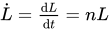
In the usual setup, time is continuous, starting, for simplicity, at and continuing forever. By assumption, the only productive factors are capital and labour , both required to be nonnegative. The labour force, which makes up the entire population, is assumed to grow at a constant rate , i.e. , implying that with initial level at . Finally, let denote aggregate production and denote aggregate consumption.

The variables that the Ramsey–Cass–Koopmans model ultimately aims to describe are the per capita (or more accurately, per labour) consumption: and capital intensity:It does so by connecting capital accumulation, written in Newton's notation, with consumption , describing a consumption-investment trade-off. More specifically, since the existing capital stock decays by depreciation rate (assumed to be constant), it requires investment of current-period production output . Thus,

The relationship between the productive factors and aggregate output is described by the aggregate production function, . A common choice is the Cobb–Douglas production function , but generally, any production function satisfying the Inada conditions is permissible. Importantly, though, is required to be homogeneous of degree 1, which economically implies constant returns to scale. With this assumption, we can re-express aggregate output in per capita terms For example, if we use the Cobb–Douglas production function with , then .
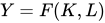

To obtain the first key equation of the Ramsey–Cass–Koopmans model, the dynamic equation for the capital stock needs to be expressed in per capita terms. Noting the quotient rule for , we have


A non-linear differential equation akin to the Solow–Swan model but incorporates endogenous consumption 𝑐, reflecting the model's microfoundations.

Maximizing welfare

[edit]

If we ignore the problem of how consumption is distributed, then the rate of utility is a function of aggregate consumption. That is, . To avoid the problem of infinity, we exponentially discount future utility at a discount rate . A high reflects high impatience.

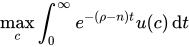
The social planner's problem is maximizing the social welfare function Assume that the economy is populated by identical immortal individuals with unchanging utility functions (a representative agent), such that the total utility is:The utility function is assumed to be strictly increasing (i.e., there is no bliss point) and concave in , with ,[note 2] where is marginal utility of consumption . Thus, we have the social planner's problem:
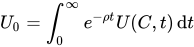
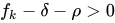
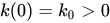
where an initial non-zero capital stock is given. To ensure that the integral is well-defined, we impose .
Solution

[edit]

The solution, usually found by using a Hamiltonian function,[note 3][note 4] is a differential equation that describes the optimal evolution of consumption,

the Keynes–Ramsey rule.[5]

The term , where is the marginal product of capital, reflects the marginal return on net investment, accounting for capital depreciation and time discounting.

Here is the elasticity of intertemporal substitution (EIS), defined byIt is formally equivalent to the inverse of relative risk aversion. The quantity reflects the curvature of the utility function and indicates how much the representative agent wishes to smooth consumption over time. If the agent has high relative risk aversion, it has low EIS and thus would be more willing to smooth consumption over time.


It is often assumed that is strictly monotonically increasing and concave, thus . In particular, if utility is logarithmic, then it is constant:We can rewrite the Ramsey rule aswhere we interpret as the "consumption delay rate," indicating the rate at which current consumption is being postponed in favor of future consumption. A higher value implies that the agent prioritizes saving over consuming today, thereby deferring consumption later.

Graphical analysis in phase space

[edit]

Phase diagram of the Ramsey model, for the case of , and .
Phase space graph (or phase diagram) of the Ramsey model. The blue line represents the economy's dynamic adjustment (or saddle) path in which all the constraints present in the model are satisfied. It is a stable path of the dynamic system. The red lines represent dynamic paths ruled out by the transversality condition.

The two coupled differential equations for and form the Ramsey–Cass–Koopmans dynamical system.

A steady state for the system is found by setting and equal to zero. There are three solutions:

The first is the only solution in the interior of the upper quadrant. It is a saddle point (as shown below). The second is a repelling point. The third is a degenerate stable equilibrium. The first solution is meant by default, although the other two are important to keep track of.

Any optimal trajectory must follow the dynamical system. However, since the variable is a control variable, at each capital intensity , to find its corresponding optimal trajectory, we still need to find its starting consumption rate . As it turns out, the optimal trajectory is the unique one that converges to the interior equilibrium point. Any other trajectory either converges to the all-saving equilibrium with , or diverges to , which means that the economy expends all its capital in finite time. Both achieve a lower overall utility than the trajectory toward the interior equilibrium point.


A qualitative statement about the stability of the solution requires a linearization by a first-order Taylor polynomial
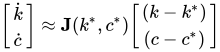
where is the Jacobian matrix evaluated at steady state,[note 5] given by

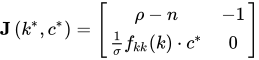
which has determinant since , is positive by assumption, and since is concave (Inada condition). Since the determinant equals the product of the eigenvalues, the eigenvalues must be real and opposite in sign.[6]

Hence, by the stable manifold theorem, the equilibrium is a saddle point, and there exists a unique stable arm, or "saddle path," that converges on the equilibrium, indicated by the blue curve in the phase diagram.

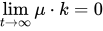
The system is called "saddle path stable" since all unstable trajectories are ruled out by the "no Ponzi scheme" condition:[7]

implying that the present value of the capital stock cannot be negative.[note 6]

History

[edit]

Spear and Young re-examine the history of optimal growth during the 1950s and 1960s,[8] focusing in part on the veracity of the claimed simultaneous and independent development of Cass' "Optimum growth in an aggregative model of capital accumulation" (published in 1965 in the Review of Economic Studies), and Tjalling Koopman's "On the concept of optimal economic growth" (published in Study Week on the Econometric Approach to Development Planning, 1965, Rome: Pontifical Academy of Science).

Over their lifetimes, neither Cass nor Koopmans ever suggested that their results characterizing optimal growth in the one-sector, continuous-time growth model were anything other than "simultaneous and independent". The priority issue became a discussion point because, in the published version of Koopmans' work, he cited the chapter from Cass' thesis that later became the RES paper. In his paper, Koopmans states in a footnote that Cass independently obtained conditions similar to what he finds. Cass also considers the limiting case where the discount rate goes to zero in his paper. For his part, Cass notes that "after the original version of this paper was completed, a very similar analysis by Koopmans came to our attention. We draw on his results in discussing the limiting case, where the effective social discount rate goes to zero". In the interview that Cass gave to Macroeconomic Dynamics, he credits Koopmans with pointing him to Frank Ramsey's previous work, claiming to have been embarrassed not to have known of it, but says nothing to dispel the basic claim that his work and Koopmans' were independent.

Spear and Young dispute this history, based upon a previously overlooked working paper version of Koopmans' paper,[9] which was the basis for Koopmans' oft-cited presentation at a conference held by the Pontifical Academy of Sciences in October 1963.[10] In this Cowles Discussion paper, there is an error. Koopmans claims in his main result that the Euler equations are both necessary and sufficient to characterize optimal trajectories in the model because any solutions to the Euler equations that do not converge to the optimal steady-state would hit either a zero consumption or zero capital boundary in finite time. This error was presented at the Vatican conference, although no participant commented on the problem at the time of Koopmans' presentation. This can be inferred because the discussion after each paper presentation at the Vatican conference is verbatim in the conference volume.

In the Vatican volume discussion following the presentation of a paper by Edmond Malinvaud, the issue does arise because of Malinvaud's explicit inclusion of a so-called "transversality condition" (which Malinvaud calls Condition I) in his paper. At the end of the presentation, Koopmans asks Malinvaud whether it is not the case that Condition I guarantees that solutions to the Euler equations that do not converge to the optimal steady-state hit a boundary in finite time. Malinvaud replies that this is not the case and suggests that Koopmans look at the example with log utility functions and Cobb-Douglas production functions.

At this point, Koopmans recognizes he has a problem. However, based on a confusing appendix to a later version of the paper produced after the Vatican conference, he seems unable to decide how to deal with the issue raised by Malinvaud's Condition I.

From the Macroeconomic Dynamics interview with Cass, it is clear that Koopmans met with Cass' thesis advisor, Hirofumi Uzawa, at the winter meetings of the Econometric Society in January 1964, where Uzawa advised him that his student [Cass] had solved this problem already. Uzawa must have then provided Koopmans with the copy of Cass' thesis chapter, which he sent along in the guise of the IMSSS Technical Report that Koopmans cited in the published version of his paper. The word "guise" is appropriate here because the TR number listed in Koopmans' citation would have put the issue date of the report in the early 1950s, which it was not.

In the published version of Koopmans' paper, he imposes a new Condition Alpha in addition to the Euler equations, stating that the only admissible trajectories among those satisfying the Euler equations are the one that converges to the optimal steady-state equilibrium of the model. This result is derived in Cass' paper via the imposition of a transversality condition that Cass deduced from relevant sections of a book by Lev Pontryagin.[11] Spear and Young conjecture that Koopmans took this route because he did not want to appear to be "borrowing" either Malinvaud's or Cass' transversality technology.

Based on this and other examination of Malinvaud's contributions in 1950s—specifically his intuition of the importance of the transversality condition—Spear and Young suggest that the neo-classical growth model might better be called the Ramsey–Malinvaud–Cass model than the established Ramsey–Cass–Koopmans honorific.

Notes

[edit]

References

[edit]

Further reading

[edit]
[edit]
Revisions and contributorsEdit on WikipediaRead on Wikipedia
from Grokipedia
The Ramsey–Cass–Koopmans model is a foundational framework in that analyzes optimal by modeling the intertemporal choices of a representative maximizing discounted from consumption, subject to a production technology and resource constraints in a closed economy. Unlike the , which assumes an exogenous saving rate, this model endogenizes savings through optimization, yielding dynamic paths for , consumption, and output that converge to a . The model assumes a constant rate, capital depreciation, with production exhibiting constant and diminishing marginal returns to capital. Originally formulated by British mathematician and economist Frank Ramsey in 1928, the model addressed the normative problem of optimal to maximize social welfare in a deterministic setting without or . Ramsey derived the condition that optimal consumption growth follows an Euler equation linking the to the rate of , laying the groundwork for dynamic optimization in . In the mid-1960s, American economists David Cass and Tjalling C. Koopmans independently extended and formalized the framework to incorporate positive economics, including , capital , and a decentralized competitive equilibrium where households and firms optimize separately. Key elements include a concave utility function, often of constant relative risk aversion (CRRA) form u(c)=c1γ1γu(c) = \frac{c^{1-\gamma}}{1-\gamma} with discount factor β\beta, and a production function such as Cobb–Douglas y=Akαy = A k^\alpha where 0<α<10 < \alpha < 1, labor is normalized to 1, and AA captures technology. The household's optimization yields the Euler equation c˙c=1γ(f(k)ρδ)\frac{\dot{c}}{c} = \frac{1}{\gamma} (f'(k) - \rho - \delta), where f(k)f'(k) is the marginal product of capital, ρ\rho is the subjective discount rate, and δ\delta is depreciation; this couples with the capital accumulation equation k˙=f(k)c(δ+n)k\dot{k} = f(k) - c - (\delta + n) k, with nn as population growth. In steady state, consumption and capital per worker are constant, satisfying f(k)=ρ+δf'(k^*) = \rho + \delta, ensuring saddle-path stability where deviations converge monotonically. The model's implications extend to policy analysis, such as the golden rule capital stock that maximizes steady-state consumption (f(kg)=δ+nf'(k_g) = \delta + n), and comparisons with suboptimal paths like constant savings rates. It exhibits a turnpike property, where optimal paths spend most time near the steady state for long horizons, influencing subsequent developments in growth theory, including endogenous growth models and computational methods for solving dynamic systems. By bridging microfoundations with aggregate dynamics, the Ramsey–Cass–Koopmans model remains central to understanding long-run economic behavior and welfare.

Model Foundations

Core Assumptions

The Ramsey–Cass–Koopmans model rests on a set of foundational assumptions that define its economic environment and enable the analysis of optimal growth paths. At its core is a neoclassical aggregate production function that displays constant returns to scale in capital KK and labor LL, along with diminishing marginal returns to each factor. The function is typically denoted as Y=F(K,L)Y = F(K, L), where output YY is produced under competitive conditions, and labor LL grows exogenously at a constant rate n0n \geq 0. In per capita or intensive terms, this becomes y=f(k)y = f(k), with f(k)>0f'(k) > 0 and f(k)<0f''(k) < 0, ensuring positive but decreasing marginal productivity of capital. Households in the model are represented by a single infinitely lived agent with perfect foresight, maximizing intertemporal utility over an infinite horizon. Preferences are captured by a time-separable constant relative risk aversion (CRRA) utility function u(c)u(c), where cc is consumption per capita, satisfying u(c)>0u'(c) > 0 and u(c)<0u''(c) < 0. The economy operates as a closed system without government activity, featuring full employment of resources and perfectly competitive markets that equate factor returns to their marginal products. Capital depreciates at a constant positive rate δ>0\delta > 0, and the representative household exhibits a positive pure rate of time preference ρ>0\rho > 0, discounting future consumption to reflect impatience. Capital accumulation follows the resource constraint K˙=F(K,L)cLδK\dot{K} = F(K, L) - cL - \delta K, ensuring that investment equals savings after accounting for consumption and depreciation. The model further assumes exogenous technological progress at rate g0g \geq 0, which augments labor efficiency and defines effective labor units as L~=Legt\tilde{L} = L e^{gt}, allowing analysis in terms of variables per effective worker. These assumptions build on the decentralized savings mechanism of the Solow model but introduce explicit optimization to determine consumption and growth dynamics.

Utility and Production Functions

The Ramsey–Cass–Koopmans model employs a time-separable function that aggregates instantaneous from per capita consumption over an infinite horizon, discounted at a constant rate ρ>0\rho > 0. The representative maximizes the objective 0eρtu(ct)dt,\int_0^\infty e^{-\rho t} u(c_t) \, dt, where ctc_t denotes consumption per capita at time tt, and u()u(\cdot) is a strictly increasing and strictly concave instantaneous function satisfying the Inada conditions u(0)=u'(0) = \infty and u()=0u'(\infty) = 0. A common specification is the constant relative risk aversion (CRRA) form, given by u(ct)=ct1θ11θu(c_t) = \frac{c_t^{1-\theta} - 1}{1-\theta} for θ>0\theta > 0, θ1\theta \neq 1, where θ\theta is the coefficient of relative risk aversion (and the inverse of the intertemporal elasticity of substitution); the limiting case θ=1\theta = 1 yields the logarithmic utility u(ct)=logctu(c_t) = \log c_t. The production side features a constant-returns-to-scale aggregate production function Yt=F(Kt,Lt)Y_t = F(K_t, L_t), where YtY_t is output, KtK_t is the capital stock, and LtL_t is labor supply, assumed to grow exogenously at rate n0n \geq 0. Labor-augmenting technological progress occurs at exogenous rate g0g \geq 0, so the technology factor is At=A0egtA_t = A_0 e^{g t} with A0>0A_0 > 0. The standard Cobb–Douglas specification is Yt=Ktα(AtLt)1α,Y_t = K_t^\alpha (A_t L_t)^{1-\alpha}, where 0<α<10 < \alpha < 1 reflects the capital share and ensures diminishing marginal returns to each factor. In per capita terms, output is yt=Yt/Lt=ktαAt1αy_t = Y_t / L_t = k_t^\alpha A_t^{1-\alpha}, where kt=Kt/Ltk_t = K_t / L_t is capital per worker; the intensive-form production function is then f(kt)=ktαAt1αf(k_t) = k_t^\alpha A_t^{1-\alpha}. To analyze long-run growth, variables are transformed into units of effective labor AtLtA_t L_t. Define hatted variables as k^t=Kt/(AtLt)\hat{k}_t = K_t / (A_t L_t), c^t=Ct/(AtLt)\hat{c}_t = C_t / (A_t L_t), and y^t=Yt/(AtLt)\hat{y}_t = Y_t / (A_t L_t), where CtC_t is aggregate consumption. The production function in these terms simplifies to y^t=f(k^t)=k^tα\hat{y}_t = f(\hat{k}_t) = \hat{k}_t^\alpha.

Optimization Framework

Social Planner's Problem

The social planner's problem in the Ramsey–Cass–Koopmans model represents a centralized approach to optimal economic growth, where a benevolent authority seeks to maximize the welfare of a representative household over an infinite horizon by choosing paths for consumption and capital accumulation. Unlike decentralized market equilibria, the planner internalizes all intertemporal externalities, ensuring an efficient allocation of resources without relying on price signals from competitive markets. This formulation builds on the foundational work of Ramsey, who first posed the issue of optimal saving, and was rigorously extended by Cass and Koopmans to incorporate discounting and capital depreciation. In aggregate terms, the planner maximizes the discounted integral of total utility from per capita consumption subject to the economy's resource constraints. Specifically, the objective is to solve: max0eρtLtu(CtLt)dt\max \int_0^\infty e^{-\rho t} L_t u\left( \frac{C_t}{L_t} \right) \, dt subject to the capital accumulation equation K˙t=F(Kt,Lt)CtδKt,\dot{K}_t = F(K_t, L_t) - C_t - \delta K_t, with given initial capital stock K0>0K_0 > 0, where ρ>0\rho > 0 is the rate of , u()u(\cdot) is a strictly increasing and concave instantaneous function, CtC_t denotes aggregate consumption, F(Kt,Lt)F(K_t, L_t) is aggregate output from a neoclassical homogeneous of degree one (with constant and Inada conditions), LtL_t is labor supply growing exogenously at rate n0n \geq 0, and δ0\delta \geq 0 is the depreciation rate. This setup assumes no technological progress for simplicity in the baseline model (g=0), focusing on the trade-off between current consumption and future . To analyze the dynamics more tractably, the problem is often transformed into per effective worker terms, accounting for and exogenous technological progress. Defining per effective worker variables—such as effective capital k^t=Kt/(AtLt)\hat{k}_t = K_t / (A_t L_t) and effective consumption c^t=Ct/(AtLt)\hat{c}_t = C_t / (A_t L_t), where AtA_t grows at exogenous rate g0g \geq 0—and assuming CRRA utility with aversion σ>0\sigma > 0, the objective becomes max0e[ρ+n+(1σ)g]tu(c^t)dt\max \int_0^\infty e^{-[\rho + n + (1 - \sigma) g] t} u(\hat{c}_t) \, dt subject to k^˙t=f(k^t)c^t(δ+n+g)k^t,\dot{\hat{k}}_t = f(\hat{k}_t) - \hat{c}_t - (\delta + n + g) \hat{k}_t, with f(k^t)=F(k^t,1)f(\hat{k}_t) = F(\hat{k}_t, 1) representing output per effective worker, satisfying f>0f' > 0, f<0f'' < 0, and Inada conditions. The effective discount rate ρ+n+(1σ)g\rho + n + (1 - \sigma) g ensures convergence of the integral, assuming ρ+n+(1σ)g>0\rho + n + (1 - \sigma) g > 0. This normalization highlights the model's saddle-path dynamics in per effective worker space. Dynamic optimization of this problem employs the current-value Hamiltonian, which incorporates the shadow price of capital. The Hamiltonian is H=u(ct)+λt[f(kt)ct(δ+n+g)kt],H = u(c_t) + \lambda_t [f(k_t) - c_t - (\delta + n + g) k_t], where λt0\lambda_t \geq 0 is the costate variable representing the marginal value of capital in terms of , and variables are in per effective terms (dropping hats for brevity). Maximization requires choosing ctc_t and ktk_t paths such that the Hamiltonian equals the maximized flow plus the valued resource constraint, with λt\lambda_t evolving according to the costate equation derived from . The transversality condition limtλtkte[ρ+n+(1σ)g]t=0\lim_{t \to \infty} \lambda_t k_t e^{-[\rho + n + (1 - \sigma) g] t} = 0 ensures finite welfare. This framework assumes the planner acts paternalistically to achieve Pareto optimality, contrasting with competitive equilibria where agents may not fully internalize social benefits of saving.

Key Equations Derivation

The derivation of the key equations in the Ramsey–Cass–Koopmans model proceeds from the social planner's optimization problem using theory in continuous time. For consistency with , the current-value Hamiltonian is formulated in terms (with n incorporated via effective discount ρn\rho - n for g=0 baseline): H~(ct,kt,λt)=u(ct)+λt[f(kt)ct(δ+n)kt],\tilde{H}(c_t, k_t, \lambda_t) = u(c_t) + \lambda_t \left[ f(k_t) - c_t - (\delta + n) k_t \right], where ctc_t is consumption , kt=Kt/Ltk_t = K_t / L_t is capital , λt\lambda_t is the current-value of capital, u()u(\cdot) is the instantaneous utility function, f(kt)=F(kt,1)f(k_t) = F(k_t, 1) is the , and δ\delta is the rate. This formulation builds on Ramsey's original optimal savings framework by incorporating discounting and extending it to a neoclassical production setting. The first-order conditions arise from maximizing the Hamiltonian with respect to the control variable ctc_t and the evolution of the costate variable λt\lambda_t. Setting the partial derivative with respect to consumption to zero yields H~ct=0    u(ct)=λt,\frac{\partial \tilde{H}}{\partial c_t} = 0 \implies u'(c_t) = \lambda_t, equating the marginal utility of consumption to the shadow value of capital. The costate equation, given by λ˙t=(ρn)λtH~kt\dot{\lambda}_t = (\rho - n) \lambda_t - \frac{\partial \tilde{H}}{\partial k_t}, simplifies to λ˙t=λt((ρn)+δf(kt)).\dot{\lambda}_t = \lambda_t \left( (\rho - n) + \delta - f'(k_t) \right). This describes how the shadow price evolves based on the net marginal product of capital relative to the effective discount rate and . To obtain the Euler equation governing consumption dynamics, differentiate the first-order condition u(ct)=λtu'(c_t) = \lambda_t with respect to time: u(ct)c˙t=λ˙t.u''(c_t) \dot{c}_t = \dot{\lambda}_t. Substituting the expression for λ˙t\dot{\lambda}_t and dividing through by λt=u(ct)\lambda_t = u'(c_t) gives u(ct)ctu(ct)c˙tct=(ρn)+δf(kt).\frac{u''(c_t) c_t}{u'(c_t)} \cdot \frac{\dot{c}_t}{c_t} = (\rho - n) + \delta - f'(k_t). For a constant relative risk aversion (CRRA) utility function u(ct)=ct1θ11θu(c_t) = \frac{c_t^{1-\theta} - 1}{1-\theta} with coefficient of relative risk aversion θ>0\theta > 0, the term u(ct)ctu(ct)=θ\frac{u''(c_t) c_t}{u'(c_t)} = -\theta, so the Euler equation becomes c˙tct=1θ(f(kt)δρ+n).\frac{\dot{c}_t}{c_t} = \frac{1}{\theta} \left( f'(k_t) - \delta - \rho + n \right). This equation links the growth rate of consumption to the marginal return on capital, ensuring intertemporal optimality. For the with technological g > 0, variables are transformed to per effective worker terms, yielding c^˙tc^t=1θ(f(k^t)δρg)\frac{\dot{\hat{c}}_t}{\hat{c}_t} = \frac{1}{\theta} \left( f'(\hat{k}_t) - \delta - \rho - g \right). The equation follows directly from the resource constraint in per terms: k˙t=f(kt)ct(δ+n)kt.\dot{k}_t = f(k_t) - c_t - (\delta + n) k_t. In per effective worker terms, defining lowercase variables as capital k^t=kt/At\hat{k}_t = k_t / A_t and consumption c^t=ct/At\hat{c}_t = c_t / A_t, where AtA_t grows at rate gg, the equation transforms to k^˙t=f(k^t)c^t(n+g+δ)k^t.\dot{\hat{k}}_t = f(\hat{k}_t) - \hat{c}_t - (n + g + \delta) \hat{k}_t. This adjustment accounts for population and technological growth diluting capital per effective worker. Finally, the ensures the optimization problem yields finite utility and prevents Ponzi-like schemes by requiring limte(ρn)tλtkt=0.\lim_{t \to \infty} e^{-(\rho - n) t} \lambda_t k_t = 0. In per effective worker terms, this becomes limte[ρ+n+(1θ)g]tλtk^t=0\lim_{t \to \infty} e^{-[\rho + n + (1 - \theta) g] t} \lambda_t \hat{k}_t = 0. Combining the Euler equation and capital accumulation equation eliminates λt\lambda_t and forms the two-dimensional describing the model's transient dynamics.

Dynamic Analysis

Steady-State Solution

In the Ramsey–Cass–Koopmans model, the steady-state solution represents the long-run balanced growth path where capital and consumption per effective labor unit remain constant over time. To derive this equilibrium, the time derivatives of capital per effective labor (k^\hat{k}) and consumption per effective labor (c^\hat{c}) are set to zero: k^˙=0\dot{\hat{k}} = 0 and c^˙=0\dot{\hat{c}} = 0. This condition yields the modified golden rule for capital accumulation, where the marginal product of capital equals the sum of the time preference rate (ρ\rho), depreciation rate (δ\delta), and an adjustment for technological progress (θg\theta g), with θ\theta denoting the inverse of the intertemporal elasticity of substitution and gg the rate of labor-augmenting technological progress: f(k^)=ρ+δ+θg.f'(\hat{k}^*) = \rho + \delta + \theta g. This rule modifies the classical by incorporating impatience (ρ>0\rho > 0) and growth effects, leading to a lower steady-state capital stock than the consumption-maximizing level without discounting. The steady-state consumption per effective labor follows directly from the capital accumulation equation: c^=f(k^)(n+g+δ)k^,\hat{c}^* = f(\hat{k}^*) - (n + g + \delta) \hat{k}^*, ensuring that investment exactly offsets , , and technological dilution. Along this balanced growth path, aggregate output and consumption grow at the exogenous rate n+gn + g, driven by population and technological progress, while quantities per effective labor unit—such as k^\hat{k}^* and c^\hat{c}^*—remain constant. For a f(k^)=k^αf(\hat{k}) = \hat{k}^\alpha with capital share α\alpha, the steady-state capital per effective labor is explicitly solvable as k^=(αρ+δ+θg)11α.\hat{k}^* = \left( \frac{\alpha}{\rho + \delta + \theta g} \right)^{\frac{1}{1-\alpha}}. This implies a steady-state savings rate higher than in the exogenous-savings Solow model, as optimization internalizes the trade-off between current and future consumption, leading to greater . The steady-state equilibrium uniquely maximizes the social planner's modified utilitarian welfare function, which discounts future at rate ρ\rho and accounts for growing and , thereby balancing intertemporal against impatience.

The phase diagram of the Ramsey–Cass–Koopmans model provides a graphical depiction of the economy's dynamics in the space of consumption per effective worker (c^\hat{c}) and capital per effective worker (k^\hat{k}), illustrating how the evolves toward equilibrium. The horizontal axis represents k^\hat{k}, while the vertical axis represents c^\hat{c}. The k^˙=0\dot{\hat{k}} = 0 locus, where is stationary, is given by the resource constraint c^=f(k^)(n+g+δ)k^\hat{c} = f(\hat{k}) - (n + g + \delta)\hat{k}, forming a concave downward curve that starts at the origin and reaches a maximum before declining, reflecting diminishing returns to capital in the production function f(k^)f(\hat{k}). The c^˙=0\dot{\hat{c}} = 0 locus, derived from the Euler equation, is a vertical line at the steady-state capital stock k^\hat{k}^*, where the marginal product of capital equals the effective discount rate adjusted for growth and depreciation, f(k^)=ρ+δ+θgf'(\hat{k}^*) = \rho + \delta + \theta g. These loci intersect at the steady-state point (k^,c^)(\hat{k}^*, \hat{c}^*), as established in the model's steady-state analysis. The reveals the directions of motion through its isoclines, dividing the plane into regions of and consumption growth. Below the k^˙=0\dot{\hat{k}} = 0 locus, k^˙>0\dot{\hat{k}} > 0, indicating that investment exceeds and / growth, so capital per effective worker increases (arrows point rightward). Above this locus, k^˙<0\dot{\hat{k}} < 0, with capital decreasing (arrows leftward). To the left of the vertical c^˙=0\dot{\hat{c}} = 0 line (where k^<k^\hat{k} < \hat{k}^*), the marginal product of capital exceeds the required return, so c^˙>0\dot{\hat{c}} > 0 and consumption grows (arrows upward). To the right (k^>k^\hat{k} > \hat{k}^*), c^˙<0\dot{\hat{c}} < 0, with consumption falling (arrows downward). These directional arrows highlight the system's except along specific paths, with the region above and to the right of the loci often shaded to denote explosive, non-feasible trajectories. Saddle-point stability characterizes the dynamics, where the steady state is a with one stable dimension and one unstable dimension, ensuring a unique convergent known as the saddle path. Starting from an initial k^(0)\hat{k}(0), the optimal path follows this upward-sloping saddle path to (k^,c^)(\hat{k}^*, \hat{c}^*), satisfying both the Euler equation and resource constraint while converging monotonically. diverging from the saddle path, such as those leading to unbounded growth or collapse, violate the limte0tr(τ)dτk^(t)=0\lim_{t \to \infty} e^{-\int_0^t r(\tau) d\tau} \hat{k}(t) = 0, which prevents Ponzi-like schemes and ensures intertemporal feasibility. This structure implies policy challenges, such as time inconsistency if the discount rate ρ\rho changes over time, as reoptimization would alter the saddle path, undermining commitment to the initial plan.

Historical Context

Ramsey's Pioneering Work

In 1928, Frank Ramsey published "A Mathematical Theory of Saving" in The Economic Journal, introducing a discrete-time framework for determining the optimal savings rate in a growing economy under the guidance of a utilitarian social planner. The model posits a representative agent maximizing the discounted sum of utilities over infinite time, with savings allocated to accumulate capital that produces output via a . Key assumptions include fixed labor supply (with constant population initially), absence of technical progress, and no capital depreciation, emphasizing an ethical approach to intertemporal discounting where the planner weighs present and future generations' welfare impartially. Ramsey's central innovation derives an optimal consumption rule, where the growth rate of the marginal utility of consumption equals the rate of impatience minus the interest rate (denoted as ρ). In continuous-time approximation, this is expressed as: 1u(c)du(c)dt=ρf(k)\frac{1}{u(c)} \frac{du(c)}{dt} = \rho - f'(k) where u(c)u(c) is the of consumption cc, and f(k)f'(k) is the kk. This condition, known as Ramsey's rule, ensures that the planner saves enough to equate the utility cost of current sacrifice with the discounted future benefit, anticipating the modern Euler equation central to dynamic optimization in . Ramsey solved for the steady-state equilibrium, where consumption and capital per capita stabilize, and the interest rate equals the impatience rate ρ, balancing growth with ethical discounting. Although initially overlooked, this work laid foundational groundwork for dynamic programming techniques in economic theory, influencing subsequent developments in intertemporal optimization and growth models.

Cass and Koopmans Extensions

In 1965, David Cass and Tjalling C. Koopmans independently advanced Frank Ramsey's 1928 optimal growth framework by reformulating it in continuous time and integrating it with Robert Solow's 1956 neoclassical growth model, which emphasized and . This synthesis shifted the focus from Ramsey's discrete-time ethical maximization to a more dynamic analysis of intertemporal allocation under neoclassical production, addressing broader applicability in and policy. Cass's contribution, detailed in his paper "Optimum Growth in an Aggregative Model of ," introduced the Hamiltonian approach to derive optimal paths in continuous time, incorporating a neoclassical aggregate with constant and Inada conditions to ensure well-behaved dynamics. By framing the social planner's problem as maximizing discounted utility subject to capital evolution, Cass proved the existence of a unique optimal and explored convergence properties, resolving ambiguities in infinite-horizon solutions that Ramsey had left unresolved. His analysis highlighted the "turnpike" property, where optimal trajectories asymptotically approach the steady-state capital stock regardless of initial conditions, provided the economy follows the stable saddle path. Koopmans's contemporaneous paper, "On the Concept of Optimal ," complemented Cass by emphasizing the conditions under which decentralized market equilibria replicate the planner's optimal allocation, using competitive and consumer optimization to achieve . Koopmans formalized transversality conditions to bound the shadow price of capital at , preventing over-accumulation and ensuring finite in perpetual growth scenarios. He further developed the turnpike theorem in this context, demonstrating that finite-horizon optimal paths spend most time near the long-run equilibrium, akin to a "turnpike" route in transportation, which bolstered the model's relevance for development planning. These extensions popularized representations of the model's dynamics, illustrating the saddle-point stability central to the dynamic . Together, Cass and Koopmans established the Ramsey–Cass–Koopmans model as a cornerstone of neoclassical growth theory, bridging with aggregate economics.
Add your contribution
Related Hubs
User Avatar
No comments yet.