


Community hub
Recent from talks
Contribute something
Nothing was collected or created yet.
Acorn Computers
View on Wikipedia
Acorn Computers Ltd. was a British computer company established in Cambridge, England in 1978 by Hermann Hauser, Chris Curry and Andy Hopper.[2] The company produced a number of computers during the 1980s with associated software that were highly popular in the domestic market, and they have been historically influential in the development of computer technology like processors.
Key Information


The company's Acorn Electron, released in 1983, and the later Acorn Archimedes, were highly popular in Britain, while Acorn's BBC Micro computer dominated the educational computer market during the 1980s.[3] The company also designed the ARM architecture and the RISC OS operating system for it. The architecture part of the business was spun-off as Advanced RISC Machines under a joint venture with Apple and VLSI in 1990, now known as Arm Holdings, which is dominant in the mobile phone and personal digital assistant (PDA) microprocessor market today.[4]
Acorn in the 1990s released the Risc PC line and the Acorn Network Computer, and also had a stint in the set-top box and educational markets. However, financial troubles led to the company closing down its workstation division in September 1998, effectively halting its home computer business and cancelling development of RISC OS and the Phoebe computer.[5] The company was acquired and largely dismantled in early 1999.[6][7] In retrospect, Acorn is sometimes referred to as the "British Apple"[8][9] and has been compared to Fairchild Semiconductor for being a catalyst for start-ups.[10][11]
History
[edit]Early history
[edit]On 25 July 1961, Clive Sinclair founded Sinclair Radionics to develop and sell electronic devices such as calculators.[citation needed] The failure of the Black Watch wristwatch and the calculator market's move from LEDs to LCDs led to financial problems, and Sinclair approached a government body, the National Enterprise Board (NEB), for help.[12] After losing control of the company to the NEB, Sinclair encouraged Chris Curry to leave Radionics and get Science of Cambridge (SoC—an early name for Sinclair Research) up and running. In June 1978, SoC launched a microcomputer kit, the MK14, that Curry wanted to develop further, but Sinclair could not be persuaded so Curry resigned.[13] During the development of the MK14, Hermann Hauser, a friend of Curry's, had been visiting SoC's offices and had grown interested in the product.
CPU Ltd. (1978–1983)
[edit]Curry and Hauser decided to pursue their joint interest in microcomputers and, on 5 December 1978, they set up Cambridge Processor Unit Ltd. (CPU) as the vehicle with which to do this.[14] CPU soon obtained a consultancy contract to develop a microprocessor-based controller for a fruit machine for Ace Coin Equipment (ACE) of Wales. The ACE project was started at office space obtained at 4a Market Hill in Cambridge. Initially, the ACE controller was based on a National Semiconductor SC/MP microprocessor, but soon the switch to a MOS Technology 6502 was made.
The microcomputer systems
[edit] | This section called "The microcomputer systems" needs additional citations for verification. (March 2010) |
CPU had financed the development of a SC/MP based microcomputer system using the income from its design-and-build consultancy.
This system was launched in January 1979 as the first product of Acorn Computer Ltd., a trading name used by CPU to keep the risks of the two different lines of business separate. Acorn was chosen because the microcomputer system was to be expandable and growth-oriented. It also had the attraction of appearing before "Apple Computer" in a telephone directory.[15]

Around this time, CPU and Andy Hopper set up Orbis Ltd. to commercialise the Cambridge Ring networking system Hopper had worked on for his PhD, but it was soon decided to bring him into CPU as a director because he could promote CPU's interests at the University of Cambridge Computer Laboratory.
CPU purchased Orbis, and Hopper's Orbis shares were exchanged for shares in CPU Ltd. CPU's role gradually changed as its Acorn brand grew, and soon CPU was simply the holding company and Acorn was responsible for development work.
At some point, Curry had a disagreement with Sinclair and formally left Science of Cambridge, but did not join the other Acorn employees at Market Hill until a little while later.

The Acorn Microcomputer, later renamed the Acorn System 1, was designed by Sophie Wilson. It was a semi-professional system aimed at engineering and laboratory users, but its price was low enough, at around £80 (equivalent to £420 in 2023),[16] to appeal to the more serious enthusiast as well. It was a very small machine built on two cards, one with an LED display, keypad, and cassette interface (the circuitry to the left of the keypad), and the other with the rest of the computer (including the CPU). Almost all CPU signals were accessible via a Eurocard connector.
The System 2 made it easier to expand the system by putting the CPU card from the System 1 in a 19-inch (480 mm) Eurocard rack that allowed a number of optional additions.[17] The System 2 typically shipped with keyboard controller, external keyboard, a text display interface, and a cassette operating system with built-in BASIC interpreter.
The System 3 moved on by adding floppy disk support,[18] and the System 4 by including a larger case with a second drive.[19] The System 5 was largely similar to the System 4, but included a newer 2 MHz version of the 6502.[20]
The Atom
[edit] | This section called "The Atom" needs additional citations for verification. (March 2010) |

Development of the Sinclair ZX80 started at Science of Cambridge in May 1979. Learning of this probably prompted Curry to conceive the Atom project to target the consumer market. Curry and another designer, Nick Toop, worked from Curry's home in the Fens on the development of this machine. It was at this time that Acorn Computers Ltd. was incorporated and Curry moved to Acorn full-time.
It was Curry who wanted to target the consumer market. Other factions within Acorn, including the engineers, were happy to be out of that market, considering a home computer to be a rather frivolous product for a company operating in the laboratory equipment market.
To keep costs down and not give the doubters reason to object to the Atom, Curry asked industrial designer Allen Boothroyd to design a case that could also function as an external keyboard for the microcomputer systems.
The internals of the System 3 were placed inside the keyboard, creating a quite typical set-up for an inexpensive home computer of the early 1980s: the relatively successful Acorn Atom.
To facilitate software development, a proprietary local area network had been installed at Market Hill. It was decided to include this, the Econet, in the Atom, and at its launch at a computer show in March 1980, eight networked Atoms were demonstrated with functions that allowed files to be shared, screens to be remotely viewed and keyboards to be remotely slaved.
BBC Micro and the Electron
[edit]
After the Atom had been released into the market, Acorn contemplated building modern 16-bit processors to replace the Atom. After a great deal of discussion, Hauser suggested a compromise—an improved 6502-based machine with far greater expansion capabilities: the Proton. Acorn's technical staff had not wanted to do the Atom and they now saw the Proton as their opportunity to "do it right".[citation needed]
One of the developments proposed for the Proton was the Tube, a proprietary interface allowing a second processor to be added. This compromise would make for an affordable 6502 machine for the mass market which could be expanded with more sophisticated and expensive processors. The Tube enabled processing to be farmed out to the second processor leaving the 6502 to perform data input/output (I/O). The Tube would later be instrumental in the development of Acorn's ARM processor.[21]
In early 1980, the BBC Further Education department conceived the idea of a computer literacy programme, mostly as a follow-up to an ITV documentary, The Mighty Micro, in which Dr Christopher Evans from the UK National Physical Laboratory predicted the coming microcomputer revolution.[22] It was a very influential documentary—so much so that questions were asked in Parliament. As a result of these questions, the Department of Industry (DoI) became interested in the programme, as did BBC Enterprises, which saw an opportunity to sell a machine to go with the series. BBC Engineering was instructed to draw up an objective specification for a computer to accompany the series.
Eventually, under some pressure from the DoI to choose a British system, the BBC chose the NewBrain from Newbury Laboratories. This selection revealed the extent of the pressure brought to bear on the supposedly independent BBC's computer literacy project—Newbury was owned by the National Enterprise Board, a government agency operating in close collaboration with the DoI. The choice was also somewhat ironic given that the NewBrain started life as a Sinclair Radionics project, and it was Sinclair's preference for developing it over Science of Cambridge's MK14 that led to Curry leaving SoC to found CPU with Hauser.[citation needed] The NEB moved the NewBrain to Newbury after Sinclair left Radionics and went to SoC.
In 1980–1982, the British Department of Education and Science (DES) had begun the Microelectronics Education Programme to introduce microprocessing concepts and educational materials. In 1981, through to 1986, the DoI allocated funding to assist UK local education authorities to supply their schools with a range of computers, the BBC Micro being one of the most popular. Schools were offered 50% of the cost of computers, providing they chose one of three models: BBC Micro, ZX Spectrum or Research Machines 380Z.[23] In parallel, the DES continued to fund more materials for the computers, such as software and applied computing projects, plus teacher training.

Although the NewBrain was under heavy development by Newbury, it soon became clear that they were not going to be able to produce it—certainly not in time for the literacy programme nor to the BBC's specification. The BBC's programmes, initially scheduled for autumn 1981, were moved back to spring 1982. After Curry and Sinclair found out about the BBC's plans, the BBC allowed other manufacturers to submit their proposals. Hauser quickly drafted in Steve Furber (who had been working for Acorn on a voluntary basis since the ACE fruit machine project) and Sophie Wilson to help complete a revised version of the Proton which met the BBC's specifications. BBC visited Acorn and were given a demonstration of the Proton. Shortly afterwards, the literacy programme computer contract was awarded to Acorn, and the Proton was launched in December 1981 as the BBC Micro. In April 1984, Acorn won the Queen's Award for Technology for the BBC Micro. The award paid special tribute to the BBC Micro's advanced design, and it commended Acorn "for the development of a microcomputer system with many innovative features".

In April 1982, Sinclair launched the ZX Spectrum. Curry conceived of the Electron as Acorn's sub-£200 competitor. In many ways a cut-down BBC Micro, it used one Acorn-designed uncommitted logic array (ULA) to reproduce most of the functionality. But problems in producing the ULAs led to short supply, and the Electron, although launched in August 1983, was not on the market in sufficient numbers to capitalise on the 1983 Christmas sales period. Acorn resolved to avoid this problem in 1984 and negotiated new production contracts. Acorn became more known for its BBC Micro model B than for its other products.[24]
In 2008, the Computer Conservation Society organised an event at London's Science Museum to mark the legacy of the BBC Micro. A number of the BBC Micro's principal creators were present, and Sophie Wilson recounted to the BBC how Hermann Hauser tricked her and Steve Furber to agree to create the physical prototype in less than five days.[25] Also in 2008 a number of former staff organised a reunion event to mark the 30th anniversary of the company's formation.[26][27][28][29]
1983–1985: Acorn Computer Group
[edit]
The BBC Micro sold well—so much so that Acorn's profits rose from £3000 in 1979 to £8.6 million in July 1983. In September 1983, CPU shares were liquidated and Acorn was floated on the Unlisted Securities Market as Acorn Computer Group plc, with Acorn Computers Ltd. as the microcomputer division. With a minimum tender price of 120p, the group came into existence with a market capitalisation of about £135 million.[30] CPU founders Hermann Hauser and Chris Curry's stakes in the new company were worth £64m and £51m, respectively.[31] Ten per cent of the equity was placed on the market, with the money raised from the flotation "mainly" directed towards establishing US and German subsidiaries (the flotation raising around £13.4 million[32]), although some was directed towards research and product development.[33]
By the end of 1984, Acorn Computer Group was organised into several subsidiary companies. Acorn Computers Limited was responsible for the management of the microcomputer business, research and development, and UK sales and marketing, whereas Acorn Computer Corporation and Acorn Computers International Limited dealt with sales to the US and to other international markets respectively. Acorn Computers (Far East) Limited focused on component procurement and manufacturing with some distribution responsibilities in local markets. Acornsoft Limited was responsible for development, production and marketing of software for Acorn's computer range. Vector Marketing Limited was established to handle distribution-related logistics and the increasing customer support burden. As part of Acorn's office automation aspirations, conducting "advanced software research and development", Acorn Research Center Incorporated was established in Palo Alto, California. Acorn Leasing Limited rounded out the portfolio.[34]
New RISC architecture
[edit] | This section called "New RISC architecture" needs additional citations for verification. (March 2010) |
Even from the time of Acorn's earliest systems, the company was considering how to move on from the 6502 processor, introducing a Motorola 6809 processor card for its System 3 and System 4 models.[35] Several years later in 1985, the Acorn Communicator employed the 16-bit 65816 processor as a step up from the 6502.
The IBM PC was launched on 12 August 1981.[36] Although a version of that machine was aimed at the enthusiast market much like the BBC Micro, its real area of success was business. The successor to the PC, the XT (eXtended Technology) was introduced in early 1983. The success of these machines and the variety of Z80-based CP/M machines in the business sector demonstrated that it was a viable market, especially given that sector's ability to cope with premium prices. The development of a business machine looked like a good idea to Acorn. A development programme was started to create a business computer using Acorn's existing technology: the BBC Micro mainboard, the Tube and second processors to give CP/M, MS-DOS and Unix (Xenix) workstations.

This Acorn Business Computer (ABC) plan required a number of second processors to be made to work with the BBC Micro platform. In developing these, Acorn had to implement the Tube protocols on each processor chosen, in the process finding out, during 1983, that there were no obvious candidates to replace the 6502. Because of many-cycle uninterruptible instructions, for example, the interrupt response times of the Motorola 68000 were too slow to handle the communication protocol that the host 6502-based BBC Micro coped with easily. The National Semiconductor 32016-based model of the ABC range, was developed and later sold in 1985 as the Cambridge Workstation (using the Panos operating system).[37] Advertising for this machine in 1986 included an illustration of an office worker using the workstation. The advert claimed mainframe power at a price of £3,480 (excluding VAT). The main text of the advertisement referred to available mainframe languages, communication capabilities and the alternative option of upgrading a BBC Micro using a coprocessor.[38] The machine had shown Sophie Wilson and Steve Furber the value of memory bandwidth. It also showed that an 8 MHz 32016 was completely trounced in performance terms by a 4 MHz 6502. Furthermore, the Apple Lisa had shown the Acorn engineers that they needed to develop a windowing system; this was not going to be easy with a 2–4 MHz 6502-based system doing the graphics. Acorn would need a new architecture.[citation needed]
Acorn had investigated all of the readily available processors and found them wanting[13] or unavailable to them.[10] After testing all of the available processors and finding them lacking, Acorn decided that it needed a new architecture. Inspired by white papers on the Berkeley RISC project, Acorn seriously considered designing its own processor.[39] A visit to the Western Design Center in the US, where the 6502 was being updated by what was effectively a single-person company, showed Acorn engineers Steve Furber and Sophie Wilson they did not need massive resources and state-of-the-art research and development facilities.[40]
Sophie Wilson set about developing the instruction set, writing a simulation of the processor in BBC BASIC that ran on a BBC Micro with a 6502 second processor. It convinced the Acorn engineers that they were on the right track. Before they could go any further, however, they would need more resources. It was time for Wilson to approach Hauser and explain what was afoot. Once the go-ahead had been given, a small team was put together to implement Wilson's model in hardware.

Acorn initiated its RISC research project in October 1983, and by 1987 had spent £5 million.[41] VLSI Technology, Inc were chosen as silicon partner, since they already supplied Acorn with ROMs and some custom chips. VLSI produced the first ARM silicon on 26 April 1985;[42] it worked first time and came to be known as ARM1. Its first practical application was as a second processor to the BBC Micro, where it was used to develop the simulation software to finish work on the support chips (VIDC, IOC, MEMC) and to speed up the operation of the CAD software used in developing ARM2. The ARM evaluation system was promoted as a means for developers to try the system for themselves. This system was used with a BBC Micro and a PC compatible version was also planned.[clarification needed] Advertising was aimed at those with technical expertise, rather than consumers and the education market, with a number of technical specifications listed in the main text of the adverts.[43] Wilson subsequently coded BBC BASIC in ARM assembly language, and the in-depth knowledge obtained from designing the instruction set allowed the code to be very dense, making ARM BBC BASIC an extremely good test for any ARM emulator.
Such was the secrecy surrounding the ARM CPU project that when Olivetti were negotiating to take a controlling share of Acorn in 1985, they were not told about the development team until after the negotiations had been finalised. In 1992, Acorn once more won the Queen's Award for Technology for the ARM.[44] Acorn's development of their RISC OS operating system required around 200 OS development staff at its peak.[45] Acorn C/C++ was released commercially by Acorn, for developers to use to compile their own applications.
Financial problems
[edit]Having become a publicly traded company in 1983 during the home computer boom, Acorn's commercial performance in 1984 proved to be consequential. Many home computer manufacturers struggled to maintain customer enthusiasm, some offering unconvincing follow-up products that failed to appeal to buyers. The more successful manufacturers, like Amstrad, emphasised the bundling of computers with essential peripherals such as monitors and cassette recorders along with value for money. The collapse of the market from the manufacturers' perspective, it was argued, was due to the "neglect of the market by the manufacturers".[46] Market adversity had led to Atari being sold,[47] and Apple nearly went bankrupt.
The Electron had been launched in 1983, but problems with the supply of its ULA meant that Acorn was not able to capitalise on the 1983 Christmas selling period.[48] A successful advertising campaign, including TV advertisements, had led to 300,000 orders, but the Malaysian suppliers were only able to supply 30,000 machines.[citation needed] The apparently strong demand for Electrons proved to be ephemeral: rather than wait, parents bought Commodore 64 or ZX Spectrum for their children's presents. Ferranti solved the production problem and in 1984, production reached its anticipated volumes, but the contracts Acorn had negotiated with its suppliers were not flexible enough to allow volumes to be reduced quickly in this unanticipated situation, and supplies of the Electron built up. At the time of the eventual financial rescue of Acorn in early 1985, it still had 100,000 unsold Electrons plus an inventory of components which had all been paid for and needed to be stored at additional expense.[49] 40,000 BBC Micros also remained unsold.[33]
After a disappointing summer season in 1984, Acorn had evidently focused on making up for lost sales over the Christmas season, with the Electron being a particular focus. However, a refusal to discount the BBC Micro also appeared to inhibit sales of that machine, with some dealers expressing dissatisfaction to the point of considering abandoning the range altogether. With rumours of another, potentially cheaper, machine coming from Acorn,[46] dealers eventually started to discount heavily after Christmas.[50] For instance, high street retailer Rumbelows sought to clear unsold Christmas stocks of around 1500 machines priced at £299, offering a discount of around £100, also bundling them with a cassette recorder and software.[51] The rumoured machine turned out to be the BBC Model B+ which was a relatively conservative upgrade and more, not less, expensive than the machine it replaced.[52] It was speculated that the perception of a more competitive machine soon to be launched might well have kept potential purchasers away from the products that Acorn needed to sell.[53]
Acorn was also spending a large portion of its reserves on development: the BBC Master was being developed; the ARM project was underway; the Acorn Business Computer entailed a lot of development work but delivered few products, with only the 32016-based model ever being sold (as the Cambridge Workstation). The company's research and development staff had grown from around 100 in 1983 to around 150 in 1984, the latter out of a total of 450 employees. Meanwhile, Acorn's chosen method of expansion into West Germany and the United States through the establishment of subsidiaries involved a "major commitment of resources", in contrast with a less costly strategy that might have emphasised collaboration with local distributors. Localisation of the BBC Micro for the US market also involved more expenditure than it otherwise might have due to a failure to consider local market conditions and preferences, with "complex technical efforts" having been made to make the machine compatible with US television standards when local market information would have indicated that "US home computer users expect to use a dedicated personal computer monitor".[33] Consequently, obtaining Federal approval for the BBC Micro in order to expand into the United States proved to be a drawn-out and expensive process that proved futile: all of the expansion devices that were intended to be sold with the BBC Micro had to be tested and radiation emissions had to be reduced. It was claimed that Acorn spent £10 million on its US operation without this localised variant of the BBC Micro establishing a significant market share.[54] The machine, however, did make an appearance in the school of Supergirl in the 1984 film Supergirl: The Movie.[55]
Acorn also made or attempted various acquisitions. The Computer Education in Schools division of ICL was acquired by Acorn in late 1983 "reportedly for less than £100,000", transferring a staff of six to Acorn's Maidenhead office to form Acorn's Educational Services division and to provide "the core of education support development within Acorn".[56] Having had a close relationship with Torch Computers in the early 1980s, Acorn sought to acquire Torch in 1984 with the intention of making Torch "effectively the business arm" of Acorn, despite a lack of clarity about competing product lines and uncertainty about the future of Acorn's still-unreleased business machine within any rationalised product range,[57] although this acquisition was never completed,[58] with Torch having pulled out as Acorn's situation deteriorated.[59]
At around the same time, Acorn also bought into Torus Systems - a company developing a "graphics-controlled local network called Icon" for the IBM PC platform - to broaden Acorn's networking expertise.[60] Icon was a solution based on Ethernet, as opposed to the Acorn-related Econet and Cambridge Ring technologies,[61][62] equipping appropriately specified IBM-compatible computers to participate on a network using a relatively low-cost Ethernet interface card utilising Intel's 82586 network controller chip.[63]: 108 Torus later released a network management solution called Tapestry,[64] based on Icon and marketed by IBM for its own networking technologies.[65] Torus also released support for the use of Novell's Advanced Netware product on its own networking hardware.[66] The company eventually entered receivership in 1990 with Acorn reporting a £242,000 loss associated with the investment.[67] Such were the ambitions of Acorn's management that a joint venture company was established in Hong Kong under the name Optical Information Systems, apparently engaging in the development of "digital, optical technology for computer data storage".[68] Involving a Hong Kong turntable manufacturer, Better Sound Reproduction Ltd., Acorn were to set up a research and development facility in Palo Alto, California, US to bring "compact laser disk drives designed as floppy disk drive replacements" to market within 18 months.[69]: 24
In February 1985, speculation about the state of Acorn's finances intensified with the appointment of a temporary chief executive, Alexander Reid, to run the company, together with the announcement that Acorn had replaced its financial advisors, Lazards, and that the company's stockbrokers, Cazenove, had resigned, ultimately leading to the suspension of Acorn shares, these having fallen to a low of 23 pence per share. With these events reportedly being the result of disagreement between Acorn and Lazards over the measures needed to rescue the company, with Lazards favouring a sale or refinancing whereby the founders would lose control, Acorn and their replacement advisors, Close Brothers, were reported to be pursuing a "radical reorganisation of the company".[58] Lazards had sought to attract financing from GEC but had failed to do so. Close Brothers also found themselves in the position of seeking a financing partner for Acorn, but in a significantly more urgent timeframe, making "financial institutions or a large computer company" the most likely candidates, these having the necessary resources and decision-making agility for a timely intervention.[33]
1985–1998: Olivetti subsidiary
[edit]The dire financial situation was brought to a head in February 1985, when one of Acorn's creditors issued a winding-up petition.[70] It would eventually emerge that Acorn owed £31.1 million to various creditors including manufacturers AB Electronics and Wong's Electronics.[71] Wong's had been awarded a $45 million contract to produce the BBC Micro for the US market.[72] During the search for potential financing partners, an Olivetti director had approached Close Brothers, ostensibly as part of Olivetti's strategy of acquiring technologically advanced small companies.[33] After a short period of negotiations, Curry and Hauser signed an agreement with Olivetti on 20 February. With the founders relinquishing control of the company and seeing their combined stake fall from 85.7% to 36.5%, the Italian computer company took a 49.3% stake in Acorn for £10.39 million, which went some way to covering Acorn's £10.9 million losses in the previous six months,[73] effectively valuing Acorn at around a tenth of its valuation of £216 million the year before.[58] Acorn's share price collapse and the suspension of its listing was attributed by some news outlets to the company's failure to establish itself in the US market, with one source citing costs of $5.5 million related to that endeavour.[74]
In July 1985, Olivetti acquired an additional £4 million of Acorn shares, raising its ownership stake in the company to 79.8%. Major creditors agreed to write off £7.9 million in debts, and the BBC agreed to waive 50% of outstanding royalty payments[75] worth a reported £2 million. This second refinancing left the Acorn founders with less than 15% ownership of the company. Meanwhile, the financial difficulties had reduced the number of employees at Acorn from a peak of 480 to around 270.[76]
With Brian Long appointed as managing director, Acorn were set to move forward with a new OEM-focused computer named the Communicator and the Cambridge Workstation, whose launch had been delayed until the end of July 1985 due to the suspension of Acorn's shares. Of subsequent significance, Hermann Hauser was also expected to announce a "VLSI chip design using a reduced instruction set".[76] Unveiled towards the end of 1985,[77] the Communicator was Acorn's answer to ICL's One Per Desk initiative. This Acorn machine was based around a 16-bit 65SC816 CPU, 128 KB RAM, expandable to 512 KB, plus additional battery-backed RAM. It had a new multi-tasking OS, four internal ROM sockets, and shipped with a software suite based on View and ViewSheet. It also had an attached telephone, communications software and auto-answer/auto-dial modem.[78] However, with Acorn's finances having sustained the development cost of the Archimedes, and with the custom systems division having contributed substantially to the company's losses in 1987,[79] a change in strategy took effect towards the end of 1987, moving away from "individual customers" and towards "volume products", resulting in 47 of Acorn's 300 staff being made redundant,[80] the closure of the custom systems division, and the abandonment of the Communicator.[79]
In February 1986, Acorn announced that it was ceasing US sales operations, and sold its remaining US BBC Microcomputers for $1.25 million to a Texas company, Basic, which was a subsidiary of Datum, the Mexican manufacturer of the Spanish version of the BBC Microcomputer (with modified Spanish keyboards for the South American market). The sales office in Woburn, Massachusetts was closed at this time.[81] Acorn was reported as having achieved "negligible U.S. sales".[82] In 1990, in contrast, Acorn set up a sales and marketing operation in Australia and New Zealand by seeking to acquire long-time distributor Barson Computers Australasia, with Acorn managing director Sam Wauchope noting Acorn's presence in Australia since 1983 and being "the only computer manufacturer whose products are recommended by all Australian state education authorities".[83]
Acorn also sought once again to expand into Germany in the 1990s, identifying the market as the largest in Europe whose technically sophisticated computer retailers were looking for opportunities to sell higher-margin products than IBM PC compatibles, with a large enthusiast community amongst existing and potential customers. Efforts were made to establish a local marketing presence and to offer localised versions of Acorn's products.[84] Despite optimistic projections of success, and with Acorn having initially invested £700,000 in the endeavour,[85] the loss-making operation was closed in 1995 as part of broader cost-cutting and restructuring in response to a decline in revenue and difficulties experienced by various Acorn divisions.[86]
Ostensibly facilitated or catalysed by Olivetti's acquisition of Acorn, reports in late 1985 indicated plans for possible collaboration between Acorn, Olivetti and Thomson in the European education sector to define a standard for an educational microcomputer system analogous to the MSX computing architecture and to the established IBM PC compatible architecture.[87] Deliberations continued into 1986, with Acorn proposing its own ARM processor architecture as the basis for the initiative, whereas Thomson had proposed the Motorola 68000.[88] Expectations that Olivetti would actively market Acorn's machines in Europe were, however, frustrated by Olivetti's own assessment of Acorn's products as "too expensive" and the proprietary operating system offering "limited flexibility". Instead, Olivetti sought to promote its M19 personal computer for the European schools market, offering it to Acorn for sale in the UK (ultimately, as the rebadged Acorn M19).[89] Olivetti would eventually offer both Acorn's Master Compact and the Thomson MO6 to the Italian market with its Prodest branding.
Collaboration involving Acorn, Olivetti and Thomson (subsequently as SGS-Thomson) continued in the context of research projects, with a consortium of vendors including AEG, Bull, Philips and ICL participating in the Multiworks initiative to develop Unix workstations as part of the European ESPRIT framework.[90] Acorn's particular role in Multiworks concerned a low-cost workstation featuring the ARM chipset, alongside a "high-cost authoring workstation" based on Olivetti's CP486 workstation.[91] The Chorus system was to be used as the basis of the Unix operating system provided.[92]
Olivetti would eventually relinquish majority control of Acorn in early 1996, selling shares to US and UK investment groups to leave the company with a shareholding in Acorn of around 45%.[93] In July 1996, Olivetti announced that it had sold 14.7% of the group to Lehman Brothers, reducing its stake at that time to 31.2%. Lehman said it planned to resell the shares to investors.[94]
BBC Master and Archimedes
[edit]
The BBC Master[95] was launched in February 1986 and met with considerable success. From 1986 to 1989, about 200,000 systems were sold,[96] each costing £499, mainly to UK schools and universities. A number of enhanced versions were launched, for example, the Master 512,[97] which had 512 KB of RAM and an internal 80186 processor for MS-DOS compatibility, and the Master Turbo,[98] which had a 65C102 second processor.
The first commercial use of the ARM architecture was in the ARM Development System, a Tube-linked second processor for the BBC Master which allowed one to write programs for the new system. It sold for £4,500 and included the ARM processor, 4 MB of RAM and a set of development tools with an enhanced version of BBC BASIC. This system did not include the three support chips (VIDC, MEMC, and IOC) which were later to form part of the Archimedes system. They made their first appearance in the A500 second processor,[99] which was used internally within Acorn as a development platform, and had a similar form-factor to the ARM development system.

The second ARM-based product was the Acorn Archimedes desktop-computer, released in mid-1987, some 18 months after IBM launched their RISC-based RT PC.[100] The first RISC-based home computer, using the ARM (Acorn RISC Machine) chip,[101] the Archimedes was popular in the United Kingdom, Australasia and Ireland, and was considerably more powerful and advanced than most offerings of the day. The Archimedes was advertised in both printed[102] and broadcast media.[103] One example of such advertising is a mock-up of the RISC OS 2 desktop, showing some software application directories, with the advert text added within windows.[104] However, the vast majority of home users opted for an Atari ST or Amiga when looking to upgrade their 8-bit micros. As with the BBC, the Archimedes instead flourished in schools and other educational settings but just a few years later in the early 1990s this market began stratifying into the PC-dominated world. Acorn continued to produce updated models of the Archimedes, including a laptop (the A4), and in 1994 launched the Risc PC, whose top specification would later include a 233 MHz StrongARM processor. These were sold mainly into education, specialist and enthusiast markets, such as professional composers using Sibelius 7.
ARM Ltd.
[edit]Acorn's silicon partner, VLSI, had been given the task of finding new applications for the ARM CPU and support chips. Hauser's Active Book company had been developing a handheld device and for this the ARM CPU developers had created a static version of their processor, the ARM2aS.
Members of Apple's Advanced Technology Group (ATG) had made initial contact with Acorn over use of the ARM in an experimental Apple II (2) style prototype called Möbius. Experiments done in the Möbius project proved that the ARM RISC architecture could be highly attractive for certain types of future products. The Möbius project was briefly considered as the basis for a new line of Apple computers but it was stopped for fear it would compete with the Macintosh and confuse the market. However, the Möbius project evolved awareness of the ARM processor within Apple. The Möbius Team made minor changes to the ARM registers, and used their working prototype to demonstrate a variety of impressive performance benchmarks.[105]
Later Apple was developing an entirely new computing platform for its Newton. Various requirements had been set for the processor in terms of power consumption, cost and performance, and there was also a need for fully static operation in which the clock could be stopped at any time. Only the Acorn RISC Machine came close to meeting all these demands, but there were still deficiencies. The ARM did not, for example, have an integral memory management unit, as this function was being provided by the MEMC support chip and Acorn did not have the resources to develop one.[106]
Apple and Acorn began to collaborate on developing the ARM, and it was decided that this would be best achieved by a separate company.[106] The bulk of the Advanced Research and Development section of Acorn that had developed the ARM CPU formed the basis of ARM Holdings when that company was spun off in November 1990. Acorn Group and Apple Computer Inc. each had a 43% shareholding in ARM (in 1996),[107] while VLSI was an investor and first ARM licensee.[108]
Acorn Pocket Book
[edit]
In 1993, Acorn decided to offer an Acorn branded Psion Series 3 PDA, badged as an Acorn Pocket Book, with a later variant branded the Acorn Pocket Book II. Essentially a rebadged OEM version of the Series 3 with slightly different on-board software, the device was marketed as an inexpensive computer for schoolchildren, rather than as an executive tool.[109] The hardware was the same as the Series 3, but the integrated applications were different. For instance, the Pocket Book omitted the Agenda diary and Spell dictionary applications, which became an optional application, supplied on ROM SSD which could be inserted into either of the ROM bays underneath the device. Other programs were renamed: System became Desktop, Word became Write, Sheet became Abacus and Data became Cards.[110][111]
Set-top boxes
[edit]In 1994, Acorn established a new division, Online Media, focusing on interactive multimedia client hardware.[112] Online Media aimed to exploit the projected video-on-demand (VOD) boom, an interactive television system which would allow users to select and watch video content over a network.[113] In September 1994 the Cambridge Digital Interactive Television Trial of video-on-demand services was set up by Online Media, Anglia Television, Cambridge Cable (now part of Virgin Media) and Advanced Telecommunication Modules Ltd (ATML). The trial involved creating a wide area ATM network linking TV-company to subscribers' homes and delivering services such as home shopping, online education, software downloaded on-demand and the World Wide Web. The wide area network used a combination of fibre and coaxial cable, and the switches were housed in the roadside cabinets of Cambridge Cable's existing network.[114] Olivetti Research Laboratory developed the technology used by the trial. An ICL video server provided the service via ATM switches manufactured by ATML, another company set up by Hauser and Hopper. The trial commenced at a speed of 2 Mbit/s to the home, subsequently increased to 25 Mbit/s.[115]
Subscribers used Acorn Online Media Set Top Boxes. For the first six months the trial involved 10 VOD terminals;[115] the second phase was expanded to cover 100 homes and eight schools with a further 150 terminals in test labs. A number of other organisations gradually joined in, including the National Westminster Bank (NatWest), the BBC, the Post Office, Tesco, and the local education authority.[which?] Having initially deployed set-top boxes based on Risc PC hardware, a second generation of the hardware, STB2, featured the ARM7500 system-on-a-chip,[116] this having been manufactured for Online Media by VLSI,[117] and integrated MPEG video decoding hardware. (The C-Cube Microsystems CL450 part is evident on the STB20 circuit board,[118] this product being an MPEG-1 decoder introduced in May 1992.[119]) Plans were announced to expand the initiative from 250 homes to 1000, to support NatWest's cable television banking and shopping services, with video on demand provision being strengthened through the deployment of a digital video server from ICL having "a maximum capacity of several hundred gigabytes of fast hard disc storage", connected via a 155 Mbit/s link and supplementing Olivetti Research Disc Bricks already acting as smaller capacity video servers. Industry support for the Online Media platform was also announced by Oracle and Macromedia.[116]
BBC Education tested delivery of radio-on-demand programmes to primary schools, and a new educational service, Education Online, was established to deliver material such as Open University television programmes and educational software. Netherhall School was provided with an inexpensive video server and operated as a provider of trial services, with Anglia Polytechnic University taking up a similar role some time later.[114]
It was hoped that Online Media could be floated as a separate company, and a share issue raising £17.2 million of additional capital was announced in 1995,[120] this to finance the division and "underpin Acorn Group finances" against a backdrop of deteriorating financial results partly caused by an increasingly uncompetitive lower-end product range.[121] Having entered into a deal with Lightspan Partnership Inc. to supply set-top boxes for the US education market,[122] the order was cancelled and put pressure on Acorn's already straitened financial situation. Various other factors ensured that the predicted video-on-demand boom never really materialised as anticipated.[123]
Acorn subsequently planned to incorporate set-top box technology into its product range, launching an initiative entitled "No Limits to Learning" and previewing a range of products under the MediaRange brand, with the MediaSurfer being "essentially an Online Media STB with a World Wide Web browser built in", and with other products in the range being based on "focused applications" of established Acorn products.[124] Evolution of the technology continued with the launch of the STB22 model, described as "a cross between an NC (Network Computer) and a STB". This model combined set-top box features such as ATM25 networking for interactive video with more general Internet features such as Web browsing and Java application support. Described as "the icing on the cake", MPEG2 video decoding hardware was provided by a chipset from LSI. Although Acorn were reportedly hoping for the interactive television market to "eventually take off" and initiate "mass deployment" by traditional telecoms operators, corporate intranet applications were also seen as a target market. With more conservative deployments in mind, the ATM25 interface in the product could be replaced by an Ethernet interface.[125]
NewsPad
[edit]
In 1994, the EU initiated the NewsPad[126] programme, with the aim of developing a common mechanism to author and deliver news electronically to consumer devices. The programme's name and format were inspired by the devices described and depicted in Arthur C. Clarke and Stanley Kubrick's 1968 film 2001: A Space Odyssey. Acorn won a contract to develop a consumer device / receiver, and duly supplied a RISC OS-based touch-screen tablet computer for the pilot.[127][128][129] The device measured 8.5 × 11 inches (220 × 280 mm) and was being tried in 1996 in Spain by Ediciones Primera Plana.[130] The Barcelona-based pilot ended in 1997, but the tablet format and ARM architecture may have influenced Intel's 1999 WebPad / Web Tablet program.[131][132][133]
SchoolServer
[edit]Although Acorn had largely focused on its ARM-based product range offering RISC OS (and, for a time, RISC iX), albeit with an increasing emphasis on DOS and Windows compatibility through its PC card products,[134][135] the emergence of larger networks in education connecting systems based on different computing platforms—typically Acorn, PC and Apple Macintosh—motivated the introduction of the SchoolServer product range in 1995. The range consisted of server systems manufactured by IBM running Windows NT Server (specifically Windows NT 3.5[122]), employing a single 100 MHz PowerPC processor, with 24 MB or 32 MB of RAM, one or two 1 GB hard drives, and built-in Ethernet interfaces.[136]
Acorn bundled ANT Limited's OmniClient software to provide the connectivity support required for Acorn's own computers to access the SchoolServer's facilities, these being based on Microsoft's own SchoolServer platform and proprietary networking technologies. The adoption of such hardware and software platforms, motivated by concerns about the capabilities of Acorn's existing products (such as the Risc PC) in the server role, even apparently led to Acorn becoming a Microsoft Solution Provider despite having been "very vocal critics" of Microsoft and its technologies in the past.[122]
Other companies in the educational market introduced similar products to the SchoolServer. For instance, Datathorn Systems introduced a solution called Super Server based on the Motorola PowerStack server system,[137] which was a PowerPC-based machine capable of running Windows NT 3.51 or AIX 4.1,[138] with the Super Server project reportedly being "the product of research at both Oxford and Cambridge universities". Having approval from Acorn and offering interoperability between Acorn and PC platforms, the solution was deployed at several sites.[139]
Xemplar Education
[edit]In 1996, Acorn entered into a joint venture with Apple Computer UK called Xemplar to provide computers and services to the UK education market.[140] Described as "the unthinkable" and a "marriage of convenience", the alliance sought to reverse the declining fortunes of both Acorn and Apple in the sector, also prompting speculation that Apple's own strategy based on adoption of the PowerPC platform might lead Acorn along the same path, with Acorn already having expressed some interest in PowerPC and having introduced a PowerPC-based product in the form of its SchoolServer offering. The deal was regarded as benefiting Apple more strongly, with Acorn developers being encouraged to port their software to Mac OS, and with RISC OS effectively being sidelined to Acorn's set-top box and network computing products.[141]
Xemplar initially resisted the demand for PC-compatible products in classrooms, limiting its PC offerings to school administration.[142] A survey in 1998 found that Apple and Acorn systems at that time accounted for 47% and 1⁄3 of computers in UK primary and secondary schools respectively.[143] However, in 1999, with Acorn undergoing restructuring, the company's remaining stake in Xemplar was sold to Apple for £3 million.[144][145] By this time, Xemplar had become "a significant supplier of Wintel PCs" out of commercial necessity, with Acorn's Network Computer being the only product from its former co-owner still actively marketed by Xemplar.[144] Despite Acorn's own upheavals, Xemplar remained committed to selling Acorn products in its portfolio.[146] Renamed to Apple Xemplar Education, the operation was wound up in 2014.[147] Acorn Education and later Xemplar Education were heavily involved in Tesco's "Computers for Schools" programme in the UK, providing hardware and software in exchange for vouchers collected from Tesco purchases.[148]
The Welsh Office Multimedia/Portables Initiative (WOMPI), launched in 1996 to provide primary schools with computer equipment,[149] prescribed that Welsh schools choosing the multimedia option received multimedia PCs exclusively supplied by RM. This upset other suppliers such as Xemplar and members of the National Association of Advisers for Computers in Education (NAACE), with complaints including those about the imposition of an incompatible computing platform on small schools who were already committed to the RISC OS platform, these schools being potentially incapable of managing "a mix of machines", and the lack of appropriate Welsh language software for the Windows platform, this being of particular concern in schools where lessons were "conducted exclusively in Welsh" and where an "excellent working relationship with British software houses" had cultivated the availability of major RISC OS applications in Welsh. The range of multimedia software offered in the initiative was also criticised: "none of the scheme's CD-Roms" were in Welsh, and Acorn machines also needed additional software, at an estimated £300 in extra costs, to "make effective use" of the software titles.[150]
Network computers
[edit] | This article appears to contradict the article Acorn Network Computer. (July 2011) |

When BBC2's The Money Programme screened an interview with Larry Ellison in October 1995, Acorn Online Media Managing Director Malcolm Bird realised that Ellison's network computer was, basically, an Acorn set-top box.[151] After initial discussions between Oracle Corporation and Olivetti, Hauser and Acorn a few weeks later, Bird was dispatched to San Francisco with Acorn's latest Set Top Box. Oracle had already talked seriously with computer manufacturers including Sun and Apple about the contract for putting together the NC blueprint machine; there were also rumours in the industry that said Oracle itself was working on the reference design. After Bird's visit to Oracle, Ellison visited Acorn and a deal was reached: Acorn would define the NC Reference Standard.
Ellison was expecting to announce the NC in February 1996. Sophie Wilson was put in charge of the NC project, and by mid-November a draft NC specification was ready. By January 1996 the formal details of the contract between Acorn and Oracle had been worked out,[152] and the PCB was designed and ready to be put into production.[151] In February 1996, Acorn Network Computing was founded.[107] In August 1996 it launched the Acorn Network Computer.

It was hoped that the Network Computer would create a significant new sector in which Acorn Network Computing would be a major player,[153] either selling its own products or earning money from licence fees paid by other manufacturers for the right to produce their own NCs. To that end, two of Acorn's major projects were the creation of a new 'consumer device' operating system named Galileo, and, in conjunction with Digital Semiconductor and ARM, a new StrongARM chipset consisting of the SA-1500 and SA-1501. Galileo's main feature was a guarantee of a certain quality of service to each process in which the resources (CPU, memory, etc.) required to ensure reliable operation would be kept available regardless of the behaviour of other processes.[154] The SA-1500 sported higher clock rates than existing StrongARM CPUs and, more importantly, a media-focussed coprocessor (the Attached Media Processor or AMP). The SA-1500 was to be the first release target for Galileo.[155]
After having incorporated its STB and NC business areas as separate companies, Acorn created a new wholly owned subsidiary, Acorn RISC Technologies (ART). ART focused on the development of other software and hardware technologies built on top of ARM processors.[107]
1998–1999: Element 14 and MSDW acquisition
[edit]
During the first half of 1998 Acorn's management were heavily involved in the initial public offering of ARM Holdings plc which raised £18 million for Acorn throughout 1998.[156] In June 1998, Stan Boland took over as CEO of Acorn Computers from David Lee,[157] initiating a review of Acorn's core business.[156]
The company had losses of £9 million in the first nine months of the year[156] and in September 1998 the results of the review led to a significant restructuring of the company.[158] The Workstation division was to close,[159] a 40% reduction in staff, and the Risc PC 2 code-named Phoebe that was nearing completion was cancelled.[160] These actions allowed the company to reduce ongoing losses and focus on other activities.[156][161] Acorn concentrated on development of digital TV set-top boxes and high performance media centric DSP (silicon and software). It also produced a reference design for a Windows NT thin client using a Cirrus Logic system on a chip.[162][163][164]
Refocusing and discontinuation of activities
[edit]To concentrate on these two activities Acorn hired a group of former STMicroelectronics silicon-design engineers and they formed the basis of a £2 million silicon-design centre that Acorn set up in Bristol.[156][165] They also started to dispose of some of their interests in the former workstation market and in January 1999 sold their 50% interest in Xemplar Education to Apple Computer.[166][167]
Attempts were made to secure the rights to Acorn's desktop products including network computers and "various associated technologies", RISC OS, and the abandoned Phoebe workstation project by a consortium of Acorn market interests, and a memorandum of understanding was reportedly signed by both Stan Boland, representing Acorn, and former Acorn executive Peter Bondar, representing the consortium. However, Acorn pulled out of this tentative deal amidst accusations of attempts to sideline the consortium and to negotiate directly with its financial backers.[168] It was reported that Stephen Streater of Eidos may have made a £0.5 million bid for the rights to the PC range,[169] but in October 1998 the distribution rights to the existing designs of machines were granted to Castle Technology to supply Acorn's dealer network.[161][170][171] In March 1999, RISCOS Ltd acquired a licence to develop and release RISC OS.[172][173]
[T]he future of this company lies as a leading player in the digital TV system components ...
By January 1999, Acorn Computers Limited had renamed to Element 14 Limited (though still owned by Acorn Group plc), referring to the element silicon with atomic number 14; this change was to reflect the changed nature of the business and to distance itself from the education market that Acorn Computers was most known for.[161][175] Other names had been considered by the company, but the domain name e-14.com had been registered before the official announcement.[176]
Acquisition and asset disposal
[edit]Ultimately, the widely anticipated issues around releasing Acorn's 24% shareholding in ARM, with a need for "minimising the massive tax burden posed by disposing the holding",[177] were resolved through "creative accounting courtesy of Morgan Stanley", with an offshore subsidiary of the bank acquiring Acorn, releasing the £300 million shareholding "using the purchase as a tax loss and swapping Acorn investors' shares for ARM shares", and with the bank retaining an estimated £40 million shareholding in ARM as a consequence.[178] As part of the process leading to the acquisition of Acorn by the Morgan Stanley subsidiary, MSDW Investment Holdings Limited, with the intention to "minimise the liabilities" of the group through the disposal of assets, Pace Micro Technology agreed to acquire Acorn's set-top box division for approximately £200,000,[156] also obtaining Acorn's rights and obligations with regard to RISC OS.[179]
In conjunction with the acquisition of Acorn, an offer was extended to a company "owned by Stan Boland and certain senior management to purchase ... the silicon and software design activity" for approximately £1 million. This distinct company, known as "New Jam Inc" or "NewJam Inc", already founded in April 1999,[180] eventually acquired these assets for £620,539,[1]: 24 and effectively became the independent Element 14 venture,[156] acquiring the name from the former Acorn Computers Limited in October 1999.[180] Acorn Computers then became known as Cabot 2 Limited.[181] A subsequent report put the sale price of this division of Acorn at £1.5 million, offering the prescient observation that this new business would itself be acquired for "several million pounds" by an established company in the industry.[179] This anticipated acquisition, involving Broadcom, occurred the following year.[182]
1999–2015: Legacy operations
[edit]Acorn Computers, in its new guise of Cabot 2, would continue to administer the remaining assets of the business and to "tidy up remaining contractual and logistical obligations", these including the servicing of product warranties. In late 1999, Reflex Electronics signed a five-year contract to perform warranty work and technical support for Acorn-manufactured products, renewing an earlier arrangement with Acorn.[183] Acorn Group – the parent company of Acorn Computers Limited – had itself been renamed from Acorn Computer Group in 1997, and the company was subsequently renamed Cabot 1 Limited and taken private by MSDW in February 2000.[184] The company remained (at least legally) active until being dissolved in December 2015.[185]
Legacy
[edit]![[icon]](https://en.wikipedia.org/wiki/File:Wiki_letter_w_cropped.svg) | This section needs expansion. You can help by adding to it. (December 2013) |
The legacy[186] of the company's work is evidenced in spin-off technologies, with the company being described in 2013 as "the most influential business in the innovation cluster's history".[187] In 2010, the company was listed by David Meyer in ZDNet as number nine in a feature of top ten "Dead IT giants".[6] Many British IT professionals gained their early experiences on Acorns, which were often more technically advanced than commercially successful US hardware.[169]
Revival of the Acorn trademark
[edit]In early 2006, the dormant Acorn trademark was licensed from the French company Aristide & Co Antiquaire de Marques, by a new company based in Nottingham.[188] This company was dissolved in late 2009.
On 23 February 2018 the Acorn trademark made another return when a new company Acorn Inc. Ltd announced a brand new smartphone, the Acorn Micro C5.[189] The Acorn Micro C5 has since been discontinued.
In popular culture
[edit]In 2009, BBC4 screened Micro Men, a drama based on the rivalry between Acorn Computers and Sinclair's competing machines.[190]
TV series
[edit]Acorn products featured prominently in a number of Educational television series, including:
- The Computer Programme
- Micro Live
- Making the Most of the Micro
- Computers in Control[citation needed]
Magazines
[edit] | This section needs additional citations for verification. (September 2021) |
Acorn products spawned a series of dedicated publications, including:
- Acorn User (named BBC Acorn User while its publisher was owned by the BBC)
- The Micro User (initially BBC Micro User, renamed due to a trade mark objection) / Acorn Computing
- Archive
- BEEBUG
- Electron User
They also featured in dedicated sections of:
See also
[edit]Notes
[edit]- ^ a b "Financial Statements for the Year Ended 31 December 1998". Companies House. Retrieved 25 July 2021.
- ^ "Acorn co-founder on the BBC Micro and the early days of personal computing". ZDNET. Retrieved 26 September 2024.
- ^ "History of ARM: from Acorn to Apple". 6 January 2011. Archived from the original on 16 March 2018 – via The Telegraph.
- ^ "ARM CPU Core Dominates Mobile Market". Tech-On!. Nikkei Electronics Asia. Archived from the original on 11 September 2011.
- ^ "Chris's Acorns: RISC OS After Acorn". chrisacorns.computinghistory.org.uk. Retrieved 26 September 2024.
- ^ a b Meyer, David (19 November 2010). "Dead IT giants: A top 10 of the fallen". ZDNet. Archived from the original on 3 January 2015. Retrieved 7 March 2012.
- ^ Staff (20 January 1999). "Acorn renames to fit with design business". Electronics Weekly. Retrieved 26 September 2024.
- ^ "Acorn founder advocates moving datacentres to NZ". Stuff.co.nz. 31 January 2009. Retrieved 4 March 2012.
Acorn Computers, once regarded as the UK's equivalent of Apple Computer ...
- ^ Report on Network Computer Technology Archived 3 March 2016 at the Wayback Machine. Simon Booth, European Commission, 1999.
- ^ a b Shillingford, Joia (8 March 2001). "From the BBC Micro, little Acorns grew". The Guardian. Archived from the original on 10 May 2014. Retrieved 2 June 2011.
Originally, Acorn planned to use Intel's 286 chip in its Archi-medes computer. But because Intel would not let it license the 286 core and adapt it, Acorn decided to design its own.
- ^ Athreye, Suma S. (18 July 2000). "Agglomeration and Growth: A Study of the Cambridge Hi-Tech Cluster" (PDF). SIEPR Discussion Paper No. 00-42. Stanford Institute for Economic Policy Research. Archived from the original (PDF) on 21 October 2013. Retrieved 18 June 2012.
- ^ Adamson, Ian; Kennedy, Richard (1986). Sinclair and the Sunrise Technology: The Deconstruction of a Myth (1st ed.). Harmondsworth, England: Penguin Books LTD. p. 262. ISBN 978-0-14-008774-1.
- ^ a b Sethi, Anand (15 April 2008). "UK electronics – a fallen or sleeping giant?". EMT WorldWide. IML Group. Archived from the original on 5 October 2011. Retrieved 6 July 2011.
One of Sir Clive's long term employees, Chris Curry quit because of differences over the technology roadmap [...] Finding nothing readily available on the market including from the leading US chip manufacturers [...] RISC processor called ARM which basically had the design ethos of the simple 6502 but in a 32 bit RISC environment making it that much simpler to fabricate and test.
- ^ Garnsey, Elizabeth; Lorenzoni, Gianni; Ferriani, Simone (2008). "Speciation through entrepreneurial spin-off: The Acorn-ARM story" (PDF). Research Policy. 37 (2): 210–224. doi:10.1016/j.respol.2007.11.006. S2CID 73520408.
- ^ "News - Business Weekly - Technology News - Business news - Cambridge and the East of England". businessweekly.co.uk. Archived from the original on 5 March 2016. Retrieved 12 May 2018.
- ^ "Acorn System 1 price list". speleotrove.com. Archived from the original on 9 March 2012. Retrieved 22 July 2010.
- ^ Whytehead, Chris. "Acorn System 2". Chris's Acorns. The Centre for Computing History. Archived from the original on 13 June 2021. Retrieved 2 September 2021.
- ^ Whytehead, Chris. "Acorn System 3". Chris's Acorns. The Centre for Computing History. Archived from the original on 13 June 2021. Retrieved 2 September 2021.
- ^ Whytehead, Chris. "Acorn System 4". Chris's Acorns. The Centre for Computing History. Archived from the original on 13 June 2021. Retrieved 2 September 2021.
- ^ Whytehead, Chris. "Acorn System 5". Chris's Acorns. The Centre for Computing History. Archived from the original on 13 June 2021. Retrieved 2 September 2021.
- ^ Attack, Carol (October–December 1988). "From Atom to Arc". Acorn User.
Should Acorn abandon the 6502 processor which lay at the heart of all its machines? Should the next machine be full of the latest features or should it sacrifice advanced technology for the mass market?
- ^ Kibble-White, Jack (December 2005). "Standby for a Data-Blast". Off the Telly. Archived from the original on 28 November 2011.
- ^ Langley, Nick (9 September 1989). "Schools: the early learning curve". New Scientist. p. 65.
In 1981 the British government launched a scheme which offered schools 50% of the cost of a computer from one of three suppliers. The computers were the Sinclair Spectrum, the BBC Micro from Acorn and the Research Machines 380Z, all 8-bit machines.
- ^ Sadauskas, Andrew (27 July 2012). "BBC Micro B lives on: Strong growth for ARM after increased tablet and smartphone use". SmartCompany. Archived from the original on 28 July 2012. Retrieved 7 August 2012.
- ^ "BBC Micro ignites memories of revolution". BBC News. 21 March 2008. Archived from the original on 7 April 2008. Retrieved 29 June 2011.
- ^ "Acorn celebs to mark 30th anniversary with reunion". Drobe. 28 January 2008. Archived from the original on 10 February 2012. Retrieved 21 July 2011.
Top Acorn Computers luminaries are planning a reunion for former company staff to mark the firm's 30th birthday, drobe.co.uk has learned.
- ^ Smith, Tony (28 August 2008). "Acorn alumni to toast tech pioneer's 30th anniversary". RegHardware, The Register. Archived from the original on 25 May 2011. Retrieved 21 July 2011.
Some 400 staffers from that flag bearer of the 1980s UK home computing revolution, Acorn, are to gather next month to celebrate the 30th anniversary of the firm's foundation.
- ^ Goodwins, Rupert; Barker, Colin (29 August 2008). "Acorn to celebrate 30th anniversary". ZDNet. Archived from the original on 1 July 2010. Retrieved 21 July 2011.
Thirteenth of September will see the 30th anniversary of UK technology company Acorn Computers, famous in the 1980s 8-bit boom for its 6502-based microcomputers such as the Electron, Atom and BBC Micro. Some 400 previous employees and guests are expected at a celebratory party, which will be held in the grounds of Cherry Hinton Hall, Cambridge, close to the company's old HQ.
- ^ "Mighty Acorn holding 30th anniversary reunion bash". Business Weekly. 28 August 2008. Archived from the original on 13 March 2012. Retrieved 18 July 2011.
Around 400 ex-Acorn employees and guests are expected to attend the event in Cambridge on September 13th. It will be held in the grounds of Cherry Hinton Hall, close to the company's old headquarters building.
- ^ "Editorial". Popular Computer Weekly. 6 October 1983. p. 3. Retrieved 30 December 2020.
- ^ "October 6 1983 - Electronics Times - Find Articles". 11 July 2012. Archived from the original on 11 July 2012 – via Find Articles.
- ^ Acorn Computer Group PLC. Macmillan Publishers Ltd. 1990. p. 139. ISBN 978-1-349-11287-6. Retrieved 15 February 2022.
{{cite book}}:|work=ignored (help) - ^ a b c d e Fleck, Vivien; Garnsey, Elizabeth (1 March 1988). "Managing Growth at Acorn Computers". Journal of General Management. 13 (3): 4–23. doi:10.1177/030630708801300301. S2CID 168090550. Retrieved 19 June 2021.
- ^ This is Acorn Computer (PDF). Acorn Computers Limited. p. 36. Retrieved 27 March 2021.
- ^ Whytehead, Chris (2 May 2014). "Acorn 6809 CPU". Chris's Acorns.
- ^ "IBM's Invention of the First Personal Computer". About. Archived from the original on 17 July 2012.
- ^ "Acorn re-enters the marketplace". New Scientist. 8 August 1985. p. 32.
Acorn [...] unveiled two products last week – a cheap microprocessor chip and a range of scientific workstations. [...] called the Acorn Cambridge Workstation, was developed from Acorn's now defunct range of business micros and is compatible with the BBC Micro.
- ^ Acorn Cambridge Workstation, New Scientist, 24 April 1986, retrieved 17 October 2011,
Happily, all the mainframe power you have been waiting for can now be found in a 32-bit micro – the Acorn Cambridge Workstation.
[permanent dead link] - ^ Chisnall, David (23 August 2010). "Understanding ARM Architectures". Archived from the original on 3 July 2013. Retrieved 26 May 2013.
- ^ Furber, Stephen B. (2000). ARM system-on-chip architecture. Boston: Addison-Wesley. ISBN 0-201-67519-6.
- ^ Hammond, Ray (18 June 1987). "'Fastest' micro in the world". New Scientist. p. 41.
Acorn first started working on its RISC research programme in 1983. [...] has spent £5 million developing the RISC microprocessor [...]
- ^ Garnsey, Elizabeth; Lorenzoni, Gianni; Ferriani, Simone (March 2008). "Speciation through entrepreneurial spin-off: The Acorn-ARM story" (PDF). Research Policy. 37 (2): 210–224. doi:10.1016/j.respol.2007.11.006. S2CID 73520408. Retrieved 2 June 2011.
[...] the first silicon was run on April 26th 1985.
- ^ Acorn Risc technology, New Scientist, 31 July 1986, retrieved 26 May 2011[permanent dead link]
- ^ "High hopes for Advanced Risc Machines Ltd as Acorn returns to the black". Computergram International. Computer Business Review. 26 April 1992. Archived from the original on 2 January 2014. Retrieved 2 January 2014.
- ^ Hansen, Martin (1 March 2004). "Castle, RISCOS Ltd., FinnyBank theatre report". Drobe. Archived from the original on 18 July 2011. Retrieved 4 February 2011.
In Acorn's prime, 200 people worked on developing the OS [...]
- ^ a b Kewney, Guy (March 1985). "Unfinished business". Personal Computer World. pp. 94, 99. Retrieved 21 November 2020.
- ^ Sanger, David E. (3 July 1984). "Warner Sells Atari To Tramiel". The New York Times. pp. Late City Final Edition, Section D, Page 1, Column 6, 1115 words. Archived from the original on 6 December 2008.
- ^ Chris's Acorns Archived 11 October 2009 at the Wayback Machine Acorn Electron - Release and ULA supply issues.
- ^ "Beeb safe, but ABCs under review". Acorn User. April 1985. p. 7. Retrieved 31 August 2020.
- ^ Kewney, Guy (April 1985). "Acorn reprise". Personal Computer World. pp. 106–107. Retrieved 19 November 2020.
- ^ "Cut price BBC B's". Popular Computing Weekly. 28 February 1985. p. 10. Retrieved 20 November 2020.
- ^ Kewney, Guy (June 1985). "Acorn anti-climax". Personal Computer World. p. 124. Retrieved 28 April 2021.
- ^ Kewney, Guy (July 1985). "Newsprint". Personal Computer World. p. 111. Retrieved 28 April 2021.
- ^ Littler, Gareth (May 1985). "Amstrad Education Campaign". Amstrad Computer User. pp. 98–99. Retrieved 13 February 2023.
- ^ "Starring the Computer - Supergirl". starringthecomputer.com. Archived from the original on 16 July 2011. Retrieved 2 August 2010.
- ^ "Acorn shot in the arm". Popular Computing Weekly. 17 November 1983. p. 1. Retrieved 30 December 2020.
- ^ "Acorn acquires Torch". Acorn User. June 1984. p. 7. Retrieved 4 November 2020.
- ^ a b c "Black week for Acorn". Popular Computing Weekly. 14 February 1985. p. 1. Retrieved 20 November 2020.
- ^ "Acorn searches for way out of crisis". Personal Computer News. 16 February 1985. p. 1. Retrieved 11 November 2020.
- ^ "Acorn's Icon". Acorn User. June 1984. p. 7. Retrieved 4 November 2020.
- ^ Kewney, Guy (August 1988). "Newsprint". Personal Computer World. p. 94. Retrieved 26 April 2021.
- ^ Jones, Keith (November 1984). "Britain's Torus Systems employs icons to help IBM PC users on local networks". Mini-Micro Systems. pp. 83–84, 86. Retrieved 4 March 2023.
- ^ "British Information Services Advertising Supplement". Micro Marketworld. 12 November 1984. pp. 104–109. Retrieved 12 November 2023.
- ^ Kewney, Guy (May 1985). "Newsprint". Personal Computer World. p. 117. Retrieved 28 April 2021.
- ^ Jones, Russell (May 1986). "Networking made simpler". Data Processing. pp. 199–203. Retrieved 5 March 2023.
- ^ "Third party networking". Data Processing. October 1986. p. 444. Retrieved 5 March 2023.
- ^ "Hard Times". Acorn User. December 1990. p. 7. Retrieved 7 April 2021.
- ^ "Supershorts". Computerworld. 21 May 1984. p. 118. Retrieved 3 September 2022.
- ^ "Breakpoints". Mini-Micro Systems. July 1984. pp. 15–16, 19–20, 23–24. Retrieved 4 March 2023.
- ^ "Troubled Acorn faces winding-up order". Popular Computing Weekly. 21 February 1985. p. 1. Retrieved 20 November 2020.
- ^ "Acorn's shares re-open on USM". Popular Computing Weekly. 14 March 1985. p. 4. Retrieved 20 November 2020.
- ^ "BBC Micro news" (PDF). Practical Computing. November 1983. p. 15. Retrieved 2 October 2022.
- ^ "Electron in doubt after rescue". Popular Computing Weekly. 28 February 1985. pp. 1, 4. Retrieved 20 November 2020.
- ^ "International Report". Computerworld. 25 February 1985. p. 38. Retrieved 15 February 2022.
- ^ "Olivetti cash revives Acorn". Home Computing Weekly. 30 July 1985. p. 1. Retrieved 25 November 2020.
- ^ a b "The saving of Acorn - part 2". Acorn User. September 1985. p. 7. Retrieved 25 November 2020.
- ^ "Communicator's wide appeal". Acorn User. December 1985. p. 11. Retrieved 2 September 2020.
- ^ Whytehead, Chris. "Communicator". Chris's Acorns. The Centre for Computing History. Archived from the original on 13 June 2021. Retrieved 2 September 2021.
- ^ a b "Optimism reigns despite '87 losses". Acorn User. June 1988. p. 9. Retrieved 23 October 2020.
- ^ "Acorn staff sacked". Popular Computing Weekly. 17 December 1987. p. 4. Retrieved 15 October 2021.
- ^ "Acorn moves out of US". Acorn User. February 1986. p. 9. Retrieved 26 September 2020.
- ^ Warner, Edward (30 June 1986). "Centralized decision making hurts foreign firms in U.S. mart". Computerworld. pp. 118, 94. Retrieved 15 February 2022.
- ^ "Acorn Enters the Land of Oz". Acorn User. July 1990. p. 7. Retrieved 1 November 2020.
- ^ Ensor, Philip (May 1994). "Acorn in Germany". Acorn User. pp. 69–71. Retrieved 9 October 2021.
- ^ "Financial stakes". Acorn User. August 1994. p. 11. Retrieved 9 October 2021.
- ^ "Acorn's balance sheet". Acorn User. May 1996. p. 10. Retrieved 9 October 2021.
- ^ "Big three go for European micro". Acorn User. November 1985. p. 7. Retrieved 25 September 2021.
- ^ "Acorn RISCs it on micro standard". Acorn User. April 1986. p. 7. Retrieved 25 September 2021.
- ^ "Herman Hauser moves to top Olivetti post". Your Computer. April 1986. p. 11. Retrieved 25 September 2021.
- ^ "Acorn works on Unix for Europe". Acorn User. December 1988. p. 7. Retrieved 25 September 2021.
- ^ "Multimedia Integrated Workstations". IST NoEs Information Service. December 1993. Archived from the original on 20 January 2021. Retrieved 25 September 2021.
- ^ Davidson, C. (5 June 1991). "Europe United with Multimedia". Open Syst. 2 (5): 28–30. Retrieved 13 June 2022.
- ^ "Olivetti relinquishes majority control of Acorn". Acorn User. April 1996. p. 10. Retrieved 28 August 2021.
- ^ "Olivetti Sells Shares in Acorn Computer". The New York Times. New York. 2 July 1996. Archived from the original on 18 May 2013. Retrieved 12 December 2011.
Olivetti S.p.A. of Italy said yesterday that it had sold 14.7 percent of Acorn Computer Group P.L.C. to Lehman Brothers Inc. on Friday. Lehman did not disclose how much it paid, but at current market prices, the sale would have brought about L33.5 million ($52 million) to Olivetti, which has been posting losses. The purchase, representing 13.25 million of the British computer company's shares, reduced Olivetti's stake in Acorn to about 31.2 percent from 78.5 percent two years ago. Lehman said it intended to resell the shares to investors.
- ^ Whytehead, Chris (31 October 2008). "Master 128". Chris's Acorns. The Centre for Computing History. Archived from the original on 13 June 2021. Retrieved 23 March 2021.
- ^ "The 200,000th Master finds a good home" (PDF). Acorn Newsletter. March 1989. p. 3. Retrieved 23 March 2021.
- ^ Whytehead, Chris. "Master 512". Chris's Acorns. The Centre for Computing History. Archived from the original on 13 June 2021.
- ^ Whytehead, Chris. "Master Turbo". Chris's Acorns. The Centre for Computing History. Archived from the original on 13 June 2021.
- ^ Whytehead, Chris. "A500 second processor". Chris's Acorns. The Centre for Computing History. Archived from the original on 13 June 2021.
- ^ "IBM's simple route to powerful computing". New Scientist. 30 January 1986. p. 36.
... new machine, the RT ... IBM has beaten the British computer firm Acorn in the race to incorporate RISC processors into products.
- ^ Pountain, Dick (October 1987). "The Archimedes A310". BYTE. p. 125. Retrieved 4 August 2014.
- ^ "Acorn Print Adverts". 4corn Computers. Retrieved 3 May 2021.
- ^ "The Learning Curve". YouTube. 1991. Archived from the original on 11 December 2021. Retrieved 3 May 2021.
- ^ "The Archimedes 400/1 Series". New Scientist. 9 September 1989. Retrieved 26 May 2011.[permanent dead link]
- ^ "The RISC for the Rest of Us" Archived 9 June 2013 at the Wayback Machine, Art Sobel, in Advanced RISC Technology (ART), 1996. ARM Evangelist.
- ^ a b M. Culbert (1994). "Low power hardware for a high performance PDA". Low Power Electronics. Digest of Technical Papers. IEEE Symposium.
- ^ a b c Acorn Group and Apple Computer Dedicate Joint Venture to Transform IT in UK Education Archived 3 March 2016 at the Wayback Machine, press release from Acorn Computers, 1996
- ^ ARM milestones Archived 1 February 2010 at the Wayback Machine, ARM website
- ^ Whytehead, Chris. "Acorn Pocket Book". Chris's Acorns. The Centre for Computing History. Archived from the original on 13 June 2021.
- ^ Alan Glover (27 August 1992). "Acorn Press Release 3 of 8 (Acorn Pocketbook)". Newsgroup: comp.sys.acorn.announce. Retrieved 2 September 2021.
- ^ Whytehead, Chris. "Acorn Launches Pocket Book". Chris's Acorns. The Centre for Computing History. Archived from the original on 13 June 2021. Retrieved 2 September 2021.
- ^ "Acorn launches Online Media". Acorn User. September 1994. pp. 9–11. Retrieved 11 October 2021.
- ^ Sapsed, Jonathan (10 April 2001), "Strategizing under Uncertainty and Ignorance: The influence of knowledge and technological path-dependence on corporate strategies" (PDF), Managing Knowledge: Conversations and Critiques, Brighton, UK: CENTRIM, p. 13, retrieved 31 May 2011
- ^ a b Lessons in Learning Archived 29 September 2007 at the Wayback Machine, white paper, Mediation Technology, last modified 18 June 1999
- ^ a b Cambridge Corners the Future in Networking Archived 15 April 2016 at the Wayback Machine, TUANZ Topics, Volume 05, No. 10, November 1995
- ^ a b "Big month for Online Media". Acorn User. May 1995. p. 9. Retrieved 11 October 2021.
- ^ "ARM Announces Single Chip Solution for Multimedia and Portable Applications" (Press release). 18 October 1994. Archived from the original on 3 March 2016. Retrieved 11 October 2021.
- ^ "Acorn Online Media STB20 circuit board (hi-res)". Chris's Acorns. Retrieved 13 June 2022.
- ^ Product Catalog Spring 1994. C-Cube Microsystems. Spring 1994. p. 3. Retrieved 13 June 2022.
- ^ "Acorn takes shares to City". Computer Shopper. May 1995. p. 392.
- ^ "Changes as core business posts another loss". Acorn User. April 1995. p. 9. Retrieved 11 October 2021.
- ^ a b c "Two-page Acorn update". Acorn User. August 1995. p. 9. Retrieved 20 August 2021.
- ^ Ford, Simon; Garnsey, Elizabeth (2007). "Failing to disrupt: the case of the Network Computer". International Journal of Technology Intelligence and Planning. 3 (1): 6. CiteSeerX 10.1.1.736.4040. doi:10.1504/IJTIP.2007.013035.
- ^ "Acorn seeks the meaning of its existence". Acorn User. March 1996. p. 9. Retrieved 15 October 2021.
- ^ "Acorn reveals most advanced STB yet". Acorn User. May 1997. p. 6. Retrieved 15 October 2021.
- ^ "European Commission : CORDIS : Help : : Archives". cordis.europa.eu. Archived from the original on 16 May 2013. Retrieved 16 August 2012.
- ^ Whytehead, Chris. "Acorn NCs, STBs & Prototypes: NewsPAD". Chris's Acorns. The Centre for Computing History. Archived from the original on 13 June 2021.
- ^ http://adrenaline.ucsd.edu/onr/annotation%20devices.html#newspad[permanent dead link] Annotation devices
- ^ Roger, James-Yves; Roger, Jean-Yves; Stanford-Smith, Brian; Kidd, Paul T. (12 May 1998). Technologies for the Information Society: Developments and Opportunities. IOS Press. ISBN 9789051994506 – via Google Books.
- ^ Pelline, Jeff (5 November 1996). ""Daily me" device on horizon". CNET. Archived from the original on 2 November 2012. Retrieved 17 August 2012.
- ^ "Intel's NewsPad from Acorn... the saga continues..." The Register. Archived from the original on 10 August 2017.
- ^ "Home - Intel Web Tablet". 15 December 2013. Archived from the original on 15 December 2013.
- ^ "European Commission : CORDIS : Help : : Archives". cordis.europa.eu. Archived from the original on 22 February 2008. Retrieved 20 August 2012.
- ^ "Acorns and PCs Meet". Acorn User. March 1993. p. 10. Retrieved 19 June 2021.
- ^ Burley, Ian (March 1995). "Cuckoo in the nest?". Acorn User. pp. 50–51. Retrieved 20 August 2021.
- ^ Acorn SchoolServer (PDF) (Technical report). Acorn Computers Limited. July 1995 – via Chris's Acorns.
- ^ "Whole school networking - impressive connectivity" (PDF). Arc. No. 10. Acorn Computers Limited. Spring 1996. p. 46. Retrieved 22 August 2021 – via Chris's Acorns.
- ^ Rowell, Dave (November 1995). "NT Roars on the 604". Byte. pp. 209–212. Retrieved 22 August 2021.
- ^ "Datathorn lands first big Super Server contract in Scotland". Acorn User. February 1995. p. 14. Retrieved 22 August 2021.
- ^ Acorn Press Release Archived 3 March 2016 at the Wayback Machine Acorn/Apple press release on joint venture
- ^ "Acorn and Apple join forces". Acorn User. April 1996. pp. 9–10. Retrieved 7 August 2022.
- ^ "Xemplar Pentiums not for classroom". Acorn User. September 1996. p. 10. Retrieved 7 August 2022.
- ^ Cole, George (12 February 1999). "Apple's bigger bite;Market Moves". Times Educational Supplement. TSL Education. Archived from the original on 5 October 2012. Retrieved 30 June 2011.
A survey last year, found that there were 126,000 Acorn machines and 22,000 Apple computers in primary schools; in secondaries the figures were 98,000 and 45,000 respectively. So Apple and Acorn account for 47% of computers in primary schools and a third of those in secondary – a very large proportion.
- ^ a b "Acorn sells Xemplar holding". Acorn User. March 1999. p. 10. Retrieved 7 August 2022.
- ^ "Acorn falls off education tree". The Register. 11 January 1999. Archived from the original on 3 October 2012. Retrieved 30 June 2011.
Acorn ... selling its half of Xemplar. The other joint owner, Apple, now takes full charge of the educational supplier. The deal valued Xemplar at £6 million, with Acorn bagging £3 million for its share.
- ^ "Xemplar Education continues to offer all three school platforms" (Press release). Xemplar Education. 18 September 1998. Archived from the original on 2 October 2011.
- ^ Companies House Archived 29 June 2008 at the Wayback Machine Webcheck service, search for previous company names
- ^ "Tesco Computers for Schools update". Acorn User. December 1996. p. 9. Retrieved 2 October 2021.
- ^ "Projects". Rhondda Cynon Taff Education & Children's Services. 2001. Archived from the original on 16 March 2012. Retrieved 10 November 2011.
The Welsh Office Multimedia and Portables Initiative (WOMPI), launched in 1996 ...
- ^ Evans, Arnold (1 March 1996). "When a PC is non-PC". Times Educational Supplement. Archived from the original on 21 April 2013. Retrieved 10 November 2011.
But in Wales the schools that chose the multimedia option (93% of some 1,700 schools) will all receive Research Machines Pentium Multimedia PCs ... has upset not only other suppliers, but also teachers and the professionals in charge of promoting IT in schools. A conference of the National Association of Advisers for Computers in Education (NAACE) has demanded a radical overhaul of the way decisions about Government IT schemes are made ...
- ^ a b Five Go Nuts in Cambridge Archived 18 May 2011 at the Wayback Machine, Wired UK magazine 2.09, September 1996
- ^ "Oracle signs up Acorn for Net devices". CNET.com. 10 January 1996. Archived from the original on 26 October 2012. Retrieved 10 June 2011.
Oracle has signed up a small British computer design firm called Acorn Computer Group to come up with a blueprint for an inexpensive Internet access device.
- ^ "Five years ago: Acorn fights back with reduced losses". ZDNet. 8 March 2002. Archived from the original on 5 May 2013. Retrieved 15 December 2011.
Developing and licensing technologies for Internet solutions and interactive TV has also lead us to markets in the US, Japan and Korea, whereas before, we were primarily involved in dealing with UK schools and colleges.
- ^ Acorn Looks to the Stars With New Galileo Operating System Archived 3 March 2016 at the Wayback Machine, Acorn Computer Group press release, 10 February 1997
- ^ "TopixWEB - Acorn World '97 Transcripts". dnd.utwente.nl. Archived from the original on 3 March 2016. Retrieved 13 October 2005.
- ^ a b c d e f g "Acorn Group PLC - Preliminary Announcement of Audited Results for the Year Ended 31 December 1998" (PDF). marutan.net. Archived from the original (PDF) on 18 July 2011. Retrieved 14 January 2011.
- ^ "Google Groups". groups.google.com.
- ^ Boland, Stan; Rollo Head, Sarah Pascoe (Shandwick Consultants) (17 September 1998). "Result of strategic review and implementation of fundamental restructuring programme". Acorn Computers. Archived from the original on 28 January 1999. Retrieved 10 May 2011.
Acorn Group plc [...] today announced that following a strategic review of its operations, it is implementing a fundamental restructuring programme which will enable the Company to become more focused as a digital TV and thin-client components company.
- ^ Clark, Etelka (4 October 1998). "Acorn stops making desktop PCs". Personal Computer World. Archived from the original on 19 April 2013. Retrieved 10 April 2012.
- ^ "Stuart Halliday - Acorn Cybervillage Announcement - Workstation Division to close, Risc PC 2 work stopped, Acorn World Show postponed". atterer.org. Archived from the original on 25 July 2011.
- ^ a b c "Acorn : Acorn and Element 14 - Questions and Answers". 6 May 1999. Archived from the original on 6 May 1999.
- ^ "Chris's Acorns: Acorn DeskLite". chrisacorns.computinghistory.org.uk. Archived from the original on 5 April 2016.
- ^ "Cirrus Logic Enables Reference Design Targeting $199 Information Appliances for the Windows NT Environment". 29 May 2009. Archived from the original on 29 May 2009.
- ^ "Acorn DeskLite Prototype - Computing History". computinghistory.org.uk. Archived from the original on 19 March 2016.
- ^ Cullen, Drew (15 December 1998). "Acorn poaches ST Microelectronics design team". The Register. Archived from the original on 3 October 2012. Retrieved 9 May 2011.
Acorn Group PLC is beefing up its digital TV business by poaching a seven strong chip design team from ST Microelectronics. ... setting up a £2 million chip research centre in Bristol.
- ^ "Acorn falls off education tree". The Register. Archived from the original on 3 October 2012.
- ^ "Acorn : Acorn Sells Xemplar Stake". 6 May 1999. Archived from the original on 6 May 1999.
- ^ "Phoenix burns after Acorn snub". Acorn User. Christmas 1998. p. 6. Retrieved 18 March 2022.
- ^ a b "Great oaks from little Acorns? No". Personal Computer World. 26 November 1998. Archived from the original on 20 April 2013. Retrieved 10 April 2012.
- ^ "Acorn builds Castles in the Air". The Register. Archived from the original on 10 August 2017.
- ^ "Acorn Computers Press Release – Acorn announces distribution deal with Castle Technology for RISC based products" (Press release). Archived from the original on 6 May 1999.
- ^ "RISCOS to continue OS 4 development". theregister.co.uk. Archived from the original on 3 October 2012.
- ^ "RISCOS Ltd Press Release 05/03/1999". riscos.com.
- ^ "Result of strategic review and implementation of fundamental restructuring programme". Element 14. 17 September 1998. Archived from the original on 28 January 1999. Retrieved 20 March 2012.
- ^ Clarke, Peter (14 January 1999). "Acorn renamed, refocused as Element 14". EE Times. Archived from the original on 3 October 2012. Retrieved 8 June 2011.
Acorn Computers Ltd. has changed its name to Element 14 Ltd. as part of its conversion from a computer designer and manufacturer to a developer of software and silicon intellectual property (IP).
- ^ "Acorn plans name change to reflect new ambitions". Computergram International. 5 January 1999. Archived from the original on 10 June 2014. Retrieved 3 December 2013 – via HighBeam Research.
- ^ "Artistic Licence". Acorn User. June 1999. p. 6. Retrieved 18 March 2022.
- ^ "Acorn PLC". Acorn User. July 1999. p. 7. Retrieved 18 March 2022.
- ^ a b Cullen, Drew (24 April 1999). "ARM denies role in Acorn dismemberment". The Register. Retrieved 31 January 2021.
- ^ a b "Element 14 Inc". Companies House. pp. F-7. Retrieved 23 December 2024.
- ^ "Cabot 2 Limited". Companies House. Retrieved 25 July 2021.
- ^ Cullen, Drew (14 October 2000). "Broadcom eats Element 14". The Register. Retrieved 31 January 2021.
- ^ "In good repair". Acorn User. Christmas 1999. p. 8. Retrieved 2 May 2022.
- ^ "Certificate of Incorporation on Change of Name and Re-Registration of a Public Company as a Private Company". Companies House. 15 February 2000. Retrieved 26 July 2021.
- ^ "Cabot 1 Limited". Companies House. Retrieved 26 July 2021.
- ^ Clark, Etelka (1 July 1999). "Acorn dies but legacy lives on". Personal Computer World. Archived from the original on 20 April 2013. Retrieved 10 April 2012.
- ^ Quested, Tony (15 November 2013). "Acorn legacy still earning billions". Business Weekly. Archived from the original on 7 December 2013. Retrieved 3 December 2013.
- ^ "DRS Number 03682, Acorn Computers Limited and Roy Johnson, Nominet UK Dispute Resolution Service and Companies House WebCheck". bailii.org.
- ^ "Historic UK Tech Brand Acorn is Back With a New Smartphone". Everything Tech. 23 February 2018. Archived from the original on 24 February 2018. Retrieved 23 February 2018.
- ^ "Micro Men - BBC Four". BBC. Archived from the original on 25 January 2018.
References
[edit]- Personal Computer World review of the BBC Micro (including details of BBC contract), December 1981 Personal Computer World
- "ARM's Way"[permanent dead link], backup: article "ARM's Way" April 1998, Electronics Weekly, David Manners (LISA influence, Berkeley RISC, Fabrication date), April 1998, Electronics Weekly
- "The history of the ARM CPU", taken from 'The ARM RISC Chip: A Programmers' Guide' by Carol Atack and Alex van Someren, published 1993 by Addison-Wesley
- "From Atom to ARC – The ups and downs of the development of Acorn", from October, November and December 1988 editions of Acorn User
- "ARM's Race to Embedded World Domination" (Motorola 68000 was considered as a replacement to 6502), Paul DeMone, 2000
- "Sophie Wilson's most admired CPU" (32016 chip as example of "how to completely make a mess of things"), Sophie Wilson
- Flotation of Acorn on Unlisted Securities Market, Electronics Times, 6 October 1983
External links
[edit]
- The Acorn Atom pre-history
- RISC OS and Acorn pages
- Atom Review Archived 20 May 2011 at the Wayback Machine documentation of the Atom and many extensions made by Dutch Atom clubs
- About Acorn computers and ARM processors Archived 11 August 2011 at the Wayback Machine
- Acorn information from Retro Madness, the museum of home computing and gaming
- RISC OS Ltd. develop Acorn's OS under licence from Castle
- AdvantageSix develop computers and embedded systems for RISC OS
- Castle Technology are the current owners of RISC OS
- Acorn Computers The collection at The Centre for Computing History
- Steve Furber Video Interview—at Manchester University on 17 August 2009
| Main companiesa | |
|---|---|
| Hardware | |
| Emulation | |
| Key softwareb | |
| OS components | |
| OS utilities | |
| Books | |
| Related and historical | |
| |


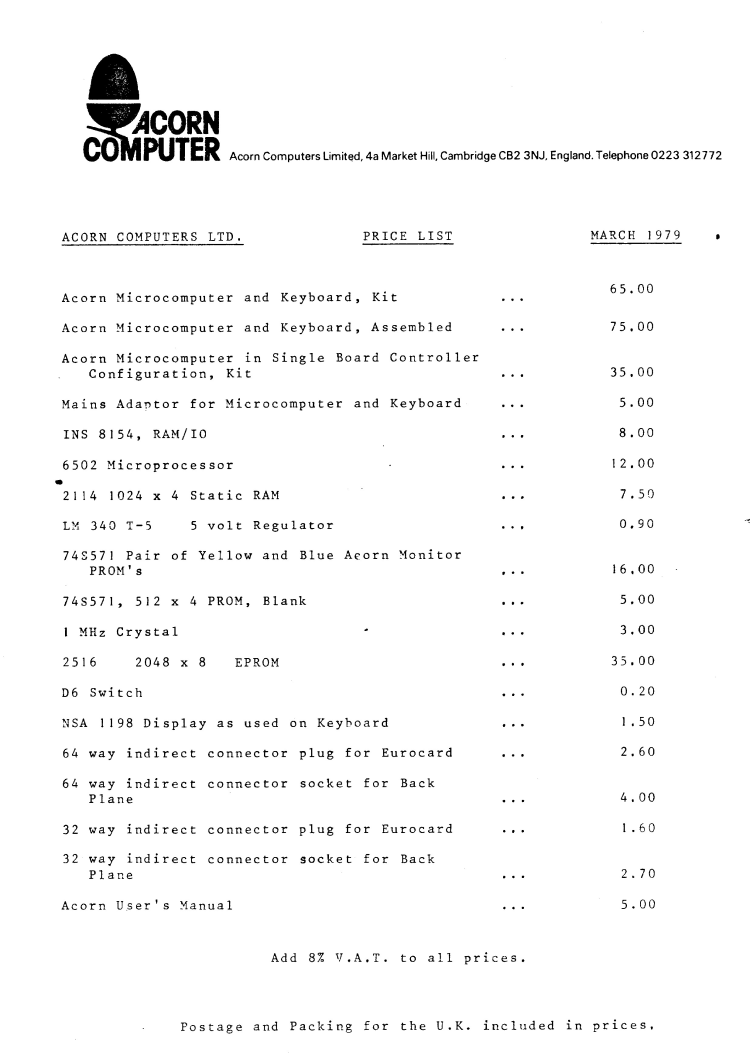
Acorn Computers
View on GrokipediaOverview
Founding and key personnel
Acorn Computers evolved from Cambridge Processing Unit (CPU) Ltd., a design consultancy founded on 5 December 1978 in Cambridge, United Kingdom, by Chris Curry and Hermann Hauser. This venture stemmed from their departure from Sinclair Radionics, where Curry had worked since 1966 and Hauser had collaborated on microprocessor projects, amid disagreements with Clive Sinclair over the company's product direction. Andy Hopper joined as the third co-founder soon after, bringing expertise from the University of Cambridge Computer Laboratory.[7][8][9] Hermann Hauser, a physicist with a PhD from the University of Cambridge, served as the technical lead, guiding the company's engineering efforts. Chris Curry, with his business experience from Sinclair Radionics—including key roles in launching early calculators—handled commercial operations and strategy. Andy Hopper contributed engineering leadership, having previously founded Orbis, a small software firm acquired by the group. The early team was bolstered by talented recruits from Cambridge University, including Sophie Wilson and Steve Furber, who joined as young engineers and later drove significant architectural innovations.[9][10][8] CPU Ltd adopted the formal Acorn Computers Ltd. branding in early 1979, shifting from consultancy to manufacturing. The company's initial focus centered on developing affordable microcomputers aimed at hobbyists and educational users, capitalizing on the emerging personal computing market.[11][12][9]Core innovations and products
Acorn Computers pioneered several foundational technologies in personal computing, most notably the ARM (Acorn RISC Machine) processor architecture, which achieved first working silicon on April 26, 1985, marking the debut of a commercial RISC-based microprocessor designed in-house.[13] This innovation stemmed from Acorn's Advanced Research and Development division, established in 1983 to create a custom CPU that emphasized efficiency and low power consumption, influencing subsequent generations of embedded and mobile processors. Complementing the hardware, Acorn developed the RISC OS operating system, originally conceived in 1987 as Arthur for the Archimedes series before evolving into a full multitasking GUI environment optimized for ARM hardware.[14] Additionally, through its partnership with the BBC in 1981, Acorn contributed to early educational computing standards in the UK by integrating robust hardware with BBC BASIC, a dialect that became a benchmark for introductory programming in schools.[15] The company's product lineup spanned multiple categories, beginning with 8-bit microcomputers such as the Atom, released in 1980 as an affordable entry-level system for hobbyists, and the BBC Micro, which became a staple in educational settings.[16] Transitioning to advanced architectures, Acorn introduced 32-bit RISC machines like the Archimedes in 1987, the first personal computer to feature an ARM processor in a consumer package, and the Risc PC in 1994, which offered modular upgrades including faster ARM variants for professional and multimedia applications.[17] Beyond core systems, Acorn ventured into peripherals, exemplified by the Acorn Pocket Book PDA in 1993, a rebranded Psion Series 3 device tailored for mobile data management with integrated scheduling and communication tools.[18] Acorn also explored non-PC domains, producing set-top boxes like the Online Media STB series in the mid-1990s for interactive video-on-demand services, and prototypes such as the NewsPad tablet in 1993, an ARM-powered touch-screen device intended for digital news delivery under an EU initiative.[19] These efforts highlighted Acorn's adaptability, though they represented a shift from traditional desktops amid market pressures. The BBC Micro alone sold over 1.5 million units, underscoring Acorn's dominance in education and home computing during the 1980s.[20] By the 2010s, the ARM architecture had become the foundation for approximately 95% of mobile devices worldwide, powering smartphones, tablets, and embedded systems through extensive licensing. Founded in 1978, Acorn operated as a key player in British computing until 1999, when it restructured and ceased desktop production; its legal entity persisted until final dissolution in 2015, leaving a legacy in RISC design and educational technology.[21]Early Development
Origins from CPU Ltd.
CPU Ltd. was established on December 5, 1978, by Chris Curry and Hermann Hauser as an independent consultancy firm specializing in original equipment manufacturer (OEM) design services for microprocessors and related electronics.[10] Curry, who had served as sales and marketing director at Sinclair Radionics since 1966, departed the company in late 1978 amid strategic disagreements with Clive Sinclair over the direction of consumer electronics, particularly the potential of microcomputers, which Sinclair initially viewed skeptically.[22] The new venture was initially funded through Hauser's personal investment as a physicist and entrepreneur from Olivetti Research Laboratory, supplemented by fees from early contracts such as designing microprocessor controllers for fruit machines for Ace Coin Equipment Ltd., which provided a £20,000 payout to launch operations on Market Hill in Cambridge; this inaugural project also involved recruiting early talent like Steve Furber.[23] In its early months, CPU Ltd. engaged in targeted consulting to build momentum, culminating in 1980 involvement with the British Broadcasting Corporation (BBC) on its Computer Literacy Project, where the firm advised on hardware specifications for an educational microcomputer and developed initial prototypes based on the existing Acorn Atom design. This collaboration marked a pivotal shift toward consumer-oriented products, leveraging CPU Ltd.'s growing reputation in 6502-based systems. The transition to full independence was formalized in January 1979 when CPU Ltd. adopted the trading name Acorn Computers Ltd. to launch its first proprietary product, the Acorn System 1 microcomputer, signaling the end of its consultancy-focused origins and the beginning of a dedicated manufacturing era.[1]Initial microcomputer systems
Acorn's entry into the microcomputer market began with the System 1, a kit-based computer launched in March 1979 that targeted hobbyists and technical enthusiasts. Priced at £70 in kit form or £81 fully assembled, it consisted of two Eurocard-sized boards: a lower board housing the 1 MHz MOS 6502 CPU, 1 KB of RAM, and supporting logic, and an upper board with a 25-key hexadecimal keypad and a 9-digit 7-segment LED display. The system was designed for expandability through an Acorn bus, allowing up to 32 KB of RAM via additional modules, and included a 300 baud cassette interface for data storage, making it suitable for basic programming and experimentation in an era of emerging home computing.[24] Following the System 1, Acorn developed the Proton in 1980 as an advanced prototype intended to succeed the Atom, but it remained unlaunched as a standalone product. This design incorporated color graphics capabilities and built on the 6502 processor, aiming to offer more sophisticated visual output for educational and hobbyist applications, though production costs ultimately prevented its independent release. The Proton represented Acorn's early push toward more capable systems amid growing competition in the UK market.[25] The Atom, released in March 1980, marked Acorn's first complete, ready-to-use microcomputer, shifting from kits to accessible systems for broader adoption. Featuring a 1 MHz 6502 CPU, 2 KB of RAM (expandable to 32 KB), and an integrated integer BASIC interpreter, it was priced at £120 in kit form or £170 assembled, positioning it as an affordable option for home users and schools. With a full keyboard, composite video output, and cassette interface, the Atom emphasized expandability through edge connectors and cartridge slots, fostering its use in programming education and simple applications; approximately several thousand units were sold before production ended in 1982. It competed directly with contemporaries like the Sinclair ZX80, which entered the market around the same time, but distinguished itself through superior expandability and potential for educational programming tasks.[26][27]Expansion and Breakthroughs
BBC Micro and Electron launch
In 1981, Acorn Computers secured the contract to develop a microcomputer for the BBC's Computer Literacy Project after demonstrating a prototype known as the Proton, which impressed BBC evaluators with its capabilities during a competitive bidding process.[28] The project, aimed at promoting computer education across the UK, led to the formation of a dedicated "crash team" at Acorn led by engineer Steve Furber to accelerate development and meet tight deadlines.[29] Launched in December 1981, the BBC Microcomputer System became a cornerstone of this initiative, with the base Model A priced at £299 and featuring 16 KB of RAM, while the enhanced Model B cost £399 with 32 KB of RAM.[30] Powered by a MOS Technology 6502 CPU running at 2 MHz, the system emphasized educational use through advanced input/output interfaces, including support for peripherals like joysticks and printers.[31] Key features of the BBC Micro included built-in Teletext mode for compatibility with broadcast standards, a versatile user port for parallel and serial connections to external devices, and optional Econet networking for local area connectivity in schools and homes.[32][33] These elements, combined with robust expandability via slots for additional memory and coprocessors, made it suitable for both programming instruction and creative applications. The design built upon the architecture of Acorn's earlier Atom microcomputer, refining its 6502-based system for broader accessibility. By the 1990s, Acorn had sold over 1.5 million units worldwide, far exceeding initial expectations of around 12,000, and establishing the BBC Micro as a dominant force in British computing education.[34] Building on the BBC Micro's success, Acorn released the Electron in July 1983 as a more affordable alternative, priced at £199 to target home users and compete with budget systems like the ZX Spectrum.[35] Retaining the 6502 CPU and 32 KB of RAM, the Electron was essentially a cut-down clone with simplified graphics capabilities—lacking some of the BBC Micro's higher-resolution modes and hardware scrolling—along with reduced I/O options, such as no built-in user port or Econet support.[36] Despite severe supply chain problems caused by delays in producing its custom Uncommitted Logic Array (ULA) chip, which limited initial shipments to just a few thousand units and frustrated eager customers, the Electron ultimately sold over 250,000 units through the mid-1980s.[37][38] This success helped Acorn expand its market presence, though production challenges highlighted vulnerabilities in scaling manufacturing for high-demand consumer products.Shift to RISC architecture
In October 1983, Acorn Computers initiated its RISC research project, inspired by white papers from the University of California's Berkeley RISC I project, with the goal of developing an efficient 32-bit processor to power the company's next-generation machines.[9][39] This effort came amid the success of the BBC Micro, as Acorn sought to transition beyond 8-bit systems toward more advanced computing architectures.[40] The resulting design, known as the Acorn RISC Machine (ARM), featured a 32-bit load/store architecture that emphasized simplicity and efficiency, with only 45 instructions to minimize complexity.[40] The first prototype, ARM1, was primarily designed by Sophie Wilson in collaboration with Steve Furber, achieving working silicon in April 1985 after six man-years of development.[41][42] It incorporated a three-stage pipeline (fetch, decode, execute) and a physical register file of 25 32-bit registers, including 16 general-purpose registers visible to software, with register 15 serving as the program counter.[41][39] Key technical specifications of the ARM1 included an initial clock speed of 6 MHz, delivering average performance of around 3 MIPS when paired with 150 ns DRAM, though peak throughput reached up to 8 MIPS under optimal conditions.[41][40] Later enhancements, such as Thumb mode for 16-bit instruction compression, were introduced in subsequent ARM implementations to further optimize code density, but were not part of the original ARM1 design. The primary rationale for shifting to RISC was to reduce costs compared to licensing complex CPUs like the Motorola 68000, which required expensive ceramic packaging and consumed more power; Acorn's internal evaluations demonstrated potential speed gains of up to five times through the simpler pipeline and load/store model, enabling higher clock rates and lower overall system expenses.[40][42] This approach targeted power consumption below 1 W—achieved at 0.1 W—facilitating cheaper plastic packaging and broader market viability for next-generation computers.[40]Corporate Evolution
Financial growth and crises
Acorn Computers achieved rapid financial growth in the early 1980s, largely fueled by robust sales of the BBC Microcomputer, which propelled the company's profits to £8.6 million by July 1983.[43] This surge in profits, rising from just £3,000 in 1979, reflected the BBC Micro's dominance in the UK educational market and enabled Acorn to expand operations aggressively.[43] In September 1983, Acorn capitalized on this momentum by floating on the Unlisted Securities Market as Acorn Computer Group plc, marking one of the largest such listings at the time and valuing the company at over £100 million by 1984.[44] Growth was further supported by international export deals for the BBC Micro to markets including Australia and parts of Europe, alongside the establishment of a US subsidiary to tap into the American educational sector.[45] However, the US venture faltered due to compatibility challenges with local standards and regulatory hurdles, incurring costs of approximately $20 million with minimal sales returns.[45] By late 1983 and into 1984, financial pressures mounted amid production delays for the Acorn Electron, a lower-cost companion to the BBC Micro; supply shortages of custom uncommitted logic array (ULA) chips limited output to just 30,000 units against 300,000 pre-orders, causing the product to miss the critical Christmas sales period.[45] These setbacks, compounded by the US market disappointment and broader industry oversupply, led to substantial losses exceeding £10 million—specifically £11 million over the six months preceding early 1985—and a sharp decline in share price from a peak of 180p in August 1984 to 45p by January 1985.[45][46] Facing near-bankruptcy by early 1985, Acorn pursued survival through urgent restructuring discussions with stakeholders, including efforts to secure government support amid the UK's push for domestic computing initiatives, which helped stabilize operations during this turbulent period.[45]Olivetti acquisition and integration
In 1985, Acorn Computers faced severe financial difficulties due to declining sales of its BBC Micro and costly expansions into international markets, prompting a takeover by the Italian conglomerate Olivetti. On February 20, 1985, Olivetti acquired a 49% stake in Acorn for £12 million, a move that directly addressed the company's £11 million losses from the previous six months and was ratified by shareholders shortly thereafter.[47] By September 1985, after Acorn failed to meet agreed sales targets, Olivetti increased its investment to secure a 79% controlling stake, with the total acquisition costing under £15 million for a firm previously valued at £100 million.[48] This completed the transition to full Olivetti control, though Acorn maintained its independent listing on the London Stock Exchange.[49] Integration proceeded with Acorn retaining significant operational autonomy, especially in research and development, allowing its Cambridge-based teams to pursue innovative projects without direct interference.[48] Olivetti provided essential financial backing and manufacturing support, including collaboration on production through partners like VLSI Technology for key components such as the ARM processor.[48] Operations remained centered in Cambridge, where Acorn's facilities expanded to support ongoing growth under the new ownership.[29] Strategically, Olivetti shifted Acorn's focus toward bolstering its presence in the UK education sector while integrating it into broader European market initiatives, leveraging Acorn's strengths to enhance Olivetti's competitive position across the continent.[48] This included influences from Olivetti's established PC lines, such as the M24, which encouraged Acorn to incorporate more standardized, compatible design elements in its systems.[50] The acquisition stabilized Acorn's finances, averting collapse and enabling critical R&D investments that culminated in the 1987 launch of the Archimedes, Acorn's first RISC-based computer.[48]Product Line Evolution
Advanced computers and peripherals
The BBC Master, released in January 1986, served as a significant upgrade to the earlier BBC Micro, enhancing compatibility while introducing expanded capabilities for educational and professional use.[51] It featured 128 KB of RAM as standard, an integrated disc filing system, and improved graphics modes, building on the RISC architecture research that Acorn had been developing.[51] An optional ARM co-processor was available via the Tube interface, allowing users to leverage the emerging 32-bit ARM technology as a second processor for advanced tasks.[52] Approximately 260,000 units of the Master series were sold, reinforcing Acorn's position in the UK education sector.[20] In 1987, Acorn launched the Archimedes series, marking the commercial debut of its proprietary ARM-based computers and transitioning fully to 32-bit RISC processing.[53] The initial models, such as the A310 and A440, utilized the ARM2 CPU running at 8 MHz, with 1 MB and 2 MB of RAM respectively, and supported color graphics through a dedicated VIDC chip for resolutions up to 640x256 pixels in 256 colors.[53] These systems ran the Arthur operating system, a modular GUI-based OS with built-in BBC BASIC and backward compatibility for BBC Micro software via emulation.[53] The Archimedes emphasized multitasking and high-performance computing for the era, particularly in graphics and education applications. Subsequent developments in the early 1990s advanced the lineup with higher-performance models. The A5000, introduced in September 1991, incorporated a 25 MHz ARM3 processor with an integrated 4 KB cache and optional FPA10 floating-point unit, alongside 2-4 MB of RAM and RISC OS 3 for improved multitasking and desktop functionality.[54] By 1994, the Risc PC debuted as Acorn's flagship, featuring a modular design with an initial ARM710 CPU at 40 MHz and support for expansion cards; it was upgradable to the StrongARM processor, reaching speeds up to 233 MHz in later configurations, which significantly boosted performance for multimedia and networking.[55] Acorn complemented these systems with specialized peripherals to enhance storage and display capabilities. Winchester hard drives, such as the 10 MB model 110 and 30 MB model 130, connected via the 1 MHz bus for reliable mass storage on BBC Master and early Archimedes setups, using an Adaptec ACB-4000 controller.[56] For visuals, Acorn offered VDU interfaces and monitors, including the 80x25 character VDU board for professional text-based displays and color monitors compatible with the Archimedes' graphics modes, enabling sharp RGB output for educational and desktop use.[57] By 1998, the Archimedes family had achieved cumulative sales of approximately 200,000 units, dominating the UK education market where it powered curricula in computing and graphics across schools.[58] This success stemmed from government-backed initiatives and Acorn's focus on affordable, expandable hardware tailored for institutional needs.[58]ARM spin-off and licensing
The ARM processor architecture originated from Acorn Computers' in-house RISC development project in the early 1980s, aimed at creating an efficient, low-power microprocessor for its systems. To commercialize this technology beyond internal use, Acorn formed a joint venture in November 1990 with Apple Computer and VLSI Technology, establishing Advanced RISC Machines Ltd (ARM Ltd) in Cambridge, England. Acorn and Apple each took a 30% ownership stake, while VLSI held 5%, with the new entity capitalized at £5 million and targeting additional investors for the remaining 35%.[59][60][61] ARM Ltd adopted an intellectual property licensing model, emphasizing the sale of design blueprints and cores to semiconductor manufacturers rather than fabricating chips itself, which allowed for broad adoption while minimizing capital-intensive production risks. Licensees paid upfront fees for access to the IP, followed by royalties on each chip produced, enabling ARM to generate revenue without competing in hardware manufacturing. The first commercial chips under this model were produced by VLSI, including integrated designs like the ARM250 in 1992, which combined an ARM3 core with memory management and support logic on a single die.[62][63] Key early milestones included the ARM2 processor, introduced in 1987 as the heart of Acorn's Archimedes computers, marking the first production RISC-based personal computer and demonstrating the architecture's viability at 8 MHz with low power consumption. This was followed by the ARM3 in 1990, which added on-chip cache to boost performance while maintaining compatibility, and was used in upgraded Acorn systems. Post-spin-off, ARM secured pivotal partnerships, such as with Texas Instruments in 1993 for embedded applications like mobile phones, and Digital Equipment Corporation in the mid-1990s to co-develop the StrongARM processor, expanding the architecture into high-performance and portable devices.[17][64][7] Acorn transferred its ARM design team to the new venture, retaining a significant equity stake that provided ongoing royalty income from licensed designs, though the company primarily concentrated on integrating ARM processors into its own hardware products like the A-series workstations rather than shifting to pure IP development. This arrangement allowed Acorn to benefit financially from ARM's growth while continuing its focus on complete computer systems through the 1990s.[11][65]Later Ventures and Decline
Diversification into set-top boxes and education
In the mid-1990s, Acorn Computers diversified beyond traditional personal computing by developing set-top boxes for interactive television services through its subsidiary, Acorn Online Media, established in 1994.[66] These devices, such as the STB1 and later models like the STB2, were ARM-based and designed to deliver video-on-demand and multimedia content over cable networks.[67] The flagship initiative was the Cambridge Interactive TV trial launched in September 1994 in collaboration with Anglia Television, Cambridge Cable, and Advanced Television Systems, initially involving 10 users and expanding to broader testing at speeds up to 25 Mbit/s.[68][69] Despite leveraging Acorn's RISC architecture for efficient processing, the set-top boxes saw limited commercial success as the anticipated market for interactive TV did not materialize in the UK during this period.[70] Parallel to these efforts, Acorn pursued educational innovations to maintain its strong foothold in the UK schools sector, where it had long dominated with earlier products. The NewsPad, a prototype wireless tablet computer developed in the mid-1990s, represented an early foray into portable, touch-screen devices for content delivery, featuring an ARM7500FE processor at 40 MHz and intended for news and educational applications.[71] Building on its networking heritage, Acorn introduced the SchoolServer in the mid-1990s as a dedicated fileserver platform to support whole-school connectivity, integrating curriculum management, resource sharing, and compatibility with Acorn's proprietary Econet and Ethernet systems.[72][73] In 1996, Acorn formed Xemplar Education as a 50/50 joint venture with Apple Computer UK to supply hardware and software solutions tailored for UK schools, focusing on RISC OS-based systems and educational peripherals.[74] However, amid shifting priorities, Acorn sold its stake in Xemplar to Apple in January 1999 for £3 million, effectively exiting direct involvement in the venture.[75] Acorn's network computer (NC) initiatives further bridged its diversification into education and emerging internet appliances, with the company commissioned by Oracle in 1996 to develop a reference design for low-cost, diskless thin clients.[69] The resulting Acorn Network Computer, including models like the NetStation, utilized ARM processors to provide centralized computing access via networks, targeting educational and corporate environments as an alternative to full PCs.[76] Limited units were sold, primarily to schools, but the NC concept struggled against the dominance of Microsoft Windows-based systems.[58] Overall, these ventures faced market challenges as the computing landscape shifted toward internet-centric PCs and broadband adoption lagged, eroding Acorn's position in education where demand increasingly favored Wintel-compatible solutions over specialized ARM-based alternatives.[77][69]Restructuring and asset sales
In September 1998, Acorn Computers undertook a major strategic review that led to the closure of its Workstation Division, effectively ending development and production of desktop computers.[78] This restructuring included the cancellation of the Phoebe project, a planned successor to the Risc PC intended to feature advanced ARM-based processing but deemed unviable amid rising costs and declining market demand for high-end workstations.[79] The decision, announced on 17 September and dubbed "Black Thursday" by staff, resulted in approximately 60 immediate redundancies within the division.[80] These changes followed earlier struggles with diversification into areas like set-top boxes, which had failed to reverse ongoing financial pressures. By January 1999, Acorn Computers Ltd rebranded as Element 14 Ltd, shifting its core focus from traditional computing hardware to broadband access and set-top box technologies, while remaining under the ownership of Acorn Group plc.[81] The set-top box operations were later sold to Pace Micro Technology in February 2000. As part of the asset disposals during this period, Acorn sold its 50% stake in Xemplar Education Ltd—a joint venture with Apple for supplying computers to UK schools—to Apple for £3 million in January 1999, fully exiting the education hardware market.[82] Concurrently, in March 1999, the rights to RISC OS were licensed to the newly formed RISCOS Ltd, allowing continued development of the operating system outside Acorn's direct control; these rights were later acquired by Castle Technology Ltd in 2003 following a transfer via Pace Micro Technology.[83] The restructuring significantly impacted the workforce, with employee numbers dropping from around 300 in late 1998 to fewer than 100 by mid-1999, reflecting the scaled-back operations and sale of non-core assets.[84]Dissolution and Legacy Operations
Element 14 transition
In early 1999, following a restructuring initiated in 1998, Acorn Computers Limited was renamed Element 14 Limited to reflect a strategic shift toward developing digital signal processing (DSP) technologies and interactive media, particularly for digital television applications.[85] This rebranding positioned the subsidiary as a fabless semiconductor designer, moving away from traditional hardware manufacturing.[86] On April 27, 1999, Acorn Group plc, the parent company, announced an agreement for acquisition by MSDW Investment Holdings Limited, a subsidiary of Morgan Stanley Dean Witter, in a deal valued at approximately £270 million.[87] The transaction was structured as an all-stock offer, exchanging two shares in ARM Holdings for every five Acorn Group shares, providing a 13.9% premium over the prior closing price and effectively distributing Acorn's significant stake in ARM to its shareholders.[87] The acquisition was completed on June 1, 1999, resulting in the delisting of Acorn Group plc from the London Stock Exchange and marking the formal end of the company as an independent entity.[85] In the immediate aftermath, MSDW integrated key assets into its portfolio, retaining approximately 7.4 million ARM shares valued at £47 million while selling others to fulfill the share exchange.[87] The set-top box division was sold to Pace Micro Technology PLC for £200,000, and the software business underwent a management buyout for £1 million.[87] Element 14's DSP operations were acquired by a management team led by Stan Boland shortly thereafter, allowing continued development in broadband and media technologies independent of the Acorn brand.[85] This dispersal of staff and operations across new entities effectively ended Acorn's hardware branding and manufacturing activities.[86]Final dissolution
Following the acquisition of Acorn Group plc by MSDW Investment Holdings Limited—a subsidiary of Morgan Stanley Dean Witter—in June 1999, the remaining core entity, previously known as Acorn Computers Limited (renamed Element 14 Limited in January 1999), was renamed Cabot 2 Limited on 3 August 1999 to oversee residual assets and operations.[85][88] This shell company managed lingering intellectual property, including patents, and generated minor royalties from existing licenses, with no development of new products or hardware.[89] Meanwhile, Element 14 Limited, spun off from Acorn as a semiconductor design house in 1999, was acquired by Broadcom Corporation in October 2000 for approximately $600 million in stock, marking the end of Acorn's active design activities.[90] Cabot 2 Limited remained dormant under MSDW ownership, holding the Acorn trademark and any remaining IP rights without significant commercial activity. In 2006, the trademark was briefly licensed to a new entity, Acorn Computers Ltd (2006), which attempted a revival by rebranding generic Windows-based laptops but failed to gain traction and was dissolved in December 2009 after failing to file accounts.[91] Ultimately, Cabot 2 Limited entered voluntary liquidation on 1 October 2013 and was formally dissolved on 15 June 2014 via compulsory strike-off, concluding all formal operations of the original Acorn Computers entity; the trademark rights reverted to MSDW holdings.[92]Technological and Cultural Impact
Influence on ARM and computing
Acorn Computers' development of the ARM processor in the mid-1980s laid the foundation for one of the most pervasive architectures in modern computing, evolving from an internal project into a global standard after its spin-off as Advanced RISC Machines Ltd in 1990, a joint venture involving Acorn, Apple, and VLSI Technology.[65] This architecture's efficiency and low power consumption enabled its rapid adoption in mobile devices, achieving over 99% market share in smartphone processors by the early 2020s, a dominance sustained through widespread licensing to major semiconductor firms.[93] ARM-based chips now power core components in products from leading companies, including Apple's custom silicon for iPhones and Macs, as well as Qualcomm's Snapdragon processors used in Android devices and laptops.[94] The legacy of Acorn's RISC OS operating system, originally designed to complement the ARM hardware in machines like the Archimedes series, persists through community-driven open-source efforts that began in the 2000s. RISC OS Open Ltd (ROOL), established in December 2006, coordinated the release of RISC OS source code under open licenses, culminating in full open-sourcing in October 2018, which has facilitated ports to modern ARM platforms like the Raspberry Pi.[6] These variants maintain compatibility with legacy software while enabling adaptations for resource-constrained environments, influencing embedded system designs by providing a lightweight, modular OS framework optimized for ARM's RISC principles.[79] Acorn's contributions extended beyond hardware to shape broader computing accessibility, particularly through the BBC Micro, which pioneered affordable personal computing for education in the UK during the 1980s. As part of the BBC's Computer Literacy Project, the BBC Micro—manufactured by Acorn—equipped over a million schools and homes, fostering early programming skills and influencing national IT curricula by demonstrating the viability of low-cost, versatile machines in educational settings.[15] This initiative not only boosted computer adoption in UK policy but also inspired a generation of technologists, indirectly supporting the ecosystem that propelled ARM's growth into diverse applications from consumer electronics to servers. In recent developments, ARM Holdings, tracing its roots to Acorn's innovations, reached a market valuation exceeding $100 billion by mid-2024 following its IPO, reflecting its pivotal role in high-performance computing architectures like ARMv8 and AArch64 introduced in the 2010s.[95] Acorn's foundational work on the original ARM design informed these 64-bit extensions, which enhanced addressable memory and performance for mobile and server use, solidifying ARM's position in over 200 billion chips shipped worldwide by the 2020s, with over 300 billion shipped as of late 2024.[17][96]Role in education and popular media
Acorn Computers played a pivotal role in UK education during the 1980s through its BBC Micro, which became a cornerstone of the nation's computing curriculum. Developed in partnership with the British Broadcasting Corporation (BBC), the BBC Micro was selected as the official computer for the BBC's Computer Literacy Project, a nationwide initiative launched in 1980 to introduce computing to schools and the public. By 1985, approximately 80% of UK schools owned at least one BBC Micro, reflecting its widespread adoption in classrooms for teaching programming and basic computer skills. Over its production run, more than 1.5 million units were sold, underscoring Acorn's dominance in the educational market. To extend accessibility beyond schools, Acorn released the Electron in 1983 as a more affordable home version of the BBC Micro, priced at around £199 to appeal to families and further embed computing in everyday use. While retaining core features like BBC BASIC programming language compatibility, the Electron targeted non-educational users, enabling home learning and hobbyist experimentation without the full cost of the educational model. In popular media, Acorn's products gained visibility through BBC television programming tied to the Computer Literacy Project, notably the series Micro Live (1983–1987), which showcased live demonstrations of the BBC Micro and emerging technologies to a broad audience. The company also supported enthusiast publications, such as Acorn User magazine, which debuted in July/August 1982 and ran until its final issue in December 2003, providing tutorials, reviews, and community news for BBC Micro and later Acorn users. Post-2015 trademark revivals have been limited and largely unsuccessful, with no major corporate resurgence of Acorn as a hardware manufacturer. In 2018, a new entity using the Acorn name launched the Micro C5 smartphone via Indiegogo, a rebranded budget Android device aimed at nostalgia-driven backers, but the project failed to gain traction and was discontinued shortly after. The RISC OS operating system, originally developed by Acorn, sustains a dedicated community through events in the 2020s, such as the virtual RISC OS London Show in 2020 and the RISC OS South West show. In 2024, Hackaday highlighted Acorn's legacy by examining the transition from the BBC Micro to later models like the Archimedes series, framing them as the "last Acorn BBC computers" in the context of British computing history. An ongoing enthusiast scene preserves Acorn's heritage via resources like the Chris's Acorns archive, hosted by the Centre for Computing History, which documents hardware and software for collectors and researchers.References
- https://en.wikichip.org/wiki/acorn/microarchitectures/arm1