


Community hub
Recent from talks
Contribute something
Nothing was collected or created yet.
Nunchaku
View on Wikipedia
 | This article needs additional citations for verification. (December 2020) |
| Nunchaku | |||||||||||
|---|---|---|---|---|---|---|---|---|---|---|---|
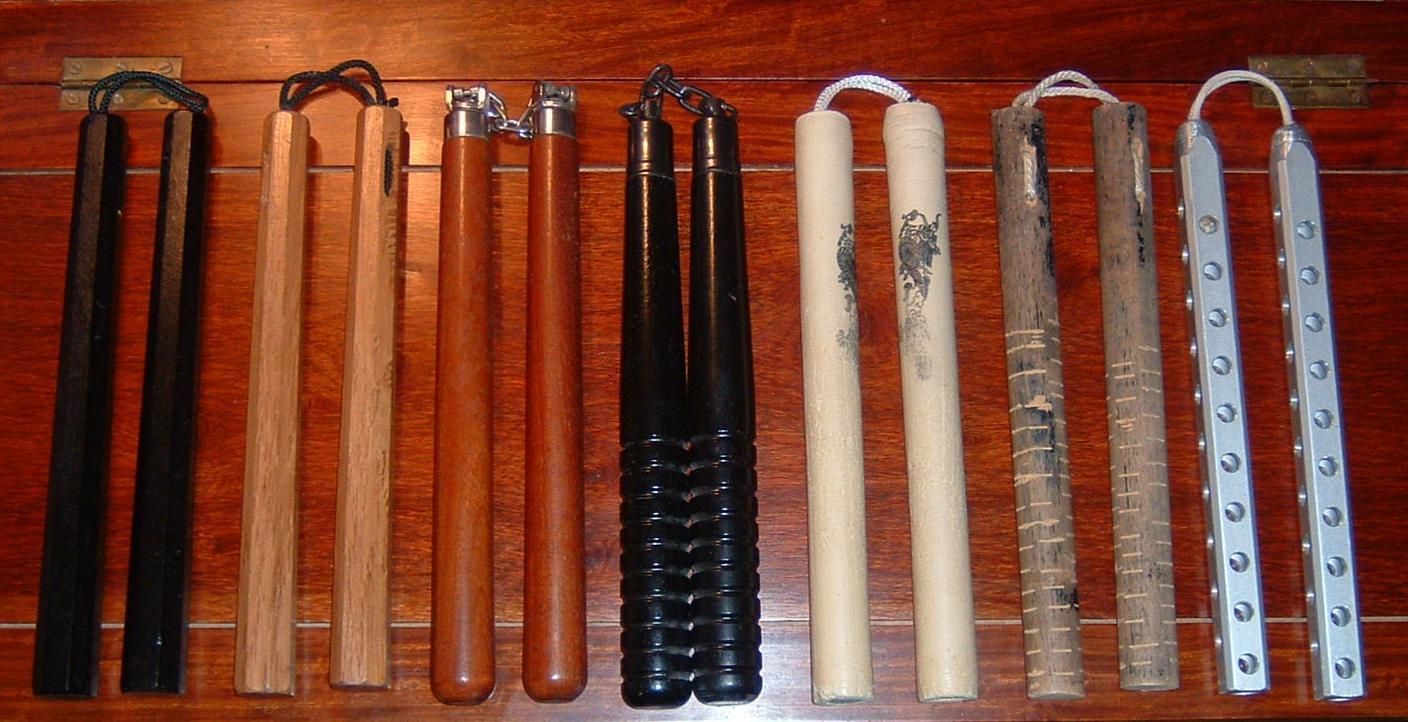
 Various types of nunchaku. | |||||||||||
| Chinese name | |||||||||||
| Traditional Chinese | 雙節棍 | ||||||||||
| Simplified Chinese | 双节棍 | ||||||||||
| |||||||||||
| Alternative Chinese name | |||||||||||
| Traditional Chinese | 双截棍 | ||||||||||
| |||||||||||
| Second alternative Chinese name | |||||||||||
| Traditional Chinese | 兩節棍 | ||||||||||
| |||||||||||
| Japanese name | |||||||||||
| Katakana | ヌンチャク | ||||||||||
| |||||||||||
The nunchaku (/nʌnˈtʃækuː/, US: /nənˈtʃɑːkuː/) (Japanese: ヌンチャク; sometimes "dual-section stick", "nunchuks"[1] (/ˈnʌntʃʌks/), "nunchucks",[2] "chainsticks",[3] or "chuka sticks"[4] in English)[a] is a traditional East-Asian martial arts weapon consisting of two sticks (traditionally made of wood), connected to each other at their ends by a short metal chain or a rope. It is approximately 30 cm or 12 inches (sticks) and 2.5 cm or 1 inch (rope). A person who has practiced using this weapon is referred to in Japanese as nunchakuka (ヌンチャク家, nunchakuka).

The nunchaku is most widely used in Southern Chinese Kung fu, Okinawan Kobudo and karate. It is intended to be used as a training weapon, since practicing with it enables the development of quick hand movements and improves posture. Modern nunchaku may be made of metal, plastic, or fiberglass instead of the traditional wood. Toy versions and replicas not intended to be used as weapons may be made of polystyrene foam or plastic. Possession of this weapon is illegal in some countries, except for use in professional martial arts schools.
The origin of the nunchaku is unclear. One traditional explanation holds that it was originally invented by Emperor Taizu of Song, as a weapon utilised in war, initially named Grand Ancestor Coiling Dragon Staff (大小盤龍棍/太祖盤龍棍, taai3 zo2 pun4 lung4 gwan3/taai3 zo2 pun4 lung4 gwan3). Another weapon, called the tabak-toyok, native to the northern Philippines, is constructed very similarly, suggesting that it and the nunchaku descended from the same instrument.
In modern times, the nunchaku and the tabak-toyok were popularized by the actor and martial artist Bruce Lee and by Dan Inosanto.[5] Lee famously used nunchaku in several scenes in the 1972 film Fist of Fury.[6] When Tadashi Yamashita worked with Bruce Lee on the 1973 film Enter the Dragon, he enabled Lee to further explore the use of the nunchaku and other kobudo disciplines. The nunchaku is also the signature weapon of the character Michelangelo in the Teenage Mutant Ninja Turtles franchise.
In addition, the nunchaku is used in certain contact sports.
Etymology
[edit]The origin of the Ryukyuan word nunchaku (ヌンチャク) likely originated from the Min Chinese word of "nng chat kun"(兩節棍). Another name for this weapon is "nūchiku" (ヌウチク).[7]
In the English language, nunchaku are often referred to as "nunchucks".[8] It is a variant of a word from the Okinawan language, which itself may come from a Min Chinese word for a farming tool, neng-cak.[5]
Origins
[edit]
.jpg)
The first written record of nunchaku-like weapon was the Chinese military compendium of 武經總要; Wujing Zongyao compiled during the Northern Song dynasty:
"鐵鏈夾棒,本出西戎,馬上用之,以敵漢之步兵。其狀如農家打麥之枷,以鐵飾之,利於自上擊下,故漢兵善用者巧於戎人。"[9]
Translation:
"Two sticks connected by metal chain, originated from Xirong, used on horses in combat against Han infantry, shaped similarly to flails used by farmers to thresh wheat, iron-decorated, easy to strike below from above, Han soldiers who were able to master could exercise with excellence against the Xirongs."
One popular belief is that nunchaku in its contemporary form was originally a short South-East Asian flail. A near variant to the nunchaku called tabak-toyok exists in the northern Philippines,[10] which was used to thresh rice or soybeans. Alternative theories are that it was originally developed from an Okinawan horse bit (muge) or from a wooden clapper called hyoshiki[11] carried by the village night watch, made of two blocks of wood joined by a cord. The night watch would hit the blocks of wood together to attract people's attention, then warn them about fires and other dangers.[12]
An oft-repeated claim is that the nunchaku and other Okinawan weapons were tools adapted for use as weapons by peasants who were forbidden from possessing conventional weapons, but available academic sources suggest this is likely a romantic exaggeration created by 20th century martial arts schools. Martial arts in Okinawa were practiced exclusively by the aristocracy (kazoku) and "serving nobles" (shizoku), but were prohibited among commoners (heimin).[13][self-published source?]
Parts
[edit].JPG)
- Ana: the hole on the kontoh of each handle for the himo to pass through—only nunchaku that are connected by himo have an ana.
- Himo: the rope which connects the two handles of some nunchaku.
- Kusari: the chain which connects the two handles of some nunchaku.
- Kontoh: the top of each handle.
- Jukon-bu: the upper area of the handle.
- Chukon-bu: the center part of the handle.
- Kikon-bu: the lower part of the handle.
- Kontei: the bottom of the handle.[14]
Construction
[edit]

Nunchaku consist of two sections of wood connected by a cord or chain, though variants may include additional sections of wood and chain. In China, the striking stick is called "dragon stick" ("龍棍"), while the handle is called "yang stick" ("陽棍").
The rounded nunchaku is comparatively heavy and used for training, whereas the octagonal nunchaku is used for combat.[15] Ideally, each piece should be long enough to protect the forearm when held in a high grip near the top of the shaft. Both ends are usually of equal length, although asymmetrical nunchaku exist that are closer to a traditional flail.
The ideal length of the connecting rope or chain is just long enough to allow the user to lay it over his or her palm, with the sticks hanging comfortably and perpendicular to the ground. The weapon should be properly balanced in terms of weight. Cheaper or gimmicky nunchaku (such as glow-in-the-dark versions) are often not properly balanced, which prevents the performer from performing the more advanced and flashier "low-grip" moves, such as overhand twirls. The weight should be balanced towards the outer edges of the sticks for maximum ease and control of the swing arcs.
Traditional nunchaku are made from a strong, flexible hardwood such as oak, loquat or pasania.
Formal styles
[edit]The nunchaku is most commonly used in Okinawan kobudō and karate, but it is also used in Korean hapkido and Filipino eskrima. (More accurately, the Tabak-Toyok, a similar though distinct Philippine weapon, is used, not the Okinawan nunchaku). Its application is different in each style. The traditional Okinawan forms use the sticks primarily to grip and lock. Filipino martial artists use it much the same way they would wield a stick: striking is given precedence. Korean systems combine offensive and defensive moves, so both locks and strikes are taught. Other proprietary systems of Nunchaku are also used in Sembkalah (Iranian Monolingual Combat Style), which makes lethal blows in defense and assault.
Nunchaku is often the first weapon wielded by a student, to teach self-restraint and posture, as the weapon is liable to hit the wielder more than the opponent if not used properly.[citation needed]
The Nunchaku is usually wielded in one hand, but it can also be dual wielded. It can be whirled around, using its hardened handles for blunt force, as well as wrapping its chain around an attacking weapon to immobilize or disarm an opponent. Nunchaku training has been noted[by whom?] to increase hand speed, improve posture, and condition the hands of the practitioner. Therefore, it makes a useful training weapon.
Freestyle
[edit]Freestyle nunchaku is a modern style of performance art using nunchaku as a visual tool, rather than as a weapon. With the growing prevalence of the Internet, the availability of nunchaku has greatly increased. In combination with the popularity of other video sharing sites, many people have become interested in learning how to use the weapons for freestyle displays. Freestyle is one discipline of competition held by the World Nunchaku Association. Some modern martial arts teach the use of nunchaku, as it may help students improve their reflexes, hand control, and other skills.
Legality
[edit]In a number of countries, possession of nunchaku is legally restricted, ranging from prohibiting carrying them concealed in public to outright banning any form of possession. Nearly all such regulations were created in the 1970s after a wave of popularity attributed to their appearances in the Bruce Lee martial arts films and related media. This popularity led to them being commonly found in the possession of delinquent youths and petty criminals. This combination of popular media exposure creating the impression of danger and lethality, and their perceived popularity with undesirable classes of society, led to legal restrictions being passed. Later legal challenges led to closer examination of nunchaku's actual use in criminal behavior, and have found most of these laws were likely not warranted.[16] For example Judge Pamela Chan in 2018's Maloney v. Singas concluded "there is virtually no evidence that nunchakus are associated with, or have been used to engage in, criminal conduct."[16]
In Australia, a state or territory approval in a B709B form is required to lawfully import any nunchaku made of hard materials[17]. They are classified as prohibited weapons in New South Wales[18].
Norway, Canada,[19][20] Russia, Poland, Chile, and Spain are all known to have significant restrictions.
In Germany, nunchaku have been illegal since April 2006, when they were declared a strangling weapon.[21][22]
In England and Wales, public possession of nunchaku is heavily restricted by the Prevention of Crime Act 1953 and the Criminal Justice Act 1988. However, nunchaku are not included in the list of weapons whose sale and manufacture is prohibited by Schedule 1 of the Criminal Justice Act 1988 (Offensive Weapons) Order 1988 and are traded openly (subject to age restrictions).
In Scotland, laws restricting offensive weapons are similar to those of England and Wales. However, in a case in 2010, Glasgow Sheriff Court refused to accept a defence submission that nunchaku were not explicitly prohibited weapons under Scottish law, although the defendants were acquitted on other grounds.[23]
The use of nunchaku was, in the 1980s and 1990s, censored from UK rebroadcasts of American children's TV shows such as ThunderCats and Teenage Mutant Ninja Turtles cartoons and films.[24] The UK version of ThunderCats edited out nunchaku used by the character Panthro. Teenage Mutant Ninja Turtles needed to be edited, the nunchaku used by Michelangelo were edited, until they were replaced by a grappling hook.[25] The UK version of the video game Soul Blade was also edited, replacing the character Li Long's nunchaku with a three-sectioned staff.
In Hong Kong, it is illegal to possess metal or wooden nunchaku connected by a chain, though one can obtain a license from the police as a martial arts instructor, and rubber nunchaku are still allowed. Possession of nunchaku in mainland China is legal.
In the United States, regulations on nunchaku vary by state as well as county and city jurisdictions. Some states do not apply any restrictions, while other state laws and local ordinances continue to prohibit carrying nunchaku in specific situations, such as on school grounds or in government facilities, or if carrying in public as a concealed weapon.[26] Broader prohibitions were passed in the 1970s for the reasons outlined above, but many have since been repealed or overturned. State-level nunchaku bans on possession were initially passed in New York, Arizona, California, and Massachusetts, but only the Massachusetts ban remains:
- New York's nunchaku ban was ruled unconstitutional in the 2018 case Maloney v. Singas.[16]
- The state of Arizona previously considered nunchaku to be a "prohibited weapon", making mere possession illegal, with the sole exception of nunchaku-like objects that are manufactured for use as illumination devices.[27] A constitutional challenge failed,[28] but Arizona legalized nunchaku in 2019.[29]
- California prohibited nunchaku with exceptions for professional martial arts schools and practitioners, but the ban was repealed in 2021.[30]
- Massachusetts law classifies nunchucks as "dangerous weapons", with an exemption for use in martial arts, and anyone found carrying them without proper authorization may face criminal charges.[26]
Law enforcement use
[edit]Nunchaku have been employed by a few American police departments for decades, especially after the popular Bruce Lee movies of the 1970's. For instance, in 2015, police in the small town of Anderson, California were trained and deployed to use nunchaku as a form of non-lethal force.[31] They were selected because of their utility as both a striking weapon and a control tool.
Orcutt Police Nunchaku (OPN) had been adopted by more than 200 law enforcement agencies in the USA. Even though it could be used as a striking weapon, it was mainly used as a grappling implement on the wrists and ankles for pain compliance. They were very effective in that regard but improper use had been associated with injuries like wrist and limb breaks that led to them being phased out.[32]
However, TASERs have become the preferred non-lethal weapon for most departments.[33]
Notable organizations
[edit]- World Nunchaku Association
- Hong Kong Nunchaku Association
- Nunchaku Association of India
- I.R. Iran Nunchaku Association
- Ken-Fu Nunchaku
- American Style Nunchaku
- North American Nunchaku Association
- Palestinian Nunchaku Federation
See also
[edit]

Notes
[edit]References
[edit]- ^ ""Nunchaku" definition, Oxford Dictionary of English". Oxford University Press. Archived from the original on 8 August 2016. Retrieved 11 July 2016.
- ^ "Nunchuck" definition, Merriam-Webster Dictionary, accessed Apr 3, 2019
- ^ "Enter the Dragon case study". British Board of Film Classification. Archived from the original on 22 March 2018. Retrieved 28 February 2023.
- ^ Active Interest Media, Inc. (March 1975). "Black Belt". Black Belt. Buyer's Guide. Active Interest Media, Inc.: 10–. ISSN 0277-3066.
- ^ a b "Meet the Guy Who Introduced Bruce Lee to Nunchucks". Angry Asian Man. Archived from the original on 25 July 2017. Retrieved 26 July 2017.
- ^ "BBC - Films - review - Fist of Fury DVD".
- ^ ヌンチャクについて [Regarding Nunchuks] (in Japanese). Budoshop Japan. Archived from the original on 2013-04-20. Retrieved 2012-01-15.
- ^ [1] www.thefreedictionary.com
- ^ "武經總要 - 维基文库,自由的图书馆". zh.wikisource.org (in Chinese). Retrieved 2023-08-20.
- ^ Donn F. Draeger & Rober W. Smith (1969). Comprehensive Asian Fighting Arts. ISBN 978-0-87011-436-6.
- ^ Reframing Japanese cinema: authorship, genre, history, Authors Arthur Nolletti, David Desser, Publisher Indiana University Press, 1992, Original from the University of Michigan, Digitized May 5, 2008 ISBN 0-253-34108-6 ISBN 978-0-253-34108-2
- ^ "OKS Nunchaku". oks-online.com. Archived from the original on 2009-04-06.
- ^ Alex Levitas. "The real history of the nunchaku". nunchaku-do.com. Retrieved 2021-04-06.
- ^ Demura, Fumio (10 May 1971). Nunchaku: Karate Weapon of Self-defense. Black Belt Communications. ISBN 9780897500067 – via Google Books.
- ^ Fumio Demura (1971). Nunchaku, Karate Weapon of Self Defense. Ohara Publications. p. 14. ISBN 9780897500067.
- ^ a b c "03-786 - Maloney v. Singas". govinfo. Retrieved 2018-12-18.
- ^ "Australian Border Force Website". Australian Border Force Website. Archived from the original on 2025-07-16. Retrieved 2025-07-21.
- ^ "View - NSW legislation". legislation.nsw.gov.au. Retrieved 2025-07-21.
- ^ Taylor, Kim. "The Legality of Martial Arts Weapons In Canada". ejmas.com. Archived from the original on 2008-05-14.
- ^ Regulations Prescribing Certain Firearms and other Weapons, Components and Parts of Weapons, Accessories, Cartridge Magazines, Ammunition and Projectiles as Prohibited or Restricted, SOR/98-462 Archived 2010-11-04 at the Wayback Machine. Canlii. Accessed 2010/06/30
- ^ Feststellungsbescheid des BKA from 5 February 2004, AZ KT21 / ZV 5-5164.02-Z-23/2004
- ^ Waffengesetz Anlage 2 (Waffenliste), Abschnitt 1, Ziffer 1.3.8
- ^ "Men cleared of banned weapon sale". BBC News. Retrieved 2018-01-21.
- ^ Reid, Craig. "TMNT: The Rennaissance [sic] Reptiles Return". Kung Fu Magazine. Archived from the original on 2010-01-06. Retrieved 2009-12-27.
- ^ Francisco, Mikael Angelo (2021-09-01). "The Untold Truth Of The Teenage Mutant Ninja Turtles - Looper". Looper.com. Retrieved 2022-04-30.
- ^ a b "World Population Review: Nunchucks Legality by State". March 2023. Retrieved 2023-08-12.
- ^ "Arizona Revised Statutes - 13-3101 - Definitions". Arizona Legislature. Retrieved 2018-12-18.
- ^ "State v. Swanton, 129 Ariz. 131 | Casetext". casetext.com. Archived from the original on March 10, 2021. Retrieved 2019-11-18.
- ^ Saldivia, Gabriela (12 May 2019). "In Arizona, It's No Longer A Felony To Own Nunchucks". NPR.org. Retrieved 2019-11-18.
- ^ "California Legislative Information: bill text: SB-827 Public Safety Omnibus.(2021-2022)". 10 September 2021. Retrieved 2023-08-12.
- ^ Michael Martinez, Dan Simon and Augie Martin (4 November 2015). "Nunchucks: California police use martial arts equipment". CNN. Retrieved 2020-09-10.
- ^ "Beyond the baton: 5 forgotten police weapons".
- ^ Peralta, Eyder (28 October 2015). "Small California Town Gives Its Police Nunchucks As Non-Lethal Alternative". NPR. Archived from the original on 6 November 2015. Retrieved 9 November 2015.
| |||||||||||||||||||||||||||||
| |||||||||||||||||||||||||||||


| International | |
|---|---|
| National | |
| Other | |

Nunchaku
View on GrokipediaHistory
Etymology
The term nunchaku (ヌンチャク) derives from the Ryukyuan languages of Okinawa, where it refers to a paired-stick weapon connected by a cord or chain.[11] The word breaks down into components "nun," denoting the linking rope, cord, or chain, and "chaku," signifying wood or stick, reflecting the tool's basic construction of two wooden handles joined by a flexible connector.[12] [13] Alternative theories propose influences from Chinese terminology, such as the Min Nan phrase nńg-chiak-kun (兩節棍), meaning "two-section staff," which describes a similar agricultural flail and may have entered Okinawan usage through trade or migration.[14] Another interpretation links "nun" to "twin" or paired elements, with "chaku" approximating the Japanese unit shaku (about 30 cm), the traditional length of each handle, though this reading is less directly attested in Ryukyuan dialects.[12] The exact etymology remains debated due to limited pre-20th-century linguistic records from Okinawa, but the Ryukyuan composite form aligns most closely with historical descriptions of the weapon's design and regional nomenclature.[9]Origins in Okinawa and China
The precise origins of the nunchaku are uncertain, with historical records providing no definitive evidence of its invention or early use. The prevailing theory among Okinawan martial arts practitioners attributes its development to the Ryukyu Kingdom, where it evolved from an agricultural flail known locally as nūchiku or similar terms, used for threshing rice, soybeans, and wheat by separating grains from husks.[9] This adaptation reportedly occurred in response to strict weapon prohibitions imposed by the Satsuma clan after their invasion of Okinawa in 1609, compelling locals to repurpose everyday farming tools for self-defense.[11] Such bans persisted into the 19th century, fostering the integration of tools like the nunchaku into clandestine training systems that later formalized as kobudō.[15] Alternative theories propose connections to equestrian equipment, such as the horse bit and bridle (muge in Okinawan), suggesting the nunchaku derived from binding these items together for storage or improvised use. However, this notion lacks robust archaeological or textual support and has been critiqued as a later romanticization rather than empirical fact.[6] In contrast, the agricultural flail hypothesis aligns with observable parallels in other cultures, where similar hinged implements transitioned from farm use to weaponry under restrictive conditions, though direct Okinawan artifacts predating the 20th century remain elusive.[9] Claims of Chinese origins trace to weapons like the shuang jie gun (paired sticks), purportedly documented during the Song Dynasty (960–1279 CE), with indirect linguistic evidence in the term "nunchaku" borrowing from Mandarin nán chā kuài. Legends attribute its refinement to figures like General Chan He or Emperor Taizu of Song, but these lack primary source verification and appear amplified by modern narratives rather than causal historical links.[2] Okinawa's longstanding tributary relations with China facilitated cultural exchanges, including martial influences, yet the nunchaku's prominence in kobudō—distinct from mainland Chinese wushu arsenals—suggests primary evolution on the islands, possibly incorporating imported elements.[4] Sources from martial arts lineages, while informed by oral traditions, often prioritize pedagogical utility over rigorous historiography, underscoring the need for skepticism toward unsubstantiated attributions.Evolution and Popularization
Following the Satsuma clan's invasion of the Ryukyu Kingdom in 1609, Okinawan peasants faced strict prohibitions on possessing conventional weapons, prompting the adaptation of agricultural tools like rice-threshing flails into improvised fighting implements, including the nunchaku.[11] These early forms consisted of two wooden sticks connected by a short cord or chain, evolving from practical farming devices used to separate grain from husks into defensive tools suitable for close-quarters combat.[12] Over subsequent centuries, nunchaku integrated into Okinawan kobudo systems, where they served primarily as training weapons to enhance striking speed, coordination, and grip strength, rather than battlefield primaries due to their limited range and the risk of self-injury.[9] By the late 19th and early 20th centuries, kobudo practitioners refined nunchaku techniques, incorporating varied designs such as octagonal or rounded handles to suit different handling preferences, though historical records indicate no standardized form existed prior to Japanese influence post-annexation in 1879.[2] The weapon's role remained niche within traditional martial arts circles until the mid-20th century, when Filipino martial artist Dan Inosanto introduced nunchaku to Bruce Lee around 1965, adapting elements from escrima influences.[9] Lee, blending Wing Chun with kobudo, elevated nunchaku proficiency through rigorous practice, transforming it from an obscure tool into a symbol of martial prowess. Nunchaku achieved widespread global popularization in the 1970s through Bruce Lee's cinematic portrayals, notably in Fist of Fury (1972) and Enter the Dragon (1973), where dynamic sequences showcased whirlwind spins and strikes, captivating audiences and sparking interest in martial arts worldwide.[16] This media exposure, amplified by Lee's death in 1973, led to a surge in nunchaku training and sales, extending their appeal beyond traditional dojos into Western pop culture, including 1980s ninja films and animated series like Teenage Mutant Ninja Turtles, where character Michelangelo wielded them as signature weapons.[8] By the 1980s, freestyle nunchaku competitions emerged, further evolving the weapon into a performance sport emphasizing acrobatics over combat utility, with international federations standardizing rules by the 1990s.[2]Design and Construction
Core Components
The core components of nunchaku consist of two rigid handles connected by a flexible linking element. Each handle is a short stick, typically measuring 10 to 12 inches (25 to 30 cm) in length and 0.75 to 1 inch (2 to 3 cm) in diameter, designed to provide a secure grip for striking and blocking maneuvers.[17] These handles are often shaped as cylinders or octagons to enhance control and reduce slippage during rapid swings.[18] The linking element, either a cord or chain, spans approximately 4 to 5 inches (10 to 13 cm), enabling the weapon's characteristic whipping action while allowing one handle to wrap around the wrist for retention.[17] Traditional cord connectors, made from materials like cotton or leather, permit smoother, quieter motion suitable for forms practice, whereas metal chains provide greater durability and a sharper impact sound but can occasionally snag during use.[19] Some designs incorporate ball-bearing swivels at the connection points to minimize twisting and enhance spin fluidity, though this deviates from classical construction.[20] Handle ends may feature reinforced caps or tapered profiles to prevent splitting under repeated stress, ensuring longevity in training applications.[21] Overall, these components balance weight distribution—ideally with the center of mass near the handles' midpoint—for optimal momentum generation without excessive user fatigue.[19]Materials and Manufacturing Variations
Traditional nunchaku consist of two hardwood sticks, typically measuring approximately 30 cm in length, connected by a short rope or chain linker of about 2.5 cm.[1] The sticks are crafted from dense woods such as oak, hickory, ash, loquat, or pasania to provide durability and balanced weight for martial applications.[22] [11] Manufacturing involves hand-carving or lathe-turning the wood into cylindrical or octagonal shapes, followed by drilling holes through the ends to secure the connector, ensuring a firm yet flexible joint.[1] The traditional connector is a rope (himo), made from braided cord for flexibility and reduced risk of self-injury during spins, while chains (kusari) emerged as a later adaptation for quicker disassembly and metallic durability, though they increase entanglement hazards.[1] Modern manufacturing retains these wood-based methods for authentic replicas but scales production via CNC machining for precision and consistency in professional martial arts tools.[14] Contemporary variations prioritize safety, portability, and performance, employing materials like plastic, fiberglass, metal, or foam padding over traditional wood.[19] Foam or rubber coverings encase wooden or plastic cores for training, minimizing injury during learning phases, as these lightweight composites (often polystyrene) absorb impacts without lethal force.[22] Metal nunchaku, forged from aluminum or steel, offer enhanced strength for advanced users but demand greater control due to increased momentum and potential for severe strikes.[17] Plastic and fiberglass models are injection-molded or extruded for mass production, allowing customizable weights (from 200g to over 1kg per pair) and collapsible designs via hinged joints for concealed carry.[22] These adaptations reflect empirical trade-offs: lighter synthetics aid speed and beginner accessibility, while heavier metals suit combat simulation, verified through practitioner feedback on balance and fatigue.[19]Techniques and Training
Traditional Formal Styles
Traditional formal styles of nunchaku are primarily embedded within Okinawan kobudō, a martial discipline focused on weapon-based self-defense techniques derived from historical farming tools and improvised arms.[23] These styles emphasize structured katas—prearranged sequences of movements that integrate strikes, blocks, spins, and stances to simulate combat scenarios—prioritizing precision, control, and power generation over acrobatic flair.[24] Unlike modern freestyle variants, traditional forms avoid excessive flourishes, instead drawing from practical applications such as straight and diagonal strikes originating from shoulder and hip levels, which differ from the simpler figure-eight patterns seen in some derivative systems.[25] Key lineages include the Matayoshi kobudō system, established in the 19th century by Shinchin Matayoshi, which features a dedicated nunchaku kata emphasizing multi-directional attacks and defensive transitions.[26] Another prominent form is Maezato no Nunchaku (or Taira no Nunchaku), attributed to early 20th-century developments in Ryukyu kobudō, focusing on foundational techniques like rapid swings, entanglements, and joint manipulations tailored for close-quarters engagement.[27] In systems like Shorin-ryū or Odo kobudō, variants such as Nunchaku Dai Ichi and Dai Ni introduce progressive complexity, starting with basic grips and escalating to integrated body movements that coordinate the weapon with footwork for balance and targeting vital areas.[28] [29] These katas were largely formalized in the mid-20th century amid efforts to preserve Okinawan traditions post-World War II, with practitioners like Taira Shinken influencing standardization across dojos. Training protocols stress rote repetition to internalize muscle memory, often progressing from single-hand manipulations to dual-wield simulations, ensuring techniques remain grounded in empirical combat utility rather than performative elements.[30] Variations exist due to lineage-specific interpretations, but core principles—such as leveraging centrifugal force for strikes while maintaining weapon control—remain consistent, reflecting kobudō's emphasis on adaptive self-defense.[31]Freestyle and Performance Techniques
Freestyle nunchaku constitutes a modern performance-oriented discipline that prioritizes visual spectacle, fluid motion, and technical proficiency over combat utility. Emerging prominently in the late 20th century alongside the rise of video-sharing platforms, it transforms the nunchaku into a prop for acrobatic displays, fostering skills in reflexes and hand-eye coordination.[14] Organizations such as the World Nunchaku Association, established in 1996 by Milco Lambrecht in the Netherlands, host competitions evaluating routines on criteria including complexity, precision, and innovation.[14] Core techniques in freestyle revolve around sustained spinning patterns, such as vertical mills, horizontal fans, and figure-eight weaves, which build momentum for seamless transitions. Practitioners execute catches involving body contours—like behind-the-neck, underarm, or leg wraps—to maintain control during high-speed sequences. Aerial maneuvers, including double throws and helicopter spins, introduce height and unpredictability, often culminating in precise recoveries to sustain flow.[32][33] Performance demonstrations extend these elements into choreographed routines, sometimes enhanced by illuminated nunchaku for low-light venues to amplify visual impact. Sequences integrate wrist rolls, arm bounces, and multi-plane rotations, demanding bilateral proficiency to avoid entanglement. While rooted in martial traditions, freestyle's emphasis on exhibition has drawn critique from purists for diverging from historical self-defense applications, yet it has broadened accessibility through online tutorials and global events.[34]Training Protocols and Skill Development
Training with nunchaku, a traditional Okinawan kobudo weapon, emphasizes progressive skill acquisition to minimize self-injury risks, which arise primarily from uncontrolled swings striking the practitioner. Beginners are advised to use foam-padded or lightweight training models to build familiarity without severe consequences, practicing in open, unobstructed spaces while starting at slow speeds to develop wrist control and timing.[35][36] Proper warm-up routines, including wrist rotations, shoulder stretches, and basic stances from karate foundations, precede sessions to enhance flexibility and reduce strain, as nunchaku handling demands integrated full-body coordination rather than isolated arm motion.[37][38] Core protocols begin with foundational grips—such as the basic hold where one stick rests against the forearm while the other swings—and simple one-handed swings or figure-eight patterns to acclimate to the weapon's momentum. Drills progress to two-handed techniques, including strikes to hypothetical targets, blocks against imagined attacks, and transitions between stances like natural or front-facing positions rooted in Okinawan karate. Repetition of these movements, often numbering 50-100 per session per side, fosters muscle memory and precision, with emphasis on maintaining loose wrists for fluid acceleration rather than rigid force, which can lead to recoil injuries upon impact.[39][25] In traditional kobudo lineages, such as those from Matayoshi or other Ryukyu schools, practitioners must first master empty-hand karate basics before advancing, ensuring the weapon complements rather than supplants core combat principles.[40] Skill development advances through structured katas—prearranged forms like those in nunchakujutsu syllabi—that integrate spins, flips, and combination sequences, typically requiring 6-12 months of consistent practice for proficiency at intermediate levels. Advanced stages incorporate partner drills for timing against defenses or light sparring analogs, conditioning the forearms via controlled impacts on padded surfaces to build resilience without over-reliance on hardening, which empirical observation shows increases injury risk if technique falters. Progress is measured by seamless execution under fatigue, with sessions ideally lasting 30-60 minutes, 3-5 times weekly, under instructor supervision to correct flaws like overextension that compromise effectiveness.[31][41] While modern freestyle elements may accelerate visual flair, traditional protocols prioritize practical utility, cautioning against unsupervised progression due to the weapon's inherent danger, as evidenced by common novice errors like facial strikes from poor arc control.[42][35]Practical Applications
Effectiveness in Self-Defense and Combat
In traditional Okinawan kobudo, nunchaku were developed as an improvised self-defense tool derived from agricultural flails, potentially used by peasants against armed oppressors or robbers during periods of weapon bans under Japanese rule in the 17th to 19th centuries, though direct historical combat records are scarce.[7] Practitioners like Shinken Taira emphasized their utility in street encounters for generating rapid strikes and creating distance, leveraging the chain or rope to whip one end while gripping the other for control. However, empirical evidence of widespread battlefield efficacy is absent, with analyses suggesting they served more as training implements to build hand speed and coordination rather than primary combat arms, unlike rigid weapons such as the bo staff.[1] From a biomechanical perspective, nunchaku can produce high-impact strikes due to the rotational kinetic energy transfer through the flexible connector, allowing tip speeds exceeding those of a solid stick of equivalent length when swung proficiently, as the free end accelerates via pendulum motion.[43] This enables targeting vital areas like the head, limbs, or groin with concussive force capable of fracturing bone in skilled application, and the design permits trapping or entangling bladed weapons in defensive maneuvers.[44] Yet, this potential demands extensive training—often years—to mitigate risks of self-injury from errant swings or entanglement, particularly under stress where fine motor control degrades, rendering them impractical for untrained users in adrenaline-fueled self-defense scenarios.[45] Comparatively, nunchaku underperform against rigid melee weapons like clubs or swords in blocking or sustained engagements, as the flexibility dissipates force upon impact and complicates follow-through, while a single stick offers superior control, reach, and defensive solidity without the learning curve.[46] Modern self-defense experts, drawing from real-world altercations, note their intimidation value may deter untrained attackers but falter against multiple assailants or grapplers who can close distance and disarm via wrist grabs, with the weapon's momentum working against the user in clinches.[47] Overall, while viable for expert kobudo practitioners in controlled one-on-one contexts emphasizing speed and unpredictability, nunchaku's high skill barrier and vulnerability to countering limit their practical combat effectiveness relative to simpler, more intuitive tools like impact weapons or edged alternatives.[48]Use in Law Enforcement
Some law enforcement agencies in the United States have adopted specialized variants of nunchaku, often constructed from hard plastic bars connected by a nylon cord, as a less-lethal tool for suspect control and restraint rather than striking.[49] These devices are intended to facilitate arrests of non-compliant individuals by allowing officers to wrap and bind wrists or ankles, a capability not typically available with traditional batons.[50] In 2015, the Anderson Police Department in Northern California equipped approximately 20 officers with police nunchaku following specialized training, positioning the tool as a means to enhance control tactics and mitigate perceptions of excessive force amid public scrutiny of police aggression.[51] Similarly, departments in Denver and Thornton, Colorado, incorporated nunchaku into their arsenals around the same period to reduce reliance on more injurious methods, emphasizing their role in de-escalation scenarios.[52] Reports indicate that roughly 100 U.S. police departments employed nunchaku by mid-2015, with 95% of deployments focused on restraint rather than impact strikes.[53] Proponents within law enforcement highlight nunchaku's versatility in high-risk encounters, such as binding extremities to prevent flight or resistance, while critics question their practicality due to the skill required for safe deployment and potential for unintended injury from the swinging motion.[54] Training protocols typically involve martial arts instructors adapting traditional techniques for compliance holds, underscoring the need for proficiency to avoid self-injury or escalation.[55] Adoption remains limited, confined primarily to select agencies seeking alternatives to tasers or batons, with no evidence of widespread international use in modern policing.[53]Cultural and Legal Dimensions
Cultural Impact and Media Representation
The nunchaku gained widespread recognition in Western popular culture primarily through the films of Bruce Lee, who featured the weapon prominently in movies such as Enter the Dragon (1973), Way of the Dragon (1972), and Game of Death (1978).[16] Lee's dynamic demonstrations, often choreographed for visual impact rather than practical combat utility in his Jeet Kune Do philosophy, transformed the Okinawan tool into a symbol of martial arts prowess and exotic weaponry.[56] This portrayal spurred a surge in nunchaku interest during the 1970s, influencing martial arts training and accessory sales globally.[8] Subsequent media expanded this representation, with nunchaku appearing in live-action films like Legend of the Fist: The Return of Chen Zhen (2010), where Donnie Yen showcased advanced techniques.[57] In animation, Michelangelo of the Teenage Mutant Ninja Turtles franchise wielded nunchaku as his signature weapon starting from the 1987 cartoon series, embedding the tool in youth-oriented pop culture and further associating it with ninja and martial arts tropes.[8] Video games reinforced this iconography, featuring nunchaku-wielding characters in titles such as Soulcalibur and Tekken series, where they serve as selectable weapons emphasizing speed and flair over realism.[8] These depictions, while elevating nunchaku's visibility, often prioritized spectacle, leading to misconceptions about their historical origins as agricultural flails rather than inherent ninja armaments.[16] Lee's influence, mediated through Hollywood, not only democratized access to martial arts imagery but also prompted regulatory responses in various jurisdictions due to perceived risks from imitative use.[8] Overall, media representations have cemented nunchaku as emblems of agility and rebellion in global entertainment, distinct from their practical roots in Okinawan kobudo.[58]Legality Worldwide
The legality of nunchaku, classified in many jurisdictions as prohibited or offensive weapons due to their design as linked impact tools capable of causing serious injury, differs widely by country and subnational region, with restrictions often enacted in the 1970s amid rising popularity from martial arts films.[59] Possession for martial arts training may receive exemptions in some areas, but public carry or concealed transport typically invites criminal penalties regardless of intent, reflecting concerns over misuse rather than empirical evidence of widespread criminal application.[59] Bans persist in over a dozen nations, primarily in Europe and the Americas, while Asian origins like Japan impose fewer outright prohibitions tied to cultural practice.[60] In the United States, nunchaku possession is permitted in 49 states as of 2025, following federal non-regulation and state-level reforms; New York lifted its ban via a 2018 federal court ruling deeming it unconstitutional under the Second Amendment, while California decriminalized private ownership in 2019 by repealing Penal Code §22010, shifting focus to misuse penalties like assault charges.[61][62][63] Massachusetts remains the sole holdout, prohibiting nunchaku as "dangerous weapons" under state law, with violations punishable by fines or imprisonment even for home possession.[61] Arizona and New York City had prior restrictions overturned or relaxed post-2010s litigation emphasizing lack of evidence for unique danger compared to bats or pipes.[64] Local ordinances may add carry limits, but interstate sales face no uniform federal bar beyond age-18 vendor policies.[65] Canada treats nunchaku as prohibited weapons under Section 84(1) of the Criminal Code, criminalizing manufacture, sale, importation, or possession without rare ministerial exemptions, a status unchanged since the 1970s and enforced stringently at borders.[66] No broad allowances exist for martial arts, contrasting U.S. trends and prioritizing public safety over cultural utility.[66] European regulations fragment along national lines: nunchaku are outright illegal to possess in Germany, Norway, Poland, and Spain, often under general weapons bans without training exceptions.[67][60] In the United Kingdom, private ownership and sale are legal absent intent to harm, but public carry violates the Offensive Weapons Act 2019 as an "offensive weapon" unless justified (e.g., transport to a dojo), with seizures common for imports lacking proof of lawful purpose.[68] France permits home ownership and purchase but bans concealed or public carry under Decree No. 2013-700, while Belgium and the Netherlands prohibit non-foam variants entirely.[67] Austria and the Czech Republic allow unrestricted possession, highlighting EU-wide variance absent harmonized directives.[67] In Australia, nunchaku qualify as controlled weapons under state laws like New South Wales' Weapons Prohibition Act 1998, requiring permits for possession or training use, with importation scrutinized by customs; foam training models may evade bans but metal or wood versions trigger confiscation.[65] Japan, the weapon's probable origin as an agricultural tool, imposes no national possession ban but regulates carry under the Swords and Firearms Control Law for public safety, allowing dojo practice freely.[69] Other bans include Russia and Chile, where nunchaku fall under prohibited melee weapons lists.[60]| Jurisdiction | Possession Status | Key Restrictions | Source |
|---|---|---|---|
| United States (most states) | Legal | Misuse prosecutable as assault; MA banned | [61] |
| Canada | Illegal | Prohibited nationwide; no exemptions | [66] |
| United Kingdom | Legal (private) | Carry illegal without excuse | [68] |
| Germany | Illegal | Total ban | [67] |
| Australia | Restricted | Permit required; import controlled | [65] |
| Japan | Legal | Carry regulated | [69] |