Hubbry Logo
NuragheNuragheMain
Open search
Nuraghe
Community hub
Nuraghe
logo
8 pages, 0 posts
0 subscribers
Be the first to start a discussion here.
Nuraghe
Nuraghe
from Wikipedia

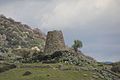
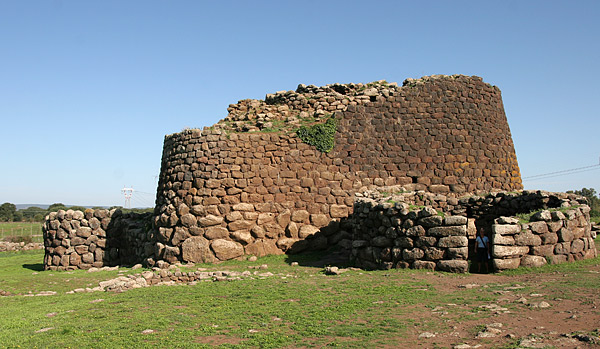
Nuraghe Losa
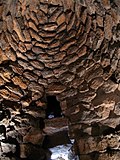
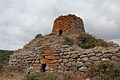
Central tower of the Nuraghe Santu Antine of Torralba
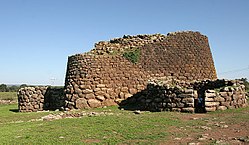
Nuraghe "Su Nuraxi"

The nuraghe, or nurhag,[1] is the main type of ancient megalithic edifice found in Sardinia, Italy, developed during the Nuragic Age between 1900 and 730 BC.[2] Today it has come to be the symbol of Sardinia and its distinctive culture known as the Nuragic civilization. More than 7,000 nuraghes have been found, though archeologists believe that originally there were more than 10,000.[3]

Etymology

[edit]

Natively, the structure is called a nuraghe (Sardinian: [nuˈɾaɣɛ], Italian: [nuˈraːɡe]; plural: Logudorese Sardinian nuraghes, Campidanese Sardinian nuraxis [nuˈɾaʒizi], Italian nuraghi). According to the Oxford English Dictionary the etymology is "uncertain and disputed": "The word is perhaps related to the Sardinian place names Nurra, Nurri, Nurru, and to Sardinian nurra 'heap of stones, cavity in earth' (although these senses are difficult to reconcile). A connection with the Semitic base of Arabic nūr 'light, fire, etc.' is now generally rejected."[4] The Latin word murus ('wall') may be related to it,[5] being a result of the derivation: murus*muraghe–nuraghe. However, such theories are debated.

An etymological theory suggests a Proto-Basque origin by the term *nur (stone) with the common -ak plural ending;[6] the Paleo-Sardinian suffix -ake is also found in some Indo-European languages such as Latin and Greek.[7] Another possible explanation is that the term nuraghe came from the name of the Iberian mythological hero Norax, and the root *nur would be an adaptation of the Indo-European root *nor.[8][9]

Density map of nuraghes on Sardinia per km2.

General layout

[edit]

The typical nuraghe is situated in areas where previous prehistoric Sardinian cultures had been distributed, that, is not far from alluvial plains (though few nuraghes appear in plains currently as they were destroyed by human activities such as agriculture, dams and road building) and has the outer shape of a truncated conical tower, thus resembling a medieval tower, with a tholos-like vault inside.[10]

The structure's walls consist of three components: an outer layer (tilted inwards and made of many layers of stones whose size diminishes with increasing height: mostly, lower layers consist of rubble masonry, while upper layers tend to be of ashlar masonry); an inner layer, made of smaller stones (to form a corbelled dome of the bullet-shaped tholos type, and where ashlar masonry is used more frequently); and an intermediate layer of very small pieces and dirt, which makes the whole construction very sturdy: it stands only by virtue of the weight of its stones, which may each amount to several tons. Some nuraghes are about 20 metres (65 ft) in height, the tallest one known, Nuraghe Arrubiu, reached a height of 25–30 metres (80–100 ft).[10]

The entrance leads into a corridor, on whose sides are often open niches, that lead to the round chamber. A spiral stone stair, leading to upper floors (if present) and/or to a terrace, was built within the thick walls and it was illuminated by embrasures. The Nuragic towers might have as much as three corbel chambers one on top of the other. In complex nuraghes corridors were often present, sometimes corbelled, such as at Santu Antine, in which the corbelled arch corridors were superimposed on two levels, and reached a length of 27 metres (89 ft).

Today fewer than 7,000 nuraghes remain standing; their number was originally larger. Nuraghes are most prevalent in the northwest and south-central parts of the island.[11]

Function

[edit]
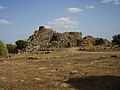
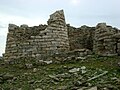
Nuraghe La Prisciona, Nuraghe village near Arzachena, Sardinia

There is no consensus on the function of the nuraghes: they could have been rulers' residences, military strongholds, meeting halls, religious temples, ordinary dwellings or a combination of any of these things. Some of the nuraghes are, however, located in strategic places – such as hills – from which important passages could be easily controlled. They might have been something between a "status symbol" and a "passive defence" building, meant to be a deterrent for possible enemies.

Nuraghes could also have been the "national" symbol of the Nuragic peoples. Small-scale models of nuraghe have often been excavated at religious sites (e.g. in the "maze" temple at the Su Romanzesu site near Bitti in central Sardinia). Nuraghes may have just connoted wealth or power, or they may have been an indication that a site had its owners. Recent unconfirmed theories tend to suggest that Sardinian towns were independent entities (such as the city-states, although in a geographical sense they were not cities) that formed federations and that the building of these monuments might have depended on agreed-on distributions of territory among federated unities.

They were not tombs of princes and their families, as was mistakenly believed by taking as an argument the discovery of human remains there, but of strata of a later age than the Nuragic, that is, Carthaginian and Roman. Neither were they monumental temples, which today are known to be of different shapes and types, even for prehistoric island times, likewise burials (domus de janas or "fairy houses"; tumbas de sos gigantes or "tombs of the giants").[12]

In 2002, Juan Belmonte and Mauro Zedda measured the entrance orientations (declinations and azimuths) of 272 simple nuraghes and of the central towers of 180 complex ones. The data revealed clear peaks corresponding to orientations pointing to the sunrise at winter solstice and to the Moon at its southernmost rising position. These alignments remained constant throughout the history of nuraghe.[13] The most common declinations revealed were of around −43° for the earlier nuraghes, shifting to just −45½° for the later. Zedda has suggested that the target is likely a star, quite possibly Alpha Centauri.[13]

Protonuraghe Bruncu Madugui, Gesturi
Nuraghe di Santa Sabina, from Silanus, an example of a monotower nuraghe.
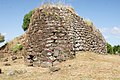
Nuraghe Santa Barbara, Villanova Truschedu, an example of a tancadu nuraghe.

Types

[edit]

Protonuraghe

[edit]

Protonuraghes are considered to be the most archaic type; they differ somewhat from the "classical" (tholos-vaulted) nuraghes in their stockier look. Protonuraghes generally follow an irregular plan and lack the large circular room present in presumed later forms; instead, they are laid out along one or more corridors or long rooms. Although lacking the central circular room, they are sometimes similar in size to later nuraghes.[14]

Mixed nuraghe

[edit]

This type is distinguished by the restorations made in later times, supposedly because of a change to the protonuraghes design, or for other needs.

Single-tower nuraghe

[edit]

This is considered to be the predominant type of nuraghe, and it represents the most diffused typology.[14] The single tower, of a truncated conical shape, contains one or more superimposed chambers, covered by a tholos-shaped chamber. The access, generally located at the ground level, leads into a passageway that leads, in the front, into the central chamber and in one side (usually the left) in the helical staircase, built inside the wall mass, that lead to the terrace or to the upper-floor chamber.

In addition to the usual circular rooms, in their inside can be found other smaller environments such as niches.

A "tancadu" nuraghe

[edit]

A "tancadu" nuraghe (Sardinian term for courtyard) represents the evolution of the single-tower nuraghe; another circular building was later added to the main tower, with two enclosing curtain walls connecting the two. A courtyard was present within the structure, sometimes provided with a well.

Nuraghe Palmavera, Alghero
Nuraghe Seruci, Gonnesa

Polylobed nuraghe

[edit]

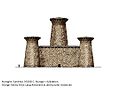
Also called Nuragic royal palaces, the polylobed nuraghes are the least frequent typology. Very elaborate and often designed in a unified manner, they look like veritable fortresses with several towers linked by high ramparts, whose function was to offer more useful space and perhaps to reinforce the central tower. These "Megalithic castles" were surrounded by additional walls, sometimes also provided with towers (the so-called bulwark).

Notable nuraghes

[edit]
Graphic reconstruction of some complex nuraghes

Nuraghes are inscribed on the UNESCO World Heritage Site list. Su Nuraxi di Barumini, in the south of the island, has been chosen to represent all the nuragic patrimony, but one of the highest and most complex nuraghes is the Nuraghe Santu Antine near the village of Torralba, in northern Sardinia. Other famous nuraghes are near Alghero (Nuraghe Palmavera), Macomer, Abbasanta (see Losa), Orroli (Nuraghe Arrubiu), Gonnesa (Nuraghe Seruci) and Villanovaforru (Nuraghe Genna Maria).

Date and cultural significance

[edit]

The nuraghes were built between the middle of the Bronze Age (18th–15th centuries BCE) and the Late Bronze Age. The claim that the El-Ahwat structures from Israel might be related has been contested; those are dated to either the 12th or the 11th century BCE.[15] The only buildings widely accepted as being related to nuraghes are the torri (plural of torre) from southern Corsica and the talaiots from Menorca and Mallorca.[8]

According to Massimo Pallottino, an Italian archaeologist specialized in Etruscology, the architecture produced by the Nuragic civilization was the most advanced of any in the western Mediterranean during this epoch, including those in the regions of Magna Graecia.[16] Of the 7,000 extant nuraghes, only a few have been scientifically excavated.

[edit]

See also

[edit]

with structure similar to nuraghes

Notes

[edit]

Bibliography

[edit]
[edit]
Revisions and contributorsEdit on WikipediaRead on Wikipedia
from Grokipedia
A nuraghe is a prehistoric megalithic tower constructed by the in , , typically featuring a truncated conical form built from dry-stone without mortar, often reaching heights of up to 20 meters. These structures, emblematic of the Nuragic culture that flourished from approximately the 18th to the 8th century BCE, represent a unique architectural tradition spanning the Middle through the Early . Over 7,000 nuraghi dot the Sardinian landscape, with estimates suggesting an original total exceeding 10,000, alongside related monuments such as villages, sacred wells, megaron temples, and around 800 megalithic tombs known as "Giant's Tombs." Nuraghi vary in type, including early proto-nuraghi with corridor layouts and later tholos varieties featuring beehive-domed interiors, sometimes evolving into complex ensembles of multiple towers enclosed by bastioned walls. Distributed primarily near river networks, plains, and mid-elevations for strategic advantage, they were constructed using local or blocks on stable foundations, reflecting advanced skills in a society without written records. Scholars interpret nuraghi as multifunctional sites, likely serving defensive, residential, and possibly ceremonial roles, with evidence from excavations indicating their integration into broader village complexes and reuse during Punic and Roman periods. The most iconic example, —a since 1997—comprises a central 18.6-meter-high tower from the 17th–13th centuries BCE, surrounded by ancillary towers, a heptagonal wall, and an adjacent settlement of over 200 huts. Collectively, these monuments testify to the Nuragic people's sophisticated social organization, territorial control, and cultural continuity from traditions until the Carthaginian conquest around the 6th century BCE.

Overview

Definition and Characteristics

A nuraghe is a megalithic stone tower or complex constructed by the during the in , approximately from the 18th to the 13th century BCE. These structures represent a distinctive architectural form unique to the island, serving multiple functions including defensive, residential, and possibly ceremonial roles within Nuragic society. The core physical attributes of a nuraghe include a truncated conical shape, often reaching heights of up to 20 in their original form, built using dry-stone without mortar. Construction typically employs local or , with stones laid in a corbelled technique that narrows inward to form beehive-like tholos vaults supporting the structure's weight. Internal features commonly comprise multi-chambered layouts with circular or rectangular rooms, spiral staircases embedded in thick walls (up to 4 ), and in some cases, central wells for water collection or megaron-style halls featuring a rectangular plan with an axial and side benches. Nuraghi differ from contemporary Mediterranean structures such as Mycenaean tholos tombs, which were primarily funerary and beehive-domed without integrated living spaces, or Iberian talayots in the , which share megalithic traits but exhibit smaller scale, lower density, and less frequent village integration compared to the expansive Nuragic complexes. Approximately 7,000 nuraghi survive today, with estimates suggesting an original total exceeding 10,000, ranging from isolated single-tower edifices to fortified villages encompassing multiple towers linked by curtain walls and surrounding settlements of up to several hundred huts.

Geographical Distribution

The vast majority of nuraghe structures, estimated at over 7,000 sites, are concentrated on the island of , which spans approximately 24,000 square kilometers, accounting for more than 90% of all known examples. Rare outliers exist in southern , associated with the related Torrean culture, and on nearby Sardinian islands such as and San Pietro, where smaller numbers—such as 66 on —have been documented. Distribution patterns across reveal denser concentrations in the central and northern highlands, particularly in regions like and the central-western uplands, where up to 1.5–1.7 nuraghe per square kilometer occur in certain zones, compared to sparser occurrences in coastal plains. This uneven spread correlates strongly with environmental factors, including fertile soils suitable for , proximity to sources such as holy wells, and defensive topographies like elevated terrains and ore-rich areas that supported activities. Overall island-wide density averages about one nuraghe per 4 square kilometers, with elevations typically between 0 and 400 meters above . Today, many nuraghe sites remain integrated into Sardinia's rural landscapes, often forming extensive clusters known as "nuragic landscapes" that enhance their accessibility for study and while preserving their prehistoric . Regional variations in architectural forms, such as more complex multi-tower designs in highland areas, reflect these locational influences.

Etymology and Terminology

Origin of the Name

The term "nuraghe" originates from the , where it appears in variants such as "nuràghe" in the Logudorese dialect and "nuràxi" in the Campidanese dialect, reflecting regional phonetic differences across the island. This indigenous nomenclature has persisted into modern Italian usage, with the plural form "nuraghi" commonly employed in Sardinian to denote multiple structures. The word lacks direct attestation in the ancient Nuragic language, as the limited inscriptions from the period are written in an undeciphered script, leaving its prehistoric pronunciation and exact form unknown. Etymological derivations point to pre-Indo-European or sub-Mediterranean roots, with the core element "nur" interpreted as signifying a "hollow construction" or "hollow place," evoking the internal chambers typical of these edifices. Scholar Giovanni Lilliu further proposed that "nur" denotes a "heap of stones" or "hollow heap" of pre-Latin origin, linking it to proto-Sardinian concepts of piled or cavernous forms. The earliest known historical reference to "nuraghe" in written records dates to the late 16th century, when Sardinian chronicler Giovanni Francesco Fara described these structures in his works De Rebus Sardois and De Chorographia Sardiniae (circa 1580), marking the first modern documentation of their significance. Prior to this, medieval accounts often dismissed them as ruins of mythical giants or ancient tribes, but Fara's accounts began elevating their study. The term gained standardization in Italian archaeological discourse during the , through systematic investigations by figures such as Alberto Ferrero La Marmora and Antonio Taramelli, who integrated "nuraghe" into formal classifications of prehistoric sites. Debates in proto-Sardinian continue to explore connections to terms for caves or accumulations, positing that "nur" may encapsulate ideas of enclosed, piled spaces akin to natural hollows or artificial mounds, though no consensus has emerged due to the of comparative linguistic data from the Mediterranean. These discussions underscore the term's deep roots in Sardinia's pre-Roman linguistic heritage, distinct from later Indo-European influences. In the study of Nuragic archaeology, several key architectural terms describe the internal and structural elements of nuraghe. The term "tholos" refers to the beehive-shaped, corbelled vaulted chambers within nuraghe towers, typically circular and 4-5 meters in diameter, constructed using overlapping stone courses to form a false dome without mortar. These chambers often served as central spaces, sometimes stacked vertically in complex designs, and represent a hallmark of Bronze Age engineering in Sardinia. "Megaron" denotes rectangular temple structures associated with Nuragic sites, characterized by a vestibule leading to a main room with an altar, often linked to water cults and built in isodomic masonry for ritual purposes. These buildings, such as those at Domu de Orgia, feature simple plans with side benches and are distinct from domestic architecture. "Corridor nuraghe" classifies an early variant of these monuments, featuring elongated, rectangular or elliptical plans with internal corridors accessing chambers, rather than the later circular tholos towers; these proto-forms date to the early Bronze Age (ca. 1800-1650 BC) and prefigure more complex developments. Associated features expand the Nuragic landscape beyond isolated towers, integrating them into broader settlement and ritual contexts. "Village" describes the clustered circular huts surrounding many nuraghe, resulting in an estimated 2,500–3,000 villages across Sardinia by 1300–1100 BC, with stone-benched meeting areas and multi-room enclosures centered on courtyards for social and economic activities. "Sacred well" refers to hypogean water temples, such as Su Tempiesu or Santa Cristina, built with precise tholos vaults and stairs descending to a water basin, embodying a cult of fertile waters from the Recent Bronze to Early Iron Age. These structures, often near nuraghe, highlight the civilization's hydraulic sophistication and religious focus on subterranean springs. "Giant's tomb" designates megalithic collective burials, over 800 in number, featuring a long rectangular chamber (up to 30 meters) flanked by a semi-circular exedra of orthostats, used from the Middle to Recent Bronze Age for communal inhumations and ancestral veneration. Comparative terms situate nuraghe within the Mediterranean megalithic tradition, emphasizing regional distinctions. The Balearic "talayot" consists of squat, tower-like structures similar to nuraghe in form and function—often defensive or residential—but smaller in scale and dating to the Late , with circular or square bases up to 5 meters high, built without mortar from . Unlike nuraghe's internal tholos chambers, talayots typically lack vaults and are more dispersed across and . The Menorcan "naveta," by contrast, are boat-shaped monuments with a single chamber and corbelled roof, akin to giant's tombs in purpose but more compact and isolated, emerging in the Talayotic culture (ca. 1400-800 BC) without the territorial clustering seen in . These parallels suggest cultural exchanges across island networks, though nuraghe exhibit greater complexity and density. Modern scholarly classifications often employ "nuragic complex" to denote integrated sites combining nuraghe with villages, sacred wells, temples, and giant's tombs, as recognized by in its tentative list for World Heritage status. Exemplified by Su Nuraxi di Barumini—a -inscribed site since 1997—this term underscores the holistic nature of Nuragic landscapes, where over 7,000 monuments from the 18th to 6th centuries BC form interconnected cultural ensembles. Such complexes, like Serra Orrios, illustrate the civilization's peak in construction techniques and social organization.

Historical Chronology

Construction Phases and Dating

The construction of nuraghe structures is linked to the emergence of the in , with precursors appearing during the Bonnanaro culture of the Early , spanning approximately the 18th to 15th centuries BCE. These proto-nuraghe edifices, characterized by simpler megalithic forms, represent the initial phase of monumental architecture and are dated through associations with Bonnanaro pottery and early settlement layers. The peak period of nuraghe building occurred in the Middle Bronze Age, from roughly the 15th to 12th centuries BCE, when the majority of single-tower structures were erected across the island. Recent excavations at sites like Nuraghe Sa Conca 'e sa Cresia have used seven new radiocarbon dates on organic remains to refine this phase to 1771–1296 BCE, highlighting a more precise timeline for the development of classic tholos-style towers. In the Late Bronze Age, from the 12th to 9th centuries BCE, shifted toward expansions and complexifications of existing nuraghe, including the addition of additional towers and village enclosures. This phase is evidenced by stratigraphic sequences showing building overlays and dated through contextual finds like metal artifacts. Dating of these phases relies primarily on radiocarbon analysis of organic materials, such as charcoal from features and debris, or seeds and bones from associated deposits, calibrated to provide calendar-year ranges. from excavation layers establishes relative sequences, while typology—evolving from Bonnanaro facies to distinctive Nuragic ware with incised decorations—provides comparative chronological markers across sites. Advancements in the 2020s include lead isotope studies of metal artifacts recovered from nuraghe contexts, which have provided insights into Late production sources and trade networks. Overall, active nuraghe construction spanned about 1,500 years, with the most intensive building concentrated between 1600 and 1200 BCE.

Decline and Transition Periods

The decline of the unfolded gradually from the 9th century BCE through the 2nd century BCE, marking a period of crisis and dissolution influenced by internal and external pressures. This timeline aligns with broader Mediterranean disruptions, alongside evidence of from intensive forest exploitation and possible climate shifts toward drier conditions during the Late to Early transition. Archaeological evidence points to reduced maintenance of nuraghi structures after approximately 900 BCE. As Phoenician colonization intensified around 900 BCE, Nuragic communities transitioned toward hybrid forms of settlement, integrating with coastal trading outposts that evolved into Punic strongholds. This shift is evident in sites like Sant’Imbenia and Monte Prama, where Nuragic ceramics and bronzetti figurines appear alongside Phoenician imports, indicating cultural negotiation rather than outright conquest, with nuraghi often repurposed within these mixed villages. Further inland, some communities adapted by relocating to defensible hill forts, while coastal areas saw the rise of Punic settlements that overshadowed traditional Nuragic centers by the BCE. By the Roman period, many nuraghi were reused as quarries or , reflecting a loss of their original societal role, though sporadic occupation persisted in some areas until around 200 BCE. Cultural continuity during this transition is highlighted by the persistence of ritual practices at nuraghi into the Early (circa 950–700 BCE), where structures like Su Mulinu and Nurdole served as temples with altars and votive offerings, blending ancestral Nuragic symbolism with emerging influences. Recent research as of 2024 on sites including Su Nuraxi in Barumini has revealed evidence of ritual use and trans-Mediterranean connections that underscore the adaptive resilience of Nuragic traditions amid these changes.

Architectural Design

General Layout and Structure

The general layout of a nuraghe centers on a robust central tower, typically rising 10 to 20 meters in height with walls 2 to 5 meters thick, often featuring battered sides for stability. In simpler forms, this tower stands alone, while complex variants incorporate surrounding bastions—up to five additional towers connected by curtain walls—that enclose courtyards, creating a fortified perimeter up to 8 to 12 meters high. These external arrangements vary in scale, with single-tower examples emphasizing verticality and multi-lobed bases in larger structures supporting elevated terraces and upper levels. Internally, nuraghe are organized around one to three superimposed tholos chambers per tower, formed by corbelled domes with internal diameters reaching up to 5 meters and heights up to 12 meters. Access occurs via narrow corridors, often less than 1 meter wide, leading to interconnected spaces equipped with storage niches recessed into the walls and spiral stairwells for vertical movement between levels. Vertical shafts and narrow slits in the walls serve as light wells and defensive loopholes, illuminating the otherwise dim interiors while allowing limited visibility outward. Common architectural elements include integrated water collection systems, such as cisterns or wells situated in central courtyards of complex nuraghe, channeling rainwater through channels in the surrounding walls. These features underscore the adaptive spatial organization, where simple towers prioritize compact, self-contained chambers and multi-lobed complexes expand into networked enclosures supporting broader layouts.

Materials and Construction Methods

Nuraghe were primarily constructed using locally sourced boulders of or , quarried from nearby outcrops to minimize transportation efforts. These materials were selected for their durability and availability, with predominant in volcanic regions and in granitic terrains. In coastal areas, was occasionally adapted as the primary material due to its prevalence in sedimentary formations. The structures employed dry-stone construction techniques, with no mortar used to bind the stones; instead, stability was achieved through precise interlocking of the boulders, allowing the weight of upper layers to compress those below. This method relied on , characterized by large, undressed or roughly shaped stones fitted together with minimal gaps, often without advanced cutting tools beyond basic levers and wedges for positioning. Corbelling was a key technique for creating internal chambers and domes, where successive courses of stones projected inward to form beehive-like vaults, distributing loads effectively to prevent collapse. Construction demanded significant communal labor, estimated at around 3,600 man-days for a single tower, likely organized through seasonal community efforts involving groups of 30 to 40 individuals. Evidence from unfinished nuraghe sites and subtle tool marks on stones suggests incremental building processes, with adjustments made on-site to ensure tight fits. Recent 2025 surveys utilizing physical digital twins have revealed advanced stability engineering in nuraghe design, particularly in the corbelled masonry's ability to withstand seismic loads through optimized load distribution and self-stabilizing geometry.

Types of Nuraghe

Protonuraghe

Protonuraghe represent the earliest precursors to the classic nuraghe structures of the in , emerging during the from approximately 1600 to 1350 BCE. These proto-forms typically lack the distinctive tholos (beehive) vaults and full conical towers of later designs, instead featuring more rudimentary layouts that mark a transitional phase in prehistoric . Key characteristics of protonuraghe include simple corridor-style plans on sub-circular, elliptic, rectangular, or irregular bases, constructed using dry-stone techniques with rows of large cyclopean stones and flat slab roofs rather than corbelled domes. Walls are generally lower than those of mature nuraghe, seldom exceeding 10 meters in height, and often incorporate natural rock outcrops for support, with internal spaces consisting of linear corridors leading to small chambers or niches. These structures average around 245 square meters in footprint, though usable living areas are typically under 50 square meters, suggesting modest-scale constructions. Protonuraghe are closely associated with the Bonnanaro culture (c. 1800–1600 BCE), the initial phase of the Nuragic period characterized by distinctive incised and cord-impressed pottery, as well as influences from the preceding Bell Beaker tradition. Notable examples include the Albucciu proto-nuraghe near , with its elongated corridor layout; Su Mulinu in Villanovafranca, featuring a three-towered configuration with concave-convex wall profiles; and Cuccurada in Mogoro, illustrating early elliptic plans. These sites often show continuity from earlier megalithic tomb traditions, such as dolmens and gallery graves, adapting stone-building techniques for fortified enclosures. Archaeological surveys indicate that protonuraghe comprise a minority of the total nuraghe corpus, with around 400 documented examples out of over 7,000 known structures, though estimates suggest up to 1,500 may exist, representing roughly 10–20% of the overall inventory. Their significance lies in their role as foundational prototypes, bridging prehistoric megalithic practices and the more advanced single-tower nuraghe that emerged around 1350 BCE, thereby laying the groundwork for the architectural and societal complexity of the mature .

Single-Tower Nuraghe

Single-tower nuraghe, also known as nuraghe monotorre, are the simplest and most common type of these prehistoric structures, characterized by a standalone truncated-conical tower built with dry-stone . They comprise an estimated 60-70% of all nuraghe in , based on archaeological surveys indicating a ratio of roughly three single-tower examples for every complex one in surveyed regions. These towers were primarily constructed during the Middle Bronze Age, from approximately the 15th to 12th century BCE, marking the classic phase of Nuragic architecture. The core features of single-tower nuraghe include a single central tholos chamber— a beehive-like dome achieved through corbelled vaulting—often accessible via a narrow entrance corridor. An internal spiral staircase embedded in the thick walls typically connects the ground-level chamber to one or more upper levels, facilitating vertical movement within the structure. Heights generally range from 8 to 15 meters, though preservation varies due to erosion and reuse over millennia. Many examples feature attached huts or outbuildings forming small settlements around the base, suggesting integrated residential use. These structures are distributed widely across Sardinia's rural interiors, particularly in elevated or strategic inland positions that overlooked agricultural lands and sources. Defensive characteristics, such as restricted narrow entrances to control access and slit-like openings in the walls for or use, underscore their role in territorial oversight. Among , the "Tancadu" subtype features modifications like flat roofs or platforms atop the main tower, potentially serving as lookout or gathering spaces, and sometimes includes an adjacent circular for added functionality. In some cases, single-tower nuraghe formed the nucleus for later expansions into more elaborate complexes.

Complex and Polylobed Nuraghe

Complex and polylobed nuraghe constitute the most elaborate variants of Nuragic architecture, characterized by multi-tower configurations that evolved from simpler forms during the Late Bronze Age. These structures typically consist of a central tower, known as the mastio or keep, surrounded by secondary towers linked by curtain walls or bastions, creating fortified enclosures that often encompass courtyards and adjacent villages. Polylobed nuraghe, a subtype of complex forms, feature distinctive lobed bases with three to five protruding towers or bastions arranged around the central structure, sometimes enclosed by an outer defensive wall called an antemurale. This design emphasizes expansiveness and fortification, distinguishing them from single-tower nuraghe through their integrated multi-component layouts. Key architectural features include multi-story central towers with tholos (beehive) vaults, reaching heights of up to 20 meters, and secondary elements such as corridors, staircases (often spiraling or counterclockwise), niches, and chambers interconnected for defensive or communal purposes. "Mixed" types blend traditional tholos chambers with linear corridor systems, allowing for complex internal circulation and possibly enhanced defensive capabilities. Construction employed using locally sourced , , or blocks, dry-stacked without mortar to form robust, earthquake-resistant walls. These nuraghe, dating primarily to the 15th–9th centuries BCE, served as elite centers in Nuragic society, likely housing rulers or coordinating territorial activities amid increasing . Engineering innovations in complex and polylobed nuraghe highlight advanced , including interconnected defensive where bastions and walls formed overlapping fields of protection, deterring invasions through strategic elevation on hilltops. Water management systems, such as cisterns, wells, and drainage channels, were integral, channeling rainwater into underground reservoirs to sustain inhabitants during dry periods—a feature evident in sites with preserved pipelines and collection basins. Prominent examples include Nuraghe Santu Antine in Torralba, a trilobate complex with a central tower originally 25 meters tall, flanked by three secondary towers connected by triangular curtain walls, exemplifying elaboration. Similarly, Nuraghe Arrubiu in Orroli stands as the largest polylobed structure, a pentalobate (five-lobed) fortress spanning three hectares at 500 meters altitude, with an antemurale incorporating up to ten additional towers for enhanced fortification.

Function and Purpose

Defensive and Residential Theories

The defensive theory posits that nuraghe served primarily as fortifications, evidenced by their strategic placement on elevated terrains offering panoramic views for surveillance and their architectural features designed to deter intruders. Many nuraghe are situated on hilltops or plateaus, facilitating oversight of surrounding landscapes and potential threats, a positioning that aligns with defensive needs in a landscape prone to inter-tribal conflicts. Narrow entrances, often just wide enough for one person, and intramural corridors with limited access points further restricted entry, while small openings interpreted as arrow slits (feritoi) in the walls allowed defenders to shoot projectiles without exposing themselves. Archaeological finds of bronze swords, daggers, and sling stones within and around nuraghe complexes support this military function, suggesting they housed warriors equipped for combat. In parallel, substantial evidence indicates residential use, with interiors containing domestic artifacts that point to everyday habitation. Chambers within the towers often feature hearths for cooking, storage jars for and provisions, and fragments of used for food preparation and consumption, alongside animal bones showing signs of butchery. These elements imply that nuraghe functioned as homes, at least for small family units or elites, with the structures' thick walls providing shelter from the elements in Sardinia's rugged environment. Surrounding many nuraghe are extensive villages composed of circular huts, accommodating communities of 100 to 500 inhabitants based on the scale of excavated settlements like those at Nuraghe La Prisgiona, where up to 100 huts have been identified. These villages integrated the central tower into a broader communal living space, with pathways connecting dwellings for shared agrarian activities. An integrated perspective views nuraghe as multifunctional elite residences embedded within larger settlements, evolving from initial defensive roles in the Middle to more residential purposes by the Late . The central towers likely served as status symbols and homes for chieftains, overseeing communal villages focused on and , while retaining defensive capabilities. However, critiques of the defensive emphasis argue that it overstates , projecting concepts onto a predominantly peaceful with limited evidence of widespread conflict or invasion during the Nuragic period. Such interpretations overlook the structures' alignment with pastoral and farming lifestyles, where visibility aided rather than solely military vigilance.

Ritual and Social Interpretations

Archaeological evidence suggests that nuraghe served significant ritual functions within Nuragic society, particularly through associations with votive offerings and ceremonial architecture. Bronzetti figurines, small bronze statues depicting warriors, chieftains, animals, and deities, were commonly deposited in or near nuraghe complexes as votive items, indicating their use in religious practices linked to , , and ancestral . These figurines, often found in clusters, underscore the nuraghe's role in hosting s that bridged the human and divine realms, with warriors symbolizing martial prowess and animals representing totemic or sacrificial elements. Recent studies, including the 2025 analysis of bronzetti alloys, further emphasize the integration of ritual and economic functions, revealing extensive Mediterranean networks that enhanced the prestige of nuraghe as sanctuary-linked hubs. Internal features of nuraghe, such as altars within halls—the central rectangular chambers—further support interpretations, where these spaces likely accommodated offerings, libations, or communal ceremonies. The architectural parallels between nuraghe halls and nearby sacred wells and reinforce this view; sacred wells, with their precise tholos vaults for rituals, and "giants' "—elongated burial structures—formed part of a broader sacred landscape where nuraghe acted as focal points for processions or initiations tied to cults and ancestor worship. Such connections imply that nuraghe were not merely utilitarian but integral to a cosmological framework emphasizing purity, renewal, and communal piety. Socially, nuraghe functioned as central gathering spaces that reflected and reinforced hierarchical structures in Nuragic society, serving as seats for or assemblies that managed resources and resolved disputes. The presence of elite artifacts, including bronzetti portraying cloaked leaders with staffs, points to a stratified where nuraghe elites wielded over surrounding villages, evidenced by their strategic placement and scale in territorial clusters. This is further indicated by the differential access to complex nuraghe interiors, suggesting controlled spaces for and social cohesion among kin groups or cantons. Interpretations of nuraghe also include symbolic theories, such as potential astronomical alignments that enhanced their prestige. Statistical analyses of orientations in complex nuraghe reveal preferences for southeast directions, aligning with sunrises around 1500–1000 BCE, possibly symbolizing renewal or seasonal rites rather than practical observation. Additionally, nuraghe operated as trade hubs, leveraging local metal resources to exchange goods across the Mediterranean, with production in associated workshops indicating economic centrality that bolstered social elites. Recent metallurgical studies from 2025 provide fresh insights into these and social dimensions, analyzing 48 bronzetti via methods to trace origins. Findings show that while much derived from Sardinian mines like Sa Duchessa, tin and some were imported from the , highlighting extensive networks that likely occurred at sanctuary-linked nuraghe and elevated the status of ritual metalworkers. This mixing of in votive bronzetti underscores their role in displaying connectivity and prestige within a hierarchical society.

Notable Examples

Su Nuraxi di Barumini

is a prehistoric archaeological complex located in the municipality of Barumini, in the province of South Sardinia, . This site exemplifies the Nuragic civilization's architectural prowess during the , with its central structure originally constructed around the 17th to 13th centuries BCE and later expanded in the [Iron Age](/page/Iron Age). The complex served as a focal point for a surrounding settlement, reflecting the social and possibly defensive of Nuragic communities. It was inscribed on the World Heritage List in as the finest preserved example of a nuraghe, highlighting its role in understanding Sardinia's ancient societies. The core of the site features a central tower, originally standing approximately 18.6 meters tall and built from stone blocks in a corbelled, truncated shape with three superimposed chambers. This tower is enveloped by a quadrilobate comprising four corner towers connected by curtain walls, forming an enclosed that includes a central well for water access. Further fortifications added in the created a heptalobate outer wall with seven lobes, enhancing the defensive layout. Surrounding the main structure is an extensive village of over 200 circular huts, arranged in a planned layout with streets and communal areas, indicating a population that inhabited the site from the late through the and into later periods up to the 3rd century CE. The site's discovery and excavation were spearheaded by Sardinian archaeologist Giovanni Lilliu starting in the late 1940s and continuing through the 1950s, following initial descriptions in 1938 and exposure due to erosion in 1949. Lilliu's work uncovered the full extent of the complex, including the village and inner structures, and revealed key artifacts such as a bronze model of a nuraghe, indicative of metallurgical skills, along with pottery shards used for dating and evidence of daily life. These findings, including ceramics from the Middle Bronze Age, confirmed the construction chronology and highlighted ritual and domestic activities within the towers, which feature megaron-like chambers with hearths. Systematic conservation efforts began in the early 1990s to preserve the site's integrity. As the archetype of complex nuraghe, Su Nuraxi demonstrates the evolution from simple single-tower structures to elaborate fortified settlements, symbolizing elite status and communal organization in Nuragic society. The presence of the well and chambers underscores its multifunctional role, potentially encompassing residential, ceremonial, and strategic elements. This site's preservation and detailed study provide critical insights into the Nuragic people's engineering and cultural practices, distinguishing it as a premier example of architecture in the Mediterranean.

Other Prominent Sites

Santu Antine, located in Torralba in northern , stands as one of the most impressive complex nuraghi, featuring a central keep surrounded by three lateral towers connected by robust walls that form a triangular . This structure, dating to the Middle around the 16th century BC and expanded in the Recent , exemplifies advanced Nuragic engineering with its multi-towered design and extensive defensive perimeter, enclosing an area that once supported a surrounding village of circular huts. The site's harmonious integration of tall, roofed walls and strategic positioning on the Cabu Abbas plain highlight the architectural prowess of Nuragic builders in creating fortified complexes. In the northeastern region near , Nuraghe Albucciu represents a distinctive single-tower nuraghe of mixed typology, combining corridor-style elements with advanced tholos () corbelling techniques that demonstrate early experimentation in vaulted construction during the Middle , circa 15th century BC. Nestled against a natural and partially concealed by groves and Mediterranean maquis, the structure's two-story interior features well-preserved chambers and stairways, underscoring its role in the dense cluster of sacred and funerary sites in the area, including nearby sacred wells. This site's proximity to other megalithic monuments illustrates the regional concentration of Nuragic activity in , where natural rock formations were ingeniously incorporated into architecture. Further south in the plateau of Abbasanta, Nuraghe Losa exemplifies a well-preserved complex nuraghe with a robust, equilateral triangular plan, constructed primarily from local in the around the 13th century BC. Rising to approximately 13 meters in height (originally up to 20 meters), its intact tholos dome and accessible internal chambers, including a central hall with niches, have been studied since the , revealing remnants of an adjacent village with megaron-style huts that suggest communal living spaces. The site's elevated position and durable reflect the adaptability of Nuragic construction to volcanic terrains in central-western , providing insights into settlement patterns in the Abbasanta region. Recent archaeological efforts have extended focus to more remote Nuragic sites, such as Nuraghe Sa Jua in Aidomaggiore, where a 2025 three-dimensional integrated survey using UAV and terrestrial documented its complex layout for the first time, aiding in conservation and revealing its isolated position in west-central . Similarly, Nuraghe Izzana near Tempio Pausania is one of Gallura's largest mixed-type structures, with a triangular plan and dual entrances dating to the Late , situated in the dramatic Valle della Luna amid granite boulders that enhance its remote, defensive character. These investigations underscore the ongoing exploration of peripheral sites, highlighting 's diverse Nuragic landscape beyond central complexes.

Cultural Significance and Legacy

Role in Nuragic Society

The nuraghe served as central symbols of status and authority within Nuragic , particularly during the Late Bronze Age, where they likely represented the residences or strongholds of emergent chieftains or families, as suggested by the discovery of luxury imports such as Aegean-style pottery and Mycenaean artifacts in select tower complexes. These imports, including and Cypriot copper, indicate access to Mediterranean trade networks controlled by a nascent social , though clear evidence of rigid hierarchies remains limited due to the communal nature of most burials. status is further inferred from rare in associated tombs, such as bronze weapons and ornaments mirroring sanctuary votives, pointing to a stratified where tower-builders held symbolic power without fully centralized dominance. Economically, the nuraghe anchored a mixed subsistence system centered on and , with surrounding villages cultivating cereals and while herding sheep and , as evidenced by faunal and botanical remains near tower sites. The structures themselves facilitated economic functions through integrated storage chambers for and products, supporting community-level processing and redistribution in a predominantly rural . played a pivotal role, with nuraghe near sources in Monte Arci serving as hubs for exporting this material across the western Mediterranean, alongside and from local mines, fostering economic interdependence among settlements. Politically, the distribution of nuraghe across suggests a decentralized network of allied sites forming tribal confederations, where clusters of towers facilitated coordination for defense, , and activities without of overarching kingdoms. This acephalous structure emphasized communal cohesion, with larger complex nuraghe possibly acting as focal points for inter-group alliances, as indicated by shared artifact styles and proximity to trade routes. Insights into gender roles and daily life emerge from bronze figurines deposited near nuraghe, which predominantly depict male warriors armed with swords and shields, underscoring a martial aspect to male identity in community defense and status display. Female figures, often shown in prayer or holding infants, highlight roles in motherhood and ritual, suggesting women contributed to household production, childcare, and possibly religious practices integral to social reproduction. These artifacts, found in nuraghe vicinities, reflect a balanced yet gendered division of labor supporting the society's pastoral-agricultural economy.

Influence on Later Cultures

During the Punic and Roman periods, many nuraghe structures in Sardinia were repurposed for practical uses, reflecting their enduring architectural value to later Mediterranean societies. Phoenician and Carthaginian settlers, arriving around the 8th century BCE, adapted some nuraghe as defensive outposts or storage facilities, integrating them into their colonial networks due to the towers' strategic locations and robust construction. Romans, following their conquest in 238 BCE, similarly reused nuraghe for military purposes, such as watchtowers or temporary forts, and occasionally quarried stones from them for new constructions, though communities also domesticated them for residential and agricultural functions. This reuse is evidenced at sites like Su Nuraxi di Barumini, where Roman-era modifications overlay Nuragic foundations. The prominence of nuraghe in the landscape influenced Sardinian toponymy, with numerous place names incorporating "nuraghe" (e.g., Nuraghe Palmavera, Nuraghe Losa), preserving their cultural memory in the island's linguistic heritage. In the medieval period, nuraghe contributed to Sardinian and architectural traditions, embedding the structures in local narratives and built environments. Medieval tales often portrayed nuraghe as the work of giants, symbolizing ancient superhuman feats and serving as cautionary sites in oral traditions passed down through generations. This legacy of wonder parallels associations with fairies in broader Sardinian mythology, though more directly tied to nearby prehistoric tombs, and reinforced the towers' mystical aura in rural communities. The Church of is built adjacent to a nuraghe, highlighting the enduring presence of these prehistoric structures in the medieval landscape. Recent 2025 research highlights nuraghe's role in broader connections, particularly through metal trade networks extending to . Analysis of bronzetti figurines—small statues from Nuragic sites—reveals copper sourced locally in and from the , with tin imported from Iberia, underscoring Sardinia's pivotal position in Mediterranean-Atlantic exchanges around 1000–800 BCE. Stylistic parallels, such as horned helmets on bronzetti, link them to Scandinavian artifacts like the Viksø helmets, while studies suggest connections to through trade routes, illustrating how Nuragic metallurgical expertise influenced technological and artistic exchanges across continents. In modern times, nuraghe stand as enduring symbols of Sardinian identity, permeating literature, art, and cultural expression. They represent indigenous resilience and pre-Roman heritage, frequently invoked in 20th- and 21st-century works to evoke regional pride and continuity. For instance, exhibitions like "The Nuragic Wave" in explore how artists such as Pinuccio Sciola drew from nuraghe forms in sculptures and sound installations, blending ancient motifs with contemporary media. In literature, authors like incorporated nuraghe into narratives of and landscape, reinforcing their role as icons of Sardinian autonomy amid historical marginalization. Today, they feature prominently in , festivals, and political discourse, symbolizing cultural sovereignty.

Modern Research and Preservation

Recent Archaeological Discoveries

In recent years, advancements in archaeometallurgical analysis have illuminated the extensive trade networks of the . A 2023 study utilizing lead and tin ratios alongside analysis on 48 bronzetti figurines from key sanctuaries, such as Santa Vittoria-Serri and Abini-Teti, revealed that was sourced from both local Sardinian deposits in the Iglesiente region and imported materials primarily from the , with evidence of deliberate metal mixing. Tin, absent from local sources, was imported from regions including Iberia, the Erzgebirge, and , underscoring trans-European exchanges during the to Early (ca. 1350–700 BC). These findings challenge earlier assumptions of isolation, highlighting Sardinia's integration into Mediterranean and Atlantic metal trade circuits. Technological surveys have enhanced the documentation and revelation of Nuragic sites. In 2025, an integrated approach combining terrestrial and drone was applied at Nuraghe Sa Jua in Aidomaggiore, producing high-resolution 3D models that identified structural vulnerabilities, such as detaching ashlars, and facilitated phased reconstruction analysis for conservation. Similarly, drone-based surveys in 2022 at Bruncu 'e s'Omu in Villa Verde uncovered a previously hidden monumental nuraghe and associated capannicolo village settlement obscured by dense vegetation, demonstrating the efficacy of in detecting subsurface features without invasive excavation. These methods have accelerated the mapping of complex sites, revealing settlement patterns and aiding in preservation planning. New discoveries have expanded the known extent of Nuragic landscapes. In 2025, sonar mapping and remote-operated vehicles identified multiple submerged nuraghi in the shallow waters of Cabras Lagoon, dating to the and Iron Ages (1500–500 BC), suggesting deliberate construction for symbolic or defensive purposes and yielding artifacts like and tools that inform daily life. Concurrently, excavations in 2025 at the Sant'Andrea Priu complex in Bonorva unearthed three additional tombs (XVIII–XX), increasing the site's hypogea to 20 and linking them to nearby Nuragic structures like Nuraghe Oes through shared cultural heritage projects. The necropolises of , including Sant'Andrea Priu, were inscribed on the World Heritage List in July 2025 under the title "Funerary Tradition in the Prehistory of Sardinia – The domus de janas," recognizing their outstanding universal value as prehistoric hypogean burials spanning the 5th to 3rd millennia BCE. Remote sites, such as the isolated Nuraghe Izzana in , have also benefited from renewed surveys, emphasizing their role in peripheral networks. Pollen-based paleoenvironmental studies have addressed longstanding questions about the Nuragic decline around 580 BCE. A 2023 analysis of vegetation dynamics across from 1700–580 BCE indicated persistent and a shift to agro-silvo-pastoral landscapes driven primarily by human activities like and , rather than abrupt shifts, with evergreen forests showing resilience despite exploitation. This multiproxy approach, integrating records with archaeological data, refines understandings of environmental pressures, suggesting that intensified , possibly exacerbated by subtle climatic variability, contributed to societal transformations without of catastrophic .

UNESCO Status and Conservation

The archaeological site of Su Nuraxi di Barumini was inscribed on the World Heritage List in 1997, recognized as the finest and most complete example of Nuragic , a unique defensive complex built from megalithic basalt blocks. This designation highlights its outstanding under criteria (i), (iii), and (iv), encompassing an 2.3254-hectare property and a 3.9178-hectare . In a broader effort to protect the Nuragic legacy, the "Nuragic monuments of " were added to Italy's Tentative List in 2021, integrating Su Nuraxi into a network of 31 representative sites that illustrate the diversity of Nuragic settlements, sacred structures, and defensive towers across the island. The candidacy, driven by the "Sardinia towards " association, proposes 32 key sites to encompass the approximately 7,000 surviving Nuragic monuments, with dossiers submitted between 2023 and 2025 aiming for full World Heritage status to enhance global recognition and protection. Conservation efforts for Nuraghe sites focus on structural stabilization and , with ongoing restoration campaigns addressing basalt stone degradation. For instance, post-excavation work at Su Nuraxi di Barumini has included partial restoration to preserve the central tower and surrounding village huts, ensuring long-term accessibility while preventing further collapse. Major threats include natural from and landslides, exacerbated by heavy rainfall in Sardinia's hilly terrains, as well as anthropogenic pressures from foot traffic and nearby that accelerate surface wear on these exposed megalithic structures. In coastal or low-lying areas, rising sea levels and storm surges pose additional risks to vulnerable sites, as documented in assessments of Mediterranean World Heritage properties. To counter these challenges, initiatives emphasize and . EU-funded projects, such as the DESTI-SMART program, promote low-carbon tourism development in by integrating Nuragic sites into eco-friendly itineraries that balance visitor access with habitat preservation. Digital archiving efforts utilize and 3D modeling for precise documentation, as applied to sites like Nuraghe Sa Jua and Nuraghe Diana, enabling virtual reconstructions, damage monitoring, and global dissemination without physical strain on the monuments. Persistent issues include preventing illegal looting, which historically disrupted artifact contexts, and building through reinforced engineering against , all supported by the ongoing UNESCO candidacy to secure international funding and legal safeguards.

References

Add your contribution
Related Hubs
User Avatar
No comments yet.