


Community hub
Recent from talks
Contribute something
Nothing was collected or created yet.
Nvidia Shield TV
View on Wikipedia | |
 | |
| Also known as | Shield Android TV |
|---|---|
| Manufacturer | Nvidia |
| Product family | Shield |
| Type | Set-top box, microconsole |
| Release date |
|
| Introductory price | US$199.99 |
| Operating system | Android TV |
| System on a chip | Tegra X1+ |
| Memory | 2 GB or 3 GB |
| Storage | 8 GB or 16 GB flash memory |
| Display | Up to 4K HDR, 60FPS |
| Controller input | Remote |
| Connectivity | 802.11ac 2.4 GHz & 5 GHz Wi-Fi, Bluetooth 5.0, Gigabit Ethernet, USB 3.0, HDMI 2.0 |
| Online services | GeForce Now Google Play |
| Weight | 250 g (8.82 oz) |
| Related | Shield Tablet |
| Website | www |
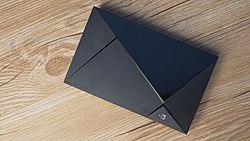
The Nvidia Shield TV (Shield Android TV or just Nvidia Shield[1]) is an Android TV-based digital media player and microconsole produced by Nvidia as part of its Shield brand of Android devices. First released in May 2015, the Shield was initially marketed by Nvidia as a microconsole, emphasizing its ability to play downloaded games and stream games from a compatible PC on a local network, or via the GeForce Now subscription service. As with all other Android TV devices, it can also stream content from various sources using apps, and also supports 4K resolution video. It is produced in two models, with the second Shield TV Pro model distinguished primarily by increased internal storage.
In 2017, Nvidia released a refreshed version of the 16 GB Shield, which has a smaller form factor that drops MicroSD and infrared support, comes with an updated controller, and is otherwise identical in hardware to the original model. In 2019, Nvidia refreshed the Shield TV lineup with upgraded processors, and revised the base model with a smaller form factor and less internal storage.
Specifications
[edit]The Shield utilizes Nvidia's Tegra X1 system-on-chip, based on the ARM Cortex-A57 CPU and Nvidia's Maxwell microarchitecture GPU, with 3 GB of RAM. The device supports 4K resolution output at 60 FPS over an HDMI 2.0 output, with support for HEVC-encoded video. The Shield can either contain 16 GB of internal flash storage or a 500 GB hard drive, expandable via microSD card or removable storage. 2015 and 2017 Shield models with a 500 GB hard drive are branded as Shield Pro.[2][3][4] It contains two USB ports.[4] For internet connections, it supports gigabit Ethernet and 802.11ac Wi-Fi. The console ships with one wireless controller; a wireless micro-USB-rechargeable remote with voice control and a headphone jack is sold separately[3][5] but is no longer available from official channels.
The Shield runs Android TV; games optimized and ported for the device are offered through a separate Shield Store app.[3] The device can also stream games through Nvidia's on-demand subscription cloud gaming service, GeForce Now (formerly Nvidia GRID), and from a local computer using the GameStream function of supported Nvidia graphics cards via the GeForce Experience application. In addition to native Android gaming and game streaming, retro gaming emulation[6] is popular on the Nvidia Shield TV.[5][7][8]
On January 16, 2017,[9] Nvidia announced Shield Experience Upgrade 5.0, which is based on Android 7.0 "Nougat". It adds software features from the updated 2017 model, including HDR support for 4K video, new apps (including Amazon Video), SmartThings integration, Google Assistant support, and a new Nvidia Games interface. Google Assistant support requires a new iteration of the Shield Controller.[10][11] In June 2018, Nvidia released an update to Android 8.0 "Oreo".[12]
On June 23 2021, an update of Android TV to Google TV made Google Stadia available for the 2019 versions of Nvidia Shield TV and Nvidia Shield TV Pro.
2017 version
[edit]On January 16, 2017, Nvidia unveiled a refreshed version of the 16 GB Shield. It has a revised form factor with a smaller size but no microSD slot, and is supplied with Shield Experience Upgrade 5.0. A revised Bluetooth remote control with no headphone jack and replaceable CR2032 battery is now bundled, as well as an updated controller with an always-on microphone. The 2017 model contains the same Tegra X1 system-on-chip as the 2015 model.[4] The 2017 Shield replaced the original 16 GB version.
2019 version
[edit]On October 28, 2019, Nvidia unveiled two new Shield TV models. Both models use the Tegra X1+ system-on-chip, ship with Android 9.0 "Pie", support Dolby Atmos and Dolby Vision, and include a redesigned remote control, and a new "AI-enhanced" upscaling system that can upscale high-definition video to 4K resolution. The new base model uses a cylindrical form factor rather than a set-top box style, and has 2 GB of RAM and 8 GB of flash storage, expandable via MicroSD card (in place of USB ports). The Shield TV Pro uses the same set-top box form factor as the previous model, and includes 3 GB of RAM, 16 GB of flash storage, and two full-size USB 3.0 ports. A gamepad is no longer included.[13][14]
Models
[edit]| Model name | Model # | Launch | Form factor | Processor | RAM | Storage | microSD | USB | IR receiver | HDMI / DP | Ethernet | WiFi | Bluetooth | Bundled accessories | VQ- playback (max) | VQ- capture (max) | Upscaling | HDR | Dolby Atmos | Voice control |
|---|---|---|---|---|---|---|---|---|---|---|---|---|---|---|---|---|---|---|---|---|
| Shield TV | P2571 | 2015 | Box | Nvidia Tegra X1 | 3GB | 16GB | Yes | 3x (2x 3.0 typeA, 1x microUSB) | Yes | HDMI 2.0 w/ HDCP 2.2 & CEC (HDMI 2.0b by FW update) | GbE | 802.11ac 2x2 MIMO | 4.1 / LE | Gamepad | 4K at 60fps | 4K at 30fps | HDR10 | Passthrough | ||
| Shield TV Pro | P2571 | 2015 | Box | Nvidia Tegra X1 | 3GB | 500GB | Yes | 3x (2x 3.0 typeA, 1x microUSB) | Yes | HDMI 2.0 w/ HDCP 2.2 & CEC (HDMI 2.0b by FW update) | GbE | 802.11ac 2x2 MIMO | 4.1 / LE | Remote, gamepad | 4K at 60fps | 4K at 30fps | HDR10 | Passthrough | ||
| Shield TV | P2897 | 2017 | Box | Nvidia Tegra X1 | 3GB | 16GB | No | 2x (3.0 typeA) | No | HDMI 2.0 w/ HDCP 2.2 & CEC (HDMI 2.0b by FW update) | GbE | 802.11ac 2x2 MIMO | 4.1 / LE | Remote, gamepad (V2) | 4K at 60fps | HDR10 | Passthrough | |||
| Shield TV | P3430 | 2019 | Cylindrical | Nvidia Tegra X1+ | 2GB | 8GB | Yes | No | No | HDMI 2.0b w/ HDCP 2.2 & CEC | GbE | 802.11ac 2x2 MIMO | 5.0 + LE | Remote (V2) | 4K at 60fps | AI upscaling | HDR10 and Dolby Vision | Decode + passthrough | ||
| Shield TV Pro | P2897 | 2019 | Box | Nvidia Tegra X1+ | 3GB | 16GB | No | 2x (3.0 typeA) | No | HDMI 2.0b w/ HDCP 2.2 & CEC | GbE | 802.11ac 2x2 MIMO | 5.0 + LE | Remote (V2) | 4K at 60fps | AI upscaling | HDR10 and Dolby Vision | Decode + passthrough |
See also
[edit]References
[edit]- ^ Smith, Ryan. "NVIDIA's SHIELD Console Becomes SHIELD Android TV". Anandtech. Archived from the original on 3 May 2017. Retrieved 5 May 2017.
- ^ "NVIDIA SHIELD And SHIELD Pro Review: Easily The Best Android TV On The Market, But Don't Toss Out Your Game Consoles Just Yet". Android Police. 28 May 2015. Archived from the original on 19 May 2017. Retrieved 5 May 2017.
- ^ a b c "NVIDIA Announces SHIELD Console: Tegra X1 Android TV Box Shipping In May". Anandtech. Archived from the original on 16 February 2017. Retrieved 4 May 2017.
- ^ a b c "Nvidia's new Shield TV is a refined media box, but it's still best for gamers". The Verge. 16 January 2017. Archived from the original on 13 July 2017. Retrieved 5 May 2017.
- ^ a b "NVIDIA Shield TV review: the best Android set-top box you can buy". Engadget. Archived from the original on 18 February 2017. Retrieved 4 May 2017.
- ^ moe (2020-12-03). "Best NVIDIA Shield TV Emulators - Best Android TV Emulators for SHIELD". Tech Up Your Life. Archived from the original on 2020-12-07. Retrieved 2020-12-04.
- ^ "NVIDIA's GeForce NOW - GRID Cloud Gaming Service Goes the Subscription Way". Anandtech. Purch, Inc. Archived from the original on 10 March 2017. Retrieved 4 May 2017.
- ^ "Nvidia finally launches GeForce Now cloud gaming for Shield set-top console". VentureBeat. 30 September 2015. Archived from the original on 2016-08-31. Retrieved 2016-07-18.
- ^ "Support Shield". Nvidia. Archived from the original on 2020-11-26. Retrieved 2020-12-28.
- ^ "The updated Nvidia Shield is now available". The Verge. 16 January 2017. Archived from the original on 18 January 2017. Retrieved 5 May 2017.
- ^ "Old Nvidia Shield TV will also get Google Assistant in update". Pocket-lint. 31 January 2017. Archived from the original on 28 April 2017. Retrieved 5 May 2017.
- ^ "NVIDIA Shield TV Android 8.0 Oreo update rollout is back on!". Android Central. 2018-06-27. Archived from the original on 2018-07-18. Retrieved 2018-07-18.
- ^ Welch, Chris (2019-10-28). "Nvidia Shield TV (2019) review: totally tubular". The Verge. Archived from the original on 2019-10-31. Retrieved 2019-10-31.
- ^ Shilov, Anton. "NVIDIA Reveals New SHIELD TV: Tegra X1+, Dolby Vision, Dolby Atmos". www.anandtech.com. Archived from the original on 2022-06-06. Retrieved 2019-10-31.
External links
[edit]Nvidia Shield TV
View on GrokipediaHistory
Development and Announcement
The Nvidia Shield TV originated from the company's earlier Project Shield initiative, a handheld gaming device announced at the Consumer Electronics Show (CES) in January 2013. Project Shield was designed as a portable Android-based console powered by Nvidia's Tegra 4 processor, aimed at delivering high-performance mobile gaming and PC game streaming to untethered players.[9] This concept evolved through subsequent products like the Shield Portable (released in 2013) and Shield Tablet (2014), both emphasizing Nvidia's Tegra hardware for gaming on open platforms, setting the stage for a living-room adaptation by 2015.[4] Nvidia's motivation for developing the Shield TV stemmed from a desire to extend its Tegra processors' capabilities into home entertainment, merging high-end gaming with media streaming on the emerging Android TV platform. The company sought to create a premium device that could handle demanding tasks like 4K video decoding and advanced game rendering in a compact set-top form factor, addressing the limitations of typical smart TVs and media players at the time. By leveraging Tegra's GPU prowess, Nvidia aimed to position the Shield TV as a versatile hub for both casual streaming and enthusiast-level gaming, differentiating it in a market dominated by less powerful alternatives.[4][10] The set-top box version of the Shield was formally announced on March 3, 2015, at the Game Developers Conference (GDC), shortly after Nvidia unveiled its Tegra X1 processor at CES 2015, which became the device's core. Marketed as the world's first Android TV console, it was positioned as a premium streaming and gaming device capable of delivering ultra-high-definition content and native Android game support. Key to its launch was certification through Google's Android TV program, ensuring seamless integration with the ecosystem for apps, voice search via Google Now, and certified hardware compatibility.[4][10][11]Release Timeline
The Nvidia Shield TV was first launched in May 2015, with the initial models including a 16 GB base version and a 500 GB Pro variant featuring a built-in hard drive.[12] These devices were released in select regions including the United States, Canada, and parts of Europe, though availability varied by country due to regional app certifications and distribution agreements.[13] In January 2017, Nvidia unveiled a redesigned Shield TV lineup at CES 2017, with shipping beginning later that month in the US, Canada, and select European markets.[14] The updated models included a compact dongle-style Shield TV and a box-style Shield TV Pro, both emphasizing improved streaming capabilities; older 2015 models were gradually phased out from official sales around this time.[15] The next major update came in October 2019, when Nvidia released refreshed Shield TV and Shield TV Pro models announced earlier at IFA 2019, powered by an upgraded Tegra X1+ processor.[5] These were made available starting October 28 in the US, Canada, and several European countries, with the 2017 variants discontinued to focus on the new lineup.[16] No new Shield TV hardware has been announced or released through 2025, with Nvidia instead prioritizing ongoing software support for existing models, including a milestone of nine years of updates by 2024 and continued patches into 2025 for features like bug fixes and compatibility enhancements.[17][18]Design and Hardware
Form Factors and Aesthetics
The Nvidia Shield TV line has employed varied form factors to prioritize compact placement, premium build quality, and thermal management in home entertainment setups. The 2015 model utilized a flat, angular design constructed from black plastic with alternating gloss and matte surfaces for a distinctive, futuristic aesthetic, measuring 210 x 130 x 25 mm and weighing 654 g. This form factor facilitated horizontal positioning near or behind televisions, with side ridges enhancing grip and visual appeal. The Pro variant maintained identical external dimensions and aesthetics but incorporated an internal 500 GB hard drive, contributing to a slightly bulkier internal structure without altering the overall profile. Vents along the edges supported efficient heat dissipation during extended use.[4][19] The 2017 models marked a shift to more versatile shapes, with the non-Pro version adopting a slim tube-shaped design of premium plastic accented by metallic finishes, measuring approximately 159 x 98 x 26 mm and weighing 250 g. This elongated, low-profile form allowed for inconspicuous horizontal or vertical mounting, ideal for space-constrained media consoles. In contrast, the Pro model reverted to a compact tower configuration, 159 x 98 x 98 mm, using similar high-quality plastic and metal elements for a sturdy, upright stance that optimized desk or shelf placement. Both included updated accessories such as an IR-capable remote for TV control and an ergonomic game controller with haptic feedback and extended battery life; an optional stand for the Pro tower further improved stability and airflow. Vent placement on the sides and bottom of both models ensured passive cooling without fans, accommodating enclosed installations.[20][21] The 2019 iterations refined the aesthetics for the Pro model while introducing a new, more compact form factor for the non-Pro version. The non-Pro adopted a smaller cylindrical tube design measuring 40 x 40 x 165 mm and weighing 137 g, with subtler surface textures and enhanced durability in the plastic/metal composites for a refined look and feel. The Pro tower retained the 2017 dimensions of 159 x 98 x 98 mm, benefiting from the same optional stand for ergonomic vertical setup. Key accessory updates included a redesigned remote with backlit buttons for visibility in dim environments and integrated far-field voice search microphones supporting hands-free Google Assistant commands. Controllers remained consistent with prior ergonomics, featuring intuitive layouts and Bluetooth connectivity. Overall, the vent configurations across models emphasized unobtrusive placement options, such as tucking behind AV receivers, while maintaining low operating temperatures.[5][22][23][24]Processors and Performance
The Nvidia Shield TV models from 2015 and 2017 incorporate the Tegra X1 system-on-chip (SoC), which features an octa-core ARM-based CPU consisting of four high-performance Cortex-A57 cores clocked up to 2.0 GHz and four efficiency-oriented Cortex-A53 cores, paired with a Maxwell architecture GPU containing 256 CUDA cores operating at 1.0 GHz, and 2-3 GB RAM depending on model.[25] This configuration, fabricated on a 20 nm process, enables robust handling of Android TV multitasking, including simultaneous media streaming and app navigation, without significant lag in typical usage scenarios. In 2019, Nvidia upgraded to the Tegra X1+ SoC in both the standard and Pro variants, retaining the same core architecture but shifting to a more efficient 16 nm manufacturing process, with 2-3 GB RAM, delivering approximately 25% better overall performance compared to the original Tegra X1, contributing to smoother operation under load while maintaining compatibility with the Android TV ecosystem.[26][27] Both processor generations support hardware-accelerated decoding of 4K HDR video at 60 frames per second, ensuring seamless playback of high-dynamic-range content from sources like Netflix and YouTube.[24] The 2019 models introduce AI-powered upscaling, leveraging the upgraded GPU to intelligently enhance lower-resolution video (such as 480p or 720p) to 4K, reducing artifacts and improving sharpness for non-native content.[28] Benchmark results illustrate the Tegra X1's capabilities, with Geekbench 3 single-core scores around 1,600, sufficient for responsive multitasking in the resource-constrained Android TV environment.[29] Power efficiency is a key aspect, with typical consumption ranging from 5-10 W during normal operation and peaking at around 20 W under heavy load, such as during 4K streaming or light gaming.[2] Idle power draw is notably low at approximately 2 W, aiding energy savings in standby modes.[30] Thermal management relies primarily on passive cooling through integrated heat sinks and chassis dissipation in the compact designs, preventing throttling during extended sessions without the need for active fans in all variants.[31] This setup ties into gaming performance by enabling stable frame rates for local emulation and cloud-based services like GeForce Now.[1]Connectivity and Storage
The Nvidia Shield TV series provides a range of connectivity options designed for high-quality media streaming and peripheral integration, with all models featuring an HDMI 2.0 port that supports 4K video at 60 Hz including HDR10 and Dolby Vision formats.[24] Some users have reported repeated popups of the Dolby Vision indicator on compatible televisions, particularly LG OLED models, during media playback. This phenomenon is commonly attributed to HDMI handshake instability, causing the television to repeatedly detect the Dolby Vision signal. Common user-reported fixes include replacing the HDMI cable with a certified high-speed model (supporting at least 18 Gbps), disabling HDMI-CEC (known as Simplink on LG televisions) on the Shield, television, or connected receiver, configuring the television's audio output to passthrough, or using alternative media applications such as Kodi instead of Plex or Emby.[32][33] Gigabit Ethernet is available on Pro variants across generations for stable wired networking, enabling reliable 4K streaming without buffering over local networks.[2] Base models from 2019 onward omit the Ethernet port, relying instead on wireless connections.[34] Wireless connectivity is consistent across models with dual-band 802.11ac (Wi-Fi 5) support, offering speeds up to 433 Mbps on the 5 GHz band for smooth 4K content delivery, alongside Bluetooth versions that evolved from 4.1 in 2015 models to 5.0 in 2019 iterations for pairing controllers, headphones, and other accessories.[35][24] Pro models in 2015 and 2017 include two USB 3.0 Type-A ports for connecting external drives, keyboards, or cameras, while the 2015 base model and 2019 base model use a microSD card slot for expansion; a micro-USB port for service and power is present on 2015 models, while 2017 and 2019 Pro use a DC barrel connector, and the 2019 base uses USB-C for power.[36][37][34] Audio outputs emphasize HDMI passthrough for advanced formats, with all models supporting Dolby Atmos, Dolby TrueHD, DTS:X, and DTS-HD Master Audio decoding or direct transmission to compatible AV receivers.[38] Earlier Pro models (2015 and 2017) add an optical S/PDIF port for legacy digital audio connections, but this is absent in 2019 variants, which rely on HDMI eARC for enhanced audio return channel capabilities.[39][21]| Model Year | Internal Storage | Expansion Options | Key Ports |
|---|---|---|---|
| 2015 Base | 16 GB | microSD card, USB (via micro-USB adapter) | HDMI 2.0, micro-USB (power/service), Gigabit Ethernet, microSD |
| 2015 Pro | 500 GB HDD | microSD card, up to 8 TB via USB | HDMI 2.0, 2x USB 3.0, micro-USB (service), Gigabit Ethernet, optical S/PDIF, microSD |
| 2017 Base | 16 GB | microSD card | HDMI 2.0, DC power |
| 2017 Pro | 16 GB | Up to 8 TB via USB | HDMI 2.0, 2x USB 3.0, DC power, Gigabit Ethernet, optical S/PDIF |
| 2019 Base | 8 GB | microSD card, up to 8 TB via USB (OTG adapter required on USB-C) | HDMI 2.0, USB-C (power), microSD |
| 2019 Pro | 16 GB | Up to 8 TB via USB | HDMI 2.0, 2x USB 3.0, DC power, Gigabit Ethernet |
Software and Features
Operating System and Updates
The Nvidia Shield TV runs on Android TV as its base operating system, initially launching with version 5.0 Lollipop in 2015 for the first-generation models.[36] Subsequent models and upgrades have progressively advanced the OS, with the 2017 lineup debuting on Android TV 7.0 Nougat and the 2019 models shipping with Android TV 9.0 Pie.[43][44] In 2021, Nvidia rolled out Shield Experience Upgrade 9.0, bringing Android 11 to all Shield TV models dating back to 2015, marking a significant milestone in long-term software support.[6] Overlaid on Android TV is Nvidia's custom Shield Experience software skin, which provides a tailored user interface with dedicated sections for gaming, media, and smart home integration. This includes the Nvidia Gaming Hub for accessing cloud gaming services and local game libraries, as well as seamless integration with the Nvidia Shield TV Remote app for control via smartphones or tablets over Wi-Fi or Bluetooth.[6] These customizations enhance navigation and functionality while maintaining compatibility with the core Android TV ecosystem, such as Google Assistant and app recommendations. Nvidia has maintained a robust update timeline, delivering major OS upgrades alongside regular security patches and feature enhancements. Key milestones include the 2017 upgrade to Android 7.0 for 2015 models via Shield Experience 5.0, the 2019 introduction of Android 9.0, and the 2021 Android 11 rollout.[6] Security updates have continued uninterrupted, with the February 2025 Shield Experience Upgrade 9.2 adding support for AURO-3D immersive audio playback over HDMI and a security enhancement for 4K DRM playback, alongside bug fixes.[6] A follow-up 9.2.1 update in May 2025 further refined audio matching features and resolved DRM app crashes.[45] In November 2025, Shield Experience Upgrade 9.2.2 introduced accessibility enhancements such as Bounce Keys, a pairing alert sound for remotes and controllers, and support for TalkBack text-to-speech in 23 European languages, along with fixes for issues like audio dropout in Disney+.[6] All Shield TV models, including the original 2015 variants, receive these updates, demonstrating exceptional backward compatibility that extends support to over a decade by 2025.[46] However, due to hardware limitations of the Tegra X1 processor, no upgrades to Android 12 or later versions are planned or feasible.[47]Media Playback and Streaming
The Nvidia Shield TV supports high-definition video playback up to 4K UHD resolution at 60 frames per second, including HDR formats such as HDR10, Dolby Vision, and Hybrid Log-Gamma (HLG).[2][48] Some users have reported occasional repeated popups of the Dolby Vision indicator on compatible displays, particularly LG OLED televisions, typically resulting from HDMI handshake instability. This issue is commonly resolved by using a high-quality certified high-speed HDMI cable (18 Gbps or better), disabling HDMI-CEC (known as Simplink on LG TVs) on the Shield, television, or AV receiver, or setting the television audio output to passthrough. In some instances, switching to alternative playback applications has also mitigated the problem.[33][32] A key feature for enhancing lower-resolution content is AI-powered upscaling, introduced with the 2019 models using Nvidia's deep learning neural network trained on 720p and 1080p sources to intelligently scale video up to 4K, with support extending to 480p inputs for improved clarity on modern displays.[28][49] For audio, the device provides passthrough support for immersive formats like Dolby Atmos and DTS:X, alongside compatibility with up to 7.1-channel surround sound configurations, ensuring lossless delivery to compatible AV receivers.[2][50] The Shield TV integrates natively with major streaming services through apps available on the Google Play Store, including Netflix, Plex, Disney+, and YouTube, all optimized for 4K HDR playback where available.[3][51] It also enables casting from mobile devices using built-in Google Cast functionality, allowing seamless wireless streaming from compatible apps.[2] Local media playback is handled effectively via third-party applications such as Kodi and VLC, which support a wide range of container formats including MKV and AVI, along with embedded or external subtitle files in formats like SRT for multilingual viewing.[52][53] In a 2025 software update (Shield Experience 9.2), Nvidia introduced Match Frame Rate as a beta feature, which dynamically adjusts the device's output refresh rate to match the source content's frame rate—such as 24Hz for films—reducing judder and improving playback smoothness without manual intervention.[54][55]Gaming Capabilities
The Nvidia Shield TV positions Android TV as a central gaming hub, enabling access to a diverse library of titles through native apps, streaming services, and hardware optimizations tailored to its Tegra processors.[56] Native Android games benefit from the device's Tegra architecture, which delivers enhanced performance for titles optimized by Nvidia partners. For instance, Asphalt 8: Airborne runs at high graphical settings with smooth frame rates on the Tegra X1 chipset, leveraging the 256-core Maxwell GPU for detailed visuals and responsive controls on a connected TV.[57] Community-driven emulation expands the Shield TV's retro gaming potential, with Android-based emulators like RetroArch supporting systems from Atari to PlayStation 2 through sideloaded apps and external storage.[58][59] Controller support enhances the gaming experience, with compatibility for the official Nvidia Shield Controller in its 2015 and 2017 designs, which feature ergonomic layouts, haptic feedback, and direct connectivity without Bluetooth interference. Bluetooth-enabled Xbox One, Xbox Series X/S, PlayStation 4, and PlayStation 5 DualSense controllers pair seamlessly via the device's settings menu, providing broad options for precision input across games and emulators.[60][61] In-home PC game streaming was facilitated by Nvidia's GameStream protocol, allowing users to transmit titles from a GeForce-equipped PC to the Shield TV over a local network at up to 4K resolution with minimal latency, though the feature was discontinued in March 2023 in favor of third-party alternatives like Steam Link.[62][63] Cloud gaming arrives via integrated GeForce Now, Nvidia's service that streams PC titles to the Shield TV without local hardware demands. The free tier offers basic access, while paid memberships like Ultimate enable 4K resolution at 60 frames per second with low-latency RTX rendering on high-end cloud servers, supporting over 1,000 games including free-to-play options.[64][65]Models and Variants
2015 Models
The 2015 Nvidia Shield TV models marked the debut of Nvidia's Android TV set-top box lineup, announced on March 3, 2015, and released in May 2015 initially in the United States and Europe.[4][66] Nvidia offered two variants: a base model with 16 GB of internal flash storage priced at $199, and a premium model with 500 GB of built-in hard disk drive storage for enhanced media capabilities, priced at $299 and bundled with a game controller.[4][66][67] Both models featured the Nvidia Tegra X1 processor with a 256-core Maxwell GPU, 3 GB of RAM, and shipped with Android TV 5.0 as the initial operating system.[4] These devices introduced Nvidia GameStream technology to the TV platform for the first time, enabling wireless streaming of PC games to the living room, alongside support for expandable storage via USB ports for additional media and apps.[4] Subsequent bundles in select markets paired the devices with a voice-enabled remote and controller for improved usability.[66] The 2015 models were phased out by early 2017 following the launch of slimmer redesigned successors.[68] Nvidia maintained software support for these original devices through at least 2025, providing nearly a decade of updates and security patches.[69]2017 Models
In 2017, Nvidia refreshed the Shield TV lineup with two variants aimed at enhancing compactness and performance for streaming and gaming. The standard non-Pro model featured a slim, tube-shaped design measuring just 3.9 by 1.6 by 0.9 inches, priced at $199 with 16 GB of internal storage and expandable via USB. The Pro variant retained a more traditional box form factor at 5.6 by 5.1 by 1.0 inches, priced at $299, and included 500 GB of HDD storage for users needing greater onboard capacity without external drives. Both models supported 4K HDR10 playback, positioning them as premium devices for cord-cutters focused on high-definition content from services like Netflix and Amazon Prime Video.[20][21] The 2017 models utilized the same Tegra X1 processor as the previous generation but with optimized tuning for improved efficiency in handling 4K HDR decoding and graphics rendering, delivering up to three times the performance of competing streamers. They launched running Android 7.0 Nougat, which introduced a revamped app-switching interface and better integration with Google services. The redesigned Bluetooth remote included dedicated buttons for Netflix and Google Play Movies & TV, along with built-in voice search powered by Google Assistant for hands-free navigation and content discovery. These upgrades emphasized seamless media consumption, with the devices often bundled with the voice-enabled remote to simplify setup for users transitioning from traditional TV setups.[14][70] A key unique aspect of the 2017 Shield TV was its native integration with Samsung's SmartThings platform, enabling control of compatible smart home devices directly from the device via Google Assistant commands, such as adjusting lights or thermostats during viewing sessions. Additionally, Nvidia introduced enhanced video upscaling technology in these models, which algorithmically improved SD and HD content to approach 4K quality, though the full AI-based version arrived in later iterations. Marketed heavily toward cord-cutters, the lineup highlighted support for HDR10 and Dolby Atmos audio to deliver cinematic experiences on compatible TVs, without relying on cable providers.[71][20]2019 Models
The 2019 Nvidia Shield TV lineup introduced two variants: the standard Shield TV, priced at $149 with 8 GB of internal storage, and the Shield TV Pro, priced at $199 with 16 GB of storage. Both models feature a redesigned form factor emphasizing compactness and efficiency, with the standard model adopting a cylindrical "tube" design measuring 40 mm × 40 mm × 165 mm and weighing 137 g, providing a smaller base footprint compared to previous iterations. The Pro variant retains a more traditional rectangular enclosure at 98 mm × 159 mm × 26 mm and 250 g, suitable for users needing expanded storage and connectivity options like dual USB 3.0 ports. These devices launched in October 2019 and remain the primary offerings in Nvidia's Shield TV portfolio as of 2026, with no new model released or announced for 2025 or 2026.[44][1] A key upgrade across both 2019 models is the Nvidia Tegra X1+ processor, which delivers 25% improved power efficiency over the prior Tegra X1 while maintaining the same 256-core Maxwell GPU architecture and RAM configurations (2 GB for the standard model, 3 GB for the Pro). This SoC enables enhanced performance in AI-driven features like upscaling without increased power draw. At launch, the devices shipped with Android 9 Pie, providing a stable foundation for media streaming and gaming, bolstered by full Dolby Vision HDR support for superior dynamic range in compatible content. Audio capabilities were refined with HDMI 2.0b connectivity that includes ARC passthrough and readiness for eARC setups when paired with supporting TVs or AV receivers, allowing uncompressed Dolby Atmos and DTS:X audio transmission.[72][73][42] The included remote control for both variants features a backlit design with voice search integration and runs on two AAA batteries, an update from previous rechargeable models for easier maintenance. An optional vertical stand is available for the standard Shield TV's tube form factor, aiding placement in entertainment setups. These models continue to receive ongoing software updates, ensuring compatibility with evolving Android TV features and security patches.[74]Reception and Legacy
Critical Reception
Upon its launch in 2015, the Nvidia Shield TV received generally positive reviews for its gaming capabilities and performance, though it faced criticism for its high price. IGN awarded it a 7.6 out of 10, praising its impressive hardware specs and potential as a gaming device but noting that the Android TV ecosystem at the time limited its appeal.[75] CNET gave it a 7.5 out of 10, highlighting its power for 4K streaming and gaming, while acknowledging the premium cost as a barrier for casual users.[76] The 2017 and 2019 models garnered stronger acclaim, with average scores around 4.5 out of 5 across major outlets for their enhancements in 4K streaming and AI upscaling. IGN rated the 2017 version 8.5 out of 10, calling it one of the most powerful and flexible streaming media players available and an excellent showcase for Android TV.[77] CNET scored the 2017 model 8 out of 10, appreciating its compact design and retained processing power despite the smaller form factor.[20] For the 2019 iteration, PCMag awarded 4 out of 5 stars, commending the lowered price point and refined media and gaming experience.[34] The device also received recognition, such as 9to5Google's "Best Android TV" award at CES 2017.[78] Critics and users consistently praised the Shield TV's longevity, premium build quality, and feature richness, including robust support for media playback and cloud gaming, which have kept it relevant years after release.[79] However, common criticisms included its elevated price—starting at over $150—and the absence of HDMI 2.1 support, limiting compatibility with newer high-refresh-rate displays.[80] Some users have also reported recurring Dolby Vision indicator popups on compatible televisions (particularly LG OLED models) during playback of Dolby Vision content, often attributed to HDMI handshake instability. This issue is typically resolvable through simple adjustments such as using a certified high-speed HDMI cable (18Gbps or higher), disabling HDMI-CEC (known as Simplink on LG TVs), or setting audio output to passthrough.[33][32] Occasional software bugs, such as app crashes or update-related issues, were also noted in reviews.[73] As of November 2025, user feedback remains strong, with the Shield TV Pro holding a 4.4 out of 5 rating on Amazon based on over 12,000 reviews, though some recent comments express frustration over the lack of new hardware iterations.[51] On Best Buy, it scores 4.6 out of 5 from more than 4,000 ratings, with users highlighting its enduring performance for streaming and gaming.[81]Long-term Support
Nvidia has maintained extensive long-term support for the Shield TV lineup, delivering software updates to all models originating from 2015 through 2025, surpassing the initial expectations of 4-5 years of major updates and extending to over a decade of enhancements and maintenance. This commitment is exemplified by the rollout of Android 11 to the 2015 models in 2021, followed by ongoing Shield Experience upgrades and security patches into 2025, ensuring compatibility and functionality for legacy hardware.[82][46][83] In February 2025, Nvidia released Shield Experience Upgrade 9.2, introducing features such as full support for high-resolution AURO-3D audio playback over HDMI, a beta Match Frame Rate option for smoother video synchronization, French language support for parental controls, support for matching audio content resolution when using a USB DAC, and the ability to clear HDMI 1.4 flags, alongside numerous bug fixes and stability improvements.[55][84] A subsequent update to version 9.2.1 in May 2025 further addressed quality-of-life issues with additional stability and compatibility enhancements.[45] In November 2025, Nvidia released Shield Experience Upgrade 9.2.2, adding accessibility features such as the Bounce Keys option for people with disabilities, a pairing alert sound for the SHIELD Remote and Controller, and various bug fixes including stability improvements for the Disney+ app, along with updated Android security patches to the September 2025 level.[6][85] Security remains a priority in this support framework, with regular patches addressing Common Vulnerabilities and Exposures (CVEs); for instance, the 9.2 upgrade included enhancements to 4K Digital Rights Management (DRM) playback for improved protection against unauthorized access. These updates incorporate the latest Android security patches, keeping devices secure despite their age.[6][83] The longevity of support has fostered a vibrant legacy community, where enthusiasts develop custom ROMs and modifications via platforms like XDA Developers to extend functionality on older models. All Shield TV variants from 2015 onward continue to receive these official updates, preserving their relevance in media and gaming ecosystems. Looking ahead, Nvidia has not announced new Shield TV hardware for 2025, though industry observers and users advocate for upgrades like HDMI 2.1 compatibility and Wi-Fi 6 integration to align with emerging standards. This sustained software focus has been positively received, with critics noting the rarity of such extended lifecycle support in the streaming device market.[86][87]Comparison with Budget Android TV Devices (2025–2026)
As of 2025–2026, no new NVIDIA Shield TV model has been released or announced since the 2019 versions (Shield TV and Shield TV Pro). The device remains one of the premier Android TV options due to its powerful hardware, extended software support, AI upscaling, GeForce Now gaming integration, and Plex media server capabilities. Compared to inexpensive HDMI Android TV sticks priced between $20 and $60 from generic manufacturers:- Performance: The Shield TV's Tegra X1+ processor, up to 3 GB RAM, and dedicated GPU substantially outperform the weak processors (such as Amlogic or Rockchip), 1–2 GB RAM, and limited storage in budget sticks, which commonly exhibit lag, slow user interfaces, and poor multitasking.
- Features: The Shield TV supports advanced video and audio formats (Dolby Vision/Atmos), AI-enhanced upscaling, gaming features, and media server functions. Budget sticks are typically limited to basic streaming (e.g., Netflix, YouTube) and often suffer from poor app compatibility, advertisements, and lack of certification for HD/4K content on certain services.
- Software support: The Shield TV continues to receive ongoing Android TV/Google TV updates and security patches. Budget sticks generally provide short or no support, often running outdated Android versions.
- Value: Priced at approximately $150–$200, the Shield TV offers premium longevity and versatility. Budget sticks may suffice for simple streaming but frequently lead to user frustration and replacement.