


Community hub
Recent from talks
Contribute something
Nothing was collected or created yet.
Oderzo
View on WikipediaOderzo (Latin: Opitergium; Venetian: Oderso) is a comune, with a population of 20,003,[3] in the province of Treviso, in the Italian region of Veneto. It lies in the heart of the Venetian plain, about 66 kilometres (41 miles) to the northeast of Venice. Oderzo is crossed by the Monticano river, a tributary of the Livenza.
Key Information


The centro storico, or town center, is rich with archeological ruins which give insight into Oderzo's history as a notable crossroad in the Roman Empire.
Political division
[edit]The six suburbs or frazioni which surround Oderzo almost in the form of a hexagon. Starting from the north and then proceeding clockwise, they are:
|
|
History
[edit]Venetic period
[edit]The earliest settlement of the area can be dated to the Iron Age, around the 10th century BC. From the mid-9th century BC the Veneti occupied site and gave it its name. Etymologically, "-terg-" in Opitergium stems from a Venetic root word indicating a market (q.v. Tergeste, the old name of Trieste). The location of Oderzo on the Venetian plain and between the Monticano and Navisego[4] rivers made it ideal as a center for trade.

Roman Republic Period
[edit]The Veneti of Oderzo appear to have maintained friendly relations with the Romans and the population was gradually Romanized after the Romans moved into the area around 200 BC. The town was granted Latin rights in 182 BC. The Via Postumia, finished in 148 BC, passing through Oderzo, connected Genua to Aquileia, and thus, increased the importance of Oderzo.
Citizens of Oderzo likely were involved in the Social War in 89 BC since acorn-like missiles with names in Venetic and Latin inscriptions have been found at Ascoli Piceno.[5]
During the Roman Civil War, Caius Volteius Capito, a centurion born in Oderzo, led a number of men from the town to fight on the side of Julius Caesar against Pompey.[6] For their loyalty, Caesar exempted Oderzo from conscription for 20 years and enlarged its territory.[7] Moreover, in 48 BC the city was elevated to the rank of Roman municipium and its citizens assigned to the Roman tribe Papiria by the Lex de Gallia Cisalpina.
Roman Empire Period
[edit]With the reforms of Augustus Oderzo was incorporated into Regio X of Italia, Venetia et Histria. The Roman era witnessed prodigious building projects including a forum, a basilica, temples and many private homes.
Oderzo achieved its greatest splendor during the 1st and 2nd centuries AD. Its population grew to about 50,000 inhabitants. It lent its name to the Venetian lagoon which was called laguna opitergina and to the mountains of Cansiglio which were called montes opitergini. A number of Roman authors mention the city, among whom are Claudius Ptolomeus, Strabo,[8] Pliny the Elder,[9] Lucan,[10] Tacitus,[11] Livy and Quintilian.
Unfortunately, prosperity made Oderzo a target. During the Marcomannic Wars in 167 AD, Oderzo was sacked and destroyed by a force of Marcomanni and Quadi, who then went on to besiege Aquileia.[12] By the 5th century, Oderzo shared the fate of the rest of Venetia and had to deal with attacks in 403 by the Visigoths led by Alaric, in 452 by the Huns whose leader, Attila, according to a local legend hid a treasure in a town's pit, in 465 during a revolt of Visigothic and Roman soldiers who objected to the rule of Severus and in 473 by the Ostrogoths who took control of Rome and all of Italy after 476.
Late Antiquity
[edit]By 554, the town was restored to the Empire by Justinian's devastating Gothic War in Italy. Under the Byzantine Empire, Oderzo became the a major center within the Exarchate of Ravenna with a dux as its chief official. It would be held by the Byzantines, even after much of northern Italy was conquered by the Lombard in 568, until its destruction by the Lombard king Grimoald in 667/8.
Paul the Deacon attributes the Lombard hatred for the city to the perfidy of a certain citizen of Oderzo, a "patricius Romanorum" named Gregory, who in 641, while under the promise of a truce, beheaded Taso and Cacco, sons of Gisulf, the Lombard duke of Forum Iulium. The Lombard king, Rothari, subsequently led a war of vendetta and, having breached Oderzo's defenses, inflicted upon it severe devastation. However, the Lombards apparently withdrew, since in 667, Oderzo was again in the hands of the Byzantines. In that year, Lombard king, Grimoald I, still holding a grudge for the murder of Taso and Cacco, laid siege to Oderzo. Much of its population fled to the nearby cities of Heraclea and Equilium still under Byzantine control. According to Venetian tradition, one of the refugees from Oderzo was the first Doge of Venice, Paolo Lucio Anafesto. After his victory, Grimoald destroyed the city and divided its territory between the dukes of Tarvisium, Forum Iulii, and Ceneta, with the bulk going to Ceneta.[13]
Middle Ages
[edit]It was not until about AD 1000 that Oderzo again gained relative importance. Over time, the town had grown again around a castle. It would be contested between the bishops of Belluno and Ceneda, the comune of Treviso and the feudal da Camino (originally of the Camino castle, now part of Oderzo) and da Romano families until 1380 when it became a stable possession of the Republic of Venice.
Modern era
[edit]Oderzo was annexed to the Kingdom of Italy in 1866. In 1917, during World War I, the town was damaged in the aftermath of the Italian rout at Caporetto.
In 1943 it was a centre of the civil war between the German puppet Italian Social Republic (RSI) and the Italian resistance movement. In 1945, 120 people suspected of allegiance to the RSI were executed (see Oderzo Massacre).
The city was governed by the Italian Christian Democratic party from 1945–1993, and experienced a notable economic boom, which also attracted a massive immigration [citation needed] from the southern Italian regions.
The Ciclocross del Ponte Faè di Oderzo is a cyclo-cross race held in December.
Main sights
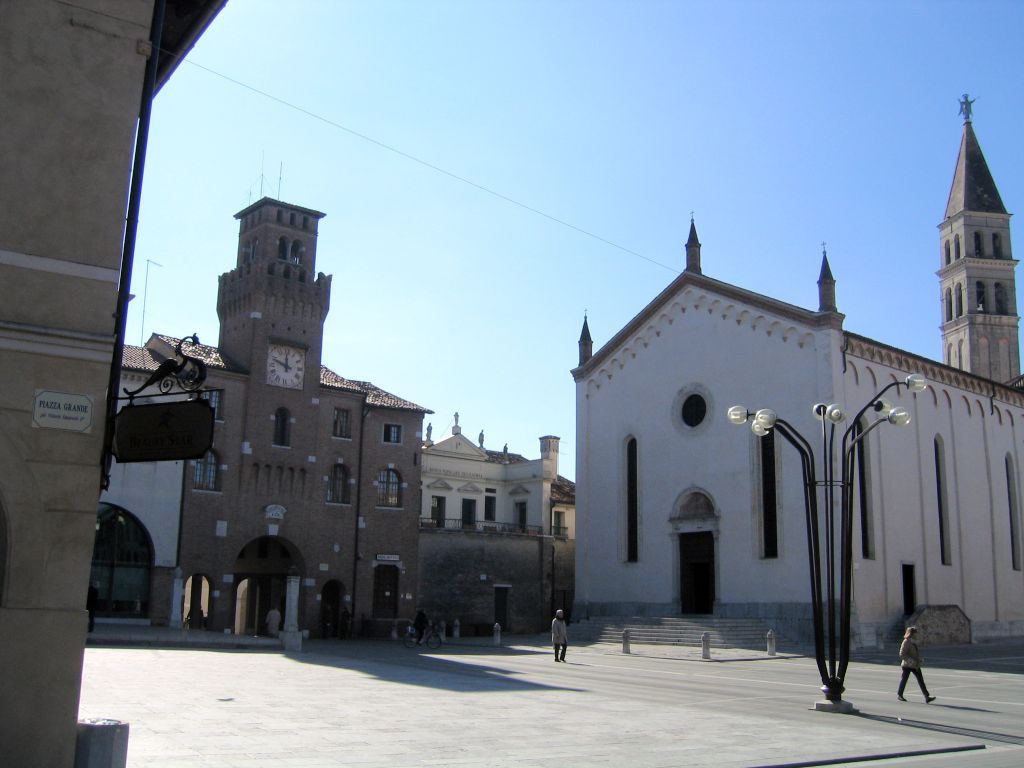
[edit]- The Piazza Grande
.jpg)
- The Duomo (Cathedral) of St. John the Baptist, begun in the 11th century over the ruins of the Roman temple of Mars, and re-consecrated in 1535. The original Gothic-Romanesque appearance has been modified by the subsequent renovations. It includes some notable works by Pomponio Amalteo.
- Archaeological area of the Roman Forum. It includes the remains of the basilica and a wide staircase.
- Torresin (watchtower)
- The Renaissance Palazzo Porcia e Brugnera.
- The former Prisons (Porta Pretoria). It includes the remains of a medieval prison, whose most famous guest was the troubadour Sordello da Goito.
In the frazione of Colfrancui is the mysterious Mutera, an artificial hill of the Adriatic Veneti, probably used as an observatory.
International relations
[edit]

People
[edit]- Paolo Lucio Anafesto, first Doge of Venice, serving from 697 to 717
- Amedeo Obici (1877–1947), American entrepreneur born in Oderzo
References
[edit]- ^ "Superficie di Comuni Province e Regioni italiane al 9 ottobre 2011". Italian National Institute of Statistics. Retrieved 16 March 2019.
- ^ Population data from Istat
- ^ "Demo-Geodemo. - Mappe, Popolazione, Statistiche Demografiche dell'ISTAT". demo.istat.it. Retrieved 2022-06-05.
- ^ The Navisego is now filled in with sediment, but the Piavon canal follows part of its course.
- ^ E. Mangani, F. Rebecchi, and M.J. Srazzulla, Emilia Venezie (Bari: Laterza & Figli, 1981), 191.
- ^ Lucan, Pharsalia, B.IV.1.462
- ^ Livy, Ep. 110; Florus, II.13.33
- ^ Geografia, (in English)lib. V, cap. I, par. 8.
- ^ Naturalis Historia, lib. III.
- ^ Pharsalia, lib. IV.
- ^ Histories lib. III, cap.VI
- ^ Ammianus Marcellinus, book 29, 6, 1
- ^ Paul the Deacon, History of the Lombards, IV.38-45
Sources
[edit]- Brisotto, G.B. (1999). Guida di Oderzo.
External links
[edit]

| International | |
|---|---|
| National | |
| Geographic | |
| Other | |

Oderzo
View on GrokipediaGeography
Location and Topography
Oderzo lies in the province of Treviso within the Veneto region of northeastern Italy, at coordinates 45°47′N 12°29′E.[8] The town occupies a position in the central Venetian plain, an extensive flat alluvial basin integral to the Po Valley, approximately 66 kilometers northeast of Venice.[8] The topography consists of low-lying, level terrain typical of the Po Plain, with an average elevation of 13 meters above sea level and variations between 6 and 16 meters across the municipal area.[9] This uniform flatness results from sedimentary deposition by ancient fluvial systems, rendering the landscape devoid of significant relief or natural elevations suitable for defensive positioning without hydraulic modifications.[10] Settlement at the site was influenced by proximity to major ancient rivers, including the Piave to the east and Livenza to the west, with the Monticano River currently crossing the territory; these waterways provided avenues for commerce along prehistoric and Roman trade routes while offering limited natural defenses via levees and floodplains.[11] [10] Geologically, the region features Quaternary alluvial and fluvial deposits overlying Tertiary sedimentary strata, with scant local outcrops of durable stone; Roman-era architecture in Oderzo predominantly employed imported limestones, such as Aurisina variety from Istrian quarries, due to the paucity of viable indigenous lithic resources in the plain's soft sediments.[11]Climate and Environment
Oderzo features a humid subtropical climate (Köppen Cfa), marked by mild winters, hot humid summers, and no prolonged dry season. Average daily temperatures fluctuate from a January low of approximately 1°C to a July high of 29°C, with extremes seldom falling below -4°C or rising above 33°C.[12][13] This pattern aligns with broader Veneto regional conditions, where continental influences moderate coastal maritime effects, fostering year-round viability for agriculture and settlement without severe freezes or droughts.[12] Annual precipitation totals around 1,274 mm, concentrated in autumn and winter, often exceeding 100 mm monthly from October to December, while summers remain relatively drier.[14] Such distribution replenishes groundwater and irrigates the plain's crops but elevates hydrogeological risks during intense events, as saturated soils reduce infiltration capacity.[14] Ecologically, Oderzo occupies the flat Venetian alluvial plain, where the Monticano River courses through the municipality, flanked by the nearby Piave and Livenza rivers, depositing silt-rich sediments that enhance soil fertility and have underpinned millennia of continuous occupation from Venetic to modern eras.[15] This fluvial dynamic causally links environmental productivity to human persistence, as nutrient cycling from periodic inundations bolsters arable land, yet incurs flood vulnerabilities—exemplified by the 1923 Monticano overflow inundating adjacent farmlands on November 29.[16] Regional assessments classify Veneto municipalities like Oderzo under medium flood probability zones, prompting engineered controls such as levees and drainage consortia to sustain habitability amid these recurrent threats.[17] Contemporary conditions show low industrial pollution levels, with the area's rural-agricultural profile minimizing airborne or waterborne contaminants relative to urban Veneto centers, thereby preserving biodiversity in local waterways and fields.[18] Flood mitigation integrates with broader environmental oversight, ensuring the climate's inherent stability continues to support demographic and economic continuity without acute ecological degradation.[17]Administrative and Political Status
Current Governance
Oderzo operates as a comune within Italy's decentralized administrative framework, governed by an elected mayor (sindaco) and a municipal council (consiglio comunale) of 21 members, which holds legislative authority, approves annual budgets, and oversees executive actions.[19] The mayor directs the executive junta (giunta comunale) and represents the municipality in intergovernmental relations, while permanent commissions, such as the first commission on urban planning and services, provide specialized policy review.[20] Local elections occur every five years, with the council elected via proportional representation and the mayor by majority vote. Maria Scardellato has served as mayor since her re-election on October 4, 2021, securing 53.9% of the vote in a runoff against a center-left challenger, under a center-right coalition including Lega and Fratelli d'Italia.[21] [22] Her term extends to 2026, during which the administration has prioritized infrastructure via national recovery funds like the PNRR, without deviations from provincial, regional, or EU mandates.[23] Veneto's center-right regional dominance, led by similar coalitions, shapes Oderzo's alignment on fiscal conservatism and limited central intervention, though the comune maintains standard compliance with Italy's unitary state structure. The municipality reports expenditures through transparent platforms mandated by Italian law, integrating into the Province of Treviso for territorial planning and the Veneto Region for health and education coordination, with no documented disputes over autonomy or resource allocation.[24]Historical Administrative Changes
In 49 BC, Julius Caesar granted Oderzo (ancient Opitergium) the status of municipium, conferring Roman citizenship on its inhabitants and integrating it into the administrative framework of the Republic.[25] Under Augustus, it was incorporated into Regio X Venetia et Histria, one of the 11 regions of Augustan Italy, enhancing its role as a key urban center in the northeast.[2] Diocletian's reforms in 297 AD reorganized Veneto, including Oderzo, within the province of Venetia et Histria, shifting from regional to provincial governance amid broader imperial centralization.[26] Following the Lombard conquest around 640 AD, Oderzo's territory was fragmented, with its jurisdiction divided among the provinces of Treviso, Ceneda, and Cividale, marking a transition from centralized Byzantine oversight to decentralized Lombard dukedoms.[27] In the High Middle Ages, it fell under feudal control of local lords, including the da Romano and da Camino families, who exercised seigneurial authority over its lands until the late 14th century.[28] This period reflected typical medieval fragmentation, with administrative functions tied to noble holdings rather than unified civic entities. In 1380, Oderzo was annexed to the Republic of Venice, becoming part of its terraferma dominion and administered through Venetian podestà and rectors, ensuring fiscal and judicial integration into the Serenissima's mainland territories.[2] Napoleon's conquest ended Venetian rule in 1797, incorporating Oderzo into the short-lived departments of the Cisalpine Republic and later the Napoleonic Kingdom of Italy (1805–1814), where it fell under the Department of the Piave, involving municipal mergers and centralized French-style prefectures.[29] The Congress of Vienna restored Austrian control in 1815, placing Oderzo within the Kingdom of Lombardy–Venetia, where it retained communal status under Habsburg provincial divisions emphasizing military and bureaucratic oversight. Following Austria's defeat in 1866, it was annexed to the Kingdom of Italy and assigned to the Province of Treviso, maintaining its comune structure with minimal boundary alterations until 1929, when it absorbed the neighboring comune of Piavon under Fascist-era consolidations.[28][30] These changes underscored pragmatic continuity, avoiding wholesale restructurings in favor of incremental adjustments to national frameworks.History
Pre-Roman Venetic Period
The area around Oderzo shows evidence of early Iron Age settlement dating to approximately the 10th century BCE, with archaeological artifacts from prehistoric phases and the initial stages of Venetic culture uncovered in local excavations. These include pottery and other material remains indicative of proto-urban communities in the Veneto lowlands, as documented in collections from the Eno Bellis Civic Archaeological Museum.[31] By the mid-9th century BCE, the Veneti, an Indo-European Indo-Italic people, had established a stable presence at the site, which functioned as a key lowland settlement rather than a fortified hilltop oppido. Oderzo ranked among the primary Venetic centers in eastern Veneto, comparable to Este, Padua, and Altino, supporting regional networks for trade in goods like amber and metalwork along prehistoric routes.[32][28][33] Material evidence from Late Iron Age necropolises near Oderzo, including human-animal co-burials with ritual deposits, reflects Venetic funerary customs and social organization, laying groundwork for gradual settlement expansion toward more structured layouts by the 6th century BCE. Venetic linguistic traces, known regionally from over 300 inscriptions in a distinct alphabet, underscore cultural continuity, though specific epigraphic finds at Oderzo remain limited to broader artifactual contexts.[34][35]Roman Republic and Early Empire
Opitergium, the Roman name for Oderzo, was integrated into the Roman Republic's administrative framework around 49 BCE when Julius Caesar granted it municipium status during his campaigns in northern Italy.[2] This elevation provided local inhabitants with partial Roman citizenship rights, enabling self-governance through a municipal council while aligning the settlement with Roman legal and civic norms. As a municipium, Opitergium served as a regional center in Venetia, facilitating Roman expansion and control over the Po Valley.[36] The attainment of municipium status spurred infrastructural enhancements that bolstered connectivity and urban development. Paved roads, including segments linked to the Via Annia along the Adriatic coast, improved overland transport for military and commercial purposes.[11] Aqueducts and water distribution systems, constructed using durable trachyte from the Euganean Hills, supplied the town and supported public amenities, marking a shift from pre-Roman Venetic settlements to a Romanized urban layout.[37] These developments, initiated in the late Republic, laid the groundwork for sustained growth by mitigating environmental challenges in the marshy plain.[38] Economically, Opitergium's integration enhanced its role in regional production networks. The fertile alluvial soils of the surrounding Po Valley enabled significant grain cultivation, contributing to the Republic's food supply chains amid expanding urban demands in Cisalpine Gaul. Local quarries yielded limestones and trachytes, processed for architectural elements, paving, and infrastructure projects both locally and in nearby settlements, underscoring the town's emerging specialization in stone resources.[11][39] This dual focus on agriculture and extractive industries positioned Opitergium as a vital node in early imperial supply lines, though full prosperity awaited later consolidations.Imperial Roman Period and Peak Prosperity
Opitergium, elevated to municipium status in the late 1st century BCE following the granting of Roman citizenship to the region, underwent significant urban development during the Imperial period from the 1st to 3rd centuries CE. This era marked the city's peak prosperity, characterized by the construction of monumental public structures including a forum complex, a theater adjacent to the northwestern walls, and at least two bath complexes. Residential expansion featured multiple domus, indicating a growing elite class and economic vitality. These developments reflect the stability provided by Roman imperial administration and infrastructure investments.[11][39] The city's strategic location along the Via Annia, a key Roman road linking Aquileia to Patavium (Padua) and facilitating access to Adriatic ports, positioned Opitergium as a vital node in regional trade networks. This connectivity supported commerce in goods such as building materials, evidenced by the importation of trachyte and limestones from distant quarries in the Euganean Hills and Istrian Peninsula for architectural purposes. Such trade links, combined with agricultural productivity in the surrounding fertile plains, underpinned economic prosperity and urban growth. Archaeological evidence from stone provenance studies highlights the extensive supply chains that sustained these activities during the early Empire.[39][40] Post-Civil War settlements under the Flavians in the late 1st century CE further bolstered the local economy through military presence and integration into the imperial system. As part of Regio X Venetia et Histria, Opitergium benefited from the Pax Romana, enabling sustained investment in infrastructure and public amenities that symbolized civic wealth and Romanization. The scale of these constructions, including the forum's role as a center for administration and commerce, underscores the municipality's role as a prosperous regional hub rather than a mere peripheral settlement.[26]Late Antiquity and Decline
In the 4th and early 5th centuries AD, Opitergium, like much of Venetia, endured mounting pressures from barbarian migrations across the Alps, exacerbating economic strains already evident from reduced coin finds and abandoned rural villas in the region. These incursions disrupted the Via Postumia's trade networks, which had sustained the town's prosperity, leading to localized contraction in urban activity as resources shifted toward defense. Archaeological strata from the town's forum and surrounding necropoleis reveal a thinning of material culture layers post-350 AD, indicative of depopulation and selective abandonment of peripheral zones in favor of fortified cores.[41] The Visigothic invasion under Alaric in 401–403 AD marked a pivotal escalation, with forces ravaging northern Italy en route to sacking Rome in 410, compelling Roman authorities to divert troops and taxes northward and further eroding municipal finances. By 452 AD, Attila's Huns compounded the damage, systematically destroying key Venetic centers including Opitergium during their campaign through the Po Valley, as evidenced by historical accounts of widespread devastation in the area. These assaults prompted mass flight from exposed inland sites, with survivors seeking refuge in marshy lagoons or hilltop refugia, patterns corroborated by shifts in settlement archaeology showing reduced habitation density until the 6th century.[42] Amid this turmoil, Christianization provided a counterpoint of institutional continuity, with Opitergium emerging as an early episcopal see subordinate to Aquileia's patriarchate by the mid-5th century, reflecting the faith's role in community cohesion during crisis. Excavations uncover paleo-Christian adaptations, such as converted Roman structures and intramural burials with Christian motifs in late imperial necropoleis spanning the 4th–5th centuries, suggesting basilical constructions or martyria erected even as pagan infrastructure decayed. This religious persistence underscores causal realism in the decline: invasions directly triggered material contraction, yet adaptive institutions mitigated total collapse until subsequent Lombard conquests in 568 AD.[41][43]Medieval Period
Following the sack of Oderzo by Lombard King Grimoald I in 667, undertaken in retaliation for the murder of his sons by Byzantine forces, the city suffered severe depopulation, with many residents fleeing to coastal refuges such as Eraclea, contributing to its transition from an urban center to a more dispersed rural landscape.[44][45] The territory remained under Lombard control, characterized by decentralized governance and military settlements (farae), until the Frankish conquest in 774, when Charlemagne defeated King Desiderius and integrated northern Italy, including Oderzo's environs, into the Carolingian realm, introducing vassalage systems and comital administration that laid groundwork for feudal hierarchies. From the 9th to 11th centuries, Frankish and subsequent Ottonian influences facilitated tentative recovery through land grants to loyal retainers, emphasizing agricultural production on self-contained estates (curtes) as a bulwark against insecurity from raids and weak central authority. Episcopal centers, initially diminished after the 7th-century disruptions to Oderzo's own diocese, shifted influence to nearby sees like Belluno, whose bishops asserted temporal lordship over the area, managing fortifications and tithes to sustain local stability.[46] Local power dynamics solidified around fortified sites, including an emerging turreted castle by the late 11th century, which served as a defensive hub amid contests between ecclesiastical lords and nascent noble families, underpinning a feudal order reliant on peasant labor for grain, wine, and livestock to weather economic fragmentation.[47][48] This structure prioritized defensive autonomy over trade, reflecting causal adaptations to post-Roman instability rather than revival of ancient urbanism.Renaissance to Early Modern Era
Oderzo integrated into the Republic of Venice in the late 14th century, with Venetian influence evident as early as the 1340s through the appointment of a podestà by Doge Francesco Dandolo, though formal control solidified around 1380.[49] The town became the administrative seat of a podesteria, governing a territory extending westward to the Piave River and eastward toward other Venetian holdings in the Trevisano plain.[50] This structure emphasized centralized oversight from Venice, positioning Oderzo as a secondary hub in the expanding Terraferma possessions acquired during the 15th-century wars against Milanese forces. As part of Venice's mainland defensive network, Oderzo contributed to regional stability by hosting garrisons and serving as a logistical point amid conflicts like the Wars of Ferrara (1482–1484) and the League of Cambrai (1508–1516), though it avoided direct sieges due to its inland location.[51] Urban development remained constrained, with porticoed palaces and facades reflecting Venetian stylistic influence but no significant expansion beyond medieval outlines, preserving a compact historic center.[47] The local economy centered on agriculture, with surrounding farmlands producing grains, wine, and livestock under feudal-like tenures managed by Venetian patricians, contrasting with the republic's maritime trade focus elsewhere.[52] This rural orientation fostered stasis, as population and infrastructure grew minimally, reliant on agrarian output rather than industry or commerce. The 1630–1631 plague, part of the broader northern Italian outbreak originating from Mantua, struck Oderzo severely, with local records documenting rapid fatalities before containment measures like quarantines took effect.[53] The epidemic subsided by 1631, leading to the erection of votive churches dedicated to the Virgin Mary as empirical markers of survival and communal piety.[54] Such events underscored the era's demographic vulnerabilities, yet Venetian administration maintained continuity without major reforms.19th and 20th Centuries
In 1866, following Austria's defeat in the Austro-Prussian War and the subsequent Peace of Vienna, Oderzo, as part of the Veneto region, was annexed to the Kingdom of Italy through a plebiscite held on October 21–22, which overwhelmingly favored unification with 99.8% approval across the Venetian provinces.[55] Local celebrations marked the event, reflecting broader Risorgimento sentiments in the area previously under Habsburg administration since 1815.[56] The transition integrated Oderzo into the new national framework, though rural Veneto experienced economic stagnation and emigration pressures amid agricultural reforms and land disputes in the late 19th century. During World War I, Oderzo's proximity to the Piave River front—established after the Italian retreat from Caporetto in October–November 1917—positioned it near active combat zones, with Treviso province suffering extensive devastation from artillery, troop movements, and refugee influxes totaling over 300,000 displaced persons in the region. The area hosted military logistics and billeting, contributing to material strain but avoiding direct frontline occupation. Under Fascist rule from 1922 to 1943, Oderzo saw targeted infrastructure developments, including the 1935 construction of the bridge over the Monticano River along the Via Postumia, aimed at improving regional connectivity and agricultural transport in line with national autarky policies.[57] World War II brought limited physical destruction to Oderzo compared to industrialized northern cities, with no major bombings recorded, though partisan activity and end-of-war reprisals culminated in the April–May 1945 Oderzo massacre, where 120–144 Republic of Salò militiamen were summarily executed amid chaotic liberation efforts.[58] This period also spurred temporary migrations, as residents fled rural unrest and sought urban opportunities, exacerbating labor shortages. After 1945, local governance shifted to the Christian Democratic Party (DC), which dominated Oderzo's administration through 1993, fostering political continuity amid Italy's postwar republican transition and emphasizing anti-communist stability in Veneto's Catholic heartland.[59] This era prioritized reconstruction and social order, averting radical upheavals seen elsewhere.Post-World War II Development
Following the end of World War II in 1945, Oderzo underwent a structured recovery under administrations aligned with Italy's dominant Christian Democratic (DC) party, which governed nationally and locally in Veneto from 1948 onward, fostering policies that prioritized infrastructure rebuilding and economic liberalization. The town, previously agrarian, transitioned to a hub of small-scale manufacturing and services, attracting firms in textiles, mechanics, and food processing amid Italy's broader "economic miracle" (1950–1973), where GDP grew at an average annual rate of 5.8%. Local governance efficacy was evident in zoning reforms and incentives that channeled investments, enabling Oderzo to integrate into the Veneto's decentralized industrialization model without the large-scale disruptions seen in centralized northern hubs like Turin.[2][60] This period saw significant internal migration, with workers from southern Italy and rural Veneto relocating to Oderzo for factory jobs; between 1955 and 1965, Veneto's industrial employment rose by over 200%, absorbing an estimated 1.5 million migrants regionally without precipitating the urban social strains—such as high unemployment or ethnic enclaves—that plagued Milan or Genoa, as evidenced by stable local crime rates and cohesive community structures in provincial towns. DC-led policies, emphasizing family subsidies and vocational training, facilitated this integration, maintaining social order through Catholic networks and avoiding the partisan violence that marred other areas post-1945. Data from ISTAT censuses indicate Oderzo's population grew from approximately 10,000 in 1951 to 16,000 by 1971, reflecting orderly expansion tied to productive employment rather than welfare dependency.[61][62] In recent decades, archaeological investigations have renewed focus on Oderzo's ancient substrate, complementing post-war modernization by underscoring its historical continuity. Petrographic analyses of Roman-era stones, including limestones from Istrian quarries used in forums and necropolises, published in studies from the early 2020s, have highlighted supply chains and craftsmanship, drawing scholarly and touristic interest that bolsters local identity without disrupting contemporary development. These findings, derived from systematic sampling of architectural fragments, reveal provenance patterns linking Oderzo to Adriatic trade networks, prompting heritage initiatives that align with Veneto's balanced growth model under stable governance.[11][39]Demographics
Population Trends
The population of Oderzo exhibited modest growth from the late 19th century through the early 20th century, rising from 8,027 in 1871 to 12,256 in 1921, driven primarily by natural increase amid agricultural stability in the Veneto plain.[63] A slight decline occurred during the interwar period, with numbers dipping to 12,524 by 1936 due to economic pressures and emigration, before recovering to 12,873 in 1951.[63] This era reflected limited urban exodus, as the town's role as a local hub retained residents despite broader rural depopulation trends in northern Italy.[63] Post-World War II industrialization spurred accelerated growth, with the population increasing to 14,423 by 1971 and reaching 16,353 in 1981, marking a 13.4% decennial rise attributable to inbound migration from rural areas and improved economic opportunities in manufacturing.[63] By 1991, it stood at 16,632, indicating sustained but moderating expansion with minimal net outflow, as Oderzo maintained an urban-rural balance through its commuter proximity to Treviso and Venice.[64] Growth continued steadily into the 2000s, peaking above 20,000 residents around 2010-2017, supported by Veneto's regional prosperity.[65]| Census Year | Population |
|---|---|
| 1971 | 14,423 |
| 1981 | 16,353 |
| 1991 | 16,632 |
| 2001 | 17,316 |
| 2011 | 20,068 |
| 2021 | 20,042 |