Hubbry Logo
Roadster (bicycle)Roadster (bicycle)Main
Open search
Roadster (bicycle)
Community hub
Roadster (bicycle)
logo
8 pages, 0 posts
0 subscribers
Be the first to start a discussion here.
Roadster (bicycle)
Roadster (bicycle)
from Wikipedia

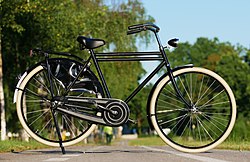
An opafiets, a single speed traditional Dutch roadster with double top tube and coaster brake

A roadster bicycle[1] is a type of utility bicycle once common worldwide, and still common in Asia, Africa, Latin America, and some parts of Europe. During the past few decades, traditionally styled roadster bicycles have regained popularity in the Western world, particularly as a lifestyle or fashion statement in an urban environment.[2]

Design and variants

[edit]

There were three basic variants of the roadster.

Roadster

[edit]

Gents' roadster

[edit]
Contemporary gents' roadster

The classic gents' roadster, also known as the English roadster, has a lugged brazed steel diamond frame, rod-actuated brakes and of late, cable operated drum brake systems have been widely produced for the European market, upright North Road handlebars, a single gear ratio or three- or five-speed hub gears, a chaincase, steel mudguards, steel cranks, 711 mm × 38 mm (28 in × 1+12 in) (ISO 635) wheels, Westwood rims, and often a Sturmey-Archer hub dynamo. Roadsters are built for durability above all else and no serious attempt is made to save weight in their design or construction, roadsters weigh upwards of 18–20 kilograms (40–45 lb). They were often the mounts of policemen and rural letter carriers.[3] A derivative of the roadster, the ladies' model, is seldom called a roadster.

The roadster is very similar in design and intended use as the European city bike, a model still used in Germany, Denmark and, most notably, the Netherlands (see below). The primary differences are that the continental bicycles tend to have a higher handlebar position for a more upright riding posture, and are more likely to have rod-actuated drum brakes.

Ladies' roadster

[edit]
The Dutch omafiets is a ladies' roadster of classic design

The ladies' version of the roadster's design was very much in place by the 1890s. It had a step-through frame rather than the diamond frame of the gentlemen's model so that ladies, with their dresses and skirts, could easily mount and ride their bicycles, and commonly came with a skirt guard to prevent skirts and dresses becoming entangled in the rear wheel and spokes. As with the gents' roadster, the frame was of steel construction and the positioning of the frame and handlebars gave the rider a very upright riding position. Though they originally came with front spoon-brakes, technological advancements meant that later models were equipped with the much-improved coaster brakes or rod-actuated rim or drum-brakes.

Though the ladies' version of the roadster largely fell out of fashion in England and many other Western nations as the 20th century progressed, it continuously remained popular in the Netherlands right to the present day. In the Dutch language the name of these bicycles is omafiets ('grandma bike'), a term which has been in use since the 1970s.[4][a] The omafiets is a national icon, and is even used by men in the Netherlands;[5] this is why some people refer to bicycles of this design as Dutch bikes. The classic omafiets is still in production in the Netherlands and has changed little since 1911:[6] it comes with a single-speed gear, 711 mm × 38 mm (28 in × 1+12 in) (ISO 635) wheels, black painted frame and mudguards (with white-blazoning at the back of the rear one), and a rear skirt guard. Modern variants, be they painted in other colours, with aluminium frames, drum-brakes or multiple gear ratios in a hub gearing system, will all conform to the same basic look and dimensions as the classic omafiets. The Dutch gentlemen's equivalent is called the opafiets ('grandpa bike') or stadsfiets ('city bike') and generally has the same characteristics but with a "diamond" or "gents'" frame, thereby much the same as the gentleman's roadster in England and elsewhere.

Sports roadster

[edit]
Three-speed 1971 Raleigh Superbe sports roadster with 26-inch tires and Dynohub

A variation on this type of bicycle is the sports roadster (also known as the "light roadster"), which typically has a lighter frame, and a slightly steeper seat-tube and head-tube angle of about 70°–72°, fitted with cable brakes, comfortable "flat" North Road handlebars, mudguards and, as often as not, three, four or five-speed internal hub gears. Sports or light roadsters were fitted with 660 mm × 35 mm (26 in × 1+38 in) (ISO 590) traditional English size wheels with Endrick rims, hence a lower bottom bracket and correspondingly lower stand-over height and weighing around 16–18 kg (35–40 lb).[7] It was these bikes that were dubbed "English racers" in the United States.[3][8]

Club sports

[edit]

Club sports, or semi-racer, bicycles were the high-performance machines of their time and place, named so as they were the style of bicycle popular with members of the many active cycling clubs. A club bicycle would typically have Reynolds 531 frame tubing, a narrow, unsprung leather saddle, inverted North Road handlebars (or drop bars), steel "rat trap" pedals with toe clips, 5-15 speed derailleur gearing, alloy rims and light high-pressure 660 mm × 32 mm (26 in × 1+14 in) (ISO 597) or 686 mm × 32 mm (27 in × 1+14 in) (ISO 630) tires. Some club bicycles would be likely to have a more exotic Sturmey-Archer hub, perhaps, a medium- or close-ratio model, 3 or 4 speed, with a very few even being equipped with the rare ASC three-speed fixed-gear hub. Many club bicycles were single-speed machines, usually with a reversible hub: single-speed freewheel on one side, fixed-gear on the other. Derailers began to be used on this type of bicycle starting in the early 1940s. Although primarily intended for fast group rides, club bicycles were also commonly used for touring as well as for time-trialing.[3][8]

History

[edit]

From the early 20th century until after World War II, the roadster constituted most adult bicycles sold in the United Kingdom and in many parts of the British Empire. For many years after the advent of the motorcycle and automobile, they remained a primary means of adult transport. Major manufacturers in England were Raleigh and BSA, though Carlton, Phillips, Triumph, Rudge-Whitworth, Hercules, and Elswick Hopper also made them.

In the United States, the sports roadster was imported after World War II, and was known as the "English racer". It quickly became popular with adult cyclists seeking an alternative to the traditional youth-oriented cruiser bicycle.[7][9] While the English racer was no racing bike, it was faster and better for climbing hills than the cruiser, thanks to its lighter weight, tall wheels, narrow tires, and internally geared rear hubs.[7] In the late 1950s, U.S. manufacturers such as Schwinn began producing their own "lightweight" version of the English racer.[7]

In Britain, the utility roadster declined noticeably in popularity during the early 1970s, as a boom in recreational cycling caused manufacturers to concentrate on lightweight (10–14 kg or 23–30 lb), affordable derailleur sport bikes, actually slightly modified versions of the racing bicycle of the era.[10]

In the 1980s, U.K. cyclists began to shift from road-only bicycles to all-terrain models such as the mountain bike.[10] The mountain bike's sturdy frame and load-carrying ability gave it additional versatility as a utility bike, usurping the role previously filled by the roadster. By 1990, the roadster was almost dead; while annual U.K. bicycle sales reached an all-time record of 2.8 million, almost all of them were mountain and road/sport models.[10]

A different situation, however, occurred and still occurs in most Asian countries as of 2014. Roadsters are still widely made and used in countries such as China, India, Pakistan, Thailand, Vietnam and others. Some of the most significant roadster manufacturers are: Flying Pigeon, Hero Cycles and Sohrab Cycles.

During Vietnam's long war for independence, structurally reinforced roadsters were often used to haul munitions and supplies across the countryside. Generally, the bicycles were so heavily loaded that they could no longer be conventionally ridden, and were pushed instead.[11]

Roadsters in contemporary society

[edit]
Roadsters are known in East Africa as Black Mambas, and are often used as cycle taxis or boda-bodas.[12]

In much of the world, the roadster is still the standard bicycle used for daily transportation. Mass-produced in Asia, they are exported in huge numbers (mainly from India, China, and Taiwan) to developing nations as far afield as Africa and Latin America. India's Hero Cycles and Eastman Industries are still two of the world's leading roadster manufacturers, while China's Flying Pigeon was the single most popular vehicle in worldwide use.[13] Due to their relative affordability, the strength and durability of steel frames and forks and their ability to be repaired by welding, and the ability of these bicycles to carry heavy payloads, the roadster is generally by far the most common bicycle in use in developing nations, with a particular importance for those in rural areas. In parts of East Africa, the roadster is called the Black Mamba, where it is used as a taxi by enterprising cyclist/drivers, called a boda-boda. Black Mambas are often repaired, customized, and manufactured locally for low costs. To further reduce costs of the Black Mamba, engineers have begun to test 3D printed bike parts that meet CEN standards.[14]

Traditional roadster models became largely obsolete in the English-speaking world and other parts of the Western world after the 1950s with the noticeable exceptions of the Netherlands and to a much lesser extent Belgium along with other parts of north-western Europe. However, they are now becoming popular once more in many of those countries that they had largely disappeared from, due to the resurgence in the bicycle as local city transport where the roadster is ideally suited due to its upright riding position, ability to carry shopping loads, simplicity and low maintenance.

In the United Kingdom, there are a number of bicycle manufacturers (such as Pashley Cycles) which make updated versions of the classic roadster and many more are imported from the continent, such as those from Dutch manufacturers such as Royal Dutch Gazelle. They are popular as student transport at universities, especially at Cambridge and Oxford, and are increasingly seen in other British cities, including London. In Australia, there has also been an increase in roadster use, particularly in Melbourne, and many second-hand ones from the 1950s and 60s are being discovered and restored.[15]

[edit]

See also

[edit]

Notes

[edit]

References

[edit]
[edit]
Revisions and contributorsEdit on WikipediaRead on Wikipedia
from Grokipedia
The roadster bicycle is a type of designed for durable, everyday transportation, featuring an upright riding position, heavy steel frame, and practical components suited to rough roads and urban commuting. Originating in Britain around the early 1900s as an evolution of the , it became a staple of working-class mobility, particularly through manufacturers like Raleigh in , and remained popular from the 1930s to the 1960s before declining with the rise of automobiles and lighter bicycles. Key characteristics of the roadster include 28-inch (635 mm) wheels with Westwood rims for stability on uneven surfaces, a long , shallow frame angles of 68 degrees or less, and long cranks to accommodate the upright posture, making it ideal for loads and prolonged rides without . It typically incorporates low-maintenance features such as a fully enclosed chaincase and chainguard to protect clothing, roller-lever rod brakes for reliable stopping on cobblestones or dirt paths, and often a three-speed internal for versatility in varied terrain. These elements prioritized longevity over speed, with roadsters weighing around 30-35 pounds and built to withstand heavy use by delivery workers, policemen, and rural carriers. Historically, roadsters fostered a vibrant cycling club culture in Britain and were exported worldwide, influencing utility bikes in regions like , , and parts of where simpler, robust designs persist today in modern productions from and . Examples from the era, such as the 1931 BSA Light Roadster or 1919 Ford Gents Roadster, showcase variations like double top tubes for added strength or spring frames for comfort, reflecting ongoing refinements in Victorian and Edwardian engineering. While less common in the West post-1970s due to shifts toward sportier models, the roadster's legacy endures in its emphasis on accessibility and resilience, embodying the bicycle's role in mass transportation before motorized alternatives dominated.

Definition and Characteristics

Core Features

The roadster bicycle is characterized by its upright riding position, which promotes comfort and improved visibility for urban and rural commuting. This posture is achieved through North Road-style handlebars, featuring a swept-back design with moderate rise that positions the rider's hands at or near shoulder height, reducing strain on the back and wrists during extended rides. Typical roadsters utilize 28-inch (635 mm) wheels fitted with balloon tires, measuring approximately 1.5 to 1.75 inches in width, which provide enhanced stability and cushioning on uneven surfaces such as cobblestones or dirt paths. The heavy construction, often lugged and brazed for strength, results in a total weight of 18-20 kg, prioritizing long-term durability and resistance to wear over lightweight performance or speed. Gearing on roadsters is kept simple, with most models featuring a single-speed setup or internal hub systems offering 3-5 speeds, such as the classic models, which allow for easy shifting without derailleurs and minimal maintenance. Braking is handled by rod-actuated mechanisms, either rim brakes or drum brakes, delivering reliable, low-maintenance stopping power suitable for everyday utility, along with a fully enclosed chaincase and chainguard to protect clothing and reduce maintenance. Originating with early bicycles in the late and evolving into its classic form in the early , the roadster design focused on practical everyday utility rather than sport, evolving into a staple for transportation in Britain and beyond.

Distinction from Other Bicycle Types

The roadster bicycle is distinguished from drop-handlebar road bikes primarily by its upright riding posture, achieved through flat or North Road-style handlebars positioned at or above saddle height, which promotes comfort during extended urban rides rather than the forward-leaning, aerodynamic position of drop bars optimized for high-speed efficiency on open roads. This design choice in roadsters emphasizes relaxed over racing performance, with slack frame angles (typically 68 degrees or less at the ) contributing to a stable, less aggressive handling profile. In contrast to s, roadsters feature rigid frames without suspension and smooth, narrow tires (often 28 x 1 1/2 inches) suited for urban commuting on paved roads, cobblestones, and light dirt paths, lacking the knobby treads, wide tires (50mm+), and front or full suspension that enable s to navigate off-road terrain like trails and rocks. Roadsters prioritize durability on mixed urban and uneven surfaces, with balloon tires providing cushioning but higher compared to mountain bike knobby tires. Compared to modern city bikes or hybrids, roadsters employ robust frames for enhanced load-bearing strength and traditional rod-actuated for reliable in scenarios, differing from the lighter aluminum and cable-operated V- that offer easier and modulation on contemporary urban hybrids. Rod on roadsters, operated via mechanical linkages rather than cables, provide consistent performance in enclosed chaincase setups but require more precise alignment than the versatile V-brake arms found on city bikes. Overall, roadsters emphasize load-carrying capacity—facilitated by integrated rear racks and chainguards—over agility, with long wheelbases and slack geometry ensuring stability at low urban speeds of 5-15 mph, ideal for errands or commuting with cargo. Unlike folding bikes, which prioritize portability through compact, hinged frames and smaller wheels for storage on , roadsters are full-size bicycles with fixed 28-inch wheels and non-collapsible structures, better suited for long-distance where stability and load capacity outweigh the need for foldability. This full-size design enhances handling security and comfort over extended rides but limits convenience in multi-modal travel scenarios.

Design Elements

Frame and Geometry

The roadster bicycle's frame is traditionally constructed using lugged and brazed steel, with high-tensile steel tubing providing strength and durability for everyday utility use. Historically, frames were constructed from high-tensile steel for affordability and resilience in the emerging safety bicycle era. This method involves ornate steel lugs at the frame junctions where tubes are brazed together, ensuring a robust structure capable of withstanding regular loads while maintaining a classic aesthetic. The geometry emphasizes stability and comfort, featuring a long of approximately 44 to 46 inches and a shallow angle of 68 degrees or less, which promotes predictable handling at low speeds and reduces the risk of tipping during loaded rides. This relaxed configuration, combined with a higher , positions the rider upright and supports efficient pedaling over varied terrain without aggressive racing postures. Gents' models typically employ a diamond frame design for structural integrity, while ladies' variants utilize a with a low standover height of approximately 28 to 32 inches (71 to 81 cm), allowing easy mounting and dismounting in everyday clothing. These frames are engineered for a total load capacity of 250 to 300 pounds, encompassing rider weight and , making them suitable for practical needs. Following , manufacturers introduced rust-resistant coatings, such as on key components or specialized paints, to enhance corrosion protection amid increased post-war production and urban use.

Components and Accessories

The North Road handlebars, a hallmark of the roadster bicycle's upright riding posture, typically measure 22-24 inches in width, allowing for a natural arm position that reduces strain during extended rides. This design promotes relaxed , with a gentle back sweep and rise that aligns the rider's wrists and shoulders comfortably. Drivetrain components emphasize durability and ease of use, with hub gears such as the S2 or S3 models providing internal shifting for reliable performance. The S2 offers a 2-speed setup with a 138% overdrive ratio from direct drive, while the S3 delivers a 3-speed configuration with ratios of approximately 0.75:1, 1:1, and 1.33:1, enabling climbs on grades up to 10-20% when paired with standard chainring and sprocket combinations. These hubs contribute to the bicycle's total weight of 18-20 kg by integrating seamlessly without external derailleurs. Braking systems on traditional roadsters often utilized rod-actuated rim brakes for reliable stopping on cobblestones or dirt paths, while modern variants may use cable-actuated drum brakes, which enclose the mechanism within the hub for protection against environmental factors. These drum brakes maintain 50-70% of their dry in wet conditions, outperforming exposed rim brakes due to reduced water interference on the friction surfaces. Saddles like the Brooks B17 leather model prioritize long-term comfort through a flexible, hammock-like structure that molds to the rider's body over time, weighing approximately 0.5-1 kg. Standard accessories enhance practicality and all-weather usability, including full mudguards to shield the rider from splashes, rear carrier racks with capacities up to 50 lb for transporting loads, and dynamo lighting systems that generate power from wheel rotation without batteries.

Historical Development

Origins and Early Adoption

The roadster bicycle traces its origins to the , invented in 1885 by British engineer , whose model featured two equal-sized s, a to the rear wheel, and a diamond-shaped frame, marking a significant evolution from the precarious high-wheel penny-farthings of the 1870s and 1880s. This design addressed the dangers of earlier velocipedes, such as boneshakers with solid tires that delivered jarring rides over cobblestone streets. The pivotal advancement came in 1888 with John Boyd Dunlop's patent for the pneumatic tire, which inflated with air to absorb shocks and enable smoother travel, fundamentally shifting bicycle usability from novelty to practical transport. In Britain during the 1890s, the rapidly gained traction as the standard for urban commuting, propelled by from leading manufacturers like the Raleigh Cycle Company, founded in 1888 and producing diamond-frame safeties by 1886, and Birmingham Small Arms (BSA), which supplied high-quality fittings from the early onward. These safety bicycles, with their upright riding position and robust build, suited the era's growing working-class need for affordable daily mobility in industrial cities, where bicycles offered a reliable alternative to walking or horse-drawn transport. By the mid-1890s, adaptations for broader adoption included the introduction of step-through frames for women, facilitating easier mounting in long skirts and promoting as a socially acceptable activity for ladies. The early 1900s further solidified the roadster's design through standardization of chain-driven models with features like freewheels and back-pedal brakes, enabling efficient and widespread use; for instance, post-1903 iterations from firms like emphasized durable, upright configurations ideal for everyday errands. Institutional adoption accelerated this trend, with British police forces incorporating bicycles for patrols by the early 1900s, as seen in Manchester's cycle-mounted despatch riders who enhanced response times in congested urban areas. This era's innovations positioned the roadster as a cornerstone of British mobility, peaking in popularity during the before later shifts in transportation.

Evolution and Decline

During , steel shortages in Britain necessitated simplified bicycle designs, with manufacturers producing stripped-down utility models that conserved materials while maintaining essential functionality for civilian and military transport. Post-war recovery saw a significant boom in bicycle production, particularly incorporating innovations like the AW three-speed hub, which had been introduced in but gained widespread adoption in the 1940s and 1950s for its durability and ease of maintenance on roadster frames. This period marked the peak of bicycle sales at approximately 1.1 million units in 1950, driven by demand for affordable, practical transport amid economic rebuilding. By the and 1970s, the traditional roadster faced declining popularity in Western markets, as rising car ownership and favoring automobiles reduced the need for utilitarian . The emergence of lightweight sports bicycles, such as ten-speed models, appealed to a growing recreational demographic, further eroding demand for heavier roadsters. bicycle sales had plummeted to under 200,000 units by the late , reflecting this shift away from everyday utility bikes. The 1970s oil crisis provided a brief resurgence, quadrupling UK bicycle sales between 1970 and 1973 as higher fuel costs encouraged alternative transport, though this uptick was short-lived. In the 1980s, the rise of mountain bikes and bicycles captured recreational interest, overshadowing roadsters for leisure use. Additionally, the standardization of ISO 4210 safety requirements in 1982 established rigorous performance and durability tests that marginalized heavier traditional roadsters, promoting lighter, more compliant designs in regulated markets.

Variants and Regional Adaptations

Traditional British Roadster

The Traditional British Roadster serves as the archetype of the roadster bicycle, embodying utilitarian design suited to everyday commuting in the . The gents' model features a classic diamond frame, typically in a 23-inch size, constructed from lugged and brazed for and strength. This configuration has been a staple for postal workers and police officers since the , providing a stable platform for carrying loads over urban and rural routes. The iconic Raleigh Roadster from the 1930s exemplifies this tradition, equipped with a Brooks saddle for comfort during long rides and Dunlop tires for reliable traction on wet roads. A key aspect of the gents' roadster is its emphasis on low-maintenance components, particularly rod-actuated brakes, which perform effectively in the UK's frequent rainy conditions without requiring frequent adjustments. These bikes often incorporate hub gearing, such as the three-speed system, for effortless shifting in varied terrains. Heritage branding underscores their enduring appeal, with production continuing today by Pashley Cycles in a faithful reproduction that maintains the original geometry and upright riding position. The ladies' variant, introduced in the , adapts the roadster for female riders with a that allows easy mounting while wearing skirts or dresses, complemented by a skirt guard to prevent fabric from catching in the rear wheel. Weighing slightly less than the gents' model at approximately 20-22 kg, it prioritizes accessibility without sacrificing the robust build essential for daily use. This design has preserved the roadster's practical ethos, focusing on comfort and reliability over speed.

International and Sports Variants

The sports roadster variant emerged as a lighter and more agile evolution of the traditional roadster, featuring frames weighing 16-18 kg and steeper angles around 73 degrees to enhance speed and handling. In the United States during the , these bicycles gained popularity as "English racers," with manufacturers like Schwinn producing lightweight models inspired by British designs for recreational and light touring use. Club sports bicycles further refined this performance focus, employing high-strength Reynolds 531 steel tubing for durability and incorporating gear systems to support longer distances. These models were particularly favored in the for Audax events, which emphasized over 200 km or more in non-competitive settings. Outside Britain, the roadster inspired various regional adaptations tailored to local needs. The Dutch omafiets, originating in the early , retained the upright posture of the archetype but incorporated backpedal coaster brakes for simple urban navigation on flat terrain. In , the model, introduced in the , served as a robust single-speed utility bike for mass urban commuting under socialist policies, emphasizing reliability for daily worker transport. Post-1980s, Indian manufacturer adapted the roadster design with added rear carriers to facilitate goods transport in rural and urban areas, supporting small-scale commerce and agriculture. In , the roadster evolved into the "," a reinforced variant used as a boda-boda capable of carrying multiple passengers along with on rugged roads.

Contemporary Role and Revival

Use in Developing Regions

In , particularly in and , roadster bicycles continue to serve as essential utility vehicles in rural and urban settings, with hundreds of millions of units in circulation supporting daily commuting and goods transport. As of 2015, and together accounted for a substantial portion of the global bicycle stock, with the top five countries (including them) exceeding 1 billion units out of a global total of approximately 1.9 billion; more recent estimates suggest continued growth in these markets. As of 2025, in , manufacturers like produce around 19,000 bicycles daily (approximately 5.2 million annually), many of which are basic roadster designs utilized for rural delivery services in informal economies, positioning Hero as the world's largest bicycle manufacturer. In , roadster bicycles are widely adapted as boda-boda taxis, providing affordable passenger and cargo transport in urban areas like and , , where operators often modify the frames with extended rear carriers to accommodate multiple riders or loads. These modifications enhance versatility in densely populated regions with limited infrastructure. In , particularly in cities like , roadster bicycles facilitate market vending and street trade, enabling vendors to navigate congested areas while carrying produce or goods on customized racks. Their persistence in these regions stems from low acquisition costs, for example in ranging from approximately $40 to $70 for basic secondhand or new models, and ease of repair using simple tools on durable frames. Recent market analyses indicate that bicycles like roadsters comprise a of the global fleet in developing areas, supporting informal economies by allowing riders to exceed the original design's 50 kg load limit and carry 100-200 kg of goods such as or . This adaptability underscores their role in livelihoods, from delivery to vending, despite evolving options. In contemporary manufacturing, British companies Pashley Cycles and Dawes maintain production of heritage-inspired roadster bicycles, emphasizing handcrafted steel frames and classic geometries for urban and leisure use. Pashley, based in since 1926, offers models like the Roadster Sovereign, featuring hand-crafted steel frames with traditional lugged and brazed construction, Brooks saddles, and or hubs in 5- or 8-speed configurations, with each bike assembled to order by skilled craftsmen. Dawes, drawing on its origins from 1906, produces variants incorporating vintage styling with modern brakes and puncture-resistant tires for everyday reliability. Exports from , led by Avon Cycles, supply affordable roadster models to Western markets, including the Royal 5 Star and Classic 28T, which replicate traditional designs using sturdy frames while meeting international safety standards. Avon, operating facilities in since 1948, ships these bicycles to over 80 countries, facilitating access to budget-friendly options that blend heritage aesthetics with basic utility features. The have seen a resurgence of roadster-style bicycles in Western urban commuting, particularly in the and , where they serve as nostalgic yet practical alternatives to high-speed alternatives amid growing emphasis on low-impact mobility. This revival includes adoption in shared fleets, such as those at universities promoting sustainable . Post-2020 developments have integrated electric assistance into roadster designs, exemplified by the Ride1Up Roadster v3, a e-bike with a 500W hub motor and 360Wh battery providing pedal-assist ranges of up to 20 miles on mixed , appealing to commuters seeking extended without sacrificing classic lines. In the , sales of hybrid bicycles—influenced by roadster aesthetics, such as fixed-gear and upright-posture variants—have expanded steadily, with the overall hybrid market projected to grow at a compound annual rate of 5% from 2025 to 2035, reaching USD 38.8 billion globally by the latter year. Custom framebuilders, including UK-based Witcomb Cycles, contribute to premium offerings through bespoke steel constructions that evoke traditional roadsters, though some contemporary workshops experiment with for lighter, corrosion-resistant high-end builds tailored to individual riders. This shift positions modern roadsters as hybrids of fashion and function in affluent Western markets, with manufacturers introducing vibrant, customizable colors and modular accessories like integrated racks and LED lights to align with lifestyle-oriented culture.

References

Add your contribution
Related Hubs
User Avatar
No comments yet.