


Community hub
Recent from talks
Contribute something
Nothing was collected or created yet.
OnePlus 8
View on Wikipedia
 | |
 | |
| Brand | OnePlus |
|---|---|
| Manufacturer | OnePlus |
| Type | Phablet |
| First released | 14 April 2020 |
| Availability by region |
|
| Predecessor | OnePlus 7T |
| Successor | OnePlus 8T |
| Related | Oppo Find X2 OnePlus Nord |
| Compatible networks | 2G, 3G, 4G and 5G |
| Form factor | Slate |
| Dimensions |
|
| Weight |
|
| Operating system | Original: OxygenOS 10 (based on Android 10) Current: OxygenOS 13 (based on Android 13) |
| System-on-chip | Qualcomm Snapdragon 865 |
| CPU | Octa-core (1x2.84 GHz Kryo 585 & 3x2.42 GHz Kryo 585 & 4x1.80 GHz Kryo 585) |
| GPU | Qualcomm Adreno 650 |
| Memory | 8 or 12 GB RAM |
| Storage | 128 GB or 256 GB UFS 3.0 |
| Battery |
|
| Rear camera |
|
| Front camera | 16 MP, f/2.45, 1/3", 1.0 μm 1080p@30 fps, Auto-HDR, gyro-EIS |
| Display | Fluid AMOLED capacitive touchscreen with HDR10+ support
|
| Sound | Dolby Atmos Dual stereo speakers with active noise cancellation |
| Connectivity |
|
| Data inputs |
|
| Codename | instantnoodle (OnePlus 8), instantnoodlep (OnePlus 8 Pro) |
| Website | oneplus |
| OnePlus phone models |
|---|

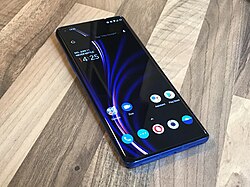
OnePlus 8 and OnePlus 8 Pro are Android-based smartphones manufactured by OnePlus, unveiled on April 14, 2020.[1][2][3] They became available for purchase in the United States on April 29, 2020.
Specifications
[edit]Hardware
[edit]Both the OnePlus 8 and 8 Pro use the Snapdragon 865 processor with the Adreno 650 GPU, with either 128 or 256 GB of non-expandable UFS 3.0 storage. Both have 8 GB or 12 GB of RAM; the 8 has LPDDR4X RAM and the 8 Pro has faster, more efficient LPDDR5 RAM. Both have stereo speakers with active noise cancellation; there is no audio jack.
Design
[edit]The 8 and 8 Pro are constructed similarly to previous OnePlus phones, using an anodized aluminum frame and curved Gorilla Glass 5 on both the front and back. Both have a circular cutout in the upper-left-hand corner for the front-facing camera. On the 8 Pro, this replaces the pop-up camera used on the 7 Pro and 7T Pro. The rear camera module is similar to that of the 7 Pro and 7T Pro, protruding slightly from the back panel. On the 8, the dual-LED flash is located below, while on the 8 Pro, the telephoto camera, laser autofocus and dual-LED flash are all located to the left of the module. The 8 and 8 Pro are the first OnePlus phones to receive an official IP Code water resistance rating, rated at IP68. All 8 Pro models have water resistance, although for the 8 it is present only on carrier models. Both are available in Onyx Black (glossy) and Glacial Green (matte), while the 8 Pro has its own Ultramarine Blue (matte) finish. The 8 has two additional colors, a Polar Silver (matte) finish exclusive to the Verizon model,[4] and an Interstellar Glow (glossy) finish exclusive to the T-Mobile model.
Display
[edit]AMOLED panels with HDR10+ support are used on both phones. The 8's display is carried over from the 7T, a 6.55-inch (166.4 mm) 1080p screen with a 20:9 aspect ratio and a 90 Hz refresh rate. The 8 Pro's display has a 6.78-inch (172.2 mm) 1440p screen with a 19.8:9 aspect ratio and a 120 Hz refresh rate. This makes it the first smartphone to support both 1440p resolution and a 120 Hz refresh rate. The 8 Pro has an Adaptive Display feature, similar to Apple's True Tone, and an MEMC (Motion Estimation, Motion Compensation) option akin to "motion smoothening" on high-end TVs.[5] MEMC works with supported apps and games, and analyzes footage of at least 24 fps and interpolates frames to make the footage playback in what looks to be a higher frame rate. The 8 Pro is also one of the first smartphones able to display 1 billion colors.
Biometric options include an optical (in-display) fingerprint scanner and facial recognition.[6][7][8]
Camera
[edit]The camera system has been changed to further differentiate the 8 and 8 Pro. The 8's camera array consists of a 48 MP wide sensor, a 16 MP ultrawide sensor, and a 2 MP macro sensor, while the 8 Pro's camera array consists of a 48 MP wide sensor, a 48 MP ultrawide sensor, an 8 MP telephoto sensor, and a 5 MP "Color Filter Camera" for infrared photography. The color filter camera was later disabled in China.[9] The 8's wide sensor is the same as on the 7T series, the Sony IMX586, while the 8 Pro's wide sensor is the newer Sony IMX689. Unlike the 7T, the 8 does not have a telephoto camera, which is now exclusive to the 8 Pro. OnePlus also claims that the 8 Pro uses Nokia OZO audio recording technology for its triple microphone array, which is used for the Audio 3D, Audio Zoom and Audio Windscreen camera features.[10] The front camera on both phones uses a 16 MP sensor.
Battery
[edit]The battery capacity has been increased to 4300 mAh on the 8 and 4510 mAh on the 8 Pro. Both smartphones support wired fast charging at 30W via Warp Charge, and the 8 Pro also supports wireless charging via the new OnePlus Warp Charge 30 Wireless,[11] which is able to charge 50% of the phone's battery in under 30 minutes.[12] The OnePlus 8 Pro also supports reverse wireless charging.[13]
Software
[edit]The 8 and 8 Pro run on OxygenOS 11, which is based on Android 11. OnePlus states both phones would go on and continue to receive software updates until April 2023.[14] The latest Oxygen OS version given to Oneplus 8/8Pro was Oxygen OS 13. However, Oneplus 8/8 pro are still supported by custom roms. Most notable of them include Lineage OS, Evolution X, and CrDroid. Oneplus 8 has already received Android 16 update from Lineage OS, Evolution X, and CrDroid.
Network compatibility
[edit]| Model | GSM
Bands |
CDMA
Bands |
UMTS
Bands |
LTE
Bands |
5G
Bands |
|---|---|---|---|---|---|
| 8 | 850 / 900 / 1800 / 1900 MHz | BC0, BC1 | 1, 2, 4, 5, 8, 9, 19 | FDD: 1, 2, 3, 4, 5, 7, 8, 12, 13, 17, 18, 19, 20, 25, 26, 28, 29, 30, 32, 66, 71
TDD: 34, 38, 39, 40, 41, 42, 46, 48 |
FDD: 1, 2, 3, 5, 7, 28, 66, 71
TDD: 41, 78, 79 |
| 8 5G UW | FDD: 1, 2, 3, 5, 7, 28, 66, 71
TDD: 41, 78, 79 mmWave: 260, 261 | ||||
| 8 Pro | FDD: 1, 2, 3, 5, 7, 28, 66, 71
TDD: 41, 78, 79 |
Connectivity options have been improved with the implementation of 5G technology for all models, however only the Verizon OnePlus 8 5G UW model is compatible with ultra-fast millimeter-wave networks.[15] Verizon and T-Mobile sell the 8 but not the 8 Pro, however the 8 Pro still works on their networks.[16]
Variants
[edit]There are six model OnePlus 8 variants available depending on the country of intended use or USA carrier: IN2010 (China), IN2011 (India), IN2013 (Europe/Asia), North American variants include the IN2015 (NA/USA Dual Sim), IN2017 (T-Mobile), and IN2019 (Verizon). The IN2017 supports T-Mobile 5G bands, the IN2019 supports Verizon 5G bands, and no variant supports AT&T 5G bands.
There are four model OnePlus 8 Pro variants available depending on the country of intended use: IN2020 (China), IN2023 (Europe/Asia), IN2021 (India), and IN2015 (NA/USA).
| Model | Variant | Region |
|---|---|---|
| OnePlus 8 | IN2010 | China |
| IN2011 | India | |
| IN2013 | Europe/Asia | |
| IN2015 | NA/USA | |
| IN2017 | T-Mobile | |
| IN2019 | Verizon | |
| OnePlus 8 Pro | IN2020 | China |
| IN2021 | India | |
| IN2023 | Europe/Asia | |
| IN2025 | NA/USA |
Reception
[edit]Both the OnePlus 8 and OnePlus 8 Pro were met with generally positive reviews from critics, with praise for the design, display, performance, and battery life. However, the price increase was said to have signified that OnePlus phones were no longer "flagship killers".[17][18]
The OnePlus 8 received an 8/10 from The Verge,[19] an 8.7/10 from CNET[20] and a 3/5 from Digital Trends.[21] Jon Porter of The Verge remarked that the 8 was "a phone that absolutely delivers flagship Android performance" and called the display "bright, vibrant and buttery smooth", but the camera quality was inferior to the 8 Pro; Tom's Guide and CNET also noted the lack of optical zoom.[22] The lack of wireless charging and water resistance were criticized, and the macro camera was panned for being of limited use.
The OnePlus 8 Pro received an 8.5/10 from The Verge,[23] an 8.6/10 from CNET[24] and a 4/5 from Digital Trends.[25] Mark Spoonauer of Tom's Guide stated that "overall the OnePlus 8 Pro is easily one of the best Android phones you can buy if you want a premium phone without the $1,000-plus sticker shock from Samsung or Apple".[26] Several reviewers questioned the inclusion of the color filter sensor, which was widely seen as a gimmick.
The OnePlus 8 Pro received an overall score of 119 from DXOMARK, with a photo score of 126 and video score of 103, the tenth-highest ranking as of May 2020.[27]
The OnePlus 8 became the first phone by OnePlus to be a part of the Android Enterprise Recommended program.[28]
Issues
[edit]After pre-orders delivered, OnePlus 8 Pro owners reported issues with black crush, green and red tints, and image retention resembling display burn-in. OnePlus has attempted to fix the display issues with software, but the issue may be with the screen hardware itself.[29] As of 20 July 2020, the dual-sim function on the NA version of either mode of the phone is not functional.[30][31] In August 2020, users reported a dark bar appearing across the selfie camera. The issue is easily visible over gray backgrounds such as the incognito window of Google Chrome, or the Google Search app in dark mode. In October 2020, users reported battery drain issues on the OnePlus 8 Pro after updating to OxygenOS 11. A software update was released in mid-November to fix the issue.[32]
Controversy
[edit]It was discovered that the 8 Pro's Color Filter camera can see through certain plastics, including clothing, producing an X-ray like effect. This occurs because the sensor lacks an IR filter.[33] OnePlus later apologized for "creating privacy concerns and causing troubles for OnePlus users and other netizens", and temporarily disabled the filter on Chinese models with HydrogenOS.[34] An over-the-air update, OxygenOS 10.5.9, disabled the filter globally; however, OnePlus later stated this was an error, and subsequently pulled the update. A future update was pushed to reinstate the filter.[35] The feature was still usable after enabling an ADB command during the shutdown period.[36]
See also
[edit]References
[edit]- ^ Dayaram, Sareena; Blumenthal, Eli (14 April 2020). "OnePlus 8 and 8 Pro launch: Everything you need to know". CNET. Archived from the original on 15 April 2020. Retrieved 14 April 2020.
- ^ Warren, Tom (14 April 2020). "The OnePlus 8 Pro has a 120Hz screen, quadruple camera, and costs $899". The Verge. Archived from the original on 14 April 2020. Retrieved 14 April 2020.
- ^ Amadeo, Ron (14 April 2020). "OnePlus 8 Pro review—The best flagship of 2020, even if it is more expensive". Ars Technica. Archived from the original on 14 April 2020. Retrieved 14 April 2020.
- ^ Welch, Chris (14 April 2020). "The OnePlus 8 5G is coming to Verizon for $799". The Verge. Archived from the original on 14 April 2020. Retrieved 14 April 2020.
- ^ Huseman, Hayato (16 May 2020). "What is Motion Graphics Smoothing on the OnePlus 8 Pro and how to use it". androidcentral. Archived from the original on 22 May 2020. Retrieved 17 May 2020.
- ^ "Specs | OnePlus 8 | Lead with Speed - OnePlus (United States)". www.oneplus.com. Archived from the original on 20 May 2020. Retrieved 21 May 2020.
- ^ "Specs | OnePlus 8 Pro | Lead with Speed - OnePlus (United States)". www.oneplus.com. Archived from the original on 18 May 2020. Retrieved 21 May 2020.
- ^ "OnePlus 8 Pro - Full phone specifications". www.gsmarena.com. Archived from the original on 26 May 2020. Retrieved 21 May 2020.
- ^ OnePlus messed up., 20 May 2020, retrieved 8 August 2020
- ^ "The OnePlus 8 Pro packs Nokia OZO microphone tech". GSMArena. 15 April 2020. Archived from the original on 27 April 2020. Retrieved 15 April 2020.
- ^ "Warp Charge 30 Wireless – All power, no wires". OnePlus Forum. Archived from the original on 16 June 2020. Retrieved 24 May 2020.
- ^ "The fastest wireless charger ever: the new OnePlus Warp Charge 30 Wireless breaks all the records". Charger Universe. 22 April 2020. Retrieved 24 May 2020.
- ^ "OnePlus 8 Pro is all about speed, photography and wireless charging". Engadget. 14 April 2020. Archived from the original on 28 April 2020. Retrieved 24 May 2020.
- ^ "OnePlus 8 Series, OnePlus Nord End of Support Planned for Mid-2023". NDTV Gadgets 360. 8 December 2020. Retrieved 24 March 2021.
- ^ Cheng, Roger; Blumenthal, Eli (14 April 2020). "The fastest OnePlus 8 5G variant is an exclusive with Verizon". CNET. Archived from the original on 22 April 2020. Retrieved 14 April 2020.
- ^ Faulkner, Cameron (14 April 2020). "How to buy the OnePlus 8 and OnePlus 8 Pro". The Verge. Archived from the original on 14 April 2020. Retrieved 14 April 2020.
- ^ Chia, Osmond (25 April 2020). "2020: Death of the flagship killer phones". SlashGear. Archived from the original on 13 May 2020. Retrieved 25 May 2020.
- ^ Shahid, Furqan (15 April 2020). "OnePlus Phones are No Longer the Flagship Killer They Once Were". wccftech. Archived from the original on 31 May 2020. Retrieved 25 May 2020.
- ^ Porter, Jon (14 April 2020). "OnePlus 8 Review: Familiar Formula". The Verge. Archived from the original on 22 April 2020. Retrieved 22 April 2020.
- ^ La, Lynn (16 April 2020). "OnePlus 8 review: Even without wireless charging, I prefer this cheaper model". CNET. Archived from the original on 21 April 2020. Retrieved 22 April 2020.
- ^ Boxall, Andy (14 April 2020). "OnePlus 8 Review: A fine phone that needs a killer feature". Digital Trends. Archived from the original on 21 April 2020. Retrieved 22 April 2020.
- ^ Michaels, Philip (14 April 2020). "OnePlus 8 review". Tom's Guide. Archived from the original on 26 April 2020. Retrieved 22 April 2020.
- ^ Bohn, Dieter (14 April 2020). "OnePlus 8 Pro Review: Big League". The Verge. Archived from the original on 21 April 2020. Retrieved 22 April 2020.
- ^ La, Lynn (16 April 2020). "Review: OnePlus 8 Pro is an excellent phone, but dang, it's pricey". CNET. Archived from the original on 21 April 2020. Retrieved 22 April 2020.
- ^ Boxall, Andy (14 April 2020). "OnePlus 8 Pro Review: Everything you want". Digital Trends. Archived from the original on 22 April 2020. Retrieved 22 April 2020.
- ^ Spoonauer, Mark (16 April 2020). "OnePlus 8 Pro review". Tom's Guide. Archived from the original on 25 April 2020. Retrieved 22 April 2020.
- ^ Carroll, Paul (5 June 2020). "OnePlus 8 Pro camera review". DXOMARK. Archived from the original on 5 June 2020. Retrieved 5 June 2020.
- ^ Russell, Brandon (14 August 2020). "The OnePlus 8 is OnePlus's first Android Enterprise Recommended phone". xda-developers. Retrieved 16 August 2020.
- ^ Wilde, Damien (4 May 2020). "[Update: Potential hardware defect] OnePlus 8 Pro display issues surface on some devices but a fix is inbound". 9to5Google. Archived from the original on 1 June 2020. Retrieved 12 May 2020.
- ^ "OxygenOS 10.5.12 and 10.5.11 [EU] for the OnePlus 8 Pro". OnePlus Community. Retrieved 20 July 2020.
- ^ "DUAL SIM does not work". OnePlus Community. Retrieved 20 July 2020.
- ^ "OnePlus 8, 8 Pro Reportedly Facing Battery Drain Issues After Update to OxygenOS 11". MySmartPrice. 30 October 2020. Archived from the original on 1 November 2020. Retrieved 22 November 2020.
- ^ Vincent, James (15 May 2020). "OnePlus 8 Pro has an accidental X-ray vision filter that sees through plastic and clothes". The Verge. Archived from the original on 15 May 2020. Retrieved 15 May 2020.
- ^ Porter, Jon (19 May 2020). "OnePlus will disable 'X-ray' camera feature in a future update". The Verge. Archived from the original on 19 May 2020. Retrieved 19 May 2020.
- ^ Wilde, Damien (29 May 2020). "OxygenOS 10.5.9 for OnePlus 8 Pro disables the Color Filter camera". 9to5Google. Archived from the original on 31 May 2020. Retrieved 29 May 2020.
- ^ Siddiqui, Aamir (17 July 2020). "The OnePlus 8 Pro's color filter camera is still accessible with an ADB command". xda-developers. Archived from the original on 17 July 2020. Retrieved 17 July 2020.
External links
[edit]| Devices |
| ||||||||||||||||
|---|---|---|---|---|---|---|---|---|---|---|---|---|---|---|---|---|---|
| Software | |||||||||||||||||
| People | |||||||||||||||||
| Brands | |||||||||||||||||||||||||||||||||||||||||||||||||||||||||||||||||||||||||||||||||||||||||||||||||||||||||||||||||||
|---|---|---|---|---|---|---|---|---|---|---|---|---|---|---|---|---|---|---|---|---|---|---|---|---|---|---|---|---|---|---|---|---|---|---|---|---|---|---|---|---|---|---|---|---|---|---|---|---|---|---|---|---|---|---|---|---|---|---|---|---|---|---|---|---|---|---|---|---|---|---|---|---|---|---|---|---|---|---|---|---|---|---|---|---|---|---|---|---|---|---|---|---|---|---|---|---|---|---|---|---|---|---|---|---|---|---|---|---|---|---|---|---|---|---|---|
| |||||||||||||||||||||||||||||||||||||||||||||||||||||||||||||||||||||||||||||||||||||||||||||||||||||||||||||||||||
| |||||||||||||||||||||||||||||||||||||||||||||||||||||||||||||||||||||||||||||||||||||||||||||||||||||||||||||||||||
OnePlus 8
View on GrokipediaHistory and Development
Announcement and Launch
The OnePlus 8 was unveiled on April 14, 2020, during a digital launch event streamed online globally, a format necessitated by the COVID-19 pandemic disrupting in-person gatherings.[8][9] The announcement highlighted the device's integration of 5G connectivity, a Qualcomm Snapdragon 865 processor, and a 90Hz Fluid AMOLED display, positioning it as a flagship offering in OnePlus's lineup alongside the premium OnePlus 8 Pro variant.[10][11] OnePlus had teased the series earlier in March 2020 via social media and official channels, building anticipation for mid-April reveals without specifying exact dates until the confirmation on March 30.[12] Pre-orders opened immediately following the event in regions such as Europe, with general availability commencing on April 21, 2020, in those markets through OnePlus's website and partners.[13] In the United States and Canada, the OnePlus 8 went on sale April 29, 2020, available via OnePlus.com, Best Buy, and other retailers, reflecting staggered rollouts to manage supply chains amid pandemic-related logistics challenges.[14][2] The launch emphasized competitive pricing, starting at $699 for the base 128GB model, aimed at undercutting rivals like Samsung's Galaxy S20 series while delivering comparable high-end specifications.[15]Pricing and Market Positioning
The OnePlus 8 was launched in the United States on April 29, 2020, with a base price of $699 for the 8 GB RAM and 128 GB storage configuration, positioning it as the most affordable unlocked 5G smartphone available at the time.[16] [15] A higher-end variant with 12 GB RAM and 256 GB storage retailed for $799, while carrier-specific models like the Verizon 5G UW edition started at $799.99.[17] [18] These prices reflected OnePlus's strategy of offering flagship-level specifications—including a Snapdragon 865 processor, 90 Hz Fluid Display, and 5G connectivity—at a discount compared to contemporaries like the Samsung Galaxy S20 ($999 base) or Google Pixel 4 ($799 base, without full 5G support initially).[16]| Variant | RAM/Storage | US Launch Price |
|---|---|---|
| Base | 8 GB/128 GB | $699 |
| Premium | 12 GB/256 GB | $799 |
Physical Design and Build
Materials and Durability
The OnePlus 8 features a front and rear panel constructed from Corning Gorilla Glass 5, a chemically strengthened alkali-aluminosilicate sheet glass designed to resist scratches and drops.[26] This material, applied in a 3D curved form on the display cover, provides enhanced surface hardness capable of withstanding scratches from objects up to level 6 on the Mohs scale, such as keys or coins, though deeper abrasions occur at level 7 and above.[27] The device's frame is made of aluminum alloy, which contributes to a lightweight yet rigid structure weighing 180 grams, balancing aesthetics with structural support against everyday flexing.[28] Durability testing of similar builds indicates that Gorilla Glass 5 on the OnePlus 8 survives drops from up to 1.6 meters onto hard surfaces with low failure rates in controlled conditions, though real-world impacts on concrete or uneven terrain often result in cracks or shattering without protective cases. The aluminum frame resists moderate bending forces but its anodized coating scratches easily under metal-edged tools, potentially exposing the underlying metal to corrosion over time if not maintained.[28] Unlike the OnePlus 8 Pro, the base model lacks an official IP68 dust and water resistance rating in its global unlocked configuration, relying instead on basic gaskets for splash resistance equivalent to IP64 in some tests; U.S. carrier variants (T-Mobile and Verizon) incorporate additional sealing for full IP68 compliance, submersible up to 1.5 meters for 30 minutes.[29][30] Overall, the materials prioritize a sleek, premium hand-feel over ruggedness, making the device susceptible to damage from high-impact drops or prolonged exposure to liquids without certification-backed protection; users report frequent recommendations for tempered glass screen protectors and cases to mitigate glass fracture risks observed in user forums and reviews.[31][28]Dimensions and User Ergonomics
The OnePlus 8 measures 160.2 mm in height, 72.9 mm in width, 8.0 mm in thickness, and weighs 180 grams.[27][2] These specifications position it as a compact flagship smartphone for its era, with a 6.55-inch display that balances screen real estate and portability.[32] User ergonomics benefit from the device's lightweight build and slim profile, which reviewers described as not burdensome during extended use, facilitating easier pocketability and handling compared to heavier contemporaries like the Xiaomi Mi 10.[33] The rounded edges and aluminum frame contribute to a secure grip, with the phone often perceived as feeling smaller than its actual dimensions suggest, aiding one-handed operation for tasks such as typing and navigation.[5] The signature alert slider on the left side enables seamless toggling between ring, vibrate, and silent modes without software interaction, a hardware feature praised for streamlining daily usability.[5] Power and volume buttons are positioned on the right side at a natural reach for right-handed users, while the placement of the ultrasonic fingerprint sensor under the display supports quick authentication without compromising the glass-backed aesthetics.[5] However, the lack of an official IP rating means users must exercise caution around water, potentially limiting ergonomic confidence in wet conditions despite informal splash resistance claims from testing.[2] Overall, these elements make the OnePlus 8 suitable for users prioritizing maneuverability over larger-screen bulk.[33]Display Features
The OnePlus 8 is equipped with a 6.55-inch Fluid AMOLED display, featuring a resolution of 1080 x 2400 pixels at a 20:9 aspect ratio and a pixel density of approximately 402 ppi.[27][2] This configuration yields a screen-to-body ratio of about 88.7%, facilitated by slim bezels and a punch-hole cutout for the front-facing camera.[2] The panel supports a 90 Hz refresh rate, enabling smoother animations, scrolling, and app transitions compared to standard 60 Hz displays, with adaptive switching to conserve battery when high refresh is unnecessary.[2][34] It also incorporates HDR10+ certification for dynamic metadata-enhanced color and contrast in compatible video content, alongside features like Night Mode for reduced blue light emission and Reading Mode for eye comfort during prolonged use.[2][27] The display is protected by Corning Gorilla Glass 5, providing resistance to scratches and minor drops, though it lacks an official IP rating for water or dust ingress.[2] Peak brightness reaches up to 1100 nits in high ambient light conditions, ensuring visibility outdoors, while the AMOLED technology delivers deep blacks and vibrant colors through individual pixel-level dimming.[2]Core Hardware Performance
Processor, RAM, and Storage
The OnePlus 8 employs the Qualcomm Snapdragon 865 5G Mobile Platform as its system-on-chip (SoC).[27] Announced by Qualcomm on December 4, 2019, this 7 nm-process SoC includes an octa-core Kryo 585 CPU with one prime core (Cortex-A77) at up to 2.84 GHz, three performance cores (Cortex-A77) at up to 2.42 GHz, and four efficiency cores (Cortex-A55) at up to 1.8 GHz.[35] It integrates the Adreno 650 GPU for graphics processing and the Snapdragon X55 modem for 5G connectivity supporting sub-6 GHz and mmWave bands.[35][27] RAM configurations consist of 8 GB or 12 GB LPDDR4X, with the higher amount paired exclusively with expanded storage in available variants.[27] Internal storage options are 128 GB or 256 GB utilizing UFS 3.0 on a 2-lane interface, which provides faster read/write speeds compared to prior UFS standards but lacks support for microSD expansion.[27]| Variant | RAM | Storage |
|---|---|---|
| Base | 8 GB LPDDR4X | 128 GB UFS 3.0 |
| Premium | 12 GB LPDDR4X | 256 GB UFS 3.0 |
Benchmark Results and Real-World Use
The OnePlus 8, powered by the Qualcomm Snapdragon 865 processor with up to 12 GB of LPDDR4X RAM and UFS 3.0 storage, delivered flagship-level synthetic benchmark performance upon release in April 2020. In Geekbench 6, it achieved an average single-core score of approximately 1158 and multi-core scores in line with Snapdragon 865 peers, reflecting strong CPU efficiency for tasks like app launching and computation. [37] AnTuTu v10 results averaged around 743,500 points, with CPU subscores emphasizing the octa-core Kryo 585 configuration's balance of prime cores at 2.84 GHz and efficiency cores. Graphics performance via the Adreno 650 GPU scored well in 3DMark Wild Life at 3843 points with 99% stability, indicating minimal thermal throttling during sustained loads and effective handling of OpenGL ES 3.1 workloads. GFXBench tests further confirmed consistent frame rates in Manhattan and T-Rex scenarios, underscoring GPU reliability without significant degradation over extended runs.[38] [39] [40]| Benchmark | Score | Notes |
|---|---|---|
| Geekbench 6 Single-Core | ~1158 | Average from user submissions |
| AnTuTu v10 Total | ~743,500 | Includes CPU, GPU, memory, and UX subtests[38] |
| 3DMark Wild Life | 3843 | 99% stability; 23 FPS in graphics test[39] |
Camera System
Rear Cameras and Capabilities
The OnePlus 8 features a triple rear camera array consisting of a 48-megapixel main sensor, a 16-megapixel ultrawide lens, and a 2-megapixel macro shooter, arranged vertically with a dual-LED flash below.[2][27] The main camera uses a Sony IMX586 sensor with 0.8µm pixels, a 1/2.0-inch size, f/1.75 aperture, 6-element lens, phase-detection autofocus (PDAF), optical image stabilization (OIS), and electronic image stabilization (EIS).[27][44] The ultrawide camera employs a Sony IMX481 sensor with f/2.2 aperture, 116-degree field of view, and EIS but lacks autofocus or stabilization.[27][2] The macro lens, with its f/2.4 aperture and fixed focus, enables close-up shots at approximately 4cm but delivers limited detail due to low resolution.[2][45] Software capabilities include Nightscape mode for low-light enhancement via multi-frame stacking, Pro mode for manual controls (ISO, shutter speed up to 30 seconds, white balance), and AI Scene Enhancement for automatic optimization.[3] Video recording supports 4K at 30/60fps, 1080p at 30/60/240fps, and 720p at 480fps on the main and ultrawide lenses, with gyro-EIS for stabilization.[6] The camera app allows seamless switching between lenses and offers high-resolution mode for 48MP stills without pixel binning.[3] In daylight, the main sensor produces sharp, color-accurate images with good dynamic range, though saturation can appear elevated compared to reference sensors.[3][29] Ultrawide shots maintain consistent exposure but exhibit edge distortion and softer details at the periphery.[3] Low-light performance on the main camera benefits from OIS and Nightscape, reducing noise effectively, but the ultrawide suffers from softness and elevated noise without dedicated stabilization.[3] The macro lens yields usable but low-fidelity results suitable only for casual close-ups, lacking the versatility of higher-resolution alternatives.[45] Overall, the system prioritizes competent everyday photography over specialized low-light or zoom prowess, aligning with mid-range hardware constraints.[43][29]Front Camera and Additional Imaging
The OnePlus 8 features a single 16-megapixel front-facing camera with a Sony IMX471 sensor, 1.0 µm pixel size, f/2.4 aperture, and fixed focus, positioned in a punch-hole cutout on the 6.55-inch Fluid AMOLED display.[27] [2] This setup supports electronic image stabilization (EIS) via gyro-EIS and HDR processing for enhanced dynamic range in selfies.[27] [2] Software features include portrait mode with software-based edge detection for bokeh effects, introduced via OxygenOS updates, enabling high-quality selfies with blurred backgrounds.[34] The camera records 1080p video at 30 fps with gyro-EIS for smoother footage during handheld use, but lacks 4K support or autofocus, limiting versatility in varied lighting or close-up scenarios.[2] [32] In performance tests, the front camera produces detailed images with accurate skin tones and good exposure in well-lit conditions, though fixed focus can result in softer details at varying distances.[46] Low-light selfies exhibit noise and reduced sharpness compared to competitors with autofocus, but overall output is deemed respectable for social media and casual use.[43] No additional dedicated sensors, such as depth or infrared modules, are present for the front camera, relying instead on computational photography for enhancements like face detection and beauty filters in the OxygenOS camera app.[45]Battery and Power
Capacity and Efficiency
The OnePlus 8 features a non-removable lithium-polymer battery with a typical capacity of 4300 mAh and a rated capacity of 4230 mAh.[34][2] This represents an increase from the 3700 mAh battery in the OnePlus 7 and the 3800 mAh in the OnePlus 7T, reflecting optimizations in cell density and power management.[47][36] Battery efficiency benefits from the Qualcomm Snapdragon 865 chipset's 7 nm architecture, which delivers improved power consumption over prior generations, alongside software tweaks in OxygenOS for adaptive refresh rates on the 90 Hz Fluid AMOLED display.[48] Independent tests demonstrate solid endurance: continuous YouTube playback over Wi-Fi lasted 9 hours and 37 minutes at default settings, while mixed usage (browsing, video, and gaming) averaged 9.5 to 11.5 hours depending on configuration.[47][43] Switching from 90 Hz to 60 Hz refresh extended video playback by up to 13% in some benchmarks, though real-world gains were marginal for lighter tasks due to the display's adaptive mode.[47][29] Despite the integrated Snapdragon X55 5G modem's potential for higher drain, the OnePlus 8 maintained competitive efficiency in 4G and early 5G scenarios, with reviewers noting full-day usability under moderate loads (e.g., 6-8 hours screen-on time) without aggressive throttling.[48][49] Factors like background app optimization and the absence of excessive bloatware contributed to this, outperforming some contemporaries in sustained web browsing at 11.5 hours.[43][50]Charging Methods and Speeds
The OnePlus 8 employs wired charging exclusively via its USB Type-C 3.1 Gen 1 port, utilizing OnePlus's proprietary Warp Charge 30T technology, which delivers a maximum power input of 30 watts at 5 volts and 6 amperes.[27] This system requires the bundled 30W Warp Charge adapter and USB-A to USB-C cable for optimal performance, achieving a full charge of the 4300 mAh battery from 0% to 100% in approximately 60 minutes under controlled laboratory conditions with the device powered off or in low-power mode.[27] Charging speeds taper off above 80% to preserve battery health, and real-world times may extend to 75-90 minutes depending on ambient temperature, usage, and cable quality. The device does not feature native wireless charging support, distinguishing it from the OnePlus 8 Pro model, which includes 30W wireless capabilities.[27] Reverse wireless charging is similarly absent. Third-party USB-C wireless charging adapters can enable inductive charging by plugging into the port, but these operate at reduced speeds—typically 5-10W—and may increase thermal output without the efficiency of direct wired connection.[51] Reverse wired charging is supported through USB On-The-Go (OTG) functionality, permitting the OnePlus 8 to output power to compatible devices via a USB-C to USB-C cable at up to 5 watts, accessible via settings under battery options or USB preferences.[52] This feature proves useful for emergency top-ups of accessories like earbuds or other phones but drains the host battery rapidly and is not optimized for high-power transfer.[53] OnePlus does not advertise reverse charging as a primary feature for the base model, prioritizing it in the Pro variant's wireless implementation.Software and Operating System
Initial OxygenOS Version
The OnePlus 8 launched on April 14, 2020, with OxygenOS 10.0, a customized user interface built directly on Android 10.[43] This version emphasized a near-stock Android experience, minimizing bloatware while incorporating OnePlus-specific enhancements for performance and usability, such as fluid animations optimized for the device's 90 Hz Fluid AMOLED display and gesture-based navigation that replaced traditional buttons for smoother interaction.[43] OxygenOS 10 included utility features like Zen Mode, which temporarily locks the device to promote focused usage without distractions, and an Always-On Display (AOD) with an Insight engine providing contextual notifications such as weather or calendar events without fully waking the screen.[54] Key system optimizations in the initial OxygenOS 10 rollout focused on battery efficiency and thermal management for the Snapdragon 865 chipset, enabling sustained high-frame-rate gaming and multitasking with up to 12 GB of LPDDR4X RAM.[43] The software supported advanced customization options, including icon pack theming, dark mode with adjustable contrast, and parallel app processing for dual instances of select applications like WhatsApp.[54] Shortly after launch, the first incremental update to OxygenOS 10.5.4 on April 17, 2020, introduced minor refinements such as Live Caption for real-time audio transcription and camera app stability improvements, but the core initial build retained Android 10's security patches from March 2020 and native 5G connectivity toggles.[55] This setup positioned the OnePlus 8 as a device prioritizing speed and simplicity over heavy feature layering, aligning with OnePlus's philosophy of "OxygenOS as close to pure Android as possible" while adding value through subtle, non-intrusive tools.[43]Update Timeline and Policy
The OnePlus 8 series, launched in April 2020 with OxygenOS 10 based on Android 10, was supported under OnePlus's policy of three major Android OS updates and four years of security patches for flagship devices starting from that generation.[56][57] This represented an extension from the initial two-year OS commitment, announced in July 2021 to align with competitive standards.[56] Security updates were delivered bi-monthly or aligned with Google patches within 90 days of release, though delays occurred in later cycles.[58] Major OS updates progressed as follows: OxygenOS 11 (Android 11) in late 2020, OxygenOS 12 (Android 12) in early 2022, and OxygenOS 13 (Android 13) finalized in November 2022, marking the end of OS upgrades.[59] Security patches continued through 2023, with the final update in April 2024 incorporating patches up to March 2024, after which support officially ceased.[60][61] No further updates, including Android 14 or beyond, were provided, consistent with the policy's limits and OnePlus's prioritization of newer hardware for advanced features like AI enhancements in OxygenOS 15 and 16.[62] Post-support, devices remain on OxygenOS 13 with potential for third-party custom ROMs, but official policy excludes ongoing maintenance due to hardware constraints and resource allocation toward models eligible for up to four OS updates and six years of security from the OnePlus 12 series onward.[63] This timeline reflects OnePlus's historical pattern of reliable but not class-leading longevity, with the four-year security window providing adequate but finite protection against vulnerabilities.[64]Connectivity Options
Network Bands and 5G
The OnePlus 8 is equipped with the Qualcomm Snapdragon 865 chipset, which includes the X55 5G modem supporting sub-6 GHz 5G frequencies in non-standalone (NSA) and standalone (SA) modes on select bands, but lacks millimeter-wave (mmWave) capability across all variants. Theoretical 5G downlink speeds reach up to 7.5 Gbps, while LTE peaks at Cat 18 with 1.2 Gbps downlink and 200 Mbps uplink, depending on carrier aggregation and local deployment. Network band support varies significantly by regional model (e.g., IN2010/IN2013 for global/EU/India, IN2015/IN2017/IN2019 for North America), optimized for major carriers in each market but potentially limiting roaming or compatibility in unsupported regions.[65][27][66] For global variants (primarily EU and India markets), the device supports quad-band 2G GSM for basic fallback connectivity, WCDMA and CDMA for 3G, and extensive FDD/TDD LTE bands for 4G coverage. 5G is limited to key sub-6 GHz bands, with n1, n3, n7, and n28 restricted to NSA mode (relying on 4G LTE anchors), while n78 supports both SA and NSA for broader future-proofing in Europe and India. Actual performance depends on operator deployment, as n78 is widely used by carriers like Vodafone in Europe and Reliance Jio/Airtel in India.[27][67]| Network Type | Supported Bands |
|---|---|
| 2G (GSM) | 850, 900, 1800, 1900 MHz[27] |
| 3G (WCDMA) | B1, B2, B4, B5, B8, B9, B19; CDMA BC0[27] |
| 4G LTE (FDD) | B1, B2, B3, B4, B5, B7, B8, B12, B13, B17, B18, B19, B20, B25, B26, B28, B32, B66[27] |
| 4G LTE (TDD) | B34, B38, B39, B40, B41, B42, B46[27] |
| 5G NR | n1, n3, n7, n28 (NSA only); n78 (SA/NSA)[27] |
| Network Type | Supported Bands |
|---|---|
| 4G LTE | B1, B2, B3, B4, B5, B7, B8, B12, B13, B17, B18, B19, B20, B25, B26, B28, B29, B30, B34, B38, B39, B40, B48, B66, B71[66] |
| 5G NR | n2, n5 (NSA); n41, n66 (NSA); n71 (SA/NSA)[66][49] |
Wireless Features and Compatibility
The OnePlus 8 incorporates Wi-Fi 6 (IEEE 802.11 a/b/g/n/ac/ax) with dual-band support, enabling theoretical maximum speeds up to 9.6 Gbps under optimal conditions, alongside features like Wi-Fi Direct for peer-to-peer connections and DLNA for media sharing compatibility with certified devices.[2][69] This standard ensures backward compatibility with older Wi-Fi protocols while improving efficiency and range in congested environments compared to Wi-Fi 5.[70] Bluetooth connectivity is provided via version 5.1, supporting core profiles including A2DP for stereo audio streaming, LE for low-energy operations, and advanced codecs such as aptX HD, LDAC, and AAC, which enhance audio fidelity over wireless headphones and speakers without requiring proprietary hardware.[2][36][70] The implementation maintains compatibility with a broad range of Bluetooth peripherals, though real-world range and stability depend on environmental interference. NFC hardware is integrated, facilitating secure contactless transactions via Google Pay and similar services, as well as quick data transfers like Android Beam when enabled in settings.[36][71] It adheres to standard NFC Forum protocols for interoperability with payment terminals and tags. The device does not include built-in Qi-compatible wireless charging coils, necessitating USB-C wired charging or external adapters for inductive power delivery, which may introduce efficiency losses.[72] No infrared (IR) blaster is present, precluding native remote control of TVs, air conditioners, or other IR-dependent appliances.[73]Model Variants
Base OnePlus 8
The OnePlus 8 served as the entry-level model in the OnePlus 8 series, announced on April 14, 2020, and released globally starting April 21, 2020.[2] It targeted premium mid-range buyers with a focus on performance and display fluidity at a lower price point than the Pro variant, starting at $699 for the 8 GB RAM and 128 GB storage configuration, with a higher-end 12 GB RAM and 256 GB storage option at $799.[15] The device measured 160.2 x 72.9 x 8.0 mm and weighed 180 grams, featuring a glass front and back with an aluminum frame protected by Gorilla Glass 5, available in Onyx Black and Glacial Green color options.[2] At its core, the OnePlus 8 utilized the Qualcomm Snapdragon 865 chipset with an Adreno 650 GPU, paired with 8 GB or 12 GB of LPDDR4X RAM and 128 GB or 256 GB UFS 3.0 storage options, lacking expandable storage via microSD.[27] The 6.55-inch Fluid AMOLED display offered a 1080 x 2400 pixel resolution, HDR10+ support, and a 90 Hz refresh rate for smoother scrolling compared to standard 60 Hz panels, though it lacked the higher 120 Hz of the Pro model.[34] Connectivity included 5G support across sub-6 GHz bands, Wi-Fi 6, Bluetooth 5.1, NFC, and dual stereo speakers, but omitted wireless charging and an official IP rating for water resistance present in the Pro.[74] The rear camera system comprised a triple setup: a 48 MP Sony IMX586 main sensor with optical image stabilization, a 16 MP ultrawide lens with 116-degree field of view, and a 2 MP macro lens, alongside a 16 MP front camera for selfies and video calls.[27] Video recording peaked at 4K at 30 fps or 1080p at 240 fps for slow-motion. The 4300 mAh battery supported 30W Warp Charge wired fast charging, achieving full capacity in approximately 55 minutes, but required a separate charger and lacked the Pro's 4510 mAh capacity or 15W wireless charging.[34] Launched with Android 10 under OxygenOS 10, it received updates up to Android 13 with OxygenOS 13 by late 2022.[2]| Specification | Details |
|---|---|
| Display | 6.55-inch Fluid AMOLED, 1080 x 2400 pixels, 90 Hz, HDR10+[34] |
| Processor | Qualcomm Snapdragon 865 (7 nm), octa-core up to 2.84 GHz[27] |
| Memory | 8/12 GB LPDDR4X RAM, 128/256 GB UFS 3.0 storage (no microSD)[2] |
| Rear Cameras | 48 MP (main, OIS), 16 MP (ultrawide), 2 MP (macro)[27] |
| Front Camera | 16 MP[27] |
| Battery | 4300 mAh, 30W wired charging[34] |
| Dimensions & Weight | 160.2 x 72.9 x 8.0 mm, 180 g[2] |
| Other | 5G, stereo speakers, in-display fingerprint, no wireless charging or IP rating[74] |
OnePlus 8 Pro
The OnePlus 8 Pro is the premium variant in the OnePlus 8 series, featuring enhanced hardware capabilities compared to the base model. It was released on April 21, 2020, with a starting price of $899 for the 12 GB RAM and 128 GB storage configuration.[75][76] The device measures 199 grams and 8.5 mm in thickness, incorporating an IP68 dust and water resistance rating.[75][77] Equipped with the Qualcomm Snapdragon 865 processor, the OnePlus 8 Pro supports 5G connectivity via the X55 modem and includes up to 12 GB LPDDR4X RAM paired with 128 GB or 256 GB UFS 3.0 storage options, without expandable storage.[78][79] Its 6.78-inch Fluid AMOLED display offers a 120 Hz refresh rate, 1440 x 3168 pixel resolution, and HDR10+ support, surpassing the base OnePlus 8's 90 Hz panel in smoothness and detail.[79][80] The camera system distinguishes the Pro model with a quad rear setup: a 48 MP Sony IMX689 main sensor with OIS, a 48 MP ultrawide, an 8 MP telephoto with 3x hybrid zoom, and a 5 MP color filter camera for specialized imaging effects.[78][80] Front-facing is a 16 MP sensor. Unlike the base model, it supports 30W wireless charging alongside 30W wired Warp Charge for its 4510 mAh battery.[79][81] Available in Onyx Black, Glacial Green, and Ultramarine Blue, the OnePlus 8 Pro launched in configurations of 8 GB/128 GB and 12 GB/128 GB or 256 GB, with regional model variants differing primarily in supported network bands such as IN2020 for China and IN2023 for Europe/Asia.[77][78] These differences position the Pro as a flagship contender emphasizing display quality, versatile photography, and charging flexibility over the more compact base model.[80]OnePlus 8T
The OnePlus 8T is a mid-cycle refresh in the OnePlus 8 series, positioned as an upgraded alternative to the base OnePlus 8 model without the premium features of the OnePlus 8 Pro, such as wireless charging or a telephoto camera. Announced on October 14, 2020, and released in the United States on October 23, 2020, it emphasizes faster charging, a higher refresh rate display, and a flat screen design to address user feedback on the curved edges of the OnePlus 8. Priced starting at $699 for the 8 GB RAM/128 GB storage configuration and $749 for the 12 GB/256 GB variant, it targeted consumers seeking flagship performance at a competitive price point.[82][83] The device measures 160.7 x 74.1 x 8.4 mm and weighs 188 grams, featuring a flat 6.55-inch Fluid AMOLED display with a 120 Hz refresh rate, 1080 x 2400 pixel resolution, HDR10+ support, and Corning Gorilla Glass 5 protection on both front and back panels. Powered by the Qualcomm Snapdragon 865 5G chipset with an octa-core Kryo 585 CPU (1x2.84 GHz, 3x2.42 GHz, 4x1.80 GHz) and Adreno 650 GPU, it offers configurations of 8 GB or 12 GB LPDDR4X RAM paired with 128 GB or 256 GB UFS 3.1 storage, lacking expandable storage via microSD. Unlike the OnePlus 8's 90 Hz curved display, the 8T's panel provides smoother scrolling and reduced edge distortions, though it maintains the same resolution without the higher pixel density of the Pro model.[84][85][86] Camera capabilities include a triple rear setup with a 48 MP Sony IMX586 main sensor (f/1.7, OIS), 16 MP ultrawide (f/2.2, 123° FOV), and 5 MP macro lens (f/2.4), alongside a 16 MP front camera for selfies; this adds a dedicated macro option absent in the base OnePlus 8's dual-camera array but omits the 8 Pro's 8 MP telephoto. The 4500 mAh battery supports 65 W Warp Charge fast charging, achieving a full charge in approximately 39 minutes, a significant upgrade over the OnePlus 8's 30 W and 4300 mAh setup, though wireless charging is not included. Connectivity encompasses 5G (sub-6 GHz), Wi-Fi 6, Bluetooth 5.1, NFC, and an in-display fingerprint sensor, with stereo speakers but no 3.5 mm headphone jack. It launched with Android 11 under OxygenOS 11 and received updates up to Android 14 with OxygenOS 14. Available in Aquamarine Green and Silver Black, the model lacks an official IP rating for water and dust resistance in most regions, though some carrier variants (e.g., T-Mobile) include IP68 certification.[84][85][87]| Specification | Details |
|---|---|
| Display | 6.55-inch Fluid AMOLED, 120 Hz, 1080 x 2400, HDR10+ |
| Processor | Snapdragon 865 5G (7 nm) |
| RAM/Storage | 8/12 GB LPDDR4X; 128/256 GB UFS 3.1 (no microSD) |
| Rear Camera | 48 MP (main, OIS) + 16 MP (ultrawide) + 5 MP (macro) |
| Front Camera | 16 MP |
| Battery/Charging | 4500 mAh; 65 W wired |
| Dimensions/Weight | 160.7 x 74.1 x 8.4 mm; 188 g |
| Other | IP64 (standard); stereo speakers; no wireless charging |