Hubbry Logo
Pachomius the GreatPachomius the GreatMain
Open search
Pachomius the Great
Community hub
Pachomius the Great
logo
8 pages, 0 posts
0 subscribers
Be the first to start a discussion here.
Pachomius the Great
Pachomius the Great
from Wikipedia

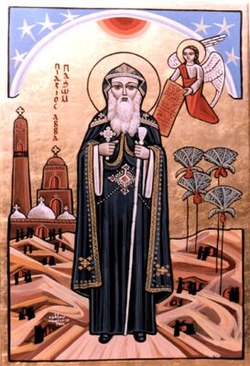
Pachomius (/pəˈkmiəs/; Greek: Παχώμιος Pakhomios; Coptic: Ⲡⲁϧⲱⲙ; c. 292 – 9 May 348 AD), also known as Saint Pachomius the Great, is generally recognized as the founder of Christian cenobitic monasticism.[1] Coptic churches celebrate his feast day on 9 May, and Eastern Orthodox and Catholic churches mark his feast on 15 May[2] or 28 May.[3] In Lutheranism, he is remembered as a renewer of the church, along with his contemporary (and fellow desert saint), Anthony of Egypt on 17 January.

Key Information

Name

[edit]

The name Pachomius is of Coptic origin:[4] ⲡⲁϧⲱⲙ pakhōm from ⲁϧⲱⲙ akhōm "eagle or falcon" (ⲡ p- at the beginning is the Coptic definite article), from Middle Egyptian ꜥẖm "falcon", originally "divine image". Into Greek, it was adopted as Παχούμιος and Παχώμιος. By Greek folk etymology, it was sometimes interpreted as "broad-shouldered" from παχύς "thick, large" and ὦμος "shoulder".

Life

[edit]

Pachomius was born in c. 292 in Thebaid (near modern-day Luxor, Egypt) to pagan parents.[5] According to his hagiography, at age 21, Pachomius was swept up against his will in a Roman army recruitment drive, a common occurrence during this period of turmoil and civil war. With several other youths, he was put onto a ship that floated down the Nile and arrived at Thebes in the evening. Here he first encountered local Christians, who customarily brought food and comfort daily to the conscripted troops. This made a lasting impression, and Pachomius vowed to investigate Christianity further when he got out.[6] He was able to leave the army without ever having to fight. He moved to the village of Sheneset (Chenoboskion) in Upper Egypt and was converted and baptized in 314.

Pachomius then came into contact with several well known ascetics and decided to pursue that path under the guidance of the hermit named Palaemon (317). One of his devotions, popular at the time, was praying with his arms stretched out in the form of a cross. After studying seven years with Palaemon, Pachomius set out to lead the life of a hermit near St. Anthony of Egypt, whose practices he imitated until Pachomius heard a voice in Tabennisi that told him to build a dwelling for the hermits to come to.[7] An earlier ascetic named Macarius had created a number of proto-monasteries called lavra, or cells, where holy men who were physically or mentally unable to achieve the rigors of Anthony's solitary life would live in a community setting. According to the Bohairic Life of Pachomius (17), while Pachomius was praying at the deserted village of Tabennisi, he heard a voice calling him, saying, "Pachomius, Pachomius, struggle, dwell in this place and build a monastery; for many will come to you to become monks with you, and they will profit their souls."[8]: 39  Later, while praying at night after a day of harvesting reeds with his brother on a small island, Pachomius had another vision of an angel saying to him three times, "Pachomius, Pachomius, the Lord's will is [for you] to minister to the race of men and to unite them to himself" (Bohairic Life of Pachomius 22).[8]: 45 

Pachomius established his first monastery between 318 and 323 at Tabennisi, Egypt.[9] His elder brother John joined him, and soon more than 100 monks lived nearby. Pachomius set about organizing these cells into a formal organization. Until then, Christian asceticism had been solitary or eremitic with male or female monastics living in individual huts or caves and meeting only for occasional worship services. Pachomius created the community or cenobitic organization, in which male or female monastics lived together and held their property in common under the leadership of an abbot or abbess. Pachomius realized that some men, acquainted only with the eremitical life, might speedily become disgusted if the distracting cares of the cenobitical life were thrust too abruptly upon them. He therefore allowed them to devote their whole time to spiritual exercises, undertaking all the community's administrative tasks himself. The community hailed Pachomius as "Abba" ("father" in Aramaic), from which "Abbot" derives. The monastery at Tabennisi, though enlarged several times, soon became too small and a second was founded at Pbow.[7] This monastery at Pbow would go on to become the center for monasteries springing up along the Nile in Upper Egypt.[10] Both of these are believed to have initially been abandoned villages, which were then repurposed for Pachomius’ vision of his Koinonia (network of monasteries).[11] After 336, Pachomius spent most of his time at Pbow. Though Pachomius sometimes acted as lector for nearby shepherds, neither he nor any of his monks became priests. St. Athanasius visited and wished to ordain him in 333, but Pachomius fled from him. Athanasius' visit was probably a result of Pachomius' zealous defence of orthodoxy against Arianism.[12] Basil of Caesarea visited, then took many of Pachomius' ideas, which he adapted and implemented in Caesarea. This ascetic rule, or Ascetica, is still used today by the Eastern Orthodox Church, comparable to that of the Rule of St. Benedict in the West.

Pachomian monasteries

[edit]

Rule of St. Pachomius

[edit]

Pachomius was the first to set down a written monastic rule.[6] The first rule was composed of prayers generally known and in general use, such as the Lord's Prayer. The monks were to pray them every day. As the community developed, the rules were elaborated with precepts taken from the Bible. He drew up a rule which made things easier for the less proficient, but did not check the most extreme asceticism in the more proficient.[7] The Rule sought to balance prayer with work, the communal life with solitude. The day was organised around the liturgy, with time for manual work and devotional reading.

Fasts and work were apportioned according to the individual's strength. Each monk received the same food and clothing.[13] Common meals were provided, but those who wished to absent themselves from them were encouraged to do so, and bread, salt, and water were placed in their cells. In the Pachomian monasteries it was left very much to the individual taste of each monk to fix the order of life for himself. Thus the hours for meals and the extent of his fasting were settled by him alone, he might eat with the others in common or have bread and salt provided in his own cell every day or every second day.[9]

His rule was translated into Latin by Jerome. Honoratus of Lérins followed the Rule of St. Pachomius. Basil the Great and Benedict of Nursia adapted and incorporated parts of it in their rules.[14]

Death and legacy

[edit]
Painting of Pachomius the Great in the Curtea Veche Church, Bucharest.

Pachomius continued as abbot to the cenobites for some thirty years. During an epidemic (probably plague), Pachomius called the monks, strengthened their faith, and failed to appoint his successor. Pachomius then died on 14 Pashons, 64 AM (9 May 348 AD).

By the time Pachomius died, eight monasteries and several hundred monks followed his guidance.[9] Within a generation, cenobic practices spread from Egypt to Palestine and the Judean Desert, Syria, North Africa and eventually Western Europe.[15] The number of monks, rather than the number of monasteries, may have reached 7000.[16][17]

His reputation as a holy man has endured. As mentioned above, several liturgical calendars commemorate Pachomius. Among many miracles attributed to Pachomius, that though he had never learned the Greek or Latin tongues, he sometimes miraculously spoke them.[12] Pachomius is also credited with being the first Christian to use and recommend use of a prayer rope.

See also

[edit]

References

[edit]

Further reading

[edit]
[edit]
Revisions and contributorsEdit on WikipediaRead on Wikipedia
from Grokipedia
Pachomius the Great (c. 292–346 CE) was an Egyptian Christian saint and ascetic widely regarded as the founder of cenobitic monasticism, the communal form of monastic life that emphasized shared labor, prayer, and discipline under a rule. Born to pagan parents in a village near the Nile in Upper Egypt, he was conscripted into the Roman army around 312 CE during a period of civil unrest, where he first encountered Christian charity that prompted his conversion. After his discharge, Pachomius was baptized in the village of Sheneset and apprenticed under the hermit Palamon, adopting a rigorous ascetic lifestyle of fasting, manual labor, and nocturnal prayer. In the early 320s CE, following a divine vision instructing him to build a monastery for seekers of God, Pachomius established the first cenobitic community at Tabennisi on the Nile, initially in a simple cell that attracted his brother John and other disciples. Under his leadership, the community expanded rapidly, implementing structured rules for common meals, work (such as basket-weaving and farming), and liturgical prayer, which fostered mutual service and spiritual growth among the monks. By the time of his death from an illness around 346 CE, Pachomius had founded nine monasteries housing approximately 3,000 to 5,000 monks, along with two convents for women, including one led by his sister Mary. Pachomius's innovations distinguished his koinonia (fellowship) from the eremitic solitude of contemporaries like Anthony the Great, prioritizing organized communal living over isolated hermitage and influencing later monastic traditions, including the Rule of St. Benedict in the West. His life, preserved in Coptic and Greek hagiographies such as the First Greek Life and the Bohairic Life, portrays him as a humble leader known for miracles, healings, and visions, though these accounts blend historical events with pious legend. Venerated in the Coptic, Eastern Orthodox, and Roman Catholic churches, his feast day is observed on May 14 (or 9 May in some calendars).

Early Life and Background

Birth and Family

Pachomius the Great was born around 292 AD in the Thebaid region of Upper Egypt, near modern-day Nag Hammadi, into a family of pagan Copts residing in the village of Seneset in the diocese of Latopolis. His family belonged to an impoverished farming community typical of the area, where agriculture along the Nile sustained local livelihoods amid Roman rule. Ethnically Coptic, they maintained ties to the indigenous population, though the region featured a mix of Greek, Roman, and Egyptian influences. His parents adhered strictly to traditional Egyptian paganism, participating in rituals honoring local deities such as river spirits and temple idols, which were remnants of ancient pharaonic customs blended with Hellenistic elements. They raised Pachomius in this faith, taking him as a child to sacrifice at an idol's temple, where he reportedly showed an instinctive aversion by rejecting the offerings. This upbringing reflected the persistent pagan traditions in Upper Egypt during the late third century, before widespread Christian conversion. The family ensured Pachomius received a formal secular education, focusing on reading and writing in Coptic, with possible exposure to Greek to navigate the multicultural administrative context of Roman Egypt. Such training was not uncommon for Coptic youth from modest backgrounds, preparing them for roles in local governance or commerce. As a young adult, this background transitioned into his conscription into the Roman military.

Pagan Upbringing and Education

Pachomius was born around AD 292 in the diocese of Sne, in the Upper Thebaid region of Egypt, into a pagan family from an impoverished farming community. His early years were shaped by the multicultural yet predominantly pagan society of late Roman Egypt, where local Egyptian traditions intertwined with Greco-Roman influences in rural settings like Seneset, his hometown. As a child in this environment, he contributed to family labor in agriculture, gaining practical knowledge of cultivating vegetables and maintaining palm trees, skills that reflected the self-sustaining agrarian lifestyle of the Thebaid. Raised in a household devoted to traditional Egyptian polytheism, Pachomius participated in local pagan rituals from a young age, accompanying his parents to offerings at the Nile River and temple sacrifices. These practices exposed him to the worship of local deities and animistic beliefs, including libations of wine to spirits, which were central to community life in the Thebaid's villages. Such rituals underscored the pervasive influence of polytheistic customs, where familial piety reinforced adherence to ancient Egyptian religious norms amid the region's isolation from urban centers. His parents provided him with instruction in Egyptian learning, molding him through the study of ancient texts and traditions, which equipped him with foundational intellectual tools. This education, typical for children of modest means in the Thebaid, likely emphasized practical literacy and cultural knowledge derived from Greco-Egyptian sources, fostering skills in administration and organization that later proved useful. Combined with his rural experiences, these formative elements cultivated a disciplined approach to work and community, rooted in the pagan worldview of his upbringing.

Conversion and Early Monasticism

Military Service

Pachomius was conscripted into the Roman army at the age of twenty around 312 AD, during a period of civil unrest in the Eastern Roman Empire under the Tetrarchy. Born into a pagan family in Upper Egypt, his initial worldview was shaped by traditional Egyptian religious practices, but this conscription thrust him into military service amid the conflicts between the tetrarchs, likely under Maximinus Daia, who ruled the East and was mobilizing forces against rivals such as Licinius. Mass recruitments were common during these wars, and Pachomius, described as "not too sturdy," was nonetheless drafted from his hometown of Snê (modern Esneh) due to the urgent need for troops. His service began with transportation by boat down the Nile to Thebes, where new conscripts were held in a prison-like facility, possibly the legionary camp at Luxor, before undergoing basic training and enrollment. From Thebes, Pachomius and his fellow recruits marched approximately 400 kilometers northward to Antinoöpolis (modern Antinoe), experiencing the rigors of military travel, including long-distance marches and communal living under strict oversight. During this period, he observed the discipline of the Roman legions, which emphasized organized movement and hierarchy, while interacting with diverse companions from various Egyptian regions, some of whom attempted to tempt him with vices, though he resisted to maintain personal purity. These encounters exposed him to the logistical demands and cultural mixing inherent in legionary life. Pachomius's military tenure lasted about one year, ending with his honorable discharge around 313 AD following Licinius's victory over Maximinus Daia at the Battle of Tzirallum, which resolved the immediate eastern conflicts and reduced the need for conscripts. Throughout his service, he remained uninvolved in major combat, focusing instead on the preparatory aspects of legionary duty, which later influenced his organizational approaches to monastic communities.

Encounter with Christians and Baptism

During his conscription into the Roman army around 312 AD, amid the hardships of military service under Emperor Maximinus Daia, Pachomius was quartered with fellow recruits in a prison in Thebes, Upper Egypt. Local Christians, moved by compassion, regularly provided food, water, and other necessities to the imprisoned soldiers, an act of charity that stood out in the tense atmosphere of wartime conscription. This unexpected kindness deeply impressed the young pagan Pachomius, prompting him to question the recruits and guards about the motivations behind such selfless behavior. Upon learning that the Christians' actions stemmed from the teachings of Jesus Christ—emphasizing love for God and neighbor as the foundation of their faith—Pachomius felt a profound stirring in his heart. He inquired further into these principles, which contrasted sharply with the rituals and idols of his pagan upbringing, and vowed to explore this path of service to humanity if he survived his ordeal. This encounter marked the beginning of his rejection of traditional Egyptian polytheism, as he began to see Christian charity as a divine imperative rather than mere human benevolence. Following his discharge from the army shortly after Maximinus Daia's defeat in 313 AD, Pachomius returned to Upper Egypt and was baptized around 314 AD in the village of Sheneset. This sacrament formalized his entry into the faith, symbolizing his full embrace of Christianity and complete renunciation of pagan beliefs. The event, as recounted in early hagiographical sources like the Bohairic Vita Pachomii, underscored the transformative power of Christian witness in a region still transitioning from persecution to tolerance under the Edict of Milan.

Apprenticeship under Palamon

After his baptism around 314 AD, Pachomius spent about three years engaging in works of mercy among the needy and practicing initial ascetic disciplines before seeking deeper guidance. He then attached himself to the hermit Palamon in the desert near Seneset in Upper Egypt, settling there circa 317 AD to pursue a solitary eremitic life under his guidance. Palamon, an experienced anchorite, initially tested Pachomius's resolve by having him stand outside for three months, reciting prayers and psalms, before accepting him as a disciple and clothing him in the monastic habit. This apprenticeship marked Pachomius's transition from novice Christian to committed ascetic, emphasizing obedience and humility in a remote, self-sufficient setting. For approximately seven years, until around 324 AD, Pachomius adhered to a rigorous daily regimen under Palamon's strict oversight, combining manual labor, prayer, and fasting to cultivate spiritual discipline. Their labor involved weaving mats from reeds and palm leaves or spinning hair into sacks, often while carrying heavy loads of sand to maintain vigilance during prayer. Prayer formed the core of their routine, with fifty recitations at night and sixty during the day, alongside continuous vigil from evening to morning in summer, reciting the words of God; fasting was equally demanding, limited to bread and salt eaten only in the evening during summer or every other day in winter, without oil, wine, or cooked food. During this period, Pachomius received formative spiritual training, learning the Coptic Scriptures through memorization and recitation, which deepened his understanding of Christian doctrine and prepared him for future leadership. Palamon's instruction emphasized basic ascetic disciplines, including battling temptations from demons, practicing humility, and total obedience to the elder, fostering a father-son bond that shaped Pachomius's approach to monasticism. As Palamon taught, "Prayer is indeed the mother of all virtues," underscoring the apprenticeship's focus on interior transformation over external achievements.

Founding of Cenobitic Monasticism

Vision at Tabennisi

Around 320 AD, while residing in the deserted village of Tabennisi on the River in , Pachomius experienced a pivotal divine vision that marked a turning point in his monastic vocation. During an extended period of in , a voice from heaven addressed him directly, instructing, "Stay here and build a ; for many will come to you to become monks." This revelation came after Pachomius had spent several years in eremitic training under the Palamon, practicing ascetic withdrawal from the world. Pachomius interpreted the vision as a clear divine mandate to pioneer a new form of monastic life, one centered on communal living rather than the solitary eremitism he had known. The instruction emphasized gathering future monks under one roof for mutual instruction and spiritual profit, contrasting sharply with the isolated contemplative practices of earlier desert hermits. In the First Greek Life of Pachomius, this call is portrayed as originating from God Himself, underscoring its authority and the founder's role in fostering a structured brotherhood dedicated to shared obedience and labor. Initially, Pachomius approached the vision with caution, engaging in discernment to verify its authenticity through the purity of his heart and alignment with Scripture. He returned to Palamon to discuss the , facing some resistance but ultimately persuading his mentor of its divine origin after further reflection and communal . This period of hesitation and testing ensured the vision's guidance would shape a lasting cenobitic foundation, drawing on the practical skills Pachomius had acquired during his in and construction.

Establishment of the First Monastery

Following the angelic vision at Tabennisi that directed him to build a for those seeking spiritual instruction, Pachomius established the first cenobitic there around 320 AD. He initiated the project with a small group of followers, prominently including his elder brother John, who abandoned his secular life to join Pachomius in ascetic living and manual labor under a shared rule. Construction focused on practical, communal to support group life rather than isolation, beginning with simple monastic cells for individual rest and . These were soon complemented by a central church for collective and a for shared meals, along with surrounding walls for security, all built through the labor of the initial members. This setup marked a deliberate shift toward organized coenobitism, where monks lived and worked together in mutual support. Initial recruitment drew from local seekers drawn by Pachomius's reputation as a pious ascetic and his public preaching on Christian discipline. The first to join beyond his brother were three men—Psenthessus, Suris, and Obsis—followed by others like Pecusius and Cornelius, who committed to the community's emerging practices of obedience, prayer, and toil. This organic growth laid the foundation for the monastery's role as a model of communal monasticism.

Initial Growth and Organization

Following the establishment of the monastery at Tabennisi around AD, the community experienced rapid growth, drawing in converts from diverse backgrounds and expanding to dozens of monks by 325 AD, including early recruits such as Pachomius's brother John, Psenthessus, Suris, Obsis, Pecusius, Cornelius, Paul, and others. This influx necessitated structural adaptations to maintain order and spiritual focus, as the initial small group quickly outgrew the basic cells. To manage this expansion, Pachomius introduced a hierarchical organization, dividing the monks into smaller units called oikoi (houses), each led by a responsible for overseeing daily , labor assignments, and discipline within their group. These leaders, often selected based on maturity and ability, reported to Pachomius as the overall superior, creating a layered that balanced communal unity with practical . Shared practices were central to this system, including communal labor tailored to each monk's strength—such as weaving mats or farming—followed by collective meals eaten in silence with faces veiled to promote and concentration. schedules were standardized with twelve offices throughout the day, evening, and night, allowing flexibility for the frail while ensuring rhythmic devotion for all. Challenges arose from integrating these varied recruits, some of whom proved negligent or resistant to the demanding communal life, leading to internal conflicts over and observance. Pachomius addressed these through prayerful and firm , as seen in instances where he invoked on wayward , resulting in either their reform or departure, which ultimately strengthened the community's cohesion. For example, when some ignored meal preparations or spiritual duties, Pachomius enforced corrections that reinforced mutual accountability without fracturing the growing brotherhood.

The Pachomian Monastic System

Network of Monasteries

Following the establishment at Tabennisi as the originating model, Pachomius expanded his monastic foundations across , founding additional communities to accommodate growing numbers of adherents. Among the key sites was Pbow (also spelled Pabau or Phbow), established around 336–337 AD near the modern town of Fāw Qiblī, which soon became the central hub of the network due to its strategic location along the and capacity for larger gatherings. Another important foundation was Seneset (or Chenoboskion/Schenisit), located further south near modern , which joined the order as the third monastery and served as a vital outpost for regional recruitment. By the time of Pachomius's death in 348 AD, the network had grown to encompass nine monasteries for men and two convents for women, all situated in the region of to facilitate mutual support amid the arid landscape. These foundations, including lesser-known sites like Tmoushons and Thew, were strategically placed along the Nile River for access to water, agriculture, and trade routes essential to communal sustainability. The convents, led initially by Pachomius's sister Mary, were integrated into the system while maintaining separation from the male houses and followed analogous communal rules adapted for women. Under Pachomius's direct oversight, the total population across these communities included over 3,000 , with estimates reaching up to 5,000 or more, and two convents for , contributing to a combined community of several thousand. This scale underscored the network's role as a pioneering federated structure, far surpassing isolated eremitical settlements of the era. The monasteries operated as an interconnected , with regular travel between houses enabling Pachomius and his stewards to conduct inspections, resolve disputes, and distribute resources such as food and liturgical items produced communally. Annual assemblies at Pbow further reinforced unity, allowing superiors from each site to convene for spiritual guidance and administrative coordination, ensuring adherence to shared practices without centralizing all operations in one location.

Daily Life and Communal Practices

In Pachomian monasteries, the daily routine revolved around a structured balance of manual labor and communal , beginning at dawn with work that extended until evening. engaged in tasks such as mats from palm fibers, basket-making, farming and tending palm trees, and other crafts like , all assigned according to individual strength and ability to ensure productivity without overburdening the weak. This labor not only sustained the community but also supported external needs, such as providing for women's and the poor, with working in organized groups of about twenty, known as associations, to foster collective effort. Prayer punctuated the day multiple times, with communal sessions including psalmody before meals and vigils extending through parts of the night, emphasizing continuous spiritual focus alongside physical toil. To promote equality among the brethren, all wore uniform attire consisting of sleeveless tunics, girdles, blankets for sleep, and hoods marked with purple crosses, removing outer garments only for specific liturgical moments like Communion. Food rations were identical and frugal for all, typically comprising , salt, , pulses, and occasional olives or herbs, eaten in during communal meals with heads covered to minimize distractions and distractions from personal . The prohibition of personal property was strictly enforced, with monks permitted only essential issued items like two undergarments and shoes; any excess was surrendered to the common store, reinforcing a shared economy where resources were distributed equally regardless of background or status. Communal practices highlighted mutual support and adaptation to diverse abilities, with stronger monks aiding the sick or elderly in their duties and the community collectively caring for burials and other needs through prayer and shared labor. Illiterate monks, common among recruits, learned Scriptures orally by memorizing recitations during group sessions, ensuring spiritual formation without reliance on personal literacy. Roles such as stewards, porters, or prefects were assigned based on proven character and capability after a three-year novitiate, allowing the system to function harmoniously across the expanding network of sites where these practices were uniformly observed.

The Rule of Pachomius

Core Principles of Obedience and Labor

At the heart of Pachomius the Great's monastic rule lay the principle of absolute obedience to superiors, which he regarded as the foundational virtue for communal life and a direct imitation of Christ's submission to the Father. This obedience was not merely disciplinary but a spiritual exercise in humility and self-renunciation, enabling monks to transcend personal will and align with divine order, much like Christ's kenosis in Philippians 2:5-8. Pachomius himself modeled this during his apprenticeship under the anchorite Palamon, where he practiced unreserved submission, later extending it to his communities as a "universal pattern" for fostering unity and charity. In the Pachomian tradition, such obedience was deemed superior to fasting or prayer when performed with zeal, transforming monks into "living martyrs" who mortified self-love for the community's sake. Manual labor held equal centrality in Pachomius's system, sanctified as both an economic necessity for self-sufficiency and a spiritual discipline to combat idleness and , echoing the in 2 Thessalonians 3:10 that "if anyone is not willing to work, let him not eat." Monks were organized into specialized trades—such as , , and basket-making—producing goods not only to sustain the monasteries but also to support women's cloisters, prisons, and the poor, thereby integrating productivity with acts of charity. This labor was integrated with , preventing spiritual sloth while promoting virtues like and , as Pachomius viewed it as a form of that mirrored Christ's and service. For instance, excess products from reed work were distributed to the needy, reinforcing labor's role in and communal welfare. Communal ownership and voluntary poverty further embodied Pachomius's ideals, serving as mechanisms to detach from worldly attachments and cultivate total dependence on God, in line with the Acts 4:32 description of the early Church holding "all things in common." Upon entry, renounced personal possessions, receiving only essential garments and tools from superiors, with all goods managed collectively under a bursar to ensure equality and prevent accumulation. This practice was not mere privation but a communal bond that fostered detachment and mutual service, allowing resources to flow toward the vulnerable and reinforcing the koinonia's apostolic ethos. By prohibiting private ownership, Pachomius ensured that material simplicity supported spiritual freedom, aligning the community's life with Christ's during his earthly ministry.

Liturgical and Disciplinary Regulations

The liturgical structure in the Pachomian monasteries centered on a regimen of communal prayers recited twelve times each in the morning, evening, and night, and three times at the ninth hour (3 p.m.), to sanctify the day and night. These prayers involved the recitation of and other prayers, fostering a of constant praise inspired by :164. The Eucharist was celebrated weekly, primarily on Saturdays and Sundays, when monks gathered for communion, emphasizing the communal aspect of ; priests were not always resident, so services occurred whenever clergy were available, typically twice weekly. Disciplinary regulations enforced these liturgical practices through a code that addressed infractions such as tardiness to prayers or meals, gossip, cursing, or laughing during psalm-singing. Minor faults, like arriving late to communal prayer, resulted in judgment by superiors, often involving fasting or exclusion from the meal, ensuring accountability without excessive severity. More serious offenses, including contention or cursing, incurred penances such as a 10-day exclusion from the Eucharist, repeated prostrations (up to 500 per day), or temporary isolation from community activities to promote repentance. A key element was the "chapter of faults," held periodically (such as annually at the gathering in Phbew), where monks publicly confessed daily infractions before the assembly for reconciliation and mutual correction, underscoring the role of obedience in maintaining communal harmony. The Rule of Pachomius, which codified these liturgical and disciplinary elements, consists of several collections of precepts issued progressively during the early expansion of his monastic foundations, reflecting the founder's vision for structured cenobitic life. Surviving primarily in fragmentary Coptic originals and later translations, including Greek fragments and the Latin version by St. Jerome in 404 AD, it allowed the rule's influence to spread beyond . These regulations balanced spiritual discipline with , accepting ignorance or weakness as mitigating factors in enforcement.

Later Years and Death

Leadership Challenges and Expansion

As the Pachomian federation, or , expanded beyond the initial monasteries, Pachomius implemented structured oversight mechanisms to maintain unity and across the growing network. He appointed capable abbots to lead individual houses, such as , whom he designated as superior of the at Tsmine due to his exceptional discernment and administrative skills. These appointments allowed Pachomius to delegate daily governance while retaining ultimate authority as the father of the koinonia. To facilitate coordination, he instituted annual assemblies, known as synaxes, held primarily at the central of Pbow; these gatherings served for superiors to render accounts of production and resources, appoint leaders, and address communal issues, evolving into multi-day events that included mutual forgiveness of spiritual debts to foster cohesion. Leadership was not without significant challenges, including internal resistance to the communal rule that emphasized strict obedience and manual labor. Some monks chafed against these regulations, leading to incidents of disobedience; for instance, a cook's refusal to follow instructions reportedly resulted in the accidental burning of 500 woven mats, underscoring the tensions in enforcing discipline. Economic strains also tested the federation, such as during grain shortages that threatened sustenance, which Pachomius addressed through communal prayer and reliance on divine provision, eventually receiving unsolicited bread donations to alleviate the crisis. Additionally, external influences posed risks, including heresy infiltration; Pachomius responded to a monk's lapse into pagan sacrificial practices by imposing rigorous penance, including extended prayer, fasting, and isolation, to restore orthodoxy and prevent broader corruption within the communities. Despite these obstacles, Pachomius oversaw substantial expansions that diversified and scaled the . By around 340 AD, the had grown to include several monasteries for men, with the number of monks reaching thousands. He extended the model to women by establishing two convents, one led by his Maria, who had sought his guidance after remaining a virgin devoted to Christian life; Pachomius dispatched brothers to construct facilities and provided a tailored rule emphasizing communal practices, thereby integrating the female monasteries into the while maintaining gender segregation. This inclusive expansion, governed partly through the established rule as a unifying framework, solidified the koinonia's influence in .

Illness and Passing

In 348 AD, a severe plague outbreak swept through Upper Egypt, striking the monastic communities amid ongoing efforts to expand the Pachomian network. Pachomius contracted the illness while residing at the central of Pbow, where he had been overseeing the brothers. As his condition worsened, Pachomius gathered the monks to strengthen their faith and received the before succumbing on May 9, 348 AD, at the age of 56. His body was buried within the grounds of the Pbow , in keeping with the communal traditions he had established. In his final moments, Pachomius appointed Theodore, his trusted disciple and longtime assistant, as successor to lead the koinonia, emphasizing the importance of preserving unity among the monasteries despite the challenges ahead.

Legacy and Veneration

Influence on Christian Monasticism

Pachomius the Great pioneered cenobitism in the early fourth century as a structured alternative to the solitary eremitic life, founding the first communal monasteries along the Nile in Egypt around 320 CE. His system organized monks into self-sustaining communities governed by a rule that mandated shared labor, meals, prayer, and obedience to superiors, fostering mutual support and discipline over individual asceticism. This approach rapidly expanded, encompassing thousands of monks across multiple sites by the mid-fourth century. Basil the Great encountered Pachomian monasticism during his travels to around 358 CE and drew heavily from it in developing his own ascetic rules for communities in Cappadocia. Basil adapted Pachomius's emphasis on communal living and organized work—such as assigning trades under overseers—to create a moderated framework in his Longer and Shorter Rules, which integrated eight daily hours, shared possessions, and hierarchical while prioritizing scriptural guidance and . These adaptations moderated Pachomius's stricter elements, making cenobitism more accessible and influencing the growth of monastic federations in the Eastern . Benedict of Nursia incorporated Pachomian principles indirectly through intermediaries like Basil and John Cassian, shaping his Rule of 530 CE as a balanced synthesis of Eastern communal traditions for Western contexts. Benedict's rule echoed Pachomius's focus on stability, manual labor as spiritual formation, and cenobitic obedience, establishing a prototype that underpinned organized monastic life in Latin Europe and contributed to the stabilization of Christian communities amid the fifth- and sixth-century migrations. The Pachomian rule's dissemination accelerated in the fourth through sixth centuries via translations and disciples, including Jerome's Latin version around 404 CE, which introduced its precepts to Western audiences and enabled adoption in emerging Catholic orders. In the East, it anchored , with approximately nine monasteries for men and two convents for women, housing 3,000–7,000 monks and nuns under federated oversight, and extended to Orthodox traditions through figures like Theodore of Tabennesi. This spread fueled a broader monastic revival, providing a foundational model for disciplined, communal religious life across Christian denominations.

Hagiographical Traditions and Saints' Cult

The hagiographical traditions surrounding Pachomius the Great primarily derive from early Coptic texts composed in the 4th and 5th centuries, which portray him as a visionary monastic founder endowed with divine gifts. The Sahidic Life, likely written in the second half of the 4th century at the monastery of Tabennesi in Upper Egypt, survives in fragmentary form and includes accounts of his life, monastic establishment, and supernatural interventions, emphasizing his role as a spiritual leader guided by angelic visitations. The Bohairic Life, a later recension from the 5th century or beyond, was reconstructed from disparate manuscripts and expands on the Sahidic version, incorporating additional narratives of Pachomius's interactions with disciples and his ascetic discipline. Complementing these are eleven letters attributed to Pachomius, preserved in Coptic and Greek originals and translated into Latin by Jerome around 404 CE, which offer exhortations on communal harmony, scriptural observance, and spiritual vigilance, often employing a cryptic alphabet to convey esoteric teachings. The Rules of Pachomius, also translated by Jerome from Coptic via an intermediate Greek version, outline cenobitic practices such as daily labor, prayer cycles, and hierarchical obedience, serving as foundational documents that underscore his authoritative voice in early monastic literature. Miracles attributed to Pachomius, compiled within these hagiographies and later traditions, highlight his thaumaturgic prowess and closeness to the divine, often recorded by his disciples to affirm his sanctity. Accounts in the Sahidic Life describe healings through his mere presence or touch, such as curing two men afflicted with dropsy and a man bitten by a snake, portraying these as manifestations of God's power channeled through Pachomius's intercession. Visions frequently feature in the narratives, including angelic instructions for monastic rules and prophetic insights into community affairs, with disciple Theodore—Pachomius's successor—contributing to compilations that integrate such episodes to inspire emulation among monks. Other attributed wonders include unharmed encounters with scorpions, snakes, and wild animals, as well as the miraculous ability to speak Greek and Latin despite lacking formal education, events drawn from oral traditions preserved in the Bohairic recension and Greek parallels. These miracle stories, emphasizing healing, protection, and divine communication, were instrumental in elevating Pachomius's profile as a model of cenobitic holiness. Pachomius's cult as a saint endures across major Christian traditions, reflecting his universal appeal as a pioneer of organized monasticism. In the , he is venerated on 14 Bashans (corresponding to May 9 in the ), commemorating his departure in 348 CE. The honors him on May 15, celebrating his legacy in liturgical texts and icons that depict him with monastic symbols like a staff and book. The Roman observes his feast on May 9, as noted in the , with devotions focusing on his rule's influence on Western monastic orders. His relics, including his burial site, are associated with the original monastery at Pbow (modern Faw Qibli), where he was interred on a nearby hill following his death, drawing pilgrims to the ruins that preserve his foundational legacy. This cross-denominational veneration, rare for a non-biblical figure, underscores the enduring role of Pachomius's hagiographical traditions in fostering communal spirituality.

References

Add your contribution
Related Hubs
User Avatar
No comments yet.