Hubbry Logo
PainitePainiteMain
Open search
Painite
Community hub
Painite
logo
8 pages, 0 posts
0 subscribers
Be the first to start a discussion here.
Painite
Painite
from Wikipedia
Painite
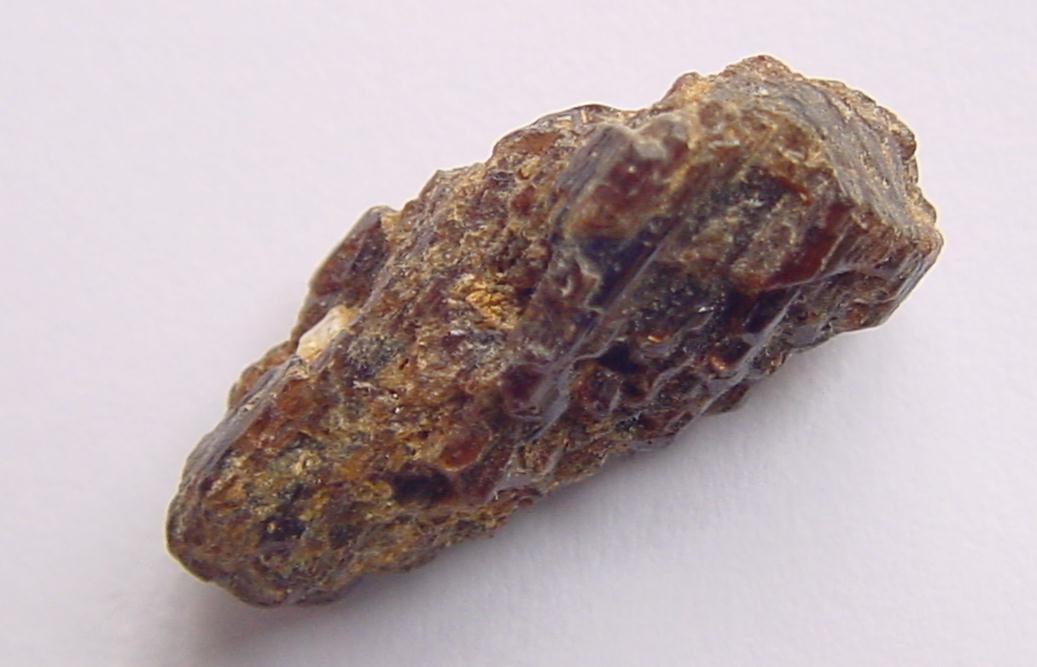
Painite from Myanmar, 2 cm long
General
CategoryBorate minerals
FormulaCaZrAl9O15(BO3)
IMA symbolPai[1]
Strunz classification6.AB.85
Dana classification7.5.2.1
Crystal systemHexagonal[2]
Crystal classDipyramidal (6/m)
(same H-M symbol), although earlier reported as hexagonal (6)[3]
Space groupP63/m
Unit cella = 8.72 Å,
c = 8.46 Å; Z = 2
Identification
ColorRed, brownish, orange-red
Crystal habitElongated crystals, pseudo-orthorhombic[4][3]
Mohs scale hardness7.5 – 8
LusterVitreous
StreakRed
DiaphaneityTransparent
Specific gravity4.01
Optical propertiesUniaxial (-)
Refractive indexno = 1.8159, ne = 1.7875[4]
PleochroismRuby-red parallel to [0001]; pale brownish orange or pale red-orange at right angles to [0001]
Melting point2094[ambiguous][citation needed]
SolubilityInsoluble in acids[4]
References[3][5][6]

Painite is a rare borate mineral. It was first found in Myanmar (Burma) by British mineralogist and gem dealer Arthur C.D. Pain who misidentified it as ruby, until it was discovered as a new gemstone in the 1950s. When it was confirmed as a new mineral species, the mineral was named after him.[3]

The chemical makeup of painite contains calcium, zirconium, boron, aluminium, and oxygen (CaZrAl9O15(BO3)). The mineral also contains trace amounts of chromium and vanadium, which are responsible for Painite's typically orange-red to brownish-red color,[2][7] similar to topaz. The mineral's rarity is due to zirconium and boron rarely interacting with each other in nature. The crystals are naturally hexagonal, but may also be euhedral or orthorhombic. They also may have no crystalline structure, but usually are accompanied by a crystalline structure. Until late 2004, only two had been cut into faceted gemstones.[8]

Discovery and occurrence

[edit]

Extensive exploration in the area surrounding Mogok, which comprises a large part of the extremely small region the mineral is known to exist in, has identified several new painite occurrences that have been vigorously explored[when?] resulting in several thousand new available painite specimens.[7]

See also

[edit]

References

[edit]
[edit]
Revisions and contributorsEdit on WikipediaRead on Wikipedia
from Grokipedia
Painite is an extremely rare with the CaZrAl₉(BO₃)O₁₅, characterized by its , deep red to brownish-red coloration—often exhibiting strong from orangish-red to brownish-red—and a Mohs hardness of 8, making it one of the world's rarest s suitable for jewelry despite challenges from inclusions and fractures. Discovered in the early 1950s near , , by British gemologist Arthur C.D. Pain—after whom it is named—the mineral was initially misidentified as and remained known from only three crystals (weighing 1.7 g, 2.1 g, and a later-identified third) for nearly five decades, earning it recognition as the rarest gemstone in the Guinness Book of World Records from 1981 to 2005. Significant finds beginning in 2001, including an 11 g crystal and subsequent recoveries from sites like Thurein-taung, Wetloo, and Namya, have yielded over 1,000 crystals and fragments by , though only a small percentage is transparent and facetable, with most cut stones ranging from 0.05 to 0.30 ct, though exceptional faceted examples can exceed 200 ct. These discoveries, primarily from Myanmar's and northern regions, have slightly increased availability for collectors and jewelers as of 2025, but painite's specific gravity of 4.01–4.03, vitreous luster, and unique composition—including trace and responsible for its color—continue to render it exceptionally valuable and prized in , with all known localities remaining confined to . No industrial applications are noted.

History and discovery

Initial discovery

Painite was first discovered in 1951 by British mineralogist and gem dealer Arthur Charles Davy Pain during prospecting expeditions in the ruby mines near , (then known as ). The specimens consisted of small, embedded crystals initially appearing dark or blackish within a surrounding matrix, leading Pain to misidentify them as or possibly due to their association with ruby-bearing deposits and superficial resemblances in color and form. The samples were promptly transported to later that year for further examination at the (Natural History), now part of the Natural History Museum. There, initial analyses revealed the crystals to be unusual, exhibiting a reddish-brown hue and distinct from common gem minerals, but they defied immediate classification amid the limited specimens available. A pivotal advancement occurred in 1957 when detailed studies, conducted by G. F. Claringbull, Max H. Hey, and C. J. Payne at the , confirmed the material as a novel mineral species with a unique composition and hexagonal . This analysis, based on a 1.7-gram type specimen (BM 1954,192), marked the formal recognition of painite, distinguishing it from previously known borates like .

Naming and identification

Painite was named in honor of Arthur Charles Davy Pain (d. 1971), a British mineralogist and gem dealer who first recognized the unusual nature of the mineral and donated the type specimen to the (Natural History) in 1954. The identification process began after Pain acquired the specimen from gem gravels near , , in the early . Initial optical examination at Chamber of Commerce revealed its distinct properties, prompting further analysis at the Department of Mineralogy, . Scientists G. F. Claringbull, Max H. Hey, and C. J. Payne conducted comprehensive studies using to determine refractive indices (ω = 1.8159, ε = 1.7875) and , wet chemical analysis to establish the composition (including significant Al₂O₃, B₂O₃, ZrO₂, and CaO), and to confirm a hexagonal with parameters a = 8.725 Å, c = 8.46 Å, and density of 4.01 g/cm³. These methods distinguished painite as a novel featuring a unique association of and , setting it apart from known aluminosilicates and other borates. The formal description of painite as a new was published in 1957 by Claringbull, Hey, and Payne in the Mineralogical Magazine (volume 31, pages 420–425), based on the presentation read on 1 November 1956. This predated the founding of the International Mineralogical Association (IMA) in 1958; painite received retrospective approval as a valid under the IMA's "grandfathered" status for pre-1959 descriptions.

Subsequent finds

Following the initial discovery in the , painite exhibited extreme scarcity for over four decades. From 1959 until 2001, only two additional crystals were known worldwide beyond the original specimens, with the third identified in 1979 in gem rough examined at the () laboratory; these were held in major collections such as the of and private holdings. This changed in 2001 with the recovery of a significant 55 ct crystal from secondary deposits near , , marking the first major find in decades. In , further exploration by gemologists uncovered a small number of pale pink crystals, each under 1 ct, in gravels near Namya (Nanyaseik) village in northern , expanding known localities beyond the region. A breakthrough occurred in 2004–2005 when local miners in the area recovered over 1,000 crystals and fragments from secondary deposits, including sites at Thurein-taung and the Wetloo mine, where in-situ occurrences were confirmed in May ; however, many of these were later questioned for quality or identification, with current estimates indicating only a few hundred total crystals known worldwide. These efforts, verified by mineralogists like George R. Rossman of the , reportedly yielded more than 167 faceted stones by late , typically ranging from 0.05 to 0.30 ct, with exceptional pieces up to 2.02 ct, though later assessments suggest only about two dozen confirmed gem-quality crystals exist. Subsequent mining from 2005 to 2006 produced additional crystals from new sites. No significant new discoveries have been reported since 2006. As of 2023, only a few hundred painite crystals are known globally, with about two dozen of gem quality, all from . Extraction in the region has been restricted since the 2021 military coup, limiting access and international verification of any potential small deposits.

Physical and optical properties

Appearance and color

Painite typically occurs as elongated prismatic to short stubby crystals, often reaching lengths of up to several centimeters, though most specimens are small, under 1 cm in dimension. These crystals exhibit a hexagonal form but may appear pseudo-orthorhombic due to twinning, resulting in a pseudo-hexagonal appearance in some cases. The mineral's color ranges from deep garnet-red to brownish-red or orange-red, with the reddish hues primarily caused by trace amounts of chromium (Cr³⁺) and vanadium (V³⁺) impurities. Clean crystals are transparent to translucent, displaying a vitreous to subadamantine luster that enhances their gem-like brilliance. Notable specimens include the crystal, approximately 1 cm in size, housed at the Natural History Museum in (BM 1954,192). Cut gems from painite often reveal rich red hues, as seen in faceted pieces from that showcase the mineral's vibrant transparency. Painite may exhibit strong , appearing ruby-red in one direction and pale brownish-orange in another.

Hardness and durability

Painite exhibits a Mohs of 8, providing sufficient resistance to scratching for use in jewelry applications, though it requires careful handling due to its brittleness. This hardness level makes it comparable to (Mohs 8) but softer than (Mohs 9), offering good wear resistance during and everyday wear. However, its poor to indistinct cleavage and conchoidal to uneven contribute to vulnerability under impact, particularly in stones with inclusions, which can reduce overall durability. The specific gravity of painite ranges from 4.01 to 4.03, rendering it denser than most other gem borates such as (3.0–3.2). This density aids in its identification and contributes to its substantial feel in finished gems. Painite demonstrates , being insoluble in acids and resistant to most common solvents, though it may be slowly attacked by fusion with . Despite this stability, its brittle nature necessitates protection from mechanical shocks in jewelry settings. No known treatments or enhancements are applied to painite, preserving its natural properties without artificial alteration.

Optical characteristics

Painite is optically uniaxial negative, characterized by refractive indices of nω=1.8159n_\omega = 1.8159 and nϵ=1.7875n_\epsilon = 1.7875. This range contributes to its high brilliance as a gemstone, distinguishing it from similar red minerals like ruby through standard gemological testing. The mineral displays moderate to strong of 0.028 to 0.029, which can produce noticeable doubling of edges under polarized and affects the cutting orientation for faceted stones. is strong and diagnostic, with colors shifting from ruby-red parallel to the c-axis to pale brownish-orange or pale red-orange perpendicular to it, aiding in orientation during gem identification. Absorption spectra reveal strong bands in the and regions, primarily due to trace Cr³⁺ and V³⁺ ions, centered near 398 nm, 455 nm, and 550 nm, which enhance the dominant hues by selective transmission. A faint spectrum is also observable, further confirming the color origins in examined specimens.

Chemical composition and structure

Chemical formula

Painite has the ideal chemical formula \ceCaZrAl9(BO3)O15\ce{CaZrAl9(BO3)O15}, consisting of calcium, , , aluminum, and oxygen in a structure. This composition is alternatively written as \ceCaZrBAl9O18\ce{CaZrBAl9O18} to emphasize the single atom integrated into the framework. As an , painite lacks water or hydroxyl groups in its structure. The elemental makeup has been verified through electron microprobe analysis, revealing a content of approximately 1.6 wt%. Trace impurities commonly include (Cr) and (V), while minor iron (Fe) may substitute for aluminum in the lattice.

Crystal system and habit

Painite crystallizes in the hexagonal with P6₃/m. The lattice parameters are a = 8.724(1) and c = 8.464(2) , yielding a c/a ratio of approximately 0.97. The typical crystal habit of painite is prismatic, forming elongated or short, stubby crystals up to 1.5 cm in length. These crystals often exhibit twinning that causes them to appear pseudo-orthorhombic, with common striations parallel to the c-axis. The unit cell contains Z = 2 formula units and features an aluminoborate framework composed of AlO₆ octahedra, analogous to the structure in the related jeremejevite. No polymorphism is known for painite, and it remains stable under surface conditions. Painite is identified in part through X-ray diffraction, with key peaks observed at d-spacings of 5.76 Å (very strong), 3.70 Å (strong), and 2.520 Å (very strong).

Geological occurrence

Formation processes

Painite primarily forms in deposits hosted within metamorphic marbles, resulting from metasomatic processes during the contact of by granitic intrusions. These conditions involve the interaction of rocks with silica- and metal-bearing fluids derived from the cooling , leading to the replacement and recrystallization of minerals in the aureole surrounding the intrusion. The formation occurs at elevated temperatures ranging from 500 to 700°C, where boron-rich hydrothermal fluids play a crucial role in mobilizing and concentrating the necessary elements for painite . is typically sourced from evaporitic or sedimentary precursors in the host rocks, while is contributed by the associated granitic or pegmatitic phases, enabling the rare co-precipitation required for painite's unique composition. Associated minerals in this paragenesis include , , , and other borates such as dravite, reflecting the boron-enriched and aluminum-saturated environment. Following formation, painite crystals are frequently liberated from their primary host rocks through and , concentrating in alluvial gem gravels where they may be secondarily deposited.

Primary locations

Painite is known exclusively from , with no confirmed occurrences outside the country as of 2025. The mineral's primary deposits are concentrated in the Mogok Valley of , where it has been recovered from several specific sites including Ohngaing (the type locality), Pein Pyit, Kyauk-Pyat-That, Wetloo, and Thurein-Taung. These locations are situated in metamorphic terrains featuring formations at the contacts between marbles and granitic intrusions. Minor additional occurrences have been documented in Namyazeik (also known as Namya) in , approximately 300 km north of , where water-worn crystals appear in alluvial deposits alongside other gems like and . Possible traces have also been reported from the Hpakant area in , associated with jade mining operations, but these remain unconfirmed and require further verification. Mining for painite in these areas is predominantly artisanal, involving manual extraction from alluvial gravels and primary outcrops. In the Valley, traditional methods such as (twinlon) into gem-bearing gravels up to 30 meters deep and sluicing of are employed to recover the small, embedded crystals. Primary deposits are targeted through open-pit or underground workings in contact zones, though operations remain small-scale due to the mineral's extreme scarcity. Historically, less than 1 kg of painite material has been recovered worldwide, comprising thousands of tiny crystals and fragments, most of which are under 1 gram each and unsuitable for . The largest known specimen weighs 633 grams, but the vast majority are minute inclusions in matrix or isolated grains from secondary deposits. Access to primary painite sites has been severely restricted since the 2021 military coup in , exacerbated by escalating conflicts in 2025 that have engulfed the region. Rebel advances and junta airstrikes have led to the displacement of miners, shutdown of operations, and unsafe conditions, further limiting exploration and recovery efforts.

Rarity and value

Factors contributing to rarity

Painite's rarity stems primarily from its unique geochemical composition, which requires the rare coexistence of and in sufficient quantities during formation. These elements seldom combine in nature because typically forms in volatile-rich environments, while prefers more stable, silica-saturated conditions, limiting the conditions under which painite can crystallize. The mineral's occurrence is further restricted to limited deposits in specific formations within , where it forms through metasomatic processes involving boron-bearing fluids interacting with aluminum-rich rocks. Unlike more abundant gems, painite lacks extensive commercial vein systems or widespread alluvial deposits, confining production to small-scale in areas like the region. Most painite crystals are diminutive, typically measuring less than 1 carat and often exhibiting inclusions or fractures that render them unsuitable for . Only a small percentage yield transparent, gem-quality material capable of being cut into jewelry-grade stones. Historical factors have also contributed to its perceived and actual scarcity; early specimens were frequently misidentified as , , or due to superficial similarities, delaying systematic recognition and exploration until the mid-20th century. Over 1,000 painite crystals and fragments have been recovered, primarily from discoveries up to , a stark contrast to common gems like , of which billions of carats have been mined. Several hundred have been faceted into gems, though high-quality, transparent material suitable for fine jewelry remains exceptionally rare.

Market value and trade

Painite commands exceptionally high market values due to its status as one of the rarest gemstones, with fine faceted specimens typically priced between $50,000 and $60,000 per carat in 2025. This pricing reflects the gem's scarcity, vibrant red coloration, and appeal to high-end collectors, though actual transactions remain infrequent owing to limited availability. Rough painite crystals, often smaller and less refined, are valued significantly lower, ranging from $0.60 to $15 per carat for non-gem-quality material, with higher-quality rough potentially reaching thousands per carat depending on size and potential for cutting. The trade in painite is niche and controlled, primarily handled by specialized dealers and through private sales or auctions rather than mainstream jewelry markets. Most supply originates from , where export is governed by strict regulations and permits to prevent illegal trade, compounded by on certain gem commodities from the region. Asian markets, particularly in and , serve as key hubs for Myanmar gem distribution, facilitating sales to global buyers via established networks. Grading painite emphasizes color intensity, clarity, and size as primary determinants of value, with the most premium stones displaying deep, vivid hues free from brownish tones, minimal inclusions for enhanced transparency, and weights exceeding 1 carat. Redder specimens without excessive brown overtones or visible flaws command the highest premiums, while larger sizes amplify desirability given the gem's inherent rarity. As an , painite attracts high-net-worth collectors and institutions seeking unique assets, with outstripping supply and positioning it as a long-term . However, the market's illiquidity—stemming from and infrequent sales—limits short-term trading opportunities, making it suitable primarily for patient investors focused on rarity rather than .

Uses and significance

As a gemstone

Painite is rarely faceted into s due to the of suitable rough material, but when cut, it reveals a striking to orangy-red color prized by collectors and jewelers. As of 2025, several hundred painite crystals have been faceted, though truly gem-quality stones remain limited, with most weighing under 1 carat. The process is complex, often yielding small and shallow cuts because of the mineral's common twinning, abundant inclusions such as crystals and feather-like fractures, and overall brittleness, which result in high waste rates. Cutters typically select emerald, oval, , or rectangular step cuts to best maximize the gem's color and transparency while navigating these structural challenges. Painite's Mohs of 8 makes it durable enough for jewelry applications like rings and pendants, provided it is set in protective mountings to guard against impacts that could exploit its fractures. No standard treatments or enhancements are applied to painite gems, which are valued exclusively in their natural, untreated form. Examples of painite in jewelry are exceptionally uncommon, limited to pieces such as custom pendants or rings featuring small oval- or cushion-cut stones set in to highlight the gem's vibrant red tones.

In mineral collections

Painite's exceptional rarity has made it a prized addition to mineral collections worldwide, particularly in major museums where it serves as a benchmark for mineralogy and gemological studies. The mineral's historical significance, stemming from its initial discovery in 1951 and as a new species in 1957, elevates its status beyond mere aesthetics, representing a pinnacle of rarity in . The Natural History Museum in holds some of the most iconic Painite specimens, including the first identified (Painite #1), a 1.7-gram donated in 1952 and cataloged as BM 1954,192. A second early specimen (Painite #2), weighing 2.118 grams and featuring a darker hue, is also on public display there, underscoring the museum's role in the mineral's early authentication. In the United States, the Smithsonian Institution's maintains several Painite samples, notably a slab fragment (Painite #4c) from a larger discovery. These specimens, originating from , contribute to the museum's extensive Asian suite and support ongoing research into borate structures. The in New York similarly features Painite examples, acquired to represent extreme rarity in its global collection. Since the early 2000s, when several thousand additional crystals and fragments emerged from deposits, Painite has become slightly more accessible to advanced private collectors and smaller institutions as of 2025, though high-quality matrix specimens remain elusive and command premium value in auctions and trades. This influx has not diminished its allure; instead, it has broadened representation in collections focused on gem diversity and geological rarity, with specimens often displayed to illustrate the challenges of mining in restricted areas like the Mogok Valley.

References

Add your contribution
Related Hubs
User Avatar
No comments yet.