Hubbry Logo
NephriteNephriteMain
Open search
Nephrite
Community hub
Nephrite
logo
8 pages, 0 posts
0 subscribers
Be the first to start a discussion here.
Nephrite
Nephrite
from Wikipedia
Nephrite
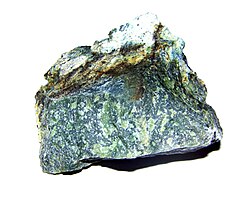
Nephrite from Jordanów Śląski (Poland)
General
CategoryInosilicate
FormulaCa2(Mg,Fe)5Si8O22(OH)2[1]
Crystal systemmonoclinic[1]
Identification
ColorTranslucent to opaque and often mottled. Light to dark green, yellow to brown, white, gray, black.[1]
Crystal habitmassive[1]
Fracturesplintery to granular[1]
Mohs scale hardness6.0 to 6.5[1]
Lusterdull[1]
Specific gravity2.95+0.15
−0.05
[1]
Polish lustervitreous to greasy[1]
Optical propertiesDouble refractive with anomalous aggregate reaction[1]
Refractive index1.606 to 1.632+0.009
−0.006
[1]
Birefringenceusually not detectable[1]
Pleochroismnone[1]
Ultraviolet fluorescenceinert[1]
Absorption spectraVague line may be present at 500 nm, but rarely any lines. Rarely, in stones of exceptional gem quality, vague lines in the red part of the spectrum may be seen.[1]

Nephrite is a variety of the calcium, magnesium, and iron-rich amphibole minerals tremolite or actinolite (aggregates of which also make up one form of asbestos). The chemical formula for nephrite is Ca2(Mg, Fe)5Si8O22(OH)2.[1] It is one of two different mineral species called jade. The other mineral species known as jade is jadeite, which is a variety of pyroxene. While nephrite jade possesses mainly grays and greens (and occasionally yellows, browns, black or whites), jadeite jade, which is rarer, can also contain blacks, reds, pinks and violets. Nephrite jade is an ornamental stone used in carvings, beads, or cabochon cut gemstones. Nephrite is also the official state mineral of Wyoming.

Nephrite can be found in a translucent white to very light yellow form which is known in China as mutton fat jade, in an opaque white to very light brown or gray which is known as chicken bone jade,[1] as well as in a variety of green colors. Western Canada is the principal source of modern lapidary nephrite.[2] Nephrite jade was used mostly in pre-1800 China as well as in New Zealand, the Pacific Coast and Atlantic Coasts of North America, Neolithic Europe, and southeast Asia.

Name

[edit]

The name nephrite is derived from Latin lapis nephriticus, which in turn is derived from Ancient Greek λίθος νεφριτικός (líthos nephritikós) or νεφρός λίθος (nephrós líthos), which means 'kidney stone' and is the Latin and Greek version of Spanish piedra de ijada (the origin of jade and jadeite).[3]

Nephrite was deprecated by the International Mineralogical Association as a mineral species name in 1978 (replaced by tremolite).[4]

Other names

[edit]

Besides the terms already mentioned, nephrite has the following synonyms and varieties: axe-stone, B.C. jade, Beilstein, kidney stone, lapis nephriticus, nephrite, nephrite, pounamu, New Zealand greenstone, New Zealand jade,[1] spinach jade (dark grayish green), and talcum nephriticus. Tomb jade or grave jade are names given to ancient burial nephrite pieces with a brown or chalky white texture as a surface treatment.[1]

History

[edit]

Neolithic and Chalcolithic Europe

[edit]

A lot of nephrite tools and amulets are known since the Early Neolithic (7th millennium BC) to the Late Chalcolithic (5th millennium BC) periods on the Balkans (mainly Bulgaria; also in Greece, Serbia, Croatia) from two or more unknown sources—Balkan "nephrite culture". Such tools are found in the Later Neolithic of Poland (from the most probable local source Jordanów), Sardinia (Italy) (unknown source) and Switzerland.[5] Single or just a few finds of nephrite artifacts are also reported from some other European countries.

Prehistoric and historic China

[edit]
"Mutton fat" jade for sale at Hotan Jade Market
Large "mutton fat" nephrite jade displayed in Hotan Cultural Museum lobby

During Neolithic times, the key known sources of nephrite jade in China for utilitarian and ceremonial jade items were the now depleted deposits in the Ningshao area in the Yangtze River Delta (Liangzhu culture 3400–2250 BC) and in an area of the Liaoning province in Inner Mongolia (Hongshan culture 4700–2200 BC). Jade was used to create many utilitarian and ceremonial objects, ranging from indoor decorative items to jade burial suits. Jade was considered the "imperial gem". From about the earliest Chinese dynasties until present, the jade deposits in most use were from the region of Khotan in the Western Chinese province of Xinjiang (jade deposits from other areas of China, such as Lantian, Shaanxi, were also in great demand). There, white and greenish nephrite jade is found in small quarries and as pebbles and boulders in the rivers flowing from the Kuen-Lun mountain range northward into the Takla-Makan desert area. River jade collection was concentrated in the Yarkand, and the White Jade (Yurungkash) and Black Jade (Karakash) Rivers in Khotan. From the Kingdom of Khotan, on the southern leg of the Silk Road, yearly tribute payments consisting of the most precious white jade were made to the Chinese imperial court and there transformed into objets d'art by skilled artisans, as jade was considered more valuable than gold or silver.

Prehistoric Taiwan and Southeast Asia

[edit]

Carved nephrite jade was the main commodity trade during the historical Maritime Jade Road, an extensive trading network connecting multiple areas in Southeast and East Asia. The nephrite jade was mined in east Taiwan by animist Taiwanese indigenous peoples and processed mostly in the Philippines by animist indigenous Filipinos. Some were also processed in Vietnam, while the peoples of Malaysia, Brunei, Singapore, Thailand, Indonesia, and Cambodia also participated in the massive animist-led nephrite jade trading network, where other commodities were also traded. Participants in the network at the time had a majority animist population. The maritime road is one of the most extensive sea-based trade networks of a single geological material in the prehistoric world. It was in existence for at least 3,000 years, where its peak production was from 2000 BCE to 500 CE, older than the Silk Road in mainland Eurasia. It began to wane during its final centuries from 500 CE until 1000 CE. The entire period of the network was a golden age for the diverse animist societies of the region.[6][7][8][9]

Māori

[edit]
Nephrite from Wyoming

Nephrite jade in New Zealand is known as pounamu in the Māori language and is highly valued, playing an important role in Māori culture. It is considered a taonga, or treasure, and therefore protected under the Treaty of Waitangi. The exploitation of it is restricted to the Ngāi Tahu iwi (tribe)[10] and it is closely monitored. The South Island of New Zealand is Te Wai Pounamu in Māori—'The [land of] Greenstone Water'—because that is where it occurs.

Weapons and ornaments are made of it; in particular the mere (short club) and the hei-tiki (neck pendant). These are believed to have their own mana (prestige), are handed down as valuable heirlooms, and often given as gifts to seal important agreements. It has also been used for a range of tools such as adzes and was used to make nails used in construction, as Māori culture had no metalworking before European contact.

Commonly called "greenstone", jade jewellery in Māori designs is widely popular with tourists. Stone is often imported from Canada, China and Siberia, and Ngāi Tahu runs a pounamu certification scheme to verify the authenticity of New Zealand stone.

References

[edit]

Further reading

[edit]
[edit]
Revisions and contributorsEdit on WikipediaRead on Wikipedia
from Grokipedia
Nephrite is a tough, amphibole primarily composed of fine-grained and , with the Ca₂(Mg,Fe)₅Si₈O₂₂(OH)₂. It forms a dense aggregate of fibers, exhibiting a Mohs of 6 to 6.5 and colors ranging from creamy to dark , often translucent to opaque. Distinguished from , the other termed jade, nephrite derives its name from the Greek nephros (), reflecting ancient beliefs in its medicinal properties for renal ailments. Geologically, nephrite occurs in metamorphosed ultramafic rocks, such as , through processes involving contact metamorphism or hydrothermal alteration, with major deposits in regions like , , , , and the (notably Wyoming, where it serves as the state ). Its exceptional toughness—stemming from the felted microstructure of crystals—makes it highly resistant to , surpassing many other gem materials. Historically and culturally, nephrite has been prized for carvings, tools, and ornaments since times, with significant use in Chinese imperial artifacts, Māori hei-tiki pendants, and Mesoamerican ceremonial objects, valued for both aesthetic and purported protective qualities. Today, it remains a popular material for jewelry, sculptures, and decorative items, though distinguishing authentic nephrite from treated or imitation varieties requires spectroscopic and microscopic analysis due to market prevalence of enhancements.

Etymology and Terminology

Origin and historical names

The term nephrite originates from the Latin lapis nephriticus, translating to " stone," derived from the lithos nephritikos (λίθος νεφριτικός), where nephros (νεφρός) means "." This stems from longstanding empirical observations in antiquity associating the mineral's or application with relief from renal calculi and related disorders, a belief documented in medical and texts from the Roman era onward. In Chinese linguistic tradition, nephrite falls under the broad category of yu (玉), a term encompassing durable siliceous rocks valued for carving since at least the period, with no early distinction from other jade-like materials based on . Specific designations emerged tied to provenances, such as Hetian yu (和田玉) for nephrite sourced from the (ancient Hetian) region in Uyghur Autonomous Region, where deposits have been exploited continuously since around 2000 BCE, yielding fine-grained varieties prized for their translucency and uniformity. Other historical synonyms include "kidney stone" in early European mineralogical accounts, reflecting the same therapeutic attribution that coined the Western name, and among the of , where it denotes nephrite (along with related greenstones like ) sourced from [South Island](/page/South Island) riverbeds and used in pre-colonial tool-making. These designations highlight regional empirical identifications of nephrite's toughness and availability rather than uniform global taxonomy until modern in the .

Distinction from jadeite

Nephrite is a tough, fibrous aggregate primarily composed of minerals from the tremolite-actinolite series, characterized by its to structure of densely interlocked calcium magnesium-iron fibers. In contrast, belongs to the group as a sodium aluminum , forming as a distinct crystalline phase under higher conditions, typically 5–11 kbar and 150–300 °C in subduction-related metamorphic environments, whereas nephrite develops in regional at comparatively lower pressures and temperatures. This mineralogical divergence— versus —underlies their separate identities despite superficial resemblances in toughness and luster. Historically, the term "" denoted only , derived from ancient uses in and , until French mineralogist Alexis Damour analyzed Burmese specimens in 1863 and differentiated as a unique based on its chemical and crystallographic properties. Damour's work resolved prior conflations, confirming that what Europeans and early Chinese sources called was , while the rarer Burmese material represented . In trade and cultural contexts, this distinction manifests in artifact provenance: pre-18th-century Chinese carvings and objects universally employed nephrite sourced from domestic or Central Asian deposits, reflecting its abundance and workability. entered Chinese markets via imports from around 1750, prized for its intense emerald hues and translucency unattainable in nephrite, which gradually elevated its status and value in imperial collections despite nephrite's continued prevalence. By 1798, established trade routes from formalized jadeite's role, distinguishing it from nephrite's longstanding utilitarian and symbolic applications.

Mineralogy and Geology

Chemical composition and structure

Nephrite consists primarily of minerals in the tremolite-actinolite series, with the chemical formula Ca₂(Mg,Fe)₅Si₈O₂₂(OH)₂. This composition features calcium, magnesium, iron, , oxygen, and , where magnesium and iron substitute variably in the octahedral sites of the . The mineral forms a massive aggregate dominated by these s, typically exceeding 90% by volume in high-quality specimens. The structure comprises elongated, fibrous crystals of (Mg-rich endmember) and (Fe-rich), interlocked in a felted or interlocking texture that defines its to nature. This fibrous arrangement arises from the double-chain framework characteristic of the group, confirmed through patterns showing peaks consistent with monoclinic symmetry and parameters around a ≈ 9.8 , b ≈ 18.0 , c ≈ 5.3 , β ≈ 105°. Variations in iron substitution, from near-pure (FeO < 1 wt%) to actinolite-dominant (FeO up to 10-15 wt%), influence the atomic arrangement without altering the overall formula. X-ray diffraction studies further distinguish nephrite's polycrystalline texture from single-crystal amphiboles, revealing broad diffraction peaks indicative of submicroscopic grain sizes below 1 μm and preferred orientation of fibers. Minor impurities such as chromite, magnetite, or serpentine may occur but do not significantly alter the primary amphibole matrix.

Formation processes

Nephrite, a microcrystalline aggregate of calcium-magnesium-iron amphiboles primarily from the tremolite-actinolite series, originates through metasomatic and metamorphic processes acting on ultramafic rocks such as peridotite or their hydrated equivalents like serpentinite. These protoliths, derived from mantle material, undergo hydration during serpentinization, followed by interaction with silica-bearing fluids in shear zones or along lithological contacts, promoting recrystallization into densely interlocked, fibrous amphibole crystals. This transformation relies on fluid-mediated mass transfer, where magnesium and iron from the host rock combine with introduced silica to stabilize the amphibole structure under dynamic tectonic conditions. The process typically unfolds during regional at temperatures of 300–500 °C and low pressures (less than 1–2 kbar), corresponding to - to amphibolite-facies conditions without the extreme compression of deeper environments. Such settings favor the development of nephrite's tough, felted texture through oriented and deformation, often enhanced by ductile shearing that aligns fibers for enhanced mechanical interlocking. Nephrite deposits are commonly associated with complexes or Alpine-type orogenic belts, where obduction or tectonic emplacement exposes ultramafic bodies to metasomatic fluids derived from devolatilization during convergence. Unlike jadeite, which requires high-pressure, low-temperature eclogite-facies (exceeding 10–20 kbar) in active zones to form its pyroxene-based structure, nephrite's lower-pressure genesis in relatively shallow crustal levels or obducted sequences results in more widespread and surficial accessibility. This distinction arises from the amphibole mineralogy's stability in hydrous, silica-undersaturated environments versus jadeite's need for , high-density assemblages, underscoring causal links to tectonic setting rather than mere compositional overlap.

Global occurrences and deposits

Nephrite deposits are distributed globally, with principal occurrences in metamorphic and altered ultramafic rocks such as serpentinite and amphibolite. Major sources include northwestern China, British Columbia in Canada, Siberia in Russia, the South Island of New Zealand, and Wyoming in the United States, as identified through geological surveys and mining records. In , the Hetian (Hotan) region of hosts extensive nephrite deposits in the , representing one of the largest known concentrations and the traditional source for most high-quality material used historically. These deposits feature placer and primary outcrops formed through metasomatic alteration of ultramafic protoliths. Canadian nephrite primarily derives from , where deposits along fault zones and serpentinite belts near Cassiar and have supported commercial mining since the 1930s, producing fine-grained green varieties from both placer boulders and in-situ sources. In , significant nephrite occurs in the and areas adjacent to in , with mining documented since the 18th century in primary deposits associated with alpine-type ultramafics. New Zealand nephrite, termed pounamu, is restricted to the South Island's West Coast, forming in contact zones between mafic-ultramafic intrusions and greywacke within terranes like Caples and Torlesse, often as boulders in river gravels. Wyoming's Granite Mountains yield high-purity nephrite from alluvial deposits in granitic gneiss and amphibolite shear zones, with primary hydrothermal pods confirmed in situ as recently as 2019–2020. Secondary nephrite occurrences appear in California's Franciscan Complex, where subduction-related has produced nephrite within mélanges of and sedimentary rocks.

Physical and Optical Properties

Mechanical properties

Nephrite possesses a Mohs of 6 to 6.5, conferring resistance to abrasion similar to that of but inferior to . This moderate , combined with its specific of 2.90 to 3.03, yields a material density that facilitates precise carving while maintaining sufficient mass for tool efficacy in prehistoric applications. Nephrite is the toughest known natural mineral due to its interlocking fibrous crystal structure, which provides exceptional resistance to breaking, chipping, or fracturing and renders it tougher than steel or ceramics in impact resistance, despite not being the hardest mineral (with diamond excelling in scratch resistance). Its paramount mechanical attribute is toughness, quantified by fracture surface energy of approximately 225,000 ergs/cm², which derives from the interlocking fibrous aggregates of tremolite-actinolite crystals that compel crack propagation to traverse extended paths, thereby dissipating energy via fiber bridging and pull-out. This microstructure yields fracture toughness values between 2.9 and 5.5 MPa·m^{1/2}, rendering nephrite more resistant to impact-induced fracture than most ceramics, whose energies typically fall an order of magnitude lower. In , nephrite surpasses many steels, a property that historically favored it over brittle alternatives like flint for axes and adzes, as the fibrous lattice arrests crack growth under dynamic loads. Such durability stems causally from the amphibole fibers' parallel orientation and mutual reinforcement, which distribute stress and inhibit absent in granular ceramics or isotropic metals.

Color variations and varieties

Nephrite's color variations stem from its position in the tremolite-actinolite series, where magnesium-dominant compositions yield white or colorless material, and progressive iron substitution for magnesium produces green hues, with elevated iron levels resulting in gray or black shades. These spectral properties arise from trace impurities and Fe-Mg ratios, typically rendering nephrite less translucent than , with most specimens semi-opaque to opaque. Among subtypes, "mutton fat" nephrite denotes high-purity white varieties with a creamy, uniform appearance due to minimal iron content and fine-grained structure. Green nephrite from , termed , features iron-induced vibrant greens alongside whites and darker tones, linked to regional metamorphic conditions favoring specific compositions. For laboratory verification, nephrite exhibits a of 1.600 to 1.627, often measured as a spot value around 1.61 due to its aggregate nature. It is generally inert under long- and short-wave radiation, though rare weak blue-white may occur in certain low-iron samples.

Historical and Cultural Uses

Neolithic Europe and early civilizations

Nephrite was employed in for crafting durable stone tools, particularly axes and adzes, due to its fibrous structure conferring high toughness and resistance to fracture. Deposits in , , such as those near Jordanów Śląski, were exploited from approximately 3000 BCE for producing axes, knives, and hoes, marking early evidence of nephrite use in tool-making within the region. Archaeological finds of nephrite axes appear in sites across , , and , dated to the and Eneolithic () periods, roughly 4000–2500 BC. These tools feature polished surfaces, oval profiles, and triangular outlines, indicative of sophisticated grinding and polishing techniques adapted to the material's properties. Petrographic studies confirm the nephrite composition, distinguishing it from more common lithics and linking artifacts to local metamorphic sources rather than distant Alpine jadeitite deposits. Nephrite's mechanical advantages over alternatives like —offering greater toughness despite comparable (Mohs 6–6.5)—enabled polished edges that withstood repeated impacts without chipping, outperforming brittle in practical applications such as . This durability contributed to the persistence of nephrite tools into the era, even as emerged around 3500 BC, as stone axes remained effective and accessible via established extraction and networks. Distribution patterns of these axes suggest regional exchange systems, with artifacts recovered beyond immediate vicinities, though on a smaller scale than jadeitite circulation from the .

Ancient China and East Asia

Nephrite jade artifacts appear in the archaeological record of ancient from the (c. 3800–2700 BCE), where they were fashioned into bi discs—flat, circular objects with a central —often placed on the bodies of the deceased in tombs. These discs, carved from gray-green mottled nephrite, exemplify early ritual use and craftsmanship, with examples measuring up to 5 cm in diameter. The culture's production of such forms laid foundational techniques for later jade working, emphasizing the material's toughness for precise carving. Usage peaked during the (c. 3300–2300 BCE), which produced exclusively nephrite artifacts including bi discs and cong tubes—square vessels with circular bores—numbering in the thousands across sites. One elite tomb yielded 25 bi discs and 33 cong, highlighting the scale of production and burial practices involving these items. Nephrite sourced from distant locales, such as the Hetian region in (operational for extraction since at least the period, with deposits formed around 400 million years ago), supported this output, evidencing early long-distance procurement. Artisans refined drilling and polishing methods, as seen in cong up to 20.5 cm high. From the Zhou dynasty (1046–256 BCE) through the Qing dynasty (1644–1912 CE), nephrite held imperial preference for seals and ornaments, with spinach-green varieties reserved for official stamps denoting authority, as in Qin dynasty (221–207 BCE) precedents extended into later eras. Carvings included tiger-button seals and intricate vessels, leveraging the stone's durability for functional and decorative roles in court artifacts. In East Asia beyond the mainland, prehistoric Taiwanese sites and Southeast Asian exchanges from c. 2000 BCE documented nephrite ear pendants and tools, tracing the dispersal of carving techniques via Austronesian networks linking Taiwan to the Philippines and beyond. These artifacts, verified as Taiwanese nephrite by spectroscopic analysis, indicate migratory craft dissemination over millennia.

Polynesian and Maori traditions

Following the Polynesian settlement of in the late 13th to early AD, communities in the began exploiting nephrite deposits, known as or greenstone, primarily for practical implements due to its exceptional toughness and edge-holding capacity. These sources, concentrated in river gravels such as those of the Arahura and Taramakau rivers on the west coast, yielded boulders suitable for crafting adzes (toki), chisels (whao), clubs (mere and ), and pendants (). Archaeological evidence from early sites confirms the integration of stone tools, including variants, into the settlers' toolkit for , , and combat, reflecting adaptation to local resources absent in ancestral . Māori carving techniques emphasized abrasion and percussion, employing stone hammers (kōrū pōhātū), sharp chips (pūrihi pōhātū), and rubbers (hōāngū) to rough-shape material by grinding with water, followed by obsidian-tipped drills for perforations. High-polish surfaces were achieved through extended rubbing on fine slabs or micaceous stones, a labor-intensive process often spanning weeks for items like a mere club, enabling the nephrite's inherent luster while preserving its mechanical integrity for utility. Sourcing frequently occurred at rivermouths where concentrated nodules, supporting localized production without reliance on imported abrasives. Pre-colonial distribution networks facilitated trade of finished artifacts from iwi to northern regions via coastal routes and , functioning as a valued exchange medium while communities remained self-sufficient in extraction and fabrication using endemic tools and materials. European observers documented these practices in the , noting the stone's durability for tools amid initial post-contact exchanges, though tool-making predated such interactions by centuries.

Other indigenous and historical applications

In , prehistoric Native American tribes reportedly utilized nephrite from deposits to fashion pipes and tools before European contact in , with artifacts including ground and polished implements suggestive of localized extraction and working; however, these claims remain unverified by systematic archaeological analysis, as nephrite's presence in verified pre-Columbian assemblages is rare compared to other lithic materials like chert or . Indigenous groups in , such as those near and the , incorporated nephrite from regional outcrops into traditional carvings for amulets and ritual objects, a practice documented through ethnographic records of Evenki and Buryat peoples predating 19th-century Russian expansion, though extensive archaeological evidence is limited due to the material's secondary export to Chinese markets rather than local proliferation. European medicinal applications of nephrite trace to Roman-era beliefs in its renal affinity—deriving from the Greek nephros for ""—where it was pulverized and consumed as a remedy for , urinary issues, and detoxification, traditions that endured into medieval as described in herbals like those of (circa 1150–1179); absent randomized empirical trials or causal mechanisms beyond , these uses exemplify over verifiable therapeutic outcomes, with no modern substantiating efficacy. Prehistoric evidence for nephrite utilization in Africa and Australia is markedly sparse, despite known deposits; in Australia, nephrite lenses occur in marbles dating 1000–2500 million years old, yet no artifacts indicate indigenous working before European arrival in 1788, contrasting sharply with Eurasian ophiolite-hosted sites yielding abundant tools and ornaments from onward. Similarly, 's first documented nephrite deposit in (reported 2023, with over 1000 tons estimated) shows no associated prehistoric indigenous applications, underscoring geological availability without cultural adoption in these regions.

Symbolism and Cultural Significance

In Chinese imperial culture

In the (206 BCE–220 CE), nephrite jade served as a potent emblem of imperial purity and posthumous status, most notably in burial suits crafted for royalty and high elites. These suits, such as the ensemble for Dou Wan (consort of Emperor Cheng), comprised thousands of meticulously cut nephrite plaques—often exceeding 4,000 pieces per suit—interlinked with gold wire to encase the body, reflecting beliefs in jade's preservative qualities against decay and its role in facilitating spiritual immortality. One exemplary suit from the State of Chu featured 4,248 polished nephrite plates, underscoring the material's rarity and the labor-intensive craftsmanship reserved for those at the apex of Confucian hierarchies. Nephrite's symbolic weight in imperial rituals drew from Confucian classics like the Liji (Book of Rites), where the stone embodied eleven virtues—including benevolence, righteousness, propriety, wisdom, and fidelity—mirroring the moral imperatives of rulership and . Yet this association rested on empirical attributes: nephrite's exceptional toughness (Mohs hardness 6–6.5) and made it ideal for durable heirlooms and ritual objects like bi discs and gui tablets, which signified authority and were passed through generations to affirm lineage continuity. In practice, emperors wielded jade scepters during ceremonies to invoke heavenly mandate, with the stone's unyielding nature paralleling the steadfast expected of the sovereign. This tradition peaked in the Qing dynasty (1644–1912), where imperial workshops monopolized nephrite sources like Manasi green deposits from 1789 onward, commissioning carvings for palace rituals and imperial seals that reinforced Manchu legitimacy through Han cultural continuity. Post-1912 republican upheavals and the abolition of monarchy eroded state-sponsored jade rituals, leading to a sharp decline in large-scale imperial productions as patronage shifted from courts to private markets. Nonetheless, nephrite retained cachet among elite collectors, who preserved artifacts as tangible links to dynastic prestige amid modern political transformations.

Spiritual and ritual roles

In ancient Chinese funerary practices, nephrite jade artifacts, such as bi discs and cong tubes, were commonly interred in tombs from the Neolithic (circa 3300–2200 BCE) onward, reflecting beliefs in the material's capacity to safeguard the soul during the afterlife transition. These inclusions, often numbering in the dozens per , underscore jade's rarity and durability as markers of elite status rather than empirically verified metaphysical efficacy, with scarcity driving symbolic attribution over causal healing properties. By the (206 BCE–220 CE), this evolved into elaborate jade burial suits sewn with gold thread for imperial elites, intended to preserve the body and ensure , though archaeological evidence links their use more to ritual display of power than to any preservative effect on remains. Among of , nephrite, termed , holds status as a species—treasured heirlooms embodying ancestral mana (spiritual authority)—with carvings like pendants and mere clubs deployed in rituals for protection, including wartime fortification against harm. Such items, sourced exclusively from rivers, were not merely utilitarian but invoked tapu (sacred restrictions) to channel protective energies, a persisting from pre-European contact, though modern interpretations emphasize cultural continuity over supernatural validation. Neolithic European sites yield nephrite axes and beads in burial contexts, suggesting analogous ritual roles tied to provisioning, potentially imported over long distances due to the stone's toughness and prestige value. The etymological root of "nephrite" in the Latin lapis nephriticus ("kidney stone") stems from pre-modern European lore positing it as a remedy for renal disorders, a claim echoed in for spleen and adrenal support, yet unconfirmed by pharmacological analysis or clinical trials. Contemporary assertions in circles attribute nephrite to fostering emotional equilibrium and alignment lack substantiation from randomized controlled studies, with any perceived benefits attributable to mechanisms rather than the mineral's composition. This contrasts with its verifiable ornamental and cultural utility, where ritual significance arises from historical scarcity and craftsmanship rather than intrinsic causal powers.

Modern cultural perceptions

In , the 1998 Ngāi Tahu Claims Settlement Act vested ownership of (nephrite) resources in the South Island's riverbeds and lakes to the , following inquiries into historical breaches, thereby enabling regulated harvesting and a resurgence of traditional carving techniques integrated into modern cultural expressions. This legal affirmation has supported community-led initiatives to preserve artisanal knowledge while adapting to contemporary jewelry and artifacts, distinct from pre-colonial utility. Globally, nephrite's perception has evolved into that of a prestige material in 21st-century art markets, particularly through Canadian deposits in , where sculptors like Lyle Sopel craft large-scale, collector-oriented pieces from deep green varieties, emphasizing aesthetic durability over historical functionality. Similarly, artists such as Michael Binkley utilize local nephrite for intricate carvings sold internationally, reflecting a broader shift toward viewing the as a symbol of refined craftsmanship amid rising demand from affluent buyers. This transition aligns with nephrite's mechanical toughness, enabling complex modern designs that command premiums in auctions and galleries. In spirituality prevalent since the late , nephrite is marketed for purported benefits like emotional balance and prosperity attraction, often without supporting clinical evidence beyond anecdotal reports. However, its geological prevalence—major deposits in , , and yield thousands of tons annually—undercuts claims of inherent sacred scarcity, attributing enduring appeal more to cultural tradition and polishability than rarity or unverifiable metaphysical qualities.

Modern Uses and Applications

Jewelry and ornamental carvings

Nephrite jade is commonly fashioned into cabochons, beads, and pendants for contemporary jewelry, capitalizing on its exceptional which allows for detailed polishing and resistance to fracture during wear. This , stemming from its fibrous structure, makes nephrite suitable for everyday pieces like necklaces that endure daily handling without chipping, outperforming softer simulants such as . In ornamental applications, nephrite supports intricate carvings and sculptures due to its superior toughness compared to , rendering it preferable for larger, more affordable decorative works where fracture resistance is paramount over maximum hardness. Traditional techniques persist in modern contexts, such as the creation of or scholars' rocks from Hetian nephrite, valued for their natural forms enhanced by subtle polishing. nephrite, designated as the state's official in 1967, features prominently in American jewelry, often as cabochons or pendants showcasing its green hues.

Tools and artifacts reproduction

Modern reproductions of nephrite tools, such as Maori mere clubs and axes, are crafted for museum displays and to assess prehistoric functionality. For instance, carvers produce oversized replicas of traditional pounamu mere, replicating artifacts from institutions like Museum, using nephrite sourced from regional deposits to demonstrate hafting techniques and balance for one-handed combat simulations. Similarly, replicas of nephrite yue axes from Chinese sites, such as Fanshan and Yaoshan, have been manufactured to study grinding and polishing methods, revealing that these tools required extensive labor—up to hundreds of hours per piece—due to nephrite's fibrous structure resisting fracture during abrasion. In , nephrite tool replicas test efficacy in prehistoric tasks, highlighting advantages over softer materials like . Plateau studies replicate nephrite adzes from cobbles, used for over 3,000 years, showing sustained edge retention in chopping simulations where nephrite's (Mohs 6-6.5) outperforms 's malleability (Mohs 3), enabling repeated impacts without deformation. Japanese experiments with edge-ground stone axe replicas, adaptable to nephrite analogs, confirm superior in tree-felling and hide-processing, with edges retaining sharpness after 50-100 strikes compared to rapid blunting in tools. These tests underscore nephrite's selection for high-impact applications in resource-scarce environments, validating archaeological evidence of long-distance sourcing for its mechanical properties. Contemporary industrial applications remain niche due to nephrite's high extraction and processing costs relative to , limiting widespread tool use. However, select high-end knives incorporate nephrite handles for their and aesthetic , as seen in custom blades with California-sourced green nephrite scales bedded to for ergonomic grip under stress. Commercial examples, like Kershaw's model with olive-toned nephrite slabs, prioritize the material's resistance to wear in assisted-opening mechanisms, though production is constrained to premium markets where cost exceeds $100 per unit.

Trade, Valuation, and Authenticity

Market sources and economics

The primary sources of nephrite originate from , particularly , and , with raw material predominantly exported to , where approximately 80% of global processing occurs. 's production surged post-2000, rising from an annual average of 200 tonnes between 1975 and 2000 to around 1,000 tonnes per year, driven by demand from 's expanding market; exports reached up to 1,200 tonnes annually to by the late 2000s. Valuation of nephrite is determined chiefly by color intensity (with vivid commanding premiums), translucency, texture, and , as larger pieces allow for substantial carvings. High-quality nephrite typically prices at $2 to $20 per carat for finished gems, though exceptional specimens can reach $100 per carat or more, far below jadeite's potential of thousands per carat for imperial varieties due to nephrite's greater abundance. The global nephrite market was valued at approximately $1.2 billion in 2024, supporting supply chains from in and to Asian fabrication hubs. In mining regions like , nephrite extraction occurs on a small scale, contributing to local economies through limited job creation in prospecting and rough processing amid broader mineral sector activities. Nephrite's market exhibits lower volatility than jadeite's, owing to steady supply from multiple deposits, though recent demand shifts have pressured rough prices downward from peaks of $200–$1,000 per kilogram in the .

Identification techniques

Nephrite, an mineral aggregate primarily composed of or , is identified through a combination of physical, optical, and chemical tests that confirm its diagnostic properties, including specific gravity of 2.90 to 3.05 g/cm³ and Mohs hardness of 6 to 6.5. testing via immersion in heavy liquids, such as methylene iodide (SG 3.32), allows verification by observing whether the sample sinks or floats relative to known standards; genuine nephrite typically sinks in liquids around 3.00 g/cm³ but floats in higher-density ones, distinguishing it from denser (SG 3.30–3.40) or lighter simulants like (SG 2.50–2.65). Hardness tests using the provide a field-applicable method to differentiate nephrite from softer imitations; nephrite resists scratching by (Mohs ~5.5) but can be scratched by (Mohs 7), whereas often yields to knife-edge scratches due to its lower hardness of 3 to 5. Under ultraviolet light, untreated nephrite is generally inert, but dye-treated simulants may exhibit , aiding detection of color enhancements not inherent to the mineral's iron-magnesium structure. Optical examination under cross-polarized light reveals nephrite's characteristic felted or mosaic texture of interlocking fibers, with subdued and undulatory , confirming its polycrystalline nature as opposed to the more uniform structure of . Spectroscopic methods, particularly , provide definitive mineral confirmation by identifying peak shifts corresponding to tremolite-actinolite vibrations around 670–700 cm⁻¹, enabling distinction from serpentine minerals lacking these signatures. For in-situ provenance tracing, portable X-ray fluorescence (pXRF) analyzes trace elements like , , and iron ratios, linking samples to specific deposits—such as elevated Cr in nephrite—while verifying composition through elevated calcium and magnesium signals. This non-destructive technique supports empirical sourcing without access, though against reference standards is essential for accuracy.

Counterfeits and ethical mining considerations

Counterfeits of nephrite jade primarily consist of or imitations molded to mimic its texture and color, as well as lower-grade stones that have been to remove impurities and subsequently dyed to achieve desirable green hues. These fakes exploit the high of authentic nephrite, with imitations often indistinguishable to the untrained eye without advanced testing. Unlike , which is frequently subjected to bleaching followed by impregnation to fill fractures and stabilize color, nephrite undergoes such treatments far less often due to its denser, less porous structure. Nephrite mining in Hetian, , has resulted in localized from extensive extraction, alongside environmental contamination from minerals inherent to tremolite-actinolite compositions, contributing to elevated rates among nearby populations— with 278 new cases reported in a 2024 study of exposed communities. In contrast, Canadian operations, primarily in , operate under stringent federal Metal and Diamond Mining Effluent Regulations that limit effluent discharge and require environmental impact assessments, though the provincial government halted new jade mining permits in May 2024 citing persistent compliance failures and habitat disruption in remote areas. These activities provide economic sustenance through seasonal employment in otherwise isolated rural regions, where harsh winters limit operations but support local livelihoods amid limited alternative opportunities. Smuggling concerns for nephrite remain tied to regional geopolitical tensions, including opaque supply chains amid broader Uyghur labor scrutiny, though verifiable provenance efforts have advanced with pilots in gem trade transparency initiatives since the early 2020s, reducing fraud risks without fully resolving opacity. Empirical assessments indicate that while entails measurable ecological costs like and dust dispersal, these are often site-specific and mitigated by regulatory oversight in jurisdictions like , where economic gains in employment and export revenue—valued in millions annually—typically exceed documented environmental externalities per sector analyses.

References

Add your contribution
Related Hubs
User Avatar
No comments yet.