


Community hub
Recent from talks
Contribute something
Nothing was collected or created yet.
Paul Martin
View on Wikipedia
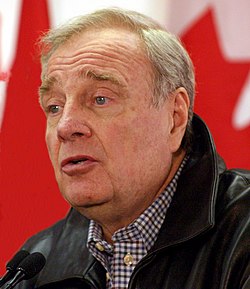
Paul Edgar Philippe Martin (French: [pɔl maʁtɛ̃]; born August 28, 1938), also known as Paul Martin Jr., is a Canadian lawyer and retired politician who served as the 21st prime minister of Canada and the leader of the Liberal Party of Canada from 2003 to 2006.
Key Information


The son of former senator and secretary of state for external affairs Paul Martin Sr., Martin was a lawyer from Ontario before he became president and the chief executive officer of Canada Steamship Lines in 1973. He held that position until his election as a member of Parliament for the Montreal riding of LaSalle—Émard in 1988. Martin ran for leader of the Liberal Party in 1990, losing to Jean Chrétien. Martin became Chrétien's longtime rival for the leadership of the party, though he was appointed as minister of finance after the Liberal victory in the 1993 federal election. As minister, Martin oversaw many changes in the financial structure of the Canadian government, and his policies had a direct effect on eliminating the country's chronic fiscal deficit by sharply cutting spending and reforming programs. In 2002, he left as finance minister as tensions with Chrétien reached their peak. Martin initially prepared to challenge Chrétien's leadership, but when Chrétien announced his intention of retiring, Martin entered the 2003 Liberal Party of Canada leadership election. Martin won the leadership in a landslide, and was sworn in as prime minister that December.
Martin led the Liberal Party in the 2004 federal election, in which the party retained power as a minority government, losing its majority due to the sponsorship scandal that began to develop in the late 1990s. After the election, Martin's government reached an agreement with provincial premiers on increased healthcare spending, signed the Kelowna Accord to improve the living conditions of Indigenous peoples, and legalized same-sex marriage through the Civil Marriage Act. In 2005, the opposition parties in the House of Commons passed a motion of no confidence contending that his government was corrupt after the Gomery Commission released new details about the sponsorship scandal, which triggered the 2006 federal election. In that election, Martin's Liberals were defeated by the newly unified Conservative Party led by Stephen Harper, ending over 12 years of Liberal rule.
Shortly after the defeat, Martin stepped down as Liberal leader and declined to seek re-election in 2008. Evaluations of Martin's prime ministership have been mixed, whereas his tenure as finance minister has been viewed more favourably. Now seen as a global diplomat, Martin continues to contribute on the international arena through a variety of initiatives such as Incentives for Global Health and the not-for-profit behind the Health Impact Fund, the latter of which he serves on as a member of the advisory board. He also sits as an advisor to Canada's Ecofiscal Commission.
Early life
[edit]Martin was born at Hôtel-Dieu of St. Joseph Hospital in Windsor, Ontario,[1] and grew up in Windsor and Ottawa. His father, Paul Martin Sr., a Franco-Ontarian of Irish and French descent, served 33 years as a member of the House of Commons of Canada, and was a Cabinet minister in the Liberal governments of Prime Ministers W. L. Mackenzie King, Louis St. Laurent, Lester B. Pearson, and Pierre E. Trudeau. His mother, Eleanor "Nell" Alice (née Adams), was of Scottish and Irish descent.[2] He had one sister, Mary-Anne Bellamy, who was diagnosed with Crohn's disease at a young age.[3] She died on July 20, 2011.[4] Martin contracted polio in 1946 at the age of eight (like his father, who contracted the disease in 1907).[5]
Martin briefly attended the University of Ottawa before transferring to St. Michael's College at the University of Toronto, where he graduated with a B.A. in history and philosophy in 1961.[6][7] He was a member of the U of T Young Liberals[8] during his time at the University of Toronto. He then attended the University of Toronto Faculty of Law, where he received an LL.B. in 1964. He was called to the Ontario bar in 1966.[1]
On September 11, 1965, Martin married Sheila Ann Cowan,[9] with whom he has three sons: Paul, Jamie and David.
Business career
[edit]Board of directors
[edit]In 1969, Power Corporation took a controlling share in Canada Steamship Lines. On December 2, 1970, Paul Martin, the 32-year-old executive assistant[8] to Power Corporation Chief Executive Officer (CEO) Maurice Strong, was appointed to the CSL board of directors. In 1971, CSL minority shareholders sold outstanding shares to Power Corporation, making CSL a Power Corporation subsidiary.
Presidency
[edit] | This section of a biography of a living person does not include any references or sources. (June 2024) |
CSL suffered losses in 1972 when forced to cover unexpected cost overruns in the construction of three 80,000-ton ocean-going tankers at Davie Shipbuilding. On November 22, 1973, Martin was appointed president and CEO of the CSL Group. In 1974, CSL earnings were further hurt by an eight-week strike on the Great Lakes.
In 1976, Power Corporation reversed itself and took over the investment portfolio that had been sold to CSL five years earlier. CSL reverted to an operating division of Power Corporation.
Early political career (1988–1993)
[edit]In 1988, Martin was elected as the Member of Parliament (MP) for the southwestern Montreal riding of LaSalle-Émard. He was re-elected without much difficulty at every election until he retired from politics.
In 1984, the Liberal Party was defeated under the leadership of John Turner, falling to just 40 seats. A group of young Liberals approached Martin as a possible candidate to replace Turner, and while he did not take part in an attempt to overthrow Turner, he did prepare to succeed him in the leadership should the position open.
Martin was a candidate at the 1990 Liberal Party of Canada leadership election, losing to Jean Chrétien in a bitter race that resulted in lasting animosity between the two men and their supporters. A key moment in that race took place at an all-candidates debate in Montreal, where the discussion quickly turned to the Meech Lake Accord. Martin, favouring Meech, attempted to force Chrétien to abandon his nuanced position on the deal and declare for or against it. When Chrétien refused to endorse the deal, young Liberal delegates crowding the hall began to chant "vendu" ("sellout" in French) and "Judas" at Chrétien. Chrétien was upset at the response from the floor and another similar outburst by Martin supporters at the convention when Chrétien accepted the party leadership. Jean Lapierre and his supporters, who supported Martin, wore black armbands at the convention to protest Chrétien's victory. The Meech Lake accord was officially defeated just one day before the Liberal leadership was to be decided. In the House of Commons, Lapierre then crossed the floor to the newly formed Bloc Québécois.[10]
After the leadership convention, Martin co-authored the election platform Creating Opportunity, colloquially known as the Red Book. The Liberal Party won a landslide majority government in the 1993 election.
Finance Minister (1993–2002)
[edit]After the Liberals formed the government, Martin was chosen as minister of finance by Prime Minister Chrétien. At the time, Canada had one of the highest budgetary deficits of the G7 countries. Standard & Poor's had lowered its rating on Canada's foreign-denominated government debt from AAA to AA-plus in 1992, and in 1994, Moody's lowered its rating on Canada's foreign currency debt from Aaa to Aa1, partly due to Canada's growing public debt.[11] In his debut as finance minister, Martin made huge budget cuts that almost ground economic growth to a halt, scaling down government to 1951 levels. In 1994–96, when these cuts were made, economic growth decreased by 3.5 percentage points, according to a study by CIBC-Wood Gundy. The resulting loss in tax revenue almost eliminated the savings made by the cuts and turned the economy away from the public sector toward the private sector. The cuts endangered the provinces' abilities to pay for social programs, health care, and public infrastructure. In response, the Bank of Canada lowered interest rates to avoid contributing to a growing recession, causing a huge spurt of economic growth and resulting increase in government revenue.[12] In 1998, Martin introduced a balanced budget, an event that had occurred only twice in 36 years before 1997.[13] In 2002, Moody's and Standard and Poor's restored Canada's domestic and foreign currency debt ratings to AAA.[11]
During his tenure as finance minister, Martin was responsible for lowering Canada's debt-to-GDP ratio from a peak of 70 percent to about 50 percent in the mid-1990s. In December 2001, he was named a member of the World Economic Forum's "dream cabinet."[14] The global business and financial body listed Martin along with United States Secretary of State Colin Powell and United Nations Secretary-General Kofi Annan as top world leaders.
Also during his tenure as finance minister, Martin coordinated a series of meetings between the finance ministers of all provinces to discuss the pending crisis in the Canada Pension Plan (CPP). Consequently, Martin oversaw the creation of a general public consultation process in February 1996 that eventually led to major structural reform of the CPP. The results of this public consultation process were collected and analyzed by the Finance department. Eventually, it led to a proposal for overhauling the CPP, which was presented to Parliament and was approved soon after, averting a pension crisis.[14][15]
While Martin's record as finance minister was lauded in business and financial circles, there were undeniable costs. Some of these took the form of reduced government services, affecting the operations and achievement of the mandate of federal and provincial departments. This was probably most noticeable in health care, as major reductions in federal funding to the provinces meant significant cuts in service delivery. Martin's tactics, including those of using contributor's funds from RCMP, Military and Civil Service pension plans and Employment Insurance, created further controversy. CAW economist Jim Stanford said that a combination of a spending freeze at 1994 levels and lower interest rates would have eliminated the deficit in two years through economic growth alone, without the reduction in services.[12]
Relations with Chrétien
[edit]Chrétien and Martin frequently clashed while in office. It was reported that Chrétien privately often condemned Martin in bitter terms and had never forgiven Martin for running against him in the Liberal leadership convention of 1990. During that bitter contest, Martin had forced Chrétien to declare his opposition to the Meech Lake Accord and, as a result, Chrétien was generally unpopular in his home province for the next decade.[16]
Even before the Liberals' second electoral victory in the 1997 election, there was much speculation in the media and in Ottawa that Martin was after Chrétien's job and wanted to force him to retire. As the Liberals emerged with a smaller majority government after the 1997 election, it seemed unlikely that any opposition party could pose a serious challenge, but Martin began to gain support from those who began to disagree with Chrétien. Chrétien, however, resolved to stay on after the Liberals were reelected in 2000, having regained much of the ground lost in 1997. By this time, Martin had gained control of much of the party machinery.
Becoming prime minister
[edit]The conflict between the two men reached a peak in 2002. Martin left Cabinet, being replaced by John Manley as finance minister. There is some question about whether Martin resigned or Chrétien had him dismissed. Being out of Cabinet was likely a boost to Martin's campaign as he was no longer obligated to disclose his donors. Soon after, Martin declared his intention to run as leader of the Liberal Party at the next party convention. Over the summer of 2002, Martin toured the country campaigning to succeed Chrétien while his Liberal organizers prepared to challenge Chrétien's leadership during a review vote in January 2003. During the fall, Chrétien announced that he would step down in the spring of 2004 after less than half of caucus agreed to sign a commitment supporting him. The Liberal party called a leadership convention for the fall of 2003, to be held in Toronto.
Several other potential leadership contenders, such as Brian Tobin and Allan Rock, declined to enter the contest. John Manley's attacks on Martin's refusal to disclose his campaign contributors did little to dent the latter's commanding lead and Manley eventually conceded the race. This left no strong candidate for Chrétien supporters to rally around, and some of them grudgingly voted for Martin.
On September 21, 2003, Martin easily defeated his sole remaining opponent, former deputy prime minister Sheila Copps, securing 93 percent of the party delegates. On November 14, 2003, he was declared the winner at the Liberal leadership convention, capturing 3,242 of 3,455 votes. He had won the leadership almost unopposed, due to his hold on the party machinery, and because Chrétien supporters did not rally around either of the leadership opponents.
Simon Fraser University professor Doug McArthur has noted that Martin's leadership campaign used aggressive tactics for the 2003 leadership convention, in attempting to end the contest before it could start by giving the impression that his bid was too strong. McArthur blamed Martin's tactics for the ongoing sag in Liberal fortunes, as it discouraged activists who were not on side.[17]
Prime Minister (2003–2006)
[edit]Majority government and sponsorship controversy
[edit]On December 12, 2003, Martin was appointed by then-Governor General Adrienne Clarkson as the 21st Prime Minister of Canada. When sworn in as prime minister, Martin held the flag that flew on Parliament Hill when the elder Martin died. Both father and son had served as Cabinet ministers and contested the Liberal leadership on multiple occasions; their attempts from 1948 to 1990 were unsuccessful. Martin's election as leader and becoming prime minister was described as fulfilling a family dream. Both also earned the honorific prefix The Right Honourable. One difference between them was that Paul Sr. was one of the most left-wing members of the party, while Paul Jr. is considered on the right-wing.[18]
When he was sworn in, Martin's new cabinet retained only half the ministers from Chrétien's government, a noteworthy break in tradition from previous instances where a retiring prime minister handed over power to his successor as party leader. Martin and his supporters exercised control over the riding nomination process, breaking with the precedent to automatically sign the nomination papers of backbenchers and former ministers who wanted to run for reelection. While these were signs of open party infighting, this had little impact on Martin's record popularity, with several pundits suggesting that the cabinet change was meant to present a new government different from Chrétien's ten-year tenure. Martin declined to appoint leadership contestants John Manley and Sheila Copps to cabinet.
Martin and the Liberals were adversely affected by a report from Auditor General Sheila Fraser on February 9, 2004, indicating that sponsorship contracts designed to increase the federal government's status in Quebec resulted in little to no work done. Many of the agencies had Liberal ties, and roughly $100 million of the $250 million in program spending went missing. The scandal hurt Martin's popularity, especially in Quebec, where Bloc Québécois leader Gilles Duceppe even accused Martin of planning to widen the St. Lawrence seaway to benefit his own Canada Steamship Lines. The scandal also cast skepticism on Martin's recommendations for Cabinet appointments, prompting speculation Martin was simply ridding the government of Chrétien's supporters to distance the Liberals from the scandal. Martin acknowledged that there was political direction but denied involvement in, or knowledge of, the sponsorship contracts. He had a judicial inquiry called to investigate what came to be known as the Sponsorship Scandal, and nominated John Gomery to head it.
During his term, Martin appeared as himself in a fictional, comedic context in several programs, including an episode of the CTV sitcom Corner Gas in 2006, and also in the CBC mockumentary series Jimmy MacDonald's Canada in 2005.
2004 federal election
[edit]The Liberals were facing a new united Conservative Party led by Stephen Harper, while the Bloc Québécois and NDP were also buoyed by the Sponsorship Scandal. Martin advised Governor General Adrienne Clarkson to call an election for June 28, 2004.
The Liberals were also hampered by their inability to raise campaign money competitively after Chrétien passed a bill in 2003 that banned corporate donations, even though the Liberals had enjoyed by far the lion's share of this funding due to the then-divided opposition parties. It has been suggested that Chrétien, who had done nothing about election financing for his 10 years in office, could be seen as the idealist as he retired, while his rival and successor Martin would have the burden of having to fight an election under the strict new rules.[19][20]
An unpopular provincial budget by Liberal Premier Dalton McGuinty, who broke a pledge not to raise taxes, hurt the federal party's numbers in Ontario,[21] as did a weak performance from Martin in the leaders' debates. The Conservatives soon took the lead, prompting some predictions of an imminent Harper government. The Liberals managed to narrow the gap and eventually regain momentum.[22] Martin was successful in winning a plurality of seats to continue as the government, though they were now in a minority situation, the first since Joe Clark's tenure in 1979–80.
Minority government
[edit]The Martin government faced combined challenges from Quebec separatism and general hostility arising from the Sponsorship Scandal. The first test of the Liberal minority came following the Speech from the throne on October 5, 2004. The Bloc Québécois moved an amendment to the speech challenging the government over provincial jurisdiction. The Conservatives supported the amendment, but the NDP opposed it. Collapse of the government on the confidence vote was averted after Martin called Harper and reached a last-minute deal watering down the motion's wording.[23] The government faced another hurdle when the Conservatives announced their own plan to move an amendment to the speech. Harper denied that the Tories intended to bring down the government.[24] The fall of the government was averted for the second time after the Liberals reached a deal with the opposition parties.[25] Don Boudria, the Liberals' Chrétien-era House leader, likened the brinkmanship in the first few weeks of the 38th Parliament to a game of Russian roulette.[26]
Economic policy
[edit]Martin invested heavily in Quebec, for example with the Bombardier Inc. C series project,[27] which was later taken over by Airbus when the owner got into financial difficulties and called the Airbus A220.[28] By June 2005 Martin gave the Federation of Canadian Municipalities a GST rebate and was about to supply to them a portion of the federal gasoline tax;[27][29] the programme was called "New Deal for Cities and Communities".[30] This was a left-over of his time as Minister of Finance,[31][32] spurred by continued carping by academics,[33][34] some of whom did not hesitate to note in 2004 that "[u]nlike the federal and provincial governments, municipalities cannot borrow for operating purposes; they can only do so for capital expenditures."[35]
Healthcare funding
[edit]At the First Ministers' Meeting of September 13–15, 2004, Martin and the provincial premiers reached an agreement on increased funding for healthcare.[36] This 10-year plan outlined $18 billion in increased transfers to the provinces over 6 years, notably through increases in the CHT:[37][38]
- The CHT was to be increased by $3 billion in 2004-05 and $2 billion in 2005-06;
- A new CHT base set at $19 billion starting in 2005–06, greater than suggested in the Romanow Report;
- An escalation factor set at 6% starting in 2006–07.
Equalization
[edit]Martin also introduced changes to the equalization program, under which the Federal Government is constitutionally obligated to redistribute federal revenue to provinces having less ability to raise revenues through taxation than wealthier provinces. The goal is to ensure uniformity of public service provision across the nation. This was received well in "have-not" provinces, but Nova Scotia and Newfoundland and Labrador sought to retain income from natural resources on federal marine territory that would generally be taken, or 'clawed back', by the federal treasury in lieu of equalization payments. In the 2004 federal election campaign, Harper provided a written promise that Newfoundland and Labrador and Nova Scotia under a Conservative government would receive 100 percent of the revenue generated from their natural resources without an equalization clawback, a promise he reneged upon when he became prime minister. NDP leader Jack Layton followed suit soon after with a similar guarantee, and later Martin promised that under a Liberal government both provinces would receive the same deal, except only for oil resources.[39] Negotiations over the agreement were harsh, with Newfoundland and Labrador Premier Danny Williams at one point ordering all Canadian flags removed from provincial government buildings in December 2004.[40] The dispute was resolved when the federal government agreed to Martin's original campaign promise.
2005 budget
[edit]The 2005 federal budget was presented in the House of Commons on February 23, 2005. The budget included an array of new spending for the Armed Forces, the environment and a national child-care program.
Public hearings of the Gomery Commission inquiry into the sponsorship scandal involving alleged kickbacks and "donations" from Quebec advertising agencies and corporations to Liberal Party operatives led to a drop in the Liberal Party's popularity. The security of the minority government came under fire as the Conservatives threatened to force an election by use of their "opposition day," when they get to set the Parliament's agenda. The Conservatives would use this time to hold a vote of no confidence in order to topple Martin's government.[41] To avoid this, Martin removed all opposition days from the schedule and made a televised appearance on April 21, 2005, to attempt to gain support from the Canadian people to let the inquiry run its course before an election was called. In the rebuttal speeches by the opposition party leaders, Layton offered his party's support provided that they were given major concessions in the budget such as canceling the proposed corporate tax cuts. Days later, the Liberals took the NDP up on their offer and negotiated tax cut deferments and new spending initiatives. Among the new commitments was aid for Sudan, which Sudan's officials turned down as Martin did not consult them about it beforehand. This aid was attacked as a perceived attempt to win the vote of a single independent MP, former Liberal David Kilgour. Kilgour nevertheless voted against the government.[42]
In May, Parliament passed a motion asking one of its committees to express a lack of confidence in the government. The Liberals dismissed this as a procedural matter, causing some to accuse them of governing unlawfully by ignoring parliamentary tradition. The Conservatives and Bloc interpreted it as a vote of no confidence, and they combined their votes to shut down the House of Commons early for two days in a row. The Speaker of the House of Commons later ruled in favour of the Liberal stance.
On May 17, 2005, MP Belinda Stronach crossed the floor from the Conservative Party and joined the Liberal Party to become Minister of Human Resources and Skills Development. Martin claimed Stronach's move was due to concerns over the direction the Conservative Party was taking; others accused Stronach of political opportunism.[43][44] The event changed the balance of power in the House of Commons in favour of the government. This, and the support of independent MP Chuck Cadman, caused a tie during a May 2005 confidence vote, meaning that Peter Milliken, Speaker of the House needed to cast the deciding vote. He voted with the government, following the tradition that the Speaker votes to continue debate, and that allowed the budget to pass through the House on May 19, 2005.
Social policy
[edit]Same-sex marriage proved to be a defining issue of Martin's mandate. Martin opposed same-sex marriage in a 1999 vote on the issue along with a majority of MPs,[45] but changed his stance on the issue in 2004, citing recent court rulings and his personal belief that same-sex marriage was primarily a human rights issue.[46] In the midst of various court rulings in 2003 and 2004 that allowed for the legalization of same-sex marriages in seven provinces and one territory, the government proposed a bill to legalize same-sex marriage across Canada. The House of Commons passed the Civil Marriage Act in late June 2005 in a late-night, last-minute vote before Parliament closed down, the Senate passed it in July 2005, and it received Royal Assent on July 20 of the same year. This made Canada the fourth country in the world to allow same-sex marriages.[47]
In November 2005, the Martin government reached a historic consensus with Canada's provinces, territories, First Nations, Métis and Inuit. Known as the Kelowna Accord, it aimed to eliminate the gaps between Aboriginal and non-Aboriginal Canadians in health, education, housing and economic opportunity.
Foreign relations
[edit]
On February 24, 2005, Foreign Affairs Minister Pierre Pettigrew told the House of Commons that Canada would not participate in the American National Missile Defense Program, and that he expected to be consulted in the case of a missile being launched over Canadian airspace. Martin's decision met with much praise, but others saw that the government was distancing itself from the U.S. His government continued to cooperate with the United States on border control, refugee claimants, and defense, and he appointed seasoned Liberal politician Frank McKenna as Canada's ambassador to Washington.
Martin was criticized for failing to reach a foreign-aid target of 0.7 percent of GDP, most notably by Bono of Irish rock group U2 (who claimed that he was going to "kick [Martin's] butt" over the issue). Martin later responded that, in his view, many foreign leaders had made pledges that were too fanciful and that he would only commit to targets that he knew his government could be held accountable for.[48][49]
Martin became involved in a diplomatic row with the United States administration after accusing, with Bill Clinton, the US of not listening to global environmental concerns. Martin rejected US ambassador David Wilkins's rebuke and said he was standing up for Canada's interests over softwood and other issues.[50][51]
Martin promoted the expansion of the G8 into a larger group of twenty nations, G20, whose inaugural chairman was himself. He also forged a closer relationship with the People's Republic of China by announcing the strategic partnership initiative during PRC president Hu Jintao's state visit to Canada in September 2005.[52]
Appointment of Governor General
[edit]On August 4, 2005, the government announced that Martin had advised Queen Elizabeth II to appoint Michaëlle Jean as governor general. The reception to the appointment was mixed: some applauded the move, while accusations that her husband had both dined with former members of the terrorist organization FLQ and been supportive of Quebec separatism surprised others.[53] Subsequent to her appointment, she reaffirmed her commitment to federalism and the issue died down.
Fall of government
[edit]The first volume of the Gomery Report, released on November 1, 2005, cleared Martin of any wrongdoing while placing some blame for the scandal on Chrétien for lack of oversight, although it acknowledged that Chrétien had no knowledge of the scandal.[54] On June 26, 2008, Chrétien was cleared of all allegations of involvement in the scandal.[55]
A Canadian judge issued a gag order that barred Canadian media from covering the hearings of the Gomery Inquiry. Despite this, leaked information circulated after being published in an American blog Captain's Quarters.[56]
After the Gomery findings, NDP leader Jack Layton notified the Liberals of conditions for the NDP's continued support; the terms of these conditions are unclear, but the two parties were unable to come to an agreement. An opposition proposal to schedule an election for February 2006 in return for passing several pieces of legislation was also unrealized.[57] The Conservatives, supported by the other two opposition parties (the NDP and Bloc Québécois), introduced a motion of non confidence against the Martin government. The motion passed on November 28 by a count of 171–133, defeating the government, after which the governor general issued election writs for a vote to be held on January 23, 2006.[58][59]
Some commentators described Martin's tenure as prime minister as unfocused and indecisive, with the Canadian correspondent of The Economist reporting that he was being called "Mr. Dithers" in Ottawa.[60][61]
2006 federal election
[edit]Prior to the campaign and upon dropping of the writs, opinion polling indicated the Liberals were ahead of the Conservatives by 2–10% popular support (November 30, 2005: Liberals 35%, Conservatives 30%). But the Liberal lead did not last. They did not plan much serious campaigning during December, allowing the Conservatives to take the initiative in rolling out policy ideas. Several early gaffes were picked up by an unsympathetic media. One notable gaffe was Liberal Party strategist Scott Reid's suggestion that parents might buy beer and popcorn with the Conservatives' child care subsidy, although Martin declined to apologize. Martin was also criticized for portraying himself as the defender of Canadian unity; some opponents said that the election was not a referendum while others pointed to the Sponsorship Scandal.[62]
Near the end of December, the Liberals were rocked by a Royal Canadian Mounted Police criminal investigation into the leaking of news of a federal tax change for income trusts.[63][64] This again brought the Sponsorship Scandal to public attention at a time when Martin planned to make important policy announcements. Under constant campaign pressure by all opposition parties casting Martin and the Liberals as corrupt, Liberal support fell to as low as 26% in early January 2006. The decline was not halted even by a glossy election pledge booklet.[65]
Martin did not put in a strong performance during the televised campaign debates. While appearing passionate in his message, he stuttered in making statements and appeared somewhat flustered.[66][67] During one debate, Martin made a surprise pledge that he would eliminate the notwithstanding clause; the Conservatives pointed out that this was not one of the announced Liberal campaign promises.[68]
In an attempt to sway voter sentiment in the final two weeks of the campaign, the Liberals prepared a series of attack ads. One unreleased ad was seen widely as disrespectful of the military and it not only overshadowed the other ads but also forced Martin to defend it instead of releasing new policies. During the last week, Martin was forced to defend Harper after the latter was called a separatist by Canadian Auto Workers union leader Buzz Hargrove. In another tactic similar to the 2004 campaign, Hargrove urged all progressive voters to unite under the Liberal banner in English Canada and the Bloc Québécois in Quebec to stop the Conservatives, hoping to attract voters who were leaning towards the NDP, but New Democrat leader Jack Layton responded by focusing his attacks on Liberal corruption.
In the end, the Conservatives won a plurality of support and seats, finishing 31 seats short of a majority. The Liberals held their base of support in Ontario, with 54 seats of the 103 in the province. The Liberals lost a number of seats in Quebec, winning only 13 of the 75 seats in the province, down from 21 in 2004, while the Conservatives won 10 seats there. The Liberals did not improve their standings in the Western provinces, winning only 14 of the 92 seats, the same number as in 2004.
Shortly after midnight on January 24, 2006, after it became clear that the Conservatives were on their way to a plurality, Martin conceded defeat. (Near the end of the 2004 election, Martin and Harper both pledged that they would not form a government unless they won a plurality of seats.) Martin surprised many by announcing his resignation as party leader, saying "I will continue to represent with pride the people of LaSalle—Émard, but I will not take our party into another election as leader." The next day, Martin officially informed Governor General Michaëlle Jean of his intention to resign as prime minister.[69] Jean asked Harper to form a government later that day. Martin remained as prime minister until the Harper minority government was sworn on February 6, 2006.[70]
Supreme Court appointments
[edit]Martin chose the following jurists to be appointed as justices of the Supreme Court of Canada by the Governor General:
- Rosalie Abella (October 4, 2004 – July 1, 2021)
- Louise Charron (October 4, 2004 – August 30, 2011)
Return to the back benches (2006–2008)
[edit].jpg)
Choosing not to take on the office of Leader of the Opposition, the first defeated Prime Minister who had retained his seat not to do so, Martin stepped down as parliamentary leader of his party on February 1, and the Liberal caucus appointed Bill Graham, MP for Toronto Centre and outgoing Defence Minister, as his interim successor.
Martin temporarily remained nominal Liberal party leader until March 18, 2006, when he submitted his resignation to party executives, who handed that post to Graham for the interim until that next leadership convention could be held. At the same meeting Martin tendered his resignation, the date for the leadership convention to select his successor was set for the weekend of December 2–3, 2006. According to media reports, Martin decided to move up the date of his resignation to end speculation that he might lead the Liberals into another election if Stephen Harper's minority government were to fall prior to the Liberal leadership convention.[71] This began a trend of high turnover among permanent Liberal leaders, in contrast to their predecessors who usually served over two or more elections, including Pierre Trudeau and Jean Chrétien who each led for over a decade.[72]
At the Liberal convention in Montreal, Martin was officially neutral in the contest. The party's tribute to Martin was hosted by former Olympian Mark Tewksbury. Martin's press secretary denied that the tribute was low key due to the Sponsorship Scandal and lingering bitterness inside the party, saying that the former prime minister wanted a simple evening. In his farewell speech, Martin paid homage to Chrétien, though the latter was not present for the event, and urged the Liberals to emerge united from the convention. Stéphane Dion was elected Liberal leader from a field of eight candidates.[60][73]
For his last years of public office after resigning as prime minister, Martin was a backbencher, devoting his time to projects related to improving educational opportunities for Aboriginals (The Martin Aboriginal Education Initiative), and protecting the Congo Basin rain forest. In the 2008 federal election, Martin did not run for re-election to Parliament.
Retirement (2008–present)
[edit]
In November 2008, CTV reported that Martin would be a member of a four-person council of economic advisers to a coalition government formed by the Liberals and the NDP if they succeeded in toppling the Harper government.[74] However, the proposed coalition dissolved, as outgoing Liberal leader Stéphane Dion was quickly forced out and replaced by Michael Ignatieff, who distanced the party from the coalition.
Martin published his memoirs, Hell Or High Water: My Life In And Out of Politics (ISBN 0771056923), in late 2008. Published by McClelland & Stewart, the book draws heavily upon interviews conducted by Sean Conway, a former Ontario Liberal provincial cabinet minister, which were carried out for the Library and Archives Canada.
Martin was asked by Kofi Annan (at that time Secretary General of the United Nations), Gordon Brown (then Prime Minister of the United Kingdom), and other international politicians and diplomats to help African countries develop their economic potential.[75]
In 2009, Martin was co-chair of the Congo Basin Forest Fund, along with Nobel Peace Prize Laureate Professor Wangari Maathai, to address global warming and poverty issues in a ten-nation region in Africa.[75]
In September 2022, Martin attended Elizabeth II's state funeral, along with other former Canadian prime ministers.[76]
After his retirement from active Canadian politics, Martin was an adviser to the International Monetary Fund and to the Coalition for Dialogue on Africa. He also worked with the Martin Family Initiative, which assists First Nations youth.[77] He lives in Knowlton, Québec.
Honours
[edit]_ribbon_bar.svg)


| Ribbon | Description | Notes |
|
Companion of the Order of Canada (C.C.) |
|
|
125th Anniversary of the Confederation of Canada Medal |
|
|
Queen Elizabeth II Golden Jubilee Medal for Canada |
|
|
Queen Elizabeth II Diamond Jubilee Medal for Canada |
|
- Prenominal title "The Honourable" and postnominal "PC", for life upon being made a member of the Queen's Privy Council for Canada, November 4, 1993[80]
- Upgraded prenominal title "The Right Honourable", for life upon becoming prime minister, December 12, 2003

|
|
A Trillium-class freighter in Canada Steamship Lines, Rt. Hon. Paul E. Martin, is named for him.
Honorary degrees
[edit]| Location | Date | School | Degree |
|---|---|---|---|
 Quebec Quebec |
November 1998 | Concordia University | Doctor of Laws (LL.D)[82] |
 Ontario Ontario |
June 2001 | Wilfrid Laurier University | Doctor of Laws (LL.D)[83] |
| Ontario |
June 14, 2007 | University of Windsor | Doctor of Laws (LL.D)[84] |
| Quebec |
May 30, 2009 | Bishop's University | Doctor of Civil Law (DCL) |
| Ontario |
May 28, 2010 | Queen's University | Doctor of Laws (LL.D)[85] |
| Ontario |
June 18, 2010 | University of Western Ontario | Doctor of Laws (LL.D)[86] |
| Ontario |
June 3, 2011 | University of Toronto | Doctor of Laws (LL.D)[87] |
| Ontario |
June 16, 2011 | McMaster University | Doctor of Laws (LL.D)[88] |
| Ontario |
June 13, 2012 | Nipissing University | Doctor of Education (D.Ed.)[89] |
 British Columbia British Columbia |
Fall 2012 | University of British Columbia | Doctor of Laws (LL.D)[90][91] |
| Ontario |
June 1, 2013 | Lakehead University | Doctor of Laws[92] |
| Ontario |
2013 | University of Ottawa | [93] |
 New Brunswick New Brunswick |
2013 | University of New Brunswick | Doctor of Laws (LL.D)[94] |
 Israel Israel |
2013 | University of Haifa | Doctor of Philosophy (Ph.D.) |
| New Brunswick |
2014 | Mount Allison University | Doctor of Laws (LL.D)[95] |
 Nova Scotia Nova Scotia |
October 2014 | Dalhousie University | Doctor of Laws (LL.D)[96] |
 Manitoba Manitoba |
May 27, 2016 | Brandon University | Doctor of Laws (LL.D)[97] |
| Quebec |
June 7, 2017 | McGill University | Doctor of Laws (LL.D)[98][99] |
| Ontario |
June 9, 2017 | Trent University | Doctor of Laws (LL.D)[100][101] |
| Ontario |
June 14, 2019 | Carleton University | Doctor of Laws (LL.D)[102][103][104] |
 Alberta Alberta |
October 19, 2019 | University of Lethbridge | Doctor of Laws (LL.D) [105][106] |
| Ontario |
June 19, 2020 | Brock University | Doctor of Laws (LL.D)[107] |
Electoral record
[edit]See also
[edit].svg)

References
[edit]- ^ a b Munroe, Susan. "Prime Minister Paul Martin". About: Canada Online. Archived from the original on December 14, 2003. Retrieved November 29, 2006.
- ^ "Like father, like son?". CBC Archives. December 14, 1988. Retrieved June 5, 2015.
- ^ "Former PM's sister always helped those in need". The Windsor Star. July 22, 2011. Archived from the original on July 21, 2015. Retrieved October 19, 2014.
- ^ "Mary-Anne Bellamy". legacy.com. July 22, 2011. Retrieved October 19, 2014.
- ^ "We are on the cusp of ending polio". Globe & Mail. Retrieved July 28, 2016.
- ^ "Honorary Degree Citation – Paul Martin – Concordia University Archives". Retrieved July 28, 2016.
- ^ Emshey, Lori-Lee (January 16, 2012). "U of T alumnus Paul Martin receives Order of Canada". The Medium. Archived from the original on May 27, 2016. Retrieved July 28, 2016.
- ^ a b Kerr, Peter (August 21, 2009). "Paul Martin – life after politics". The Montrealer. Retrieved October 21, 2014.
- ^ Martin, Paul (2009). Hell or High Water: My Life in and out of Politics. Emblem Editions. p. 33. ISBN 978-0771056932.
- ^ "A very bitter defeat for Paul Martin". Archives.cbc.ca. June 23, 1990. Retrieved June 5, 2015.
- ^ a b Martell, Allison; Guttsman, Janet (August 8, 2011). "Factbox: How Canada tamed its budget deficit". Reuters. Thomson Reuters. Retrieved February 17, 2021.
- ^ a b "Paul Martin: He has a record". rabble.ca. Retrieved August 6, 2011.
- ^ CBC News Online. "Ottawa's cup runneth over Federal budget surpluses – FAQs". CBC News. Canadian Broadcasting Corporation. Retrieved April 26, 2014.
- ^ a b Keith Boag (reporter) (November 29, 1993). Paul Martin, deficit buster (.wmv) (news report). CBC Archives. Retrieved June 5, 2015.
- ^ Murphy, John. "An Open Letter About The Canada Pension Plan". National Council of Welfare. Archived from the original on August 10, 2006. Retrieved November 29, 2006.
- ^ "Juggernaut: Paul Martin's Campaign for Chrétien's Crown / Paul Martin: The Power of Ambition (comptes rendus)". Policy Options. Retrieved December 17, 2019.
- ^ Mickleburgh, Rod (September 25, 2011). "Topp's NDP campaign tactics border on bullying, professor warns". Globe and Mail. Toronto.
- ^ "Paul Martin sworn in as prime minister". Archives.cbc.ca. December 12, 2003. Retrieved June 5, 2015.
- ^ Grey, John (June 13, 2006). "Reality Check". CBC News. Archived from the original on November 14, 2006. Retrieved February 11, 2020.
- ^ Warnica, Richard (April 17, 2013). "The liberal resurrection". National Post. Retrieved February 11, 2020.
- ^ (Friday, July 2, 2004). "Why Stephen Harper Lost (by John Chuckman) – Media Monitors Network (MMN)". Usa.mediamonitors.net. Archived from the original on August 5, 2004. Retrieved October 24, 2008.
{{cite web}}: CS1 maint: multiple names: authors list (link) CS1 maint: numeric names: authors list (link) - ^ CBC News (June 29, 2004). "Tories fail to make breakthrough in Ontario". CBC. Retrieved April 26, 2014.
- ^ "Parliamentary crisis averted". The Globe and Mail. October 7, 2004. Retrieved April 13, 2025.
- ^ "Tories won't topple government, Harper says". The Globe and Mail. October 6, 2004. Retrieved April 13, 2025.
- ^ "Leaders condemn PM's plan - The Globe and Mail". The Globe and Mail. April 13, 2025. Archived from the original on April 13, 2025. Retrieved April 13, 2025.
- ^ "A dangerous game indeed". The Globe and Mail. October 6, 2004. Retrieved April 13, 2025.
- ^ a b "Address by Prime Minister Paul Martin in Montreal".
- ^ "From war to partner: Airbus and the CSeries". Leeham. October 18, 2017. Archived from the original on February 23, 2018. Retrieved October 19, 2017.
- ^ "Address by Prime Minister Paul Martin to the conference of the Federation of Canadian Municipalities".
- ^ "Senator Éric Forest - Topic Intervention 572377 - 29".
- ^ Young, Robert; McCarthy, Kelly (2009). "Why do municipal issues rise on the federal policy agenda in Canada?". Canadian Public Administration. 52 (3): 347–370. doi:10.1111/j.1754-7121.2009.00087.x.
- ^ "Cities call on PM to continue support in Martin's absence". cbc.ca. June 4, 2002.
- ^ Mau, Tim A (June 2005). "Political Rhetoric or Genuine Leadership: An Assessment of the "New Deal" for Cities" (PDF). University of Guelph.
- ^ Levi, Ron; Valverde, Mariana (July 2006). "Freedom of the City: Canadian Cities and the Quest for Governmental Status". Osgoode Hall Law Journal. 44 (3): 409–459. doi:10.60082/2817-5069.1281.
- ^ Young, Robert; Leuprecht, Christian, eds. (2004). "Municipal-Federal-Provincial Relations in Canada" (PDF). McGill-Queen's University Press.
- ^ CBC News (September 16, 2004). "Anatomy of an agreement". CBC. Retrieved April 26, 2014.
- ^ "Dénouement d'une conférence des premiers ministres sur la santé". bilan.usherbrooke.ca (in French). Université de Sherbrooke. September 15, 2004. Archived from the original on February 23, 2020. Retrieved May 16, 2020.
- ^ Health Canada (September 16, 2004). "New Federal Investments on Health Commitments on 10-Year Action Plan on Health". canada.ca. Government of Canada. Archived from the original on September 7, 2021. Retrieved December 23, 2021.
- ^ CBC News (October 26, 2004). "Nfld. premier says PM broke promise". CBC. Retrieved April 26, 2014.
- ^ CBC News (December 24, 2004). "Newfoundland's flag flap 'disrespectful,' PM says". CBC. Retrieved April 26, 2014.
- ^ CBC News (April 19, 2005). "Opposition threatens to shut down government". CBC. Retrieved June 5, 2015.
- ^ CTV.ca News Staff (May 9, 2005). "Sudan aid doesn't buy vote, Kilgour says". CTV.ca. Archived from the original on August 17, 2005. Retrieved November 29, 2006.
- ^ CTV.ca News Staff (May 17, 2005). "Stronach decision likely a long time coming". CTV.ca. Archived from the original on October 28, 2006. Retrieved November 29, 2006.
- ^ CTV.ca News Staff (May 17, 2005). "Stronach crosses the floor, joins Liberal cabinet". CTV.ca. Archived from the original on October 6, 2006. Retrieved November 29, 2006.
- ^ Mackenzie, Ian. "Marriage Vote: The Liberals could leave us at the altar". XTRA Archives. Archived from the original on September 28, 2007. Retrieved November 29, 2006.
- ^ CBC News (December 9, 2004). "Supreme Court OK's same-sex marriage". CBC. Retrieved April 26, 2014.
- ^ CBC News (June 29, 2005). "The Supreme Court and same-sex marriage". CBC. Retrieved April 26, 2014.
- ^ CTV.ca News Staff (July 9, 2005). "Resolute G-8 leaders unveil $50B in foreign aid". CTV.ca. Archived from the original on March 2, 2006. Retrieved November 29, 2006.
- ^ "Irish rock star Bono says Canadian Prime Minister mystifies him". News From Russia. pravda.ru. November 26, 2005. Archived from the original on April 17, 2007. Retrieved November 29, 2006.
- ^ CBC News (November 30, 2005). "Martin warns of threat to national unity". CBC. Retrieved April 26, 2014.
- ^ CBC News (December 13, 2005). "Martin rejects U.S. ambassador's rebuke". CBC. Retrieved April 26, 2014.
- ^ The Consulate General of The People's Republic of China in Canada (September 9, 2005). "China, Canada agree on building strategic partnership". Embassy of the People's Republic of China in Canada. Retrieved February 17, 2021.
- ^ CTV.ca News Staff (August 15, 2005). "Gov. Gen. designate denies separatist link". CTV.ca. Archived from the original on September 22, 2007. Retrieved November 30, 2006.
- ^ Brown, Jim (November 1, 2005). "Justice John Gomery report lays blame with Chrétien, exonerates Martin". Canadian Press. canada.com. Archived from the original on October 14, 2007. Retrieved November 29, 2006.
- ^ "Key Gomery finding involving Chrétien, Pelletier struck down". CBC News. June 26, 2008. Retrieved April 26, 2014.
- ^ Adamson, Rondi (April 13, 2005). "Borderless blogs vs. Canada press ban". The Christian Science Monitor. Retrieved February 11, 2020.
- ^ CBC News (November 21, 2005). "MPs pass motion calling for February election". CBC. Retrieved April 26, 2014.
- ^ CTV.ca News Staff (November 28, 2005). "Liberal government defeat sets stage for election". CTV.ca. Archived from the original on October 10, 2006. Retrieved November 29, 2006.
- ^ CBC News (November 28, 2005). "Liberals lose confidence of the House". CBC. Retrieved April 26, 2014.
- ^ a b CBC News (December 1, 2006). "Martin urges Liberals to leave convention 'side by side'". CBC. Retrieved April 26, 2014.
- ^ CBC News (February 18, 2005). "British magazine dubs Martin 'Mr. Dithers'". CBC. Retrieved April 26, 2014.
- ^ CTV.ca News Staff (December 11, 2005). "Liberals wrong to play separatism card, Lord says". CTV.ca. Archived from the original on March 11, 2007. Retrieved November 29, 2006.
- ^ CBC News. "The Income Trusts Probe". Canada Votes 2006. CBC. Archived from the original on November 1, 2006. Retrieved November 29, 2006.
- ^ Canadian Press (January 22, 2006). "Income trust a major campaign turning point". CTV.ca. Archived from the original on January 16, 2009. Retrieved November 29, 2006.
- ^ Marin, Paul, ed. (2006). "Securing Canada's Success" (PDF).
- ^ "CTV.ca | Debate cements, rather than sways, voter intents". Ctv.ca. January 9, 2006. Archived from the original on August 18, 2006. Retrieved October 24, 2008.
- ^ "Stephen Taylor – a blog on Canadian politics » Blog Archive » Harper wins the English debate". Stephentaylor.ca. June 15, 2004. Retrieved October 24, 2008.
- ^ "CTV.ca | Martin vows to end federal notwithstanding clause". Ctv.ca. January 9, 2006. Archived from the original on March 16, 2008. Retrieved October 24, 2008.
- ^ Richer, Eric (January 24, 2006). "Media Advisory". Rideau Hall Press Office. Retrieved November 29, 2006.
{{cite web}}:|archive-url=is malformed: timestamp (help)CS1 maint: url-status (link) - ^ Richer, Eric (February 6, 2006). "Details regarding the swearing-in ceremony of the 22nd prime minister of Canada and his ministry". Rideau Hall Press Office. Archived from the original on November 25, 2008. Retrieved November 29, 2006.
- ^ "Martin to officially resign as party leader". CBC News. March 16, 2006. Retrieved June 15, 2023.
- ^ Wells, Paul. (May 4, 2011) The untold story of the 2011 election: Introduction and Chapter 1 – Paul Wells. Macleans.ca. Retrieved on July 12, 2013.
- ^ "CTV.ca | Liberals pay tribute to Paul Martin at convention". Ctv.ca. November 30, 2006. Archived from the original on October 14, 2007. Retrieved October 24, 2008.
- ^ "Opposition agrees to coalition with Dion as PM". Ctv.ca. December 2008. Archived from the original on December 4, 2008. Retrieved April 20, 2010.
- ^ a b Paul Martin – Life after Politics, The Montrealer, August 1, 2009.
- ^ Major, Darren (September 15, 2022). "Prime minister, Governor General to be joined by Indigenous leaders at Queen's funeral". CBC.ca. Retrieved September 19, 2022.
- ^ Perkins, Tara (September 17, 2011). "Martin's recipe for economic stability", The Globe and Mail, p. B3.
- ^ a b The Office of the Secretary to the Governor General. "The Governor General of Canada". Retrieved March 27, 2018.
- ^ The Office of the Secretary to the Governor General. "The Governor General of Canada". Retrieved March 27, 2018.
- ^ "Members of the Queen's Privy Council". Privy Council Office. Archived from the original on October 21, 2017. Retrieved October 6, 2014.
- ^ "Paul Edgar Phillippe MARTIN". reg.gg.ca. Retrieved February 10, 2020.
- ^ Mohsen Anvari. "Honorary degree citation - Paul Martin". Concordia University. Archived from the original on July 27, 2020. Retrieved July 24, 2021.
- ^ "Wilfrid Laurier University – University Secretariat – Senate – Honorary Degree Recipients". Wlu.ca. Archived from the original on December 25, 2007. Retrieved April 20, 2010.
- ^ "Honorary degrees conferred (Chronological)" (PDF). Archived from the original (PDF) on January 28, 2016. Retrieved February 17, 2016.
- ^ "Former Prime Minister Paul Martin among Queen's honorary degree recipients". Queensu.ca. Archived from the original on August 5, 2013. Retrieved September 23, 2013.
- ^ "HONORARY DEGREES AWARDED" (PDF). Archived (PDF) from the original on March 8, 2021. Retrieved July 24, 2021.
- ^ "University of Toronto Honorary Degree Recipients 1850 - 2016" (PDF). Archived (PDF) from the original on December 16, 2020. Retrieved July 24, 2021.
- ^ "University Secretariat" (PDF).
- ^ "Honorary Degree Recipients – Nipissing University". Archived from the original on June 12, 2018. Retrieved July 28, 2016.
- ^ "The Right Honourable Paul Martin". The University of British Columbia. Retrieved July 24, 2021.
- ^ "The Right Honourable Paul Martin, PC, CC - UBC Vancouver 2012 Fall Honorary Degree Recipient". YouTube. January 29, 2013. Archived from the original on November 17, 2021. Retrieved July 24, 2021.
- ^ "Lakehead University Announces its 2013 Honorary Degree Recipients". Lakehead University. Retrieved June 15, 2019.
- ^ "Home – Media – University of Ottawa". Archived from the original on June 5, 2013. Retrieved July 28, 2016.
- ^ Carter, Jeff. "UNB Honorary Degrees Database". Retrieved July 28, 2016.
- ^ "Mount Allison University – Honorary degree recipients 21st century". Archived from the original on June 9, 2021. Retrieved July 28, 2016.
- ^ "The Right Honourable Paul Martin, PC, OC". Archived from the original on September 17, 2016. Retrieved July 28, 2016.
- ^ "Brandon University to bestow honorary degree on Paul Martin at Spring Convocation". Brandon University. May 6, 2016. Archived from the original on January 27, 2021. Retrieved July 24, 2021.
- ^ "List of McGill Honorary Degree Recipients from 1935 to September 2019" (PDF). Archived (PDF) from the original on February 1, 2020. Retrieved July 24, 2021.
- ^ "Former Prime Minister Paul Martin will receive honorary doctorate from McGill's Faculty of Education". McGill University. April 25, 2017. Retrieved July 24, 2021.
- ^ "Home – Media – Trent University". April 3, 2017. Retrieved April 8, 2017.
- ^ "Honorary Degree Recipients 2018 – Convocation – Trent University".[dead link]
- ^ "Honorary Degrees Awarded Since 1954". Archived from the original on July 12, 2021. Retrieved July 24, 2021.
- ^ "Honorary Degree Recipients (Spring 2019)". Archived from the original on October 17, 2019. Retrieved July 24, 2021.
- ^ "The Right Honourable Paul Martin awarded degree Doctor of Laws (Carleton U, 154th Convocation)". YouTube. June 14, 2019. Archived from the original on November 17, 2021. Retrieved July 24, 2021.
- ^ "Convocation kicks off busy time for U of L". The Lethbridge Herald – News and Sports from around Lethbridge. October 19, 2019. Archived from the original on October 19, 2019. Retrieved October 19, 2019.
- ^ Fominoff, Lara. "Former Prime Minister Paul Martin to receive honorary Doctor of Laws at U of L Fall Convocation". LethbridgeNewsNOW| Lethbridge, Alberta | News, Sports, Weather, Obituaries, Real Estate. Retrieved October 19, 2019.
- ^ "BROCK UNIVERSITY HONORARY DEGREE AND AWARD RECIPIENTS" (PDF). Archived (PDF) from the original on December 16, 2020. Retrieved July 24, 2021.
Further reading
[edit]Archives
[edit]- Paul Edgar Philippe Martin fonds. Ottawa, Ontario: Library and Archives Canada.
Bibliography
[edit]- Gray, John. Paul Martin, 2003.
- Jeffrey, Brooke. Divided Loyalties: The Liberal Party of Canada, 1984 – 2008 (University of Toronto Press. 2010)
- Wilson-Smith, Anthony; Greenspon, Edward (1996). Double Vision: The Inside Story of the Liberals in Power. Doubleday Canada. ISBN 0-385-25613-2.
External links
[edit]

- Paul Martin – Parliament of Canada biography
- "Prime Minister Paul Martin says he would use the Constitution's notwithstanding clause".
- CBC Digital Archives – Paul Martin: Prime Minister in Waiting
- Paul Edgar Philippe Martin by Steven Azzi and Norman Hillmer Archived April 8, 2018, at the Wayback Machine
- "Does Canada's former prime minister hold the key to reducing Britain's budget deficit?" The Guardian January 12, 2009
- Paul Martin at IMDb
- The Right Honourable Paul Martin, P.C., C.C., Q.C. | The Governor General of Canada
- Appearances on C-SPAN


| National leaders |
|  | |||||||
|---|---|---|---|---|---|---|---|---|---|
| Cabinets |
| ||||||||
| Parliamentary election candidates | |||||||||
| Related parties |
| ||||||||


Paul Martin
View on GrokipediaEarly Life and Education
Family Background and Childhood
Paul Edgar Philippe Martin Jr. was born on August 28, 1938, at Hôtel-Dieu Grace Hospital in Windsor, Ontario, to Paul Joseph James Martin Sr. and Eleanor Alice "Nell" Adams.[8][9] His father, a Franco-Ontarian lawyer and politician born June 23, 1903, in Ottawa to parents of Irish paternal and French-Canadian maternal descent, had been elected as the Liberal Member of Parliament for Windsor in the 1935 federal election and held the seat continuously until 1968.[10] Paul's mother, born around 1913, came from a family with roots in Ontario.[11] The Martins had two children: Paul Jr. and a younger daughter, Mary-Anne.[12][13] During his early childhood, Martin resided in Windsor, where his father represented the riding, but the family relocated to Ottawa in 1945 after Paul Sr. joined the federal cabinet as Secretary of State and subsequently Minister of National Health and Welfare under Prime Minister William Lyon Mackenzie King.[12] This move immersed the young Martin in the political environment of the national capital, influenced by his father's long parliamentary career spanning governments of four prime ministers.[8] In 1946, at age eight, Martin contracted polio, as had his father in childhood, but he made a full recovery without lasting effects.[2] His sister's later diagnosis with Crohn's disease highlighted family health challenges, though it emerged in her adulthood.[11] The family's bilingual household and exposure to public service shaped Martin's formative years amid the stability of post-World War II Canada.[10]University Education and Early Career Influences
Martin attended the University of Ottawa for a brief period before transferring to the University of Toronto's St. Michael's College, where he completed an honours Bachelor of Arts in philosophy in 1962.[14][15] He then pursued legal studies at the University of Toronto Faculty of Law, earning a Bachelor of Laws degree in 1965 and being called to the Ontario Bar in 1966.[15][16] Although qualified as a lawyer, Martin did not enter legal practice, opting instead for business opportunities that aligned with his interests in commerce and industry.[2] In 1966, shortly after his bar admission, Martin relocated to Montreal and joined Power Corporation of Canada as an executive assistant, marking his entry into the corporate sector under the influence of the firm's leadership, including figures like Maurice Strong, who shaped his approach to international business and resource development.[9][2] This position exposed him to conglomerate operations and strategic investments, fostering skills in corporate governance and shipping logistics—key precursors to his later executive roles.[17] His early experiences at Power Corporation emphasized practical economic management over theoretical pursuits, reflecting a pragmatic shift influenced by his father's legacy in public service and the firm's focus on North American industrial expansion.[15] By the late 1960s, Martin had transitioned into operational roles within shipping subsidiaries, laying the groundwork for his specialization in maritime transport and self-unloading vessels.[17]Business Career
Entry into Corporate World
After being called to the Ontario bar in 1966 following his graduation from the University of Toronto Faculty of Law, Paul Martin chose to forgo legal practice and entered the corporate sector by relocating to Montreal to join Power Corporation of Canada.[8][18] There, he took on the role of executive assistant to Maurice Strong, the company's president, a position arranged to afford Martin initial business exposure under Strong's mentorship.[19][20] This entry point into Power Corporation, a major Canadian conglomerate with diverse holdings in energy, finance, and communications, provided Martin with foundational experience in high-level corporate operations and strategic decision-making at age 28.[2]Role at Power Corporation of Canada
Martin joined Power Corporation of Canada in 1966, shortly after completing his legal studies, initially serving as executive assistant to the company's president, Maurice Strong.[2][18][21] In this capacity, he supported Strong's leadership during a period of expansion for the Montreal-based holding company, which focused on investments in financial services, energy, and transportation sectors.[8] Following Paul Desmarais Sr.'s acquisition of Power Corporation in 1968, Martin continued in executive roles, rising to vice-president by the early 1970s.[22] His responsibilities included contributing to corporate strategy and oversight of subsidiaries, amid the firm's growth into a major Canadian conglomerate with assets exceeding $1 billion by the mid-1970s.[8] This period marked Martin's immersion in high-level business operations, leveraging his legal background for negotiations and deal structuring. In 1969, under Martin's involvement as an executive, Power Corporation acquired a controlling interest in Canada Steamship Lines, a key marine transportation firm, setting the stage for further integration of shipping assets into the portfolio.[8] His tenure at Power ended in the early 1980s when the company divested certain holdings, though Martin maintained close ties through subsequent business ventures.[8]Presidency of Canada Steamship Lines
Paul Martin was appointed president and chief executive officer of Canada Steamship Lines (CSL), Canada's largest operator of bulk cargo vessels on the Great Lakes and St. Lawrence River, on November 22, 1973.[23] The appointment came during a challenging period for the company, a subsidiary of Power Corporation of Canada since 1969, which had posted losses in 1972 due to cost overruns on three 80,000-ton ocean-going tankers built at Davie Shipbuilding.[24] Martin, aged 35 and previously an executive at Power Corporation, replaced Paul Desmarais and focused on stabilizing operations through cost controls and fleet modernization.[23] Under Martin's leadership, CSL reversed its financial downturn, achieving profitability by 1976 via improved efficiency in domestic freight hauling and investments in self-unloading vessels suited to Great Lakes trade.[25] The company, which traced its origins to 19th-century paddle steamers and a 1913 merger of inland lines, benefited from Martin's emphasis on technological upgrades, including early adoption of self-unloaders that reduced port handling times and costs for commodities like grain, iron ore, and coal.[26] In 1981, Martin partnered with Laurence Pathy to acquire CSL from Power Corporation in a leveraged buyout valued at an undisclosed sum, transitioning the firm to private ownership while retaining his role in strategic direction until 1991.[24][26] This ownership shift enabled bolder expansions, including entry into ocean shipping in 1982 with vessels flagged under foreign registries like Barbados to access international markets, thereby diversifying revenue beyond seasonal Great Lakes routes.[20] By the mid-1980s, these moves had positioned CSL as a multinational player, with innovations in self-unloader design enhancing competitiveness in global bulk transport.[26]Board Directorships and Investments
Martin served as chief executive officer, director, and principal owner of CSL Group Inc., the parent company of Canada Steamship Lines, following its acquisition in 1981 for $189 million in partnership with Laurence Pathy.[24][27] He also acted as president of the board of Canada Steamship Lines, a role he assumed after being appointed president of the company in 1974 while it was a subsidiary of Power Corporation of Canada.[21] In 1988, Martin bought out Pathy's stake, gaining full control of the voting shares alongside his wife, Sheila.[24] Beyond shipping, Martin's directorships extended to affiliated entities, including oversight of CSL's subsidiaries in trucking, bus operations (such as Voyageur Colonial Bus Lines), and real estate, though several were later divested.[28] His wife and a relative served as directors of Nellmart Holdings Inc., which managed personal investments in Vancouver movie theatres (Dunbar and Varsity) and office buildings.[28] Martin's investment portfolio diversified across sectors. Through CSL Equity Investments Ltd., in which CSL held a 50% interest, he controlled properties including condominiums and office buildings in Ontario, Alberta, Quebec, Arizona, and Colorado, as well as stakes in Canadian Shipbuilding & Engineering Ltd., encompassing shipyards in St. Catharines and Thunder Bay.[28][24] Personal holdings in 1989 included shares in an Alberta oil company, a junior oil venture (Cordex Petroleums Ltd., which filed for bankruptcy in 1999), $2 million in Power Corporation stock, ownership of Big Splash Water Slides, 22 Edmonton apartments, a Quebec farm, 66 beef cattle, and investments in four films (valued at nil).[28] CSL itself generated $350 million in annual revenue by the mid-1980s, operating bulk carriers across Canada, the U.S., Europe, and South America.[28]Entry into Politics
Motivations and Initial Involvement
After a successful career in business, particularly as president of Canada Steamship Lines, Paul Martin decided in his late forties to enter public life as a means to "give back" to society.[21] Despite growing up immersed in politics through his father, Paul Martin Sr., a long-serving Liberal cabinet minister, he initially resisted following that path, preferring pursuits in international development or corporate leadership to establish his own independence.[21] His father's 1977 diary entry anticipated this shift, noting that Martin "had the bug" for politics, a realization that materialized when he was 50 years old.[21] Martin's initial political involvement centered on securing the Liberal nomination for the Montreal riding of LaSalle—Émard, which he chose for its diverse community and working-class residents.[21] He won the nomination in May 1988, a move viewed as a deliberate first step toward higher leadership within the party, echoing his father's unfulfilled ambitions to become prime minister.[29] In the November 21, 1988, federal election, Martin was elected as the Member of Parliament for LaSalle—Émard, securing victory amid the Progressive Conservative majority government led by Brian Mulroney, placing the Liberals in opposition.[29] His entry generated significant expectations due to his business reputation for fiscal prudence and family legacy, positioning him as a potential future leader despite the party's minority status in the House of Commons.[29]1988 Federal Election and Early Parliamentary Role
Paul Martin contested the 1988 Canadian federal election as the Liberal Party candidate for the Montreal riding of LaSalle—Émard, a seat held by the governing Progressive Conservatives since 1984. On November 21, 1988, he was elected to the House of Commons, defeating incumbent Progressive Conservative MP Claude Lanthier by leveraging his business credentials and family political legacy to appeal to voters in the diverse, working-class constituency.[30] The election occurred amid Brian Mulroney's Progressive Conservative majority government, formed after the controversial Canada–United States Free Trade Agreement debate, which Martin supported in principle due to his pro-business stance but critiqued for lacking sufficient safeguards for Canadian sovereignty.[29] As a newly elected opposition MP during the 34th Parliament (1988–1993), Martin initially served as a backbencher, focusing on economic and environmental issues reflective of his corporate background in shipping and finance. In 1990, he entered the Liberal Party leadership race to succeed interim leader John Turner, campaigning on fiscal responsibility and party renewal; he finished third behind Jean Chrétien and Sheila Copps, garnering support from younger reformers but lacking broad establishment backing.[8] That year, Liberal leader Chrétien appointed him as opposition critic for the environment, where Martin advocated for sustainable development policies amid growing concerns over acid rain and Great Lakes pollution.[31] By 1992, Martin's portfolio shifted to assistant critic for finance, positioning him to critique Mulroney's Goods and Services Tax implementation and rising federal deficits, drawing on his executive experience at Power Corporation and Canada Steamship Lines to propose private-sector efficiencies.[31] These shadow roles enhanced his visibility within the Liberal caucus, though he remained a junior figure amid the party's recovery from its 1984 rout, emphasizing deficit control over expansive spending—a theme that foreshadowed his later ministerial tenure. No major legislative initiatives or scandals marked his early parliamentary service, which was characterized by committee participation and constituency work in LaSalle—Émard, a riding with significant anglophone and immigrant populations.[8]Tenure as Minister of Finance
Appointment and Immediate Challenges
Paul Martin was sworn in as Minister of Finance on November 4, 1993, following the Liberal Party's victory in the October federal election, with Prime Minister Jean Chrétien tasking him with addressing the inherited fiscal imbalances from the preceding Progressive Conservative administration.[8][5] Martin's appointment came amid expectations set by the Liberal "Red Book" platform, which pledged to reduce the federal deficit to 3% of GDP within three years through spending restraint rather than tax increases, though the document avoided specifying deep cuts to entitlements.[32] Upon taking office, Martin confronted a severe fiscal crisis, including a projected deficit of approximately $42–43 billion for the 1993–94 fiscal year—equivalent to about 7.5% of GDP—and a federal debt exceeding $500 billion, or roughly 68% of GDP, which had ballooned due to persistent deficits and high interest payments consuming over one-third of revenues.[33][34] Compounding these domestic pressures were warnings from credit rating agencies, such as Standard & Poor's placing Canada's AAA rating under review in early 1994, signaling risks of downgrade that could elevate borrowing costs amid global investor skepticism toward high-debt G7 economies.[34] Martin's initial response emphasized deficit control as the overriding priority to avert economic instability, declaring in his first public statements that failure to act decisively threatened the sustainability of social programs and national sovereignty over fiscal policy.[8] This involved launching a comprehensive Program Review in late 1993 to scrutinize all federal expenditures for efficiency, though implementation faced resistance from within the Liberal caucus and public sector unions wary of austerity measures that contradicted campaign rhetoric on protecting universal healthcare and transfers to provinces. By early 1994, Martin's team had identified $7–10 billion in potential annual savings through departmental targets, but achieving balance required overriding internal opposition and navigating provincial demands for maintained equalization payments amid their own deficits.[32]Fiscal Reforms and Deficit Reduction
Upon assuming the role of Minister of Finance on November 4, 1993, Paul Martin inherited a federal deficit of $42 billion for the 1993–94 fiscal year, representing approximately 6% of GDP and the highest among G7 countries at the time.[33] [35] His initial 1994 budget targeted a reduction to 3% of GDP by fiscal 1997–98 through a combination of spending restraint and revenue measures, with spending cuts comprising $13.4 billion of a $15.6 billion cumulative deficit reduction over the next two years.[36] These early efforts focused on expenditure control rather than broad tax hikes, setting the stage for deeper reforms amid warnings of potential credit downgrades and interest payments consuming 36 cents of every tax dollar.[37] The pivotal 1995 federal budget, delivered on February 27, 1995, and dubbed the "hell or high water" budget, accelerated deficit reduction with $29 billion in cumulative savings over three years, including $25.3 billion from direct expenditure cuts that reduced program spending from $120 billion in 1993–94 to under $108 billion by 1996–97.[38] [39] Central to this was the Program Review exercise, completed in six months, which imposed average departmental spending reductions of nearly 20% from 1994 levels—up to 60% in some areas—and eliminated approximately 50,000 federal public service positions.[35] [37] Measures included reforms to unemployment insurance, cuts to federal transfers to provinces for health, education, and social services, and a 10% overall decline in non-interest spending within two years, prioritizing structural restraint over cyclical economic reliance.[38] [39] These reforms yielded tangible results: the deficit shrank progressively, achieving balance in the 1997–98 fiscal year—the first since 1969—and transitioning to surpluses by 1998–99, with five consecutive surpluses thereafter that enabled $50 billion in debt principal repayment by 2002.[40] [41] Canada's debt-to-GDP ratio fell from 67% in 1993, restoring investment-grade credit ratings from Moody's and Standard & Poor's in 2002, though critics from progressive outlets argued the cuts disproportionately affected social programs and regional transfers without fully offsetting revenue shortfalls from economic downturns.[36] [42] The emphasis on spending discipline, rather than tax increases, was credited by Martin and fiscal conservatives for fostering sustained economic growth averaging 3.2% annually post-1997, though causal attribution remains debated given concurrent global recovery.[41][43]Program Spending Cuts and Economic Growth
In February 1995, Finance Minister Paul Martin tabled a budget that implemented deep program spending cuts derived from a comprehensive Program Review process completed in six months.[35] This review mandated reductions across nearly all federal departments and agencies, achieving departmental spending cuts of almost 20 percent from 1994 levels by 1997–98.[35] [44] The measures yielded cumulative expenditure savings of $25.3 billion over three years, with program spending declining nominally from $123.2 billion in 1994–95 to $111.3 billion in 1996–97—a 9.7 percent reduction.[44] Key targets included slashing business subsidies from $3.8 billion in 1994–95 to $1.5 billion by 1997–98, alongside workforce reductions in the federal civil service and elimination of duplicative programs.[45] These actions prioritized reallocating resources to core functions while curbing non-essential outlays, contributing to a broader deficit elimination strategy that reduced the $42 billion shortfall inherited in 1993–94 to surplus by 1997–98.[33] By restoring investor confidence and lowering government borrowing demands, the cuts facilitated a decline in long-term interest rates, freeing capital for private investment.[39] This fiscal discipline underpinned accelerated economic expansion, with Canada's GDP growth strengthening in the latter 1990s amid low unemployment and rising productivity, outcomes that contradicted predictions of austerity-induced recession from spending-cut opponents.[39] [46] The reforms demonstrated that targeted spending restraint could enhance macroeconomic stability without derailing growth, as debt-to-GDP ratios improved and public finances shifted to sustained surpluses.[33]Conflicts with Jean Chrétien
Tensions between Paul Martin and Jean Chrétien emerged from their competition for Liberal Party leadership, dating back to the 1990 convention where Chrétien defeated Martin on the second ballot after six rounds of voting.[47] As Martin's superior in cabinet after the 1993 election, Chrétien retained authority despite Martin's success in reducing the federal deficit from $42 billion in 1993–94 to a surplus by 1997–98, fostering perceptions among Martin's supporters that he deserved the premiership.[47] By 2000, Martin's ambitions intensified as he urged Chrétien not to seek a third term, viewing it as a delay to his own leadership; Chrétien, however, won re-election as party leader that year amid internal party pressure.[48] The rift widened publicly in early 2002 when Martin announced his candidacy for the next leadership contest on May 9, prompting Chrétien to dismiss him from the Finance portfolio and cabinet on June 3, citing disloyalty and a need for party unity.[49] [50] Martin's ouster, which he framed as a voluntary resignation to focus on his bid, exposed deep factionalism within the Liberal caucus, with Martin's allies controlling much of the party's grassroots organization in Ontario and Quebec.[49] The dismissal triggered a prolonged power struggle, including a failed May 2002 caucus revolt against Chrétien that saw 40 MPs, including Martin's backers, sign a letter demanding his resignation, which Chrétien rebuffed by securing a confidence vote among party members.[47] Chrétien announced his retirement effective upon the selection of a successor on August 6, 2002, initially setting February 2004 as the timeline, but delayed it to December 12, 2003, after Martin's dominant win at the November 14, 2003, leadership convention with 88.3% of delegate votes.[47] In his 2007 memoir, Chrétien retrospectively claimed he regretted not firing Martin in 2000, accusing Martin's circle of disloyalty and self-interest, though this reflects Chrétien's perspective amid ongoing bitterness over the sponsorship scandal's fallout.[48] These conflicts centered less on policy divergences—both prioritized fiscal restraint—and more on personal ambition and control of the party apparatus, ultimately weakening Liberal unity and contributing to vulnerabilities exposed in the 2004 election.[47]Ascension to Liberal Leadership and Premiership
Leadership Contest Against Chrétien
Following his dismissal from cabinet on June 3, 2002, amid irreconcilable differences over party leadership ambitions, Paul Martin positioned himself as the inevitable successor to Prime Minister Jean Chrétien, intensifying a long-simmering intra-party rivalry that dated back to Martin's narrow defeat by Chrétien in the 1990 Liberal leadership contest.[50] Martin's supporters within the Liberal Party, including many from his finance minister era who credited him with deficit elimination, mobilized to pressure Chrétien for a timeline on retirement, viewing continued delay as a barrier to renewal.[51] Chrétien, backed by loyalists wary of Martin's business-oriented approach and perceived entitlement, resisted, but mounting defections and poor polling for the government forced his hand.[49] On August 21, 2002, Chrétien conceded he would not seek a fourth term, announcing his intention to step down by February 2004, a move Martin's camp hailed as a victory while Chrétien framed it as his own strategic choice to ensure party stability.[52] This opened the formal leadership race, with Martin officially entering on February 19, 2003, leveraging his extensive fundraising network—having raised over $10 million in pledges—and grassroots support from provincial Liberal associations.[53] Opponents emerged primarily from Chrétien's camp, including Deputy Prime Minister John Manley, who positioned himself as a continuity candidate emphasizing multilateralism and federal-provincial harmony, and Sheila Copps, a social progressive appealing to the party's left wing; however, both garnered limited backing, with Manley withdrawing in July 2003 after failing to consolidate anti-Martin votes.[54] The contest unfolded through regional delegate selection meetings and preferential voting among party members, where Martin secured overwhelming majorities, winning 84-93% of votes in key rounds by September 2003, effectively neutralizing challenges from lesser candidates like Marc Garneau and Pierre Pettigrew.[55] At the national convention in Toronto on November 14, 2003, Martin was acclaimed leader on the first ballot with approximately 93% of delegate support, reflecting the collapse of organized opposition and the exhaustion of Chrétien-era resistance.[56] Chrétien's subsequent resignation on December 12, 2003, formalized Martin's ascension, though lingering factionalism between "Team Martin" reformers and Chrétien loyalists would influence early governance.[57]Transition to Prime Minister
Following his overwhelming victory in the Liberal Party of Canada leadership election on November 14, 2003, where he secured approximately 94% of the delegate votes on the second ballot, Paul Martin emerged as the unchallenged successor to Jean Chrétien.[58] The contest, which featured minimal opposition after other potential rivals withdrew or endorsed him, effectively confirmed Martin's position as party leader and positioned him to become prime minister upon Chrétien's departure.[29] Chrétien, who had initially announced his intention to retire as party leader in August 2002 amid internal party pressures and policy disagreements with Martin, delayed his full resignation to ensure a structured handover.[59] On November 19, 2003, Chrétien specified December 12 as the date of his resignation as prime minister, proroguing Parliament until late January 2004 to allow Martin time to organize his administration without immediate legislative demands. This interregnum period, lasting about four weeks, involved Martin consulting stakeholders on cabinet selections and signaling continuity in fiscal policy while distancing the party from emerging scandals associated with Chrétien's tenure. On December 12, 2003, Chrétien formally tendered his resignation to Governor General Adrienne Clarkson, who then invited Martin to form a government; Martin was sworn in as the 21st prime minister later that day at Rideau Hall in Ottawa.[60][61] The ceremony marked the culmination of Martin's long ascent within the Liberal Party, fulfilling a political legacy tied to his father, Paul Martin Sr., a prominent cabinet minister under multiple Liberal governments, as symbolized by Martin carrying a flag that had flown at half-mast upon his father's death in 1982.[62] Martin's immediate priorities included retaining most of Chrétien's cabinet with targeted adjustments to consolidate loyalty and address regional balances, setting the stage for a federal election call in May 2004.[31]Formation of Government
Paul Martin was sworn in as the 21st Prime Minister of Canada on December 12, 2003, by Governor General Adrienne Clarkson at Rideau Hall in Ottawa.[63] Immediately following the ceremony, his cabinet, comprising 39 members—the largest in Canadian history at the time—was also sworn in, reflecting Martin's intent to broaden representation while retaining fiscal discipline.[64] This formation involved significant turnover, with approximately 20 new appointees entering cabinet and several long-serving Chrétien-era ministers, such as Don Boudria and Jane Stewart, being excluded, signaling a deliberate shift to refresh the Liberal government's image amid ongoing scandals.[64] Key portfolios were assigned to emphasize continuity in economic management and renewed focus on bilateral relations. Saskatchewan MP Ralph Goodale, a Martin ally and former public works minister, was appointed Minister of Finance to maintain the deficit-elimination legacy Martin had established during his own tenure in the role.[65] [63] Alberta MP Anne McLellan, previously health minister, became Deputy Prime Minister with oversight of public safety, emergency preparedness, and Canada-U.S. negotiations, highlighting Martin's prioritization of Western representation in senior roles.[66] [67] Bill Graham retained the Foreign Affairs portfolio, valued for his experience in managing relations with the United States during a period of strained ties over Iraq and trade issues.[64] The cabinet structure incorporated new committees to address specific priorities, including a dedicated Canada-U.S. relations committee chaired by Martin himself, aimed at restoring cooperation with Washington on security and economic fronts.[66] Other notable appointments included Reg Alcock as President of the Treasury Board to drive public sector accountability reforms and David Anderson continuing as Environment Minister to advance sustainable development initiatives.[68] This configuration balanced experienced holdovers with fresh perspectives, positioning the government for an anticipated spring election while underscoring Martin's commitment to accountable governance and federal-provincial partnerships.[64]Domestic Policy as Prime Minister
Economic Continuity and Budget Management
Upon ascending to the office of Prime Minister on December 12, 2003, Paul Martin committed to sustaining the fiscal prudence that had characterized his decade as Minister of Finance, where he had overseen the elimination of chronic deficits and the achievement of consecutive surpluses. This continuity was evident in his administration's initial actions, including an immediate freeze on non-essential capital spending and government hiring, alongside the formation of an Expenditure Review Committee tasked with identifying at least $1 billion in annual program savings to reinforce budgetary discipline.[46] The first federal budget under Martin's premiership, presented by Finance Minister Ralph Goodale on March 23, 2004, projected a balanced budget for the 2004–05 fiscal year while prioritizing debt reduction, with an explicit goal of lowering the federal debt-to-GDP ratio from approximately 40% to 25% within a decade through sustained surpluses and restrained expenditures. Key measures included modest personal income tax reductions, such as eliminating the 5% surtax on taxable incomes over $100,000, and corporate tax incentives to stimulate investment, alongside targeted investments in health care and infrastructure without compromising fiscal targets. The budget underscored Martin's emphasis on "prudent government management" as a core principle, building directly on the contingency funds and revenue forecasting practices he had instituted earlier to buffer against economic volatility.[69][70] Fiscal outcomes validated this approach: the 2004–05 fiscal year closed with an eighth consecutive surplus of $1.6 billion, driven by stronger-than-expected economic growth and revenue collections exceeding projections by over $10 billion. Martin's government directed a portion of these gains toward $9 billion in net debt repayment, continuing the trajectory of reducing the absolute federal debt burden inherited from prior deficits. An November 2004 economic update reaffirmed balanced budgets amid accelerating GDP growth of 3.1%, attributing stability to ongoing expenditure controls and avoidance of new structural spending commitments.[71][72] The 2005 federal budget, tabled on February 23, 2005, extended this framework by forecasting a $2 billion surplus for 2005–06 while allocating funds for security enhancements, such as $445 million for border inspections, and productivity initiatives like research and development tax credits. Facing a minority Parliament after the June 2004 election, Martin negotiated a confidence-and-supply agreement with the New Democratic Party in April 2005, incorporating $4.6 billion in additional social spending over two years—primarily for affordable housing, Aboriginal programs, and foreign aid—without reverting to deficits, as the adjustments drew from reallocated savings and contingency reserves. The 2005–06 fiscal year ultimately recorded a surplus, marking 100% balanced or positive budgets during Martin's mandate, with federal debt per capita declining by approximately 7.6% over his tenure amid nominal GDP expansion. This record reflected causal emphasis on revenue-neutral growth policies and rigorous program reviews, though critics from progressive outlets argued it underinvested in social infrastructure relative to surpluses achieved.[73][74][75]Social Initiatives and Kelowna Accord
During his premiership, Paul Martin emphasized social policies targeting child poverty reduction and Indigenous socio-economic advancement, building on fiscal surpluses to fund targeted programs without increasing deficits. A key initiative was the national early learning and child care program, pledged during the 2004 federal election campaign as a $5 billion investment over five years to create 250,000 affordable child care spaces at an average cost of $15 per day, with federal-provincial-territorial agreements to prioritize quality care for working families.[76] In December 2005, Martin's minority government formalized this as a permanent commitment, allocating initial funds through multilateral accords that began distributing $250 million annually to provinces for space creation and wage enhancements for early childhood educators.[77] However, the program's expansion ceased after the January 2006 election loss to the Conservatives, who replaced it with direct taxable payments via the Universal Child Care Benefit, redirecting resources away from public infrastructure.[78] The Kelowna Accord represented Martin's most ambitious social reform, culminating an 18-month consultative process involving federal, provincial, and territorial leaders alongside national Aboriginal organizations. Announced on November 18, 2005, following a summit in Kelowna, British Columbia, the accord pledged nearly $5 billion in new federal funding over five years—supplemented by provincial commitments—to narrow gaps in health, education, housing, and economic outcomes between Indigenous and non-Indigenous Canadians.[79] Key targets included reducing Indigenous infant mortality, youth suicide, childhood obesity, and diabetes by 20% within five years (and 50% over ten years), alongside investments in clean water infrastructure for over 300 communities, on-reserve housing construction, and Aboriginal-controlled education programs to boost high school graduation rates.[79] The framework emphasized partnerships with Indigenous leaders, such as Assembly of First Nations National Chief Phil Fontaine, to prioritize community-led solutions over top-down federal mandates.[80] Despite broad consensus at the time, the accord received no legislative ratification and was effectively abandoned by the Harper government post-2006, with funds reallocated to per-capita transfers rather than the specified multi-year investments, leading Martin to later criticize the decision as a missed opportunity for measurable progress.[81]Sponsorship Scandal and Governance Reforms
The federal Sponsorship Program, initiated in 1996 under Prime Minister Jean Chrétien to bolster national unity in Quebec after the 1995 referendum, allocated funds for public events and advertising purportedly to counter separatist sentiment. Auditor General Sheila Fraser's report, tabled in the House of Commons on February 10, 2004, exposed severe mismanagement: of roughly $250 million expended by Public Works and Government Services Canada, approximately $100 million was paid to 89 communications and advertising firms for contracts yielding little or no tangible work, with evidence of kickbacks, inflated fees, and preferential awards to Liberal Party-connected entities. Prime Minister Paul Martin, who had served as finance minister during the program's operation but maintained separation from its administration, cancelled the initiative on December 12, 2003—the day of his swearing-in—and replaced the public works minister amid foreknowledge of the impending Auditor General's findings. On February 11, 2004, Martin appointed Quebec Superior Court Justice John Gomery to lead a public inquiry into the program's procurement and advertising practices, granting it authority to recommend preventive measures. The inquiry's Phase One report, issued November 1, 2005, held senior bureaucrats and Chrétien-era political aides culpable for a "culture of entitlement" and lax oversight, but cleared Martin and Quebec Liberal ministers of complicity, concluding they were neither briefed on nor involved in the abuses. In immediate remedial actions, Martin shuffled his cabinet, removed implicated figures such as Alfonso Gagliano from caucus, and directed the RCMP to pursue criminal probes, resulting in charges against several contractors and officials, though few high-level convictions ensued.[82][83][84] The scandal profoundly undermined the Martin government's credibility, fueling opposition demands for transparency and contributing to the Liberals' reduced 2004 election plurality and a November 2005 non-confidence motion triggered by Gomery testimony implicating Liberal operatives. Martin's administration responded with preliminary governance enhancements, including the 2004 federal budget's revival of the Office of the Comptroller General to centralize internal audits and procurement reviews, alongside commitments to stricter contracting guidelines and whistleblower safeguards announced in his April 21, 2005, national address. Gomery's Phase Two report in February 2006 outlined broader preventive reforms, such as centralized advertising oversight and ethical codes for public servants, which informed subsequent legislation but highlighted persistent vulnerabilities in political-public service interfaces during Martin's tenure. These steps, while proactive, were critiqued for insufficient scope amid ongoing revelations, reflecting Martin's emphasis on institutional separation from Chrétien's legacy rather than comprehensive statutory overhaul.[85][86]Foreign Policy and International Relations
Relations with the United States
Canada and the United States maintained a close economic partnership during Paul Martin's premiership from 2003 to 2006, with bilateral trade constituting the largest in the world and Canada serving as the U.S.'s primary trading partner.[87] Post-9/11 security concerns drove cooperation on border management, including Martin's commitment to enhanced "smart borders" to facilitate trade while improving security.[88] However, policy divergences emerged on military matters, as Martin upheld Canada's decision against participating in the Iraq War, stating it was "right for Canada" and committing instead to reconstruction efforts.[89] Martin and U.S. President George W. Bush held several bilateral meetings, beginning with Martin's visit to Washington on April 30, 2004, where Bush described the relationship as "crucial" and discussed trade issues like softwood lumber and bovine spongiform encephalopathy (mad cow disease).[90] Bush reciprocated with a visit to Ottawa on November 30, 2004, amid protests over Iraq, reaffirming the "indispensable" ties for North American peace and prosperity.[91] Tensions arose in February 2005 when Martin announced Canada would not join the U.S. ballistic missile defense program, a decision that drew criticism in Washington for undermining continental defense cooperation.[92] A notable initiative was the trilateral Security and Prosperity Partnership (SPP) launched on March 23, 2005, in Waco, Texas, with Bush and Mexican President Vicente Fox, aimed at streamlining borders, enhancing supply chain security, and promoting economic growth across North America.[93] This framework built on NAFTA foundations to address post-9/11 challenges without formal treaty obligations. Despite such efforts, ongoing disputes like softwood lumber tariffs persisted, with Martin advocating for resolution based on WTO rulings favoring Canada.[88] Overall, Martin's approach balanced economic interdependence with assertions of Canadian sovereignty on defense and foreign interventions.Engagement with Global Institutions
During his premiership, Paul Martin advocated for strengthened multilateralism through engagement with key global institutions, building on his earlier experience as finance minister in establishing the G20 forum for finance ministers and central bank governors in 1999 to address emerging market crises and globalization risks.[94] [95] He emphasized reforming outdated structures like the International Monetary Fund (IMF) and World Bank to better handle issues such as infectious diseases, clean water access, and market access for developing nations, arguing that existing institutions required modernization to match the pace of global interdependence.[88] This approach reflected a commitment to "muscular multilateralism," involving institutional reforms at the United Nations (UN) and enhanced coordination among forums like the G8 to enforce decisions and incorporate outreach to non-members.[96] At the UN General Assembly on September 22, 2004, Martin delivered a major address calling for the evolution of international law to enable multilateral interventions in extreme humanitarian crises, while proposing a dedicated UN mechanism to assist the Security Council with weapons inspections in states of concern.[97] He stressed the need for the UN to prioritize preventive diplomacy, conflict resolution, and support for fragile states, critiquing the organization's inefficiencies and advocating for expanded roles in global security without undermining state sovereignty.[97] This speech underscored Martin's vision for a reformed UN as central to addressing threats like failed states and proliferation, aligning with Canada's traditional emphasis on multilateral peacekeeping and human security.[96] Martin actively participated in G8 summits, attending the Sea Island meeting in Georgia from June 8-10, 2004, where leaders focused on non-proliferation, global security, Middle East peace, and African development, with Canada endorsing initiatives for brokering peace in Sudan and enhancing intelligence sharing.[98] [99] He returned for the Gleneagles Summit in Scotland from July 6-8, 2005, hosted by the United Kingdom, which expanded to include outreach with emerging economies (G8+5) on climate change, debt relief for Africa, and counter-terrorism, reflecting Martin's push for inclusive global governance to tackle interconnected challenges like poverty and environmental degradation.[100] These engagements highlighted his efforts to leverage G8 mechanisms for concrete outcomes, including aid commitments and institutional follow-through, though implementation tracking remained a noted weakness in the forum.[101]Approach to Multilateralism
Paul Martin's approach to multilateralism as prime minister prioritized reforming international institutions to enhance their effectiveness and legitimacy, viewing them as essential for addressing global challenges beyond the capacity of individual nations. In a 2004 address in Washington, D.C., he argued that multilateral bodies, despite frustrations, provide a legitimacy no single country can achieve alone, advocating for their strengthening to manage issues like pandemics and financial crises.[88] This stance built on his earlier role as finance minister in founding the G20 to stabilize the global economy post-1997 Asian financial crisis, which he sought to elevate to leaders' summits for broader governance.[102][103] At the 2005 United Nations World Summit, Martin called for a "new and pragmatic multilateralism" replacing status quo rhetoric with concrete outcomes, including reforms to the UN Security Council and enhanced peacekeeping capabilities.[104] His government's 2005 International Policy Statement emphasized "muscular multilateralism," integrating defence, diplomacy, and development through institutions like the UN and NATO, while committing Canada to increased aid and human security initiatives.[96][105] During the 2004 G8 Summit in Sea Island, Georgia, Martin advanced Canadian priorities such as African development and non-proliferation, underscoring multilateral cooperation on poverty reduction and global health.[106] Critics noted that while Martin's rhetoric promoted institutional reform, implementation often lagged, with limited concrete advances in UN restructuring during his tenure.[96] He consistently opposed unilateral actions, favoring UN-centered approaches, as seen in Canada's abstention from the U.S.-led Iraq invasion and advocacy for space as a "universal good" free from weaponization through multilateral agreements.[107][108] This reflected a commitment to rules-based international order, though constrained by domestic politics and minority government status.Electoral Politics and Fall from Power
2004 Federal Election
The 2004 federal election was held on June 28 to elect members of the House of Commons for the 38th Parliament.[109] Paul Martin had become Liberal leader and prime minister on December 12, 2003, succeeding Jean Chrétien, and dissolved Parliament on May 23, 2004, to seek a personal mandate after inheriting a majority government.[110] The campaign emphasized Martin's policy agenda, including a "New Deal for Cities and Communities" with $5 billion in transfer payments to municipalities over five years, increased federal health care funding, establishment of a national child care program, and environmental initiatives like ratifying the Kyoto Protocol.[111] Opposition parties, led by Conservative leader Stephen Harper, New Democratic Party leader Jack Layton, and Bloc Québécois leader Gilles Duceppe, focused attacks on emerging revelations from the March 2004 Auditor General's report on the Sponsorship Scandal, portraying Liberal governance under Chrétien—and by extension Martin—as marred by waste and corruption in Quebec advertising contracts totaling over $100 million.[110] Martin distanced himself by commissioning the Gomery Inquiry into the scandal on his first day in office and highlighting his finance minister record of deficit elimination and debt reduction.[111] Conservative ads accusing Martin of hidden agendas alienated moderate voters, contributing to a late Liberal surge, while regional dynamics saw strong Bloc support in Quebec and Conservative gains in Western Canada.[111] The Liberals secured 135 seats, falling short of the 155 needed for a majority in the 308-seat House, forming Canada's first minority government since 1980.[110] [112] The Conservatives won 99 seats, the Bloc 54, and the NDP 19, with independents and others taking one seat each.[112] Popular vote shares were Liberals 36.7%, Conservatives 29.6%, NDP 15.7%, Bloc 12.4%, and Greens 4.3%, reflecting vote inefficiency for opposition parties outside Quebec.[112] Voter turnout was 60.9%, the lowest since Confederation outside wartime elections.[112] The minority outcome forced Martin to negotiate with opposition parties for legislative support, constraining his agenda amid ongoing scandal inquiries, though it allowed initial passage of confidence measures and budget items like health accords with provinces.[110] Martin's government was sworn in on July 27, 2004, with a reduced cabinet reflecting the seat loss.[110]Minority Government and Confidence Votes
Following the June 28, 2004, federal election, Paul Martin's Liberal Party secured 135 seats in the 308-member House of Commons, falling short of a majority and forming Canada's 38th minority government. To maintain power, the administration depended on ad hoc support from opposition parties, particularly the New Democratic Party (NDP) under Jack Layton, which held 19 seats, and occasionally the Bloc Québécois with 54 seats.[113] This arrangement enabled passage of key legislation, including a May 2005 budget bolstered by NDP amendments that added social spending measures in exchange for confidence support.[114] The government's fragility was tested repeatedly amid the ongoing Gomery Commission inquiry into the Sponsorship Scandal, which revealed misuse of public funds under the prior Chrétien administration. In May 2005, opposition parties, led by Conservatives under Stephen Harper, moved multiple non-confidence motions, culminating in a razor-thin survival on May 19, when Martin's government prevailed by a single vote (152-153 initially tied, but adjusted via procedural ruling).[115] [116] Another confidence vote on the same day, tied to the Sponsorship issue, was also narrowly defeated, averting an immediate election.[117] These episodes highlighted Martin's strategy of proroguing Parliament briefly in April 2005 to regroup and negotiate, a move criticized by opponents as evading accountability but legally permissible under constitutional conventions.[118] Tensions escalated with the release of the Gomery inquiry's first report on November 1, 2005, which condemned Liberal mismanagement in Quebec advertising contracts but cleared Martin of personal involvement.[119] Despite Martin's pledge on November 14 to continue governing, opposition unity fractured the minority arrangement. On November 28, 2005, a combined motion of non-confidence from Conservatives, Bloc Québécois, and NDP passed 171-133, citing corruption allegations and governance failures.[120] [121] This defeat triggered a federal election for January 23, 2006, ending Martin's 13-month minority tenure marked by legislative productivity but eroded by scandal-driven instability.[122]2006 Federal Election Defeat
The minority Liberal government led by Paul Martin fell on November 28, 2005, after opposition parties passed a motion of non-confidence, prompted by the interim report of the Gomery Commission into the sponsorship scandal, which highlighted mismanagement and corruption in a federal program intended to promote national unity in Quebec.[120] The report, released on November 1, 2005, criticized the program's administration under the prior Chrétien government but cleared Martin of direct involvement, though public perception linked the Liberals broadly to the abuses, eroding voter trust despite Martin's efforts to distance himself as finance minister and prime minister.[123] This led Governor General Adrienne Clarkson to dissolve Parliament and call an election for January 23, 2006. During the campaign, Martin emphasized the Liberal record of economic stability and social programs, including balanced budgets and debt reduction from his finance minister days, while warning against a Conservative shift under Stephen Harper. However, the Conservatives, unified after merging the Canadian Alliance and Progressive Conservatives in 2003, ran on a platform of accountability, tax cuts, and five key priorities like reducing the GST and toughening crime laws, capitalizing on anti-Liberal sentiment fueled by the scandal. Polls showed a tight race, with regional dynamics favoring Conservatives in Western Canada and Ontario suburbs, while the Bloc Québécois consolidated sovereignist votes in Quebec. On election night, the Conservative Party secured 124 seats with 36.3% of the popular vote, forming a minority government, while the Liberals dropped to 103 seats with 30.2% of the vote, the Bloc gained 51 seats, and the NDP won 29. Voter turnout was 64.7%.[124] Martin conceded defeat in the early hours of January 24, 2006, stating the Conservatives had won and announcing his intention not to lead the party into the next election. He retained his seat in LaSalle—Émard but formally resigned as Liberal leader on February 1, 2006, paving the way for a leadership contest, and stepped down as prime minister on February 6, allowing Harper to take office.[125] The defeat ended 13 consecutive years of Liberal federal governance, attributed primarily to the sponsorship scandal's damage to the party's reputation for integrity, despite a strong economy with low unemployment and surpluses, underscoring how ethical lapses can override policy achievements in voter decisions. Analysts noted Harper's disciplined campaign avoided alienating moderate voters, contrasting with Martin's perceived fatigue after internal party strife and the short-lived minority parliament.[126]Post-Premiership Activities
Return to Backbenches and Retirement from Politics
Following the Liberal Party's defeat in the January 23, 2006, federal election, Paul Martin retained his seat in the Montreal riding of LaSalle—Émard, securing 48 percent of the vote against Conservative candidate Lawrence Cannon.[127] He formally resigned as prime minister on February 6, 2006, and as Liberal Party leader on March 18, 2006, transitioning to the role of backbench Member of Parliament.[128] In this capacity, Martin focused on parliamentary work related to Indigenous education, advocating for initiatives to improve high school completion rates among First Nations youth, including support for a pilot program in Thunder Bay, Ontario.[129] On February 26, 2007, Martin announced that he would not seek re-election in the next federal contest, opting to complete his current term while shifting emphasis toward humanitarian efforts outside elected office.[129] He cited a desire to dedicate more time to global advisory roles and domestic projects aiding Indigenous communities and African development, such as advising the African Development Bank.[129] Martin remained an MP until the dissolution of Parliament on September 7, 2008, ahead of the October 14 federal election, marking his full retirement from Canadian politics after two decades in Parliament.[31]Philanthropy Focused on Indigenous Communities
Following his retirement from politics, Paul Martin founded the Martin Family Initiative (MFI) in 2008 with his family, aiming to collaborate with First Nations, Inuit, and Métis communities to improve educational, familial, and economic outcomes for Indigenous youth.[130] The initiative emphasizes co-creation, partnering only with communities that request involvement and integrating Indigenous knowledge with evidence-based practices to address gaps in living standards.[131] Key programs include early childhood development to foster healthy growth, educational enhancements to boost literacy and cultural pride through adapted curricula, and entrepreneurship support to build self-sufficiency.[132] A core component of Martin's efforts was the Martin Aboriginal Education Initiative (MAEI), which targeted reducing high school dropout rates—historically around 50% in some Indigenous communities—and increasing post-secondary enrollment.[6] One notable project under this banner, the Model School initiative launched in select First Nations schools, implemented culturally relevant teaching methods and resulted in significant improvements in reading proficiency, with some communities reporting doubled graduation rates within a few years.[133] These interventions prioritized on-reserve schools, providing resources like teacher training and parental engagement without supplanting government funding.[134] Economically, Martin co-founded the Capital for Aboriginal Prosperity and Entrepreneurship (CAPE) Fund in 2007 with his son David, raising $50 million from private sector partners including major Canadian corporations to invest in Indigenous-led businesses, particularly in resource sectors.[135] The fund focused on equity investments rather than grants, aiming to generate returns while fostering job creation and skills development in remote communities.[136] By 2015, CAPE had supported ventures in manufacturing and innovation, aligning with Martin's view that economic independence requires private capital alongside policy reform.[137] Martin's philanthropy earned recognition, including the Excellence in Aboriginal Relations Award from the Canadian Council for Aboriginal Business in 2013 for his sustained commitment to education and prosperity initiatives.[138] He has advocated publicly for greater public awareness of Indigenous challenges, arguing that federal policies often overlook treaty obligations and community-specific needs, though his private efforts avoided direct government dependency.[139]International Advisory Roles
Following his departure from elected office in 2006, Paul Martin served as an advisor to the African Development Bank, providing guidance on economic policy and development initiatives across the continent.[140][141] Martin also held a position on the advisory council of the Coalition for Dialogue on Africa (CoDA), an international body established in 2007 to promote African-led strategies for growth, governance, and poverty reduction through partnerships with global stakeholders.[6][3][142] In this role, he engaged in high-level consultations aimed at aligning donor support with African priorities, building on his prior experience chairing G20 finance ministers' meetings during his tenure as Canada's finance minister from 1993 to 2002.[6] These positions reflected Martin's continued influence in multilateral forums, focusing on sustainable development in Africa without direct involvement in Canadian governmental affairs.[140]Honours, Recognition, and Legacy
Awards and Honorary Degrees
Paul Martin was appointed Companion of the Order of Canada (CC), the highest class of the order, on November 3, 2011, with investiture on May 25, 2012, in recognition of his leadership in economic and social development, including fiscal reforms as Finance Minister and advocacy for Indigenous communities through education and health initiatives.[143] He received the Gold Medal of the Royal Canadian Geographical Society on June 15, 2022, honoring his public service career and commitment to Indigenous reconciliation.[144] Martin has been awarded multiple honorary degrees by Canadian universities for his contributions to public policy, governance, and philanthropy:- Doctor of Laws (honoris causa) from Concordia University in November 1998.[145]
- Doctor of Laws from the University of Toronto on June 3, 2011.[146]
- Doctor of Laws from the University of British Columbia in 2012.[136]
- Honorary doctorate from the University of Ottawa, announced May 2, 2013.[147]
- Doctor of Laws from Brandon University in 2016.[148]
- Doctor of Laws from Carleton University on June 14, 2019.[149]
- Doctor of Laws from the University of Lethbridge in October 2019.[150]
- Doctor of Civil Laws from Acadia University in 2021.[16]