Hubbry Logo
search
logo
2068989

Phorminx

logo
Community Hub0 Subscribers
Read side by side
from Wikipedia

Phorminx is also a genus of cylindrical bark beetles.
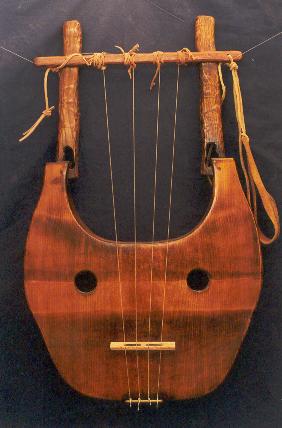
A phorminx

The phorminx (Ancient Greek: φόρμιγξ) was one of the oldest of the Ancient Greek stringed musical instruments, in the yoke lutes family, intermediate between the lyre and the kithara. It consisted of two to seven strings, richly decorated arms and a crescent-shaped sound box. It most probably originated from Mesopotamia. While it seems to have been common in Homer's day[1] accompanying the rhapsodes, it was supplanted in historical times by the seven-stringed kithara. Nevertheless, the term "phorminx" continued to be used as an archaism in poetry.

The term "phorminx" is also sometimes used in both ancient and modern writing to refer to all four instruments of the lyre family collectively:

References

[edit]
[edit]
Revisions and contributorsEdit on WikipediaRead on Wikipedia
from Grokipedia
The phorminx (Ancient Greek: φόρμιγξ) was an ancient Greek stringed musical instrument of the yoke lute family, particularly prominent in the Archaic and Classical periods, characterized by a small crescent-shaped soundbox elastically connected to two short straight arms, producing a resonant, wave-like tone, and typically featuring three to seven strings—most commonly four—made of gut or linen and tuned via leather-wrapped crossbars.[1] It was played by holding the instrument against the thigh in the left hand and striking the strings with a plectrum in the right, allowing for both melodic strumming and accompaniment.[1] Its precursor in the Mycenaean period (ca. 1600–1100 BCE) appears in archaeological evidence as a large concert lyre, often with seven strings tuned in conjunct tetrachords for enharmonic scales, and was used by professional bards in palatial settings for performances that combined music and poetry.[2] In the Homeric epics, such as the Iliad and Odyssey, it is prominently featured as the instrument of epic singers (aoidoi), described for its sweet, clear (ligeia) sound that enhanced the recitation of heroic tales, symbolizing beauty and skilled artistry.[1][2] During the Archaic and Classical periods (ca. 800–323 BCE), the phorminx evolved as an intermediate form between the simpler lyre and the more advanced kithara, remaining a key tool for musical education, religious ceremonies, and sympotic entertainment, where it facilitated the simultaneous performance of vocals and instrumentals to emphasize lyrical content.[3] Its cultural significance extended to iconography, often depicted with decorative elements like ivory inlays or associations with divine inspiration, underscoring music's integral role in Greek identity, philosophy, and mythology.[2]

Overview

Definition and classification

The phorminx (Ancient Greek: φόρμιγξ, romanized: phórminx) was an ancient Greek stringed musical instrument, primarily associated with early poetic and epic traditions. The term derives directly from the Ancient Greek word φόρμιγξ, denoting a type of lyre or stringed instrument used for accompaniment in song.[4] In modern organological classification, the phorminx belongs to the chordophone family, specifically categorized as a yoke lute under the Hornbostel-Sachs system (321.22), where strings are stretched between a yoke and a resonator body. It represents an archaic variant of the lyre, serving as an evolutionary intermediate between simpler, more primitive lyres and the more complex, larger kithara, and typically featuring three to seven strings.[5][6] Distinguishing it from the kithara, the phorminx was notably smaller and more portable, designed for individual or itinerant use rather than large performances. Its body featured a distinctive crescent-shaped soundbox, typically resonant and compact, with two straight arms extending upward to connect to a crossbar that held the strings in tension.[5][7] The instrument was played in a seated or standing posture, held against the player's body or lap for stability, with strings plucked either by the fingers for melodic expression or with a plectrum for rhythmic emphasis.[5][1]

Role in ancient Greek music

The phorminx served primarily as an accompaniment for the recitation of epic poetry by aoidoi, or bards, in ancient Greek musical traditions, where it provided rhythmic and melodic support to enhance the singer's improvisational delivery of heroic narratives.[2] These performers, often depicted in Homeric texts as self-accompanying their songs, relied on the instrument to underscore the emotional and structural flow of tales like those in the Iliad and Odyssey.[8] The phorminx's role emphasized its integration with vocal performance, distinguishing it from purely instrumental uses and highlighting its centrality in oral poetic traditions.[9] Playing techniques for the phorminx included plucking the strings with the fingers to generate soft, clear tones suitable for nuanced expression, or employing a plectrum—typically made of wood, ivory, horn, or metal—for louder strumming that could project over the singer's voice in larger gatherings.[9] The instrument was held in the left arm while standing, with the right hand strumming or plucking, and the left occasionally fingering strings to adjust pitch or produce individual notes.[2] Its physical design, featuring articulated arms and a crescent-shaped soundbox, facilitated these dynamic methods by enabling greater control over string tension and vibration.[2] Acoustically, the phorminx yielded a sweet, resonant sound characterized by clarity and brightness, often described in ancient sources as ligeia (clear-voiced), making it well-suited for solo or small ensemble performances in intimate venues such as symposia or religious rituals.[2] The instrument's smaller soundbox and equal-length strings contributed to this timbre, which resonated effectively without overpowering the accompanying vocals.[9] In contrast to the kithara's louder, more formal style adapted for choral and professional settings, the phorminx's playing was inherently intimate and narrative-focused, prioritizing subtle accompaniment to storytelling over grand instrumental display.[10][11]

Physical characteristics

Construction and materials

The phorminx, classified as a yoke lute, consisted of a resonant soundbox connected to two straight arms that extended upward and were joined by a horizontal crossbar known as the yoke, from which the strings were suspended. The instrument's design emphasized structural simplicity and acoustic efficiency, with the arms providing tension support without additional bracing. The soundbox was crescent-shaped and elastically connected to the arms, allowing for vibrato effects through lateral movement. The soundbox formed the core of the phorminx, typically crafted from wood such as walnut or cedar, and covered with taut animal skin—often from an ox or sheep—to create a vibrating membrane that amplified sound. This covering was stretched tightly over the open side of the soundbox and secured at the edges, ensuring optimal sound projection while maintaining the instrument's lightweight profile.[1] The arms and yoke were fashioned from durable woods like boxwood, chosen for their strength and resistance to warping under string tension; boxwood, in particular, was favored in ancient descriptions for its fine grain and stability.[12][13] These straight arms rose symmetrically from the soundbox, typically without elaborate curvature, and the yoke served as a rigid crossbar drilled or notched to anchor the strings at one end. The phorminx was compact and portable for use in performance or travel. Assembly involved tying the strings to the yoke and securing their opposite ends to a simple tailpiece affixed to the soundbox, with no frets present to allow reliance on open-string harmonics and manual pitch adjustment. This method of construction, rooted in ancient woodworking techniques, prioritized acoustic clarity over complexity.

String configuration and sound production

The phorminx was equipped with three to seven strings made from animal gut, arranged in descending order of pitch from the highest treble to the lowest bass across the instrument's yoke and soundbox.[2][1] These strings ran parallel and of equal length, anchored at the tail end via loops or leather attachments and secured at the yoke with adjustable mechanisms such as twisted leather bulges. This configuration allowed for a balanced tension distribution, enabling the instrument to produce a stable and resonant tone suitable for epic recitation accompaniment.[2] Tuning followed a diatonic system rooted in ancient Greek scalar traditions, often employing modes like the Dorian or Phrygian, with strings adjusted to form conjunct tetrachords spanning a heptatonic scale. Tension was modified by rotating the leather fastenings at the yoke or tail, allowing performers to adapt to specific harmonic needs without fixed pegs in earlier models.[1] The resulting intervals emphasized whole and half steps, providing a framework for melodic improvisation within the cultural conventions of archaic Greek music. Sound production arose from the vibration of the plucked or strummed strings over a fixed bridge, known as the magadion, which efficiently transmitted oscillations to the soundbox for amplification and generated rich harmonics through nodal divisions on the string lengths.[2][1] Volume levels were controlled primarily by the plucking force applied with a plectrum near the soundbox, while the wooden body's resonance—enhanced by its elastic arm connections—sustained and colored the tones.[2] The clear, bell-like sounds carried well in performance settings due to the soundbox's acoustic focusing.

Historical development

Origins in the Bronze Age

The phorminx, recognized as an archaic lyre-like instrument, first appeared in the Aegean Bronze Age, with its earliest evidence tied to Minoan Crete during the Middle Minoan II period (c. 2000–1700 BCE), where depictions on seals, wall paintings, and gold rings illustrate a distinctive lyre featuring two sets of four strings.[14] This instrument evolved from Near Eastern lyre prototypes, including Mesopotamian balag harps and Egyptian triangular lyres, with cultural exchanges facilitating its adoption through trade routes connecting Anatolia, Mesopotamia, and the Aegean by around 1500 BCE.[15][16] By the Late Helladic IIIA phase (c. 1400–1200 BCE), Mycenaean adaptations of the Minoan phorminx became prominent on the mainland, as seen in ivory lyre fragments from Mycenae chamber tomb 81 and tortoiseshell remnants from the Phylakopi sanctuary.[15][2] Proto-forms of the phorminx are evident in earlier Cycladic artifacts, such as marble figurines of harpists from 2700–2300 BCE, which depict simple bow harps or rudimentary lyres suggesting migration and adaptation via maritime trade networks from the Near East.[14] These instruments, often shown with shuttle-shaped arms and string attachments via pegs or knots, mirror designs from Mesopotamian tombs at Ur (c. 2600 BCE), indicating a shared technological lineage across the Eastern Mediterranean.[15] In both Minoan and Mycenaean contexts, the phorminx supplanted earlier frame harps by the Late Bronze Age, transitioning to a concert lyre played standing, as illustrated in frescoes like those from Pylos and the Ayia Triada sarcophagus.[2] Culturally, the phorminx served in early rituals and storytelling, integral to Minoan vegetation cults and religious ceremonies depicted in Thera frescoes and the Agia Triada sarcophagus, where musicians accompanied sacrifices and processions.[15] In Mycenaean society, it symbolized professional bardic performance, often linked to singing epic narratives and divine invocation, as inferred from associations with winged griffins in palace art, predating later Homeric traditions.[2] These uses highlight the instrument's role in fostering social and spiritual cohesion within palatial and sanctuary settings.[16] Archaeological ties include Linear B tablets from Thebes (c. 1250 BCE), such as TH Av 104, which record two professional "lyre-players" (ru-ra-ta-e) as palace contributors, confirming the phorminx's institutional status in Mycenaean administration.[2] This evidence underscores the instrument's continuity from Minoan origins into Mycenaean practice, laying groundwork for its later developments.[14]

Evolution in the Archaic and Classical periods

In the Archaic period (c. 800–500 BCE), the phorminx underwent significant standardization, particularly through the innovations attributed to the Lesbian musician Terpander in the mid-7th century BCE, who is credited with expanding the instrument from four strings to seven, establishing a heptatonic diatonic tuning system that spanned an octave or seventh.[17][18] This development, influenced by Near Eastern musical traditions during the Orientalizing period, enhanced the phorminx's melodic range and versatility, allowing it to accompany epic poetry recitations by rhapsodes, as seen in Homeric traditions, and sympotic performances amid the Greek colonization of the Mediterranean and Black Sea regions.[17][18] The seven-string configuration became the norm, with strings tuned relative to a central mese (middle string) for consonant intervals like fourths and fifths, facilitating structured compositions such as nomoi and prooimia at festivals like the Spartan Karneia.[17] During the Classical period (c. 500–300 BCE), some variants of the phorminx incorporated up to nine strings, as innovated by musicians like Phrynis of Mytilene in the mid-5th century BCE, enabling greater harmonic modulation and complexity in citharody and choral songs.[17] However, the instrument began to be gradually supplanted by the larger, more resonant kithara among professional musicians, who favored its increased volume and technical capabilities for public performances in tragedies, processions, and competitions at events like the Pythian Games.[17] The phorminx persisted in amateur and educational contexts, often paired with auloi for ensemble playing, but its role diminished as the kithara dominated elite musical culture by the late 5th century BCE.[17] Regional variations distinguished Ionian styles, centered in Lesbos and associated with Terpander and Sappho, which emphasized lighter, melodic sympotic and closed-strophe forms, from Dorian traditions in Sparta, where the phorminx supported robust, martial paeans and open-strophe choral works by composers like Alcman and Pindar.[17] Refinements in yoke design, including the addition of tension levers and adjustable bandages or beads for precise string tuning, improved overall stability and resonance across these styles, allowing better control over pitch and intonation.[17] By the Hellenistic era (c. 300 BCE onward), the phorminx had largely been replaced by the kithara and other lyres in mainstream use, though it influenced the development of instruments like the barbiton, a deeper-toned lyre favored in sympotic and Dionysiac contexts.[17] Its decline reflected broader shifts toward more elaborate professional music, relegating the phorminx to niche or nostalgic roles in later antiquity.[17]

Cultural and literary significance

Depictions in Homeric epics

In the Iliad and Odyssey, the phorminx is portrayed as the primary instrument of bards and heroes, often producing clear-sounding strains that accompany epic narratives. In Iliad Book 9, Achilles holds a phorminx of beautiful and intricate workmanship, featuring a silver bridge, while singing the famous deeds of men (klea andrōn) to soothe his spirit, with Patroclus sitting silently nearby (9.186–189).[19] In the Odyssey, the blind bard Demodocus plays the clear-sounding phorminx (ligē phorminx) at the Phaeacian court, performing songs of the Trojan War's return, the adulterous love of Ares and Aphrodite, and the stratagem of the wooden horse, which move Odysseus to tears (8.66–73, 250–266, 492–500).[20] Apollo, as the god of music, is closely associated with the phorminx in the epics, symbolizing its divine patronage over poetic song, though his direct performances appear more explicitly in related hymnic traditions.[21] The phorminx embodies divine harmony and the seamless flow of narrative in Homeric poetry, linking music to inspiration and cultural transmission. Achilles' use in the Iliad marks a poignant interlude of artistic reflection amid heroic strife, illustrating how the instrument fosters emotional balance and heroic introspection.[22] Similarly, Demodocus' playing in the Odyssey underscores the bard's role as a vessel for collective memory, with the phorminx enabling the recreation of distant events and evoking communal catharsis at feasts.[23] Homer's linguistic descriptions emphasize the phorminx's ornate quality, using adjectives like "clear-sounding" (ligē), "beautiful" (kalēn), and "intricate" (daidalēn), and references to its silver fittings, which evoke luxurious, elite versions befitting gods and nobles.[19][20] These details reflect the 8th-century BCE oral tradition, where the phorminx aided bards in memorizing and improvising expansive epics, structuring performance through rhythmic accompaniment and formulaic verse.[24][8]

Use in mythology and religious contexts

In Greek mythology, the phorminx held profound associations with the god Apollo, who served as its divine patron and was credited with either inventing or perfecting the instrument to embody musical harmony. Apollo, the deity of prophecy, healing, and the arts, frequently wielded the phorminx in mythic narratives, symbolizing his role in establishing cosmic order against primordial chaos. This connection underscores the instrument's sacred status, as Apollo's mastery of it represented rationality and self-control, in contrast to the wilder, more ecstatic sounds of wind instruments like the aulos associated with rustic or chthonic deities.[21][25] A pivotal mythological episode appears in the Homeric Hymn to Hermes, where the infant god Hermes fashions the first phorminx from a tortoise shell, cowhide, and reeds, creating an instrument capable of enchanting melodies that soothe both gods and mortals. Hermes presents this prototype to Apollo in exchange for peace after stealing his cattle, thereby transferring the phorminx's patronage to Apollo while highlighting themes of invention, reconciliation, and the transformative power of music. Beyond Homer, non-epic sources reinforce these ties: in Hesiod's works, the Muses—daughters of Zeus and companions of Apollo—invoke the phorminx in their songs of divine genealogy and prophecy, linking it to the origins of inspired utterance. Similarly, Pindar's victory odes frequently summon the "golden phorminx" as a divine tool, as in Pythian 1, where it heralds celebrations and prophetic visions, blending music with oracular insight.[26][27] Religiously, the phorminx featured in rituals at Apollo's sanctuary at Delphi, where it accompanied invocations and processions to the oracle, facilitating divine communication through harmonious strains that aligned human supplicants with cosmic order. Votive offerings of miniature phorminxes, crafted in bronze or terracotta, were dedicated in sanctuaries such as that of Artemis Knakeatis, serving as symbolic gifts to invoke the instrument's protective and harmonizing essence in cult practices. In broader symbolic terms, the phorminx represented kosmos—the ordered universe—particularly in mystery cults like the Orphic rites, where Orpheus employed a lyre akin to the phorminx to produce ecstatic music that bridged the mortal and divine realms, guiding initiates toward purification and enlightenment.[28][29]

Archaeological and modern evidence

Surviving artifacts and iconography

The phorminx, as a wooden instrument with gut strings, has left few physical remains due to the perishable materials involved, with most evidence derived from fragmentary or votive objects rather than intact examples. A rare surviving artifact is a thin bronze plaque in the shape of a miniaturized phorminx, unearthed at the sanctuary of Artemis Knakeatis in Mavriki, south of Tegea in Arcadia, dating to the Geometric period (ca. 8th–7th century BCE); this votive dedication, approximately 10 cm long, replicates the instrument's yoke and arms but lacks strings or soundbox details.[29] Similar miniature bronze lyre plaques, potentially representing phorminx forms, have been found in other Peloponnesian sanctuaries, such as that of Athena Alea at Tegea, underscoring their role as ritual offerings rather than playable instruments.[30] Iconographic evidence provides the primary visual record of the phorminx, with depictions appearing on pottery from the Geometric period onward, confirming its distinctive features like a flat soundbox and extended arms. In 8th-century BCE Geometric art, early representations on Attic vases and bronze figurines show the instrument with 4-7 strings, often played standing by bards or figures in procession, as seen on a Dipylon oinochoe from Athens illustrating a musician amid funerary scenes. These images, recovered from Athenian cemeteries, highlight the phorminx's role in early epic performance and its evolution from simpler lyres. By the Archaic period, black-figure pottery offers more refined portrayals, typically showing 7 strings arranged in a tetrachordal tuning and players holding the instrument against the left thigh or waist with a plectrum in the right hand. Notable examples include Attic lekythoi and amphorae from the 6th century BCE, such as those depicting Muses tuning or performing on the phorminx, which emphasize dynamic postures and the instrument's larger size compared to the chelys lyre. Fragments from Athenian workshops, including 6th-century BCE vases, reveal these details through iconographic representations. Such iconography extends to key sites beyond Athens, with phorminx depictions on Corinthian pottery from local excavations illustrating trade and workshop influences in the 7th-6th centuries BCE. In Delphi, related musical motifs appear on votive reliefs and metopes from the Sanctuary of Apollo, though direct phorminx images are sparse amid broader lyre representations. Etruscan tombs in Italy have yielded imported Attic black-figure vases with phorminx players, dating to the 6th-5th centuries BCE, evidencing Greek cultural exchange through maritime trade. These artifacts and images collectively verify the phorminx's typical 4 to 7 string configuration—often 7 in Archaic depictions—and playing postures, such as standing or seated with crossed legs, which inform scholarly understandings of its acoustics and ergonomics without relying on literary sources. Earlier Mycenaean depictions suggest up to 7 strings, while later Homeric contexts favor 4.

Contemporary reconstructions and studies

Modern instrument makers have produced handcrafted replicas of the phorminx based on ancient iconographic and literary evidence, employing traditional materials such as maple wood for the arms and yoke, sheep gut for strings, and animal bone for the plectrum. These reconstructions typically feature seven or nine strings stretched across a crescent-shaped soundbox, often incorporating a vibrato mechanism via articulated arms to mimic effects described in Homeric texts. For instance, the Athens-based workshop Luthieros crafts phorminx models allowing for three to four octaves when tuned in diatonic scales.[31] Similarly, Seikilo offers versions emphasizing the instrument's evolution from ancient prototypes, with tuning pegs of ebony and mulberry wood and a focus on expressive techniques like tremolo.[32] Scholarly efforts have included acoustic simulations and analyses to understand the phorminx's tonal properties. Researchers at the National Technical University of Athens developed a hybrid digital model using digital waveguides for string vibration and finite element methods for the body resonance, simulating a 0.36 m string length under 32.85 N tension to generate real-time audio outputs in various tunings.[33] This approach revealed a bright, resonant timbre suitable for epic accompaniment, with convolution of string signals and body impulse responses confirming compatibility with ancient scales. Classicist Martin L. West analyzed the phorminx as a seven-stringed lyre tuned in conjunct tetrachords, likely producing a hexatonic or heptatonic compass within an octave, drawing on Mycenaean depictions and Homeric descriptions of its "clear, bright" (ligeia) sound when struck with a plectrum.[34] Ethnomusicologist Annalee Winegar Grodzins compared its tuning to Near Eastern lyres, suggesting a cycle-of-fifths progression emphasizing tonic and subdominant notes, based on ethnographic parallels from Mesopotamia and Egypt.[2] These replicas have found application in historical reenactments and contemporary performances, bridging ancient practices with modern audiences. Groups like Lyravlos use phorminx reconstructions in live concerts of Homeric poetry, as demonstrated in Athens performances that evoke the instrument's role in epic recitation.[35] In neo-classical music, performer Michael Levy incorporates phorminx-like lyres to interpret ancient melodies, including experiments with diatonic tunings derived from surviving notations, confirming the instrument's capacity for melodic improvisation over a limited heptatonic range.[36] Such efforts extend to educational and theatrical contexts, where the phorminx accompanies reconstructed ancient Greek songs, highlighting its heterophonic interplay with voice.[37] Ongoing debates center on precise pitch standards, as ancient Greek music lacked a fixed reference like modern A=440 Hz, complicating reconstructions. Scholars note variability in tuning due to regional practices and the loss of notations, with influences from artifacts like the Seikilos epitaph suggesting flexible diatonic frameworks rather than strict intonation.[37] West and others argue that enharmonic or chromatic microtones may have been achievable via finger-stopping, but exact replication remains contentious without comprehensive acoustic data from originals.[34]

References

User Avatar
No comments yet.