Hubbry Logo
Francis PicabiaFrancis PicabiaMain
Open search
Francis Picabia
Community hub
Francis Picabia
logo
8 pages, 0 posts
0 subscribers
Be the first to start a discussion here.
Francis Picabia
Francis Picabia
from Wikipedia

Francis Picabia (French: [fʁɑ̃sis pikabja]: born Francis-Marie Martinez de Picabia; 22 January 1879 – 30 November 1953) was a French avant-garde painter, writer, filmmaker, magazine publisher, poet, and typographist closely associated with Dada.[1]

Key Information

When considering the many styles that Picabia painted in, observers have described his career as "shape-shifting"[2] or "kaleidoscopic".[3] After experimenting with Impressionism and Pointillism, Picabia became associated with Cubism. His highly abstract planar compositions were colourful and rich in contrasts. He was one of the early major figures of the Dada movement in the United States and in France before denouncing it in 1921.[3] He was later briefly associated with Surrealism, but would soon turn his back on the art establishment.[4]

Early life

[edit]
Francis Picabia, 1912, La Source (The Spring), oil on canvas, 249.6 × 249.3 cm, Museum of Modern Art, New York. Exhibited at the 1912 Salon d'Automne, Paris

Francis Picabia was born in Paris of a French mother and a Cuban father of Spanish descent. Some sources would have his father as of aristocratic Spanish descent, whereas others consider him of non-aristocratic Spanish descent, from the region of Galicia.[5] His birth year of 1879 coincided with the Spanish-Cuban Little War; and though Picabia was born in Paris, his father was involved in Cuban-French relations and would later serve as attaché at the Cuban legation in Paris (see the Treaty of 1898). The family ties to Cuba would be important in Picabia's life later on.

The family was affluent, and both parents encouraged Picabia to pursue an art career.[6] Picabia's mother died of tuberculosis when he was five, and he was raised by his father.[7]

Picabia's artistic ability was apparent from his youth. In 1894, he copied a collection of Spanish paintings that belonged to his grandfather, switching the copies for the originals and selling the originals to finance his stamp collection.[8] A lifelong philanderer,[2] Picabia eloped to Switzerland in 1897 with one of his mistresses, causing his father to briefly cut off contact with him.[7]

Art career

[edit]
Francis Picabia, c. 1909, Caoutchouc, Centre Pompidou, Musée National d'Art Moderne

During the late 1890s, Picabia began to study art under Fernand Cormon and others at École des Arts Decoratifs, Cormon's academy at 104 boulevard de Clichy, where Van Gogh and Toulouse-Lautrec had also studied. He studied under Fernand Cormon, Ferdinand Humbert, and Albert Charles Wallet for two years.[9] From the age of twenty, Picabia lived by painting. Subsequently, he inherited money from his mother, leaving him far wealthier than most of his contemporaries in the art world. He began buying at least one new sports car each year,[2] and ultimately owned 127 over the course of his life.[7]

Early in his career, from 1903 to 1908, Picabia was influenced by the Impressionist paintings of Alfred Sisley. His subject matter included small churches, lanes, roofs of Paris, riverbanks, wash houses, and barges. This led critics to question his originality, saying that he copied Sisley, that his cathedrals looked like Monet cathedrals, or that he painted like Signac.[10] He soon came to feel he was working in an outdated style and began to look for a new approach.[2]

From 1909, his style changed as he came under the influence of a group of artists soon to be called Cubists. These artists would later form the Golden Section (Section d'Or). The same year, Picabia married Gabrielle Buffet. (They would divorce in 1930.)

Salon d'Automne, Grand Palais des Champs-Élysées, Paris, Salle XI, between 1 October and 8 November 1912. Joseph Csaky (Groupe de femmes, sculpture front the left); Amedeo Modigliani (sculptures behind that of Csaky); paintings by František Kupka (Amorpha, Fugue in Two Colors); Francis Picabia (The Spring); Jean Metzinger (Dancer in a café); and Henri Le Fauconnier (Mountaineers Attacked by Bears)
Francis Picabia, 1913, Udnie (Young American Girl, The Dance), oil on canvas, 290 × 300 cm, Musée National d'Art Moderne, Centre Georges Pompidou, Paris

Around 1911 Picabia joined the Puteaux Group, whose members he had met at the studio of Jacques Villon in Puteaux, a commune in the western suburbs of Paris. There he became friends with artist Marcel Duchamp and close friends with Guillaume Apollinaire. Other group members included Albert Gleizes, Roger de La Fresnaye, Fernand Léger and Jean Metzinger.

Picabia paintings published in the New York Tribune, 9 March 1913

Proto-Dada

[edit]

In 1913, the Association of American Painters and Sculptors held the first major show of modernist art in New York City, which would become known as the Armory Show. The wealthy Picabia was the only member of the Cubist group to personally attend the Armory Show, as the others could not afford to do so, and he also contributed four paintings.[2] The American press was largely hostile to the show, describing it as bizarre or deviant, but Picabia was widely interviewed and discussed as the only representative of the movement available. He immediately became a major name in New York's artistic circles.[2]

Avant-garde art dealer Alfred Stieglitz also gave Picabia a solo show, Exhibition of New York studies by Francis Picabia, at his gallery 291 (formerly Little Galleries of the Photo-Secession), 17 March – 5 April 1913.[2] There, Picabia displayed work that he had created in the past few months in New York. Influenced by abstract art from the Armory Show such as that of Wassily Kandinsky, he was now creating abstract works of his own. When he returned to Paris in April 1913, he formally broke with the Cubists.[2]

From 1913 to 1915 Picabia traveled to New York City several times. During that same era, France became embroiled in war. In 1915, Picabia again traveled to the United States en route to Cuba to buy molasses for a friend of his—the director of a sugar refinery. He landed in New York in June 1915. Though the stopover was ostensibly meant to be a simple port of call, he decided to remain there for a while to continue working on his art.[2] He did not return to France until the war's conclusion.[2]

(Left) Le saint des saints c'est de moi qu'il s'agit dans ce portrait, 1 July 1915; (center) Portrait d'une jeune fille américaine dans l'état de nudité, 5 July 1915: (right) J'ai vu et c'est de toi qu'il s'agit, De Zayas! De Zayas! Je suis venu sur les rivages du Pont-Euxin, New York, 1915

The following years can be characterized as Picabia's proto-Dada or "machinist" period, consisting mainly of his portraits mécaniques.[11] Picabia was first impressed by mechanical advances on his initial, 1913 visit to New York, and on returning to Europe, he was impressed by futurist painters such as Natalia Goncharova and Mikhail Larionov. Picabia was particularly influenced by the "machine style" of Marcel Duchamp, in which the artist used materials such as metal and glass as well as mechanical drawing implements.[11] In 1915, Picabia began to create and exhibit his own drawings and prints of mysterious machines and apparatuses to reflect the coming of the Machine Age. He continued in this style for almost a decade, exhibiting a large solo show of his machinist work in 1922. In 1923, he abruptly discontinued his work in the style, as he had with several previous styles.[11]

In this period, the magazine 291 devoted an entire issue to him, he met Man Ray, Gabrielle and Duchamp joined him, drugs and alcohol became a problem and his health declined. He suffered from dropsy and tachycardia.[12]

Manifesto

[edit]
Machine Turn Quickly, 1916–1918, tempera on paper, National Gallery of Art

Later, in 1916, while in Barcelona and within a small circle of refugee artists that included Albert Gleizes and his wife Juliette Roche, Marie Laurencin, Olga Sacharoff, Robert Delaunay and Sonia Delaunay, he started his Dada periodical 391 (published by Galeries Dalmau), modeled on Stieglitz's own periodical. He continued the periodical with the help of Marcel Duchamp in the United States. In Zürich, seeking treatment for depression and suicidal impulses, he had met Tristan Tzara, whose radical ideas thrilled Picabia. Back in Paris, and now with his mistress Germaine Everling, he was in the city of "les assises dada" where André Breton, Paul Éluard, Philippe Soupault and Louis Aragon met at Certa, a Basque bar in the Passage de l'Opera. Picabia, the provocateur, was back home.

Francis Picabia, Réveil Matin (Alarm Clock), Dada 4–5, Number 5, 15 May 1919

Picabia continued his involvement in the Dada movement through 1919 in Zürich and Paris, before breaking away from it after developing an interest in Surrealist art. (See Cannibale, 1921.) He denounced Dada in 1921,[3] and issued a personal attack against Breton in the final issue of 391, in 1924. The same year, he appeared briefly in the René Clair short film Entr'acte, which would become one of the most famous surrealist films of the decade.[13]

Later years

[edit]

Reflecting on his break with Dada, Picabia wrote, "If you want to have clean ideas, change them like shirts."[3] His career would later be remembered in part for his wide range of artistic styles.[3][2] In 1922, André Breton relaunched Littérature magazine with cover images by Picabia, to whom he gave carte blanche for each issue. Picabia drew on religious imagery, erotic iconography, and the iconography of games of chance.[14]

In 1925, Picabia returned to figurative painting, producing a series of dense, garish paintings known as his "Monster" period. These would later be an important influence on German painter Sigmar Polke.[6] From 1927 to 1930, Picabia produced his "Transparencies" series, paintings that combined images from High Renaissance art with figures from contemporary popular culture.[6]

During the 1930s became a close friend of and received encouragement from the modernist novelist Gertrude Stein,[15] painting a portrait of her in 1933.[16] In 1940, he married Olga Mohler on 14 June, the same day that the Nazis seized Paris. Shortly after, he moved to Southern France, where his work took a surprising turn: he produced a series of paintings based on the nude glamour photos in French "girlie" magazines like Paris Sex-Appeal,[17][18] in a garish style which appears to subvert traditional, academic nude painting. Some of these went to an Algerian merchant who sold them, and so it passed that Picabia came to decorate brothels across North Africa under the Occupation.[citation needed]

Francis Picabia, Francis chante le Coq, 391, n. 14, Nov. 1920

Before the end of World War II, he returned to Paris, where he resumed abstract painting and writing poetry. A large retrospective of his work was held at the Galerie René Drouin in Paris in the spring of 1949. Picabia died in Paris in 1953 and was interred in the Cimetière de Montmartre.

Personal life

[edit]

He was married in 1909 to Gabrièle Buffet-Picabia, a French art critic and writer affiliated with Dadaism and later an organizer of the French resistance. They had four children. They divorced in 1930. Their tumultuous union is re-imagined by great-granddaughter Anne Berest in The Postcard, a semi-autobiographical French novel published in 2021.[19]

Legacy

[edit]

Public collections holding works by Picabia include the Museum of Modern Art and Solomon R. Guggenheim Museum in New York; the Philadelphia Museum of Art; the Art Institute of Chicago; the Tate Gallery, London and the Musée National d'Art Moderne, Paris.

In the mid-1980s two of Picabia's Dada writings, Who Knows and Yes No were published in English by Hanuman Books and in 2007 MIT Press published a large book of his poetry and other writings in English called I Am a Beautiful Monster: Poetry, Prose, and Provocation that was translated by Marc Lowenthal.

A major retrospective of Picabia's work in the United States was held in 2016 at Kunsthaus Zürich and then from 2016 to 2017 at the Museum of Modern Art, New York.[20] The retrospective was widely discussed by international art critics such as Philippe Dagen from Le Monde.[21]

Among the artists influenced by Picabia's work are the American artists David Salle and Julian Schnabel, the German artist Sigmar Polke, and the Italian artist Francesco Clemente.[22][23][24][25] In 1996, French artist Jean-Jacques Lebel initiated and co-curated the exhibition Picabia, Dalmau 1922 (with reference to Picabia's solo exhibition at Galeries Dalmau in 1922) shown at Fundació Antoni Tàpies in Barcelona and the Musée National d'Art Moderne, Centre Pompidou. In 2002, the artists Peter Fischli & David Weiss installed Suzanne Pagé's retrospective devoted to Picabia at the musée d'art moderne de la ville de Paris (MAMVP).

In 2003, a Picabia painting once owned by André Breton sold for US$1.6 million.[26] Picabia's Volucelle II (c. 1922) sold for US$8,789,000 at Sotheby's in 2013, then the highest price for one of the artist's works.[27][28] A new record was set in 2022 with the sale of Pavonia at Sotheby's for US$11 million.[27]

[edit]

See also

[edit]

References

[edit]

Bibliography

[edit]
[edit]
Revisions and contributorsEdit on WikipediaRead on Wikipedia
from Grokipedia
Francis Picabia (January 22, 1879 – November 30, 1953) was a French avant-garde whose multifaceted career encompassed , poetry, publishing, and performance, marking him as a central figure in early 20th-century . Born and died in to a Spanish father and French mother, Picabia began exhibiting as an Impressionist in 1905 before rapidly evolving toward Cubist-influenced abstractions by 1912, as seen in large-scale works like The Spring and Dances at the Spring [II] displayed at the . His artistic trajectory reflected a deliberate rejection of traditional forms, prioritizing provocation and in response to industrialization and I's upheavals. During his New York exile amid the war (1914–1918), Picabia pioneered mechanomorphic imagery—depicting human forms through machine parts—in pieces such as “M’Amenez-y”, aligning with emerging Dadaist impulses that challenged rationality and bourgeois values. He played a pivotal role in Dada's transatlantic spread, collaborating with figures like Marcel Duchamp and publishing the irreverent journal 391 starting in 1917, which disseminated anti-art manifestos across Zurich, Barcelona, and New York. Upon returning to Paris post-war, Picabia intensified Dada activities, producing satirical works like Tableau Rastadada, though he renounced the movement in 1921 amid ideological shifts toward Surrealism and figurative revival. Later phases incorporated found imagery and erotic themes, as in Portrait of a Couple, underscoring his lifelong commitment to subverting artistic conventions. Picabia's legacy endures through his influence on subsequent avant-gardes, evidenced by participation in landmark events like the 1913 and his 1949 retrospective at Galerie René Drouin, affirming his status as a restless innovator who prioritized conceptual disruption over stylistic fidelity.

Early Life and Background

Family Origins and Childhood

Francis Picabia, born François Marie Martinez Picabia on January 22, 1879, at 82 rue des Petits Champs in , was the only child of Francisco Vicente Martinez Picabia and Marie Cécile Davanne. His father, born on May 5, 1847, in , , to Spanish-descended parents, served as an at the Cuban in , reflecting the family's ties to Spanish colonial heritage in and diplomatic circles. Picabia's mother hailed from a prosperous French family, contributing to the household's affluent status amid Paris's cultural milieu. The family environment fostered an early affinity for , with Picabia's upbringing immersed in a home emphasizing artistic collection and appreciation, supported by his parents' encouragement of creative pursuits. However, tragedy marked his childhood: his mother succumbed to in 1886, when Picabia was seven years old, followed by the death of his maternal grandmother in 1887. These losses left him primarily under the care of his and maternal grandfather, alongside an , in a male-dominated described as "quatre sans femmes"—four men without women—where the adults' professional demands shaped a structured yet isolated early life. Despite these personal upheavals, the family's wealth and connections provided stability, with Picabia's father maintaining diplomatic roles that later influenced the artist's international outlook and mobility. This background of mixed Franco-Spanish heritage and early bereavement informed Picabia's later and irreverent artistic persona, though direct causal links remain interpretive rather than empirically fixed.

Education and Initial Artistic Exposure

Francis Picabia, born François Marie Martinez Picabia on January 22, 1879, in Paris, grew up in an affluent household surrounded by art and photography collections maintained by his family, which provided his initial exposure to visual culture. His father, Francisco Vicente Martinez Picabia, a Cuban-born Spanish diplomat, and French mother, Marie Cécile Davanne, both from prominent European lineages, ensured a privileged environment that nurtured his early artistic inclinations, evident from childhood drawings and interests. Following his mother's death from tuberculosis around age five or seven, Picabia was raised primarily by his father in this culturally rich setting, fostering an autodidactic familiarity with painting before formal training. His was marked by disruption and instability, described as tumultuous, leading to enrollment in a in , , from 1892 to 1897, where he encountered his first systematic artistic stimuli through local paintings and family connections. This period abroad honed his observational skills amid a less structured environment compared to Parisian norms, though specific instructors or curricula remain undocumented in primary accounts. In 1895, at age 16, Picabia commenced formal artistic apprenticeship at the École des Arts Décoratifs in , studying there until 1897 under traditional academic methods emphasizing decorative and . He supplemented this with attendance at the for historical art exposure and the Académie Humbert, a private atelier, where he encountered emerging talents like and , broadening his network and stylistic foundations in Impressionist landscape techniques. These institutions prioritized technical proficiency over innovation, aligning with Picabia's initial output of conventional plein-air scenes, though his innate restlessness foreshadowed later departures from such orthodoxy.

Early Career and Stylistic Foundations

Impressionist Beginnings and Early Success

Francis Picabia adopted an Impressionist style during the winter of 1902–1903, following earlier academic training and initial exhibitions that showcased more conventional landscapes. His subjects drew from rural French scenes, including village lanes, church facades, and rooftops, reflecting the influence of and in capturing light and atmospheric effects through loose brushwork and vibrant color. Between 1903 and 1907, he frequently painted in Moret-sur-Loing, a locale previously favored by Impressionists for its picturesque motifs, producing works that emphasized transient natural light over rigid form. Picabia's public debut in this vein occurred in 1903, when he exhibited at both the Salon des Indépendants and the in , platforms that had historically supported Impressionist innovators despite initial resistance from traditional academies. These showings marked his shift toward professional recognition, building on a prior 1899 entry at the Salon des Artistes Français titled A Street in Martigues, which hinted at emerging landscape interests but predated his full Impressionist commitment. By 1905, at age 26, he secured his first solo exhibition at Galerie Hausmann in , displaying 61 Impressionist landscapes that garnered substantial critical and commercial acclaim, establishing him as a promising talent in the lingering Impressionist tradition. This early success enabled Picabia to sign a contract with dealer Danthon, who organized multiple solo shows and facilitated sales of his decorative, light-infused canvases, reflecting market demand for accessible Impressionist derivatives amid the movement's commercial peak. However, sources note his growing dissatisfaction with the style's ornamental qualities, foreshadowing his abrupt pivot to experiments by 1912, though his Impressionist phase yielded financial stability and visibility essential to his subsequent innovations.

Transition to Cubism and Futurism

By early 1912, Picabia abandoned Impressionist landscapes for fragmentation and multiple viewpoints, influenced by and Georges Braque's analytic approach as well as the theoretical framework outlined in and 's Du Cubisme, which reproduced his painting Tarentelle as an example of the style's evolution toward abstraction. His adoption reflected engagement with the group, including Gleizes and Metzinger, emphasizing rhythmic color and form over strict . Key works from this phase include The Procession, Seville (1912), a large-scale composition blending architectural elements with Orphic vibrancy—termed by to describe Picabia's colorful abstractions—and La Source (1912), exhibited at the that year, showcasing planar interpenetrations and heightened chromatic intensity. Picabia also participated in the exhibition in October 1912, affirming his alignment with this Cubist offshoot focused on mathematical harmony and optical effects. Futurist influences emerged concurrently, drawn from Italian exhibitions in during 1911–1912, incorporating dynamism and simultaneity into his canvases; by 1913, paintings like Udnie (Young American Girl, The Dance) featured explosive lines and repetitive motifs evoking motion, bridging Cubist structure with energy. This synthesis culminated in works shown at the 1913 in New York, where The Dance at the Spring (1912) exemplified the transitional , provoking both acclaim and controversy for its departure from representational norms.

Avant-Garde Engagement and Dada Period

Mechanomorphic Paintings and Anti-Art Stance

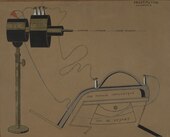
Picabia's mechanomorphic paintings emerged in 1915 during his residence in New York, marking a shift toward depicting human figures through abstracted machine components, often in the form of pseudo-technical diagrams. This style drew inspiration from American industrial machinery and , transforming portraits into eroticized assemblages of gears, pistons, and spark plugs, as seen in works like the ink drawing Voilà Haviland, a mechanomorphic representation of photographer Paul B. Haviland published in Alfred Stieglitz's 291 magazine. These images equated biological functions with mechanical operations, critiquing the dehumanizing effects of modernity while scandalizing viewers with their implied analogies between human anatomy and industrial parts. Key examples from this period include Machine with No Name (1915), a watercolor portraying an anonymous subject as interlocking mechanical elements, and Réveil Matin (Alarm Clock, 1919), an ink drawing of a humanoid figure composed of clock gears and springs, symbolizing the mechanization of daily life. Larger paintings such as Machine Turn Quickly (circa 1916–1918) featured dynamic arrangements of blue-toned sprockets against black backgrounds, evoking motion and futility in . Picabia produced these works primarily in ink, watercolor, and on or , often for in avant-garde periodicals, reflecting a deliberate rejection of traditional oil-on-canvas portraiture in favor of ephemeral, reproducible forms. This mechanomorphic phase intertwined with Picabia's adoption of an stance through his involvement in the nascent movement, co-initiated with in New York amid I's disruptions. , characterized as an international initiative, rejected aesthetic norms and bourgeois values, with Picabia's machine imagery embodying this by stripping human essence to soulless contrivances, thereby mocking artistic pretensions to transcendence. His contributions extended to publishing provocations in 391, a Dadaist journal he founded in 1917, where mechanomorphic illustrations amplified assaults on conventional art's sanctity. By 1921, Picabia expressed disillusionment with rigid Dada orthodoxy, declaring separation from certain adherents due to stifling conformity, yet his earlier works remained foundational to 's iconoclastic ethos.

Key Collaborations and International Influence

Picabia's collaborations during the period were pivotal in fostering transatlantic avant-garde networks, particularly through his close partnership with , which began around 1911 and intensified in New York by 1913, where they shared mechanomorphic aesthetics critiquing industrial modernity. Their joint activities included contributions to Alfred Stieglitz's 291 gallery and periodical, with Picabia designing the cover for issue No. 1 in 1915, symbolizing faith in Stieglitz's promotion of experimental art. From 1917 to 1924, Picabia edited and published the Dada magazine 391 across , , New York, and Paris, featuring works by , , , and , thereby disseminating manifestos and cryptographic experiments that linked disparate centers. A notable instance was the 1924 issue's collaboration with and Satie, incorporating visual poems and metamorphosed imagery to challenge conventional representation. In 1921, Picabia orchestrated L'Oeil cacodylate (The Cacodylic Eye), a radical group portrait involving approximately fifty associates who signed or inscribed the canvas, embodying communal irreverence and extending his influence through participatory . Picabia's international reach amplified 's global dispersion; arriving in in 1919, he contributed to DADA 4-5 with Tzara and organized exhibitions that bridged New York proto-Dada with European variants, while his 1920 Paris Dada exposition further propagated the movement's nihilistic ethos across continents before his disillusionment by 1921.

Literary and Publishing Contributions

Manifestos, Magazines, and Experimental Typography

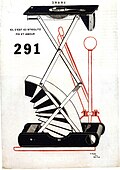
Francis Picabia contributed to the movement through provocative manifestos that challenged artistic conventions and commodification. In his 1920 "," published on the cover of his magazine 391, Picabia declared Dada's opposition to the high pricing of art, equating it to commodities like sausages or women, and aimed to halt profiteering in the art trade. He further articulated Dada's life-affirming stance against snobbery in the Manifeste Cannibale Dada of the same year, accusing society of valuing expense over essence. Earlier, in 1913, Picabia issued the Amorphist manifesto, illustrated with blank canvases to undermine color opposition and artistic seriousness. Picabia founded and edited the Dada magazine 391 from 1917 to 1924, producing 19 issues across , , New York, and as a vehicle for his iconoclastic ideas and artworks. The publication featured contributions from Dada figures like and , alongside Picabia's poems, satirical gossip columns, and scathing critiques of the art world, blending provocation with playfulness. Issues often parodied emerging "isms" with mock manifestos, reflecting Picabia's internationalist outlook and self-referential navel-gazing. He also designed covers for Alfred Stieglitz's 291 magazine, such as the 1915 issue proclaiming "Ici, c'est ici Stieglitz, foi et amour," linking New York avant-garde circles. In 391 and related Dada publications, Picabia pioneered experimental , integrating visual poems, word collages, and typographic flourishes that dissolved boundaries between text and image. These techniques, including distorted layouts and satirical juxtapositions, embodied 's and critiqued rationalist design, influencing modernist graphic practices from 1909 onward. His typographic innovations, often hand-executed with ink and mixed media, extended his mechanomorphic aesthetic into print, prioritizing disruption over legibility.

Poetry and Written Critiques of Modernity

Picabia produced several collections of poetry characterized by Dadaist absurdity, fragmentation, and rejection of conventional meaning, often blending verse with provocative to undermine artistic and social norms. His 1919 work Pensées sans langage exemplifies this approach, employing surrealistic imagery, playful associations, and a mix of humor and melancholy to delve into themes of , existential futility, and life's , while offering incisive commentary on contemporary societal values. The collection resists linear narrative, inviting readers to grapple with chaos as a reflection of human experience's inherent disorder. In broader compilations of his writings, such as those gathered in I Am a Beautiful Monster (2012 English edition), Picabia's poetry appears alongside prose pieces from key publications like Fifty-two Mirrors and Poems and Drawings of the Daughter Born Without a Mother, revealing a belligerent, abstract, and polemical style that resists imposed significance. These texts disclose a vulnerable persona beneath radical bravura, frequently challenging the interpretive frameworks of modern art and culture. Picabia's written critiques of modernity emerged through this Dada-inflected lens, satirizing bourgeois conventions, capitalist structures, and nationalist pretensions that Dada broadly rejected as hollow. His prose provocations, integrated with poetry, polemicize against the mechanized rationalism and seriousness of early 20th-century society, portraying progress as illusory and human endeavors as comically futile—echoing Nietzschean influences in his aphoristic deflations of ideological fidelity. By prioritizing anti-art disruption over constructive ideology, these writings positioned modernity's faith in innovation and meaning as a neurasthenic obsession, aligning with Picabia's visual mechanomorphisms in scorning dehumanizing efficiency. Such elements underscore his role as a "true" Dadaist, per André Breton, who used linguistic experimentation to expose the fragility of societal constructs.

Later Artistic Phases

Post-Dada Figurative and Erotic Works

Following the decline of around 1921, Picabia abandoned mechanomorphic abstraction and returned to figurative painting by 1922, relocating to Tremblay-sur-Mauldre outside to pursue representational forms infused with personal provocation. This shift emphasized distorted human figures, vibrant palettes, and satirical distortions of elegance, often incorporating erotic motifs to critique societal norms. Picabia's "Monster" series, commencing circa 1925, exemplified this post-Dada figurative turn, featuring garish enamel and oil paintings with heavy black contours, grotesque elongations, and hybrid forms blending high-society subjects with carnal exaggeration. Works like Les Amoureux (Après la pluie) (The Lovers [After the Rain], 1925; enamel and , 116 × 115 cm) portrayed fashionable couples in monstrous, rain-slicked intimacy, subverting romantic ideals through hyperbolic sensuality. Earlier transitional pieces, such as The Spanish Night (1922) and Animal Trainer (1923), introduced bold graphic lines and sinister eroticism, drawing from Romanesque frescoes, Ingres portraits, and Spanish painting traditions while amplifying bodily distortions for . Female figures in these monsters frequently evoked erotic charge through exaggerated and provocative poses, sourced from Picabia's subversive gaze on bourgeois and commercial imagery, aiming to dismantle refined taste with raw, carnal directness. This erotic undercurrent persisted into the late 1920s, as in densely colored society portraits that fused influences with modern hedonism, maintaining Picabia's commitment to anti-conventional representation over aesthetic coherence. By , while experimenting further, he retained figurative in select nudes and hybrids, prioritizing personal caprice over movement allegiance.

Transparencies and Abstract Experimentation

In the late , Francis Picabia initiated his Transparencies series, spanning roughly from 1927 to 1932, as a departure from his earlier figurative erotic works toward a renewed engagement with through superimposed, semi-transparent layers. These paintings and works on paper employed , watercolor, and ink to overlay disparate motifs—such as human heads, equine forms, landscapes, and architectural elements—creating visual ambiguity and depth without reliance on conventional perspective. This technique produced "pockets of obscurity" amid clarity, enabling Picabia to evoke psychological complexity and what he described as expressions of "innermost desires." The series drew on classical sources, incorporating mythological, biblical, and natural imagery reinterpreted through fragmentation and multiplicity; for instance, works like Têtes-paysage (c. 1928–1930) juxtapose humanoid profiles with verdant terrains, blurring boundaries between figure and ground. Similarly, Otaïti (1930) layers Tahitian-inspired with abstract veils, reflecting Picabia's interest in and the third via transparency rather than linear recession. Picabia exhibited these pieces in galleries during the period, including at the Galerie Cyrenia in 1929, where they garnered attention for their innovative defiance of spatial logic, though critics noted their elusive, non-narrative quality as both liberating and hermetic. By the early 1930s, Picabia shifted themes within Transparencies toward more overt religious and equestrian motifs, as seen in Transparence - Tête et Cheval (c. 1930), which merges a spectral horse's head with human features in a dotted, ethereal composition measuring approximately 77 x 59 cm. This evolution underscored his persistent , appropriating and distorting sourced to prioritize personal vision over mimetic representation, a continuity from his Dada-era mechanomorphism but abstracted into luminous, veiling overlays. The series concluded around 1933, paving the way for subsequent photo-based experiments, yet it exemplified Picabia's refusal to adhere to singular styles, favoring perpetual reinvention amid the interwar .

Photo-Based Paintings in the 1940s

In the early 1940s, during , Francis Picabia, residing in , developed a series of photo-based s produced primarily between 1940 and 1943. These works involved transferring enlarged photographic images from commercial and erotic magazines—such as Paris Magazine and Paris Sex Appeal—onto canvas, followed by overpainting with thick layers of oil in garish colors to heighten the stark contrasts, lens distortions, and artificial lighting inherent in the sources. Often depicting nude or semi-nude figures, the paintings juxtaposed photographic precision with bold, tactile brushwork, creating hyper-realistic yet unsettling compositions that blended eroticism with ironic detachment. Picabia maintained a prolific output, reportedly completing one such painting daily in his studio at the de Mai in . This technique reconciled and , preserving mechanical reproduction's flaws while emphasizing the medium's physicality through pasty skin tones and exaggerated forms, diverging from Picabia's prior abstractions toward a satirical realism that echoed classical nudes like those of but subverted them via mass-media vulgarity. The results evoked a "painted " effect, underscoring the era's cultural amid wartime isolation. Many sourced from late-1930s soft-core imagery, these pieces reflected Picabia's opportunistic adaptation to constrained circumstances, prioritizing marketable figurative appeal over innovation. Exemplars include Portrait d’un Couple (c. ), atypical for its clothed subjects, derived from Paul Wolff's April 1937 Paris Magazine photograph of a couple entwined in trees—evoking actors and —and reinterpreted to amplify photographic artifice without nudity. Paysanne (c. 1940–1942), oil on board, adapts Martin Imboden's January 1935 Paris Magazine image of a , framing her with a vibrant to merge profane commercial photography and sacred iconography. L’Adoration du veau (1941–42), at the , fuses popular erotic motifs with provocative, politically tinged . Largely unexhibited during Picabia's life due to the war, they appeared in posthumous retrospectives, including the 1976 survey categorized as "pin-ups."

Personal Life and Lifestyle

Marriages, Affairs, and Social Circle

Francis Picabia married Gabrièle Buffet, a and , on January 24, 1909; she provided intellectual stimulation and connections within avant-garde musical and artistic circles, influencing his early explorations in and machine-inspired forms. The couple had two daughters, born in 1910 and 1914, but their relationship deteriorated amid Picabia's extramarital involvements, culminating in separation around 1919 when he began a relationship with artist Germaine Everling. Picabia's affair with Everling, a painter and model associated with the Paris avant-garde, lasted until their definitive break in 1933, during which time he fathered a son with her in 1921; Everling later documented their tumultuous partnership in her 1973 memoir Je ne suis pas la plus mauvaise, attributing the dissolution partly to Picabia's infidelity with household staff, including governess Olga Mohler. Mohler, who entered Picabia's life as an employee around 1930, became his companion and eventually his third wife in 1940, following his formal divorce from Buffet; this union marked a period of relative stability in his later years, though details remain sparse due to the couple's reclusive tendencies post-World War II. Picabia's personal relationships intersected with expansive social networks in Paris and New York, where he cultivated friendships with key figures such as , with whom he shared Dadaist provocations and transatlantic travels starting in 1913, and , a poet who introduced him to Cubist innovators like and in the Puteaux Group around 1911. Through Buffet's salon, he engaged with experimental musicians and writers, while in New York, associations with Alfred Stieglitz's 291 gallery circle—including Marius de Zayas and Walter Arensberg's collector milieu—fostered his mechanomorphic phase and anti-art stance, often blending professional collaborations with intimate gatherings marked by bohemian excess. These ties, sustained across his marriages and affairs, reflected his nomadic lifestyle and opportunistic alliances rather than enduring loyalties, as evidenced by his shifts between Dadaist rebels and later figurative painters.

Financial Independence and Extravagant Habits

Picabia attained at a young age due to his family's substantial wealth. His father, Francisco Vicente Martinez Picabia, derived a fortune from a sugar , while his , Marie Cécile Davanne, came from a prosperous Parisian bourgeois family; following her death from in , Picabia inherited assets that supported his early artistic pursuits without reliance on sales. This inheritance, combined with his affluent upbringing under his father's diplomatic career and maternal grandfather's influence, freed him from financial pressures, enabling full-time painting from approximately age 20. In 1925, Picabia received a further large inheritance from his uncle, Maurice Davanne, which he promptly invested in purchasing a house in near , solidifying his economic autonomy amid shifting artistic phases. Such resources distinguished him from many contemporaries, allowing uncompromised experimentation in and beyond, as his income derived primarily from family holdings rather than consistent patronage or market success. Picabia's fortune facilitated extravagant habits that defined his personal life. He amassed 127 automobiles, acquiring at least one new annually and favoring high-performance models, alongside yachts and other luxury conveyances he termed "machines." He hosted lavish parties, gambled prolifically, and pursued indulgences including heavy alcohol consumption and , embodying a ethos that prioritized sensory excess over fiscal restraint. These patterns persisted into the 1930s on the , though wartime constraints later curtailed such displays.

Controversies and Political Positions

Associations with Vichy France and Wartime Activities

During , Francis Picabia resided in , within the Vichy-controlled unoccupied zone of southern France, where he maintained a modest lifestyle sustained by sales of his paintings. From 1940 to 1943, he produced photo-based realistic works, including erotic nudes derived from contemporary magazines, marking a shift toward commercial viability amid wartime constraints. Picabia expressed public support for Vichy leader Marshal through flattering statements in the press, such as portraying Pétain as youthful and superior to republican politicians, which aligned with regime efforts. These remarks, alongside his decision to remain in rather than join exiles, fueled perceptions of toward the collaborationist , though his lifelong Dadaist complicates attributions of ideological commitment. Following the Allied liberation of in August 1944, Picabia was briefly imprisoned by French authorities on suspicion of Vichy collaboration, based on his statements and social associations, but released without formal charges due to insufficient evidence. The episode damaged his reputation in postwar , prompting him to avoid returning after 1945, though debates persist among critics regarding the extent of his political agency versus opportunistic survival.

Anti-Semitic Remarks and Ideological Skepticism

Picabia made several documented anti-Semitic statements, particularly in personal correspondence following . After the in 1944, when his studio on the Côte d'Azur was requisitioned by Jewish individuals, he wrote to his former wife, Gabrielle Buffet-Picabia, describing them as “vulgar individuals, dirty egoists who think only of their financial interest,” invoking longstanding stereotypes of Jewish greed and unscrupulousness. These remarks, preserved letters, have been cited in scholarly analyses of his character as of casual , though they arose from a specific rather than systematic . Contemporaries and biographers also reported that Picabia uttered anti-Semitic comments , aligning with his for provocative and unfiltered speech amid a nihilistic . His wartime artwork further reflects engagement with anti-Semitic tropes, albeit ambiguously. In 1941, under Vichy France's anti-Jewish statutes enacted in October 1940, Picabia produced Le Juif Errant (The Wandering Jew), a painting titled explicitly after the medieval Christian legend of a Jew cursed to eternal vagabondage for mocking Christ—a motif historically weaponized to depict Jews as rootless pariahs. The work's iconography, featuring a spectral figure alongside a female form, has prompted debate over intent: some curators view it as ironic Dadaist provocation, while others see unwitting or deliberate alignment with prevailing prejudices in occupied France. Picabia remained in France throughout the occupation, avoiding exile unlike many avant-garde peers, and his output during this period included imagery echoing authoritarian aesthetics, though he faced no formal charges of collaboration beyond brief postwar scrutiny. This personal coexisted with Picabia's broader ideological , a hallmark of his Dadaist ethos that rejected dogmatic commitments across art, politics, and society. From his mechanomorphic phase onward, he cultivated a nihilistic detachment, refusing stylistic or intellectual cages—"willing to try anything" without fidelity to any "ism," as evidenced by his serial abandonments of , , and . Politically, this manifested as resolute apoliticality, scorning both leftist collectivism and rightist ; he publicly endorsed Pétain in 1940 for pragmatic reasons but evaded deeper allegiance, prioritizing personal libertinism over ideological battles. Such cynicism, rooted in first-principles doubt of human constructs, allowed selective prejudices—like anti-Semitism—to surface without broader fascist sympathy, distinguishing him from committed ideologues. Critics note this ambiguity complicates legacy assessments, as his undermined moral clarity even as it fueled artistic .

Legacy and Reappraisal

Artistic Influence and Criticisms of Erratic Style

Picabia's refusal to adhere to a singular artistic style throughout his career, spanning in 1906, around 1912, abstraction post-1913, mechanomorphic imagery during , and in the postwar period, drew significant criticism for its perceived lack of coherence and depth. Critics and contemporaries, including members of the Cubist group, were baffled by his rapid defections from established movements, viewing his shifts—such as from Cubist works like Dances at the Spring (1912) to abstract experiments influenced by —as evidence of dilettantism or opportunism. Early abstractions exhibited at the 1913 , including The Spring (1912), were derided by some journalists as a "," while later 1940s erotic nudes sourced from magazines were dismissed by postwar curators as commercial and superficial, sidelining them in favor of his output. encapsulated this view in 1949, describing Picabia's oeuvre as a "kaleidoscopic series of art experiences," implying fragmentation over focused innovation. Despite such rebukes, scholars have reinterpreted Picabia's stylistic volatility as a deliberate rejection of artistic , embodying a provocative that challenged the modernist expectation of signature consistency. His chameleonic approach, which he likened to "change ideas as often as your shirt," prioritized reinvention and critique of movements he helped pioneer, such as destabilizing and through ironic mechanomorphic depictions that blended technical precision with human forms. This erraticism, far from mere caprice, anticipated postmodern strategies of appropriation, irony, and anti-style, as seen in his Transparency series of the 1920s, which layered disparate imagery to undermine visual unity. Picabia's influence endures precisely through this unbound experimentation, inspiring later artists who embraced multiplicity and cultural critique. His Transparency works, such as Adam et Eve (1930–31), informed the multi-layered, sourced imagery of and , while his 1940s erotic nudes, like Deux femmes nues au bulldog (1941–42), shaped John Currin's ironic engagement with and . The anarchic spirit of his contributions, disseminated via his magazine 391 (1917–1924), propagated aesthetic disruption that resonated in and contemporary practices rejecting dogmatic forms. By pioneering non-objective in in 1912 and using machine aesthetics to satirize human pretensions, Picabia paved the way for experimental artists prioritizing provocation over stylistic fidelity.

Recent Exhibitions and Scholarly Developments

In 2025, mounted "Éternel recommencement / Eternal Beginning," the inaugural major exhibition centered on Francis Picabia's output from 1945 to 1952, opening in before traveling to New York (May 1–July 25). Featuring over 20 paintings, the show examined his late —including repainted canvases and "dot" motifs—drawing on Romanesque frescoes and Nietzschean themes of eternal recurrence, with standout works like Le U (1950), Villejuif [I] (1951), and Cherchez d’abord votre Orphée ! (1948). Co-curated by Beverley Calté and Arnauld Pierre, it underscored Picabia's alignment with art informel while challenging prior dismissals of his postwar phase as derivative. The accompanying catalog, Francis Picabia: Éternel recommencement / Eternal Beginning, published by Publishers, includes essays by Arnauld Pierre and Candace Clements analyzing this period's technical innovations and philosophical underpinnings, marking a focused scholarly reevaluation of Picabia's final innovations. Advancing , the fourth volume of Picabia's appeared in 2023 from , compiled by William A. Camfield, Candace Clements, and Arnauld Pierre with a preface by Beverley Calté; it inventories 2,125 paintings and selected drawings from 1935–1947, enabling precise attribution and stylistic analysis amid his shifting media. This installment, part of a multivolume project, rectifies gaps in and dating, facilitating empirical reassessments of his Dada-to-postwar trajectory. Michael Werner Gallery exhibited Picabia's works in New York from September 5 to November 23, 2024, spotlighting motifs from his later decades. These efforts reflect growing curatorial interest in Picabia's stylistic volatility, prioritizing material evidence over narrative coherence in his legacy.

References

Add your contribution
Related Hubs
User Avatar
No comments yet.