Hubbry Logo
PinnerPinnerMain
Open search
Pinner
Community hub
Pinner
logo
8 pages, 0 posts
0 subscribers
Be the first to start a discussion here.
Contribute something
Pinner
Pinner
from Wikipedia

Pinner is a suburb in the London Borough of Harrow, northwest London, England, 12 miles (19 km) northwest of Charing Cross, close to the border with Hillingdon, historically in the county of Middlesex. The population was 38,698 in 2021.[2]

Key Information

Originally a mediaeval hamlet, the St John Baptist church dates from the 14th century and other parts of the historic village include Tudor buildings. The newer High Street is mainly 18th-century buildings, while Bridge Street has a more urban character and many chain stores.

History

[edit]
Street sign

Pinner was originally a hamlet, first recorded in 1231 as Pinnora,[3]: 11  although the already archaic -ora (meaning 'hill') suggests its origins lie no later than circa 900.[3]: 1  The name Pinn is shared with the River Pinn, which runs through the middle of Pinner. Another suggestion of the name is that it means 'hill-slope shaped like a pin'.[4]

The oldest part of the town lies around the fourteenth-century parish church of St. John the Baptist, at the junction of the present day Grange Gardens, High Street and Church Lane. The church was originally a chapel of ease to St Mary's Church, Harrow on the Hill, and was first mentioned in 1234. It was rebuilt in the early fourteenth-century, and rededicated in 1321. The parish became independent of St Mary's in 1766, when the first perpetual curate was appointed; not until the Wilberforce Act[which?] of 1868 did it appoint its first vicar, one William Hind.[3]: 34  The earliest surviving private dwelling, East End Farm Cottage, dates from the late fifteenth century.[3]: 18 

The village expanded rapidly between 1923 and 1939, when a series of garden estates, including the architecturally significant Pinnerwood estate conservation area – encouraged by the Metropolitan Railway – grew around its historic core.[3]: 176–184  It was largely from this time onwards that the area (including Hatch End, which forms the northeastern part of Pinner) assumed much of its present-day suburban character. The area is now contiguous with neighbouring suburban districts including Rayners Lane and Eastcote.

Pinner contains a large number of homes built in the 1930s Art Deco style, the most grand of which is the Grade II listed Elm Park Court at the junction of West End Lane and Elm Park Road.[3]: 25  Pinner is also the site of one of the UK's oldest chartered fairs, called Pinner Fair, which has been held annually since 1336.[5]

Pinner lay within the historic county of Middlesex; it was located at the western end of the hundred of Gore, before it was in the Hendon Rural District.[6] In 1965 it became a part of the London Borough of Harrow in the newly formed ceremonial county of Greater London.[7]

Parish church

[edit]

Pinner's St John the Baptist parish church was consecrated in 1321, but built on the site of an earlier Christian place of worship. The west tower and south porch date from the 15th century.[8]

Governance

[edit]

Harrow Council has been governed by the Conservative Party since 2022. Pinner has two wards, Pinner and Pinner South, each represented by three Conservative councillors. Pinner is in the Brent and Harrow constituency for the London Assembly which has been represented since 2024 by Krupesh Hirani (Labour). Since the 2010 general election, Pinner has been part of the Ruislip, Northwood and Pinner parliamentary constituency, currently served by David Simmonds.[9]

Geography

[edit]
Farmland near Pinner

Pinner includes Pinner Village at its centre, along with the localities of Pinner Green and Pinnerwood Park Conservation Area[10] to the north. To the north east is the larger area of Hatch End, served by Hatch End railway station (originally opened as Pinner).

The River Pinn flows through Pinner, flowing in a diagonal direction. Large parks and open spaces are Pinner Memorial Park, Pinner Village Gardens, Roxbourne Gardens, Pinner Wood (woodlands) and Pinner Park (farmland).

Pinner Memorial Park has a large house in it which includes a museum to Illustrator Heath Robinson as well as a cafe which hosts regular music events throughout the summer; while Roxbourne Gardens also hosts a pop-up cafe and music venue on Sundays year-round.

Much of Pinner has an elevation of about 148 feet (45 m) to 200 feet (60 m). Nower Hill rises to a peak of about 260 feet (80 m) above sea level while Pinner Park peaks at 203 feet (62 m). The semi-rural Pinnerwood area is steep, and rises to a peak of over 390 feet (120 m) around Pinner Hill Golf Course.

Demography

[edit]
The lake at Pinner Memorial Park

Pinner is both a religiously and culturally mixed area, with the ethnic minority population having grown significantly since the 1970s.[11] Pinner ward nonetheless had the highest concentration of people describing themselves as white in the London Borough of Harrow, at 72 per cent of the population in 2011. In 2013 the Pinner South ward had the next highest proportion of white people in the borough at 69.4 per cent.[12] Various churches, a synagogue and others serve the religious needs of the community.

Pinner also has several independent schools and single-sex schools.[13] In the 2014/15 period, the Pinner South ward had a crime rate of 24.5, which was the lowest out of all 628 wards of Greater London.[14] The ward also has (data from 2009 to 2013) the second highest female life expectancy in the capital: 91.7 years, only bettered by Holland ward in Kensington and Chelsea.[14]

Fairs and fetes

[edit]
Crowds at Pinner Fair, 1988

Pinner holds a number of fairs and fetes that are renowned in north west London for bringing its diverse and cosmopolitan community together.

Pinner Fair has been held annually since 1336, when it was granted by Royal Charter by King Edward III. The fair still draws thousand of people and families from Pinner and the surrounding areas in North West London.[15][16] The Pinner Fair was cancelled in 2020 and 2021 due to the COVID-19 pandemic, but the fair's charter was preserved.[17] To keep the annual tradition going, a small selection of non-operational rides were put up in 2020, and the Vicar came out to bless the showmen.[18][19]

Pinner Donkey Derby and Fete, held between 1925 and 1939 was a Charity event organised by Rev. John Caulfield, parish priest of St. Luke's, Pinner and Steve Donoghue, a leading flat-race jockey. Huge crowds would turn up to see the Derby, as it was also a chance to see celebrities and sporting personalities of the era.[20][21][22]

St. George’s Day annual celebrations are organised by the Rotary Club of Pinner and features the "Ye Olde Wheelbarrow Race".[23]

Sport and leisure

[edit]

Pinner has a rugby union team, Pinner and Grammarians RFC, a member club of the Rugby Football Union. It is the most junior team to have supplied a President to the RFU.[24] Pinner also has a cricket team, Pinner Cricket Club,[25] and a youth football club, Pinner United FC.[26] The area also has a golf course, Pinner Golf course.[27]

In addition to numerous restaurants and a number of public houses, Pinner has an amateur theatre group, Pinner Players, who have been performing in the area since 1936 and currently stage productions at Pinner Village Hall[28] off Chapel Lane.[29]

The Heath Robinson Museum in Pinner Memorial Park was opened in 2016 and is dedicated to the work of the cartoonist William Heath Robinson.

[edit]

Literature

[edit]

Edward Lear makes reference to Pinner[30] in More Nonsense Pictures, Rhymes, Botany, etc:

There was an old person of Pinner,
As thin as a lath, if not thinner;
They dressed him in white,
And roll'd him up tight,
That elastic old person of Pinner.

H. G. Wells mentions Pinner in The War of the Worlds:

He learned they were the wife and the younger sister of a surgeon living at Stanmore, who had come in the small hours from a dangerous case at Pinner, and heard at some railway station on his way of the Martian advance.

Broadcast media

[edit]
  • The Pinner Fair held in Pinner High Street features in Sir John Betjeman's 1973 BBC film Metro-Land.[31]
  • The BBC sitcom May to December (1989–1994) was set in Pinner.[32]
  • During the 1990s the children's TV series Aquila was filmed in and around Pinner, particularly at the local Cannon Lane School.[citation needed]
  • Chucklevision, the children's TV series based on the Chuckle Brothers was also filmed in Pinner.[citation needed]
  • Between 2000 and 2006 Pinner was used for location footage for BBC sitcom My Hero, starring Ardal O'Hanlon as Thermoman.[33]
  • Channel 4's coming-of-age television teen sitcom The Inbetweeners, Season 1 (2008), Episode 2 "Bunk Off" was filmed on the High Street in Pinner.[34]
  • The 2009 film Nowhere Boy had a number of scenes filmed in Pinner, including outside the Queens Head Pub, Pinner High Street,[35]
  • The 2012 film May I Kill U?, written and directed by Stuart Urban and starring Kevin Bishop, was also filmed in Pinner.[36]
  • The documentary series, Great British Railway Journeys, Series 6 (2015), Episode 6, "Amersham to Regent's Park" features Michael Portillo in Pinner, where he finds out about a Victorian domestic goddess (Isabella Beeton) and whips up a pint of her fanciest ice cream.[37]
  • BBC Radio 1's 24 Years at the Tap End (2011–) is Chris Stark's memoir of growing up in and around Pinner during the turn of the millennium.[38]
  • BBC Radio 5 Live's hit podcast That Peter Crouch Podcast (2018–) has many references to Pinner, Hatch End and the surrounding areas.[39]
  • Rocketman (2019), the biographical musical film based on the life and music of British musician Elton John, had a number of scenes filmed in and around Pinner. Oakmeade substituted for Pinner Hill Road as Elton John's childhood home[40] and Albury Drive as his father's home.
  • The British dark comedy-drama spy thriller television series Killing Eve's Season 3 (2020), Episode 5, is titled "Are You from Pinner?". This is in reference to the character Bor'ka's fondness of Elton John.[41][42]

Notable people

[edit]
Sir Elton John was born and grew up in Pinner

Transport

[edit]
George V Avenue dual carriageway, which cuts through Pinner Park

Rail

[edit]

Pinner Underground station was opened in 1885 and is on the Metropolitan line in London fare zone 5. In normal off-peak conditions the train takes approximately half an hour to Baker Street Underground station and approximately three-quarters of an hour to Aldgate Underground station.

Hatch End railway station was opened in 1842 and is on the London Overground Watford DC line in London fare zone 6. In normal off-peak conditions it roughly takes three-quarters of an hour to Euston railway station.

Buses

[edit]
Route Start End Operator
183 Pinner, Bridge Street Golders Green Bus Station London Sovereign
H11 Harrow Bus Station Northwood, Mount Vernon Hospital, London Sovereign
H12 South Harrow Bus Station Stanmore Station London Sovereign
H13 Ruislip Lido Northwood Hills, St Vincent's Park Metroline
398[68] Ruislip Station Greenford, Hemery Road London United Busways

Public Transport in Pinner is governed by Transport for London.

Cycling

[edit]

The Metropolitan Quietway Cycle Route runs through Pinner, as well as street-running cycle lanes on Pinner Road and Eastcote Road.[69]

Walking Trails

[edit]

The Celandine Route from West Drayton terminates at Pinner Memorial Park.

Heritage

[edit]

Harrow Heritage Plaques

[edit]

The brown plaques are awarded by the Harrow Heritage Trust,[70] who secure the protection, preservation, restoration and improvement of the character and amenities of the London Borough of Harrow.

  • Queen's Head Public House on the High Street.[71]
  • Wax Well on Waxwell Lane.[71]
  • Elthorne Gate on the High Street.[71]
  • Grim's Dyke on Montesole Playing Fields.[71]
  • Pinner House on Church Lane.[71]
  • Pinner Hill Farm on Pinner Hill Road.[71]

English Heritage Plaques

[edit]

London's blue plaques scheme, run by English Heritage,[72] celebrates the links between notable figures of the past and the buildings in which they lived and worked.

  • Sir Ambrose Heal (1872–1959), "Furniture Designer and Retailer lived here 1901–1917", The Fives Court, Moss Lane[73]
  • W. Heath Robinson (1872–1944), "Illustrator and comic artist lived here 1913–1918", 75 Moss Lane[74]

Architecture

[edit]

The architecture in Pinner has evolved greatly over the centuries. The majority of the architecture is conserved by private residents or by Harrow council's Conservation Team.[75]

Norman, Gothic and Tudor architecture (1066–1603)

High Street

Georgian architecture (1714–1811)

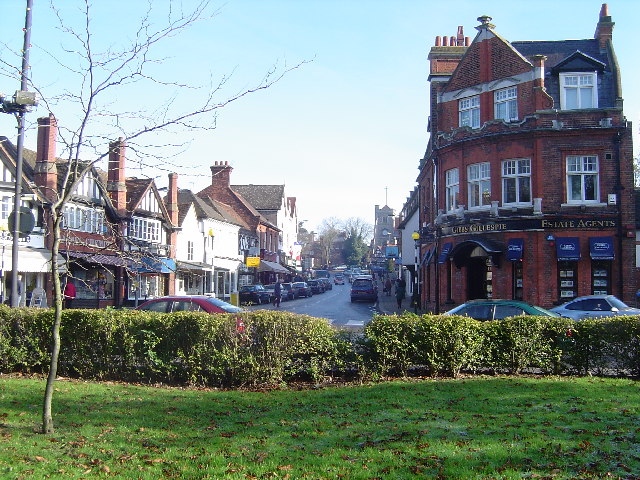
Estate agent at the corner of High Street
Pinner Police Station, Waxwell Lane

Victorian architecture (1837–1901)

Tooke's Folly at Pinner Hill Farm, c. 1862

Metro-land architecture (1903–1939)

  • Suburban prototypes on Cecil Park Estate[112][113][114]
  • Tudor revival dwellings on Grange Estate[113][114]
  • Arts and Crafts dwellings on Pinnerwood Park Estate[77]
  • Cottages on Elm Park Road[115]

Art Deco architecture (1919–1939)

  • Elm Park Court on Elm Park Road[77][116]
  • Pinner Court on Pinner Road[77][117]
  • Harrow Fire Station on Pinner Road[77]
  • Pinner Wood School on Latimer Gardens[77][118]

Modern architecture (1945–1980)

  • Roman Catholic Church of St Luke on Love Lane[119]
  • Shops on Bishops Walk
  • Shops on Barters Walk
  • Dwellings on Nursery Road

Postmodern architecture (1980–present)

See also

[edit]

References

[edit]
[edit]
Revisions and contributorsEdit on WikipediaRead on Wikipedia
from Grokipedia
Pinner is a suburban district and former agricultural in the London of Harrow, located in the northwest sector of , . First recorded as Pinnora in 1232, it originated as one of the medieval hamlets of Harrow Manor and retains a historic village core centered on its , which preserves timber-framed buildings from the medieval and Tudor periods. The area, absorbed into in 1965 under the London Government Act, features significant conservation zones including the Pinner Hill Estate and Pinnerwood Park Estate, alongside green spaces such as Pinner Memorial Park, contributing to its affluent, low-density residential character amid post-railway suburban development. The combined Pinner North and Pinner South wards recorded populations of 13,137 and 15,739 respectively in the 2021 census, reflecting an older demographic profile compared to the wider borough. Notable residents and connections include musician , born in Pinner in 1947, highlighting the area's appeal as a culturally significant blending rural heritage with metropolitan proximity.

History

Origins and Medieval Period

Pinner originated as a Saxon settlement, with its name deriving from elements suggesting a location on a or edge, as evidenced by its early recording as Pinnora in 1231 or 1232. The archaic suffix -ora, meaning "" or "ridge," indicates pre-Norman roots tied to the local near the River Pinn, though the settlement itself is not explicitly listed in the of 1086, which instead records the broader Harrow manor encompassing it. As one of the ten hamlets comprising the medieval manor of Harrow, Pinner functioned as a rural agricultural community under the lordship of Harrow, where tenants rented land or labored in exchange for holdings. The manor's included significant properties such as Woodhall Farm, Headstone Manor (with its surviving moated house and barn), and Pinner Park, a 250-acre deer protected by banks and ditches to preserve game for the lord's hunt. Villagers cultivated subdivided fields south of the settlement, with commons and woodlands to the north, reflecting a typical of medieval agrarian organization. The of St. , central to early Pinner, was rebuilt in flint and consecrated in 1321 as a subordinate to Harrow's ancient church, marking a key development in local ecclesiastical independence. By the 1230s, records confirm the presence of a church structure, underscoring Pinner's established community by the early . In 1336, King Edward III granted a midsummer fair to be held outside the church on the feast of St. , fostering economic activity through and markets amid the hamlet's growing cohesion. These elements highlight Pinner's evolution from a peripheral to a within the feudal framework of Harrow manor during the medieval period.

Post-Medieval Development

In the 16th and 17th centuries, Pinner evolved from a medieval into a more established village centered on and emerging crafts, with timber-framed buildings constructed along the , including the Queen's Head and Victory public houses. These structures, often incorporating jettied upper stories and pargeted facades, reflect the period's and the growing presence of trades such as butchery, , and lace-making, the latter becoming a notable local industry that drew workers and merchants. Pinner Fair, originally granted a in the medieval era, expanded as a hub for lace trade during this time, fostering economic ties beyond subsistence farming. Prominent figures contributed to localized development; Sir Christopher Clitherow, in , constructed a on Pinner Hill, exemplifying how affluent Londoners invested in rural estates for leisure and status. Around the same period, the lord of Harrow Manor sold off estates including Woodhall, Headstone, and Pinner Park, fragmenting larger holdings and enabling smaller-scale farming and residential use. By the mid-17th century, the village supported a of tradespeople operating from home workshops, alongside its core agrarian economy of arable and dairy production on fertile lands watered by local streams. The saw modest continuity in this rural character, with population growth remaining gradual and building limited to on existing ; surviving barns and farmhouses from this underscore Pinner's role as a peripheral supplier to London's markets, though without significant industrialization or enclosure until later. Enclosures, such as those at Pinner Hill in the early 1800s, marked the transition toward more intensive , but pre-1800 development prioritized maintenance of the village core over expansion.

19th and 20th Century Growth

During the 19th century, Pinner transitioned from a predominantly rural settlement to an emerging suburb, with population growth reflecting national trends but remaining modest initially. The census recorded 761 residents in 1801, rising to 1,310 by 1851, supported by agricultural stability and limited local trade. The arrival of the railway in 1885, via the extension of the Metropolitan Railway line, catalyzed further development by enabling daily commuting to central London, transforming Pinner into a dormitory suburb. This infrastructure spurred residential and commercial expansion along the High Street, where frontages were progressively closed and rebuilt by 1880 to accommodate increasing footfall from tradespeople and incoming Londoners. By 1911, the population had increased dramatically to 7,103, underscoring the railway's impact on attracting middle-class households seeking rural amenities near the capital. The 20th century accelerated Pinner's suburbanization, particularly during the , as part of the "" marketing by the Company, which promoted semi-rural estates accessible by tube. Residential development boomed between 1923 and 1939, with large-scale construction of semi-detached houses on former farmland, exemplified by estates along roads like George V Avenue, drawing artists, writers, and professionals to its tranquil yet connected setting. This era saw Pinner's evolve into a bustling local hub with shops and services, while population growth continued post-World War II, solidifying its status as a affluent commuter enclave within the expanding . By the mid-20th century, restrictions on further infilling preserved much of the village character amid broader urbanization pressures.

Recent Historical Preservation

In response to threats of insensitive modernization during the mid-20th century, local campaigns in Pinner successfully advocated for the protection of its historic and Bridge Street in 1968, preserving timber-framed buildings dating from the 16th and 17th centuries that originally served as inns and workshops. This initiative marked an early focus on retaining the area's medieval village character amid suburban expansion. The London Borough of Harrow designated multiple conservation areas within Pinner to safeguard its architectural and historic interest, with the Pinner Conservation Areas Supplementary Planning Document adopted in December 2009 providing guidance on their management. These include Pinner High Street, Pinner Hill Estate (covering 30 hectares), and Pinnerwood Park Estate (27 hectares), emphasizing distinct identities formed by inter-war housing and earlier structures. Strict planning guidelines enforce preservation, as seen in Pinner Hill's , which restricts developments to maintain the area's early 20th-century domestic architecture and town planning. A notable restoration project involved West House in Pinner Memorial Park, a historic building threatened with demolition but saved through community efforts led by the Pinner Association and trustees; following extensive renovations, it reopened in June 2010 as the home of the Heath Robinson Museum. Increased awareness of historic value has driven further restorations along Pinner High Street, where properties underwent refurbishment to retain their picturesque qualities while adapting to modern uses, such as a recent medical centre development that preserved surrounding historic elements. Local organizations, including the Pinner Local History Society established to promote and in the area's heritage, continue to support preservation through talks, visits, and advocacy against incompatible developments. Preservation societies and Harrow Council collaborate to ensure Pinner's architectural heritage endures, balancing conservation with contemporary needs in these designated zones.

Geography

Location and Administrative Boundaries

Pinner is a suburban locality in the northwestern sector of , situated within the London Borough of Harrow, approximately 12.5 miles (20.1 km) northwest of . Its central coordinates are 51.5938°N 0.3822°W. Administratively, Pinner functions as an electoral ward, designated as Pinner Ward (E05013555), under the governance of the London Borough of Harrow. The borough, established in 1965 through the London Government Act 1963, absorbed areas previously in the historic county of , including Pinner, into the new administrative structure of . The ward's boundaries are delineated by Harrow Council and encompass residential, commercial, and green areas, adjoining other local wards such as Hatch End to the north and Pinner South to the southeast, while sharing an external border with the London Borough of to the west. These boundaries have been periodically reviewed, with updates reflected in council ward maps, such as those from 2019 and proposed revisions for 2022. Pinner lacks separate parish status, aligning with the unparished nature of most areas under the authority of the borough council and the .

Topography and Natural Features

Pinner's topography consists of undulating terrain shaped by the underlying Formation, with higher elevations concentrated around Pinner Hill and adjacent areas like Pinner Cemetery. Pinner Hill itself rises to 134 meters above , capped by pebble gravels that enhance its prominence amid the surrounding clay plateau. The , an Eocene deposit reaching depths of about 100 meters beneath sites like Pinner Park Farm, forms the dominant substrate, interrupted locally by Reading Beds near watercourses. The River Pinn, a of the originating in nearby Harrow Weald, traverses Pinner, providing a key hydrological feature that supports riparian habitats despite sections being culverted for urban development; it emerges visibly near Pinner and Pinner Park Farm. Subsurface includes workings, as evidenced by the Pinner Chalk Mines—a Regionally Important Geological Site featuring shafts up to 34 meters deep, the deepest known chalk mine shaft in the UK, located near Pinner Hill Farm. Vegetative natural features encompass ancient woodlands such as Pinner Wood, spanning approximately 2 hectares with characteristic species including , , , and , remnants of historic parkland integrated into the semi-rural . Adjacent areas like Oxhey Wood and Nanscot Woods contribute to dense greenery, mature tree cover, and diverse flora-fauna assemblages, preserving ecological continuity amid suburban pressures. These elements, including hedgerows and grass verges, underscore Pinner's transition from clay-dominated lowlands to gravel-capped elevations, fostering views across the broader Harrow .

Urban and Green Spaces

Pinner maintains a balance between suburban urban development and extensive green spaces, preserving its village-like character within the London Borough of Harrow. The borough manages 80 green spaces, including parks, nature reserves, and open lands, several of which are located in or near Pinner. Pinner Memorial Park, situated centrally with entrances on West End Lane, West End Avenue, and Chapel Lane, features a supporting ducks and geese, a , an , playground equipment, an , and diverse habitats such as patches, hedges, and mature trees including native and exotic species like and weeping willow. This park holds status, recognizing high-quality management and facilities accessible to all, including baby changing and dog-friendly areas. Additional green areas include Pinner Recreation Ground, offering recreational facilities, and Roxbourne Park on Cannon Lane, which provides paths for walking and jogging alongside children's play areas. Pinner Village Gardens contribute to the local network of open spaces. Farmland persists on the periphery, supporting the area's semi-rural topography. Urban spaces emphasize conservation, with Pinnerwood Park Estate—a in Arts and Crafts style—covering 27 hectares, and Pinner Hill Estate spanning 30 hectares as key protected zones. These areas integrate low-density housing with green buffers, limiting intensive development while accommodating suburban expansion since the . The serves as the urban core, blending historic structures with modern commerce amid leafy surroundings.

Governance

Local Administration

Pinner is administered by the London Borough of Harrow Council, the unitary local authority responsible for delivering public services across the borough, including collection, planning permissions, housing allocation, social care, , and leisure facilities. The council operates from its main offices at the Council Hub on Kenmore Avenue in Harrow, with full council meetings convened at the Harrow Arts Centre in Pinner. Following the Local Government Boundary Commission's review and boundary changes effective from the elections, Harrow comprises 22 wards electing a total of 55 councillors, with each ward represented by either two or three members depending on population size. The Pinner area specifically falls under the Pinner and Pinner South wards, each electing three councillors to represent local interests on the council. These wards handle resident concerns through mechanisms such as monthly surgeries held at Pinner on Marsh Road, where councillors address issues like parking, maintenance, and community services. Pinner lacks a separate or , with all administrative functions centralized at the level, ensuring uniform application of policies without sub-local layers. As of the 2022 local elections, representation in these wards is held by Conservative Party councillors, including Paul Osborn and Norman Stevenson for Pinner ward, and June Baxter and Hitesh Karia for Pinner South ward, reflecting the party's majority control of the council at 31 seats to Labour's 24. This structure facilitates decision-making via cabinet-style , where a leader and portfolio holders oversee departments, supported by scrutiny committees for oversight. Local planning applications and enforcement in Pinner, for instance, are processed through the borough's development control committee, adhering to national and borough-wide frameworks.

Political Dynamics and Representation

Pinner is represented in the UK by the , Northwood and Pinner constituency, which encompasses the area along with parts of the London Borough of Hillingdon. The seat has been held by of the Conservative Party since 2019. In the July 4, 2024, general , Simmonds received 21,366 votes (45.4% share), securing a majority of 7,581 over Labour candidate Tony Gill's 13,785 votes (29.3% share), despite a 9.9 decline in the Conservative vote share from 2019. At the local level, Pinner is divided between the Pinner and Pinner South wards of , which elects 55 councillors across 22 wards every four years. In the May 5, 2022, local elections, the Conservative Party retained control of both wards. In Pinner ward, Norman Shairp Stevenson (Conservative) was re-elected with 1,979 votes (46.6% share under first-past-the-post for the three seats), contributing to a narrow hold amid a turnout of 39%. Pinner South ward saw June Rosemary Baxter (Conservative) elected with 2,418 votes (18% in the multi-member contest), with Conservatives securing two of the three seats and a of 1% over Labour. These results aligned with the Conservative Party's overall on Harrow Council, holding 34 of 55 seats post-2022. Pinner residents are also represented in the Assembly by the Harrow and Brent constituency member, currently of the Conservative Party, elected in 2024 with 58,000 votes (44.5% share). Local political dynamics in Pinner reflect a consistent Conservative preference, evidenced by vote shares exceeding 45% in recent parliamentary and assembly contests, though national shifts in 2024 narrowed margins compared to prior elections. Key issues in council representation include resident concerns over planning, green belt preservation, and infrastructure, with Conservative councillors advocating for restrained development to maintain the suburb's semi-rural character.

Economy

Employment Patterns

Pinner ward records a low long-term rate of 1.6 per 1,000 working-age for the period 2019/20, substantially below typical urban averages and indicative of robust local labor market stability. This aligns with the area's elevated median household income of £43,000 (2012/13 estimate), surpassing the Harrow borough average of £38,000 and reflecting higher earning potential among residents. Census 2021 data for sub-areas like Pinner Green highlight a predominance of professional and managerial roles, with managers, directors, and senior officials forming the largest occupational group, while elementary occupations represent the smallest share. Specific lower super output areas (LSOAs) within Pinner, such as Harrow 009D, show 23.8% of residents in higher managerial and professional occupations—10.5 percentage points above the London average—underscoring a skew toward skilled, knowledge-based . Employment deprivation in Pinner remains minimal, with LSOA scores as low as 0.028 (ranking 30,995 out of 32,844 nationally in the Indices of Deprivation), pointing to limited barriers to participation compared to more deprived urban zones. Within the encompassing Harrow borough, the overall rate for ages 16-64 stood at 73.4% for the year ending 2023, with Pinner's affluence likely contributing to rates at or above this benchmark through commuting to professional sectors.

Local Businesses and Commerce

Pinner's commerce is primarily concentrated along its and adjacent Bridge Street, designated as a conservation area since 1968 to preserve over 20 historic timber-framed buildings. These streets host a blend of independent retailers, cafes, restaurants, and service providers catering to the local residential population and visitors drawn to the area's village-like charm. Supermarkets such as , , , and anchor the retail landscape, while independent delis, interiors shops, and eateries provide specialized options. The features a notable increase in coffee shops, up 22% in recent years, alongside pubs like the Queen's Head, one of Pinner's oldest structures dating back centuries. Independent cafes such as Augustina's Tearoom and Kafe Ador, along with vegan options like , contribute to a diverse hospitality sector that includes both chains like Pizza Express and local establishments. This mix supports daily commerce for residents, with boutique stores, salons, and niche retailers adapting to modern trends amid challenges from rising rents and competition. Historically, the evolved from medieval markets and fairs—Pinner Fair has operated annually since 1336—to 20th-century independent trades including greengrocers, butchers, and hardware stores, many family-run for generations. Contemporary shifts emphasize food, beauty services, and small offices, reflecting suburban economic patterns within the broader Harrow borough, which recorded 15,215 registered businesses in 2019. Local commerce sustains employment in retail and services, bolstering the area's affluent, family-oriented demographic without dominating the regional .

Demographics

The population of Pinner ward, as defined in the early , grew modestly from 9,601 residents in the 2001 census to 10,026 in , an increase of 4.4% over the decade, reflecting limited expansion amid constrained suburban development. This growth rate was below the 15.3% recorded for the wider during the same period, attributable to factors such as established residential stock and preservation of green spaces limiting large-scale housing additions. Ward boundaries were redrawn by the Local Government Boundary Commission for following a review concluded in 2019, with changes taking effect for the 2022 local elections; the revised Pinner ward now covers a broader area previously including elements of adjacent wards like Pinner South and Hatch End. Under these new boundaries, the 2021 census enumerated 13,137 residents, implying an approximate annual growth of 0.67% from mid-2011 estimates when adjusted for the expanded footprint, though direct comparability across censuses is limited by the reconfiguration. This trajectory aligns with Harrow's overall 9.3% decadal rise to 261,205 by 2021, driven by net migration and natural increase rather than aggressive development.
Census YearPopulation (Pinner Ward)Growth from Prior DecadeNotes
20019,601-Original boundaries
201110,026+4.4%Original boundaries
202113,137Not directly comparableRevised boundaries post-2019 review

Ethnic and Cultural Composition

According to the 2021 United Kingdom census, Pinner ward in the London Borough of Harrow had a population of 13,155, characterized by a diverse ethnic makeup reflecting post-1970s immigration trends in outer London suburbs. The largest ethnic group was White, comprising 6,099 residents or 46.4% of the population, followed by Asian or Asian British at 5,097 residents or 38.7%. Within the White category, British Whites accounted for approximately 35% of the total population, lower than the London average of 37%, indicating a notable presence of other White ethnicities such as Irish or European.
Ethnic GroupNumber of ResidentsPercentage
White6,09946.4%
Asian/Asian British5,09738.7%
Black/Black British7015.3%
Mixed/Multiple~1,065~8.1%
Arab1931.5%
Other(remainder)(balance)
The Asian population in Pinner is predominantly of Indian origin, consistent with Harrow borough-wide patterns where Indians form the largest at around 26-29% locally, driven by selective migration for economic opportunities in professional sectors. Black residents, at 5.3%, are primarily African or , while the Mixed category reflects inter-ethnic unions increasingly common in suburban . This composition underscores causal factors like chain migration and policies since the 1960s, leading to sustained formation without the higher deprivation seen in inner-city areas. Religiously, Pinner exhibits , with as the plurality but significant Hindu and Jewish adherence tied to ethnic demographics. Approximately 5% of residents (679 individuals) identified as Jewish, supporting local synagogues and reflecting historical Jewish settlement in northwest . No religion was reported by 16% (2,126 residents), aligning with secular trends among younger cohorts, while "other religions" totaled 321. Hindu practices, prevalent among the Indian community, manifest in community events and temples nearby, though specific ward-level figures mirror borough highs of 22% Hindu overall. This religious diversity fosters cultural institutions like multicultural festivals, but empirical data shows lower inter-ethnic tensions compared to more polarized urban zones, attributable to higher socioeconomic stability.

Socioeconomic Indicators

Pinner exhibits low levels of deprivation relative to national benchmarks. In the 2019 English Indices of Multiple Deprivation, Pinner South ward recorded the lowest overall deprivation score in the London Borough of Harrow, with an income deprivation rate of 8.6%, placing its lower-layer super output areas (LSOAs) among the least deprived in . Pinner ward similarly features minimal deprivation, with only two LSOAs identified as relatively more deprived within the borough, both ranking in the least deprived national deciles across domains such as , , and . These rankings reflect structural advantages including high property values and professional concentrations, though they mask pockets of disparity. Economic activity rates in Pinner ward stand at approximately 75-80% for working-age residents, lower than Harrow's borough average of 85% but aligned with patterns in suburban areas influenced by higher proportions of retirees and self-employed professionals. Median gross weekly earnings for full-time employees residing in the Ruislip, Northwood, and Pinner constituency, which encompasses Pinner, were £575.50 as of recent labour market data, below London's £804.90 regional median but indicative of a commuter economy reliant on sectors like finance, IT, and healthcare in central London. Unemployment remains low, with claimant rates under 2%, supported by proximity to Metropolitan line transport links facilitating access to high-wage opportunities. Educational attainment is a strength, with residents showing elevated qualification levels. In Pinner ward, 69.6% of pupils achieved GCSE grades 5 or above in English and in 2018, the highest rate among Harrow wards and exceeding national averages. Secondary schools such as Pinner High School report Attainment 8 scores of 55.1, with 61% of pupils securing grade 5 or above in English and maths, reflecting above-average progress in value-added metrics. Adult qualification rates align with this, featuring high proportions holding degree-level or equivalent credentials, contributing to socioeconomic stability. Housing affordability poses challenges, with average property prices in Pinner reaching £799,500 as of 2025 data, a 12.7% year-on-year increase driven by for homes in greenbelt-adjacent locations. This elevates price-to-income ratios well above national medians, rendering homeownership difficult for median earners and fostering reliance on private rentals or , though rates exceed 70% due to legacy holdings from earlier decades.
IndicatorPinner Ward ValueComparator (Harrow/England)Source
Income Deprivation Rate (2019 IMD)8.6% (Pinner South)Harrow: ~10%; : 20%
Economic Activity Rate (Working Age)~75-80%Harrow: 85%; : 82%
Median Weekly Earnings (Full-Time)£575.50London: £804.90; : £640
GCSE 5+ in Eng/Maths (Pupils)69.6%Harrow average: ~65%; : ~50%
Average House Price (2025)£799,500London average: ~£520,000

Education

Primary and Secondary Schools

Pinner is served by several state-funded primary schools, primarily catering to children aged 3-11, with a mix of , academy, and faith-based institutions under the London Borough of Harrow's oversight. Key establishments include Pinner Wood School, a primary academy located at Latimer Gardens, Pinner HA5 3RA, which enrolled approximately 470 s as of recent data and achieved an rating of Outstanding in December 2023 for its , , and . Pinner Park Primary School, comprising infant and junior sections at Melbourne Avenue, serves a diverse intake of over 600 s and reported 87% achieving expected standards in reading, 93% in mathematics, and 75% in combined reading, writing, and math in 2023 assessments. Cannon Lane Primary School, at Cannonbury Avenue, was inspected in January 2025 and rated Outstanding across all categories, including quality of , and attitudes, , and , highlighting its strong academic outcomes and inclusive practices for its roughly 450 s. Other notable primaries include St John Fisher Catholic Primary School, a voluntary aided at Berkeley Avenue, HA5 5RA, emphasizing Catholic values alongside secular curriculum for about 240 pupils, with consistently high attainment in national tests. Grimsdyke Primary School, bordering Pinner at Sylvia Avenue, Harrow Weald, serves local families with around 450 pupils and maintains strong performance metrics, though specific recent details emphasize effective safeguarding and progress for pupils. These schools generally outperform national averages in results, with Harrow borough primaries achieving 78% pupil proficiency in reading, writing, and math combined in 2023, attributed to selective admissions pressures and high parental engagement in the area.
School NameTypeApproximate PupilsOfsted Rating (Latest)
Pinner Wood SchoolCommunity Academy470Outstanding (2023)
Pinner Park PrimaryCommunity600+Good (implied by performance data, 2023)
Cannon Lane PrimaryCommunity450Outstanding (2025)
St John Fisher CatholicVoluntary Aided240Good
Secondary education in Pinner features mixed-sex comprehensive schools for ages 11-16 or 18, with options for study, reflecting the borough's emphasis on academic rigor over selective systems. Pinner High School, a free school academy at Beaulieu Drive, HA5 1NB, opened in 2016 and serves 1,200+ pupils up to age 18 under headteacher ; it holds an Outstanding rating, praised for high aspirations, personalized learning, and above-average results, including 60% achieving grade 5+ in English and math in 2023. Nower Hill High School, located at Avenue in Pinner, is an academy converter with a enrolling about 1,600 students, noted for strong progress in humanities and sciences, though its latest inspection rated it Good overall, with leadership driving improvements in attendance and pupil outcomes post-2019. Nearby Hatch End High School at Headstone Lane provides additional capacity for Pinner residents, with 1,000+ pupils and a focus on vocational pathways alongside academics, achieving solid Progress 8 scores above national averages.
School NameTypeAge RangeApproximate PupilsOfsted Rating (Latest)
Pinner High SchoolFree School Academy11-181,200+Outstanding
Nower Hill HighAcademy Converter11-181,600Good
Hatch End HighCommunity11-181,000+Good (performance-based)
Independent secondary options are limited within Pinner proper, with pupils often attending nearby institutions like (a prestigious boys' boarding , established 1572, but selective and fee-paying at £48,000+ annually), though it draws from a wider catchment. Overall, Pinner's schools benefit from the borough's high socioeconomic profile, with 85% of secondary pupils entering or apprenticeships post-16, exceeding national figures, supported by targeted interventions for the 20-25% eligibility rate.

Further Education and Libraries

Pinner lacks dedicated further education colleges within its boundaries, with residents typically accessing post-16 provisions through nearby institutions in Borough of Harrow, such as (part of HRUC), which delivers vocational qualifications, A-levels in subjects including sciences, apprenticeships, and part-time adult courses across multiple campuses. College, located approximately 3 miles northeast, also serves the area with full-time 16-18 programs, T Levels, and vocational training equivalent to A-levels. Local secondary schools like Pinner High School guide students toward these or sixth-form options in Harrow and adjacent boroughs, emphasizing vocational pathways alongside academic routes. Adult education opportunities are coordinated borough-wide by the London Borough of Harrow, offering courses in , languages, digital skills, , and through the Learn Harrow platform, often hosted at community venues or colleges rather than Pinner-specific centers. Harrow College supplements this with flexible part-time options open to adults, focusing on career preparation and skill development. Pinner Library, situated at 78 Marsh Road, operates as a branch of Harrow Libraries, providing access to fiction, non-fiction collections, digital lending, and specialized services including family history research, career guidance, home book delivery, and children's activities. The facility supports BFI Replay for archives and caters to the area's demographics with resources like bookable spaces, though its local history materials have been partially relocated to Headstone Manor Museum for preservation and appointment-based access. Contactable at 020 3714 7718 or [email protected], it reflects Harrow's network of 10 libraries emphasizing community learning amid budget constraints.

Culture and Community

Local Events and Traditions

The annual Pinner Fair stands as the area's most enduring tradition, originating from a royal charter granted by King Edward III prior to 1336 and held continuously since that time. Initially conducted twice yearly on June 23–25 and August 29–30, it evolved into a single event, now typically on a Wednesday in late May, such as May 28 in 2025 for its 688th iteration. This fair, one of London's largest, features amusement rides, food stalls, and entertainment along the High Street, drawing crowds from across the region and necessitating road closures and bus diversions. Historically rowdy, it once involved livestock trading and festivities that occasionally led to public disorder, reflecting medieval market customs. Complementing the fair, the Pinner Rotary Wheelbarrow Race, organized by the Pinner Rotary Club since 1963, occurs annually and involves teams navigating the streets in wheelbarrows while consuming beer, preserving a lighthearted, pub-centric . Other recurring events include the Pinner Music Festival, held each June at Pinner Parish Church since at least the mid-20th century, featuring classical and choral performances over several days, with the 59th edition spanning June 9–14, 2025. The Pinner Rotary Village Show, a late-summer agricultural and craft exhibition, takes place in early September, such as on September 6, 2025, showcasing local produce and talents. Additionally, St. George's Day celebrations in , centered on the High Street near April 23, incorporate parades and gatherings organized by local groups. These events underscore Pinner's village heritage amid suburban growth, fostering communal bonds through historical and seasonal observances.

Sports and Recreational Facilities

Pinner's sports and recreational facilities are primarily centered around public parks managed by the London Borough of Harrow, offering spaces for both organized sports and casual leisure. Pinner Memorial Park, a awarded site, features a , children's , outdoor green gym equipment for bodyweight exercises, woodland trails for walking, a , and an , catering to a range of ages and activities. In September 2025, the park's underwent refurbishment, adding new equipment including a dedicated sensory play area to enhance inclusivity. Montesole Playing Fields provide dedicated sports infrastructure, including football pitches, courts, a multi-use games area suitable for and small-sided games, facilities, hockey pitches, and additional green gym apparatus alongside a children's . Pinner Village Gardens complement these with courts, tables, hoops, a , and another children's , emphasizing accessible near the town center. For indoor fitness, Better Gym Pinner, located adjacent to Pinner station, offers a 100-station with cardio machines, free weights, a area, group classes such as Body Pump and circuits, and and steam facilities. Community-driven activities are supported by the Pinner Association, which links residents to local clubs for events, , rugby, , and other pursuits, fostering participation across various sports.

Representation in Media and Literature

Pinner features in Edward Lear's 1871 collection More Nonsense, where it is the subject of a limerick describing an eccentric resident: "There was an old person of Pinner, / As thin as a , if not thinner; / They dressed him in white, / And roll'd him up tight, / That elastic old person of Pinner." This nonsensical verse exemplifies Lear's style of absurd, place-specific humor, drawing on Pinner's suburban character without deeper narrative context. In British television, Pinner has appeared as a setting and filming location for several sitcoms. The BBC series May to December (1989–1994), created by Paul Mendelson—a Pinner resident at the time—was explicitly set in the suburb, portraying its everyday domestic life and romances among middle-class characters. Similarly, Mendelson's My Hero (2000–2006) incorporated on-location footage from Pinner's streets to depict suburban family dynamics involving a adjusting to earthly norms. The series (2008–2010) used Pinner High Street for key scenes, such as the "Bunk Off" episode where characters purchase alcohol, evoking the area's unremarkable, affluent suburban backdrop that underscores the show's themes of adolescent awkwardness in northwest locales. Films have occasionally utilized Pinner for exteriors representing generic English suburbia. For instance, (2009), a biopic of , filmed scenes in Pinner, including confrontations near local pubs, to capture mid-20th-century northwest atmospheres. A 1960 amateur short, Present Day Pinner, produced for local audiences, documented the village's mid-century life through a biographical lens on novelist , who resided there in the , highlighting its historical literary ties. These depictions generally portray Pinner as a quintessentially English commuter village—prosperous, green, and insulated—rather than a site of dramatic conflict.

Notable People

Historical Figures

Sir Christopher Clitherow (c. 1578–1641), a and , served as in 1635. He acquired property in Pinner and built a mansion there, where he died on 11 November 1641. John Horne Tooke (1736–1812), a radical political reformer, philologist, and founding member of the Society for Constitutional Information, owned Pinner Hill Farm in the late . The estate's landmark, known as , commemorates his tenure and reflects the rural character of Pinner at the time. Samuel Orchart Beeton (1831–1877), a pioneering publisher of periodicals like The Englishwoman's Domestic Magazine, and his wife Isabella Mary Beeton (1836–1865), author of the seminal Mrs Beeton's Book of Household Management (first published in full in 1861), relocated to a newly built suburban home in shortly after their 1856 marriage. Isabella compiled much of her work on domestic economy during this period, drawing on the area's emerging middle-class residential appeal.

Modern Residents and Contributors

Sir , born Reginald Kenneth Dwight on 25 March 1947 in Pinner, is a prominent singer, pianist, and composer whose career spans over five decades. Raised locally and educated at Pinner Wood Junior School and Pinner County Grammar School, he formed his early musical influences in the area before achieving global success with hits co-written with , including "" (1970) and "" (1973). John has sold more than 300 million records worldwide and founded the in 1992, which has raised over $600 million for prevention and research. Simon Le Bon, lead vocalist of , grew up in Pinner at 163 Cannon Lane and attended Pinner County Grammar School. Born in in 1958 but raised in Pinner, Le Bon contributed to the band's new wave and sound, with albums like Rio (1982) selling over 12 million copies and featuring staples such as "." In 2024, he received an MBE for services to music. Racing driver Derek Bell, born in Pinner in 1941, secured five titles and six overall victories at the between 1975 and 1997, partnering with drivers like . His contributions to motorsport include advancing Porsche's dominance in endurance racing during the 1980s.

Transport

Rail Infrastructure

Pinner is served by Pinner Underground station, located on the of the London Underground network. The station lies in Travelcard Zone 5 and provides connections to via , with services extending northwest to branches terminating at , , , or . Trains on this section of the line operate as part of the broader infrastructure, which includes 67 km of track and 34 stations stretching from northwest London suburbs to the . The station opened on 25 May 1885, constructed by the as part of the expansion of suburban rail links to support dormitory communities in northwest London. Initially serving as a terminus until the line's extension to in 1887, it features two platforms and retains much of its original Victorian-era building design. Adjacent stations include North Harrow to the and Northwood Hills to the north, facilitating local commuter flows. Pinner lacks a National Rail station within its boundaries; the nearest mainline services are at Hatch End, approximately 1.5 miles west, which connects to London Euston and on the London Northwestern Railway. fast services pass through the area on parallel tracks but do not stop at Pinner Underground, emphasizing the station's role primarily in the Underground's slower, stopping services. Station facilities include a ticket office, waiting room, toilets, and two lifts for step-free access between platforms and street level, supporting daily passenger volumes typical of outer-zone suburban hubs.

Road and Bus Networks

Pinner's road infrastructure revolves around its , a medieval-era that functions as the suburb's primary commercial and connective artery, featuring preserved timber-framed structures. This street links to Bridge Street and adjacent local roads such as Love Lane and Marsh Road, which support residential access and tie into broader networks. The area connects to the A410, running from through Pinner toward Uxbridge Road (A404), facilitating outbound travel to northwest and the approximately 5 miles north. Bus services in Pinner are managed under Transport for London's network, with key stops clustered around Pinner station and . Route 183, operated under TfL contract, runs from Pinner to via Harrow Bus Station, , and , serving as a vital link for commuters to . Local circular routes include H9 from through Pinner Road and ; H11 connecting to Harrow, , and Mount Vernon Hospital; H12 linking Pinner to and South Harrow; and H13 extending to via West End Lane. These routes, supplemented by night services on select lines, provide frequent access to Underground stations and hospitals, though peak-hour congestion on Pinner Road and can affect reliability, as noted in TfL operational data.

Active Travel Options

Pinner provides active travel opportunities through walking trails in local parks and emerging , facilitated by the London Borough of Harrow and (TfL). The area features pedestrian-friendly paths in green spaces, with ongoing enhancements to support non-motorized movement amid suburban surroundings. A primary initiative is the Harrow to Pinner Cycleway Improvement Scheme, which introduces protected cycle lanes, zebra crossings, wider footways, and bus stop upgrades along routes connecting Harrow town center to Pinner. This project, funded by TfL, aims to create safer conditions for cyclists and pedestrians, with the Pinner section incorporating relocated cycle tracks, additional parking adjustments, and greening measures as of revised proposals in 2025. For walking, the 5.1 km out-and-back trail from Pinner Memorial Park to Pinner Farm Park offers an easy route through meadows and woodlands, typically taking 1.5 to 2 hours and gaining 183 meters in elevation. These paths integrate with broader recreational areas, promoting daily active travel in line with TfL's goal of ensuring 70% of Londoners live within 400 meters of the cycle network, though Pinner's suburban layout emphasizes local loops over extensive urban connectivity. Cycling options include community-curated routes, such as a 24 km and loop traversing Pinner's farms, woods, and countryside paths in . Over 300 user-generated cycling itineraries are available via platforms like Bikemap, often linking to Harrow's proposed northern east-west cycle route for cross-borough travel. These facilities, while not yet fully segregated borough-wide, leverage traffic-free segments and quiet roads to encourage commuting and leisure rides.

Heritage

Architectural Highlights

Pinner's architectural landscape is characterized by its well-preserved medieval and Tudor-era structures, particularly along the , where timber-framed buildings dating from the 16th and 17th centuries predominate. These structures, many originally serving as inns or workshops, exemplify English with exposed oak beams and jettied upper stories. The forms part of a designated conservation area, preserving its historic streetscape amid suburban development. The Church of St John the Baptist, a Grade I listed building originating in the , stands as Pinner's most prominent ecclesiastical highlight. Its tower, added in the , and surviving medieval fabric including the and underscore its role as a focal point of local heritage. The Queen's Head public house at 31 , a timber-framed Wealden-type building from the first recorded in 1692, represents typical architecture with its hall and cross-wing layout. In contrast, 20th-century developments introduce modernist elements, notably Pinner Court and Capel Gardens, apartment blocks designed by architect H.J. Mark in the 1930s. These three-storey structures, built by the Courtenay Property Company, feature streamlined facades, white-rendered walls, and horizontal window bands, reflecting interwar suburban aspirations linked to expansion. Pinner House, an early 15th-century Grade II listed since 1951, further exemplifies medieval domestic architecture with its asymmetrical lobby-entry plan and chamfered oak beams.

Conservation Efforts and Plaques

Pinner encompasses multiple designated conservation areas under the oversight of the , aimed at safeguarding its historic built environment and preventing inappropriate development. These include twelve areas totaling substantial coverage, such as the Pinner Hill Estate (30 hectares) and Pinnerwood Park Estate (27 hectares), which exemplify early 20th-century planned suburban layouts with strict planning controls to maintain architectural coherence and green spaces. The Pinner Conservation Areas Supplementary Planning Document, adopted by the council in December 2009, provides detailed appraisals and management strategies, emphasizing the preservation of vernacular buildings, mature trees, and streetscapes against urban pressures. Specific initiatives target key zones like Pinner Road Conservation Area, designated for its unaltered early 20th-century suburban housing stock in good condition, with boundaries along Pinner Road in the Headstone North ward; the associated Appraisal and Management Strategy promotes enhancements to retain special architectural interest while addressing minor deteriorations. Local heritage groups bolster these efforts: the Pinner Association, a registered amenity society, collaborates with residents and authorities to conserve environmental quality and oppose developments threatening character; the Pinner Local History Society advances public education on and to foster appreciation; and the broader Harrow Heritage Trust advocates for protecting conservation areas and land. Commemorative plaques in Pinner highlight individual contributions to heritage. English Heritage erected a blue plaque at The Fives Court, Moss Lane (HA5 3AG), honoring Sir Ambrose Heal (1872–1950), the Arts and Crafts furniture designer and Heal & Son managing director, who resided there from 1912; it was unveiled on 27 February 2013. Another marks 75 Moss Lane (HA5 3AZ) for William Heath Robinson (1872–1944), the illustrator known for whimsical contraptions, who lived and worked there from 1918 to 1944. These installations, part of English Heritage's scheme since 1986, underscore Pinner's role in nurturing creative figures while integrating preservation with public historical awareness.

Cultural Artifacts and Sites

The Church of St John the Baptist, Pinner's oldest surviving structure, was consecrated in 1321 with its constructed in the and tower added in the . Originally a chapelry subordinate to in Harrow-on-the-Hill, it gained independence as a in 1766. The churchyard contains historical monuments, including a distinctive 19th-century stone pierced by a coffin-shaped slab commemorating William Loudon and family members, known locally as the "." The Heath Robinson Museum, opened in 2016 within Pinner Memorial Park, houses over 1,000 original artworks by illustrator William Heath Robinson (1872–1944), who resided in Pinner from 1908 to 1918. Its collection includes drawings, watercolours, books, and illustrating his humorous contraptions and , preserved as cultural artifacts of early 20th-century British illustration. Pinner Memorial Park encompasses West House, an early 19th-century villa once occupied by Horatio Nelson Ward, grandson of Admiral Lord Nelson and Lady Hamilton. Acquired by local residents after to serve as a war memorial, the park features ornamental lakes, gardens, and commemorative elements such as obelisks and a peace garden. Tooke's Folly, a Grade II-listed Gothic Revival clock tower and stable built in 1862 at Pinner Hill Farm by local solicitor Arthur Tooke, stands as an eccentric 19th-century landmark offering panoramic views from its upper levels. The structure, part of the farmyard complex, exemplifies Victorian whimsy in architecture and rural estate design.

References

Add your contribution
Related Hubs
Contribute something
User Avatar
No comments yet.