Hubbry Logo
Pixie-bobPixie-bobMain
Open search
Pixie-bob
Community hub
Pixie-bob
logo
8 pages, 0 posts
0 subscribers
Be the first to start a discussion here.
Pixie-bob
Pixie-bob
from Wikipedia
Pixie-bob
Short-haired Pixie-bobs
Origin United States
Breed standards
TICAstandard
ACFA/CAAstandard
CCA-AFCstandard
Domestic cat (Felis catus)

The Pixie-bob is a breed of domestic cat claimed to be the progeny of naturally occurring bobcat hybrids. However, DNA testing has failed to detect bobcat marker genes,[1] and Pixie-bobs are considered wholly domestic for the purposes of ownership, cat fancy registration, and import and export. They were, however, selected and bred to look like American bobcats.

History

[edit]

In the spring of 1985, Carol Ann Brewer purchased near Mount Baker, Washington, a unique male cat with a spotted coat, a short tail, and polydactyl paws.[2] In January 1986, she rescued another male cat named Keba, which was very large, had a bobbed tail, and was reported to have been sired by a bobcat.[3] While this cat was starving, it still weighed 17 pounds, and was so tall it reached up to Brewer's knees. Shortly after she had acquired this large male, it mated with a next door neighbor's brown spotted female cat.[2][4] In April 1986, a litter was born from this mating. Brewer eventually kept one of the female kittens, named "Pixie", and after a year started a breeding program with Pixie as the foundation cat.[2]

Over the next couple of years, Brewer introduced into her program 23 cats from around the nearby Cascade Range, that were believed by her to be born from naturally occurring matings between bobcats and domestic cats. She coined the term "Legend Cat" to refer to such cats and has since registered a trademark in the U.S. to limit the term to describe permitted outcrosses used in her breeding program.[5] At the same time, other breeders in the U.S. were working with distinctly wild looking barn cats and collaborated with Brewer to establish a broad genetic base and to develop the foundation of today's Pixie-bob.

Led by Brewer, they succeeded in registering their new breed with The International Cat Association (TICA) and eventually the American Cat Fancier's Association (ACFA). The Pixie-bob was accepted into the "Exhibition" category by TICA in 1993, promoted to "New Breed and Color" status in 1996 and eventually gained Championship status in 1998. The Pixie-bob was classified by TICA initially as a "Native New Breed", defined as "A new breed which has been identified through selection of phenotypically similar individuals from a naturally occurring population indigenous to a particular geographic region" but it is now classified as an established breed.

Frank Ditto attempted to patent the Pixie-bob in 1999, but his application was rejected by the United States Patent and Trademark Office. Successive litigation upheld the rejection.[6]

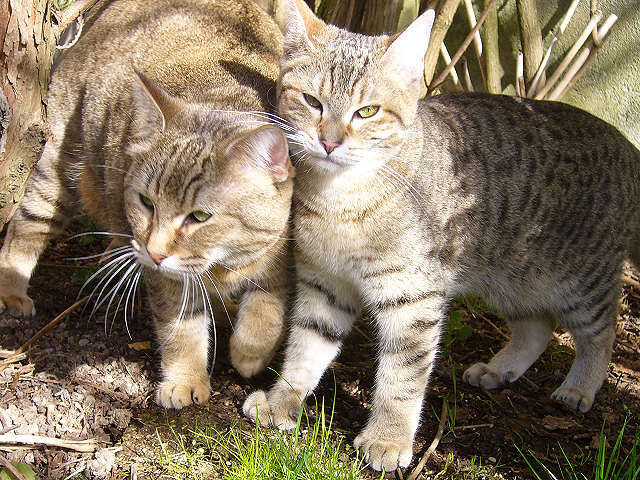
The brown spotted tabby coat of the Pixie-bob (short-haired)

Breed standard

[edit]

Pixie-bobs are a fully-domesticated, selectively-bred breed of cat (Felis cattus) intended to resemble the North American bobcat (Lynx rufus).

While the average domestic cat breed weighs about 8 lb (4 kg),[7] Pixie-bobs can be somewhat larger, but (on average) usually do not exceed 11 lb (5 kg), similar to a medium- to large-sized domestic cat. Only very few breeders are regularly producing larger cats, which are generally large-boned, muscular and massive in form. Male Pixie-bobs are, most times, larger than females. Pixie-bobs grow for up to four years, instead of one year, like most domestic breeds.[8]

Most Pixie-bobs have black fur and skin on the bottom of their paws, with tipped ears, heavy ear-hair, black lips, and white fur around the eyes (but with black eye-skin). Their muzzle is large, with rounded whisker pads and a red nose-leather. Their chins have white fur, but often have black skin underwear. Some of their whiskers change from black (root – about 25%) to white (to the tip – about 75% of the whisker). Their bobcat-like fur pattern often has reddish, apricot, and peach tones mixed-in. Most are short-haired, but some are long-haired. The brow should be heavy and the eyes should have a triangular shape. Eyes are blue when kittens, then change to green or gold when several months old. Tail size can range from 2 inches (approximately 5 cm) to hock length when leg is extended.[9] The head is pear-shaped and is considered to be the most important characteristic.

It is not presently known what genetic similarity there may be (or not) between the Pixie-bob and other breeds with suppressed tails, such as the Manx, American Bobtail, and Japanese Bobtail.

PIXIEBOB CAT
Pixie-bob at play

Temperament

[edit]

Pixie-bobs are said to be highly intelligent, social, active, bold, and enjoy playing with other animals.[10] They are also known for their "chirps", chatters, and growls; most meow scarcely if at all.

Most Pixie-bobs are highly sociable around both their owners and strangers. Almost all Pixie-bobs like to be in the same room as their owners, and will follow them around the house.

Other personality characteristics include the following:[8]

  • Head butting
  • Ball fetching and playing
  • Leash walking (for the most part)
  • Highly intelligent
  • Capable of understanding some words

Health

[edit]

As the breed is frequently outcrossed to "legend cats", Pixie-bobs are genetically diverse and are not prone to problems caused by inbreeding. Pixie-bob breeders use a disease database, Pawpeds, to ensure that health information can be recorded and monitored.

Some genetic conditions include the following:

  • Cryptorchidism – only a few cases have been recorded in Pixie-bobs since the conception of this breed in the 1980s.[11]
  • Dystocia and cystic endometrial hyperplasia – A very small percentage of Pixie-bobs do suffer from delivery problems, and are removed from breeding.[11]
  • Hypertrophic cardiomyopathy (HCM) – Since the advent of the Pixie-bob breed in the 1980s, only a few cases have been reported. In some of those cases the Pixie-bob was cross-bred with other breeds of cats, such as Bengal and Maine Coon. In the majority of cases, HCM occurred spontaneously. HCM is hereditary in at least 50% of occurrences requiring annual ultrasound screens to continuously monitor the good health of the cats.
  • Blocked tear ducts

See also

[edit]

References

[edit]
[edit]
Revisions and contributorsEdit on WikipediaRead on Wikipedia
from Grokipedia
The Pixie-bob is a medium-to-large domestic breed developed in the United States, notable for its short bobbed tail, spotted tabby coat, and wildcat-like appearance reminiscent of the North American , though has confirmed it has no bobcat ancestry and is entirely domestic. Known for its muscular build, polydactyl paws (up to seven toes), and sociable, dog-like personality, the breed comes in both shorthair and longhair varieties and is recognized primarily by (TICA) for its unique traits and family-friendly nature. The Pixie-bob originated in the Pacific Northwest, specifically Washington state, in the mid-1980s when breeder Carol Ann Brewer mated a short-tailed, polydactyl male cat named Keba with a female named Pixie, aiming to create a domestic cat resembling the coastal red bobcat. The breed's foundation stock came from naturally occurring domestic cats with short tails and extra toes found in rural areas, and early litters produced kittens with the desired bobtail and spotted patterns. Brewer founded the Pixie-bob breeding program and sought formal recognition; TICA granted exhibition status in 1994, advanced it to new breed status in 1995, and awarded full championship recognition in 1998 for both shorthair and longhair varieties. The Cat Fanciers' Association (CFA) does not recognize the Pixie-bob as a full breed. Physically, Pixie-bobs are sturdy and athletic, with males typically weighing 12–17 pounds and females 8–12 pounds, standing about 9–13 inches tall at the shoulder. Their coat is a thick, woolly double layer in brown spotted tabby pattern—ranging from tawny to reddish-brown with muted, bell-shaped spots—and the tail must be at least two inches long but no longer than half the body length. Distinctive features include lynx-tipped ears, a broad head with hooded, almond-shaped eyes in gold, green, or copper hues, and a prominent and whisker pads that give a "sweet" expression. is accepted and common, requiring extra grooming for the additional nails, while the longhair version has a semi-long coat up to two inches that stands off the body. In temperament, Pixie-bobs are loyal, intelligent, and highly interactive, often forming strong bonds with their families and exhibiting dog-like behaviors such as fetching toys, walking on a leash, and greeting people at the door. They are playful yet gentle, making them excellent companions for children and other pets, with a lifespan of 13–15 years when properly cared for. Health-wise, the breed is generally robust due to its diverse genetic background, but it can be prone to obesity and dental issues, so owners should provide a balanced diet, regular exercise, and veterinary dental cleanings. Grooming needs are moderate: weekly brushing for shorthairs and twice-weekly for longhairs to manage shedding and maintain coat health.

History and Development

Origins

The development of the Pixie-bob breed began in spring 1985 near , Washington, when breeder Carol Ann Brewer acquired a polydactyl male kitten named Sasha with a short tail and spotted coat from a barn cat litter. The kitten's previous owners claimed it resulted from a mating between a domestic female barn cat and a male , fueling early speculation about hybrid origins, though this was later disproven. In 1986, Brewer acquired another foundation male named Keba, a large tabby with a short , and bred him with a neighboring domestic female named Maggie. The first intentional litter arrived in April 1986 from this mating and included a female kitten with a heavily spotted fawn named Pixie, who became the namesake and a major foundation for the breed. Brewer selected kittens from this and subsequent litters for their bobcat-like features, such as short tails, tufted ears, and spotted patterns, while emphasizing that the breeding program relied solely on domestic to replicate wild appearances without introducing wild ancestry. DNA testing conducted in the and beyond confirmed the absence of genetic markers in Pixie-bobs, establishing the as entirely domestic and dispelling the hybrid myth that had persisted from the original acquisition story. In the late , Brewer documented the emerging and developed its initial standards, incorporating outcrosses to domestic shorthairs and other domestic cats to stabilize and enhance desired traits like muscular build and coat variations.

Recognition

The Pixie-bob breed received exhibition status from (TICA) in 1994, allowing breeders to display the cats at events while working toward full status. This was advanced to new breed status in 1995 (effective May 1, 1996), enabling limited competition, and achieved full championship recognition in 1998, permitting Pixie-bobs to compete for titles on equal footing with established breeds. TICA's standards notably permit polydactyl variations, with up to seven toes per paw allowed in Championship cats, reflecting the breed's natural traits. The American Cat Fanciers Association (ACFA) recognized the Pixie-bob in 2005, incorporating it into their breed standards and similarly allowing registration of polydactyl individuals, though show eligibility for such variants may be restricted. The Canadian Cat Association (CCA-AFC) also accepts the breed for exhibition and competition, with an updated breed standard issued as recently as June 2025 that exempts Pixie-bobs from standard toe count penalties. As of 2025, the Pixie-bob maintains full Championship status in TICA and is show-eligible in ACFA and CCA-AFC, as well as select other registries like the American Cat Association (ACA). However, it remains unrecognized for Championship competition by The Cat Fanciers' Association (CFA), where Pixie-bobs are permitted only in the Miscellaneous Class despite ongoing breeder petitions for advancement. Efforts toward broader international acceptance, such as potential inclusion in the Fédération Internationale Féline (FIFe), have not materialized by late 2025. Breeders have supported recognition through dedicated registries, including the PawPeds database established in September 2005 specifically for Pixie-bobs to track pedigrees and health data, aiding in maintaining breed integrity across organizations. This foundational work traces back to pioneer breeder Carol Ann Brewer, who initiated the formal recognition process with TICA in the early .

Physical Characteristics

Breed Standards

The Pixie-bob breed standard, as established by (TICA), aims to produce a domestic visually resembling a small North American , with a medium to large, muscular build characterized by substantial boning and a rangy torso featuring prominent shoulder blades and a slight arch to the back. The body is deep and powerful, with long, muscular legs—heavier in the hindquarters—and large, rounded feet that may exhibit , with a maximum of seven toes per foot, but cats with more than five toes on the front feet or four on the rear feet are disqualified unless due to injury; all toes except dewclaws must touch the ground when walking. A defining feature is the short tail, measuring at least 2 inches but no longer than the hock (typically 2-5 inches, or one-third to half the body length), which must be flexible and may include kinks or curls. The head presents a concave, inverted pear-shaped profile with a gently rounded transitioning to a slight concave over the , forming a broad, full muzzle with prominent whisker pads that create a "cow catcher" appearance. Ears are medium-sized with wide bases, rounded tips, and desirable tipping and interior furnishings for a tufted look, set high on the head with a slight forward tilt. Eyes are medium in size, deeply set, and almond-shaped with heavy hooding, forming soft triangles in shades of , , or . The chin is strong and fleshy, supporting a wide brick-red leather with a subtle bump. Coat standards specify a brown spotted tabby pattern exclusively, in shades from tawny to reddish , with small to medium spots muted by heavy ticking to mimic markings; ticked or broken patterns are acceptable if they enhance the wild appearance. The fur is textured and resilient, with a soft, woolly undercoat; the shorthair variety (preferred) stands away from the body without lying flat, while the longhair reaches a maximum of 2 inches in length, remaining semi-dense and close-lying, with longer hair on the belly and a prominent primordial pouch. Only these tabby patterns are permitted, with allowances for seasonal variations in color intensity, light undercoat on the throat and belly, and minimal white markings like lockets. In terms of size and proportions, Pixie-bobs are medium to large cats, with males weighing 12-17 pounds and females 8-12 pounds, though females are generally smaller and less robust. The breed matures slowly, often not reaching full physical development until 3-4 years of age. Disqualifications under TICA and ACFA standards include solid or non-tabby coat colors, tails shorter than 1 inch or exceeding hock length, more than five toes on the front feet or four on the rear feet (unless due to injury) or more than seven toes per foot overall, and any color or pattern not described; other faults warranting withholding all awards or penalties involve round eyes, fine boning, flat head profile, or lack of ticking or spotting in the pattern.

Appearance and Variations

The Pixie-bob possesses a sturdy, rectangular body with substantial boning and a rangy, build, featuring prominent blades and hips that are slightly higher than the shoulders, resulting in a rolling, wild-like . The legs are long and heavy-boned, with the hind legs slightly longer than the front, supporting this distinctive movement. The feet are large, broad, and rounded, with fleshy toes; is permitted and common in the , with a maximum of seven toes per paw (more frequently on the front feet), but cats with more than five toes on the front feet or four on the rear feet are disqualified unless due to injury, which gives the paws a bobcat-like appearance. Tail length varies naturally within the , ranging from a minimum of 2 inches to the hock, and is carried low when relaxed; the tail remains flexible and articulated, with kinks or knots allowable as long as functionality is preserved. The coat is a thick double layer with a woolly texture, available in short-haired and long-haired varieties, both exclusively in a brown tabby base to evoke the North American bobcat. The short-haired coat stands away from the body and sheds moderately, requiring weekly brushing to manage loose fur, while the long-haired version (up to 2 inches) is softer and silkier but prone to matting, necessitating more frequent grooming. Patterning features small to medium spots muted by heavy ticking, often with a unique broken tabby on the face, including mascara-like markings and a light throat band; seasonal variations in coat density and color intensity occur, with heavier silver ticking in winter. Males typically weigh 12-17 pounds and are larger overall than females at 8-12 pounds, with pet-quality lines exhibiting broader size and conformation variations compared to those bred strictly for shows. No colors or patterns beyond the tabby are accepted in the , ensuring the wild resemblance is maintained.

Temperament and Behavior

Personality Traits

Pixie-bob cats are renowned for their dog-like qualities, exhibiting strong and devotion to their families, often described as "dogs in disguise." They are highly intelligent and trainable, readily learning to fetch balls, walk on leashes or harnesses, respond to commands, and even perform tricks such as high-fives through positive reinforcement methods like . Unlike many domestic s, Pixie-bobs tend to vocalize with chirps, chitters, trills, or occasional growls rather than traditional meows, using these sounds along with head-butts to communicate with owners. They display active and playful without excessive hyperactivity, favoring interactive play sessions over solitary or destructive activities, which helps satisfy their curiosity and prevents boredom-related issues. Pixie-bobs balance independence with affection, often acting as bold explorers who follow their owners around the home while respecting personal space and rarely demanding to sit on laps. They show affection through gentle head-butting and proximity rather than constant cuddling, though they thrive on companionship. Their energy levels are moderate, requiring daily exercise such as climbing structures or short play sessions to stay content, and they generally adapt well to family environments with space for activity.

Social Interactions

Pixie-bob cats are renowned for their strong affinity with human families, making them an excellent choice for households with children. Their playful and patient nature allows them to engage gently in interactive play, tolerating handling and demonstrating loyalty that fosters positive relationships. This compatibility extends to multi-pet homes, where their social demeanor helps them integrate seamlessly with family members of all ages. In interactions with other animals, Pixie-bobs exhibit tolerance toward dogs and cats, often forming affectionate bonds that reflect their dog-like sociability. Proper introductions are essential to ensure smooth adjustments, particularly with smaller pets such as or birds, as their innate instincts may prompt predatory behavior if unsupervised. Despite this, they generally thrive in diverse pet environments when socialized early. Pixie-bobs form deep, devoted bonds with their owners, characterized by high sociability and a preference for active, engaged households where they can participate in daily activities. They communicate through chirps, chitters, and occasional vocalizations, seeking constant companionship and potentially becoming distressed if isolated for extended periods without stimulation. This attachment underscores their need for interactive environments to maintain well-being. These cats demonstrate remarkable adaptability to various living situations, from urban apartments to rural settings, provided they receive adequate enrichment such as toys, climbing structures, and supervised outdoor access. training enables safe exploration in enclosed areas or on walks, allowing them to express their active heritage while remaining content indoors with sufficient mental and physical outlets.

Health and Care

Health Issues

The exhibits relatively high due to its development through with domestic cats, which has helped minimize and associated health risks compared to more closed . This foundation contributes to the overall robustness, though individual cats remain susceptible to certain conditions common in felines. Hypertrophic cardiomyopathy (HCM), a hereditary heart disease characterized by thickening of the heart walls, has been reported in some Pixie-bobs, though cases appear rare within the breed. Affected cats may require ongoing veterinary management with medications to control symptoms, as there is no cure. Annual echocardiograms are recommended for breeding cats to screen for HCM, particularly given its prevalence in cats overall. The breed's characteristic short tail is not linked to the severe Manx gene mutation that causes taillessness and associated spinal defects, but very short tails may occasionally pose minor risks for neurological or spinal issues in extreme cases. , or undescended testicles, occurs in some male Pixie-bobs and is considered inheritable, potentially leading to or increased cancer risk; affected individuals should be neutered and excluded from breeding. Other health concerns include dystocia, or difficult births, which may necessitate cesarean sections in affected females due to the breed's larger size; breeders are advised to avoid propagating this trait. Blocked tear ducts can lead to eye discharge and irritation in some individuals, requiring regular cleaning and veterinary evaluation. appears rare in Pixie-bobs, unlike in Persian-related breeds. With proper care, Pixie-bobs have an average lifespan of 13-15 years. Screening protocols for breeders include use of databases like PawPeds for HCM evaluations since the early 2000s.

Grooming and Lifespan

Pixie-bob cats require moderate grooming to maintain their distinctive coats, which come in short or long varieties and exhibit low to moderate shedding overall. For short-haired individuals, weekly brushing with a soft rubber or metal suffices to remove and distribute natural oils, while long-haired Pixie-bobs benefit from brushing two to three times per week to prevent matting, particularly around the ruff and tail. Bathing is rarely necessary but can be done monthly if the cat becomes soiled, using a gentle, cat-specific to avoid drying the weather-resistant coat. General care routines emphasize proactive measures tailored to the breed's active, build. A featuring real meat sources, such as or , supports muscle and overall vitality; feed measured portions twice daily using AAFCO-approved commercial foods appropriate for the cat's stage to prevent , with kittens receiving up to four meals. Dental hygiene is crucial, as Pixie-bobs are prone to gum disease—brush teeth several times weekly with feline toothpaste or provide dental treats to reduce plaque buildup. Trim every two to three weeks, paying extra attention to polydactyl paws to avoid overgrowth, and supply scratching posts for natural claw and , which helps curb and destructive behaviors. The average lifespan of a Pixie-bob is 13 to 15 years, though this can vary based on factors. Spaying or significantly reduces risks of reproductive cancers and roaming-related injuries, contributing to longer health spans, while annual veterinary checkups enable early detection of issues like . Maintaining ideal body weight is essential, as excess fat can shorten by two to three years through associated conditions such as and joint strain. For breeders, Pixie-bob typically lasts 63 to 65 days, resulting in litters of three to five kittens on average. Post-weaning starting around eight weeks is vital to foster confident, well-adjusted adults, involving gentle handling and exposure to household stimuli under veterinary guidance.

References

Add your contribution
Related Hubs
User Avatar
No comments yet.