Hubbry Logo
KoratKoratMain
Open search
Korat
Community hub
Korat
logo
8 pages, 0 posts
0 subscribers
Be the first to start a discussion here.
Korat
Korat
from Wikipedia
Korat cat
Other namesSi sawat, Malet
Origin Thailand
Breed standards
CFAstandard
FIFestandard
TICAstandard
ACFstandard
ACFA/CAAstandard
CCA-AFCstandard
Domestic cat (Felis catus)

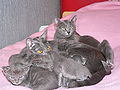
The Korat cat (Thai: โคราช, มาเลศ, สีสวาด, RTGSKhorat, Malet, Si sawat) is a silver-tipped blue-grey, short-haired breed of domestic cat with a small to medium build and a low percentage of body fat. Its body is semi-cobby, and unusually heavy for its size. It is an intelligent and playful[1] active cat that forms strong bonds with people and is very vocal, with a sound different from other breeds. Among the Korat's distinguishing characteristics are its heart-shaped head, its large green eyes.[2] Its front paws are shorter than the back paws.

The Korat is a natural breed, and one of the oldest stable cat breeds, and one of the very few that has not changed its appearance throughout centuries. Originating in Phimai, Thailand, it is named after its province of origin, Nakhon Ratchasima Province (typically called "Korat" by the Thai people).[3] In Thailand, the breed is known as Si sawat, meaning "colour of the sawat seed".[1] The Korat is known colloquially as the "good luck cat".[2] Traditionally, they are given in pairs to newlyweds or people who are highly esteemed, for good luck. Until recently, Korats were not sold, but only given as gifts.[1]

History

[edit]
Korat cat and Siamese cat in Tamra Maew (The Cat-Book Poems) thought to originate from the Ayutthaya Kingdom (1351 to 1767 AD). Over a dozen are now kept in the National Library of Thailand.

The probable first allusion to the breed is in the Thai Tamra Maew (The Cat-Book Poems), authored between 1350 and 1767 CE and now in the National Library of Thailand.[1] However, the illustration of the Korat in this book is not detailed enough to be definitive as to the breed portrayed. In recent years, the Korat was pictured on a postage stamp in Thailand. An example hangs in the city of Korat's post office.

Korats first appeared in Britain under the name "Blue Siamese" in 1889 and 1896, but these solid blue cats did not conform to the cat show judges' perception of a Siamese cat, and they disappeared by 1901. One early import, "Dwina", owned by Russian Blue breeder Mrs. Constance Carew-Cox and mentioned in Frances Simpson's The Book of the Cat (1903), reputedly produced a large number of "Siamese" kittens; the other, Mrs. B. Spearman's Blue Siamese male, "Nam Noi", was disqualified as a Siamese, but accepted in the Russian or Any Other Blue class in which he placed first (WR Hawkins, "Around the Pens", July 1896). Spearman tried unsuccessfully to import more of these "Blue Siamese".[4]

Korats first appeared in the US in the 1950s. In 1959, Cedar Glen cattery was the first to import a pair of Korats to the US for breeding: a male named Nara and a female named Darra.[2] In 1966, the Korat was accepted into championship status, through the efforts of a breeder from Maryland.[2]

Appearance

[edit]

The Korat's unusual colour is actually a silver-tipped blue that appears to shimmer. The Thais refer to this colour as "rain-cloud grey", and the shimmer as "sea foam". This cat has a single coat that is short, with roots of a lighter silver blue. The hair shaft colour increases to deeper blue and the tips are silver, especially on the muzzle and toes. This is the only colour accepted for a Korat. The eyes are large and peridot green in an adult cat, but kittens have muddy, amber or golden-green coloured eyes which gradually change as they become adults, at two to four years.[2]

Although it is rare, Korats occasionally have striking or faint white markings or spots or even very faint grey stripes. Sometimes these spots increase in size with age. These are seen as flaws, and the cats are disqualified from competing in cat shows. However, such markings have no effect on personality or health.

Female korat cat

Thai Lilac, Thai Blue Point and Thai Lilac Point

[edit]

A Thai Lilac Kitten.
Thai Lilac kitten
The first two Thai Lilac Points registered in the U.K.: Clairabelle Pixie Dust (2014) and Clairabelle Ninja Rococoa (2015)

The Governing Council of the Cat Fancy recognizes Korat-type cats differing from the traditional solid blue appearance of the Korat on their experimental register. Such cats are registered as Thai Lilac if they are solid lilac. A Thai Blue Point exhibits the colourpoint pattern also seen in Siamese. A Thai Lilac Point also exhibits the colourpoint pattern also seen in Siamese, but in addition exhibits the Chocolate gene. These should not be confused with the Thai cat, a new name for the original (traditional or classic) Siamese cat type, with a rounder face and thicker body than modern "ultra-typed" Siamese.

The policy for full registration of Korats only allows blue cats of full-registered parents or third-generation supplementary-registered parents.[5] It also requires genetic testing for gangliosidosis to be carried out to ensure that the breed remains free of this inherited disease which once existed in some Korat and Thai breeding lines.

The genes responsible for Pointeds and Lilacs were introduced into the Korat breed when new Korat breeding stock carrying the recessive genes was imported from Thailand. The first recorded Thai Lilac kitten was born to the Jenanca line in 1989, when "Jenanca Lilac Lillee" was born from two Korat parents in the U.K.. In 1990, Lillee's parents were re-mated with more lilac kittens resulting. A young male lilac was then born to another pair, also in the U.K., allowing more crossings without inbreeding too closely.[1]

The first recorded Thai Lilac Point was born to the Clairabelle line in 2014 when Clairabelle Pixie Dust was born from two Korat parents in the U.K.. A re-mating from the same parents resulted in another Thai Lilac Point, this time a boy, Clairabelle Ninja Rococoa. A third and fourth Thai Lilac Point has recently been born into the Jusarka line.

Health

[edit]

The Korat is one of the more commonly affected breeds for gangliosidosis 1 and gangliosidosis 2. An autosomal recessive mutation in the GBL1 and HEXB gene respectively is responsible for the conditions in the breed.[6]

Atherosclerosis conditions, typically never seen in cats, similar to human atherosclerosis, were also seen in Korat cats. A genetic predisposition is assumed rather than an underlying condition or medical treatment for these conditions in the cats.[7]

[edit]
[edit]

See also

[edit]

References

[edit]
[edit]
Revisions and contributorsEdit on WikipediaRead on Wikipedia
from Grokipedia
The Korat, also known as the Si-Sawat in its native , is a rare and ancient of domestic characterized by its distinctive silver-tipped blue-gray short coat, luminous peridot-green eyes, and heart-shaped face. This natural features a medium-sized, muscular, semi-cobby body with a broad chest and firm , typically weighing 6 to 10 pounds, with males slightly larger than females. Renowned for its elegant sheen and single-layered coat that feels plush to the touch, the Korat's appearance has remained largely unchanged for centuries, making it one of the oldest stable in the world. Originating from the Korat Plateau in in northeastern , the breed's history traces back over 600 years to the Ayutthaya Period (1350–1767), where it is depicted in ancient manuscripts like the Tamra Maew (Cat-Book Poems), a collection of Siamese temple illustrations housed in Bangkok's . In Thai culture, the Korat has long been revered as a symbol of good fortune and prosperity, traditionally presented as gifts to brides or on auspicious occasions, and considered a with no permitted to preserve its purity. The breed remained largely unknown outside until the mid-20th century; the first pair, named Nara and Darra, was imported to the in 1959 by cat enthusiast Jean Johnson, leading to its recognition by organizations like The Cat Fanciers' Association (CFA) in 1965. Korats are known for their intelligent, playful, and affectionate personalities, forming strong bonds with their owners while exhibiting a lively curiosity and vocal expressiveness, though they can become withdrawn if left alone for extended periods. Generally healthy with a lifespan of 10 to 15 years, they are prone to few genetic issues but benefit from regular veterinary screening for conditions like and GM2 gangliosidosis, for which DNA tests are available. Care is straightforward, requiring only weekly brushing to maintain their coat's luster, a high-quality diet to support their active nature, and ample interactive play to satisfy their social needs. Today, the Korat remains a cherished but uncommon , valued for its historical significance and devoted companionship.

Origins and History

Ancient Thai Roots

The Korat cat, referred to in as the Si-Sawat or "color of the sawat seed," represents one of the oldest documented natural cat breeds, originating from the , also known as Korat, in northeastern . This region, a high plateau area, is credited as the breed's historical homeland, where the cats developed without significant human intervention due to geographic isolation. The breed's first known documentation appears in the Tamra Maew, or "Cat-Book Poems," a series of ancient Thai manuscripts compiled between 1350 and 1767 CE during the , which describe 23 cat varieties, including the Si-Sawat as one of 17 auspicious "good luck" cats. These texts poetically depict the Korat's distinctive silver-blue coat, likening its body color to that of the Dork Lao fruit, with smooth hairs rooted like clouds and tipped like silver, and eyes shining like dewdrops on a lotus leaf. In Thai culture, the Korat held profound symbolic importance as an emblem of , , and , believed to bring to dry lands and ensure bountiful harvests, with its gray-silver fur evoking rain clouds and vibrant green eyes representing growth and . A crooked tail was particularly revered as a sign of impending wealth. Traditionally, these cats were never sold but gifted as tokens of good fortune, especially pairs presented to brides at weddings to promote marital harmony and , or used in rituals like the Hae Nang Maew ceremony to invoke rainfall. This cultural reverence, rooted in from the Ayutthaya period, underscores the Korat's role in Thai social and spiritual life, where it was cherished as a living rather than a . As a natural breed, the Korat remained largely unchanged for centuries, with no evidence of modern until the , owing to its isolation in rural Thai communities and the protective traditions surrounding it. Even today, the is rare in its native , surviving in small numbers through traditional conservation practices by local breeders, such as those in Phimai, and representing one of only four extant native Thai cat varieties from the original 23 described in historical texts.

Western Introduction and Recognition

The Korat cat made its earliest documented appearance in the West at cat shows in in 1889 and 1896, where it was exhibited under the name "Blue Siamese." However, these solid blue cats did not match judges' expectations for the pointed Siamese breed, leading to confusion and poor reception in competitions. By , the had faded from Western , with no further imports or shows recorded due to this misclassification. The breed's reintroduction to the West occurred in 1959, when Jean L. Johnson of the Cedar Glen Cattery in Oregon, USA, imported the first breeding pair—a brother and sister named Nara and Darra—from Thailand's Korat province. This pair produced the inaugural Korat litter born in America later that year, establishing the foundation stock for North American breeding programs. Formal recognition milestones soon followed in the mid-20th century. The Cat Fanciers' Association (CFA) advanced the Korat to championship status in 1966, allowing it to compete at the highest level in American shows. The International Cat Association (TICA) accepted the breed for registration in the 1970s, recognizing its status as a natural import from Thailand. In the United Kingdom, initial imports arrived in 1972, with the Governing Council of the Cat Fancy (GCCF) registering the breed from that year onward and granting full championship status in 1984. As of 2025, the Korat maintains a small global population of registered cats, reflecting its rarity even outside Thailand and a strong emphasis on preserving its ancient, unaltered traits through selective breeding. Modern trends prioritize health and genetic diversity, including the introduction of a new genetic test for atherosclerosis in 2025 to screen all breeding lines, alongside ongoing ethical imports from Thailand to broaden the limited gene pool without outcrossing.

Physical Characteristics

Body Structure and Build

The Korat is a medium-sized with a semi-cobby build, characterized by a muscular yet elegant physique that conveys power and grace without excess bulk. This structure features well-developed musculature and low body fat, giving the cat a hard, coiled-spring feel despite its refined appearance. Adult Korats typically weigh 6 to 10 pounds (2.7 to 4.5 kg), with males larger than females at 8 to 10+ pounds (3.6 to 4.5+ kg) and females 6 to 8 pounds (2.7 to 3.6 kg); shoulder height is approximately 9 to 13 inches (23 to 33 cm). The head is heart-shaped when viewed from the front, formed by smooth, rounded contours, prominent whisker pads, and a broad that accentuates an alert expression. Large, wide-set ears with rounded tips are set high on the head, contributing to the overall vigilant look, while the profile shows a slight stop and a lion-like curve to the nose. The chin and jaw are strong and well-developed, balancing the facial structure without appearing square or pointed. Body proportions emphasize compactness and strength, with a short, muscular supporting a deep, broad chest and a gently curved back that maintains an equal distance from to tail base and tail base to ground. The legs are medium-boned and well-proportioned, with front legs slightly shorter than the hind ones, ending in strong, rounded paws—five toes on the front and four on the back. The tail is medium in length, slightly shorter than the body, thicker at the base, and tapering to a rounded tip. Sexual dimorphism is evident in the Korat's build, with males displaying broader shoulders, greater overall power, and jowls in maturity, while females appear more graceful and dainty. This dense musculature often makes the cat feel heavier than its visual size suggests, enhancing the impression of solidity. The close-lying coat subtly integrates with this framework, highlighting the underlying muscular contours without adding bulk.

Coat, Color, and Eyes

The Korat's is short, single-layered, and lies close to the body, with a glossy, fine texture that accentuates the breed's muscular form. This lacks an undercoat, allowing the silver-tipped blue hairs—lighter at the roots and darkening to blue before silver tips—to create a uniform, shimmering appearance known as the "Si-Sawat" or rain-cloud color. The texture is soft and resilient, often breaking slightly over the spine during movement, which highlights the cat's compact build. Color standards emphasize an even silver-tipped throughout, with no , tabby markings, or patterns permitted in adults—though faint ghost markings may appear in kittens. Disqualifying faults in shows include any white spots, lockets, or colors other than the prescribed silver-blue, ensuring the coat remains solidly uniform without patterns. The nose leather and lips are dark blue or lavender, while paw pads show dark blue to lavender with a possible pinkish tinge, complementing the overall silvery sheen that may subtly vary in intensity with age but maintains consistency. The eyes are a defining feature, large and luminous with an oval shape when fully open—appearing more rounded and wide-set—or taking on an Asian slant when partially closed. In adults, the preferred color is an intense green, though a slight cast is acceptable; this vivid hue develops gradually, starting as , yellow, or golden-green in kittens and adolescents, and fully maturing between 2 and 4 years of age. Eye color standards are independent of coat coloration, with small or dull eyes considered undesirable.

Breed Variations

Thai Lilac and Point Variants

The Thai Lilac variant of the Korat cat features a solid lilac coat, resulting from the recessive gene (b/b) combined with the breed's characteristic (d/d), producing a warm pinkish-beige tone with silver tipping. This genetic combination traces back to recessive traits carried in original Thai imports, where the chocolate was present alongside the dilution already fixed in the Korat lineage. The first documented Thai Lilac kitten, Jenanca Lilac Lillee, was born in 1989 in the United Kingdom to two blue Korat parents, Ch Aerostar Yin Dee and Hibreeze Hurricane, confirming the recessiveness through subsequent test breedings that yielded a 3:1 blue-to-lilac ratio. Further evidence emerged in 1996 when lilac kittens appeared from newly imported Thai Korats, solidifying the variant's origin in authentic stock rather than . Thai Blue Point and Thai Lilac Point variants exhibit the colorpoint pattern, with darker pigmentation restricted to cooler body areas such as the ears, face, paws, and tail, due to the recessive colorpoint gene (/). For the Thai Blue Point, this combines the standard Korat's black-based dilute blue (a/a d/d) with /, creating a pale body contrasting with blue-gray points; pointed kittens have sporadically appeared since the earliest Western imports, including litters in the United States in 1959 and the in 1972, stemming from the widespread carriage of the cs in Thai Korats. The Thai Lilac Point, a rarer combination of b/b d/d /, has not yet been reported but is genetically feasible from dual-recessive carriers. These patterns emerged through breeding in the to as recessive genes from Thai stock surfaced, with initial pointed occurrences often linked to historical Siamese-Korat matings in . These variants remain rare, comprising less than 10% of Korat-related registrations, due to their recessive nature requiring both parents to carry the genes. In the , the Governing Council of the Cat Fancy (GCCF) granted preliminary recognition to Thai Lilac and Thai Blue Point as distinct breeds in 2002, advancing to provisional status in 2008, though they are shown separately from standard blue Korats. However, not all organizations accept them as pure Korats; for instance, the Cat Fanciers' Association (CFA) restricts the Korat to blue only, excluding lilac and pointed forms.

Breeding and Registration Standards

Breeding Korat cats emphasizes preserving the breed's silver-blue , heart-shaped head, and muscular build while maintaining genetic purity as a natural Thai breed. Major registries such as the Cat Fanciers' Association (CFA), (TICA), and the Governing Council of the Cat Fancy (GCCF) prohibit outcrossing to other breeds to uphold this heritage, with allowable outcrosses listed as none in CFA standards. Breeders aim to avoid by calculating coefficients over 5-8 generations and limiting close matings, such as granddaughter-to-grandfather pairings, to promote in the breed's relatively small global . For full Korat registration, CFA, TICA, and GCCF require a uniform silver-tipped blue coat with no other colors or markings in adults, disqualifying any deviations like white spots or tabby patterns. Only blue kittens from blue Korat parents qualify for Korat status, with three generations of documented Korat ancestry needed for full GCCF registration as Korat (KOR). Variants such as Thai Lilac or pointed cats, which carry recessive genes from Korat lineage, must provide genetic proof via DNA testing for Korat-related markers to register under separate categories like Thai, ensuring traceability to pure Korat lines without allowing mixed breeding. Recent updates in 2024–2025 have expanded mandates across registries, with GCCF requiring all Korats and Thais on the Active Register to undergo DNA testing for and GM2 gangliosidosis starting May 2025, including microchip-verified samples from accredited labs. This follows the availability of a new comprehensive genetic test in 2025 to clear all breeding lines of , which affects over 30% of untested Korats worldwide. To address the small , breeders are encouraged to import cats from for diversification, sharing males widely and avoiding overuse of popular sires, as UC Davis studies rank Korat moderately among breeds but highlight risks from limited numbers. Ethical practices prioritize health over quantity, with Western breeders mandating clearances for gangliosidosis and other defects like flat-chested kittens before breeding. In , Korats are traditionally not commercially bred or sold but gifted as symbols of , preserving their cultural status as Si-Sawat cats raised without selective pressures. Litters typically average 1–3 kittens, reflecting the breed's low fertility and emphasis on quality placements.

Temperament and Care

Personality and Behavior

The Korat cat is renowned for its affectionate and loyal temperament, forming deep, devoted bonds with its owners that often manifest as a strong preference for one primary person while remaining adaptable to family settings. These cats exhibit unwavering loyalty, frequently shadowing their humans throughout the day and seeking physical closeness, such as curling up on laps or following from room to room. Their affectionate nature makes them excellent companions, though they thrive on attention and may become withdrawn or jealous if ignored or left alone for extended periods. In terms of activity level, Korats are playful and energetic, particularly during their younger years, displaying bursts of high-speed activity like racing through the house or pouncing on with relentless enthusiasm. This energy is complemented by their , as they excel as problem-solvers, enjoying interactive , puzzles, and even learning tricks such as fetching, which keeps them mentally stimulated and engaged. Their agility enhances these playful pursuits, allowing them to climb high perches or navigate obstacles with ease. Korats are notably vocal, using a distinctive range of melodic meows, chirps, and trills to communicate needs or express emotions, often in a clear and insistent manner reminiscent of Siamese cats. They tend to be sensitive to changes in their household environment, potentially becoming shy or aloof around strangers, and may vocalize caution or seek reassurance from their owners in unfamiliar situations. Regarding compatibility, Korats generally interact well with respectful children, approaching play gently and patiently, and they can coexist with calm dogs if properly socialized, though they may assert dominance over other pets. They prefer quieter, stable environments over chaotic ones, where their sensitive nature allows them to flourish without undue stress.

Daily Care and Grooming

Korats require minimal grooming due to their short, single-layered that sheds lightly and maintains its natural sheen with little effort. Weekly with a soft brush is sufficient to remove loose hair and distribute skin oils, particularly during summer months, while every other week suffices in winter. Bathing is rarely necessary, as these cats are fastidious self-groomers, but monthly ear checks for wax buildup and gentle cleaning with a vet-approved solution help prevent infections. Nail trims every 2-4 weeks and occasional with feline support overall . A is essential for Korats to support their muscular build and active lifestyle, as they are carnivores requiring animal-based proteins for optimal . Feed a balanced commercial formulated for adults, combining quality dry kibble with wet canned options to ensure hydration and variety; Korats are not picky eaters but benefit from portion control to avoid . An average adult Korat needs 200-300 kcal daily, adjusted for activity level—lower for sedentary indoors cats and higher for playful ones—to maintain ideal weight. Always provide fresh, clean daily, ideally via a circulating to encourage intake. Korats thrive in an indoor environment, which protects them from outdoor hazards and aligns with their curious yet home-loving nature, potentially extending their lifespan. Their playful disposition necessitates climbing structures, such as cat trees or shelves, and sturdy scratching posts to satisfy natural instincts for vertical space and claw maintenance. Litter training is straightforward for this intelligent breed, with most adapting easily to a clean box filled with fine-clay clumping litter for comfort and odor control. With proper care, Korats have a lifespan of 15 years or more, with many reaching beyond 20 years when kept indoors and well-maintained. Spaying or is strongly recommended by age 5-6 months to prevent health issues like uterine infections or and to curb unwanted behaviors. Annual veterinary checkups are advised starting at age 7 for early detection of age-related concerns in seniors, including blood work to monitor overall wellness.

Health and Genetics

Common Health Concerns

The Korat cat breed is susceptible to and GM2 gangliosidosis, both autosomal recessive lysosomal storage disorders caused by deficiencies in specific enzymes leading to the accumulation of gangliosides in neural tissues. These conditions manifest with progressive neurological symptoms, including , head and limb tremors, , and loss of coordination, typically onsetting between 2 and 6 months of age. Disease progression is more rapid in GM2 than , resulting in severe debilitation and premature death or by around 1 to 2 years of age if untreated. Korats also exhibit a to atherosclerosis, stemming from a homozygous in the low-density lipoprotein receptor (LDLR) gene, which impairs regulation and promotes vascular plaque buildup. This rare condition, first detailed in studies from 2021 and expanded in 2024–2025 research, primarily affects senior cats and presents with symptoms such as , weakness, elevated levels, and clinical signs of like dyspnea. Heterozygous carriers remain and normolipidemic. In addition to these breed-specific genetic concerns, Korats face general vulnerabilities common to felines, including dental issues from plaque accumulation that can lead to , , and oral pain. Obesity poses a risk, particularly in sedentary indoor environments, contributing to joint strain, , and reduced mobility. Urinary tract infections represent another standard concern, often presenting with straining, , or , exacerbated by factors like or stress. Recent genetic screening data indicate low incidence rates for gangliosidosis in tested breeding lines owing to selective breeding practices, though rates may be higher in certain color variants or untested populations. Atherosclerosis remains exceptionally rare, confined to specific familial lines with the LDLR mutation.

Genetic Testing and Prevention

Genetic testing for Korat cats primarily focuses on identifying carriers of recessive mutations associated with gangliosidosis, a lysosomal storage disorder prevalent in the breed. DNA tests target the GLB1 gene for GM1 gangliosidosis and the HEXB gene for GM2 gangliosidosis, enabling breeders to distinguish affected, carrier, and clear individuals without invasive procedures. These tests, available through veterinary genetics laboratories, have become integral to breeding programs since their development in the late 1990s, with expanded accessibility in recent years. In the , the Governing Council of the Cat Fancy (GCCF) has emphasized comprehensive testing since 1998, when UK breeding lines were screened and confirmed clear for GM1 and GM2 mutations; all registered Korats since then have tested clear or descend from clear parents. The Cat Fanciers' Association (CFA) and (TICA) recommend DNA testing for GM1 and GM2 in all breeding stock to ensure health documentation accompanies kittens. Variant-specific tests for genes influencing coat dilution, such as the MLPH locus, are also utilized to maintain the breed's characteristic blue coloration and prevent unintended colorpoint expressions in related Thai variants. Prevention strategies center on carrier screening to eliminate matings that could produce affected offspring, significantly reducing disease incidence through . In registered populations, particularly under GCCF oversight, all lines are confirmed clear for and GM2 mutations, building on early testing efforts from that verified stock as unaffected. This approach has preserved the breed's limited while minimizing hereditary risks, with breeders advised to pair only clear or tested carriers under veterinary guidance. Broader health management incorporates routine preventive measures tailored to Korat vulnerabilities. Core vaccinations against feline panleukopenia and calicivirus are essential, typically administered as part of the FVRCP combination starting at 6-8 weeks of age, to protect against these highly contagious infections common in all cats. Annual dental cleanings under help mitigate , a standard concern in shorthaired breeds like the Korat. For early detection of —a recently identified in the breed—annual bloodwork monitoring levels and cardiac biomarkers is advised, allowing intervention before clinical develops. Advancements in 2025 have expanded genetic panels to include screening for LDLR gene mutations linked to and hypercholesterolemia, providing breeders with tools to identify carriers and avert disease transmission; approximately one in five Korats may carry the mutation asymptomatically. Breeder databases, such as those supported by GCCF policies and international genetic repositories, facilitate mate matching to enhance , countering while upholding breed standards. These resources promote , with screened Korats often achieving 12-15 years of healthy life when combined with vigilant care.

Cultural and Modern Significance

Role in Thai Tradition

In Thai culture, the Korat cat, known locally as Si-sawat, holds profound symbolic significance as a harbinger of good fortune and prosperity. The name Si-sawat derives from the silvery-blue hue of the cat's coat, reminiscent of the sawat seed and evoking the luster of silver, a traditional emblem of wealth in Thai . This association with affluence extends to matrimonial customs, where a pair of Korats is customarily gifted to brides and grooms to symbolize enduring prosperity and harmonious unions, underscoring the 's role in fostering familial blessings. Historically, Korats have been integral to Thai ceremonial and elite practices, appearing in royal courts and temple settings as cherished companions valued for their auspicious presence. Documented in ancient manuscripts such as the Tamra Maew (Cat-Book Poems) from the era (1350–1767), the breed was among 17 "good luck" cats celebrated for their ability to bring harmony and protect against misfortune. Export of Korats from was restricted until the late 1950s, when the first breeding pairs were permitted abroad, reflecting the government's efforts to preserve this cultural icon; even today, such exports remain tightly controlled to maintain the breed's integrity. In festivals like Hae Nang Maew, Korats feature in symbolic rituals where villagers parade with them to pray for rain and agricultural abundance, aligning with broader Thai traditions of invoking feline guardians for communal well-being. Folklore surrounding the Korat portrays it as a protector against malevolent forces and a facilitator of agricultural bounty, with its rain-cloud-colored coat and emerald eyes believed to summon favorable weather for crops. Stories in the Tamra Maew link the breed to mythical origins, depicting it as a divine creation destined to ward off evil and ensure household serenity, a that has persisted in rural Thai narratives. In contemporary , the Korat is designated a by the government, with breeding overseen to preserve pure lineages and prevent over-commercialization, ensuring the cats' welfare and cultural authenticity. The breed remains scarce domestically, with most individuals concentrated in rural regions where traditional reverence endures. This status reinforces the Korat's enduring emblematic role in Thai identity, blending ancient reverence with modern conservation.

Presence in Media and Society

The Korat cat has appeared in Western publications on feline s since the , as the breed gained traction among international fanciers following its importation to the in 1959. Early mentions emphasized its distinctive silver-blue coat and heart-shaped head, positioning it as a rare natural breed with unchanged morphology over centuries. These descriptions in breed standards and association literature helped establish the Korat's reputation for elegance and purity outside . In contemporary society, Korats maintain a niche but admired presence, often celebrated for their rarity—even in their native —and sophisticated appearance that evokes a of mystery and refinement. Their affectionate , marked by strong bonds with owners and playful , has contributed to their valued role as companions. preservation efforts underscore the Korat's societal impact, with the Korat Cat Fanciers Association, founded in 1965, advocating for ethical standards and genetic integrity to protect the from overbreeding. In 2025, a genetic test for became available, with breeders testing lines to maintain health-focused breeding amid increasing demand for this elusive . These campaigns highlight the Korat's role as a symbol of responsible pet ownership and in modern contexts.

References

Add your contribution
Related Hubs
User Avatar
No comments yet.