Hubbry Logo
PlocktonPlocktonMain
Open search
Plockton
Community hub
Plockton
logo
8 pages, 0 posts
0 subscribers
Be the first to start a discussion here.
Plockton
Plockton
from Wikipedia

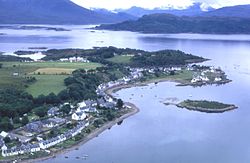
Plockton (Scottish Gaelic: Am Ploc/Ploc Loch Aillse) is a village in the Lochalsh, Wester Ross area of the Scottish Highlands with a 2020 population of 468.[2] Plockton settlement is on the shores of Loch Carron. It faces east, away from the prevailing winds; this, together with the North Atlantic Drift, gives it a mild climate despite the far-north latitude, allowing the Cordyline australis cabbage tree to prosper.

Key Information

History

[edit]

Plockton was established as a planned fishing village on the northern edge of the Lochalsh, built "when introducing sheep farming in 1814-20 and removing the population from their old hamlets in Glen Garron, founded the villages of Jeantown and Plockton on Loch Carronside" (Geddes: 1945, pp38).[full citation needed]

A local laird transformed the community into a prosperous fishery, and in the process, funded the planned village. Most of the houses date from the nineteenth and twentieth centuries.

Some maritime charts, including MacKenzie (1776) and Heather (1804), mark the peninsula where the village sits as 'Plack'; however, it is generally considered that the village was built on the 'Ploc' of Lochalsh, with 'Ploc' being understood in Gaelic as pimple or bump (of Lochalsh). This usage is shared with other places such as the Plock of Kyle and Plocrapool on the Isle of Harris. Until the end of the eighteenth century, the fishing hamlet, as it was then, was known as Am Ploc (meaning 'blunt promontory' in Gaelic).[3] The ‘-ton’ (from 'town') was added to designate it as such in the English language, following the construction of the planned village around 1800.

Facilities

[edit]

The village has a small general store with a café; a takeaway; a restaurant; newsagent and craft shop; three hotels with pubs; numerous B&Bs; library with free internet access and a village hall, which holds community events and art exhibitions. The Church of Scotland house of worship in the village, also used by the Free Church of Scotland, was designed by Thomas Telford.[4] The village is served by Plockton railway station, on the Kyle of Lochalsh Line, and the short Plockton Airfield, operated by the Highland Council,[5] is for light aircraft and microlights.

Nearby is Duncraig Castle, a nineteenth-century stately home built by the Matheson family. The castle was derelict for many years, having had a variety of commercial uses.

Plockton has been a popular location for many artists including those from The Edinburgh School (Adam Bruce Thomson, David Macbeth Sutherland) and continues to attract artists.[6]

Geography and tourism

[edit]
The mild climate permits cultivation of palm-like cabbage trees

Situated on a sheltered inlet of Loch Carron, and due to the series of New Zealand cabbage trees which have dominated Harbour Street since the 1960s, Plockton has been described as having a distinctive "sub-tropical appearance".[7] Most of the land around Plockton is within the Balmacara Estate, owned by the National Trust for Scotland.

Plockton lies about 10km (6miles) northeast of Kyle of Lochalsh, and is reached by road along single-track roads that go between Kyle of Lochalsh on the A87, and Achmore on the A890.

The village is a tourist resort, often having many tourists and day-trippers in peak season. It has been deemed "arguably the prettiest village in the highlands".[8] The television series Hamish Macbeth, starring Robert Carlyle, was filmed there, substituting for the fictional Lochdubh.[9] Plockton was also used for various scenes in the film The Wicker Man[10] and the Inspector Alleyn Mysteries television series.[11][12]

Education

[edit]
Plockton High School in the village

Plockton is home to Sgoil Chiùil na Gàidhealtachd - the National Centre For Excellence in Traditional Music at Plockton High School, which also serves the village and a wide surrounding area. The school also hosts the Am Bàta project, teaching pupils in the art of boat building, from which a number of 'local' style boats have been produced. Some have been donated to the local sailing club - Plockton Small Boat Sailing Club - whilst others have been sold to the public. Plockton was home between 1956 and 1972 to the Gaelic scholar Sorley MacLean,[13] (Somhairle MacGill-Eain) whilst headmaster at the high school, who introduced the teaching of Gaelic and championed shinty.

Since 1991 Plockton Primary School has accommodated a Gaelic-medium education unit (GMU), where instruction is through the medium of Gaelic. 24.4% of the population in the catchment area of Plockton Primary School reports being able to speak Gaelic – the highest incidence of Gaelic-speaking on the mainland of Scotland.[14]

Football club

[edit]

From 1954 the village played host to Plockton Amateur Football Club. However, from 2016, the club has been in abeyance. Plockton FC played at the Alasdair Ross Memorial Park and competed in yellow and black strips - reflected in their "Bumble Bees" nickname. They were formerly members of the West Highland Amateur Football Association.

Media

[edit]

Climate

[edit]

The Met Office operates a weather station at Plockton,[15] for which 30 year averages are available. As with the rest of the British Isles, Plockton experiences a maritime climate with cool summers and mild winters. The highest temperature was 27.7 °C recorded on 9 May 2016, and the lowest was –9.8 °C.

Climate data for Duirinish-Plockton, 18m asl, (average highs and lows 1971-2000)
Month Jan Feb Mar Apr May Jun Jul Aug Sep Oct Nov Dec Year
Record high °C (°F) 14.9
(58.8)
11.3
(52.3)
17.9
(64.2)
18.9
(66.0)
27.7
(81.9)
20.8
(69.4)
22.1
(71.8)
22.1
(71.8)
19.6
(67.3)
15.9
(60.6)
12.3
(54.1)
17.2
(63.0)
29.4
(84.9)
Mean daily maximum °C (°F) 7.2
(45.0)
7.5
(45.5)
8.9
(48.0)
11.2
(52.2)
14.7
(58.5)
16.2
(61.2)
17.7
(63.9)
17.5
(63.5)
15.2
(59.4)
12.5
(54.5)
9.4
(48.9)
7.7
(45.9)
12.1
(53.9)
Mean daily minimum °C (°F) 2.0
(35.6)
2.1
(35.8)
2.9
(37.2)
4.1
(39.4)
6.4
(43.5)
8.7
(47.7)
10.8
(51.4)
10.7
(51.3)
8.9
(48.0)
6.9
(44.4)
4.1
(39.4)
2.7
(36.9)
5.9
(42.5)
Record low °C (°F) −8.3
(17.1)
−7.3
(18.9)
−8.2
(17.2)
−9.8
(14.4)
−9.3
(15.3)
−5.5
(22.1)
1.8
(35.2)
−3.0
(26.6)
−5.0
(23.0)
−5.5
(22.1)
−8.2
(17.2)
−9.4
(15.1)
−9.8
(14.4)
Source 1: 1971-2000 averages[16]
Source 2: Met Office and Voodoo Skies[17][18][19]

See also

[edit]

References

[edit]
[edit]
Revisions and contributorsEdit on WikipediaRead on Wikipedia
from Grokipedia
Plockton is a small coastal village in the Lochalsh area of Wester Ross, within the Highland council area of Scotland, situated on the sheltered shores of Loch Carron. Established as a planned fishing settlement in the early 19th century by landowner Sir Hugh Innes to capitalize on herring shoals and house cleared tenants, the village grew to over 500 residents by the mid-1840s amid the herring boom. Its defining features include colorful waterfront cottages, a scenic harbor, and a mild microclimate influenced by the Gulf Stream, enabling the growth of subtropical palm trees unusual for the Scottish Highlands. Plockton has gained recognition as a filming location for the BBC series Hamish Macbeth, portraying the fictional Lochdubh, and scenes in the 1973 film The Wicker Man.

Geography and Environment

Location and Topography

Plockton is located in the Wester Ross region of Ross-shire, Highland, Scotland, on the northern shore of Loch Carron, a sea loch extending inland from the Inner Sound. The village sits approximately 7 miles (11 km) northwest of Kyle of Lochalsh along the A87 road, positioned at coordinates 57°20′17″N 5°39′08″W. The features a sheltered that forms the village's harbor, surrounded by steep slopes and a hilly rising to elevations over , characteristic of the ' rugged . This includes coastal islets and inland features shaped by ancient geological processes, including rocks such as Lewisian and Torridonian prevalent in the . From the , vistas extend southward across Loch Carron to the Applecross Peninsula and, weather permitting, northwest to the Isle of Skye. Adjacent to Plockton lies the Balmacara Estate, a 2,500-hectare property managed by the National Trust for Scotland, encompassing crofting townships, woodlands, and moorland that integrate with the village's coastal setting.

Climate and Unique Flora

Plockton's climate is characterized by a mild oceanic regime, moderated by the North Atlantic Drift extension of the Gulf Stream, which delivers warmer waters to the northwest Scottish coast and elevates local temperatures above expectations for 57°N latitude. Annual average temperatures reach 8.0 °C, with January daytime highs averaging 6.9 °C and nighttime lows of 1.8 °C, contrasting with colder inland Highland averages that often dip below freezing in winter. This results in infrequent severe frosts and limited snow accumulation, with only 9.4 snowfall days per year and 52 mm total snow depth, enabling extended growing seasons that span much of the year compared to the shorter, frost-prone periods in eastern or upland Scotland. Precipitation totals approximately 1,959–2,169 annually, distributed over about 214 days, primarily as rather than due to tempered winter conditions, though westerly can amplify exposure along the . Summer highs average 17 °C in , supporting prolonged daylight and moderate without the extreme or of continental climates at similar latitudes. These factors distinguish Plockton's from the broader Highland norm of harsher, more variable with greater snowfall and incidence inland. This ameliorated environment fosters unique flora atypical for the region, including subtropical species like Phoenix canariensis (Canary Island date palm), which thrive in Plockton's sheltered bays and gardens without routine winter protection, despite requiring USDA zones 9–11 elsewhere. Palms and other tender exotics, such as cordylines and tree ferns, have established self-sustaining populations since introductions in the 20th century, benefiting from minimal frost damage and the Gulf Stream's thermal influence that parallels Mediterranean conditions. Local records indicate these plants endure occasional dips to -6 °C or below with frond resilience, underscoring the microclimate's efficacy in sustaining biodiversity beyond native Highland species like heather and Scots pine.

History

Early Settlement and Highland Clearances

The area around modern Plockton, originally known as Am Ploc, consisted of sparse crofting and fishing communities prior to 1800, situated within the parish of Lochalsh in traditional clan territories dominated by the Mackenzies of Kintail. These small-scale settlements relied on subsistence agriculture, pastoralism with cattle, and seasonal coastal fishing, reflecting the pre-commercial clan economy where land tenure was tied to kinship obligations rather than individualized profit. Archaeological and historical records indicate limited permanent habitation, with populations numbering in the low hundreds across broader Lochalsh, constrained by the rugged terrain and infertile soils unsuitable for intensive farming. The Highland Clearances, spanning the late 18th to early 19th centuries, profoundly altered this pattern in Lochalsh, as landowners shifted inland holdings from traditional tenancy to large-scale sheep farming for wool export, driven by surging demand amid Britain's industrialization and post-Culloden commercialization of estates. Estate records from Mackenzie proprietors document the eviction of tenants from fertile straths to consolidate land for Cheviot and Blackface sheep, which yielded higher returns—wool prices rose over 300% between 1790 and 1810—amid population pressures from improved survival rates and failed potato crops that strained subsistence systems. This rational reconfiguration prioritized commercial viability over communal tenure, verifiable through factors' ledgers showing sheep stock increases correlating with tenant removals, though it inflicted immediate destitution on displaced families via inadequate coastal allotments lacking arable soil. In Plockton's vicinity, clearances funneled crofters toward the shoreline, fostering nucleated coastal townships as a mitigation strategy, with resettlement policies aiming to sustain populations through while freeing interior for . This causal link—displacement sheep profitability—underpinned the area's transition without village , as interim holdings proved marginal, setting preconditions for structured development amid ongoing agrarian pressures. Historical accounts from the period, including Seaforth estate correspondence, confirm over 20% of Lochalsh tenancies cleared by 1820, underscoring the economic over humanitarian concerns.

19th-Century Planned Village Development

Plockton was developed as a planned in the late 18th and early 19th centuries, primarily to provide alternative livelihoods for tenants displaced by the , shifting the local toward maritime activities like . The settlement was reorganized and laid out as a modern village around , with structured to accommodate cleared crofters productively on the shoreline. Landowner Sir Hugh Innes advanced this initiative around 1808 by constructing homes for the displaced, leasing them for 99 years to incentivize settlement and engagement in the burgeoning west coast fisheries. The village's layout featured grid-like to the harbor, surveyed by . Cumming in the early 1800s to optimize access to Carron for fleets. contributed designs for key , including the Plockton , Duirinish Bridge, and residential structures, aligning with broader Highland efforts. A dedicated harbor was constructed to support vessel operations, with emerging alongside curing and exporting , capitalizing on seasonal booms that drew labor and . Population expansion reflected the industry's viability, with the village reaching 547 by the mid-1840s, driven by peak catches in the 1820s and 1830s that sustained before later declines. Parish-level from Lochalsh, encompassing Plockton, showed growth from 1,606 in 1801 to 2,433 by 1831, underscoring the broader regional pull of fisheries amid agricultural displacement. This development positioned Plockton as a model of post-Clearance , prioritizing coastal over inland .

20th- and 21st-Century Evolution

Following the decline of the herring industry in the mid-20th century, which had previously supported Plockton's economy alongside crofting, local fishermen transitioned to landing white fish, though the overall fishing sector continued to diminish throughout the century, necessitating economic diversification into other activities. Post-World War II infrastructure enhancements improved connectivity, with the reconstruction of the A87 trunk road from Invergarry to Kyle of Lochalsh—completed in stages during the 1960s—facilitating better access to Plockton via upgraded single-track roads linking the village to this main artery. These developments aided the stabilization of the local population, which stood at 378 according to 2001 census figures, reflecting a plateau after earlier fluctuations tied to fishing fortunes. In the 21st century, community-led initiatives have further shaped Plockton's evolution, exemplified by the Plockton & District Community Trust, a Scottish Charitable Incorporated Organisation established to advance local development, heritage, and recreational facilities through resident-controlled projects. The trust has managed assets such as safeguarding the Old Post Office for community use in 2024, underscoring a shift toward self-governance in sustaining the village amid broader Highland economic pressures.

Demographics and Community

The of Plockton has remained relatively at around in recent estimates from profiles. This figure aligns with postcode-level from the 2011 for the IV52 encompassing the village, which recorded 385 usual . Historical indicate growth during the , reaching over 500 inhabitants by 1841 to resettlement patterns following , before stabilizing at lower levels through the , such as 378 in 2004. Demographic composition is predominantly ethnic Scottish, reflecting broader patterns in the , and Lochalsh area where 98.7% of the identifies as . Gaelic speakers represent a notable minority, with 24.4% of the population in the Plockton catchment able to speak the , the highest rate in mainland . Like many rural Highland communities, Plockton exhibits an aging structure, with low birth rates and net out-migration of young seeking opportunities elsewhere in . This trend contributes to stability rather than decline, sustained by limited in-migration of retirees and remote workers amid broader rural depopulation pressures.

Housing Challenges and Second Homes

In Plockton, approximately one-third to half of dwellings function as second homes, holiday lets, or remain unoccupied for significant periods, reducing the pool of housing available for permanent residents. This scarcity exacerbates affordability challenges, with 90% of surveyed locals reporting that community members cannot afford to purchase properties in the area, particularly affecting young families and contributing to depopulation trends. Recent sales data illustrate elevated prices, including a semi-detached home at £315,000 in July 2024, a terraced property at £480,000 in May 2024, and a detached house at £525,000, with many transactions exceeding £250,000, far outpacing local wages. To address these pressures, Plockton and District Community Trust initiated consultations in April 2024 on designating the village as a short-term let control area, which would require planning permission for new holiday lets to prioritize long-term residency. Local residents emphasize an affordability crisis, noting limited private long-term rentals (around 5%) and empty properties dominating streets like Harbour Street during off-seasons. Second home owners and industry advocates counter that such measures infringe on property rights and revenue generation, arguing that market demand from tourism—rather than owners—drives scarcity, and that restrictions could deter investment without expanding supply. While second homes intensify local shortages through basic supply-demand dynamics, they also sustain employment in tourism-dependent services, with owners funding property upkeep that benefits the village aesthetic. Claims likening the situation to historical —forced evictions for —overstate parallels, as current patterns reflect voluntary purchases amid high external demand, not coercive displacement, though emotive from some councillors highlights community frustrations. underscores the need for targeted supply increases, such as affordable units, over punitive controls alone to balance resident needs with economic inflows.

Economy and Infrastructure

Traditional and Modern Industries

Plockton's economy historically centered on , particularly the industry, which drove its development as a planned village established in to support the sector's expansion. By the mid-19th century, had become the of , with schooners trading catches to areas like the Clyde; indicate reached £7,000 in value by 1900. The completion of the railway extension to Kyle of Lochalsh in 1898 further enhanced the trade by enabling efficient transport of and whitefish, reducing reliance on longer sea routes across Loch Carron. Crofting supplemented incomes after land reforms in 1888, sustaining the population, which peaked at around 547 residents in the mid-1840s amid these activities. The decline of large-scale herring fishing in the 20th century, amid broader shifts in Scotland's fisheries due to overexploitation and changing markets, led to a pivot toward smaller-scale pursuits and service-oriented industries. Today, residual fishing includes small-boat operations for whitefish and leisure-related boating, while crafts such as artisanal work support local studios and galleries. Aquaculture, though prominent in broader Highland coastal economies, does not feature prominently in Plockton-specific data, with employment leaning instead toward tourism-driven hospitality. Modern economic reliance falls heavily on , which expanded from the mid-1960s with improved roads, communications, and media exposure, fostering jobs in hotels, restaurants serving , and events like the annual sailing regatta. The harbor now accommodates yachts and supports activities such as seal-watching trips and , contributing to seasonal employment in visitor services. Enhanced infrastructure, including road links to Inverness approximately 120 km away, enables some commuting for roles, alongside opportunities bolstered by access, though precise local employment figures remain limited; hospitality vacancies, such as those at the Plockton Inn offering up to £30,000 annually, underscore the sector's ongoing .

Facilities and Amenities

Plockton Harbour serves as a key facility for boating, supporting moorings for fishing vessels and recreational activities including trips, , and seal watching. The harbor is managed through efforts, with the Plockton Harbour CIC addressing needs such as improved facilities for fishermen on adjacent . The village maintains a small number of retail outlets, including Plockton Stores for groceries and a community-operated shop in the former post office on Harbour Street, which stocks local products and knitting supplies. In 2024, the Plockton & District Community Trust secured the old post office building to preserve its role as a community retail space. Public houses include the Plockton Hotel, offering a bar and restaurant with local seafood and Highland fare, and the Plockton Inn, providing a traditional pub setting. The Plockton Village Hall functions as the primary community venue, equipped for meetings, social events, sports activities, and temporary markets or pop-up shops, with configurable spaces accommodating various group sizes. Healthcare services for residents are provided by the Kyle Medical Practice in Kyle of Lochalsh, approximately 8 kilometers away, handling general practitioner consultations and clinics. Emergency and specialist care requires travel to facilities such as Broadford Hospital on Skye or Raigmore Hospital in Inverness. Transportation links include regular buses from Plockton to , a journey of about 13 minutes, to the Kyle Line for services to . coaches arrive at Kyle from , , and Fort William. initiatives, such as services to Kyle operated by trusts, supplement options at a cost of £1 per trip.

Education and Youth

Schools and Educational Institutions

Plockton Primary School and Plockton High School operate as a combined 3-18 campus under Highland Council, serving the Lochalsh area with from nursery through secondary levels. The primary school delivers instruction in both English and Gaelic mediums, featuring dedicated Gaelic classes for pupils from P1 to P7 and a Gaelic-medium nursery with 16 places. Plockton High School enrolls secondary pupils drawn from surrounding rural communities, recording 215 students in the 2024-25 session. Gaelic language and culture receive strong promotion, including separate classes for Gaelic-medium pupils and integration into broader curriculum elements like media skills and career education. The school's offerings extend to unique local projects, such as boatbuilding for senior students, reflecting the coastal environment. The curriculum incorporates outdoor activities to support pupil wellbeing and leverage the Highland setting, with sports and environmental engagements embedded in primary and secondary programs. Exam performance data, including SQA results and leaver destinations, are published annually in school handbooks, contributing to Highland-wide trends where National 5 A-C pass rates reached 76.4% in 2025, up from prior years. Recruiting teachers to remote Highland schools like Plockton faces ongoing challenges due to high vacancy rates across the , prompting Highland Council initiatives such as support and targeted rural drives to attract and retain staff.

Sports and

Football Club

Plockton Football Club is an club representing the village of Plockton in the West Highland Amateur (WHAFA), which organizes competitions for teams in Skye, Lochalsh, and . The club fields teams in local such as the Wilson League, with recorded participation including a 3–2 home victory over Glenelg on 23 April 2016. Established in the mid-20th century, the club has historically drawn players from the local community, including youth participants, and maintains a focus on grassroots involvement rather than professional competition. Its home matches are played on pitches within the village, supporting recreational play amid Plockton's small population. The club has occasionally featured in regional discussions, such as a 1995 match against Bernisdale where Plockton players walked off the pitch in protest against opponents' bad language. Youth development remains a key aspect, with notable progression of local talent; for instance, in March 2025, 17-year-old Bodhan Campbell from Plockton signed a two-year professional contract with Highland League side Buckie Thistle following strong performances in the Under-18 Highland League and Scottish Cup. Recent community engagement includes radio discussions on team activities as of October 2025, underscoring ongoing local interest despite the amateur status and limited documented achievements.

Other Recreational Activities

Plockton residents and visitors engage in sailing through the Plockton Small Boat Sailing Club, which runs a competitive racing program from April to September using traditional local boats, dinghies, and yachts, alongside training sessions open to all skill levels. The club's activities leverage the sheltered waters of Loch Carron, fostering community involvement in both racing and social events. Hillwalking draws on the village's proximity to rugged , with established trails starting from Plockton leading into the surrounding hills and to the Balmacara Estate, a encompassing acres of and coastal paths suitable for varying fitness levels. These routes, including moderate ascents with views over Duich, support local but require of general Highland hazards like sudden changes, as evidenced by broader regional police advisories on hill following multiple incidents in 2023. AllTrails documents at least five maintained paths in the immediate area, with user ratings averaging 4.4 out of 5 for accessibility and scenery. Other pursuits include sea kayaking and stand-up paddleboarding around nearby islets and Eilean Donan Castle, offered through local operators emphasizing guided tours for safety in tidal waters. At Plockton High School, extra-curricular programs encourage broad participation to build responsibility, with the 2022/23 standards report noting sustained efforts to involve pupils in non-academic activities amid a student body of approximately 200. An Active Schools coordinator supports community-wide access to these options, integrating them with school initiatives for youth engagement.

Culture and Media

Representation in Film and Television

Plockton served as the primary filming location for the fictional village of Lochdubh in the television series , which aired three series from 1995 to May 1997 and starred as the unconventional . Exterior shots captured the village's sheltered , whitewashed cottages, and surrounding hills, emphasizing its idyllic Highland character central to the series' mystery-comedy plots. In the 1973 British horror film The Wicker Man, directed by Robin Hardy, Plockton's harbour and seafront featured in opening sequences and additional scenes representing the pagan island of Summerisle, including the seaplane arrival of police sergeant Neil Howie (Edward Woodward). Filming occurred in 1972, with local extras and structures like the causeway providing authentic coastal backdrops despite the production's primary locations being in southwest Scotland. Other productions include scenes from the 2007 film Mister Lonely, directed by , which utilized Plockton's picturesque setting for elements involving impersonators, and an of the ITV series Inspector Alleyn Mysteries. These depictions have elevated Plockton's visibility by showcasing its and quaint , drawing production crews whose on-site spending provided temporary economic boosts to businesses during filming periods. The resulting media exposure has sustained from viewers and location enthusiasts, enhancing the village's recognition beyond its regional without fundamentally altering its .

Local Cultural Events and Traditions

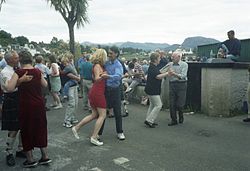
Plockton's primary annual cultural event is the Regatta Fortnight, organized by the Plockton Small Club, established in 1933. The fortnight begins on the Monday following the fourth in and includes a series of sailing races open to participants from area, culminating in competitive such as fishing competitions and community gatherings with street dancing. In 2025, the event commenced on July 28, featuring dry weather conditions conducive to racing activities over the two-week period. Ceilidhs form a staple of local traditions, often integrated into regatta celebrations and held at venues like the Plockton Inn, where live performances and dancing occur on regatta Saturdays. These social dances reflect the village's Highland heritage, with additional ceilidhs featured in touring festivals such as the of Small Halls, which visits Plockton Village Hall annually in to present traditional and original sets. Gaelic elements persist in Plockton's cultural practices, tied to its historical roots, with events incorporating Gaelic singers and musicians, as seen in performances by local artists proficient in the language. The Plockton & District Community Trust, active since the early , supports initiatives that maintain these traditions amid modernization pressures, including community-organized gatherings that emphasize maritime and Highland customs.

Tourism and Impacts

Key Attractions

Plockton's sheltered bay on Loch Carron features a waterfront lined with palm trees and subtropical vegetation, enabled by the warming influence of the North Atlantic Drift, creating a distinctive mild microclimate unusual for the Scottish Highlands. Visitors can access this scenic harbor via the main street, Harbour Street, which showcases colorful 19th-century cottages built during the herring fishing boom. A prominent natural draw is the abundance of common seals that frequent the rocky shores and islets of Carron, often visible from the village or during guided boat excursions departing daily from Plockton harbor. Operators like Calum's Seal Trips offer one-hour cruises focused on wildlife observation, including seals basking on rocks, with occasional sightings of otters, dolphins, and sea eagles. Coastal walking paths provide accessible exploration of the surrounding landscape, such as the 6 km from Plockton to , passing through with views and leading to the Victorian constructed in by Matheson. These routes highlight seasonal features like summer wildflower blooms along the shoreline, enhancing the area's for short hikes.

Economic Benefits and Local Concerns

Tourism sustains a substantial share of Plockton's economy, with the sector providing essential employment in hospitality, retail, and accommodation amid limited industrial alternatives. In the Highlands region, which encompasses Plockton, tourism supported 15,700 jobs as of 2017, comprising 14% of total regional employment—a higher proportion than Scotland's national average of 9.2% in 2023—reflecting its critical role in rural village viability. Local businesses, including hotels and guesthouses, benefit directly from visitor spending, as evidenced by Highland Coast Hotels' 2024 expansion in Plockton aimed at enhancing tourism infrastructure and creating additional jobs to bolster community resilience. The growth of short-term holiday rentals via platforms like Airbnb has further integrated tourism into residential property use, generating revenue that offsets depopulation pressures in the Lochalsh area, where traditional economies have waned since the mid-20th century. This influx counters net migration outflows common in Highland villages, sustaining shops and services that might otherwise close due to year-round low demand. Local concerns center on unmanaged seasonal visitor spikes, particularly from motorhomes, which strain infrastructure and generate environmental issues. In 2023, residents reported motorhome users dumping human waste in Plockton, exacerbating perceptions of the village as overwhelmed despite its small size limiting capacity for large vehicles. Such problems, including roadside camping and parking congestion, have prompted calls for regional measures like campervan taxes amid a 65% rise in Highland visitors since 2012, with nearly 36,000 motorhomes recorded in 2022—highlighting tensions between short-term economic gains and long-term community livability without regulatory favoritism. While frustrations exist, tourism's revenue imperative in depopulating locales underscores market-driven necessities over unsubstantiated victimhood, as business closures from reduced visitors would amplify service gaps.

References

Add your contribution
Related Hubs
User Avatar
No comments yet.