Recent from talks
Nothing was collected or created yet.
Harris, Outer Hebrides
View on Wikipedia
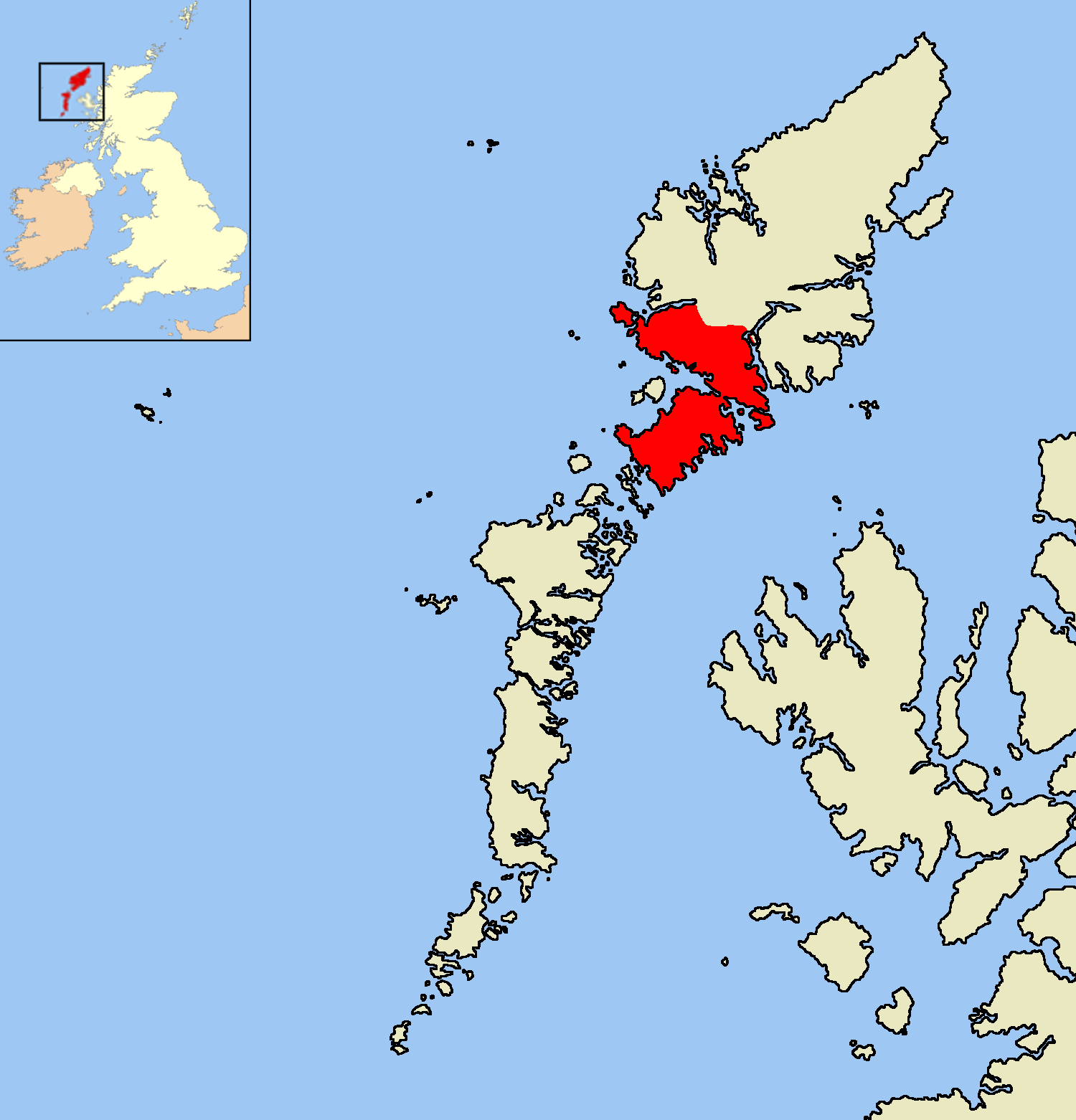
Harris (Scottish Gaelic: Na Hearadh, pronounced [nə ˈhɛɾəɣ] ⓘ) is the southern and more mountainous part of Lewis and Harris, the largest island in the Outer Hebrides, Scotland. Although not an island itself, Harris is often referred to in opposition to the Isle of Lewis as the Isle of Harris, which is the former postal county and the current post town for Royal Mail postcodes starting HS3 or HS5.
Key Information
The civil parish of Harris is considered to include St Kilda, a now uninhabited archipelago 40 miles (65 kilometres) west-northwest of North Uist, and the uninhabited islet Rockall, which is 230 miles (370 kilometres) west of North Uist.
Etymology
[edit]The Vikings arrived in the British Isles from the late 700s, and in the Northern Isles and Western Isles of Scotland they named places as part of their conquest.[2] Documents from several centuries ago show the Isle of Harris being referred to as Haray or Harray, Here or Herre, Herrie, and the plural Harreis; as well as possibly related place names such as Harris on the isle of Rùm; Herries in Dumfries; Harray on Orkney; and Harrastadhir (Harrastaðir) in Iceland.[3] The place-name Harris has been suggested to be based on Old Norse hærri, meaning 'higher', a reference to the high hills, especially in comparison with the much flatter Lewis lying to the north.[4]
The name of this island in Gaelic is "Na h-Earradh". The isles of the Hebrides once had Gaelic names, however the Norsemen renamed them.[5]
The Gaelic name "Na Hearadh" was also an earlier term for the Rinns of Islay.[citation needed]
Most of the place names on Harris are Gaelicized Old Norse.[citation needed]
Harris is most likely to be the island referred to as Adru (meaning 'thick, stout or bulky') on Ptolemy's map of the British Isles.[citation needed]
Gaelic
[edit]As of 2011[update], there were 1,212 Gaelic speakers in Harris, corresponding to roughly 60% of the population.[6] The Gaelic dialect spoken is a Southern Hebridean dialect related to that of Uist, though it also shares certain similarities with Lewis.[7]
Geography
[edit]
The boundary between Lewis and Harris is approximately a line from the head of Loch Resort on the west coast to the closest point of Loch Seaforth on the east coast. Harris itself divides naturally into northern and southern parts which are separated by West and East Loch Tarbert. These halves are joined by a narrow isthmus at the main settlement of Tarbert (An Tairbeart or Tairbeart na Hearadh).

The bedrock of Harris is largely Lewisian gneisses, which were laid down in the Precambrian period, interspersed with igneous intrusions. One of these intrusions forms the summit plateau of the mountain Roinebhal. The rock here is anorthosite, and is similar in composition to rocks found in the mountains of the Moon.[8][9]
Harris is a part of historic Inverness-shire, and was administered as such under older administrative divisions. In the 2001 census, Harris had a usually resident population of 1,916.[1] It is part of the South Lewis, Harris and North Uist National Scenic Area, one of 40 in Scotland.[10]
North Harris
[edit]
North Harris, adjoining Lewis, contains Clisham (An Cliseam), the highest mountain in the Outer Hebrides at 799 metres (2,621 ft).[11][12] The area is sparsely populated. Beyond Tarbert, the furthest settlement is Hushinish (Hùisinis) on the west coast. A bridge from the east coast links Harris to the island of Scalpay (Sgalpaigh na Hearadh).
In March 2003 the 25,300-hectare (62,500-acre) North Harris Estate was purchased[13] by the North Harris Trust, a development trust, on behalf of the local community.[14][15] In April 2006 the Trust hosted the Highlands and Islands Community Energy Company conference "Community Energy: Leading from the Edge"[16] in Tarbert. In early 2008 the Trust received planning consent for three 86 metre (282 ft) wind turbines to be located at Monan.[17] In 2008 Mike Russell, the Scottish environment minister announced that the North Harris Trust had begun canvassing local opinion about a proposal to create Scotland's third national park in the area.[18]
South Harris
[edit]
The southern part of Harris is less mountainous, with numerous unspoilt, white sandy beaches on the west coast. Its main settlements are Rodel (Roghadal), known for its medieval kirk of St. Clement (Eaglais Chliamhain), the most elaborate surviving medieval church in the Hebrides after Iona Abbey, and Leverburgh (An Tòb na Hearadh or An t-Òb na Hearadh). A ferry sails from the latter to Berneray (Beàrnaraigh na Hearadh), an island off the coast of North Uist (Uibhist a Tuath), to which it is joined by a causeway.
The east coast of south Harris is known as the Bays. The best known section called the "Golden Road" as it cost so much money to build, when it was built in 1897. It runs from Miavaig via Drinishader, Grosebay, Scadabay and Cluer to Stockinish. From Stockinish the road is the Bays and meanders through the coastal townships of Lickisto (Liceasto), Geocrab (Geòcrab), Manish (Mànais), Flodabay (Fleòideabhagh), Quidinish (Cuidhtinis), Finsbay (Fionnsbhagh) and Lingerbay (Lingreabhagh).
The beaches of Luskentyre and Scarista are amongst the most spectacular. From the former the island of Taransay, where the BBC Television series Castaway 2000 was recorded, is seen most clearly from Harris. At Scarista the beach is a venue for surfing and kite buggying. Nearby the Harris Golf Club offers well kept greens and views of the hills, but there is no play on Sundays. Scarista is the birthplace of the author Finlay J. MacDonald, who wrote about growing up on Harris in the 1930s. His books: Crowdie and Cream, Crotal and White and The Corncrake and the Lysander paint a vivid and humorous picture of Hebridean life.
Tarbert
[edit]Tarbert is the main port and main settlement of Harris, with a population of about 550. The name Tarbert comes from the Gaelic tairbeart meaning "portage" or "isthmus". It is located on an isthmus between Loch Tarbert and West Loch Tarbert. The village has a ferry terminal, local tourist information and some small shops, including a Harris Tweed shop overlooking the main access road to the CalMac ferry terminal and a general grocery store. It is also home to the Harris Distillery.
Scalpay
[edit]The island of Scalpay is located at the mouth of East Loch Tarbert. It was known historically for its fishing industry, though little of that remains. The island was linked to Harris when the Scalpay Bridge was opened in 1997, connecting Scalpay to the settlement of Kyles on Harris.
Media attention has recently been drawn to angling on Harris, and Tarbert in particular. Local fishermen have been targeting large Common Skate in the area and have had prolific catches, mainly from West Loch Tarbert, in autumn and winter. There is an application for the Scottish shore record of 183 pounds (83 kg) although a fish estimated at 204 pounds (93 kg) was later landed. These catches have attracted the attention of the local and national press and sea angling's leading magazines.[19][20]
Economy and transport
[edit]In common with many parts of the Highlands and Islands, Harris has numerous single-track roads with passing places at intervals. Ferries sail from Tarbert to Uig in Skye.
According to the Scottish Government, "tourism is by far and away the mainstay industry" of the Outer Hebrides, "generating £65m in economic value for the islands, sustaining around 1000 jobs" The report adds that the "islands receive 219,000 visitors per year".[21] The Outer Hebrides tourism bureau states that 10–15% of economic activity on the islands was made up of tourism in 2017. The agency states that the "exact split between islands is not possible" when calculating the number of visits, but "the approximate split is Lewis (45%), Uist (25%), Harris (20%), Barra (10%)".[22]
Harris is known for Harris Tweed, although this textile is mostly made in Lewis, with the major finishing mills in Shawbost and Stornoway. Every length of cloth produced is stamped with the official Orb symbol, trademarked by the Harris Tweed Association in 1909. Harris Tweed is defined as "hand woven by the islanders at their homes in the Outer Hebrides, finished in the islands of Harris, Lewis, North Uist, Benbecula, South Uist and Barra and their several purtenances (The Outer Hebrides) and made from pure virgin wool dyed and spun in the Outer Hebrides."[23]
Tarbert is home to the Harris distillery,[24] which has former Monsanto CEO, Hugh Grant among its directors.[25] In 2018, the distillery was named Scottish Gin Distillery of the year at the annual Scottish Gin Awards,[26] and in 2020, Harris Gin was voted favourite Scottish gin in the Scottish Gin Society Consumer Choice Awards for the third year in a row.[27]
As of 2021, the company was marketing only gin, but had started production of Hearach' single malt Scotch whisky; it would be some years before that product would be available for sale.[28][29]
Education
[edit]The Sir E. Scott secondary school in Tarbert serves the whole of the Isle of Harris and Scalpay. This school has a primary and secondary department and can educate up to sixth year.[30] The school has a 21 kW photovoltaic system installed. There is also a Primary School, Leverhulme Memorial School, in Leverburgh.[31]
Religion
[edit]Harris has a largely Presbyterian population that practises sabbatarianism: all retail outlets are shut on Sunday.[32] This area has been described as the last bastion of Reformed fundamentalism in the UK, and there was controversy in 2006 when Caledonian MacBrayne started a Sunday ferry service.[33] However, a Sunday ferry service between Berneray (North Uist) and Leverburgh (An t-Òb) in the south of Harris has been introduced with relatively little controversy and now operates all year round. This allowed travel to Lewis and Harris by ferry on a Sunday before the Sunday ferries to Stornoway started in 2009. The North Uist end of the connection can be reached by other ferry routes that also operate on Sundays (Uig-Lochmaddy and Oban-Lochboisdale).
Media and the arts
[edit]Tinted shots of parts of the island were used by Stanley Kubrick as an alien landscape in the film 2001: A Space Odyssey.[34]
In his 1962 novel Atlantic Fury Hammond Innes put a fictional Joint Services Guided Weapons Establishment in Northton, South Harris, where some of the action takes place.
The nearby island of Taransay became well known following the BBC show Castaway broadcast in 2000 and various scenes were shot on Harris itself. The film The Rocket Post was also filmed on Taransay in 2004. The film is based on the story of Gerhard Zucker, the German rocket scientist who in 1934 used the Isle of Scarp as his base for experimenting with sending mail over long distances by rocket.
The local newspaper is the Stornoway Gazette; there is also a community newspaper published fortnightly, called Dè Tha Dol?
District tartan
[edit]A group of sixth-year pupils at the Sir E. Scott secondary school in Tarbert won the 2003 Young Enterprise UK Award for their design, marketing, and selling of the Isle of Harris district tartan. The tartan is officially registered with the Scottish Tartans Authority (under number 6198) and with the Scottish Tartans World Register (under #2981). Its symmetrical threadcount is listed as "WW/8 B80 K8 LG16 K16 LB/24", with a colour palette of:
pelorous blue #2888C4,
forest green #289C18,
dark grey #101010,
wilson white #FCFCFC, and
Windsor blue #2C2C80.[35]
See also
[edit]Notes
[edit]- ^ a b "Island Populations" Archived 4 March 2016 at the Wayback Machine Comhairle nan Eilean Siar. Retrieved 31 January 2015.
- ^ Macbain, Alexander (1895). "The Norse Element in the Topography of the Highlands and the Isles". Transactions of the Gaelic Society of Inverness. Vol. 19. Northern Chronicle. pp. 217–218.
- ^ Macbain, Alexander (1895). "The Norse Element in the Topography of the Highlands and the Isles". Transactions of the Gaelic Society of Inverness. Vol. 19. Northern Chronicle. p. 227.
- ^ Dictionary of Scottish Place-Names, David Ross (Birlinn)
- ^ Macbain, Alexander; Watson, William J. (1922). Place names, Highlands & islands of Scotland. E. Mackay, Stirling. pp. 68–73.
- ^ Census 2011 stats. BBC News. Retrieved 20 April 2014.
- ^ Borgstrøm, Carl H.J. (1940). The dialects of the Outer Hebrides. A linguistic survey of the dialects of Scotland. Vol. 1. Oslo, Norway: Norwegian Universities Press. p. 9.
- ^ McKirdy, Alan Gordon, John & Crofts, Roger (2007) Land of Mountain and Flood: The Geology and Landforms of Scotland. Edinburgh. Birlinn. Page 94.
- ^ Gillen, Con (2003) Geology and landscapes of Scotland. Harpenden. Terra Publishing. Pages 63–4.
- ^ "National Scenic Areas" Archived 11 March 2017 at the Wayback Machine. SNH. Retrieved 30 Mar 2011.
- ^ Rotary Club (1995) p. 124
- ^ Johnstone et al (1990) p. 240
- ^ Islanders celebrate buy-out, BBC News Online, 1 March 2003
- ^ "Welcome to The North Harris Trust – Urras Ceann a 'Tuath na Hearadh" North Harris Trust. Retrieved 15 March 2008.
- ^ "About Development Trusts" Archived 4 March 2008 at the Wayback Machine DTA Scotland. Retrieved 15 March 2008.
- ^ "HICEC conference 2006". hie.co.uk. Archived from the original on 21 October 2006. Retrieved 4 April 2018.
- ^ "North Harris community wind farm approved" (February 2008) John Muir Trust Journal No. 44.
- ^ Ross, John (14 March 2008) "Island may be site of third national park". Edinburgh The Scotsman.
- ^ "Press and Journal report". thisisnorthscotland.co.uk. Archived from the original on 12 June 2016. Retrieved 4 April 2018.
- ^ "Record-breaking hope for big fish". 23 October 2007. Retrieved 4 April 2018 – via news.bbc.co.uk.
- ^ "The Outer Hebrides | Scotland.org". Scotland.
- ^ "Tourism in the Outer Hebrides". Outer Hebrides.
- ^ Harris Tweed Authority, "Fabric History", retrieved 21 May 2007. Archived 15 February 2012 at the Wayback Machine
- ^ Maclean, Charles (2016). Whiskypedia. A Gazetteer of Scotch Whisky. Edinburgh: Birlinn. pp. 240–241. ISBN 978-1-78027-401-0.
- ^ "Isle of Harris Distillers Ltd". Companies House. Retrieved 23 November 2018.
- ^ "Winners 2018". KD Media. Retrieved 18 August 2020.
- ^ "The nations favourite Scottish Gins 2020 revealed". The Scottish Gin Society. 11 February 2020. Retrieved 18 August 2020.
- ^ "Isle of Harris Distillery". Isle of Harris Distillery.
- ^ "Welcome to a new breed of distilleries and breweries in Scotland's Hebrides". The Independent. 18 June 2019. Archived from the original on 9 May 2022.
- ^ "Harris School Details" Archived 24 August 2007 at the Wayback Machine Comhairle nan Eilean Siar. Retrieved 10 February 2008.
- ^ "Scotland's largest Sun Energy system installed in Western Isles" Archived 26 September 2007 at the Wayback Machine (2 November 2004) Comhairle nan Eilean Siar. Press release. Retrieved 31 August 2007.
- ^ "Hebrides 2002" Archived 15 April 2009 at the Wayback Machine Comhairle nan Eilean Siar. Retrieved 3 August 2008.
- ^ Seenan, Gerard (10 April 2006) "Fury at ferry crossing on Sabbath" The Guardian. Retrieved 3 August 2008.
- ^ "Welcome to Film Hebrides" Archived 21 October 2006 at the Wayback Machine filmhebrides.com. Retrieved 26 September 2007.
- ^ Scotland, National Records of. "Tartan Details – The Scottish Register of Tartans". www.tartanregister.gov.uk. Retrieved 4 April 2018.
References
[edit]- Rotary Club of Stornoway (1995) The Outer Hebrides Handbook and Guide. Machynlleth. Kittwake. ISBN 0-9511003-5-1
- Johnstone, Scott; Brown, Hamish; and Bennet, Donald (1990) The Corbetts and Other Scottish Hills. Edinburgh. Scottish Mountaineering Trust. ISBN 0-907521-29-0
- Vogler, Gisela (2001). A Harris way of life: Marion Campbell (1909–1996). West Tarbert: Harris Voluntary Service. ISBN 0-903960-29-X.
External links
[edit]
Harris travel guide from Wikivoyage- Information on South Harris and Leverburgh including photographs
- Information on the Isle of Harris by Explore Hebrides
- Pictures of Harris
- Panoramas of the Island (QuickTime required)
- Photographs and useful information about Harris Archived 18 December 2008 at the Wayback Machine
- The North Harris Trust
- Scarista Beach
Harris, Outer Hebrides
View on GrokipediaEtymology and Nomenclature
Origins of the Name
The name Harris originates from the Old Norse term hærri, signifying "higher" or "upper," a designation that highlights the island's prominent hills and mountainous interior relative to the low-lying machair and peatlands of adjacent Lewis. This etymology aligns with the intensive Norse colonization of the Hebrides starting in the late 8th century, when Viking settlers imposed their language on the archipelago's topography, as evidenced by the prevalence of Old Norse-derived place names across Lewis and Harris—over 70% in some surveys of local nomenclature. Archaeological finds, including Norse-style longhouses and pagan burials dated to the 9th–10th centuries at sites like Udal on North Uist, corroborate this linguistic overlay during a period of Scandinavian dominance that persisted until the Treaty of Perth in 1266 transferred nominal sovereignty to Scotland.[7][8] Medieval documents, such as 15th-century charters and the Dean of Lismore's Book (c. 1512–1526), record early forms like Haray, Harray, Here, or Herre, preserving the Norse phonetic structure without evident Gaelic alteration at that stage. An alternative scholarly proposal links Hearadh to Old Norse herað, denoting a "district" or administrative unit, though this is less favored given the topographic specificity of hærri in comparative Hebridean onomastics. The modern Scottish Gaelic rendering, Na Hearadh ("the heights"), emerged post-Norse era as a calque or phonetic adaptation, blending the inherited Norse root with Gaelic intensifiers like àirde ("height"), but linguistic analysis prioritizes the Viking substrate over indigenous Celtic invention, as pre-Norse records for the island are absent and Gaelic place-name elements in Harris often postdate Norse imports.[9][10]Distinction from Lewis
Harris and Lewis constitute a single landmass, the largest island in the Outer Hebrides and third largest in the British Isles, yet they maintain distinct identities rooted in geography, history, and local society. The informal boundary lies amid a transitional zone of rugged hills and glens, delineating the predominantly low-lying, peat-covered expanses of northern Lewis from the elevated, rocky terrains of southern Harris, which has engendered separate cultural perceptions and communal practices despite physical continuity.[11] This separation originated in medieval clan divisions, particularly with the MacLeods, whose progenitor Leod acquired Harris, Lewis, and parts of Skye around the mid-13th century. The clan bifurcated into the MacLeods of Lewis, who dominated the north until their forfeiture of lands to the Mackenzies in 1610 following protracted feuds and failed rebellions, and the MacLeods of Harris, aligned with the Skye branch that retained control over southern territories through subsequent centuries. These divergent land tenures cultivated independent chiefly lines, alliances, and social hierarchies, embedding lasting distinctions in heritage and nomenclature.[12][13] Administratively, unification occurred with the formation of Comhairle nan Eilean Siar in 1975, encompassing the entire Western Isles under one local authority and superseding prior county divisions—Lewis under Ross and Cromarty, Harris under Inverness-shire. However, parish-level autonomy persists through separate community councils, such as North Harris and South Harris, which address localized issues like infrastructure and heritage, underscoring residual variances in customs (e.g., dialectal nuances in Scottish Gaelic) and economic orientations (e.g., Harris's emphasis on traditional weaving traditions). These entities preserve empirical social divisions amid overarching governance, reflecting how historical fractures continue to shape communal self-conception.[7]History
Prehistoric and Early Settlement
Human activity in Harris following the retreat of the Pleistocene ice sheets is first attested by Mesolithic sites at Northton (Rubh' an Teampaill), where eroding coastal dunes have yielded flint tools, middens, and other artifacts indicative of hunter-gatherer exploitation of marine and terrestrial resources. Radiocarbon dating places initial occupation between 7050 and 6700 cal BC, marking the earliest known human presence in the Western Isles and reflecting adaptation to a post-glacial environment with limited woodland cover and reliance on coastal foraging. Further Mesolithic deposits at the site, dated to 5715–5386 cal BC, include evidence of plant root harvesting, underscoring a diverse subsistence strategy amid resource variability.[14][15][16] Neolithic settlement at Northton, emerging around 4000 BCE, evidences a shift to early farming communities through permanent dwellings, pottery, and domesticated animal remains, transitioning from mobile foraging to agrarian economies supported by machair soils suitable for cultivation. Chambered cairns and megalithic structures, though more prevalent in neighboring isles, align with broader Outer Hebrides patterns of ritual and burial practices during this era, with Northton's multi-period mound incorporating Neolithic layers beneath later deposits. Bronze Age activity, circa 2500–800 BCE, is represented by Beaker-period artifacts at Northton and isolated standing stones such as MacLeod's Stone, suggesting continued ceremonial use and metalworking introduction amid population growth and trade networks.[17][18] By the Iron Age (800 BCE–400 CE), defensive architecture proliferated, exemplified by the broch at Dun Bhurigh near Borve, a drystone tower constructed over 2000 years ago on a promontory for strategic oversight of coastal approaches. These structures, with their thick walls and internal chambers, point to organized communities facing inter-group conflicts or environmental pressures, including scarce arable land and vulnerability to raids, while facilitating control over fishing and livestock herding in a rugged terrain.[19][20]Norse and Medieval Periods
The Outer Hebrides, including Harris, experienced Norse raids from the late 8th century, transitioning to sustained settlement and control by the mid-9th century under figures like Kettil Flatnose, who established jarldoms over the islands.[21] This Norse dominance, lasting approximately 400 years until the 1266 Treaty of Perth, is evidenced by the saturation of Gaelicized Old Norse place names across Harris, such as the island's name deriving from hærri meaning "higher" in reference to its elevated terrain, alongside terms like bost for farmsteads and pol for coastal settlements.[22] Archaeological and toponymic records indicate that Viking settlers assimilated or displaced prior Pictish and early Gaelic populations, with sagas alluding to influences from Harald Fairhair's unification of Norway around 872, which spurred overseas expansion and earl appointments in the islands.[23] By the 11th century, Harris formed part of the Norse-Gaelic Kingdom of the Isles, a maritime realm encompassing the Hebrides, Isle of Man, and parts of the Irish Sea coast, consolidated under rulers like Godred Crovan from 1079.[23] This kingdom facilitated hybrid Norse-Gaelic lordships, but internal fragmentation and external pressures from Norwegian and Scottish crowns limited its cohesion as a unified state. The rise of Somerled in the mid-12th century marked a pivotal shift, as his rebellion against Norse overlords—victorious at the 1156 Battle of the Strait of David—led to the establishment of the Lordship of the Isles under his descendants, integrating Harris into a semi-autonomous Gaelic-infused polity that persisted until the late 15th century.[24] Medieval economic activity on Harris remained rudimentary, centered on subsistence fishing, limited agriculture in fertile machair zones, and intermittent raiding expeditions typical of Norse maritime culture, with scant records of broader trade or surplus production. Religious infrastructure included foundations like St. Clement's Church in Rodel, constructed around 1520 under the patronage of Alasdair Crotach MacLeod, chief of the MacLeods of Harris, serving as a burial site for local lords and reflecting late medieval ecclesiastical consolidation amid feudal transitions.[25] These developments underscore a period of Norse-to-Gaelic cultural fusion, though primary sources like annals prioritize political upheavals over detailed socioeconomic data.[26]Clan Era and Highland Clearances
The MacLeods of Dunvegan, chiefs of the principal branch of Clan MacLeod, held dominion over Harris as a core territory from at least the 15th century, exercising feudal authority through tacksmen and sub-tenants in a system reliant on cattle rearing, fishing, and intermittent raiding.[27] This clan structure maintained social cohesion via kinship ties and obligations, with Harris serving as a strategic outpost amid rivalries with clans like the MacLeods of Lewis and Mackenzies.[28] By the early 17th century, however, financial strains and Jacobite involvements eroded MacLeod influence, leading to fragmented holdings; Harris eventually passed into Mackenzie of Seaforth control as part of broader Lewis-with-Harris estates, where absentee landlordism began supplanting traditional governance.[29] Under Seaforth Mackenzie ownership in the 18th century, Harris experienced population growth fueled by potato cultivation and kelp harvesting during the Napoleonic Wars, with numbers rising from around 3,900 in 1821 to 4,429 by 1831 amid subdivision of runrig holdings into uneconomic crofts supporting up to eight persons per arable acre.[30] This overpopulation, combined with post-war kelp market collapse and stagnant grain prices, rendered subsistence crofting yields insufficient to meet rising rents or sustain families, as marginal soils yielded barely 8-10 bushels of oats per acre under lazybed methods.[31] Landlords, burdened by debts from clan-era loyalties and estate improvements, shifted to Cheviot sheep farming, which promised higher returns—up to five times croft rents—via wool exports amid British textile demand, necessitating consolidation of touns into large grazings.[32] Clearances commenced in the 1820s under owners like the Scotts of Tarbert, who acquired North Harris amid Seaforth bankruptcy, evicting tenants from inland glens to coastal fringes or overseas, with over 1,000 departing Harris for Canada between 1826 and 1830 alone.[33] Population dipped to 4,250 by 1841, reflecting net emigration as sheep stocks expanded to thousands on former croft lands, though coastal crofting persisted for fisheries.[30] Resistance emerged in the 1840s "pauper wars," with riots against factor enforcements, but economic imperatives—croft arrears exceeding 50% in some townships—prevailed, fostering adaptation via selective clearances rather than wholesale depopulation.[34]19th to 21st Century Developments
In the 19th century, following the Highland Clearances, Harris experienced economic diversification through the herring fishing boom, which peaked in the Hebrides with up to 3,000 local women employed as "Herring Girls" in gutting and packing operations.[35] By the late 1800s, areas like Scalpay and the bays of Harris supported nine curing stations, providing seasonal employment amid declining traditional agriculture.[36] Concurrently, Harris Tweed emerged as a home-based weaving industry in the 1840s, commercialized through improved yarn processes promoted by landowners like Lady Dunmore, enabling crofters to produce cloth for mainland markets.[37] The Crofters Holdings (Scotland) Act of 1886 granted security of tenure to crofters across the Hebrides, including Harris, halting arbitrary evictions and formalizing small-scale landholdings that persisted into the 20th century.[38] This legislation's legacies influenced post-World War II reforms, stabilizing rural communities despite ongoing challenges from mechanization and outmigration. During WWII, the Outer Hebrides, encompassing Harris, hosted military installations such as radar stations on Lewis, contributing to Atlantic convoy protection and coastal defense efforts. These bases brought temporary employment and infrastructure but exacerbated postwar depopulation as fishing declined and youth emigrated for mainland opportunities. In the 21st century, tourism has grown to comprise 10-15% of the Outer Hebrides economy, generating £65 million in visitor spending by 2017 through attractions like Harris's coastal landscapes.[39] Population trends reflect stabilization, with Outer Hebrides estimates at 26,020 residents amid net emigration, though aging persists with a median age of 51.5 years.[40][7] This contrasts with 19th-century peaks, as census data show a decline from 46,172 in 1901 to current levels, driven by structural economic shifts rather than acute crises.[41]Geography
North Harris
North Harris features rugged mountainous terrain, contrasting with the lower, flatter landscapes of South Harris, and is defined by elevations exceeding 700 meters in its central massif.[7] This region is dominated by Clisham (An Cliseam), reaching 799 meters, the highest peak in the Outer Hebrides and the archipelago's sole Corbett.[42] The area encompasses extensive moorlands interspersed with numerous lochs, limiting arable agriculture to small-scale crofting and sheep grazing on poorer soils.[7] The underlying geology consists primarily of Lewisian gneiss, Precambrian metamorphic rocks over 2.8 billion years old, formed through ancient igneous origins and multiple tectonic events, rendering them highly stable yet subject to glacial and coastal erosion.[43] [44] Population centers remain sparse, with settlements like Amhuinnsuidhe serving as focal points; the latter centers on a castle built in 1868, historically part of a 55,000-acre sporting estate renowned for deer stalking, salmon fishing, and grouse shooting, which drew Victorian-era hunters.[45] The estate's remote location along the B886 road underscores North Harris's isolation, with community ownership established in 2003 to manage its natural resources.[46]South Harris
South Harris features extensive machair plains and shell-sand beaches along its western coast, providing a stark contrast to the rugged highlands of the north through greater ecological productivity supported by calcareous soils. These low-lying, fertile grasslands, known as machair, form from wind-blown shell fragments deposited onshore by prevailing westerlies, creating dune systems and expansive silver-white beaches that foster diverse wildflowers, insects, and birdlife.[7][47] Luskentyre Beach exemplifies these formations, with dynamic sandflats, pale shell-derived sands, and dunes exceeding 35 meters in height that harbor rich habitats including blowthroughs and machair vegetation. The white sands result primarily from fragmented marine shells ground by Atlantic waves, enabling high plant diversity on the calcareous base. Scarista Beach similarly presents wide expanses of shell sand backed by wildflower meadows, sustaining notable wildlife amid its open coastal setting.[47][47][48] Leverburgh, at South Harris's southern tip, serves as the primary ferry port connecting to North Uist and beyond, while its position on machair lands benefits from relatively milder exposure, facilitating crofting with crops suited to the fertile, lime-rich soils unavailable in the north's rockier terrain. The machair's productivity stems from shell-sand enrichment, supporting traditional small-scale agriculture despite the archipelago's overall challenging climate.[49][50] Post-1950s infrastructure developments, including the sealing of the Golden Road along the east coast—initially tracked in 1897 but paved after World War II—have enhanced access to remote crofting townships, yet such constructions on fragile dunes and machair raise erosion risks by disrupting natural sediment dynamics and vegetation cover. Blasting through gneiss and routing over coastal inlets has connected isolated communities but potentially accelerated localized coastal retreat in this erosion-prone environment.[51][52][53]Tarbert and Lochs
Tarbert occupies the narrow isthmus connecting North and South Harris, situated at the head of East Loch Tarbert, a sea loch that extends westward from the Minch.[54] West Loch Tarbert branches northward, with the two lochs penetrating approximately 10 kilometers inland and nearly bisecting the island, leaving only the constricted land bridge at Tarbert to link its northern and southern halves.[55] This geographical configuration has historically rendered the site strategically vital, as evidenced by Norse practices of portaging vessels across the isthmus to bypass open seas, facilitating trade routes and defensive positioning during medieval periods.[55] As the principal settlement and ferry terminal of Harris, Tarbert functions as the administrative hub for the region within Comhairle nan Eilean Siar, accommodating local council offices that oversee district services.[56] The harbor serves as the primary CalMac port for vehicular and passenger ferries linking Harris to Uig on Skye and Ullapool on the mainland, underpinning its role as an economic nexus by channeling maritime access to the island's interior via the encircling lochs.[57] Recent infrastructure enhancements, including a £14.3 million upgrade featuring a new pier and expanded facilities completed in 2023, have modernized the terminal to accommodate growing ferry operations and improve resilience against weather disruptions.[58][59] These developments sustain Tarbert's centrality in regional connectivity, leveraging the lochs' sheltered waters for efficient vessel maneuvering and berthing.Scalpay
Scalpay is a small island situated at the eastern entrance to East Loch Tarbert, measuring approximately three miles in length and two miles in width.[60] With a population of 291 residents recorded in the 2011 census, it supports a close-knit community historically centered on maritime activities.[60] The island's rugged terrain limits arable land, constraining agriculture and reinforcing reliance on sea-based livelihoods.[61] Prior to 1997, Scalpay's isolation was pronounced, accessible only by ferry, which shaped its distinct seafaring identity tied to fishing traditions.[62] The opening of the Scalpay Bridge in December 1997—a 300-meter structure linking the island to Harris—marked a pivotal reduction in this seclusion, facilitating easier access for residents and visitors while preserving the community's insular character.[63][64] This connection spurred modest economic integration without fully transforming the island's small-scale operations. The island features sheltered harbors, including facilities at its eastern and northern shores, which historically served as bases for herring fleets and now accommodate creel fishing for lobster and crab on a localized scale.[36][65] Prawn fishing and salmon farming supplement these activities, though industrial expansion remains limited by the island's size and environmental constraints.[65] This perpetuates a economy focused on sustainable, community-managed marine resources rather than large-scale ventures.Demographics
Population Trends and Emigration
The population of Harris reached an estimated peak of approximately 5,000 in the early 19th century, prior to the impacts of the Highland Clearances and subsequent economic pressures.[66] By the 1841 census, the Harris parish recorded 5,271 residents, reflecting a slight increase before a long-term downward trajectory set in.[66] This decline accelerated in the late 19th and 20th centuries, with the population falling to around 4,000 by the 1950s and further to 1,916 by the 2001 census.[67] Harris's demographic trends mirror the broader Outer Hebrides pattern of sustained population loss, with a 43% decrease across the archipelago from 1901 to 2022, driven primarily by net out-migration exceeding natural change.[40] Between 1981 and 1991 alone, Harris (including Scalpay) saw one of the steepest drops in the region, highlighting accelerated depopulation in the southern isles compared to Lewis.[4] Recent estimates place Harris's population at around 1,700 as of 2022, with stabilization efforts offset by ongoing youth out-migration to mainland Scotland for employment opportunities beyond limited local crofting and fishing.[40][68] Emigration from Harris has occurred in distinct waves, beginning with forced clearances in the 19th century that displaced tenants to North America, particularly Canada, where over 200 residents departed in the 1880s amid estate reorganizations and subsistence failures.[7][69] This pattern persisted into the 20th century, exacerbated by the pull of industrial opportunities like the North Sea oil boom in the 1970s, which drew younger workers to urban centers such as Aberdeen.[68] Empirical data link these outflows to structural job scarcity, with net migration turning negative as local economies failed to retain working-age populations.[70] The aging demographic, with an average age of 49.5 years across the Outer Hebrides, intensifies pressures on Harris's services, as fewer young residents contribute to sustaining infrastructure amid high dependency ratios.[7] Over 55% of the regional population was aged 45 or older by 2018, correlating with reduced birth rates and persistent out-migration of those under 30 seeking viable careers elsewhere.[71] This causal chain—limited local employment fostering youth exodus and elevating median age—has strained healthcare and community viability without reversing the underlying decline.[70]Ethnic Composition and Language Use
The population of Harris exhibits high ethnic homogeneity, with residents predominantly identifying as White Scottish or Other White British, consistent with the Na h-Eileanan Siar council area where 98.3% of the population reported White ethnic groups in census data.[72] Non-White ethnic groups constitute less than 2% of the local population, reflecting limited immigration inflows to this remote island community, where geographic isolation and historical emigration patterns have constrained demographic diversification.[73] Scottish Gaelic remains a dominant language in Harris, with higher proficiency rates than in adjacent Lewis; in the 2001 census, approximately 69% of Harris residents reported Gaelic-speaking ability, surpassing the Outer Hebrides average. By the 2011 census, Gaelic speakers in the broader Na h-Eileanan Siar area stood at 52.2% of those aged three and over, though Harris maintained elevated levels due to sustained community use in daily interactions and limited external influences.[74] This persistence correlates with cultural insularity, including localized social networks and reduced exposure to English-dominant media, rather than formal linguistic policies.[74] Intergenerational decline is evident, as proficiency drops among younger cohorts owing to English-medium schooling as the primary educational pathway and increasing reliance on English-language digital and broadcast media, which erodes domestic Gaelic transmission without compensatory immersion programs reaching scale.[74] Census breakdowns show speakers over 65 comprising a disproportionate share, with those under 18 exhibiting rates 20-30 percentage points lower than the overall average, underscoring causal pressures from modernization over inherent linguistic resilience.[74]Economy and Infrastructure
Traditional Industries like Crofting and Tweed
Crofting in Harris, formalized under the Crofters Holdings Act of 1886, consists of small-scale tenant farming on marginal land, typically combining arable cultivation, livestock rearing, and inshore fishing. The system's sustainability is constrained by acidic, nutrient-poor soils and exposure to Atlantic weather, resulting in limited yields; for instance, common practices like lazybed potato cultivation persist but produce modest outputs. Economic data from 2019-2022 indicate average annual income from crofting activities at £4,538 per crofter, with a median of £500, rendering it unviable as a primary livelihood without off-croft employment, as affirmed by nearly all surveyed crofters.[75][76] Prior to crofting reforms, Harris's economy relied on kelp harvesting, which expanded during the Napoleonic Wars (1799-1815) due to demand for alkali in soap and glass production, employing thousands amid high seasalt taxes protecting the trade. The industry's collapse post-1815, following tax repeals and cheaper foreign imports, triggered economic distress and the Highland Clearances, prompting a pivot to sheep farming on larger scales. This shift, however, led to overgrazing, eroding vegetation cover and exacerbating soil degradation, as sheep densities depleted native heather and grasses without restorative rotations.[77][32] Harris Tweed emerged in the 1840s as a cottage industry, with cloth handwoven on islands from yarn dyed and spun in Scotland, initially promoted by estate owners to supplement crofters' incomes. Production peaked mid-20th century but declined amid competition from mechanized textiles; the Harris Tweed Act 1993 legally protected the name, mandating Outer Hebrides handweaving and pure wool use, sustaining around 200 weavers today despite global market volatility and synthetic alternatives.[78][79]Tourism and Fishing
Tourism constitutes a significant portion of Harris's economy, accounting for 40.1% and valued at £14.5 million in 2024.[80] The sector is attracted by the island's dramatic landscapes, including white sandy beaches like Luskentyre and scenic routes such as the Golden Road, drawing visitors seeking natural beauty and outdoor activities. In the broader Outer Hebrides, which include Harris, tourism contributed £65 million annually as of 2017, supporting growth at approximately 5% per year through increased visitor spending.[81] Visitor numbers reached 219,000 across the islands in 2017, with many accessing Harris via ferry services from the mainland and Skye.[81] The fishing industry in Harris centers on inshore activities, predominantly shellfish such as crabs and lobsters, as whitefish and pelagic species caught west of the Hebrides are rarely landed locally. Historical peaks in whitefish and pelagic fishing occurred during the 20th century, but the sector has faced fleet reductions due to European Union quotas under the Common Fisheries Policy, aimed at stock sustainability amid declining catches. Recent initiatives, including the Outer Hebrides Creel Limitation Pilot from 2020 to 2022, tested restrictions on pot numbers to manage shellfish stocks, reflecting efforts to balance environmental pressures with economic viability.[82] Economically, tourism offers seasonal employment tied to peak summer visits, contrasting with fishing's potential for year-round operations despite volatility from quota changes, weather, and market prices. While tourism drives short-term income surges, fishing provides more consistent, albeit smaller-scale, jobs in remote communities, highlighting trade-offs between expansion in visitor-dependent roles and the instability of regulated marine harvests.[80]Transport Challenges and Recent Improvements
The Isle of Harris relies heavily on ferry services operated by Caledonian MacBrayne (CalMac) for connectivity to the Scottish mainland and other islands, with Tarbert serving as the primary port for routes from Ullapool. These services face frequent disruptions due to vessel faults and weather, contributing to economic delays by limiting timely access for goods and passengers.[83] In 2006, the introduction of Sunday sailings on the Sound of Harris route from Berneray to Leverburgh sparked significant local opposition rooted in Sabbath observance traditions, with Harris residents protesting the move as a violation of community norms and threatening legal action, which delayed broader service expansions and commerce on rest days.[84][85] Road infrastructure in Harris expanded modestly after the 1970s through targeted upgrades to connect remote crofting areas, but much of the network remains single-track with passing places, posing challenges for larger vehicles and increasing travel times across the rugged terrain.[86] Air access is indirect, with no dedicated airport on Harris; the nearest facilities are Stornoway Airport on northern Lewis (serving the combined island) or Benbecula Airport further south, requiring additional road or ferry travel that exacerbates isolation for southern Harris communities.[87][88] Recent harbor modernizations at Tarbert, including a £14.3 million pier reconstruction and extension completed in phases by 2023, alongside a new £1.5 million terminal building opened in January 2023, have improved vessel berthing capacity and passenger facilities, enhancing reliability for ferry operations.[89][90] Concurrently, a £157 million broadband rollout by Openreach, announced in May 2025, is extending gigabit-capable full-fibre networks to thousands of premises in the Outer Hebrides, including Harris, to support remote work and digital services that mitigate depopulation by enabling sustained residency amid infrastructural remoteness.[91][92]Culture and Society
Religious Conservatism and Sabbath Observance
The Isle of Harris, part of the northern Outer Hebrides, exhibits strong adherence to Presbyterianism, particularly through the Free Church of Scotland, a conservative Reformed denomination emphasizing biblical authority and traditional doctrine. Congregations such as the North Harris Free Church, established in 2014, and South Harris Free Church in Leverburgh actively promote gospel preaching and community worship, reflecting the island's historical alignment with Calvinist free churches that trace roots to the 1843 Disruption from the Church of Scotland.[93][94] This dominance persists despite broader Scottish secularization, positioning Harris and neighboring Lewis as outliers where Protestant free churches shape social norms more than in mainland UK regions.[95] Sabbath observance remains a cornerstone of religious conservatism in Harris, with most shops, public services, and leisure facilities closing on Sundays in deference to biblical commandments against work, interpreted through a literalist Reformed lens. Public buses do not operate, and traditional closures extend to community centers and sports facilities, fostering a day dedicated to rest, worship, and family, though air services to Stornoway have run Sundays for years without equivalent protest. Inter-island ferries, such as those linking Harris to Berneray, began limited Sunday operations amid ongoing debate, but full commercial activity halts, rooted in convictions that Sabbath labor harms spiritual and communal life.[96][97][98] Recent controversies highlight tensions between tradition and modernization, exemplified by the 2024 decision of Tesco in nearby Stornoway, Lewis, to open Sundays from noon to 8 p.m. starting November 17, despite over 1,500 signatures on a petition and church-led appeals citing soul-endangering sin. Protests included quiet vigils distributing leaflets against Sunday travel and trade, with calls for boycotts, though hundreds shopped on opening day, revealing community divisions. Local council approval enabled the change, but Free Church advocates argued it erodes Harris-Lewis distinctiveness, echoing earlier rows over 2009 ferry expansions by Caledonian MacBrayne, which faced legal challenges from Sabbatarians.[99][100][101] These practices yield mixed empirical outcomes: Sunday closures limit tourism revenue, as visitors cannot access sites or eateries, potentially constraining economic growth in a sector vital to the Outer Hebrides, yet they sustain social cohesion through enforced communal rest and high church attendance. Adherence shows signs of erosion among youth, mirroring Scotland's 2022 census where 51.1% reported no religion—up from 36.7% in 2011—though Hebridean Protestantism retains stronger hold than national averages, with generational shifts evident in growing acceptance of limited Sunday services.[102][103][104]Scottish Gaelic Traditions
Scottish Gaelic has historically permeated daily life in Harris, serving as the primary language of communication, work, and social interaction among residents, though its dominance has waned significantly. In the 2011 census, approximately 1,212 individuals in Harris reported some proficiency in Gaelic, representing about 60% of the local population at the time. However, broader trends in the Outer Hebrides indicate accelerating decline, with the 2022 Scotland Census recording 2,600 fewer Gaelic speakers across Na h-Eileanan Siar compared to 2011, rendering speakers a minority for the first time amid a total regional population of around 26,000. This erosion stems from intergenerational transmission failures, where fewer children acquire fluency at home, compounded by outward migration of younger demographics.[105] Oral traditions, particularly waulking songs (òran luaidh), exemplify Gaelic's integration into practical activities like tweed production, a cornerstone of Harris's textile heritage. These rhythmic, call-and-response chants, performed by groups of women during the fulling process to shrink and waterproof handwoven cloth, originated as work aids to maintain tempo and alleviate tedium, often incorporating narrative elements, improvisation, or local folklore. Documented in Harris since at least the early 20th century, such songs persist in cultural demonstrations but are rarely part of active daily cloth-making, which has mechanized.[106] The density of Gaelic-derived place names underscores linguistic continuity despite speaker attrition, with most topographical features in Harris retaining forms from Old Norse filtered through Gaelic adaptation, such as "Na Hearadh" for the island itself or "Tairbert" for Tarbert. This onomastic layer, numbering in the hundreds across the rugged terrain, preserves echoes of pre-modern settlement patterns and land use, even as English supplants spoken Gaelic in formal contexts.[107] Factors driving the decline include the imposition of English-only education from the mid-19th century onward, which prioritized assimilation and marginalized Gaelic in schools, eroding its domestic vitality. Emigration, intensified by 19th-century Highland Clearances and ongoing economic pressures, depleted the speaker base, as departing youth—often the most proficient—left aging communities with fewer transmission opportunities. Efforts like Mòd competitions, featuring Gaelic recitation, storytelling, and song at local and national levels, sustain performative traditions and engage participants from the Hebrides, yet they have not reversed the net loss of fluent speakers, serving more as preservation artifacts than revitalization drivers.[108]Arts, Media, and Local Customs
Harris Tweed constitutes a prominent artisanal output of Harris, handwoven from pure virgin wool by islanders in their homes across the Outer Hebrides, with dyeing, spinning, and finishing occurring locally as mandated by the Harris Tweed Act 1993.[109] This certification, building on the Orb trademark granted in 1910, ensures economic viability through protected branding, with production centered on the islands' crofting communities since the early 20th century.[110] The Isle of Harris district tartan, registered in the Scottish Register of Tartans, adapts traditional patterns to embody local identity, often woven using Harris Tweed fabric.[111] Media representations of Harris emphasize its landscapes and communities via BBC Alba programming, including the 2013 series From Harris With Love, which chronicles eight months in residents' lives, and documentaries like They Are Forsaken (1938), portraying crofting routines in Flodabay.[112][113] Recent productions feature the 2024 Gaelic-language crime thriller An t-Eilean, budgeted at over £1 million per episode and filmed on Harris, which showcases the island's remote settings while exploring family dynamics and insularity.[114] Local customs center on ceilidhs, Gaelic-derived social gatherings involving music, dance, and storytelling, traditionally hosted in homes to foster community bonds amid the islands' isolation.[115] These events, integral to secular cultural expression, persist in venues like community halls despite pressures from emigration and mainland influences reducing their frequency.[116]Environment and Conservation
Natural Landscapes and Wildlife
The geology of Harris features Lewisian gneiss, among the oldest rocks in the UK at 2.7 to 3 billion years old, forming a rugged terrain of exposed outcrops, knolls, and lochans that resist erosion yet contribute to dramatic coastlines shaped by glacial and marine forces.[117][118] These ancient metamorphic rocks dominate the island's interior and southern hills, including around Clisham, the highest point at 799 meters, where peaty moorlands prevail over 96% of the land.[119][7] Coastal areas include machair ecosystems—low-lying calcareous grasslands formed from shell sand—hosting diverse flora such as orchids and providing foraging grounds for birds like dunlin and ringed plover.[120] Inland moors support red deer populations, while coastal waters and shores sustain Eurasian otters and grey seals, with the latter hauling out on rocky beaches.[121][122] Harris experiences a hyperoceanic climate with mild temperatures (rare frosts, average highs of 15°C in summer and 7°C in winter), high winds exceeding 20 knots frequently, and annual rainfall around 1,200-1,500 mm, exacerbating erosion on rugged coasts vulnerable to Atlantic storms.[7][123] Observed sea-level rise of approximately 3.5 mm per year in the region threatens low-lying machair and coastal habitats through increased inundation and storm surges.[124][125]Conservation Efforts and Human Impacts
The machair grasslands and coastal habitats of South Harris, including sites such as Luskentyre Banks and Saltings, have been designated as Sites of Special Scientific Interest (SSSIs) to protect their unique ecological transitions from dunes to wetlands, with management focused on preventing erosion and maintaining biodiversity since at least the 1990s.[126] These areas form part of broader Natura 2000 designations under the EU Birds and Habitats Directives, integrated into Special Protection Areas (SPAs) like the West Coast of the Outer Hebrides SPA, which safeguards breeding grounds for species such as corncrakes and overwintering waders through regulated activities including controlled grazing and visitor access.[127] Restoration initiatives, often funded by programs like Peatland ACTION, target degraded blanket bogs across the Outer Hebrides, aiming to rewet peat and reduce carbon emissions by blocking drainage ditches and limiting burning, though success depends on landowner compliance.[128] Human activities exert significant pressures on these habitats, with overgrazing by sheep—estimated at densities exceeding sustainable levels in parts of the Hebrides—contributing to peatland degradation, vegetation loss, and increased erosion, as sheep preferentially consume dwarf shrubs and mosses that stabilize peat, leading to exposed mineral soils and higher carbon release rates.[129] Crofting practices, including historical lazybed cultivation and ongoing livestock management, have altered soil structures over centuries, exacerbating runoff and nutrient leaching into coastal machair systems.[130] Rising tourism, with visitor numbers to Harris beaches like Luskentyre surging post-2020 due to social media promotion, has amplified erosion on fragile dune paths—some sites showing up to 30% loss of vegetation cover from trampling—and generated litter and unmanaged human waste, prompting calls for tour operators to redirect groups to mitigate "biohazard" risks and infrastructure strain.[131] [132] Conservation designations have drawn criticism for imposing restrictive policies that hinder local development, such as limiting housing or small-scale infrastructure to preserve visual and ecological integrity, potentially exacerbating depopulation in remote areas like North Harris.[64] Recent proposals for onshore wind farms, including expansions near Stornoway and potential sites in South Harris, highlight tensions between renewable energy goals—aiming for energy independence via projects like the Stornoway Wind Farm with up to 36 turbines—and concerns over visual intrusion on iconic hillscapes like the Clisham range, with local debates emphasizing community ownership models to balance economic benefits against landscape alteration.[133] [134] These conflicts underscore causal trade-offs: while protections preserve habitats, they can constrain adaptive land uses needed for resilient human settlements amid climate pressures.[135]References
- https://en.wiktionary.org/wiki/Hearadh
