Hubbry Logo
PoovarPoovarMain
Open search
Poovar
Community hub
Poovar
logo
8 pages, 0 posts
0 subscribers
Be the first to start a discussion here.
Poovar
Poovar
from Wikipedia

Poovar is a tourist town in Neyyattinkara (tehsil) in the Thiruvananthapuram district of Kerala state, South India. This village is almost at the southern tip of Thiruvananthapuram while the next village, Pozhiyoor, marks the end of Kerala.

Key Information

Geography

[edit]

Poovar lies very close to Vizhinjam, a natural harbour. The beach of Pozhiyoor, named Pozhikkara is located near Poovar. The 56 km Neyyar River passes through Neyyattinkara Taluk into the Arabian Sea near Poovar.[1]

History

[edit]

Poovar was a trading centre of timber, sandalwood, ivory and spices. It is believed that ships owned by King Solomon of Israel landed in Ophir, which is identified by some sources as Poovar,[2][3] The village was one of the ancient Muslim settlements along the western coast of India. The central mosque in Poovar was built by Malik Deenar, an eighth century Muslim preacher. During the reign of the Chola dynasty, Poovar was a major port. The explorer Megasthenes, Roman writer Pliny the Elder and Venetian traveller Marco Polo mention connections with Greece and Rome.[citation needed]

The origin of the name "Poovar" has a story related to Marthanda Varma. Before that it was called Pokkumoosapuram. There were a merchant named Pokku Moosa Maraikkar who lived in Poovar during the 18th century in a house called Kallaraickal Tharavad, which many times gave shelter to Marthanda Varma (1706–58), king of Travancore from his enemies.Pokku Moosa Maraikkar is believed to have migrated from Malabar somewhere around Kozhikode for trade and finally settled in Poovar.He is believed to be in the lineage of Kunjali Maraikkars.Poovar also had trade relations with international markets at this time as well as a well trained army and some ships. At the Battle of Colachel and Battle of Kayamkulam the forces of Kallaraickal assisted the Travancore army against the Dutch East India Company during the Travancore–Dutch War.[citation needed]

During internal riots in Travancore and while escaping from the Ettuveetil Pillamar (Lords of the Eight Houses), the king reached Poovar. It was a spring season and the trees on both sides of the Neyyar were full of flowers. These flowers fell into the river making it more attractive. On seeing this pleasant scenery, Marthanda Varma commented that this was poo-var, a conjunction of the Malayalam words for "flower" and "river".[4]

Trivandrum shipyard Poovar

[edit]

Poovar is a location for Trivandrum Shipyard Poovar Project, the nation's significant contribution to the construction and repair of ultra-large vessels in the maritime industry. With a natural depth of 23 meters, the Shipyard project boasts a distinct advantage for the assembly and testing of massive vessels. Its strategic location, merely 10 nautical miles from the international shipping channel and a mere 10 kilometers from the Vizhinjam International Seaport Thiruvananthapuram , ensures seamless connectivity and global accessibility. This combination of deep waters and proximity to key shipping routes positions the Shipyard project as a pivotal hub for the construction, repair, and testing of vessels on a grand scale, solidifying India's standing in the maritime sector.

References

[edit]
[edit]
Revisions and contributorsEdit on WikipediaRead on Wikipedia
from Grokipedia
Poovar is a serene coastal village and tourist destination in the of , , situated at the southernmost tip of the state where the Neyyar River estuary meets the , forming a unique blend of golden-sand beaches, tranquil backwaters, and lush mangroves. Originally known as Pokkumoosapuram, the name Poovar—meaning "stream of flowers" in —was bestowed by , the 18th-century of , who was struck by the sight of blooming koovalam flowers floating along the river during his exile in the region. Historically, Poovar served as a vital harbor for the pepper trade under rule, managed by figures like Pooku Moosa , a confidant of who later became the kingdom's finance minister, contributing significantly to the region's economy with revenues from spices fetching around ₹45–55 per . Geographically, the village covers approximately 6.4 square kilometers and is home to a diverse , including mangroves, diverse bird species such as and Brahminy kites, and a traditional community with unique customs that rely on the for livelihoods. As of the 2011 census, Poovar's population was approximately 19,628, predominantly engaged in , , and small-scale . Today, Poovar is renowned for its eco-tourism appeal, offering uncrowded beaches ideal for sunrise and sunset views, backwater cruises through serene waterways, and proximity to attractions like Kovalam Beach (about 12 km away) and the Aazhimala Siva Temple. The area's limited accessibility by road—reachable via a short ride from the mainland—preserves its pristine environment, making it a haven for nature enthusiasts, birdwatchers, and those seeking respite from Kerala's more commercialized coastal spots, while resorts and homestays provide accommodations blending luxury with Ayurvedic wellness. This idyllic setting underscores Poovar's role as one of Kerala's hidden gems, balancing natural beauty with .

Geography and Environment

Location and Topography

Poovar is situated at coordinates 8°19′3″N 77°4′17″E in the tehsil of , , , marking the southern tip of the state. This coastal village lies approximately 35 kilometers from the district headquarters in , within the Poovar Grama Panchayat of the Block Panchayat. The area is bordered by Vizhinjam harbor to the north and the village of Pozhiyoor to the south, signifying the terminus of Kerala's continuous coastal stretch before transitioning into . This positioning underscores Poovar's role as a transitional coastal enclave, with its northern proximity to the developing International Seaport enhancing regional connectivity. Poovar features predominantly flat coastal terrain, characterized by low-lying elevations and alluvial deposits that support its distinctive landscape. The Neyyar River, measuring 56 kilometers in length and originating from the hills in the , flows westward to discharge into the at Poovar, creating a rare where freshwater, seawater, and land converge. This convergence forms expansive golden sandbars, such as the secluded Golden Sand Beach accessible primarily by boat, alongside serene backwater lagoons like Poovar Lake, fringed by mangroves and supporting diverse coastal ecosystems. The region's administrative identifiers include the registration code KL-20, assigned to the sub-regional transport office, and it operates in the Standard Time zone, UTC+5:30.

Climate and Biodiversity

Poovar features a tropical monsoon climate marked by high humidity levels throughout the year, with average relative humidity often exceeding 80%. The region receives an average annual rainfall of approximately 2,100 mm, predominantly during the southwest monsoon season from June to September, when heavy downpours contribute the bulk of precipitation. Temperatures vary seasonally, ranging from a winter low of about 23°C to a summer high of 33°C, with the Arabian Sea's proximity generating consistent mild breezes that temper extremes. This coastal influence also results in a relatively stable thermal profile, rarely dipping below 23°C or exceeding 34°C. The of Poovar is prominently shaped by its ecosystems within the backwaters and Neyyar River , where brackish conditions foster salt-tolerant vegetation and diverse wildlife. Key mangrove-associated species include and , which provide habitat and medicinal resources, while floating plants like Eichhornia crassipes contribute to the aquatic flora. These ecosystems support a rich avifauna, with resident and visiting birds such as the (Alcedo atthis), (Pelargopsis capensis), and Indian pond heron (Ardeola grayii) commonly observed foraging in the wetlands. The serves as a critical stopover for migratory birds, enhancing seasonal avian diversity and linking Poovar to broader flyways along Kerala's coast. Marine and estuarine life thrives amid these habitats, including various species that rely on s for breeding grounds and , underscoring the area's role in sustaining local aquatic food webs. However, environmental pressures threaten this richness; recent studies (as of 2025) indicate ongoing in vulnerable stretches like Poovar, with approximately 41-55% of Kerala's approximately 590 km coastline affected, leading to habitat loss through wave action and sediment redistribution. The development of the nearby International Seaport has raised concerns about increased , sedimentation in the , and impacts on habitats and livelihoods, though some 2025 assessments find no significant effects to date. , particularly from and , further endangers by contaminating backwaters and estuaries in the region, affecting both and . The Kovalam-Poovar coastal stretch holds significant environmental value as a designated area under Kerala's framework, which regulates development to preserve ecologically sensitive mangroves, wetlands, and associated .

History

Ancient and Medieval Periods

Poovar's historical significance as a coastal settlement traces back to ancient times, when it functioned as a vital trading hub along Kerala's southern shoreline. The region was involved in the export of high-value goods such as spices, timber, , and , forming part of the extensive maritime networks that linked the with the and beyond as early as 1000 BCE. In the medieval era, this period also saw the deepening of Arab trade connections, with Poovar emerging as one of several key settlements where early Muslim communities established themselves to facilitate the spice trade and cultural exchanges across the Indian Ocean. The etymology of Poovar reflects its later historical evolution; originally known as Pokkumoosapuram, it was renamed by Travancore ruler Anizham Thirunal Marthanda Varma in the 18th century, deriving from the Malayalam words "poo" (flowers) and "var" (river), evoking the area's lush, floral waterways. This renaming underscores the continuity of Poovar's identity as a riverside port from its ancient and medieval foundations.

Modern Developments

During the colonial period, Poovar functioned as a minor coastal settlement within the Kingdom of , which maintained its autonomy as a under British paramountcy following the 1795 treaty of with the British East India Company. This arrangement allowed , including peripheral areas like Poovar, to focus on local administration and trade while benefiting from British protection against external threats. In the 18th century, under the rule of (1729–1758), who unified and fortified the kingdom, emphasis shifted toward defense and internal stability; historical accounts note that the ruler sought refuge in Poovar during conflicts with local chieftains, contributing to local legends about the village's naming after the flower-filled river scenery he observed there. The harbor was managed by Pooku Moosa Marakkar, a prominent merchant and confidant of , who later became the kingdom's finance minister and contributed significantly to the economy through the pepper trade, with revenues from spices fetching around ₹45–55 per quintal. Following India's independence in 1947, acceded to the Union, merging with the princely state of Cochin in 1949 to form Travancore-Cochin. Poovar, located in the southern part of this territory, became integrated into the newly formed state of on November 1, 1956, through the States Reorganisation Act, which united Malayalam-speaking regions including Travancore-Cochin, the , and parts of . This transition marked Poovar's shift from princely oversight to democratic governance within Kerala's administrative framework, with gradual improvements in local connectivity and public services. In the 1990s, Poovar began evolving into a contemporary tourist and industrial hub, driven by Kerala's broader promotion of eco-tourism through initiatives like the "God's Own Country" branding launched in 1999, which highlighted its backwaters, estuaries, and serene beaches. Infrastructure development, including enhanced road links to Thiruvananthapuram about 20 km north, facilitated access and spurred resort construction, with early projects like tourist cottages emerging by 2000 to cater to growing domestic and international visitors seeking tranquil escapes. The 2004 Indian Ocean tsunami severely affected southern Kerala's coastline, damaging fishing vessels, homes, and coastal structures, leading to displacement and economic setbacks in fishing communities; recovery involved government-led reconstruction of over 4,000 houses statewide and enhanced early warning systems to build resilience. More recently, proposals for a major shipyard at Poovar, initiated around 2007, aim to leverage the site's deep natural harbor for large-scale maritime industry; as of late 2025, the project has been revived through state budget declarations, though it faces competition and logistical challenges.

Demographics and Society

Population and Composition

Poovar , encompassing the core village area, had a total population of 19,628 as per the 2011 Indian census, the latest available due to postponement of subsequent censuses, with 9,582 males and 10,046 females. This figure represents an approximate resident base for the locality, though smaller estimates for the immediate village environs range from 10,000 to 12,000 based on local administrative projections. The area forms part of taluk, which recorded a rural population exceeding 472,000 in the same census. in the region has been modest, influenced by limited natural increase and emerging opportunities in tourism-related jobs. The demographic composition is dominated by fishermen and daily wage laborers, reflecting the coastal economy's reliance on marine activities. Key communities include the Dheevara, a traditional Hindu integral to local maritime traditions; Latin Catholics, comprising a significant portion of coastal Christian residents engaged in ; and , whose presence traces back to ancient trading settlements. These groups contribute to a diverse social fabric, with forming about two-fifths of the panchayat population, about one-third, and a little more than one-fourth, according to the 1991 census. Literacy rates exceed 90% in Poovar, consistent with the 90.46% rural average in taluk and Kerala's statewide figure of 94.00% from the 2011 . The stands at approximately 1,048 females per 1,000 males, closely mirroring Kerala's 1,084:1,000 ratio. Socio-economic conditions support normal living standards, bolstered by small-scale traders who complement primary occupations in and labor. The sector shapes much of the through employment patterns.

Culture and Religion

Poovar's linguistic landscape reflects its position within , where serves as the official language alongside English, facilitating administration and tourism interactions. Local dialects among the coastal communities exhibit influences from historical maritime trade, incorporating elements of from early merchants and from colonial encounters, which enriched vocabulary related to seafaring and commerce. The religious fabric of Poovar embodies a syncretic blend of , , and , fostered by centuries of coastal interactions and mutual tolerance. The Juma Mosque, a central landmark of the area's Islamic heritage, coexists with Latin Catholic churches, integral to the predominantly Christian fishing communities, and Hindu temples, where shared festivals underscore communal harmony and interfaith participation. Cultural life in Poovar revolves around traditional Kerala practices adapted to its estuarine setting, including fishing folklore passed down through oral stories that celebrate the perils and bounty of sea life. The Onam festival, a statewide harvest celebration, features vibrant boat races on the Neyyar River estuary, where locals compete in colorful vallam kali events symbolizing unity and skill. Culinary traditions highlight fresh seafood, with dishes like karimeen pollichathu—pearl spot fish marinated in spices and grilled in banana leaves—exemplifying the community's reliance on local waters. Nearby temples occasionally host Theyyam rituals, ritualistic performances invoking deities through elaborate costumes and dances, blending devotion with artistic expression. Social structures in Poovar draw from Kerala's broader matrilineal influences, particularly among certain Hindu and Christian families, where and historically emphasize maternal lines, promoting women's roles in family decision-making. Community events centered on the , such as collective fishing expeditions and religious processions, reinforce social bonds and among the diverse fisherfolk. These gatherings highlight a resilient heritage shaped by the rhythms of tidal life and inter-community .

Economy

Maritime and Fishing Industries

Fishing serves as the primary occupation for a significant portion of Poovar's residents, with approximately 700 individuals relying on it for their livelihood in this coastal village. Local fishers employ a mix of traditional catamarans and mechanized boats equipped with outboard motors to conduct near-shore operations. Common catches include sardines, , and prawns, with sardines dominating the finfish landings that comprise about 99% of the haul from shore seine methods. These yields primarily support local markets in , contributing to the district's role within Kerala's broader marine fisheries sector, which sustains over 10.49 lakh fisherfolk statewide. This local involvement echoes Poovar's as a minor in ancient and medieval trade networks, though contemporary operations remain limited to subsistence and regional distribution. The industry faces notable challenges, including that has led to and forced fishers to venture 150-200 km farther into deeper waters. As of 2025, younger generations in show declining interest in , with nearly 58% of the fisheries workforce now comprising migrant laborers from other states. The 2004 inflicted severe damage on Poovar's , destroying numerous catamarans and motorized boats while reducing landings by up to 68% and monthly fishing trips by 20-60% in affected coastal areas. In response, the government provides subsidies for gear modernization and insurance coverage for implements to aid recovery and sustainability.

Tourism Sector

Poovar's tourism sector emerged in the late as an eco-tourism destination, capitalizing on the region's pristine backwaters and coastal ecosystems amid 's broader promotional efforts, including the "" campaign launched in 1989. This development transformed the former and trading village into a niche spot for nature-based experiences, attracting visitors seeking tranquility away from more crowded destinations. By the early 2000s, the influx of high-end resorts marked a shift toward luxury eco-stays, aligning with the state's emphasis on sustainable and ayurvedic . The sector draws thousands of visitors annually, forming part of Kerala's robust tourism landscape that recorded 18.38 million domestic arrivals in 2019, generating an estimated total revenue of ₹45,010.69 crore. High-end resorts, houseboat operations, and ayurvedic centers drive much of the local revenue, with businesses reporting seasonal profits ranging from ₹5,000 to over ₹20,000 per month for 50% or more of operators during peak periods. Tourism employs a notable share of the local workforce, exceeding 100 individuals in souvenir and service shops alone as of 2016, while contributing to broader hospitality roles that support the village's economy of around 20,000 residents. The industry benefits from Kerala's tourism growth, which saw domestic arrivals rise 17.81% in 2019 compared to the previous year. As of 2024, Kerala attracted over 2.22 crore tourists, marking a 21% increase from pre-pandemic levels and underscoring the sector's continued expansion. Sustainability efforts in Poovar intensified after the 2004 Indian Ocean tsunami, which impacted Kerala's coastal areas, leading to eco-friendly initiatives such as community-led and regulated resort developments to mitigate environmental risks. These measures aim to balance with preservation, though challenges like seasonal from October to March strain local resources and infrastructure during high-demand periods. Some members of fishing communities have supplemented incomes by offering guided eco-tours, fostering integration between traditional livelihoods and .

Attractions and Infrastructure

Natural and Historical Sites

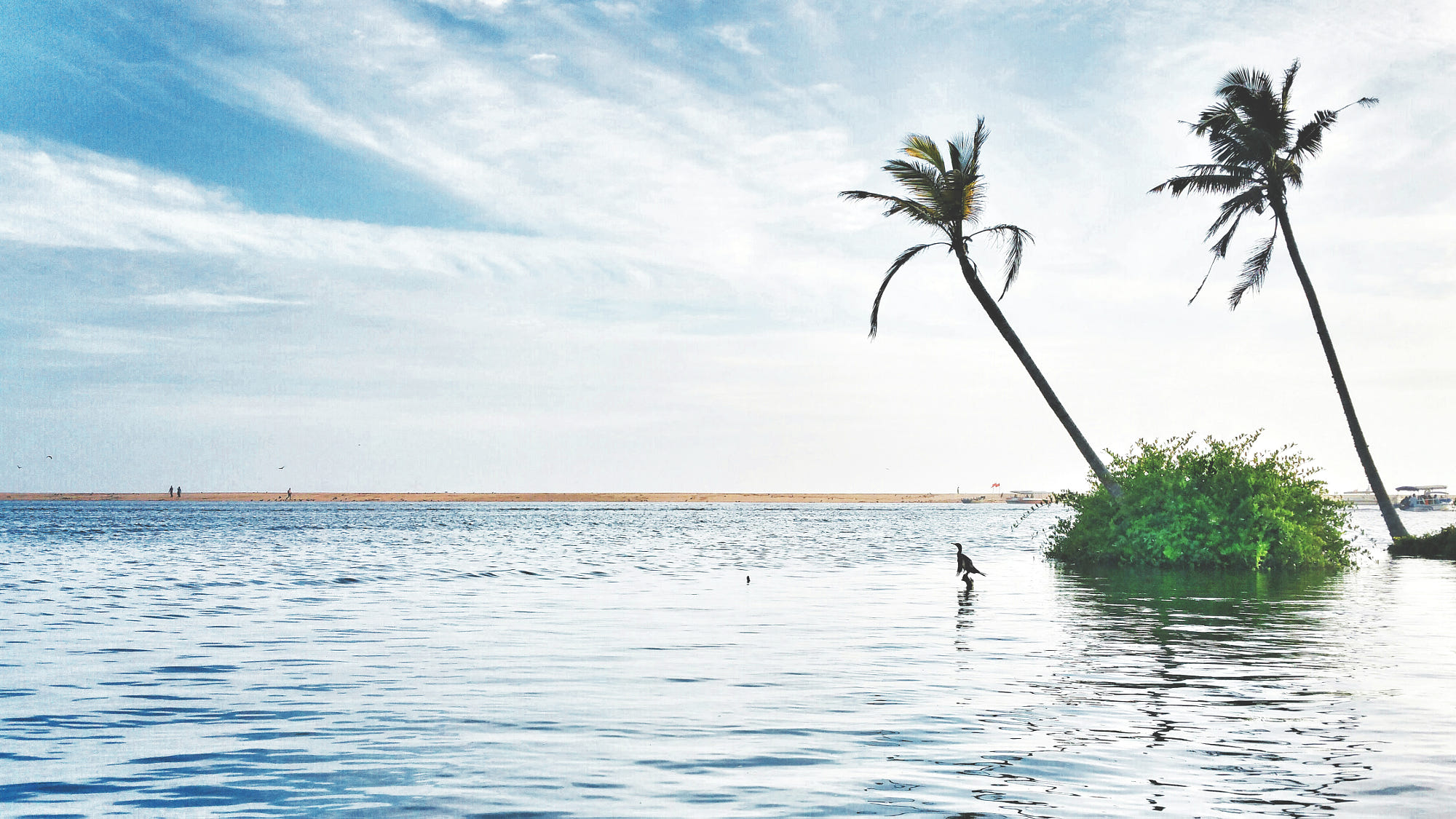
Poovar Beach features pristine golden sands fringed by coconut groves, forming a serene coastal stretch at the southern tip of . The beach is renowned for its unique where the Neyyar River meets the , creating a picturesque viewpoint especially vibrant during monsoons when river deposits enhance the landscape. Access to the beach is primarily by boat to maintain its uncrowded, ecological integrity, making it an ideal spot for tranquil sunset views overlooking the confluence. The surrounding backwaters, often called the Golden Backwaters due to their proximity to the sandy shores, offer scenic boat cruises through lush forests teeming with diverse and , including birds like and Brahminy kites. These waterways support floating cottages that provide immersive stays amid the serene environment, while the nearby Pozhikkara Beach highlights the dramatic sea-river , blending backwater tranquility with oceanic waves. The not only enrich the but also contribute to the area's ecological balance. Historically, Poovar served as a significant trading for timber, spices, , and , with legends linking it to ancient maritime routes possibly visited by ships from distant lands. It also provided refuge to King of during conflicts, underscoring its strategic coastal importance. Remnants of this era are subtle, integrated into the landscape, though specific structures like ancient warehouses are not prominently preserved. Poovar lies approximately 15 km from Beach and 25 km from the in , facilitating easy exploration of these nearby landmarks.

Shipyard and Accessibility

A at Poovar has been proposed since the early , with the Kerala Budget 2025–26 suggesting further engagement with the for establishing a facility in southern . However, as of 2025, the project remains unapproved, undeveloped, and not a priority for the state, which is considering locations in northern instead. Reported natural water depths vary from 13 to 30 meters, potentially suitable for large vessels if developed. Positioned about 10 nautical miles from international shipping lanes and 14 km from the International Seaport, it could facilitate logistics if realized, alongside local activities. Poovar's accessibility relies on a network of regional transport links, with the located about 30 kilometers away, allowing convenient air access for visitors and workers. The area connects to the NH-66 national highway, roughly 5 kilometers from the main site, providing reliable road connectivity to and beyond. Local ferries operate across the Neyyar River estuary, essential for navigating the backwater channels and reaching island resorts or the shipyard area. The nearest railway station is at Balaramapuram, approximately 10 kilometers north, offering onward connections via the Southern Railway network. Infrastructure in Poovar features basic rural roads suitable for light traffic, with no major commercial ports established, as the proposed has not progressed. Eco-friendly options, such as electric boats and bicycles, are promoted for tourists to minimize environmental impact in this sensitive coastal zone.

References

Add your contribution
Related Hubs
User Avatar
No comments yet.