Hubbry Logo
search
logo
2172411

Potential well

logo
Community Hub0 Subscribers
Read side by side
from Wikipedia
A generic potential energy well.

A potential well is the region surrounding a local minimum of potential energy. Energy captured in a potential well is unable to convert to another type of energy (kinetic energy in the case of a gravitational potential well) because it is captured in the local minimum of a potential well. Therefore, a body may not proceed to the global minimum of potential energy, as it would naturally tend to do due to entropy.

Overview

[edit]

Energy may be released from a potential well if sufficient energy is added to the system such that the local maximum is surmounted. In quantum physics, potential energy may escape a potential well without added energy due to the probabilistic characteristics of quantum particles; in these cases a particle may be imagined to tunnel through the walls of a potential well.

The graph of a 2D potential energy function is a potential energy surface that can be imagined as the Earth's surface in a landscape of hills and valleys. Then a potential well would be a valley surrounded on all sides with higher terrain, which thus could be filled with water (e.g., be a lake) without any water flowing away toward another, lower minimum (e.g. sea level).

In the case of gravity, the region around a mass is a gravitational potential well, unless the density of the mass is so low that tidal forces from other masses are greater than the gravity of the body itself.

A potential hill is the opposite of a potential well, and is the region surrounding a local maximum.

Quantum confinement

[edit]

Quantum confinement is responsible for the increase of energy difference between energy states and band gap, a phenomenon tightly related to the optical and electronic properties of the materials.

Quantum confinement can be observed once the diameter of a material is of the same magnitude as the de Broglie wavelength of the electron wave function.[1] When materials are this small, their electronic and optical properties deviate substantially from those of bulk materials.[2]

A particle behaves as if it were free when the confining dimension is large compared to the wavelength of the particle. During this state, the bandgap remains at its original energy due to a continuous energy state. However, as the confining dimension decreases and reaches a certain limit, typically in nanoscale, the energy spectrum becomes discrete. As a result, the bandgap becomes size-dependent. As the size of the particles decreases, the electrons and electron holes come closer, and the energy required to activate them increases, which ultimately results in a blueshift in light emission.

Specifically, the effect describes the phenomenon resulting from electrons and electron holes being squeezed into a dimension that approaches a critical quantum measurement, called the exciton Bohr radius. In current application, a quantum dot such as a small sphere confines in three dimensions, a quantum wire confines in two dimensions, and a quantum well confines only in one dimension. These are also known as zero-, one- and two-dimensional potential wells, respectively. In these cases they refer to the number of dimensions in which a confined particle can act as a free carrier. See external links, below, for application examples in biotechnology and solar cell technology.

Quantum mechanics view

[edit]

The electronic and optical properties of materials are affected by size and shape. Well-established technical achievements including quantum dots were derived from size manipulation and investigation for their theoretical corroboration on quantum confinement effect.[3] The major part of the theory is the behaviour of the exciton resembles that of an atom as its surrounding space shortens. A rather good approximation of an exciton's behaviour is the 3-D model of a particle in a box.[4] The solution of this problem provides a sole[clarification needed] mathematical connection between energy states and the dimension of space. Decreasing the volume or the dimensions of the available space, increases the energy of the states. Shown in the diagram is the change in electron energy level and bandgap between nanomaterial and its bulk state.

The following equation shows the relationship between energy level and dimension spacing:

Research results[5] provide an alternative explanation of the shift of properties at nanoscale. In the bulk phase, the surfaces appear to control some of the macroscopically observed properties. However, in nanoparticles, surface molecules do not obey the expected configuration[which?] in space. As a result, surface tension changes tremendously.

Classical mechanics view

[edit]
The classical mechanic explanation employs the Young–Laplace law to provide evidence on how pressure drop advances from scale to scale.

The Young–Laplace equation can give a background on the investigation of the scale of forces applied to the surface molecules:
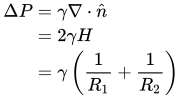
Under the assumption of spherical shape and resolving the Young–Laplace equation for the new radii (nm), we estimate the new (GPa). The smaller the radii, the greater the pressure is present. The increase in pressure at the nanoscale results in strong forces toward the interior of the particle. Consequently, the molecular structure of the particle appears to be different from the bulk mode, especially at the surface. These abnormalities at the surface are responsible for changes of inter-atomic interactions and bandgap.[6][7]

See also

[edit]

References

[edit]
[edit]
Revisions and contributorsEdit on WikipediaRead on Wikipedia
from Grokipedia
A potential well is a region in a potential energy landscape where the potential energy $ V(x) $ for a particle is lower than in the adjacent regions, confining the particle's motion if its total energy $ E $ is less than the surrounding barrier height, as visualized in graphs of $ V(x) $ versus position $ x $.[1] This concept applies across classical and quantum mechanics, with the well's shape—such as square, harmonic, or more complex forms—determining the allowed behaviors and energy states of the particle.[2] In classical mechanics, a particle in a potential well oscillates between turning points where its kinetic energy $ E - V(x) = 0 $, remaining confined within the classically allowed region where $ E > V(x) $ and unable to enter the forbidden regions where $ E < V(x) $.[1] Quantum mechanically, the time-independent Schrödinger equation $ -\frac{\hbar^2}{2m} \frac{d^2 \psi}{dx^2} + V(x) \psi = E \psi $ governs the system, yielding discrete bound states with quantized energies for $ E $ below the barrier, and wavefunctions that decay exponentially in forbidden regions due to tunneling effects.[3] For the idealized infinite square well, where $ V(x) = 0 $ inside a finite interval and $ V(x) = \infty $ outside, the energy levels are $ E_n = \frac{n^2 \pi^2 \hbar^2}{2 m a^2} $ (with $ n = 1, 2, 3, \dots $ and well width $ a $), and the wavefunction vanishes at the boundaries.[2] In contrast, a finite square well (with $ V(x) = 0 $ inside and $ V(x) = V_0 > 0 $ outside) allows a finite number of bound states depending on well depth $ V_0 $ and width, solved via transcendental equations like $ \tan(k L/2) = \gamma / k $ for even parity solutions, where $ k = \sqrt{2 m E}/\hbar $ and $ \gamma = \sqrt{2 m (V_0 - E)}/\hbar $.[3] Potential wells model fundamental physical systems, including electron orbitals in atoms and molecules, where attractive Coulomb potentials form effective wells binding particles.[4] In nuclear physics, the strong force creates a finite well approximating nucleon confinement within the nucleus, with well diameter matching nuclear size and depths around 50 MeV.[5] Double-well potentials describe phenomena like ammonia inversion via quantum tunneling between symmetric minima.[4] In modern applications, engineered quantum wells in semiconductor heterostructures (e.g., GaAs/AlGaAs layers) confine electrons and holes to nanometer scales, enabling devices like low-threshold lasers, optical modulators, and quantum dot LEDs by exploiting quantized energy levels and reduced density of states.[6] These structures highlight quantum confinement effects, altering material properties for optoelectronics and photonics.[3]

Fundamentals

Definition and Characteristics

A potential well is a region in space where the potential energy of a particle is lower than in the surrounding areas, effectively creating a trap that confines particles whose total energy is less than the height of the enclosing potential barriers.[7] This configuration arises in various physical systems, where the potential energy function exhibits a local minimum, preventing particles with insufficient kinetic energy from escaping the region.[1] Key characteristics of a potential well include its depth, defined as the difference between the minimum potential energy at the well's bottom and the height of the surrounding barriers; its width, which measures the spatial extent of the low-potential region; its shape, such as parabolic for harmonic oscillators or rectangular for idealized models; and its dimensionality, ranging from one-dimensional wells along a line to three-dimensional wells in full space.[7] These properties determine the well's ability to sustain bound states, where particles oscillate or remain confined within the well without escaping.[6] Physically, potential wells lead to the confinement of particles lacking the energy to surmount the barriers, resulting in stable bound states essential for phenomena like planetary orbits in gravitational wells or electron binding in atomic electrostatic wells.[8][9] For instance, Earth's gravitational field forms a potential well that traps satellites in orbit if their energy is below the escape threshold.[8] The concept of the potential well originates from 19th-century classical physics, rooted in potential theory developed by mathematicians such as Pierre-Simon Laplace and Siméon Denis Poisson, who formalized the mathematical description of gravitational and electrostatic potentials through equations linking potential to mass or charge distributions.[10][11] This framework laid the groundwork for understanding how potential landscapes govern particle motion in conservative force fields.[10]

Visual and Conceptual Analogies

Potential wells are commonly visualized through two-dimensional plots where the potential energy V(x)V(x) is graphed against position xx, depicting the well as a "valley" in an energy landscape with the particle's total energy represented as a horizontal line above the minimum.[1] For a harmonic potential well, the curve appears as a smooth, U-shaped parabola, illustrating symmetric confinement, while a square well is shown as a rectangular dip with vertical walls, emphasizing abrupt boundaries. These diagrams highlight how particles oscillate within the well between turning points where kinetic energy is zero, providing an intuitive grasp of bounded motion. A classic conceptual analogy for a potential well is a marble rolling in a bowl, where the bowl's curved surface represents the potential energy profile, and the marble's position corresponds to the particle's location, demonstrating classical trapping and oscillatory behavior as the marble seeks the lowest point.[12] Similarly, a ball in a valley illustrates how gravitational potential confines the object, with escape requiring sufficient energy to surmount the surrounding hills, mirroring the conditions for particle liberation from the well.[13] In a quantum context, an electron bound in an atomic orbital can be likened to a particle in a potential well, where the "holding" effect arises from electrostatic forces rather than mechanical constraints, underscoring binding without classical contact.[14] Visualization tools enhance understanding of potential wells, including energy diagrams that overlay particle trajectories on V(x)V(x) plots and contour plots for multi-dimensional wells, such as radial potentials V(r)V(r) in central force problems, which reveal circular or elliptical energy basins. Software like MATLAB facilitates plotting these profiles, allowing users to generate custom curves for various well shapes and simulate particle dynamics interactively. A common misconception is viewing potential wells as literal physical objects or holes in space, rather than abstract representations of energy landscapes shaped by forces; this linguistic trap from the term "well" can lead to confusion with tangible containers.[15] Another error involves conflating potential wells with force fields, overlooking that the well describes energy variation, while forces derive from its gradient, potentially misguiding intuitions about particle interactions.[15]

Mathematical Description

Potential Energy Profile

The potential energy profile of a potential well is graphically represented by plotting the potential energy $ V(x) $ as a function of position $ x $ in one dimension or $ V(r) $ as a function of radial distance $ r $ in higher dimensions, revealing the spatial variation that governs particle confinement.[16] Key features include minima, which correspond to stable equilibrium points where the force $ F = -\frac{dV}{dx} = 0 $ and the second derivative $ \frac{d^2V}{dx^2} > 0 $, indicating restorative behavior; maxima, representing energy barriers that particles must overcome to escape; and inflection points, where $ \frac{d^2V}{dx^2} = 0 $, often marking transitions to unstable regions.[17] These profiles are typically sketched with the horizontal axis as position and the vertical axis as energy, showing bounded regions below a certain energy level where classical particles are trapped.[18] Common functional forms for potential wells include the harmonic approximation $ V(x) = \frac{1}{2} k x^2 $, which describes small oscillations around equilibrium with a parabolic shape symmetric about the minimum at $ x = 0 $, widely used for vibrational modes in molecules and solids.[19] The Coulomb potential, $ V(x) = -\frac{k}{|x|} $ in one dimension or $ V(r) = -\frac{k}{r} $ radially, forms an asymmetric well diverging to $ -\infty $ as $ x \to 0 $ and approaching zero from below at large distances, modeling electrostatic interactions in atomic systems.[20] For more realistic molecular bonds, the Morse potential $ V(r) = D_e \left(1 - e^{-a(r - r_e)}\right)^2 $ captures asymmetry with a finite depth, steep rise near equilibrium separation $ r_e $, and gradual flattening at dissociation, better approximating anharmonic effects than the harmonic form.[21] Characteristic parameters of a potential well include the well depth $ \Delta V $, defined as the energy difference from the minimum to the asymptotic or barrier height, quantifying binding strength; the width $ L $, often the full width at half-depth or between inflection points, influencing the number of bound states; and the curvature at the minimum $ \frac{d^2V}{dx^2} \big|_{x=0} = k $, which relates to the oscillation frequency $ \omega = \sqrt{k/m} $ for small amplitudes in classical mechanics.[22] These parameters scale the profile's overall shape and depth, with the number of bound states in quantum mechanics generally increasing for deeper and wider wells.[2] In multi-dimensional cases, particularly for central force problems, the potential extends to radial form $ V(r) $ in spherical coordinates, where the effective potential becomes $ U(r) = V(r) + \frac{\ell(\ell+1)\hbar^2}{2m r^2} $ incorporating centrifugal effects, with minima shifted outward for nonzero angular momentum $ \ell $.[16] This radial profile facilitates separation of variables in the Schrödinger equation, enabling analysis of orbital motion in systems like atomic hydrogen or gravitational wells.[23]

Governing Equations

In classical mechanics, the behavior of a particle in a potential well is governed by Newton's second law, which relates the force to the gradient of the potential energy function V(x)V(x). The force acting on a particle of mass mm is F=dVdxF = -\frac{dV}{dx}, leading to the equation of motion md2xdt2=dVdxm \frac{d^2 x}{dt^2} = -\frac{dV}{dx}.[24] This differential equation describes the acceleration of the particle under the conservative force derived from the potential, assuming no dissipative effects.[24] For conservative systems, the dynamics can be reformulated using the Hamiltonian H=p22m+V(x)H = \frac{p^2}{2m} + V(x), where pp is the momentum conjugate to position xx.[25] This total energy function provides a phase-space description, with the first term representing kinetic energy and the second potential energy. Energy conservation follows directly, as the total energy E=12mv2+V(x)E = \frac{1}{2} m v^2 + V(x) remains constant along the trajectory, where v=dxdtv = \frac{dx}{dt}.[26] In a potential well, for cases with finite surrounding barriers, bound motion occurs when EE is less than the barrier height, confining the particle to oscillatory motion within the well; in potentials where $ V \to +\infty $ as $ |x| \to \infty $, such as the harmonic oscillator, the particle is bound for any finite $ E $.[1] The Hamiltonian formulation yields Hamilton's equations for phase-space evolution: x˙=Hp\dot{x} = \frac{\partial H}{\partial p} and p˙=Hx\dot{p} = -\frac{\partial H}{\partial x}.[25] These canonical equations, symmetric in form, facilitate analysis of trajectories and conserved quantities in potential wells, such as periodic orbits for bound motion.[25] Transitioning to the quantum regime, the governing equation becomes the time-independent Schrödinger equation H^ψ=Eψ\hat{H} \psi = E \psi, where the Hamiltonian operator is H^=22md2dx2+V(x)\hat{H} = -\frac{\hbar^2}{2m} \frac{d^2}{dx^2} + V(x).[27] Here, ψ(x)\psi(x) is the wavefunction, \hbar is the reduced Planck's constant, and mm is the particle mass, with solutions normalized such that ψ2dx=1\int |\psi|^2 dx = 1 to ensure probabilistic interpretation.[27] The kinetic term involves \hbar, setting the scale for quantum effects, while mm influences the curvature of the wavefunction in regions of varying V(x)V(x).[27]

Classical Perspective

Dynamics of Trapped Particles

In classical mechanics, particles trapped within a potential well exhibit bound motion when their total energy EE is less than the height of the surrounding potential barrier. The particle oscillates periodically between two turning points, where its kinetic energy vanishes and the potential energy equals EE. These turning points, denoted x1x_1 and x2x_2, satisfy V(x1)=V(x2)=EV(x_1) = V(x_2) = E, with the motion confined to the interval x1<x<x2x_1 < x < x_2. The period TT of this oscillation is determined by integrating the time taken for a full cycle, given by $ T = \sqrt{2m} \int_{x_1}^{x_2} \frac{dx}{\sqrt{E - V(x)}} $, where mm is the particle mass and V(x)V(x) is the potential energy function.[28][29] A prominent example of such bound motion occurs in parabolic potential wells, where the potential near its minimum approximates $ V(x) \approx \frac{1}{2} k x^2 $, leading to simple harmonic motion. In this case, the restoring force is linear, $ F = -k x $, and the oscillation frequency is $ \omega = \sqrt{k/m} $, independent of amplitude for small displacements. The period simplifies to $ T = 2\pi / \omega $, providing an exact solution for the ideal harmonic oscillator. This approximation is widely applicable to systems like pendulums or molecular vibrations near equilibrium.[30][19] Phase space analysis offers insight into these dynamics by plotting position xx against momentum p=mx˙p = m \dot{x}. For integrable systems like the harmonic oscillator, trajectories form closed elliptical curves, reflecting periodic and predictable motion. In anharmonic wells, where V(x)V(x) deviates from quadratic (e.g., including cubic or quartic terms), phase space portraits reveal more complex structures; low-energy orbits remain quasi-periodic, but higher energies lead to chaotic trajectories filling irregular regions, as exemplified by the Hénon-Heiles potential $ V(x,y) = \frac{1}{2}(x^2 + y^2) + x^2 y - \frac{1}{3} y^3 $.[31][32] While ideal conservative systems assume no energy loss, real-world trapped particles experience damping through dissipative forces like friction, causing amplitude decay and eventual equilibration at the well's minimum. However, analyses typically emphasize undamped cases to isolate intrinsic dynamics. Stability of these orbits is assessed via small perturbations around equilibrium; for linear wells, perturbations oscillate without growth, but nonlinear wells may exhibit instability quantified by positive Lyapunov exponents, indicating exponential divergence of nearby trajectories and the onset of chaos.[33]

Stability and Escape Conditions

In classical mechanics, a particle remains trapped within a potential well if its total energy EE is less than the height of the surrounding potential barrier, known as the escape energy EescapeE_\text{escape}. This condition ensures that the particle's kinetic energy becomes insufficient to surmount the barrier at its maximum, preventing escape to regions of higher potential. Particles with EEescapeE \geq E_\text{escape} possess enough energy to classically overcome the barrier and propagate freely.[34] In multi-dimensional or multi-well systems, such as double-well potentials, stability and escape are governed by saddle points that connect adjacent wells. The activation energy for transitioning between wells equals the potential energy at the saddle point relative to the minimum in the initial well; particles must reach this energy to cross the saddle and enter the neighboring well. For example, in the Hénon-Heiles system—a model for non-integrable escape dynamics—the threshold energy Eth=1/6E_\text{th} = 1/6 marks the onset of possible escape from the central well over saddle points.[35] Perturbations, including thermal fluctuations or external fields, can destabilize trapped particles by effectively lowering the barrier or providing transient energy boosts. In the presence of thermal noise, escape from a metastable well follows an activated process with a rate given by the Arrhenius-like expression Γexp(ΔE/kBT)\Gamma \propto \exp(-\Delta E / k_B T), where ΔE\Delta E is the barrier height, kBk_B is Boltzmann's constant, and TT is temperature; this arises from Kramers' theory for overdamped Brownian motion in a potential well. External fields, such as oscillating forces, similarly induce escape by modulating the potential landscape, with rates depending on the field's amplitude and frequency relative to the well's natural oscillation.[36] For slowly varying potential wells, where parameters change adiabatically over timescales much longer than the particle's orbital period, the adiabatic invariant—the action variable J=12πpdqJ = \frac{1}{2\pi} \oint p \, dq—remains conserved. This conservation preserves the stability of bounded orbits, ensuring that the particle's motion adapts smoothly to the evolving well without escaping, even as the energy EE adjusts proportionally.[37] Classical stability criteria break down at high energies, where relativistic effects or chaotic dynamics dominate, and at quantum scales, where tunneling permits escape for E<EescapeE < E_\text{escape} despite the absence of sufficient classical energy. These limitations highlight the regime of validity for classical descriptions, typically applicable to macroscopic systems or high-energy quantum approximations.[38]

Quantum Perspective

Wavefunctions and Energy Quantization

In quantum mechanics, bound states in a potential well arise as solutions to the time-independent Schrödinger equation for particle energies EE below the height of the confining potential barriers. The equation is given by
22md2ψ(x)dx2+V(x)ψ(x)=Eψ(x), -\frac{\hbar^2}{2m} \frac{d^2 \psi(x)}{dx^2} + V(x) \psi(x) = E \psi(x),
where ψ(x)\psi(x) is the wavefunction, V(x)V(x) is the potential energy profile, mm is the particle mass, and \hbar is the reduced Planck's constant. For bound states, the solutions ψn(x)\psi_n(x) must be normalizable, meaning ψn(x)2dx=1\int_{-\infty}^{\infty} |\psi_n(x)|^2 dx = 1, which confines the particle within the well and leads to discrete, quantized energy levels EnE_n with En<VbarrierE_n < V_{\text{barrier}}. These eigenfunctions and eigenvalues form the stationary states of the system, describing particles trapped indefinitely in the absence of perturbations.[39]/02%3A_Resonances/2.01%3A_Bound_States_and_Free_States) The physical interpretation of these wavefunctions follows from Born's rule, which states that the probability density of finding the particle at position xx is ψn(x)2|\psi_n(x)|^2. This probabilistic nature reflects the intrinsic uncertainty in quantum mechanics, where the particle does not follow a definite trajectory but is delocalized according to the wavefunction's amplitude. Regions of high ψn(x)2|\psi_n(x)|^2 indicate likely positions, while nodes—points where ψn(x)=0\psi_n(x) = 0—arise from quantum interference between de Broglie waves, resulting in zero probability density at those locations./University_Physics_III_-Optics_and_Modern_Physics(OpenStax)/07%3A_Quantum_Mechanics/7.02%3A_Wavefunctions) The lowest-energy solution, known as the ground state (n=1n=1), features a wavefunction with no nodes (except possibly at boundaries) and is characterized by a single broad maximum centered in the well, maximizing overlap with the lowest potential regions. Higher excited states (n>1n > 1) exhibit increasingly oscillatory wavefunctions with n1n-1 nodes, reflecting more rapid variations that accommodate higher energies while remaining confined. A key quantum feature is the zero-point energy, where the ground-state energy E0>0E_0 > 0 (relative to the classical minimum of the well), arising from the Heisenberg uncertainty principle, which prohibits the particle from being completely at rest even in the lowest state./03%3A_The_Schrodinger_Equation_and_a_Particle_in_a_Box/3.05%3A_The_Energy_of_a_Particle_in_a_Box_is_Quantized)[40] In the semiclassical limit of deep and wide potential wells, the Bohr correspondence principle asserts that quantum energy levels EnE_n approximate classical allowed energies, with wavefunctions concentrating near classical turning points where E=V(x)E = V(x). This alignment is captured qualitatively by the Wentzel-Kramers-Brillouin (WKB) approximation, which connects quantum quantization to classical action integrals without requiring exact solutions.[41] For transitions between these quantized levels in harmonic-like potential wells, selection rules dictate allowed changes in the quantum number, typically Δn=±1\Delta n = \pm 1, as derived from the dipole approximation in time-dependent perturbation theory; this restricts optical or vibrational excitations to adjacent states, ensuring conservation of angular momentum and parity in the interaction Hamiltonian./06%3A_Vibrational_States/6.06%3A_Harmonic_Oscillator_Selection_Rules)

Tunneling Effects

In quantum mechanics, a key feature distinguishing the quantum perspective from the classical one is the phenomenon of tunneling, where a particle with total energy EE less than the height VV of a potential barrier can penetrate into and traverse the classically forbidden region. This occurs because the particle's wavefunction, governed by the time-independent Schrödinger equation, does not abruptly terminate at the barrier's edge but instead decays evanescently in the forbidden region as ψ(x)eκx\psi(x) \propto e^{-\kappa x}, where κ=2m(VE)/\kappa = \sqrt{2m(V - E)} / \hbar, mm is the particle mass, and \hbar is the reduced Planck's constant. Although the probability density ψ2|\psi|^2 decreases exponentially, it remains finite, allowing a non-zero probability for the particle to emerge on the other side of the barrier.[42] For a rectangular potential barrier of width LL and height VV, the transmission probability TT—the ratio of transmitted to incident flux—can be approximated when κL1\kappa L \gg 1 (thick barrier limit) as
Texp(2κL), T \approx \exp\left(-2 \kappa L\right),
where the exponential factor captures the dominant suppression due to the barrier's opacity. This approximation arises from matching wavefunctions across the barrier interfaces in the exact solution of the Schrödinger equation, neglecting oscillatory contributions inside the barrier for low EE. More precise forms include a prefactor, but the exponential term sets the scale, highlighting how TT decreases rapidly with increasing barrier width or height above EE.[43] In the context of potential wells, tunneling enables escape from bound states, with profound implications in various physical systems. A seminal application is alpha decay in atomic nuclei, where an alpha particle (helium nucleus) tunnels through the Coulomb barrier surrounding the nuclear potential well. George Gamow's 1928 theory modeled the nucleus as a potential well confining the alpha particle, predicting decay rates via the tunneling probability that matched experimental Geiger-Nuttall plots of decay constant versus alpha energy. This breakthrough explained why alpha particles with EE far below the barrier height (~25 MeV) could escape, unifying radioactivity under quantum mechanics.[44] Similarly, in field emission from metals, electrons near the Fermi level in the atomic potential wells tunnel through the surface image-potential barrier under a strong external electric field, as described by the Fowler-Nordheim equation, enabling applications like electron microscopy.[45] Resonant tunneling further illustrates barrier penetration in well structures, occurring in double-barrier configurations where two potential barriers sandwich a narrow quantum well. Here, transmission TT is dramatically enhanced—approaching unity—when the incident particle's energy aligns with a quasi-bound state in the intermediate well, allowing coherent wavefunction overlap across both barriers. This resonance arises from interference effects in the time-dependent solution, leading to sharp peaks in T(E)T(E). Experimentally observed in semiconductor heterostructures like GaAs/AlGaAs, this effect was theoretically proposed and demonstrated by Esaki and Tsu, forming the basis for resonant tunneling diodes with negative differential resistance.[46] While pure ground-state tunneling is temperature-independent, overall escape rates from potential wells often exhibit temperature dependence due to thermal population of excited states within the well. Higher-energy states have wavefunctions extending farther into the barrier, effectively reducing the tunneling distance and increasing TT via smaller κ\kappa. At finite temperature, the Boltzmann factor populates these states, yielding a net rate Γ(T)ngneEn/kTTn\Gamma(T) \propto \sum_n g_n e^{-E_n / kT} T_n, where gng_n is degeneracy and TnT_n the transmission from level nn. This thermally assisted tunneling dominates in systems like molecular magnets or double wells at intermediate temperatures, bridging quantum and classical regimes.[47]

Types and Models

Infinite Potential Well

The infinite potential well, also known as the infinite square well, is an idealized model in quantum mechanics where a particle of mass $ m $ is confined to a one-dimensional region between $ x = 0 $ and $ x = L $, with the potential energy defined as $ V(x) = 0 $ for $ 0 < x < L $ and $ V(x) = \infty $ elsewhere.[48] This setup enforces hard-wall boundary conditions, requiring the wavefunction to vanish at the boundaries: $ \psi(0) = \psi(L) = 0 $.[48] The infinite barriers prevent the particle from existing outside the well, making the probability density zero beyond $ 0 \leq x \leq L $.[40] The time-independent Schrödinger equation within the well simplifies to $ -\frac{\hbar^2}{2m} \frac{d^2 \psi}{dx^2} = E \psi $, yielding exact stationary state solutions for the wavefunctions and energies. The normalized energy eigenfunctions are
ψn(x)=2Lsin(nπxL), \psi_n(x) = \sqrt{\frac{2}{L}} \sin\left( \frac{n \pi x}{L} \right),
for $ n = 1, 2, 3, \dots $, and the corresponding quantized energies are
En=n2π222mL2. E_n = \frac{n^2 \pi^2 \hbar^2}{2 m L^2}.
These solutions satisfy the boundary conditions and form orthonormal states, with the ground state ($ n=1 $) exhibiting a non-zero zero-point energy $ E_1 = \frac{\pi^2 \hbar^2}{2 m L^2} $.[48][40] Key properties of these solutions include the quadratic dependence of energy on the quantum number $ n $, leading to energy spacings that increase with $ n $: the difference $ \Delta E_n = E_{n+1} - E_n = \frac{(2n+1) \pi^2 \hbar^2}{2 m L^2} $. The wavefunctions exhibit definite parity with respect to the well's center at $ x = L/2 $, alternating between even and odd symmetry: odd $ n $ yields even parity, while even $ n $ yields odd parity. Additionally, the set $ {\psi_n(x)} $ forms a complete orthonormal basis for square-integrable functions on $ [0, L] $, enabling the expansion of any valid wavefunction as $ \psi(x) = \sum_{n=1}^\infty c_n \psi_n(x) $ with $ \sum_{n=1}^\infty |c_n|^2 = 1 $.[48] Despite its exact solvability, the model has limitations due to the unrealistic assumption of impenetrable infinite barriers, which neglects effects like tunneling in real systems.[49] It remains a valuable pedagogical tool and approximation for quantum confinement in nanostructures, such as quantum dots or wires, where barrier heights are high but finite.[49]

Finite Potential Well

The finite potential well provides a more realistic model than the infinite well by allowing the confining potential to have finite depth, enabling wavefunction penetration into classically forbidden regions. The potential is defined as $ V(x) = -V_0 $ for $ |x| < a $ and $ V(x) = 0 $ elsewhere, where $ V_0 > 0 $ is the well depth and $ 2a $ is the width.[50] Bound states occur for energies $ -V_0 < E < 0 $, while scattering states exist for $ E > 0 $.[51] The time-independent Schrödinger equation yields oscillatory solutions inside the well and exponentially decaying solutions outside. Define $ k = \sqrt{2m(E + V_0)} / \hbar $ and $ \kappa = \sqrt{-2mE} / \hbar $. For even-parity bound states, the wavefunction is $ \psi(x) = A \cos(kx) $ for $ |x| < a $ and $ \psi(x) = C e^{-\kappa |x|} $ for $ |x| > a $; continuity of the wavefunction and its derivative at $ x = a $ leads to the transcendental equation $ \tan(ka) = \kappa / k $.[51] For odd-parity states, $ \psi(x) = B \sin(kx) $ inside and an odd extension outside, yielding $ -\cot(ka) = \kappa / k $.[51] These equations are solved graphically or numerically, with intersections determining the discrete allowed energies $ E_n $.[51] The number of bound states depends on the parameter proportional to $ V_0 a^2 $, specifically $ z_0 = a \sqrt{2m V_0} / \hbar $; shallow or narrow wells support fewer states than the infinite well, and the highest energy approaches zero as the well becomes shallower.[51] For example, increasing the well width from $ 2a_0 $ (one bound state) to $ 6a_0 $ (three bound states) illustrates this dependence.[51] For scattering states with $ E > 0 $, the wavefunctions are plane waves outside the well with oscillatory behavior inside, forming a continuum of energies without quantization.[50] An incident particle from the left has amplitude $ A $ for $ x < -a $, transmitted amplitude $ F $ for $ x > a $, and inside $ -a < x < a $, $ \psi(x) = C \sin(\mu x) + D \cos(\mu x) $ where $ \mu = \sqrt{2m(E + V_0)} / \hbar $.[50] The transmission coefficient is $ T = |F/A|^2 = \left[ 1 + \frac{V_0^2 \sin^2(2 \mu a)}{4 E (E + V_0)} \right]^{-1} $, which exhibits resonances where $ T = 1 $ at certain energies, akin to the Ramsauer-Townsend effect in electron scattering.[50] The reflection coefficient is $ R = 1 - T $.[50] The one-dimensional finite well extends to three dimensions via the spherical symmetric potential $ V(r) = -V_0 $ for $ r < a $ and 0 otherwise, serving as a simple model for bound states in central potentials.[52] For $ l = 0 $ (s-states), bound states require sufficient well depth and width, solved using the radial Schrödinger equation with spherical Bessel functions inside and modified exponentials outside, analogous to the 1D case but incorporating angular momentum barriers.[52]

Applications

Atomic and Molecular Physics

In atomic physics, the potential well governing electron behavior in the hydrogen atom is described by the Coulomb potential $ V(r) = -\frac{Z e^2}{r} $, where $ Z $ is the atomic number, $ e $ is the elementary charge, and $ r $ is the radial distance from the nucleus.[53] This attractive potential confines the electron, leading to quantized energy levels and wavefunctions solved via the Schrödinger equation, with the ground state energy at -13.6 eV for hydrogen ($ Z = 1 $).[54] For multi-electron atoms, the shell structure arises from effective quantum wells formed by the nuclear attraction screened by inner electrons, resulting in an approximate central potential that organizes electrons into discrete shells labeled by principal quantum number $ n $.[55] These effective potentials explain the periodic table's filling order and chemical properties, as outer electrons experience a reduced nuclear charge due to electron-electron repulsion.[56] In molecular physics, potential wells form along the internuclear axis between atoms, dictating bond formation and stability. For van der Waals bonds, the Lennard-Jones potential models the weak attraction and repulsion between neutral atoms, capturing the equilibrium distance and binding energy for non-covalent interactions.[57] Covalent bonds, in contrast, are described by the Morse potential, which better approximates the anharmonicity of diatomic molecules, allowing for vibrational energy levels that decrease in spacing with increasing quantum number due to the well's finite depth.[58] These vibrational levels within the molecular well enable the study of bond dynamics, where the zero-point energy prevents complete collapse to the minimum.[59] Spectroscopy in atoms and molecules relies on transitions between quantized levels in these potential wells, producing absorption and emission lines corresponding to energy differences $ \Delta E $. In diatomic molecules, the Franck-Condon principle governs the intensities of these vibronic transitions, as electronic jumps occur much faster than nuclear motion, favoring vertical transitions where the internuclear distance remains unchanged. This principle, combined with selection rules, explains the progression of spectral bands observed in molecular spectra. Ionization from atomic wells requires supplying energy exceeding the binding energy, such as 13.6 eV for hydrogen's ground state electron, beyond which the particle escapes the confining potential. Quantum chemistry methods, such as the Hartree-Fock approximation, treat multi-electron systems by assuming each electron moves in an effective potential generated by the nucleus and the averaged field of other electrons, yielding self-consistent orbitals and energies. This mean-field approach provides a foundational description of atomic and molecular electronic structure, with improvements over exact solutions for heavier atoms by incorporating exchange effects to avoid unphysical electron pairing.

Solid-State Physics

In solid-state physics, potential wells play a fundamental role in describing electron behavior within crystalline materials. The periodic arrangement of ion cores in a crystal lattice generates a repeating potential landscape, where electrons are subject to a periodic potential V(r) that varies with the lattice periodicity. This structure confines electrons into allowed energy states, as described by Bloch's theorem, which states that the electron wavefunctions take the form ψ(r) = e^{i \mathbf{k} \cdot \mathbf{r}} u(\mathbf{r}), with u(r) periodic and matching the lattice symmetry. The resulting Bloch waves lead to the formation of energy bands, where allowed energies form continuous bands separated by forbidden band gaps, enabling the distinction between insulators, semiconductors, and metals based on band filling.[60] This periodic confinement is essential for understanding electrical conductivity in solids, as electrons near band edges can be excited across gaps with minimal energy input in semiconductors. Defects and impurities disrupt the ideal periodicity, creating localized potential wells that introduce discrete energy levels within the band gaps. Vacancies or interstitial atoms form deep traps, while substitutional impurities like phosphorus in silicon act as shallow donors, producing potential wells approximately 45 meV below the conduction band edge that loosely bind extra electrons.[61] Similarly, acceptors such as boron create shallow levels about 45 meV above the valence band, binding holes via analogous Coulombic wells. These levels, first systematically analyzed in the context of transistor physics, enable controlled doping to tune carrier concentrations and facilitate p-n junction formation.[62] The binding energies scale inversely with the dielectric constant and effective mass, making shallow levels prominent in wide-bandgap materials like GaAs. At the nanoscale, quantum confinement enhances these effects by shrinking the effective size of potential wells in structures like quantum dots and quantum wires. In semiconductor quantum dots, such as CdSe nanocrystals, the finite size (typically 2–10 nm) imposes three-dimensional confinement, approximating a particle-in-a-box model where energy levels discretize into atomic-like states, with the lowest transition energy increasing as the inverse square of the radius.[63] This blueshift in absorption and emission spectra, predicted by effective mass theory, allows size-tunable optoelectronics, as the confinement energy ħ²π²/(2μL²) dominates over bulk band gaps for small L. Quantum wires extend this to one dimension, further quantizing the density of states into subbands, which sharpens electrical and optical responses in nanowires. Excitons in semiconductors represent bound electron-hole pairs confined by a screened Coulomb potential well, with the attractive interaction V(r) = -e²/(εr) forming hydrogen-like states. In materials like GaAs, Wannier excitons exhibit large Bohr radii (around 10–20 nm) due to high dielectric screening (ε ≈ 12), allowing delocalization over many lattice sites while maintaining binding energies of 4–10 meV at room temperature.31002-6) These composite quasiparticles mediate efficient radiative recombination, influencing luminescence efficiency and contributing to the indirect-to-direct bandgap perception in some contexts. In electronic devices, engineered potential wells enable precise carrier confinement to boost performance. In MOSFETs, the gate-induced electric field forms a triangular potential well at the oxide-semiconductor interface, confining inversion-layer electrons to a ~10 nm thick two-dimensional electron gas, which reduces scattering and enhances mobility. For optoelectronics, multiple quantum wells in LEDs, such as InGaN/GaN heterostructures, trap electrons and holes in thin (2–5 nm) layers, increasing recombination probability and radiative efficiency by over an order of magnitude compared to bulk devices. These confinement strategies underpin modern high-speed transistors and efficient light emitters.

Nuclear and Particle Physics

In nuclear physics, the potential well describing the interaction between nucleons within atomic nuclei is often modeled using the Woods-Saxon potential, which provides a smooth approximation to the nuclear surface. This potential takes the form $ V(r) \approx -\frac{V_0}{1 + \exp\left(\frac{r - R}{a}\right)} $, where $ V_0 $ is the depth (typically around 50 MeV), $ R $ is the nuclear radius proportional to $ A^{1/3} $ (with $ A $ the mass number), and $ a $ is the surface diffuseness parameter (about 0.5–0.7 fm). This form captures the binding of nucleons in a finite well, leading to quantized energy levels in the nuclear shell model, where protons and neutrons occupy discrete orbitals analogous to electron shells in atoms, explaining magic numbers like 2, 8, 20, and 28. Alpha clustering represents a substructure within heavier nuclei, where groups of four nucleons form alpha particles (helium-4 nuclei) that occupy localized potential wells inside the overall nuclear potential. This phenomenon is prominent in light and medium-mass nuclei, such as $ ^{12}\mathrm{C} $ and $ ^{16}\mathrm{O} $, and is modeled by semi-microscopic approaches that incorporate alpha-alpha interactions as secondary wells, enhancing stability against fission or decay. Experimental evidence from resonant scattering and transfer reactions supports these clustered configurations, which lower the ground-state energy compared to independent nucleon models. In particle physics, the concept of potential wells extends to quark confinement within hadrons, governed by quantum chromodynamics (QCD). The strong force between quarks rises linearly with separation, modeled as $ V(r) \approx kr $ (with string tension $ k \approx 1 $ GeV/fm), creating an effectively infinite well that prevents free quarks from being observed, as the energy required to separate them exceeds the threshold for creating new quark-antiquark pairs. Lattice QCD simulations confirm this confining potential, reproducing hadron masses and spectra without asymptotic freedom at long distances. Beta decay involves the weak interaction enabling a transition within the nuclear potential well, converting a neutron to a proton (or vice versa) while emitting an electron and antineutrino. This process occurs between bound states of the parent and daughter nuclei, with half-lives determined by the overlap of wavefunctions and the Gamow-Teller matrix elements, as seen in decays like $ ^{14}\mathrm{C} \to ^{14}\mathrm{N} $.[64] For deep potential wells in heavy nuclei, relativistic effects become significant, necessitating modifications to the Dirac equation to account for the strong scalar and vector fields. The Dirac phenomenology incorporates a large scalar potential ($ \approx -400 $ MeV) and vector potential ($ \approx +350 $ MeV), yielding a small spin-orbit splitting that matches observed single-particle levels in nuclei like lead-208, unlike non-relativistic models. These relativistic mean-field theories, such as the Walecka model, provide accurate binding energies and radii for superheavy elements.

References

User Avatar
No comments yet.