Recent from talks
Nothing was collected or created yet.
Principality of Calenberg
View on WikipediaThis article has multiple issues. Please help improve it or discuss these issues on the talk page. (Learn how and when to remove these messages)
|
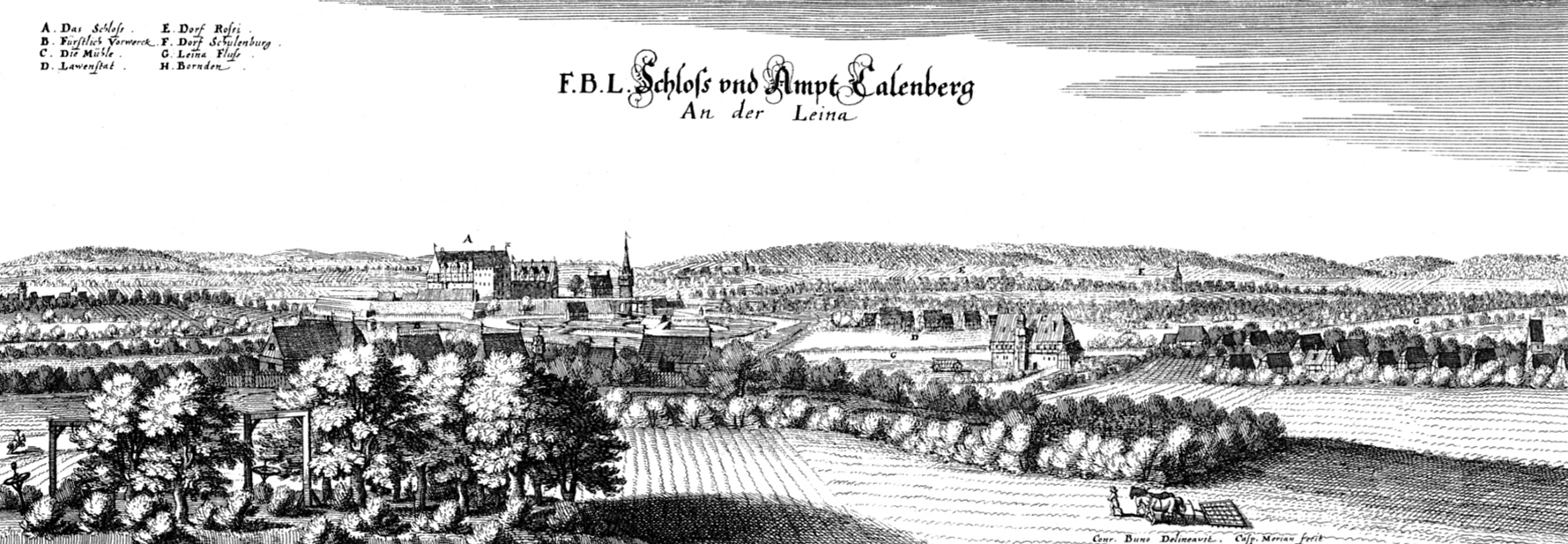
The Principality of Calenberg was a dynastic division of the Welf Duchy of Brunswick-Lüneburg established in 1432. Calenberg was ruled by the House of Hanover (from the Principality of Lüneburg) from 1635 onwards; the princes received the ninth electoral dignity of the Holy Roman Empire in 1692. Their territory became the nucleus of the Electorate of Hanover, ruled in personal union with the Kingdom of Great Britain from 1714 onwards. The principality received its name from Calenberg Castle, a residence of the Brunswick dukes.
Key Information
Territory
[edit]
When Eric I, Duke of Brunswick-Lüneburg chose the Principality of Calenberg as his part of the inheritance in 1495, he described it as "the land between the River Leine and the Deister". This geographical description, however, was never totally correct. In fact, the principality extended west of the Leine from Schulenburg as far as Neustadt am Rübenberge in the north and thus much further north than the foothills of the Deister. To the south-west the territory stretched as far as Hamelin on the Weser, well beyond the Deister.
The city of Hanover was largely independent of Welf territorial lordship, even though it was not formally a free imperial city. Not until George of Calenberg, who had been a successful general in the Thirty Years War, chose the city as his Residenz in 1636 could Hanover also be viewed as part of the Principality of Calenberg. Calenberg Castle was demolished and slighted between 1692 and 1694.
Because of the link that had existed since 1463 between the principalities of Calenberg and Göttingen, the latter was also sometimes referred to as Calenberg. Today the term Calenberg Land is usually only used for the region between Hanover and the Deister.
History
[edit]Origins and foundation of Calenberg Castle
[edit]Originally the territory belonged to the Duchy of Saxony but in 1180, after the imperial ban had been imposed on the Welf prince, Henry the Lion, he lost his ducal lands in Saxony and Bavaria. However, in 1235, Henry's grandson, Otto the Child, was promoted to the rank of prince as a result of the reconciliation between the Houses of Hohenstaufen and Welf and was given the allodial estates of the family claimed by them in the area between Lüneburg and Brunswick as the new and independent Duchy of Brunswick-Lüneburg. In the region west of Hanover, the Welfs had but few allodial possessions and so that area was disputed between the House of Welf and the bishops of Hildesheim and Minden. It was largely ruled by comital dynasties, such as the counts of Wölpe in the northwest, the counts of Hallermund in the southwest and the counts of Rhoden in the west and in Hanover.
In 1292 Duke Otto the Strict from the Lüneburg line of the Welfs subjugated the region. Earlier, he had yielded to the Bishop of Hildesheim and accepted the city of Hanover as his fief. However, he shook off his allegiance and founded Calenberg Castle, just 13 km (8.1 mi) west of Hildesheim, in a countermove in order to further reduce the power of the Bishop of Hildesheim in the Hanover area.
Administratively, this area was initially still called the Vogtei of Lauenrode, after Lauenrode Castle on the outskirts of Hanover, from where, the Welfs ruled the territory. With the extinction of the Lüneburg line of the Welfs, the Lüneburg War of Succession, broke out (1371–88) during which Lauenrode Castle was stormed by the citizens of Hanover and destroyed. The Vogtei was then moved to Calenberg Castle.
Welf inheritance divisions
[edit]
The Welf dukes did not inherit their land by primogeniture and this resulted in the late Middle Ages in numerous Welf estates and a great fragmentation of Welf territory. In 1400 the Vogtei of Calenberg went to the Wolfenbüttel line of the Welfs. In 1408 and 1409 they were able to purchase the county of Everstein and the lordship of Homburg after the extinction of their reigning families. These were added to the Vogtei of Calenberg. In a further Welf inheritance in 1432 - the ninth according to Gudrun Pischke - the area was divided again by the Welf dukes William the Victorious and Henry the Peaceful who had hitherto ruled jointly in the Principality of Brunswick-Wolfenbüttel.[1] While Henry retained the Wolfenbüttel lands, William was compensated with the newly created Principality of Calenberg. At that time, the lordship given to William had no name. It consisted of the rights formerly owned by the Principality of Lüneburg between the Deister range and the Leine river, as well as the former County of Wölpe, the lordship of Hallermund near Springe and the Homburg and Everstein dominions.
As the Welf princes all carried the ducal title and the territories they ruled were principalities within the Duchy of Brunswick-Lüneburg, their dominions were named after the main castle or town. William spent most of his time at Calenberg Castle from where he administered the territory. As a result, it is probable that the name of the Principality of Calenberg emerged during this time.
Unification with Göttingen
[edit]Between 1442 and 1463 William succeeded in taking over the rule over the Brunswick Principality of Göttingen. Although unification with Calenberg initially came about purely by chance, it lasted nonetheless. In order to distinguish the two areas which were physically separated by the foothills of the uplands in the Leine valley, Calenberg in the north was usually referred to as Unterwald ("Lower Forest"), whilst the Göttingen region was called the Oberwald ("Upper Forest"). When in 1473 William also inherited the Principality of Wolfenbüttel from his brother Henry who had left no heirs, he ceded sovereignty over Calenberg to his sons William the Younger and Frederick III, known as "the Restless" or "Turbulentus".
After the death of William the Victorious in 1482 both sons shared the regency. In an agreement dated 1 August 1483, however, they split the rights of use (Mutschierung). The younger son, Frederick the Restless, was awarded the rights of use over Calenberg and Göttingen, and his brother William the Younger was awarded the rule over Wolfenbüttel. Nevertheless, in 1484/85 William deposed his brother Frederick and declared him insane. The reasons for his removal are debated; perhaps by his participation in many armed conflicts, Frederick was seen to pose a threat to Welf rule in Calenberg and Göttingen. So William succeeded - albeit only briefly - in re-uniting the entire territory of the principalities of Calenberg, Brunswick-Göttingen and Brunswick-Wolfenbüttel. After Frederick's death in 1495, however, William again divided his territories and left the Principality of Brunswick-Wolfenbüttel to his elder son Henry V.
Under Eric I, Elisabeth and Eric II
[edit]
The younger son, Eric I received Calenberg and Göttingen and thus founded the Calenberg line of the House of Brunswick-Lüneburg. In the new territory so formed, the name Calenberg was increasingly used for both parts of the state. For the period under Eric I and his son, Eric II, however, the name "Principality of Calenberg-Göttingen" was also used a lot. The principality had separate parliamentary Estates and separate councils for each part. The chancellery for Unterwald was established in Neustadt on Rübenberge and that for Oberwald in Münden. There were also separate residences, lordly castles or manor houses and palaces in each town as well as separate repositories for their records.
Under Eric I, Calenberg Castle was expanded into a strong fortress. Another heavily fortified castle, which he had built, was the Erichsburg near Dassel on which construction began in 1527. In the Hildesheim Diocesan Feud in 1519 he was initially defeated militarily in the Battle of Soltau. Diplomatically, however, he was able to win a ruling from the Emperor Charles V that saw a large part of the Prince-Bishopric of Hildesheim added to his domain.
Eric I was hostile to the emerging Protestant Reformation. His second wife, Elisabeth of Brandenburg, however, whom he married in 1525, switched over to the new doctrine in 1535 and promoted it at the court, which then resided at Münden. After Eric's death in 1540 she took over the government for their underage son, Eric II, and implemented the Reformation in the principality with the state superintendent Antonius Corvinus she had appointed. Eric II, however, converted to Roman Catholicism in 1547 even though he was raised as an Evangelical by his mother. He was not able to reverse the Reformation in the principality however. His power in the principality was already very weak. He spent most of his time as a mercenary leader abroad, and was financially dependent on the towns. In 1553 he had to secure the financial aid of his towns by approving evangelical preaching. From 1574 he had Neustadt am Rübenberge developed as a fortified town and built Landestrost Castle within its walls as a Renaissance chateau, integrated into a bastion fortress based on the Italian model.
In 1582 when the counts of Hoya died out, the larger part of the county went to Calenberg. In 1584 Calenberg also acquired the Diepholz.
Thirty Years' War
[edit]After Eric's death in 1584 Calenberg-Göttingen was again ruled by the Wolfenbüttel line of the Welfs. In the Thirty Years' War the brother of Duke Frederick Ulrich, "mad" Christian, brought the war to the state. After Danish troops under King Christian IV, who was then commander of the Lower Saxon Circle, was defeated by the general of the Catholic League, Tilly in the Battle of Lutter, Tilly occupied the whole principality in 1626. Only the cities of Brunswick and Hanover could not be captured.

When Duke Frederick Ulrich died childless in 1634 the Wolfenbüttel line of the Middle House of Brunswick ended with him. In 1635 Duke Augustus the Elder from the Middle House of Lüneburg received the Principality of Calenberg-Göttingen.[2] After his death in 1636 his younger brother George became its ruler. He was successful as a general on the Swedish side and he also succeeded in 1637 in recovering the country and especially the towns for the Welfs. He initially ruled out of occupied Hildesheim, but then moved his residence to Hanover, which he also had built as a fortress. He had the former Franciscan friary, built around 1300, converted into the Leineschloss, which from then on served as a residence for the sovereigns of the principality. After his death in 1641 a separate peace was hastily concluded with the emperor, which had to be paid for by the return of the land acquired during the Hildesheim Diocesan Feud. George's sons, Christian Louis, George William, John Frederick and Ernest Augustus then ruled the Principality of Calenberg-Göttingen in succession.
Elevation to an electorate
[edit]In 1665 the Principality of Grubenhagen, whose line had died out in 1596 and over which the lines of Lüneburg and Wolfenbüttel had long fought in the Imperial Chamber Court, was also finally added to the Calenberg dynasty. George's youngest son, Ernest Augustus, who ruled from 1679, carried on the successful policies of his father and his brothers. In 1689 the Calenbergs also inherited Saxe-Lauenburg. Ernest Augustus switched to the side of the emperor and introduced primogeniture, contrary to the direction of his father. In 1692 for his services to the emperor, Ernest Augustus was rewarded after a long struggle with the title of the ninth electorate. Officially he was now the Elector of Brunswick-Lüneburg and his government was called the "Electoral Brunswick-Lüneburg Government".[3] In 1705 it was enhanced further by the inheritance of the Principality of Lüneburg, whereby all the estates of the Welfs, apart from the Principality of Brunswick-Wolfenbüttel, became united under the line also known as the House of Hanover from which the British royal throne are descended.
Economic and social history
[edit]The Principality of Calenberg was initially a rather insignificant territory and Welf lordship developed here quite late. By the reign of George of Calenberg in 1636, the principality had experienced 140 years of almost continuously poor government that cared little about the state. In the Middle Ages and the Renaissance the cultural centres lay outside Calenberg in the towns of Brunswick, Hildesheim and Lüneburg. New centres were created at the residences of Wolfenbüttel and Celle. Even the city of Hanover was not governed by the Calenberg princes until 1636. The other towns remained unimportant.
Only after the reign of George of Calenberg and its subsequent elevation to the electorate did the former Principality of Calenberg become the nucleus of what later became the German state of Lower Saxony.
Princes of Calenberg
[edit]References
[edit]- ^ The House of Brunswick at Leibnitiana. Retrieved on 25 Jun 2010.
- ^ Georg (George) of Calenberg at Leibnitiana. Retrieved on 25 Jun 2010.
- ^ "the electors themselves placed great value on the title "Brunswick-Lüneburg", a description which is almost always used in the official titles and documents of the electorate, Niemeyer / Ortenburg 1976: 7. Unofficially, it was also referred to as the Electorate of Hanover or Kurhannover
Sources
[edit]- Güßfeld, Ludwig; Erben, Homann (1786/2002). Die Fürstenthümer Grubenhagen, Calenberg, Wolfenbüttel und Blankenburg 1786. Verlag Rockstuhl, Bad Langensalza, Reprint 1786/2002, ISBN 3-936030-51-0 (Historic map)
- Historisches Museum Hannover (1979). Calenberg – Von der Burg zum Fürstentum. Hanover
- Hauptmeyer, Carl-Hans (1983) Calenberg – Geschichte und Gesellschaft einer Landschaft. Hanover
- Havemann, Wilhelm (1974/75). Geschichte der Lande Braunschweig und Lüneburg. 3 volumes. Reprint. Hirschheydt, Hanover 1974/75, ISBN 3-7777-0843-7 (Original edition: Verlag der Dietrich'schen Buchhandlung, Göttingen 1853–1857)
- Kalthof, Edgar (1982). Geschichte des südniedersächsischen Fürstentums Göttingen und des Landes Calenberg im Fürstentum Calenberg 1285–1584, Verlag Otto Zander, Herzberg (Harz)-Pöhlde, ISBN 3-923336-03-9
- Patze, Hans (Begr.) (1977). Geschichte Niedersachsen. 7 volumes. Hahnsche Buchhandlung, Hanover (Veröffentlichungen der Historischen Kommission für Niedersachsen und Bremen, 36) (Overview by the publishers)
- Pischke, Gudrun (1987). Die Landesteilungen der Welfen im Mittelalter. Lax, Hildesheim, ISBN 3-7848-3654-2
Principality of Calenberg
View on GrokipediaTerritory and Geography
Territorial Extent and Borders
The Principality of Calenberg encompassed a central region of the Duchy of Brunswick-Lüneburg, positioned between the Leine River to the east and the Deister hill range to the west, with the Weser River marking a northwestern boundary.[3][4] This configuration formed a compact territory focused on the Leine depression, including the vicinity of Hanover as its administrative core. The principality's extent reflected early Welf divisions, initially centered on Calenberg Castle and expanding through inheritance to incorporate adjacent administrative districts (Ämter) such as those around Pattensen and Hanover.[5] Northern borders adjoined the Principality of Lüneburg, while southwestern limits reached toward Hamelin along the Weser, and northwestern edges were delineated by streams like the Rollbeeke, separating it from the County of Minden (later under Prussian control).[4][5] To the south, the territory interfaced with the Prince-Bishopric of Hildesheim, whose ecclesiastical lands provided a natural ecclesiastical-secular divide, and eastern and southeastern frontiers connected with other Welf holdings or the Bishopric's extensions before later unifications. Western contacts included the Duchy of Brunswick-Wolfenbüttel, with shared dynastic ties influencing fluid boundary management amid Holy Roman Empire fragmentation.[6] These borders, often leveraging rivers and ridges for defensibility, underwent adjustments through partitions and reunifications, such as the 1495 merger with Göttingen, which extended southern reaches without fundamentally altering the core Calenberg outline.[3]Key Settlements and Features
The Principality of Calenberg occupied a fertile lowland region in the Leine River valley, southwest of modern Hanover, bounded by the Deister hill chain to the southwest and the Leine River along its northern and eastern edges. This landscape featured the prominent Calenberg hill, rising to approximately 154 meters, which anchored the territory's namesake fortress and provided strategic oversight of the surrounding meadows and wetlands. The Ihme River further traversed the area, contributing to its hydrological character as a region dotted with moors and streams suitable for water defenses.[7] Calenberg Castle, erected in 1292 by Welf Duke Otto the Strict as a water castle between two arms of the Leine near Pattensen, stood as the principality's foundational military and administrative hub following its establishment in 1432. Located in the Amt Calenberg district, the fortress was fortified into a bastion during the 16th century under rulers like Eric I but was largely razed after the Thirty Years' War, leaving ruins that underscore its historical centrality. Pattensen, adjacent to the castle in the municipality of Schulenburg, emerged as an early administrative focus, hosting local governance before the capital shifted.[7] By 1636, amid post-war reconstruction, the residence relocated to Hanover (Hannover), elevating it as the principality's chief urban center with growing trade and administrative prominence. Other key settlements included Barsinghausen, Springe, and Wennigsen, each featuring medieval monasteries founded in the 13th century—such as the Augustinian priory at Barsinghausen and the Cistercian house at Mariensee—which served ecclesiastical and economic roles in the rural matrix. These towns, alongside villages like Eldagsen, supported agriculture and local crafts within the principality's approximately 1,050 square miles of territory traversed by the Leine and western tributaries.[8][7][9]Historical Origins and Development
Foundation of Calenberg Castle and Early Establishment
Calenberg Castle was initially referenced as a manor (Hof Calenberg) in 1232, with subsequent mentions in 1280 suggesting the presence of a modest tower fortification (Turmburg) on the site.[10] The structure's formal foundation occurred between 1290 and 1292 under Duke Otto the Strict (Otto der Strenge) of the Lüneburg line of the House of Welf, who constructed it as a water castle (Wasserburg) overlooking the Leine River ("Super Leynem fluvium") to counter territorial encroachments by the Bishopric of Hildesheim.[10] [11] Positioned in the Leine river meadows between two river branches on a southern chalk marl bank near modern Pattensen, the castle served as a strategic bulwark in the contested border region of the Duchy of Brunswick-Lüneburg.[10] The castle received its first explicit documentary mention in 1313, by which time it had evolved into a fortified complex with defensive expansions, including a tower (Torturm), outer walls (Ummauerung), and a western wing completed around 1350.[10] By 1363, it incorporated practical infrastructure such as a mill and a toll station for a nearby bridge, underscoring its role in local economic control and administration.[10] In 1380, the fortress withstood an attempted siege by forces of the Bishop of Hildesheim, prompting retaliatory destruction of rival fortifications like Nabershausen and reinforcing Welf dominance in the area.[10] By 1405, Calenberg Castle had ascended to the status of administrative center for the Vogtei Calenberg, a bailiwick overseeing Welf lands in the Leine valley and laying groundwork for territorial consolidation.[10] This development culminated in the formal establishment of the Principality of Calenberg in 1432, when Duke William the Victorious (Wilhelm der Siegreiche) partitioned the Duchy of Brunswick-Lüneburg, designating the Calenberg region—including the castle as its namesake and initial residence—as a distinct appanage for his lineage.[12] The principality's early phase under Welf rule thus anchored on the castle's defensive and administrative legacy, delineating a core territory of approximately 1,050 square miles traversed by the Leine and Weser rivers.[12]Welf Dynastic Divisions
The House of Welf's governance of the Duchy of Brunswick-Lüneburg was characterized by repeated territorial partitions among heirs, a standard practice in medieval and early modern German principalities to allocate appanages for younger sons while preserving familial control over fragmented lands. These divisions often led to temporary separations followed by reunifications upon extinction of lines or strategic inheritances, fostering competition and administrative complexity within the dynasty. The Principality of Calenberg emerged as one such appanage through this process, initially carved from territories previously held by the Brunswick-Wolfenbüttel branch.[1][13] In 1432, a key partition divided the inheritance of Duke Henry I of Brunswick-Lüneburg, with his sons William I (c. 1392–1482) receiving the Calenberg territories—primarily lands between the Deister and Leine rivers—and Henry II (d. 1473) retaining Wolfenbüttel; Henry II's childless death returned some assets to the family pool, enabling William I to consolidate Calenberg as a semi-autonomous principality under Welf rule. William I further expanded holdings by acquiring the adjacent Principality of Göttingen in 1463 through marriage and inheritance, briefly uniting it with Calenberg until dynastic pressures prompted re-division.[1][12][13] A pivotal reconfiguration occurred in 1495, when William II, Duke of Brunswick-Lüneburg (d. 1503), apportioned his domains prior to his death; his son Eric I, the Elder (1470–1540), was granted Calenberg-Göttingen, establishing the distinct Calenberg line and marking its formal independence from Wolfenbüttel influences. Eric I's succession formalized Calenberg's status as a sovereign Welf principality, with governance centered at Calenberg Castle, though the line faced ongoing subdivision risks as Eric II (1528–1584), his son and successor, ruled a narrowed domain until its temporary merger with Wolfenbüttel in 1584 following Eric II's disputes and lack of direct heirs. These partitions underscored the Welfs' adaptive yet fragmenting inheritance strategies, prioritizing lateral distribution over primogeniture to mitigate succession crises.[1][14][12]Major Historical Phases
Unification with the Principality of Göttingen
Duke William II of Brunswick-Lüneburg, who ruled the Principality of Calenberg from its partition in 1432, pursued expansion into the adjacent Principality of Göttingen, a separate Welf branch territory established in 1368 through division from the Duchy of Brunswick.[12] Beginning in 1442, William engaged in military campaigns and diplomatic maneuvers to assert control, exploiting internal divisions among Göttingen's rulers, including conflicts with Otto the One-Eyed and subsequent heirs.[12] By 1463, he had fully incorporated Göttingen, uniting its approximately 1,200 square kilometers of southern territories—centered on the city of Göttingen and extending to the Harz Mountains—with Calenberg's northern core around the Leine River valley, thereby doubling the combined principality's territorial extent to roughly 2,500 square kilometers.[12] [15] This merger strengthened Calenberg's strategic position within the fragmented Welf domains, providing access to key trade routes and enhancing defensive capabilities against rival branches like Wolfenbüttel. William, styled "the Victorious" for these conquests, governed the unified Calenberg-Göttingen until his death on May 25, 1482, administering it as a cohesive entity despite ongoing feuds with the Holy Roman Emperor Frederick III over imperial mediatization claims.[12] The union facilitated centralized rule, with William issuing coins and charters under the combined arms, though it remained provisional due to the agnatic inheritance customs of the House of Welf, which prioritized partition over primogeniture.[15] Following William's death, his sons divided the inheritance: Frederick II received Wolfenbüttel, while Calenberg and Göttingen were initially separated among lesser heirs, leading to a temporary dissolution of the union by 1495 amid further dynastic splits.[12] This reversion underscored the fragility of Welf territorial consolidations, driven more by personal ambition than enduring legal frameworks, yet the 1463 merger set a precedent for later re-integrations, influencing the principality's evolution toward the House of Hanover's core holdings.[12]Rule under Eric I, Elisabeth, and Eric II
Eric I ruled the Principality of Calenberg-Göttingen from 1495 until his death in 1540, focusing on imperial loyalty and infrastructural development amid financial strains. He served Emperor Maximilian I in campaigns against Venice and the Swiss Confederation, notably rescuing the emperor at the 1504 Battle of Mengersbach, and later supported defenses against Turkish and French threats.[16] Domestically, he rebuilt Calenberg Castle and constructed Erichsburg at Dassel, but persistent debts led him to grant religious freedoms to cities including Göttingen, Hanover, and Northeim in 1532, allowing early Protestant influences despite his personal Catholic devotion.[16] Upon Eric I's death on July 30, 1540, his second wife Elisabeth of Brandenburg assumed regency for their underage son Eric II, born August 10, 1528, serving as primary administrator for approximately five years while co-guardians including Philip of Hesse provided nominal oversight. A convert to Lutheranism by 1538, Elisabeth corresponded with Martin Luther, who gifted her a German Bible, and actively promoted the Reformation by appointing Lutheran reformers to administrative roles and issuing a 1542 Church Order that repurposed churches and monasteries for Protestant use without outright abolition.[17] She commissioned church inspections led by preacher Anton Corvinus in 1542–1543 and authored an administrative manual to prepare Eric II for rule, embedding Protestant governance in the principality.[17][18] Eric II assumed personal rule around 1545 following the regency's end, inheriting a Protestant principality but navigating complex allegiances that included a shift toward Catholicism under Emperor Charles V's influence. Despite his evangelical upbringing, he fought on the imperial side in the Schmalkaldic War (1546–1547), besieging Protestant-held Minden unsuccessfully and suffering defeat at the Battle of Drakenburg on May 23, 1547, yet retaining northern territories.[18] His reign involved further military service in Italy, Spain, and France, earning the Order of the Golden Fleece in 1573, alongside attendance at imperial diets like Regensburg, where he affirmed but pragmatically adjusted religious loyalties. Financial woes prompted sales of principality lands, and without legitimate male heirs, Calenberg reverted to the Wolfenbüttel line upon his death on November 17, 1584, in Pavia, Italy.[18]Impact of the Thirty Years' War
The Principality of Calenberg experienced severe military disruptions during the Thirty Years' War (1618–1648), as conflicting armies—Danish, Imperial, and Swedish—traversed and occupied its territories amid the broader Protestant-Catholic struggle within the Holy Roman Empire. In the Danish intervention phase (1625–1629), Imperial forces under Johann Tserclaes, Count of Tilly, captured Calenberg Castle on November 3, 1625, following heavy losses to plague in their ranks, marking an early Imperial incursion into Welf lands. Danish troops under King Christian IV subsequently ravaged northern German principalities, including areas adjacent to Calenberg, exacerbating local instability through foraging and skirmishes. These early campaigns set the stage for prolonged foreign quartering, which strained resources and initiated economic decline by disrupting agriculture and trade in the region's fertile Deister foothills.[19] Duke George of Brunswick (1582–1641), a Welf prince who switched allegiances among Danish, Imperial, and Swedish commands, played a pivotal role in the principality's wartime fortunes. After the death of Duke Frederick Ulrich in 1634 without heirs, which fragmented Welf holdings, George asserted claims to Calenberg amid ongoing occupations. By 1636, allying with Swedish forces under the Protestant banner, he recaptured key territories, establishing Hanover as his residence to consolidate control and fortify against further incursions. This reclamation, however, occurred against a backdrop of repeated sieges and plundering, with Calenberg Castle—once a central Welf stronghold—suffering extensive damage that rendered much of it ruinous by war's end.[20][21] Demographically, the war inflicted profound losses, consistent with broader patterns in the Holy Roman Empire's urban and rural communities, where approximately one-third of urban populations perished from combat, famine, disease, and displacement. Calenberg's settlements, reliant on localized farming and forestry, faced comparable attrition—estimated at 30–40% overall—due to troop movements, epidemics like typhus, and emigration, though precise local censuses remain elusive. Economically, the principality endured looting, abandoned fields, and halted commerce, with post-1636 recovery under George involving nascent central administration and a standing army to deter recidivism, though full rebuilding lagged until the Peace of Westphalia in 1648. These impacts underscored the war's causal role in depopulating Protestant territories, fostering long-term fiscal reforms amid Habsburg overreach.[22]Elevation to Electorate Status
In 1692, Holy Roman Emperor Leopold I elevated the Principality of Calenberg, under the rule of Ernst August, Duke of Brunswick-Lüneburg, to the status of an electorate within the Empire, creating the ninth electorate known formally as the Electorate of Brunswick-Lüneburg but commonly as the Electorate of Hanover.[23] This act occurred on 22 March 1692, rewarding Ernst August's substantial military contributions, including the provision of troops to imperial forces during conflicts against France in the Nine Years' War and Ottoman advances in the Great Turkish War.[24] Ernst August, the youngest son of Duke George of Calenberg, had consolidated control over key Welf territories including Calenberg, Göttingen, and Grubenhagen by the 1680s through strategic inheritances and primogeniture agreements among his brothers, positioning his line as the dominant branch.[23] The elevation aimed to bolster Habsburg influence by creating a Protestant counterweight to Catholic electorates, particularly after the Palatinate's inheritance by a Catholic branch, while granting Ernst August influence over imperial elections and legislative matters in the Reichstag.[23] However, the grant faced immediate opposition from existing electors and princes, who contested the addition of a new vote and privileges such as appellate rights (non appellando), leading to delays in formal recognition by the Imperial Diet.[23] Ernst August died in 1698 without the elevation being fully ratified, but his son George Louis inherited the claim and pursued diplomatic efforts, securing Diet approval only in 1708 amid shifting alliances during the War of the Spanish Succession.[24] This status upgrade transformed Calenberg's administrative and diplomatic standing, enabling investments in institutions like the University of Helmstedt for training officials and facilitating dynastic ties, notably George Louis's later ascension to the British throne in 1714 under the Act of Settlement.[23] The electorate's indivisibility clause ensured territorial unity under primogeniture, preventing further Welf partitions and laying the foundation for Hanover's expansion in the 18th century.[24] Despite initial resistance rooted in concerns over diluting electoral exclusivity, the elevation reflected pragmatic imperial politics, prioritizing military loyalty over traditional precedents.[23]Governance and Institutions
Administrative Structure
The Principality of Calenberg's administration centered on the prince, supported by a privy council and chancellery that handled legislative, judicial, and fiscal matters at the territorial level. Local governance occurred through a system of Ämter, territorial districts managed by appointed Amtmänner who enforced princely authority, collected taxes, administered justice, and maintained order.[25] In 1636, Duke George established Hannover as the principal residence, initiating reforms that expanded central institutions, including dedicated fiscal and military offices, to strengthen princely control amid the disruptions of the Thirty Years' War.[26] This centralization reduced reliance on feudal lords and enhanced direct administration over the principality's approximately 48 square miles by 1800. Key Ämter included Calenberg, which preserved the legacy of the medieval Großvogtei Calenberg for judicial and fiscal oversight; Erichsburg; and others such as Hardegsen, Lauenförde, Moringen, and Nienover, as documented in the 1689 head tax register for Calenberg-Göttingen.[25][27] These districts facilitated granular control, with Amtmänner reporting to central authorities while managing local estates and peasant obligations.[28] The estates (Landstände), comprising nobility, clergy, and burghers, advised the prince on taxation and policy, convening periodically until their influence waned under absolutist reforms in the late 17th century.[29] This structure balanced central sovereignty with local autonomy, adapting to dynastic unions like the 1513 incorporation of Göttingen.Relations with the Holy Roman Empire
The Principality of Calenberg possessed imperial immediacy as a subdivision of the Welf Duchy of Brunswick-Lüneburg, rendering its rulers direct vassals of the Holy Roman Emperor with obligations including military service, financial contributions via the Reichssteuer, and representation at the Imperial Diet (Reichstag). Established in 1432 through enfeoffment to Duke Eric I, Calenberg integrated into the Lower Saxon Circle, where it maintained a designated bench (the 66th seat) for princely deliberations on imperial matters.[30] Rulers actively engaged in imperial affairs, as exemplified by Eric II, who upon inheriting Calenberg-Göttingen in 1540 complied with Emperor Charles V's summons to the Augsburg Diet of 1548, affirming Welf loyalty amid religious and political tensions.[18] Similarly, during the 1630s, imperial mediation under Emperor Ferdinand II facilitated George of Calenberg's inheritance in 1635, resolving dynastic disputes through enforced agreements among Welf branches to preserve territorial integrity.[20] Relations reached a pinnacle under Ernst Augustus, who succeeded to Calenberg in 1679 and provided substantial military contingents—numbering up to 12,000 troops—and financial aid to Emperor Leopold I against French incursions in the Nine Years' War and Ottoman threats. In recognition, on 19 December 1692, Leopold I elevated Calenberg (united with Göttingen and other Welf lands) to the ninth electorate, designated the Electorate of Brunswick-Lüneburg, thereby enhancing Hanover's influence in imperial elections and governance without immediate opposition from other electors.[24][31] This grant, formalized despite procedural delays until 1708, underscored Calenberg's transition from regional principality to key imperial player, though it preserved obligations like electoral participation and aid quotas.Economy, Society, and Culture
Economic Foundations and Growth
The Principality of Calenberg's economy was predominantly agrarian, centered on the cultivation of grains such as rye, wheat, and oats, alongside livestock rearing in the fertile Leine River valley and adjacent lowlands.[32] These areas benefited from loess soils conducive to mixed farming, with manorial estates dominating production under a system of strict seigneurial oversight that emphasized domain lands for princely revenues.[33] Impartible inheritance among peasant holdings reinforced this structure, limiting fragmentation and maintaining output stability despite feudal obligations like labor services and rents in kind.[33] Subsidiary activities included forestry and limited local crafts, but trade remained modest, oriented toward regional markets via riverine routes along the Leine for surplus grains and timber.[34] The principality lacked significant mineral resources, distinguishing it from eastern Welf territories with Harz mining; instead, economic output hinged on agricultural yields, which supported a population of approximately 100,000 by the early 17th century before wartime disruptions. Growth was constrained in the 15th and 16th centuries by the principality's modest initial extent—spanning roughly 1,500 square kilometers post-1495 unification with Göttingen—and recurrent conflicts, including the Hildesheim Feud (1519–1523), which hampered surplus accumulation.[32] The Thirty Years' War (1618–1648) inflicted severe depopulation and infrastructural damage, reducing taxable capacity by up to 40% in affected districts. Recovery commenced under the Wolfenbüttel line's interim rule (1584–1636) and accelerated after 1665 with the Hanover line's consolidation, as cameralist reforms expanded domain farming for export and encouraged enclosures to boost productivity.[35] By the late 17th century, integration into the emerging Electorate of Hanover (1692) facilitated modest expansion, with annual revenues from agrarian domains rising through improved collection mechanisms, though per capita output lagged behind more industrialized neighbors until the 18th century.[36]Social Organization and Demographics
The social structure of the Principality of Calenberg adhered to the estates-based system prevalent in the Holy Roman Empire, comprising nobility, clergy, burghers, and peasants as the primary divisions. Nobles, often vassals of the Welf dynasty, held feudal rights over estates, provided military service, and participated in governance through the territorial estates (Landstände), which convened to approve taxes and deliberate on princely policies.[37] Clergy managed church lands and spiritual affairs, with their influence waning after the adoption of Lutheranism in the 16th century under rulers like Eric II. Burghers, concentrated in urban centers such as Hanover and Göttingen (after unification phases), formed guilds for crafts, trade, and municipal self-administration, representing towns in the Landstände alongside nobles. Peasants, the largest group, were predominantly freeholders or tenants tilling arable land, subject to labor services (Frondienste) and taxes but less enserfed than in eastern Germany; instances of organized resistance, such as against enclosures or fiscal burdens, highlight underlying tensions in rural society.[38] Demographically, the principality was overwhelmingly rural and ethnically homogeneous, populated by Low German-speaking Saxons with minimal ethnic minorities; urban dwellers comprised a small fraction, centered in Hanover, which grew as the residence after 1636. Population estimates derive from sources like the 1585 muster roll (Musterungsrolle), a military census of able-bodied men used to extrapolate total inhabitants for Calenberg-Göttingen, though exact figures remain approximate due to incomplete records and war impacts.[39] The territory spanned roughly 1,050 square miles, supporting a agrarian economy that sustained modest growth until disruptions like the Thirty Years' War reduced numbers through plague, famine, and emigration. By the late 17th century, as part of the emerging Electorate of Hanover, the core Calenberg lands contributed to a regional population exceeding 500,000 across consolidated territories, reflecting recovery and administrative consolidation.[40] Rural conditions emphasized extended family households among peasants, with inheritance customs favoring partible division (Anerbenrecht variants) to maintain viable farms.[41]Religious Policies and Reformation Influence
Under Eric I (r. 1495–1540), the Principality of Calenberg maintained adherence to Catholicism, with the duke pursuing policies loyal to the Holy Roman Emperor and resisting Protestant influences, though he proved unable to fully suppress the spread of Reformation ideas among the populace and clergy.[16] Eric's second wife, Elisabeth of Brandenburg, converted to Lutheranism around 1527, a shift tolerated by her Catholic husband but which introduced tensions; she actively supported Protestant reformers, including involvement from figures like Philip I of Hesse.[17] Following Eric I's death on July 30, 1540, Elisabeth assumed regency for their underage son, Eric II (b. 1528), alongside co-regent Philip I of Hesse, enabling her to enact Lutheran reforms despite opposition from Catholic estates and clergy.[42] She implemented the Reformation by reorganizing the princely household along Protestant lines, converting churches, and appointing evangelical pastors, while handling monastic properties with restraint—confiscating some revenues but subjecting others to a separate administrative body to sustain select cloisters rather than dissolving them outright.[43] These measures aligned Calenberg with broader North German Lutheran territories, emphasizing scriptural authority, clerical marriage, and the reduction of sacramental practices, though implementation faced resistance from traditionalist factions. Upon attaining majority in 1547, Eric II reversed course by converting to Catholicism under imperial pressure, readopting the Catholic Mass and aligning with the Augsburg Interim, which provoked rebellion from Protestant estates and contributed to the plundering of Calenberg by Schmalkaldic League forces during the Battle of Drakenburg on May 23, 1547.[44] Imprisoned in 1549 by Maurice, Elector of Saxony, Eric II renounced Catholicism for release and reaffirmed Lutheranism by 1552, swearing loyalty to the Evangelical faith before the estates, thereby stabilizing Protestant dominance.[18] Subsequent rulers upheld this Lutheran establishment, with even personally Catholic princes like George William (r. 1665–1679) deferring to the territory's prevailing Protestant confession to avoid unrest, embedding cuius regio, eius religio in practice while prioritizing territorial cohesion over doctrinal uniformity.[35]Military and External Relations
Defensive Strategies and Fortifications
The Principality of Calenberg's defensive strategies centered on leveraging a network of fortified castles to secure its fragmented territories amid intra-dynastic rivalries within the House of Welf and threats from the Holy Roman Empire's imperial authorities. Key to this approach was the reinforcement of existing strongholds and the erection of new ones, prioritizing elevated sites for surveillance and artillery placement over the Leine River valley and surrounding plains. These measures aimed to deter invasions, control trade routes, and provide bases for rapid military mobilization, reflecting a pragmatic adaptation to the principality's limited resources and exposure to conflicts like the Guelph-Ghibelline struggles and later religious wars. Calenberg Castle, the eponymous fortress near Pattensen, underwent significant reconstruction under Prince Eric I (1495–1540), transforming it from a medieval residence into a robust defensive bastion capable of withstanding sieges. Eric I, seeking to consolidate his rule after annexing Göttingen in 1495, invested in rebuilding the castle's walls, towers, and artillery emplacements to project power against the competing Wolfenbüttel line. Complementing this, he ordered the construction of Erichsburg Castle near Dassel circa 1528, a purpose-built fortress designed to anchor the southern frontier, featuring thick ramparts and strategic outworks to counter incursions from Grubenhagen and other neighbors. These enhancements, funded amid mounting debts, underscored a strategy of deterrence through visible military strength rather than expansive field armies. By the mid-16th century, Calenberg's fortifications incorporated early modern elements such as gun batteries, enabling effective resistance during the Schmalkaldic War (1546–1547), when the principality aligned with Protestant leagues against imperial forces. Although the castle's defenses proved superior to those of subordinate towns like Hanover, which lacked comparable armaments, the overall system relied on alliances with the Schmalkaldic League for broader protection. During the Thirty Years' War (1618–1648), these structures facilitated localized defenses amid widespread devastation, though the principality's survival hinged more on diplomatic maneuvering than standalone fortitude. The fortifications' legacy lay in preserving territorial integrity until the line's unification with Lüneburg in 1584, paving the way for Hanover's emergence as a fortified residence.[16][45]Alliances, Conflicts, and Dynastic Ties
The Principality of Calenberg's external relations were shaped by its position within the Welf dynasty's fragmented territories and the broader Holy Roman Empire, involving strategic military support to imperial authority and Habsburgs to secure electoral elevation and territorial consolidation. Ernst August, inheriting Calenberg in 1679, provided crucial military assistance to Emperor Leopold I during the Great Turkish War (1683–1699), including campaigns against Ottoman forces, which directly led to his designation as prince-elector in 1692, elevating Calenberg's status within the Empire.[24] This alliance reflected pragmatic alignment with Habsburg interests against eastern threats and French expansionism, prioritizing imperial favor over confessional divides. Dynastic marriages reinforced these ties, linking Calenberg rulers to influential houses. Johann Friedrich, prince from 1665 to 1679, was father to Amalia Wilhelmina (1673–1742), whose 1699 marriage to Joseph I, Holy Roman Emperor, cemented a Welf-Habsburg union; this match not only symbolized diplomatic solidarity but also anticipated Hanoverian claims to the British throne, countering Bourbon dominance in European affairs.[46] Internally, Welf partitions—such as the 1432 division creating Calenberg from Wolfenbüttel territories—and lateral inheritances, like Georg's 1635 acquisition and relocation to Hanover, bound the principality to Lüneburg-Celle branches, averting outright fratricidal strife through shared dynastic succession pacts. Conflicts arose amid imperial religious wars, with Calenberg suffering invasions during the Thirty Years' War (1618–1648). Catholic League forces under Johann Tserclaes, Count of Tilly, overran Calenberg lands in 1625, devastating the region and reducing its Calenberg fortress to ruins by war's end.[20] Prince Georg (r. 1635–1641), a field commander, navigated the chaos by shifting allegiances—initially Danish, then imperial under Ferdinand II, and Swedish from 1631—commanding diverse armies to preserve Welf holdings amid Protestant-Catholic devastation that halved regional populations through combat, famine, and plague. Earlier, in the Schmalkaldic War (1546–1547), Protestant League raiders plundered Calenberg estates, prompting imperial intervention at the Battle of Drakenburg on 23 May 1547, underscoring the principality's vulnerability to confessional incursions despite its nominal Lutheran leanings post-Reformation. These episodes highlighted causal reliance on imperial protection, as isolated principalities lacked independent military capacity against larger coalitions.Rulers and Succession
List of Princes and Key Figures
- Erich I, the Elder (reigned 1495–1540): As a member of the House of Welf, he founded the Calenberg line following the partition of Brunswick-Lüneburg territories and ruled the Principality of Calenberg-Göttingen until his death.[45]
- Erich II, the Younger (reigned 1540–1584): Succeeded his father Erich I; served as a general under Holy Roman Emperor Charles V and King Philip II of Spain while administering Calenberg-Göttingen, though his reign ended without legitimate heirs, leading to temporary mergers with other Welf lines.[47],_Duke_of_Calenberg-G%C3%B6ttingen.jpg)
- George (reigned 1592–1641): Grandson of relatives in the Welf cadet branch, inherited Calenberg upon his father William's death in 1592 and shifted the princely residence to Hanover in 1638, strengthening administrative centralization amid the Thirty Years' War.[48][49]
- Christian Ludwig (reigned 1641–1665): Eldest surviving son of George; governed during the war's final phases and post-Westphalian recovery, but died without issue, prompting division among brothers.[49][12]
- John Frederick (reigned 1665–1679): Brother of Christian Ludwig; received Calenberg in the 1665 partition, pursued governance reforms, and married Benedicta Henrietta of the Palatinate-Simmern in 1665.[50][51]
- Ernst August (reigned 1679–1698 over Calenberg): Another brother of Christian Ludwig and John Frederick; inherited Calenberg after 1679, consolidated Welf territories including Lüneburg by 1680, and secured electoral dignity in 1692, effectively ending Calenberg's distinct status.[51][12]
