Hubbry Logo
ProteidaeProteidaeMain
Open search
Proteidae
Community hub
Proteidae
logo
8 pages, 0 posts
0 subscribers
Be the first to start a discussion here.
Proteidae
Proteidae
from Wikipedia

Proteidae
Temporal range: Santonian–Recent
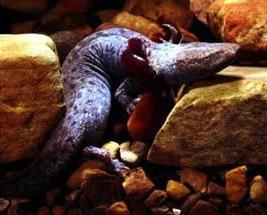
Necturus maculosus
Scientific classification Edit this classification
Kingdom: Animalia
Phylum: Chordata
Class: Amphibia
Order: Urodela
Suborder: Salamandroidea
Family: Proteidae
Gray, 1825
Genera

The family Proteidae is a group of aquatic salamanders found today in the Balkan Peninsula and North America. The range of the genus Necturus (commonly known as waterdogs or mudpuppies) runs from southern central Canada, through the midwestern United States, east to North Carolina and south to Georgia and Mississippi.[1] The range of the olm, the only extant member of the genus Proteus, is limited to the Western Balkans. The fossil record of the family extends back to the Late Cretaceous, with Paranecturus being known from the Maastrichtian of North America, and Bishara from the Santonian-Campanian of Central Asia.[2]

Taxonomy

[edit]

Proteidae, is divided into two extant genera, Necturus with five North American species, and Proteus with one extant European species, the olm. A number of extinct genera are known extending back to the end of the Late Cretaceous. Morphological analyses suggest that the oldest genus, Bishara, is a crown-group proteid more closely related to Proteus than to Necturus, suggesting an ancient divergence between the North American and Eurasian members of the family, dating to at least the Late Cretaceous.[2]

Family Proteidae

Life history

[edit]

In contrast to many salamanders, proteids never lose their gills during maturation from larvae. This aspect of their physiology is known as pedomorphosis. Despite having lungs, which appear to provide little use in respiration,[7] mudpuppies spend their entire lives underwater. The adult gills resemble fish gills in many ways, but differ from fish gills in that they are external and lack any form of operculum, or covering. The bright red exposed gills are often found closed against the body in cool, highly oxygenated water. In warmer, poorly oxygenated water, the gills expand to increase water circulation and provide greater surface area for oxygen intake. Necturus salamanders such as "mudpuppies" also absorb oxygen through their skin and by occasionally breathing air at the surface.[7]

Other distinguishing features of proteid salamanders, as compared with other salamanders, are the absence of eyelids and a lack of maxillary bones in the upper jaw. They show a degree of parental care, tending to the eggs after attaching them to submerged stones and logs. Proteid salamanders range in size from 28 centimetres (11 in) to 40 centimetres (16 in) in length.[8]

Members of the genus Necturus, commonly called "mudpuppies" or "waterdogs", prefer shallow lakes and streams that have slow moving water and rocks to hide under, but have been found in up to 90 feet of water.[9] Their name originates from the misconception that they make a dog-like barking sound.[8] Diet consists of small fish and many invertebrates, including crayfish, snails, and worms. Mudpuppies mature at four to six years and can live to be more than twenty years old. Progenesis is common for mudpuppies, enabling them to reach sexual maturity in their larval stage.

Even though they eat fish eggs, negative effects on fish populations have not been documented. Fishermen have been known to catch mudpuppies, sometimes in large numbers, but most often when ice fishing.[10] Necturus salamanders also commonly feed on mollusks, worms, insects and small fish.[11]

To distinguish between a larval mudpuppy and other larval salamanders, note that larval mudpuppies have distinct longitudinal banding and four toes on their hind legs, the combination of which is not found in most larval salamanders within the same range.[12] The main difference between a mudpuppy and a siren is that, whereas mudpuppies have both front and hind legs, a siren will only have one pair of very small, atrophied front legs.

See also

[edit]

References

[edit]
[edit]
Revisions and contributorsEdit on WikipediaRead on Wikipedia
from Grokipedia
Proteidae is a family of fully aquatic, paedomorphic salamanders within the suborder Salamandroidea of the order Urodela, distinguished by their retention of larval traits such as external gills, a laterally compressed tail with a caudal fin, and lack of metamorphosis into a terrestrial form throughout adulthood. The family includes two extant genera—Necturus (eight species of mudpuppies and waterdogs) and Proteus (one species, the olm)—encompassing a total of nine recognized species that exhibit a highly disjunct distribution between eastern North America and the Dinaric karst of southeastern Europe. These salamanders are perennibranchiate, meaning they respire primarily through their bushy, red or maroon external gills, supplemented by cutaneous breathing via moist, permeable skin often featuring dorsolateral folds. Members of Proteidae display specialized morphologies adapted to permanent aquatic life: species typically measure 8–40 cm in length, possess well-developed eyes, four toes on each foot, and pigmented skin with bushy gills, while is more elongate and eel-like, reaching up to 40 cm, with reduced, non-functional eyes, translucent pale skin, three-toed forelimbs, two-toed hindlimbs, and a more slender body suited to navigation. They inhabit cool, oxygen-rich freshwater environments, including rivers, lakes, and streams for Necturus, and subterranean aquifers and caves for Proteus, where the olm's cavernicolous lifestyle has led to troglomorphic adaptations like enhanced sensory systems relying on olfaction, lateral lines, and mechanoreception rather than vision. Ecologically, proteids are opportunistic carnivores using feeding facilitated by labial lobes and specialized —such as V-shaped tooth rows in Necturus—to consume , small , and detritus, often active nocturnally or in low-light conditions. Reproduction in Proteidae is internal via spermatophores, with no larval stage beyond hatching as miniature adults; females lay eggs in clusters on submerged substrates, guarded by one or both parents, and development to varies by , taking 4–6 years for Necturus species and 12–16 years for Proteus, influenced by environmental factors like water temperature. The family's evolutionary history traces back to the , with fossil records indicating a once-wider Euramerican distribution, and modern taxa represent a basal or early-diverging lineage among advanced salamanders, highlighting their significance in studies of , , and phylogeny. Conservation concerns include habitat degradation from pollution and groundwater extraction, particularly threatening the endemic and vulnerable populations.

Physical characteristics

Morphology

Proteidae salamanders are exclusively aquatic and exhibit pronounced , retaining several larval characteristics throughout adulthood, including prominent , a lack of eyelids, and the absence of maxillary bones in the upper . The are bushy, red, and filamentous, branching from three pairs of gill slits, while the tail is laterally compressed and bears a prominent that aids in through water. These neotenic traits, such as the persistent gills and tail , also contribute to specialized sensory functions in their environments. Adults in this family typically range from 8 to 43 cm in total length, with species in the genus Necturus reaching up to 40 cm and those in Proteus up to 40 cm. The body is generally elongated and adapted for an aquatic lifestyle, featuring a stout to slender build depending on the genus, short legs with four toes on each foot in Necturus and three toes on forelimbs and two on hindlimbs in Proteus, and small eyes that are reduced in size and often covered by thin skin. The skin is smooth and moist, lacking scales, and frequently displays mottled or spotted patterns that provide in aquatic habitats, though coloration varies from pigmented and blotchy in Necturus to pale or translucent in cave-dwelling Proteus.

Sensory adaptations

Proteidae species exhibit reduced visual capabilities, with small, lidless eyes that provide limited or no functional vision, particularly in the cave-dwelling Proteus anguinus where eyes are vestigial and covered by . This reliance on non-visual senses is a key to their permanent aquatic lifestyles in often dark environments, where the prominent system plays a central role in detecting movements, vibrations, and gradients through neuromasts distributed across the head, trunk, and tail. In Necturus species, the organs similarly enable sensitivity to water displacements, integrating with other mechanosensory inputs for environmental . Olfactory organs are highly developed in Proteidae, featuring enlarged nasal epithelia that detect low concentrations of organic compounds for and prey in murky or dark waters. , retained due to , extend beyond respiration to include chemosensory functions; within gill cavities and the sense prey-derived chemicals, allowing discrimination of food items dissolved in water. This multimodal chemosensation, combining olfaction and gustation, compensates for visual deficits and supports precise orientation in low-visibility habitats. Electroreception is present in some Proteidae, notably Proteus anguinus, through ampullary organs embedded in the skin that detect weak (threshold around 3 mV/cm at 30 Hz) generated by prey muscle activity, facilitating location in lightless caves. These organs, structurally similar to those in certain , represent an evolutionary convergence for passive electrolocation in amphibians. Hearing in Proteidae is adapted for underwater sound detection via a tympanic middle ear that transmits vibrations through air-filled cavities in the lungs and mouth to the , with sensitivity spanning low frequencies (10 Hz) up to 15 kHz. The system complements this by registering near-field water-borne vibrations, enhancing overall acoustic perception in aquatic realms.

Habitat and distribution

Geographic range

The family Proteidae exhibits a highly disjunct geographic distribution, with its two extant genera separated by vast continental distances. The genus , comprising mudpuppies and waterdogs, is endemic to eastern , ranging from the southward to the Gulf Coast. This distribution spans more than 20 U.S. states, including New York, , , , , , , , , , , , Georgia, and , as well as southern portions of such as southeastern and southern . In contrast, the genus Proteus, represented solely by the olm (Proteus anguinus), is restricted to the subterranean karst systems of the in southeastern Europe. Its range extends across , , , (particularly the region), and possibly into , with populations confined to isolated aquifers along the Adriatic seaboard and inland as far as the headwaters of drainages. These populations are fragmented, reflecting the species' dependence on disconnected underground networks, and occur from near-surface caves to depths of up to 300 meters.

Ecological preferences

Proteidae species exhibit a strictly aquatic lifestyle, residing permanently in freshwater systems and demonstrating intolerance to or fluctuating water levels, which necessitates habitats with consistent hydrological stability. This family cannot survive prolonged exposure to air or drying conditions, as their neotenic morphology, including , is ill-suited for terrestrial existence. Members of the genus Necturus, such as the common mudpuppy (N. maculosus), prefer rivers, lakes, streams, and ponds featuring rocky or muddy substrates, where they seek shelter under rocks, logs, or submerged vegetation during the day. These habitats often include areas with moderate to low flow, allowing individuals to avoid strong currents while maintaining access to cover objects essential for predator avoidance and rest. In contrast, the olm (Proteus anguinus) is adapted to subterranean karst systems, including caves, aquifers, and underground streams, favoring calm, enclosed microenvironments like cracks in rock or sediment layers. Both genera display nocturnal and cryptic behaviors, emerging primarily at night to while remaining hidden in low-light, low-disturbance zones to minimize energy expenditure and predation risk. They tolerate a broad temperature range of 4–25°C across their habitats, though Necturus species thrive in cooler, well-oxygenated surface waters up to 20–25°C in summer, while Proteus prefers the stable, cooler conditions of 8–12°C typical of . Water chemistry is generally neutral to slightly acidic ( 6.8–8.2), supporting their gill-based respiration without excessive stress. Proteidae possess notable adaptations to hypoxic conditions, including reduced metabolic rates and the ability to switch to cutaneous or lung respiration when dissolved oxygen levels drop, as seen in Proteus surviving in waters as low as 1 mg O₂/L. Necturus individuals can burrow into mud or reduce activity during periods of low oxygen or high temperatures, effectively entering a state of dormancy to conserve energy until conditions improve. These traits enable persistence in variable aquatic environments where oxygen stratification or seasonal changes might otherwise limit survival.

Taxonomy and evolution

Classification

Proteidae is a family of aquatic salamanders classified within the order Urodela (also known as ) and suborder Salamandroidea. Within this suborder, Proteidae occupies a basal position as the to the comprising Rhyacotritonidae, Amphiumidae, and (collectively Plethosalamandroidei). The family was established by in 1831 under the name Proteidae, with subsequent synonyms including Proteina, Necturidae, and Hypochthonidae; its authorship and date were reaffirmed by application of the . It encompasses two extant genera: (erected by Josephus Nicolaus Laurenti in 1768) and (erected by in 1818). No subfamilies are universally recognized in current , though proposals for divisions such as Proteinae (for ) and Necturinae (for ) have appeared in some classifications based on morphological differences. The family's is strongly supported by molecular evidence, including analyses of mitochondrial and nuclear genes that highlight synapomorphies such as obligatory and via spermatophores. Phylogenetic studies from 2024, incorporating extensive multilocus data across 765 species, have reaffirmed Proteidae's crown-group status and its position within Salamandroidea, with divergence estimates around 104 million years ago and no significant taxonomic revisions since the early .

Fossil record and phylogeny

The fossil record of Proteidae dates back to the , with the earliest known representative being Bishara backa from the Santonian to early Bostobe Formation in , approximately 85 million years ago (Ma). This crown-group proteid provides evidence of the family's presence in during the and suggests an ancient Laurasian distribution. Subsequent fossils from the stage include Paranecturus garbanii from the in , , indicating a North American presence by the end of the . In the , records shift to with Mioproteus gardneri from the lower of , representing the oldest proteid and highlighting post- persistence in . Phylogenetic analyses place the basal divergence of Proteidae within Salamandroidea at approximately 100–150 Ma, with the crown group originating around 104 Ma based on time-calibrated molecular data from 503 genes across 765 salamander species. The family's disjunct distribution between () and southeastern () is attributed to vicariance events associated with the closure of the Tethys Sea and the fragmentation of during the to , rather than recent dispersal. Molecular clock estimates suggest the split between and occurred more than 87 Ma, aligning with these tectonic changes and supporting an ancient Holarctic origin followed by isolation. Key evolutionary traits in Proteidae include the retention of obligate , a paedomorphic condition where adults maintain larval features such as and aquatic lifestyles, which molecular and morphological evidence indicates evolved once in the common ancestor of the family. Recent phylogenies position Proteidae as sister to the Plethosalamandroidei clade (encompassing Rhyacotritonidae, Amphiumidae, and ), with strong support from comprehensive genomic datasets. Studies from 2021 to 2024 on Eurasian proteid fossils, including Euronecturus grogu from the middle Miocene of and expanded analyses of Bishara backa, reinforce an ancient Laurasian origin and multiple radiations during the , with ongoing discoveries filling gaps in the family's biogeographic history.

Diversity

Genus Necturus

The genus comprises seven recognized of fully aquatic, neotenic salamanders endemic to , all retaining throughout life as a shared trait. These salamanders are characterized by their robust bodies, four toes on each foot, laterally compressed tails for swimming, and prominent bushy that are typically bright red or maroon. They are generally larger and more heavily built than their European relative Proteus, with adults ranging from 11.5 to 49 cm in total length depending on the , and exhibit coloration varying from to rusty or blue-gray, often with spotting or striping patterns. Unlike many amphibians, Necturus are known for producing vocalizations, including short grunting or barking sounds, particularly during disturbances or , which is unusual among salamanders. They primarily inhabit lotic freshwater environments such as rivers, streams, and their associated tributaries, favoring areas with rocky or woody substrates for shelter, though some tolerate lentic habitats like lakes. Necturus maculosus, the , is the largest and most widespread in the , reaching up to 49 cm in length. It features a robust body with rusty brown to gray dorsal coloration marked by conspicuous blue-black spots or blotches that may merge into stripes, and a pale gray venter that is sometimes spotted. The bushy s are vivid red, and a dark line extends from the eye to the gill base. This occupies a broad range across eastern , from southern through the to the , inhabiting diverse lotic and lentic waters including large rivers and cool lakes with ample cover like rocks or vegetation. Necturus alabamensis, known as the Alabama or Black Warrior waterdog, is a medium-sized attaining about 25 cm in length, with light to dark brown ground color accented by broad dark chocolate-brown dorsal stripes separated by cream to yellow lateral stripes extending from the nostrils to the tail. Its are bushy and red, and the body is robust with a preference for streams featuring logjams, leaf debris, or rocky bottoms. Endemic to the Black Warrior River basin in , it is highly localized to this single drainage system, underscoring its restricted distribution within the . Necturus beyeri, the Gulf Coast or western waterdog, is a medium-sized form growing to 22 cm, distinguished by its dark brown to tan body with irregular dark spots and a black stripe from the eye to the gill. The gills are feathery pink to red, and the tail is keeled for propulsion in flowing water. Following a taxonomic revision, this species is now restricted to Gulf Coast drainages in eastern and western , favoring sandy-bottomed streams, spring-fed rivers, and swampy areas with moderate current. Necturus lewisi, the Neuse River waterdog, reaches up to 28 cm and displays a uniform brown to gray-brown dorsum with subtle spotting, reddish bushy gills, and a flattened tail. It is endemic to the Neuse and Tar-Pamlico River basins in North Carolina, confined to these two adjacent watersheds where it inhabits sandy or muddy-bottomed streams and rivers with woody debris for cover. Necturus moleri, the Apalachicola waterdog, is a medium-sized species reaching up to about 20 cm, with a brown to gray-brown body similar to other Gulf Coast forms, bushy red gills, and keeled tail. Described in 2020 from the former N. beyeri complex, it is endemic to the Apalachicola, Chipola, Choctawhatchee, Econfina, and Ochlockonee drainages in southeastern Alabama, the Florida Panhandle, and southwestern Georgia. It prefers slow-flowing streams and rivers with sandy or detrital substrates. Necturus mounti, the Escambia waterdog, attains a maximum of about 20 cm (standard length up to 11.6 cm), featuring a robust body with dark brown to tan coloration, irregular spots, red gills, and a . Also described in , it is confined to the Blackwater, Escambia (Conecuh in ), Perdido, and drainages in southern and the western , inhabiting streams with rocky or woody cover. The dwarf waterdog, Necturus punctatus, is the smallest species at a maximum of 19 cm, featuring a plain slate gray to dark brown body without prominent spots, pale venter, and compact bushy red gills. It occurs in the , from to eastern , primarily in slow-flowing blackwater streams, swamps, and ditches with leaf litter or sand substrates.

Genus Proteus

The genus Proteus is represented by a single , Proteus anguinus, known as the , an obligate cave-dwelling aquatic endemic to subterranean systems. This exhibits striking adaptations to perpetual darkness and stable underground conditions, including a slender, eel-like body typically measuring 20–30 cm in length (up to 40 cm), unpigmented translucent white or pink that renders internal organs visible, and highly reduced limbs with three toes on the forelimbs and two on the hindlimbs. It is completely blind, with eyes covered by skin and regressed to non-functional remnants, emphasizing its reliance on other sensory modalities for in lightless aquifers. Proteus anguinus displays extreme , retaining aquatic larval morphology into full adulthood without undergoing , a trait that supports its exclusively subterranean lifestyle and contributes to an exceptionally long lifespan exceeding 100 years under optimal conditions. taxonomy is debated; traditionally, three have been recognized (P. a. anguinus, the pale nominate form in Slovenian caves; P. a. parkelj, a pigmented "black olm" in deeper Slovenian systems; and P. a. marmoratus, a mottled form in ), but recent analyses often synonymize parkelj within the nominate subspecies, treating P. anguinus as monotypic with local morphological variations. Genetic studies indicate broader cryptic diversity, with nine deeply divergent lineages potentially warranting species-level recognition. The olm is confined to the Dinaric system spanning , , , and , where it inhabits underground rivers and lakes with constant temperatures of 8–12°C and high humidity. This disjunct European distribution starkly contrasts with the North American genus . Key physiological adaptations enable the olm's survival in nutrient-poor caves, including an extraordinarily low metabolic rate that allows periods of up to 10 years without significant harm, facilitated by efficient energy storage in the liver and slow tissue degradation. Such traits underscore its role as a model for studying extreme and hypogean , with unpigmented skin minimizing energy costs for pigmentation and reduced limbs optimizing movement through narrow fissures.

Biology and ecology

Life cycle and reproduction

Members of the family Proteidae exhibit obligate paedomorphosis, retaining larval characteristics such as , a flattened , and an aquatic lifestyle throughout their lives without undergoing into a terrestrial form. This neotenic condition is fixed and does not respond to environmental cues like those in facultatively paedomorphic salamanders. Juveniles emerge from eggs as fully formed miniatures of adults, complete with functional gills, and grow continuously without a distinct larval stage beyond hatching. is reached relatively late: individuals of the Necturus typically mature at 4–6 years of age, while those of Proteus do so at 12–15 years. Lifespans vary by genus but are notably long for amphibians, ranging from 11–60+ years in the wild, with Necturus species averaging around 11–20 years and Proteus individuals documented up to 58 years in natural cave habitats. Reproduction in Proteidae involves achieved through spermatophores, gelatinous packets of deposited by males on the substrate during . In Necturus, breeding is seasonal, with occurring in fall or winter and egg-laying in spring; females store in their cloacae until . For Proteus anguinus, reproduction is less seasonally constrained, occurring sporadically year-round due to the stable subterranean environment, though females breed infrequently, approximately every 12.5 years. Females of both genera lay clutches of 50–200 eggs (with Necturus clutches averaging 60–120 and Proteus around 35), attaching them in underwater clusters to rocks, logs, or vegetation. These eggs, measuring 5–11 mm in diameter, are guarded by the female until hatching, which takes 1–2 months depending on water temperature (around 3–4 months for Proteus at cooler temperatures). Longevity records highlight the exceptional durability of Proteidae, particularly Proteus anguinus; captive olms have been predicted to reach up to 102 years based on demographic modeling from long-term studies, far exceeding typical lifespans. In the wild, maximum ages are lower due to environmental factors, with estimates around 58 years for olms based on mark-recapture data in caves. This extended lifespan correlates with their low metabolic rates and stable aquatic habitats, enabling slow growth and infrequent .

Diet and behavior

Members of the family Proteidae are carnivorous and employ feeding to capture prey, a mechanism involving rapid expansion of the buccal cavity to draw in water and prey while closing the gill slits. This gape-and- strategy allows them to small aquatic organisms from a stationary position, with labial lobes in genera like preventing escape of food particles. Their low metabolic rates enable infrequent feeding, supporting survival during periods of prey scarcity. In the genus Necturus, individuals primarily consume invertebrates such as , insect larvae, annelids, and amphipods, supplemented by small and amphibians, particularly during colder months when vertebrate prey increases in the diet. occurs nocturnally or crepuscularly in open water, with animals hiding under rocks or in burrows by day to avoid predators; they exhibit solitary behavior outside breeding seasons, though minimal aggression is observed among conspecifics. Necturus species produce vocalizations, including clicks and squeaks, potentially for communication during activity peaks. Prey detection relies on organs, olfaction, and limited vision, with seasonal activity highest in winter when water temperatures drop below 14°C. , including consumption of eggs and larvae, occurs opportunistically. The genus Proteus, represented by the olm (P. anguinus), feeds on small including larvae, crustaceans (e.g., amphipods, isopods), snails, and worms in dark environments, detected primarily through chemosensory cues from the nasal and oral cavity. As predators, olms exhibit slow, exploratory movements in perpetual darkness, with no distinct but increased surface activity at night in spring habitats for potential . Their exceptionally low metabolic rate permits feeding as infrequently as every few months, with studies showing survival without food for up to 10 years. Social interactions are limited to occasional co-occurrence while maintaining distance, indicating avoidance rather than aggression; predator evasion involves burrowing into substrate.

Conservation

Threats

Proteidae populations face multiple anthropogenic and environmental threats that exacerbate their vulnerability due to specialized aquatic habitats and disjunct distributions, which limit dispersal and increase susceptibility to localized impacts. Habitat loss is a primary concern, driven by damming, urban development, and groundwater extraction that fragment and degrade riverine environments for species and cave systems for Proteus anguinus. For mudpuppies (), impoundments and channelization reduce habitat connectivity and suitable rocky substrates, while dredging and erosion from land-use changes destroy spawning and foraging areas. In the case of the olm ( anguinus), extraction for and hydroelectric projects lowers water tables in subterranean aquifers, desiccating caves and disrupting nutrient flows essential for survival. Water quality degradation further imperils Proteidae, with pollution from agricultural runoff causing , acidification, and chemical contamination that impair and respiration in these oxygen-sensitive species. clogs and buries eggs in Necturus habitats, reducing oxygen availability and larval survival, while agricultural nitrates threaten Proteus in groundwater-dependent systems. Industrial effluents and urban pollutants exacerbate low-oxygen conditions, to which Proteidae exhibit high sensitivity due to their external and permeable . Emerging diseases pose a severe risk, particularly the chytrid fungus Batrachochytrium salamandrivorans (Bsal), which causes lethal skin infections in salamanders and prompted the U.S. Fish and Wildlife Service to list the genus as injurious wildlife in January 2025 to prevent imports and potential spread via the pet trade. Laboratory studies indicate Proteus vulnerability to Bsal, though field outbreaks remain undetected in native European ranges. Additional pressures include overcollection of olms for the market, which depletes small, isolated populations due to their rarity and appeal as cave-dwelling curiosities, and , which alters water temperatures and increases frequency, stressing thermal tolerances in both genera. , such as round gobies (Neogobius melanostomus), compete with for resources and prey on their eggs in altered habitats.

Status and protection

The conservation status of Proteidae species varies across taxa, reflecting differences in geographic range and threat levels. Globally, according to the IUCN Red List assessments as of 2025, Proteus anguinus (the olm) is classified as Vulnerable due to habitat degradation and pollution in subterranean karst systems, though its subspecies P. a. parkelj (black olm) is Critically Endangered. Within the genus Necturus, the common mudpuppy (N. maculosus) is assessed as Least Concern, indicating a relatively stable population across its wide North American distribution. However, more range-restricted species face greater risks: the Alabama waterdog (N. alabamensis) is Endangered, primarily from habitat loss in the Black Warrior River basin, while the Neuse River waterdog (N. lewisi) is Near Threatened, with ongoing declines linked to river modifications. Regionally, additional protections complement IUCN designations. In the United States, N. alabamensis is listed as Endangered under the Endangered Species Act (ESA), mandating habitat safeguards and recovery planning, while N. lewisi holds Threatened status, prohibiting take and requiring conservation measures in river systems. Some Necturus populations are considered ESA candidates, prompting preliminary monitoring but no formal listing yet. In , P. anguinus is prioritized under the EU (Annexes II and IV), requiring member states like and to designate special areas of conservation for its karst aquifers. In , the Manitoba population of N. maculosus is designated Threatened by COSEWIC, emphasizing vigilance against habitat alterations in rivers. Protection efforts focus on enhancement, ex situ , and to mitigate declines driven by factors like the chytrid fungus Batrachochytrium salamandrivorans (Bsal). restoration initiatives, including river cleanups to reduce and in southeastern U.S. waterways, support recovery by improving water quality and benthic habitats. Captive breeding programs at in have achieved notable success for the , with a 2022 clutch of 43 eggs yielding a 74% hatching rate in controlled aquaria, aiding reintroduction planning. To curb Bsal spread, the U.S. implemented import bans in 2025 on over 400 species, including Proteidae, under the Lacey Act, prohibiting live imports to protect native populations. Ongoing monitoring underscores the urgency of these measures, with population surveys revealing declines in select Necturus locales since 2000, attributed to cumulative pressures. Genetic on N. maculosus and N. alabamensis informs delineation and connectivity assessments, guiding targeted interventions to preserve diversity in fragmented riverine ecosystems.

References

Add your contribution
Related Hubs
User Avatar
No comments yet.