Hubbry Logo
PseudocapacitancePseudocapacitanceMain
Open search
Pseudocapacitance
Community hub
Pseudocapacitance
logo
8 pages, 0 posts
0 subscribers
Be the first to start a discussion here.
Pseudocapacitance
Pseudocapacitance
from Wikipedia
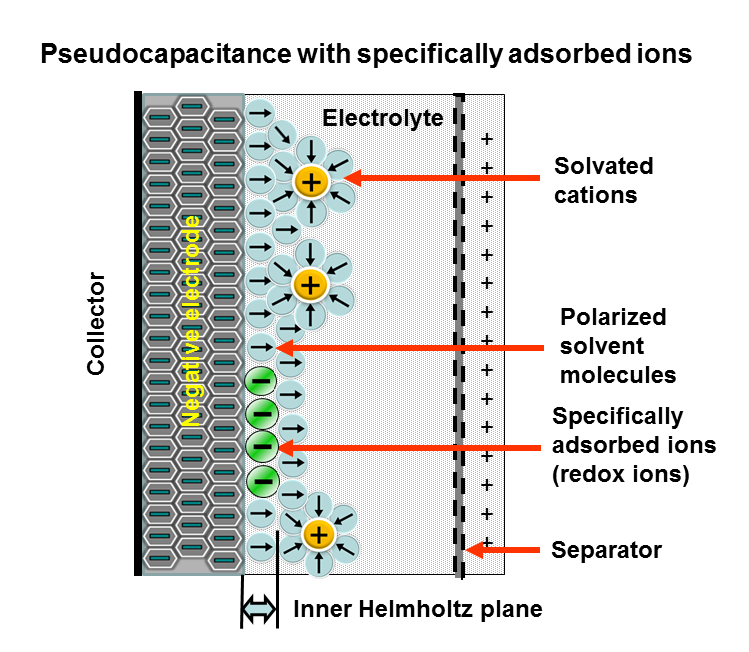
Simplified view of a double-layer with specifically adsorbed ions which have submitted their charge to the electrode to explain the faradaic charge-transfer of the pseudocapacitance.
Hierarchical classification of supercapacitors and related types

Pseudocapacitance is the electrochemical storage of electricity in an electrochemical capacitor that occurs due to faradaic charge transfer originating from a very fast sequence of reversible faradaic redox, electrosorption or intercalation processes on the surface of suitable electrodes.[1][2][3] Pseudocapacitance is accompanied by an electron charge-transfer between electrolyte and electrode coming from a de-solvated and adsorbed ion. One electron per charge unit is involved. The adsorbed ion has no chemical reaction with the atoms of the electrode (no chemical bonds arise[4]) since only a charge-transfer takes place. Supercapacitors that rely primarily on pseudocapacitance are sometimes called pseudocapacitors.[5][6][7]

Faradaic pseudocapacitance only occurs together with static double-layer capacitance. Pseudocapacitance and double-layer capacitance both contribute inseparably to the total capacitance value. The amount of pseudocapacitance depends on the surface area, material and structure of the electrodes. Pseudocapacitance may contribute more capacitance than double-layer capacitance for the same surface area by 100x.[1]

The amount of electric charge stored in a pseudocapacitance is linearly proportional to the applied voltage. The unit of pseudocapacitance is farad.

History

[edit]

Redox reactions

[edit]

Differences

[edit]

Rechargeable batteries

[edit]

Redox reactions in batteries with faradaic charge-transfer between an electrolyte and the surface of an electrode were characterized decades ago. These chemical processes are associated with chemical reactions of the electrode materials usually with attendant phase changes. Although these chemical processes are relatively reversible, battery charge/discharge cycles often irreversibly produce unreversed chemical reaction products of the reagents. Accordingly, the cycle-life of rechargeable batteries is usually limited. Further, the reaction products lower power density. Additionally, the chemical processes are relatively slow, extending charge/discharge times.

Electro-chemical capacitors

[edit]
Schematic representation of a double layer on an electrode (BMD) model. 1. Inner Helmholtz plane, (IHP), 2. Outer Helmholtz plane (OHP), 3. Diffuse layer, 4. Solvated electrolyte ions (cations) 5. Specifically adsorbed ions (redox ion, which contributes to the pseudocapacitance), 6. Molecules of the solvent

A fundamental difference between redox reactions in batteries and in electrochemical capacitors (supercapacitors) is that in the latter, the reactions are a very fast sequence of reversible processes with electron transfer without any phase changes of the electrode molecules. They do not involve making or breaking chemical bonds. The de-solvated atoms or ions contributing the pseudocapacitance simply cling[4] to the atomic structure of the electrode and charges are distributed on surfaces by physical adsorption processes. Compared with batteries, supercapacitor faradaic processes are much faster and more stable over time, because they leave only traces of reaction products. Despite the reduced amount of these products, they cause capacitance degradation. This behavior is the essence of pseudocapacitance.

Pseudocapacitive processes lead to a charge-dependent, linear capacitive behavior, as well as the accomplishment of non-faradaic double-layer capacitance in contrast to batteries, which have a nearly charge-independent behavior. The amount of pseudocapacitance depends on the surface area, material and structure of the electrodes. The pseudocapacitance may exceed the value of double-layer capacitance for the same surface area by 100x.[1]

Capacitance functionality

[edit]
Intercalated metal atoms between planar graphite layers
Confinement of solvated ions in pores, such as those present in carbide-derived carbon (CDC). As the pore size approaches the size of the solvation shell, the solvent molecules are removed, resulting in larger ionic packing density and increased charge storage capability.

Applying a voltage at the capacitor terminals moves the polarized ions or charged atoms in the electrolyte to the opposite polarized electrode. Between the surfaces of the electrodes and the adjacent electrolyte an electric double-layer forms. One layer of ions on the electrode surface and the second layer of adjacent polarized and solvated ions in the electrolyte move to the opposite polarized electrode. The two ion layers are separated by a single layer of electrolyte molecules. Between the two layers, a static electric field forms that results in double-layer capacitance. Accompanied by the electric double-layer, some de-solvated electrolyte ions pervade the separating solvent layer and are adsorbed by the electrode's surface atoms. They are specifically adsorbed and deliver their charge to the electrode. In other words, the ions in the electrolyte within the Helmholtz double-layer also act as electron donors and transfer electrons to the electrode atoms, resulting in a faradaic current. This faradaic charge transfer, originated by a fast sequence of reversible redox reactions, electrosorptions or intercalation processes between electrolyte and the electrode surface is called pseudocapacitance.[8]

Depending on the electrode's structure or surface material, pseudocapacitance can originate when specifically adsorbed ions pervade the double-layer, proceeding in several one-electron stages. The electrons involved in the faradaic processes are transferred to or from the electrode's valence-electron states (orbitals) and flow through the external circuit to the opposite electrode where a second double-layer with an equal number of opposite-charged ions forms. The electrons remain in the strongly ionized and electrode surface's "electron hungry" transition-metal ions and are not transferred to the adsorbed ions. This kind of pseudocapacitance has a linear function within narrow limits and is determined by the potential-dependent degree of surface coverage of the adsorbed anions. The storage capacity of the pseudocapacitance is limited by the finite quantity of reagent or of available surface.

Systems that give rise to pseudocapacitance:[8]

  • Redox system: Ox + ze‾ ⇌ Red
  • Intercalation system: Li+
    in "Ma
    2
    "
  • Electrosorption, underpotential deposition of metal adatoms or H: M+
    + ze‾ + S ⇌ SM or H+
    + e‾ + S ⇌ SH (S = surface lattice sites)

All three types of electrochemical processes have appeared in supercapacitors.[8][9]

When discharging pseudocapacitance, the charge transfer is reversed and the ions or atoms leave the double-layer and spread throughout the electrolyte.

Materials

[edit]

Electrodes' ability to produce pseudocapacitance strongly depends on the electrode materials' chemical affinity to the ions adsorbed on the electrode surface as well as on the electrode pore structure and dimension. Materials exhibiting redox behavior for use as pseudocapacitor electrodes are transition-metal oxides inserted by doping in the conductive electrode material such as active carbon, as well as conducting polymers such as polyaniline or derivatives of polythiophene covering the electrode material.

Transition metal oxides/sulfides

[edit]

These materials provide high pseudocapacitance and were thoroughly studied by Conway.[1][10] Many oxides of transition metals like ruthenium (RuO
2
), iridium (IrO
2
), iron (Fe
3
O
4
), manganese (MnO
2
) or sulfides such as titanium sulfide (TiS
2
) or their combinations generate faradaic electron–transferring reactions with low conducting resistance.[citation needed]

Ruthenium dioxide (RuO
2
) in combination with sulfuric acid (H
2
SO
4
) electrolyte provides one of the best examples of pseudocapacitance, with a charge/discharge over a window of about 1.2 V per electrode. Furthermore, the reversibility on these transition metal electrodes is excellent, with a cycle life of more than several hundred-thousand cycles. Pseudocapacitance originates from a coupled, reversible redox reaction with several oxidation steps with overlapping potential. The electrons mostly come from the electrode's valence orbitals. The electron transfer reaction is very fast and can be accompanied with high currents.

The electron transfer reaction takes place according to:

RuO2 + xH+ + xe ⇌ RuO2−x(OH)x where 0 < x < 2 [11]

During charge and discharge, H+
(protons) are incorporated into or removed from the RuO
2
crystal lattice, which generates storage of electrical energy without chemical transformation. The OH groups are deposited as a molecular layer on the electrode surface and remain in the region of the Helmholtz layer. Since the measurable voltage from the redox reaction is proportional to the charged state, the reaction behaves like a capacitor rather than a battery, whose voltage is largely independent of the state of charge.

Conducting polymers

[edit]

Another type of material with a high amount of pseudocapacitance is electron-conducting polymers. Conductive polymer such as polyaniline, polythiophene, polypyrrole and polyacetylene have a lower reversibility of the redox processes involving faradaic charge transfer than transition metal oxides, and suffer from a limited stability during cycling.[citation needed] Such electrodes employ electrochemical doping or dedoping of the polymers with anions and cations. Highest capacitance and power density are achieved with a n/p-type polymer configuration, with one negatively charged (n-doped) and one positively charged (p-doped) electrode.

Structure

[edit]

Pseudocapacitance may originate from the electrode structure, especially from the material pore size. The use of carbide-derived carbons (CDCs) or carbon nanotubes (CNTs) as electrodes provides a network of small pores formed by nanotube entanglement. These nanoporous materials have diameters in the range of <2 nm that can be referred to as intercalated pores. Solvated ions in the electrolyte are unable to enter these small pores, but de-solvated ions that have reduced their ion dimensions are able to enter, resulting in larger ionic packing density and increased charge storage. The tailored sizes of pores in nano-structured carbon electrodes can maximize ion confinement, increasing specific capacitance by faradaic H
2
adsorption treatment. Occupation of these pores by de-solvated ions from the electrolyte solution occurs according to (faradaic) intercalation.[12][13][14]

Verification

[edit]
A cyclic voltammogram shows the fundamental difference of the current curves between static capacitors and pseudocapacitors

Pseudocapacitance properties can be expressed in a cyclic voltammogram. For an ideal double-layer capacitor, the current flow is reversed immediately upon reversing the potential yielding a rectangular-shaped voltammogram, with a current independent of the electrode potential. For double-layer capacitors with resistive losses, the shape changes to a parallelogram. In faradaic electrodes the electrical charge stored in the capacitor is strongly dependent on the potential, therefore, the voltammetry characteristics deviate from the parallelogram due to a delay while reversing the potential, ultimately coming from kinetic charging processes.[15][16]

Examples

[edit]

Brezesinki et al. showed that mesoporous films of α-MoO3 have improved charge storage due to lithium ions inserting into the gaps of α-MoO3. They claim this intercalation pseudocapacitance takes place on the same timescale as redox pseudocapacitance and gives better charge-storage capacity without changing kinetics in mesoporous MoO3. This approach is promising for batteries with rapid charging ability, comparable to that of lithium batteries,[17] and is promising for efficient energy materials.

Other groups have used vanadium oxide thin films on carbon nanotubes for pseudocapacitors. Kim et al. electrochemically deposited amorphous V2O5·xH2O onto a carbon nanotube film. The three-dimensional structure of the carbon nanotubes substrate facilitates high specific lithium-ion capacitance and shows three times higher capacitance than vanadium oxide deposited on a typical Pt substrate.[18] These studies demonstrate the capability of deposited oxides to effectively store charge in pseudocapacitors.

Conducting polymers, such as polypyrrole (PPy) and poly(3,4-ethylenedioxythiophene) (PEDOT), have tunable electronic conductivity and can achieve high doping levels with the proper counterion. A high-performing conducting polymer pseudocapacitor has high cycling stability after undergoing charge/discharge cycles. Successful approaches include embedding the redox polymer in a host phase (e.g. titanium carbide) for stability and depositing a carbonaceous shell onto the conducting polymer electrode. These techniques improve cyclability and stability of the pseudocapacitor device.[19]

Applications

[edit]

Pseudocapacitance is used in processes that require High Power Faradaic Storage; for example: electrochemical capacitors, high-power batteries, capacitive deionization, and neuromorphic computing among others.[20]

Examples

[edit]

Energy storage

[edit]

Materials that use pseudocapacitance are considered a great opportunity for achieving high rate, high energy density and high efficiency energy storage systems based on ion absorption and intercalation.[20] Using its working properties of electrosorption and surface redox process at high-area electrode materials; for example RuO2 improves the energy storage properties of one of a traditional capacitor.[21]

Biosensing

[edit]

In the recent study, “Pseudocapacitance phenomena and applications in biosensing devices” by Raphael M.B. Oliveira, Flavio C.B. Fernandes, Paulo R. Bueno published in 2019, it was concluded that compounds with electrochemical capacitance or pseudocapacitance can be successfully used into the designed of interfaces for the biological detection of biomarkers.[22]

Water deionization

[edit]

Due to their charge transfer reactions, pseudocapacitive materials can also be used in water deionization; the high ion storage capacities and fast storage time necessary for water purification is kept during the process using this type of materials.[23][21]

References

[edit]

Literature

[edit]
Revisions and contributorsEdit on WikipediaRead on Wikipedia
from Grokipedia
Pseudocapacitance is a faradaic charge storage mechanism in electrochemical energy devices, characterized by fast and reversible reactions occurring at or near the surface, which results in a nearly linear relationship between accumulated charge and , akin to behavior. Unlike electric double-layer (EDLC), which relies on non-faradaic electrostatic ion adsorption at the -electrolyte interface, pseudocapacitance involves processes that enable significantly higher specific values, often exceeding 200 F/g in materials like ruthenium oxide (RuO₂). This mechanism bridges the performance gap between traditional capacitors and batteries, providing enhanced while preserving rapid charge-discharge kinetics and excellent cyclability. The concept of pseudocapacitance was first systematically described by Brian E. Conway in his 1999 book Electrochemical Supercapacitors: Scientific Fundamentals and Technological Applications, where it was defined as surface-confined faradaic reactions without phase changes, such as underpotential deposition or transitions in oxides. Key mechanisms include pseudocapacitance, involving direct to surface atoms (e.g., in RuO₂ or MnO₂), and intercalation pseudocapacitance, where ions reversibly insert into near-surface layers without crystallographic phase transformations (e.g., in TiO₂ or Nb₂O₅). These processes are identified through electrochemical signatures like quasi-rectangular cyclic voltammograms and triangular galvanostatic charge-discharge curves, with quantitative analysis using the b-value (where b ≈ 1 indicates capacitive-like kinetics) from power-law relationships in current-voltage scans. Pseudocapacitive materials, including oxides (e.g., MnO₂ with capacitances up to 1100 F/g in composites), hydroxides (e.g., Ni(OH)₂), and two-dimensional materials like (e.g., Ti₃C₂Tₓ achieving 1500 F/cm³), offer advantages such as tunable states, high power densities, and improved scalability for applications in supercapacitors and hybrid batteries. Recent developments emphasize nanostructuring and hybridization to induce pseudocapacitive behavior in traditionally battery-like materials, enhancing rate performance and energy output in flexible and aqueous systems.

Fundamentals

Definition and Principles

Pseudocapacitance is a faradaic charge storage mechanism in electrochemical capacitors that involves reversible reactions occurring at or near the - interface, enabling higher than traditional electrostatic double-layer while maintaining fast charge-discharge kinetics. Unlike non-faradaic processes, which rely solely on ion adsorption without , pseudocapacitance stores charge through electron exchange between atoms and , resulting in a that arises from the potential-dependent coverage of -active sites on the surface. This interfacial phenomenon, first conceptualized in foundational electrochemical studies, allows for continuous charge accumulation over a potential range rather than discrete steps. The concept of pseudocapacitance has been subject to some debate regarding its distinction from double-layer . The fundamental principles of pseudocapacitance center on rapid and reversible faradaic processes at the surface or near-surface regions, facilitating charge storage without significant structural changes in the material. In , a key diagnostic tool, pseudocapacitive behavior manifests as currents proportional to the scan rate (ivi \propto v), producing nearly rectangular voltammograms indicative of surface-controlled processes, in contrast to the peak-shaped responses of diffusion-limited faradaic reactions. The stored charge QQ from these processes is quantified as Q=IdtQ = \int I \, dt, where II represents the , and the effective pseudocapacitance CC is derived from the potential dependence as C=dQdVC = \frac{dQ}{dV}, highlighting the capacitive nature despite the faradaic origin. Thermodynamically, pseudocapacitive reactions are driven by favorable changes (ΔG\Delta G) that align the with the , E=E0+RTnFln([ox][red])E = E^0 + \frac{RT}{nF} \ln \left( \frac{[\text{ox}]}{[\text{red}]} \right), where the coverage of oxidized and reduced forms varies continuously with potential to support high-rate performance. This enables kinetics that surpass battery-like intercalation by minimizing energy barriers associated with ion diffusion, as the reactions occur primarily at the surface or in thin layers, promoting reversible with minimal .

Comparison to Other Mechanisms

Pseudocapacitance represents a hybrid charge storage mechanism that combines elements of both non-faradaic and faradaic processes, distinguishing it from pure electrostatic double-layer capacitance (EDLC) and battery-type intercalation. In EDLCs, charge storage occurs through non-faradaic physical adsorption of ions at the electrode-electrolyte interface, forming a Helmholtz double layer without electron transfer, which enables ultrafast kinetics but limits energy storage to surface area-dependent capacitance typically around 100-200 F/g. In contrast, pseudocapacitance involves faradaic redox reactions confined to the electrode surface or near-surface regions, such as underpotential deposition, allowing for higher capacitance (up to 1000 F/g) while maintaining relatively fast charge transfer rates compared to batteries. Battery mechanisms, however, rely on faradaic intercalation of ions into the bulk lattice of electrode materials, leading to phase changes and diffusion-limited kinetics that enhance energy density but reduce power delivery and cycle stability. The kinetic differences underscore pseudocapacitance's position as a bridge between EDLCs and batteries: surface-confined faradaic reactions provide power densities exceeding 10 kW/kg, akin to EDLCs, without the bulk delays that slow battery discharge to below 1 kW/kg. (CV) profiles further highlight these distinctions; EDLCs exhibit ideal rectangular shapes indicative of constant capacitive current, while pseudocapacitive materials show quasi-rectangular CVs with broad humps rather than sharp peaks, reflecting fast, reversible surface processes. Battery-like materials, by comparison, display pronounced peaks and plateaus in galvanostatic charge-discharge (GCD) curves due to slower, diffusion-controlled reactions.
MechanismEnergy Density (Wh/kg)Power Density (kW/kg)Cycle Life (cycles)Charge Storage Type
EDLC5-1010-20>10^5Non-faradaic
Pseudocapacitance10-100>10>10^5Faradaic (surface)
Battery100-3000.1-110^3-10^4Faradaic (bulk)
This table summarizes typical performance metrics, where pseudocapacitance achieves higher energy than EDLCs through redox involvement yet surpasses batteries in power and longevity due to the absence of structural degradation from deep ion insertion. Pseudocapacitance's hybrid nature allows it to fill the performance gap in Ragone plots between EDLCs and batteries, offering devices with rectangular-like CVs that confirm capacitive dominance even in faradaic systems, as seen in ruthenium oxide electrodes. However, it is limited by energy densities lower than batteries (typically below 100 Wh/kg) owing to reliance on surface reactions without bulk storage, though this avoids phase transitions that degrade battery cycle life.

Historical Development

Early Discoveries

The concept of pseudocapacitance was first introduced in the early through theoretical work on kinetics, where B. E. Conway and E. Gileadi described "pseudo-capacitance" as arising from faradaic processes at surfaces exhibiting capacitive-like voltammetric responses, distinct from traditional double-layer charging. This framework addressed non-linear cyclic voltammogram (CV) responses observed in systems with appreciable surface coverage by adsorbed species, such as underpotential deposition or surface oxide formation, which mimicked ideal but involved charge transfer. Initial experimental observations of pseudocapacitive behavior in oxides emerged in the early 1970s, notably with ruthenium dioxide (RuO₂) electrodes. In 1971, Sergio Trasatti and Giovanni Buzzanca reported on electrodeposited RuO₂ films in acidic electrolytes, which displayed nearly rectangular CV shapes indicative of capacitive charging, yet with faradaic currents proportional to the potential sweep rate, exceeding expectations from double-layer effects alone. These findings highlighted RuO₂'s potential for high , around 200-300 F/g, attributed to reversible proton insertion and at the oxide surface. Between 1975 and 1980, Brian E. Conway extended these observations through systematic studies on RuO₂-based electrochemical capacitors, confirming the pseudocapacitive mechanism via quasi-two-dimensional processes in hydrous RuO₂ films, which yielded capacitances up to 380 F/g in electrolytes. The terminology evolved to "faradaic pseudocapacitance" during this period to emphasize the distinction from purely electrostatic and battery-like phase transitions, as articulated in Conway's foundational analyses. Early electrochemical literature often conflated these surface-confined faradaic processes with battery-type behavior, leading to challenges in recognition as a unique mode, particularly due to similarities in signatures with intercalation systems. This confusion persisted until Conway's work clarified the kinetic and thermodynamic criteria for pseudocapacitance, such as sweep-rate-independent charge storage without diffusion limitations.

Key Milestones

In the 1980s and 1990s, Brian E. Conway developed a comprehensive theoretical framework that distinguished pseudocapacitance from electric double-layer (EDLC) and battery-like faradaic processes, emphasizing reversible surface-confined reactions in hydrous metal oxides like RuO₂. This framework highlighted the continuous variation of with charge accumulation, enabling high-rate charge storage through quasi-two-dimensional transitions, as modeled using Langmuir and Frumkin isotherms for adsorption and coverage-dependent kinetics. Conway's seminal 1991 paper analyzed the transition from to battery behavior, identifying pseudocapacitance signatures such as mirror-image cyclic voltammograms and potential-dependent , while his 1999 book provided foundational models for pseudocapacitance in transition metal oxides. During the , research shifted toward cost-effective non-precious metal oxides to enable practical pseudocapacitor devices, with MnO₂ emerging as a key material due to its abundance, environmental benignity, and theoretical of ~1370 F/g from proton intercalation and surface . NiO was similarly explored for its high theoretical (~2573 F/g) and reversible Ni²⁺/Ni³⁺ , often in forms for enhanced conductivity. This era saw early research prototypes of pseudocapacitors incorporating MnO₂ thin films, such as dual-planar devices achieving ~200 F/g in neutral electrolytes, paving the way for scalable beyond expensive RuO₂-based systems. From the 2010s onward, integration of like dramatically improved pseudocapacitive performance by increasing surface area and facilitating rapid diffusion, with β-MnO₂ nanowire networks demonstrating specific capacitances up to 450 F/g at high rates due to enhanced . A pivotal advancement came in 2013 with Augustyn et al.'s demonstration of intercalation pseudocapacitance in orthorhombic Nb₂O₅ (T-Nb₂O₅), achieving high-rate Li⁺ storage (up to 130 mAh/g at 10C) through reversible intercalation into subsurface layers without phase transformations. Recent advances in 2024–2025 have focused on 2D materials such as (e.g., Ti₃C₂Tₓ), where cation intercalation enables extrinsic pseudocapacitance with capacitances exceeding 300 F/g and wide potential windows up to 1.5 V, as achieved through molecular crowding electrolytes and surface modifications. Influential publications, including Augustyn et al.'s 2020 review on pseudocapacitance fundamentals and recent works on MXene hybrids, underscore the evolution toward high-power hybrid systems combining and intercalation mechanisms for energy densities rivaling batteries.

Mechanisms

Redox Processes

Pseudocapacitance arises from reversible faradaic reactions that occur at the electrode-electrolyte interface, involving multi- transfer processes confined to the surface or near-surface regions of the material. These reactions enable charge storage through rapid exchange without significant structural changes or bulk limitations, distinguishing them from battery-like intercalation. A prototypical example is the surface behavior of dioxide (RuO₂) in acidic electrolytes, where protons and electrons participate in the following : RuO2+δH++δeRuO2δ(OH)δ\text{RuO}_2 + \delta \text{H}^+ + \delta \text{e}^- \rightleftharpoons \text{RuO}_{2-\delta}(\text{OH})_\delta This process involves changes in the oxidation state of Ru (e.g., from Ru⁴⁺ to Ru³⁺) and is highly reversible, contributing to capacitance values up to 1500 F/g in optimized systems. The kinetics of these redox processes are surface-controlled, characterized by a linear relationship between current and scan rate in cyclic voltammetry (i ∝ v, where b ≈ 1 in the power-law i = a v^b), which reflects non-diffusional charge storage and enables high-rate performance exceeding 1000 mV/s. This linearity stems from the absence of slow ion diffusion, with activation energy barriers primarily associated with proton or cation transfer at the interface, typically on the order of 20–50 kJ/mol for materials like RuO₂. Such fast kinetics allow pseudocapacitive electrodes to maintain efficiency at high power densities, with minimal polarization. Redox processes in pseudocapacitance can be classified as outer-sphere or inner-sphere based on the interaction between the -active species and the . Outer-sphere mechanisms involve without bond breaking or formation, relying on physical adsorption of ions or molecules (e.g., mediators like quinones on carbon surfaces), which facilitates ultrafast kinetics due to minimal reorganization energy. In contrast, inner-sphere mechanisms entail intermediates and partial bond rearrangements, as seen in transition metal oxides like RuO₂, where protons adsorb and form OH groups, leading to slightly slower but higher-capacity storage. Both types are surface-confined, ensuring the characteristic capacitive signature. Several factors influence the efficiency and reversibility of these processes. The of the strongly affects proton availability and potentials; for instance, acidic conditions ( < 2) enhance RuO₂ pseudocapacitance by facilitating H⁺ involvement, yielding capacitances over 700 F/g, while neutral or alkaline media may shift to anion intercalation with reduced performance. Electrolyte choice impacts ion mobility and solvation—H₂SO₄ provides high conductivity for proton-based reactions, whereas KOH suits hydroxide-mediated systems in oxides like NiO. The potential window for reversible operation is typically 0.6–1.2 V, limited by the stability of states and electrolyte decomposition, beyond which irreversibility increases due to side reactions like oxygen evolution.

Intercalation and Other Types

Intercalation pseudocapacitance involves the reversible insertion of ions, such as anions or cations, into the layered or porous structures of electrode materials, enabling faradaic charge storage in near-surface regions or shallow layers of the material, while maintaining fast kinetics with minimal structural phase changes. This mechanism distinguishes itself from traditional battery-like intercalation by exhibiting capacitive-like voltage profiles due to continuous, non-discrete ion accommodation sites within the host lattice. A prominent example is observed in , two-dimensional transition metal carbides or nitrides, where lithium ions intercalate into Ti₃C₂Tₓ layers according to the reaction: Ti3C2Tx+xLi++xeLixTi3C2Tx\text{Ti}_3\text{C}_2\text{T}_x + x\text{Li}^+ + xe^- \rightleftharpoons \text{Li}_x\text{Ti}_3\text{C}_2\text{T}_x This process contributes to high-rate performance in supercapacitors, as the accordion-like structure of MXenes facilitates rapid ion diffusion without significant volume expansion. Underpotential deposition represents another variant of pseudocapacitance, wherein a monolayer of metal atoms deposits onto a foreign substrate electrode at potentials more positive than the equilibrium potential for bulk deposition, driven by surface adsorption energies. This faradaic process yields rectangular cyclic voltammograms indicative of capacitive behavior, with charge storage limited to the electrode surface but exhibiting reversible redox characteristics. For instance, lead underpotential deposition on platinum surfaces in perchloric acid electrolytes demonstrates pseudocapacitive peaks associated with adlayer formation, enhancing overall capacitance without deep ion penetration. Recent advances in 2024 have highlighted battery-like pseudocapacitance in two-dimensional materials, where intercalation processes blend thermodynamic battery-type storage with kinetic capacitive rates, often through engineered interlayer spacing in materials like vanadium oxide or transition metal dichalcogenides. These developments enable higher energy densities compared to pure capacitive mechanisms while preserving power capabilities, as seen in heterostructured 2D electrodes that facilitate ultrafast ion shuttling. As of 2025, further advancements include two-dimensional van der Waals heterojunctions that improve pseudocapacitive performance in flexible energy storage devices. To distinguish intercalation pseudocapacitance from diffusion-dominated battery processes, researchers employ b-value analysis from cyclic voltammetry, where the peak current ipi_p scales with scan rate vv as ip=avbi_p = a v^b; values of b1b \approx 1 indicate surface-controlled capacitive behavior, while 0.5<b<10.5 < b < 1 suggest a mix of intercalation and capacitive contributions, confirming the hybrid nature of these mechanisms.

Materials

Transition Metal Compounds

Transition metal compounds, particularly oxides and sulfides, serve as cornerstone materials in pseudocapacitive electrodes due to their ability to undergo reversible faradaic reactions at the surface or near-surface regions, enabling high charge storage capacities. These materials leverage the variable oxidation states of transition metals to facilitate multi-electron transfer processes, which distinguish them from purely capacitive carbon-based electrodes. Ruthenium dioxide (RuO₂) stands out as a benchmark pseudocapacitive material, exhibiting a specific capacitance of approximately 700 F/g in acidic electrolytes, attributed to its proton-coupled electron transfer reactions involving Ru⁴⁺/Ru³⁺ redox transitions. Despite its superior performance, the high cost and scarcity of ruthenium limit widespread adoption, prompting exploration of more abundant alternatives. Manganese dioxide (MnO₂) emerges as a cost-effective substitute, offering specific capacitances around 300 F/g in neutral electrolytes, where its pseudocapacitance arises from Mn⁴⁺/Mn³⁺ redox activity coupled with cation intercalation, such as Na⁺ or K⁺, without significant structural degradation. This material operates effectively within a stability window of 0-1 V vs. a reference electrode in neutral media, providing a balance of energy density and safety for practical devices. Similarly, spinel-structured nickel cobaltite (NiCo₂O₄) exploits the combined redox activity of Ni²⁺/Ni³⁺ and Co³⁺/Co⁴⁺ states, delivering enhanced capacitance values, such as 823 F/g at low current densities, due to its mixed-valence framework that promotes faster ion diffusion and higher electrical conductivity compared to single-metal oxides. Transition metal sulfides, including molybdenum disulfide (MoS₂) and cobalt disulfide (CoS₂), offer advantages in conductivity and cycling stability over their oxide counterparts, stemming from the lower electronegativity of sulfur that facilitates better electron mobility and structural flexibility during charge-discharge cycles. MoS₂, with its layered structure, enables pseudocapacitive intercalation of ions between sheets, while CoS₂ benefits from metallic-like conductivity, achieving stable performance over thousands of cycles with minimal capacitance fade. These sulfides typically exhibit stability windows up to 0.8-1.2 V in alkaline or neutral electrolytes, enhancing their suitability for high-rate applications. The electrochemical properties of these compounds are quantified using the specific capacitance formula C=I×Δtm×ΔVC = \frac{I \times \Delta t}{m \times \Delta V}, where II is the discharge current, Δt\Delta t is the discharge time, mm is the active mass, and ΔV\Delta V is the potential window, allowing direct comparison of performance metrics across materials. The multiple oxidation states inherent to transition metals, such as the d-orbital electron configurations in Ru, Mn, Ni, Co, and Mo, underpin the redox pseudocapacitance by enabling sequential electron transfers without phase changes, thus maintaining structural integrity. Recent advances in 2024 have focused on doping strategies to further optimize these materials, particularly nitrogen-doped MnO₂, which introduces oxygen vacancies and enhances electronic conductivity, leading to improved rate performance with capacitance retention exceeding 80% at high current densities (e.g., 5 A/g). Such modifications expand the accessible redox sites and mitigate diffusion limitations, pushing the boundaries of pseudocapacitive energy storage.

Conducting Polymers

Conducting polymers, such as , , and derivatives including poly(3,4-ethylenedioxythiophene) (PEDOT), serve as key materials for pseudocapacitive energy storage due to their reversible redox activity and ability to undergo doping processes. These intrinsically conducting polymers store charge through faradaic reactions involving ion insertion and extraction, enabling specific capacitances typically in the range of 200-500 F/g, achieved via anion insertion during charging. For instance, PANI-based electrodes have demonstrated capacitances up to 532 F/g, while and PEDOT variants reach 480 F/g and 210 F/g, respectively, depending on synthesis and electrolyte conditions. The pseudocapacitive mechanism in these polymers primarily relies on p- and n-doping/undoping with electrolyte ions, where oxidation (p-doping) inserts anions to balance positive charges on the polymer backbone, and reduction (n-doping) incorporates cations. A representative reaction for PANI in acidic media is: PANI+xA(PANIx+Ax)+xe\text{PANI} + x\text{A}^- \rightleftharpoons (\text{PANI}^{x+} \text{A}_x^-) + x\text{e}^- This process transitions PANI between states like leucoemeraldine and emeraldine, facilitating charge transfer through the conjugated π-system. Similar doping occurs in PPy and polythiophenes, where anion insertion (e.g., Cl⁻ or BF₄⁻) enhances conductivity and capacitance by forming polarons or bipolarons. These mechanisms provide higher energy density than electric double-layer capacitance but are distinct from bulk redox in inorganic materials due to the polymers' conformational flexibility. Advantages of conducting polymers include their inherent flexibility, which suits wearable and bendable devices, along with low cost and straightforward synthesis via chemical or electrochemical polymerization. However, challenges arise from volumetric swelling and shrinkage during repeated doping/undoping cycles, leading to mechanical degradation and reduced capacitance retention, often below 80% after 1000 cycles. Recent developments in 2025 have focused on composites of these polymers with to mitigate cycling instability, enhancing mechanical integrity and capacitance retention to over 89% after 1000 cycles while boosting specific capacitance to around 600 F/g in PANI- systems. These advancements leverage 's high conductivity to stabilize polymer swelling without altering the core doping mechanisms.

Hybrid and Emerging Materials

Hybrid materials in pseudocapacitance integrate transition metal oxides (TMOs) with carbon-based structures to leverage the high theoretical capacitance of TMOs alongside the superior electrical conductivity and mechanical stability of carbon materials. These composites mitigate limitations such as poor ion diffusion and volume expansion in TMOs during redox reactions, resulting in enhanced overall electrochemical performance. For instance, MnO₂-graphene hybrids have demonstrated specific capacitances exceeding 1000 F/g, attributed to the pseudocapacitive redox activity of MnO₂ facilitated by graphene's high surface area and conductivity. Conducting polymer/metal-organic framework (MOF) hybrids represent another class of synergistic composites, where the redox-active linkers and metal nodes of MOFs combine with the flexible, conductive backbone of polymers like polyaniline or polypyrrole to boost charge storage and rate capability. These materials exhibit improved cycling stability, often exceeding 100,000 cycles, due to the polymer's ability to buffer structural changes in the MOF during ion intercalation. Emerging materials such as , particularly Ti₃C₂Tₓ, have gained prominence for their pseudocapacitive behavior in aqueous electrolytes, enabling fast ion intercalation between 2D layers for high specific capacitance up to 570 F/g. Recent 2024 advances include their integration into aqueous sodium hybrid supercapacitors, achieving energy densities of 57 Wh/kg with excellent cycle life over 5000 cycles, driven by surface redox and intercalation mechanisms. MOFs engineered with pseudocapacitive linkers, such as those incorporating missing-linker defects, expose more unsaturated metal sites for enhanced redox reactions, yielding specific capacitances as high as 1209 F/g at low current densities. These structures promote efficient ion transport through hierarchical pores, elevating hybrid device energy densities to 30 Wh/kg. The synergies in these hybrids primarily stem from improved electrical conductivity and increased accessible surface area, which accelerate charge transfer and pseudocapacitive reactions. A representative example is the Co₃O₄@MXene hybrid, where MXene's metallic conductivity complements Co₃O₄'s rich redox states, delivering areal capacitances of 6.456 F/cm² and retaining 81.37% capacity after 5000 cycles. As of 2025, trends in pseudocapacitance emphasize 2D intercalation materials like and transition metal dichalcogenides for flexible devices, with heterostructures enhancing stability and power output for wearable energy storage applications.

Design and Fabrication

Electrode Structures

Pseudocapacitive electrodes rely on architectural designs that maximize the surface area available for faradaic reactions while ensuring efficient ion diffusion and electron transport. These structures are engineered to achieve high surface-to-volume ratios, which are critical for enhancing pseudocapacitance by increasing the number of active sites at the electrode-electrolyte interface. Common configurations include thin films, nanoparticles, nanowires, and porous scaffolds, each tailored to reduce diffusion lengths and improve accessibility for electrolyte ions. Thin films provide uniform coatings with controlled thickness, often deposited on conductive substrates to facilitate charge collection. Nanoparticles, typically in the 5-50 nm range, offer exceptionally high surface areas but require aggregation control to prevent reduced conductivity; examples include MnO₂ nanoparticles integrated with carbon supports, achieving specific capacitances up to 672 F g⁻¹ with 83% retention at high scan rates. Nanowires and nanorods, as one-dimensional structures, provide directional pathways for electron transport and radial ion access; NiCo₂O₄ nanowires on flexible substrates have shown areal capacitances of 161 mF cm⁻², benefiting from their high aspect ratios that minimize internal resistance. Porous scaffolds, such as three-dimensional graphene or metal oxide frameworks, create interconnected networks that support electrolyte infiltration; 3D MnO₂-graphene hybrids deliver volumetric capacitances of 1136 F cm⁻³ by optimizing void spaces for ion buffering. Design principles emphasize hierarchical porosity, combining mesopores (2-50 nm) and micropores (<2 nm) to shorten diffusion paths and expose more reaction sites; for example, Co₃O₄ nanosheet arrays with hierarchical pores achieve 2735 F g⁻¹ by facilitating rapid ion transport across multiple length scales. Core-shell structures further enhance performance by pairing a conductive core with a pseudocapacitive shell, protecting the active material while increasing interfacial area; Co₃O₄@MnO₂ nanowires exemplify this, boosting areal capacitance by 4-10 times through improved charge transfer at the shell interface. These principles ensure that the electrode architecture aligns with the kinetics of pseudocapacitive processes, avoiding bulk phase transformations that limit rate capability. At the electrolyte interface, optimized structures promote extensive contact areas that enhance reaction kinetics, often through features like open-ended pores or textured surfaces that increase the effective triple-phase boundary equivalents for faradaic reactions. In porous nanowire arrays, such as those of MnO₂, this design allows electrolyte ions to access inner surfaces, reducing polarization and enabling near-ideal capacitive behavior even at high current densities. Such architectural optimizations lead to superior electrochemical performance, including >90% capacitance retention at high rates; for instance, Co₃O₄/rGO hybrids on retain 95.5% capacity after 3000 cycles, while MnO₂-based porous structures maintain 100% retention over 10,000 cycles due to minimized structural degradation and efficient ion/electron pathways. These impacts underscore the role of tailored designs in bridging the gap between pseudocapacitance and practical demands.

Synthesis Techniques

Synthesis techniques for pseudocapacitive electrodes focus on achieving precise control over material morphology, phase purity, and to enable high-performance devices. Hydrothermal and solvothermal methods are widely employed for oxides, such as (MnO₂), due to their ability to produce nanostructured forms like nanowires that enhance accessibility and activity. In a typical hydrothermal process, precursors like are reacted in under elevated pressure and temperature, yielding α-MnO₂ nanowires with diameters of 10-20 nm and lengths up to several micrometers. Solvothermal variants, using non-aqueous solvents, allow further tuning of for oxides like Co₃O₄, promoting hierarchical structures that improve pseudocapacitive behavior. Reaction parameters significantly influence phase purity and electrochemical properties; for instance, hydrothermal temperatures between 120°C and 180°C favor the formation of pure α-MnO₂ over mixed phases like β- or γ-MnO₂, with higher temperatures (above 160°C) increasing crystallinity and . Similarly, solution controls phase selectivity, as acidic conditions ( 2-4) promote tunnel-structured α-MnO₂ with larger channels for better intercalation, while neutral or basic yields birnessite δ-MnO₂ with layered morphology but lower phase purity. These methods are typically batch processes in laboratory settings but face challenges in uniform heating and precursor mixing. Electrodeposition offers a versatile approach for conducting polymers like polypyrrole (PPy) and poly(3,4-ethylenedioxythiophene) (PEDOT), enabling direct deposition of thin films on conductive substrates such as carbon cloth or . This electrochemical polymerization involves anodic oxidation of s in an (e.g., 0.1 M in 0.5 M H₂SO₄) using potentiostatic or modes, resulting in nanostructured films with thicknesses of 100-500 nm that exhibit strong and tunable doping levels. The technique allows control over film morphology—yielding nanosheets or nanobelts—by varying scan rates or concentration, which directly impacts pseudocapacitive charge storage through faradaic reactions. For two-dimensional materials like MXenes, chemical vapor deposition (CVD) provides a scalable route to high-quality films with pseudocapacitive properties. In CVD, titanium substrates react with methane and titanium tetrachloride at 950°C, forming Ti₂CCl₂ sheets oriented perpendicular to the surface, which facilitate rapid ion diffusion and deliver specific capacitances up to 341 F/g in lithium-based electrolytes. This method avoids etching steps common in traditional MXene synthesis, enhancing purity and conductivity for electrode integration. Recent advances emphasize green and sustainable techniques to reduce toxic use and enhance . Additive manufacturing, such as , has emerged for fabricating structured pseudocapacitive electrodes, allowing precise architectural control. Phase change-mediated core-sheath direct writing in 2024 produces hollow microlattice /NiCo₂O₄ aerogels, where a sacrificial phase-change core creates interconnected pores post-printing and freeze-drying, supporting high active loading. This technique enables customizable geometries for flexible devices, with printing resolutions down to 200 μm. Scalability remains a key challenge, transitioning from lab-scale batch hydrothermal reactors to industrial continuous-flow systems. Couette-Taylor flow-assisted , for example, uses vortex mixing at 160°C to produce kilogram-scale α-MnO₂ nanowires with consistent pre-intercalation of Na⁺/K⁺ ions, overcoming limitations in traditional batches and enabling uniform phase purity across large volumes. Continuous processes improve yield by 10-20 times while maintaining morphological control, though optimization of flow rates and is essential to minimize .

Characterization

Electrochemical Verification

Electrochemical verification of pseudocapacitive behavior relies on in-situ techniques that assess charge storage kinetics and distinguish faradaic pseudocapacitance from diffusive battery-like processes. (CV) is a primary method, where ideal pseudocapacitive materials exhibit rectangular voltammograms indicative of non-diffusive, surface-confined reactions, similar to electric double-layer . In practice, CV curves for pseudocapacitors often show broad, symmetric peaks rather than sharp plateaus, reflecting fast charge transfer. To quantify the capacitive contribution, the scan rate dependence of peak current is analyzed using the power-law relationship logi=blogv\log i = b \log v, where ii is the current, vv is the scan rate, and bb is the exponent; values of bb approaching 1 indicate surface-controlled pseudocapacitive storage, while b0.5b \approx 0.5 suggests diffusion-limited behavior. Galvanostatic charge-discharge (GCD) testing complements CV by evaluating practical performance under constant current. Pseudocapacitive electrodes display nearly linear voltage-time profiles during charging and discharging, lacking the flat plateaus characteristic of battery materials, which confirms rapid, reversible faradaic processes without phase changes. This linearity arises from the continuous redox transitions at varying potentials, enabling high rate capability. Specific capacitance is calculated from the discharge slope as C=IΔtmΔVC = \frac{I \Delta t}{m \Delta V}, where II is current, Δt\Delta t is discharge time, mm is mass, and ΔV\Delta V is voltage window, often yielding values exceeding 200 F/g for pseudocapacitive systems at rates up to 10 A/g. To separate capacitive (surface pseudocapacitive) and diffusive contributions, Dunn's method analyzes CV data by expressing total current as i=k1v+k2v1/2i = k_1 v + k_2 v^{1/2}, where k1vk_1 v represents the capacitive term and k2v1/2k_2 v^{1/2} the diffusive term. Plotting i/vi/v versus v1/2v^{1/2} yields a straight line, with the slope giving k1k_1 and intercept k2k_2; in pseudocapacitive materials like nanostructured Nb2_2O5_5, the capacitive fraction often exceeds 90% at high scan rates (e.g., 100 mV/s). This approach, validated across oxides, highlights the dominance of non-diffusive charge storage essential for high-power applications. Electrochemical impedance spectroscopy (EIS) further verifies fast kinetics through Nyquist plots, where pseudocapacitive behavior is indicated by a near-vertical line at low frequencies (Warburg-like but capacitive) and a small at high frequencies, corresponding to low (ESR). An ESR below 1 Ω signifies minimal ohmic losses and efficient ion transport, as observed in optimized pseudocapacitor electrodes. The absence of significant diffusion impedance (short 45° tail) distinguishes pseudocapacitance from slower intercalation processes. Long-term stability serves as a key criterion, with pseudocapacitive materials typically retaining over 80% of initial capacitance after 10,000 cycles at high rates, due to the reversible nature of surface redox reactions that minimize structural degradation. This endurance, combined with the above metrics, confirms pseudocapacitive dominance over hybrid or battery-like contributions in energy storage devices.

Spectroscopic and Structural Analysis

Spectroscopic and structural analysis techniques provide critical insights into the atomic and molecular mechanisms underpinning pseudocapacitance, complementing electrochemical measurements by revealing oxidation states, bonding environments, and morphological features that influence charge storage. (XPS) is widely employed to probe surface oxidation states in compounds, such as ruthenium oxide (RuO₂), a classic pseudocapacitive material. In hydrous RuO₂ nanoparticles, XPS of the Ru 3d region displays peaks at 280.8 eV for Ru⁴⁺ in RuO₂ and 283.3 eV for Ru in RuOH, with an intensity ratio indicating the hydrous contribution that facilitates proton-mediated reactions for enhanced up to 502 F g⁻¹. Similarly, O 1s spectra show Ru-O-Ru bonds at 529.0 eV and Ru-O-H at 530.2 eV, confirming the role of hydration in pseudocapacitive behavior. Raman spectroscopy offers valuable information on the doping states and structural integrity of conducting polymers, another key class of pseudocapacitive materials. For polypyrrole-based hybrids, a prominent peak at 1552 cm⁻¹ corresponds to C=C stretching in the conjugated backbone, signaling effective (p-TSA) doping that boosts electrical conductivity and reversible doping/dedoping processes. Additional peaks between 800–1200 cm⁻¹ arise from PPy ring deformations and C-H vibrations, while 1250–1400 cm⁻¹ bands indicate C-N stretching, collectively verifying polymer-oxide interactions that support stable pseudocapacitance in flexible microdevices. In composites, Raman confirms emeraldine salt formation, correlating with improved charge transfer for pseudocapacitive . Transmission electron microscopy (TEM) and scanning electron microscopy (SEM) elucidate the nanoscale morphology of pseudocapacitive electrodes, which directly impacts accessibility and active site exposure. In NiO-TiO₂ nanotube arrays, SEM reveals ordered, vertically aligned structures with diameters tunable by anodization voltage, while TEM confirms crystalline rock salt NiO and TiO₂ phases after annealing at 600 °C, enabling rapid diffusion and pseudocapacitance retention of 88% at high scan rates up to 500 mV s⁻¹. For oxides like Co₃O₄ and MnO₂, hierarchical nanosheet or morphologies observed via SEM/TEM increase surface area, as seen in Co₃O₄ nanoarrays on Ni foam yielding 2053 F g⁻¹ due to enhanced penetration and site utilization. Porous core-shell designs, such as MnCo₂O₄@MnCo₂S₄, further optimize morphology for transport, achieving energy densities of 50.75 Wh kg⁻¹. X-ray diffraction (XRD) provides structural insights into lattice dynamics during intercalation pseudocapacitance, where ion insertion occurs without phase transitions but with subtle expansions. In MXene Ti₃C₂Tₓ electrodes, XRD detects a reversible 0.5 expansion of the c-lattice parameter during proton intercalation in 1 M H₂SO₄, confirming a pseudocapacitive mechanism that maintains fast kinetics for high-power storage. For FeVO₄, XRD reveals slight lattice swelling upon Na⁺ intercalation, attributed to the larger compared to H⁺ or Li⁺, which accommodates bulk without diffusion limitations. In-operando methods, particularly (XAS), enable real-time tracking of processes during device cycling, with notable 2025 advances enhancing resolution for pseudocapacitive oxides. In Ag/Ni-MnOₓ electrodes derived from hair carbon, operando XAS at Mn and Ni K-edges reveals reversible Mn²⁺/Mn³⁺ and Ni⁰/Ni²⁺ transitions, with Mn-O bond lengths at 1.68 evolving to support MnO to Mn₂O₃ conversion, driving a specific of 1770 F g⁻¹ through synergy. Similarly, in TiNb₂O₇ anodes exhibiting pseudocapacitive Li storage, operando XAS quantifies Nb shifts of 1.64 electrons during delithiation, correlating with 87% capacity retention over 100 cycles and superior rate performance at 10C, highlighting efficient bulk utilization. These techniques also correlate structural features, such as defects, to pseudocapacitive performance by identifying active sites that enhance charge storage. In δ-MnO₂ nanosheets, XAS and pair distribution function analysis quantify Mn vacancies at 26.5% in low-pH synthesized samples, providing more Na⁺ intercalation sites and yielding 306 F g⁻¹ with low 3 Ω charge transfer resistance, compared to 103 F g⁻¹ in vacancy-poor variants. Oxygen vacancies in layered oxides, probed via XAS, similarly increase intercalation sites, boosting pseudocapacitance by facilitating faster and activity.

Examples

Classic Systems

One of the benchmark pseudocapacitive systems involves dioxide (RuO₂) electrodes in aqueous electrolytes, where hydrous or forms exhibit faradaic reactions involving proton insertion/extraction, delivering specific capacitances around 380 within a 1.2 V potential window in media. This configuration, pioneered in early electrochemical studies, established RuO₂ as a prototypical material for high-rate charge storage due to its metallic conductivity and reversible Ru⁴⁺/Ru³⁺ transitions. Manganese dioxide (MnO₂) electrodes in neutral electrolytes represent another foundational system, leveraging surface-confined processes with cations (e.g., Na⁺ or K⁺) to achieve specific s of approximately 250 F/g, particularly for amorphous or birnessite-like structures. These systems operate in mild aqueous media like Na₂SO₄, offering environmental compatibility and demonstrating pseudocapacitive behavior through intercalation-like mechanisms without phase changes. Early conducting polymer-based systems, such as (PPy) electrodes in organic electrolytes like with tetraethylammonium salts, provided case studies for polymer pseudocapacitance via doping/undoping reactions, yielding stable capacitance retention over thousands of cycles. These configurations highlighted PPy's flexibility in non-aqueous media, where anion insertion supports charge balance, though with lower capacitance compared to metal oxides. Classic pseudocapacitive systems generally exhibit exceptional cycle life exceeding 100,000 cycles with minimal capacitance fade, attributed to the reversible faradaic processes and structural stability of materials like RuO₂. densities around 20 Wh/kg are typical for these benchmarks, bridging the gap between electric double-layer capacitors and batteries while maintaining high power output. Despite their performance, classic systems like RuO₂-based devices face limitations including high material costs due to ruthenium scarcity and potential toxicity concerns from heavy metal leaching in aqueous environments. These drawbacks have driven exploration of more abundant alternatives while underscoring the historical role of such systems in advancing pseudocapacitor technology.

Advanced Configurations

Recent advancements in pseudocapacitive configurations have focused on integrating nanostructured hybrids into device architectures to enhance flexibility, , and operational stability, particularly in asymmetric and all-solid-state designs. MXene-based asymmetric devices exemplify this trend, where Ti₃C₂Tₓ MXene serves as a negative paired with a positive like laser-induced porous , achieving specific capacitances exceeding 500 F/g while maintaining flexibility for wearable applications. Similarly, NiCo₂S₄/reduced oxide (rGO) aerogels have been developed as binder-free s, delivering high specific capacitances of 813 F/g at 1.5 A/g due to their hierarchical porous structure that facilitates rapid ion diffusion and pseudocapacitive reactions involving Ni and Co sulfides. Innovative fabrication approaches further elevate performance in these setups. All-solid-state pseudocapacitors incorporating gel polymer electrolytes, such as poly()-based systems with ionic liquids, enable leak-proof operation and improved interfacial contact, supporting voltage windows up to 2 V without liquid constraints. Additionally, 3D-printed electrodes using pseudocapacitive inks, like those based on oxides or MXene composites, allow precise control over architecture, resulting in interconnected porous networks that boost accessibility and mechanical resilience in flexible devices. These advanced configurations demonstrate superior metrics, including areal capacitances greater than 10 mF/cm², as seen in thick-film electrodes where conjugated polyelectrolytes achieve 910 mF/cm² at low current densities while retaining 70% at high rates. In 2024 aqueous systems, proton pseudocapacitors have reached energy densities of 129 Wh/kg at power densities around 1 kW/kg, attributed to optimized kinetics in acidic electrolytes. Despite these gains, remains a key challenge in advanced pseudocapacitive setups, stemming from difficulties in uniform nanomaterial dispersion during large-area fabrication and the high costs associated with precise nanostructuring techniques like or synthesis. Addressing these issues is essential for transitioning from lab prototypes to commercial viability.

Applications

Energy Storage Devices

Pseudocapacitance plays a pivotal role in enhancing the capabilities of supercapacitors, which are electrochemical devices designed for rapid charge-discharge cycles and high power delivery. In symmetric supercapacitors, both electrodes utilize pseudocapacitive materials such as metal oxides or conducting polymers, enabling faradaic charge storage that boosts while maintaining the high power inherent to capacitive mechanisms. For instance, symmetric pseudocapacitors based on redox-active electrolytes have achieved energy densities up to 138 Wh/kg at power densities of 2 kW/kg. Asymmetric designs further optimize performance by pairing a pseudocapacitive with a carbon-based , expanding the operating voltage window and yielding energy densities up to 45 Wh/kg at power densities of around 0.5 kW/kg, with values around 20 Wh/kg at power densities exceeding 10 kW/kg, as demonstrated in aqueous systems with high areal capacities. These configurations position pseudocapacitive supercapacitors as ideal for applications requiring both power surges and moderate . Hybrid energy storage devices, particularly Li-ion pseudocapacitors, integrate pseudocapacitive cathodes with battery-like anodes to combine the fast charging kinetics of supercapacitors with the higher of lithium-ion batteries. In these hybrids, pseudocapacitive materials like oxides facilitate surface-confined reactions, enabling charge times under 10 minutes while achieving specific energies 3-5 times higher than traditional supercapacitors. For example, Si-anode/TiO2-cathode hybrids exhibit rapid lithium intercalation pseudocapacitance, supporting power densities over 10 kW/kg and fast charging without significant capacity fade. This blending addresses the energy-power trade-off in conventional batteries, making Li-ion pseudocapacitors suitable for electric vehicles and portable electronics demanding quick recharges. Recent advances as of have focused on flexible and wearable pseudocapacitive devices, incorporating pseudocapacitive electrodes into or substrates for seamless integration into smart clothing and health monitors. These devices leverage asymmetric or hybrid architectures to deliver high performance under mechanical deformation, with examples showing over 97% capacitance retention after 500 bending cycles at radii below 5 mm. Innovations in solid-state electrolytes and nanostructured pseudocapacitive layers have enabled wearable supercapacitors with densities of 30-40 Wh/kg, maintaining >80% retention after repeated flexing and twisting, thus advancing applications in real-time body monitoring and wearables. As of mid-, intercalation materials have further improved electrosorption in hybrid systems. On Ragone plots, pseudocapacitive devices occupy a transitional region between electric double-layer capacitors and batteries, offering energy densities of 30-50 Wh/kg at power densities above 10 kW/kg, which surpasses conventional capacitors while approaching battery-level storage without the limitations of bulk intercalation. rates in these systems are typically moderate, ranging from 5-20% over 24-48 hours at , influenced by faradaic side reactions but mitigated in hybrids through optimized electrode-electrolyte interfaces that reduce leakage currents below 1 μA/cm².

Sensing and Catalysis

Pseudocapacitance plays a pivotal role in electrochemical sensing and by enabling rapid, reversible surface reactions that respond sensitively to analytes or reaction intermediates. In sensing applications, pseudocapacitive materials detect target molecules through changes in faradaic currents arising from modulated states at the surface. Similarly, in , these materials facilitate efficient for reactions like hydrogen evolution (HER) and (OER), lowering barriers via pseudocapacitive charge storage and release. In biosensing, (MnO₂)-based electrodes exemplify the use of pseudocapacitive current variations for glucose detection. Non-enzymatic sensors employing phage-templated MnO₂ nanowires directly oxidize glucose at low potentials, leveraging the reversible Mn³⁺/Mn⁴⁺ couple to generate detectable amperometric signals. These sensors achieve a limit of detection () as low as 1.8 μM, with a linear response range from 5 μM to 2 mM, attributed to the high surface area and pseudocapacitive activity of the nanowires that enhance kinetics. The underlying mechanism in pseudocapacitive sensing involves surface modulation by analytes, where target species interact with electroactive sites to alter the pseudocapacitive charge storage. For instance, analytes like ascorbic acid can shift the equilibrium of centers, such as Co²⁺/Co³⁺ in phosphomolybdate frameworks, leading to measurable changes in voltammetric peaks or . This faradaic process, confined to the surface or near-surface regions, ensures high selectivity and sensitivity without bulk limitations. For electrocatalytic applications, bimetallic NiCo oxides demonstrate pseudocapacitive contributions to HER and OER, enhancing water-splitting efficiency. Heteroatom-doped carbon-supported NiCo oxide electrocatalysts exhibit low overpotentials of 280 mV for OER and 186 mV for HER at 10 mA/cm² in alkaline media, driven by synergistic Ni²⁺/Ni³⁺ and Co²⁺/Co³⁺ pairs that promote pseudocapacitive charge transfer and regeneration. The Tafel slopes of 59.24 mV/dec for OER and 76 mV/dec for HER indicate favorable kinetics, with pseudocapacitance from nitrogen-doped sites further stabilizing the catalyst under operational conditions. Recent advancements include 2024 developments in wearable sensors utilizing (PANI) for real-time monitoring. Porous core-shell yarns incorporating PANI as the -sensitive layer enable flexible, sweat-compatible devices with a sensitivity of 40.2 mV/ over a wide range, relying on the pseudocapacitive / of PANI's emeraldine base to emeraldine salt form. These sensors maintain stability for over 16 hours and withstand more than 1000 bending cycles, highlighting pseudocapacitance's role in durable, on-body detection.

Environmental Uses

Pseudocapacitance plays a significant role in through capacitive deionization (CDI) processes for , where pseudocapacitive electrodes enable enhanced adsorption via faradaic reactions. In CDI systems, materials like Ti₃C₂ MXene exhibit intercalation-type pseudocapacitance, allowing for efficient sodium storage and release, which outperforms traditional electric double-layer capacitance electrodes. For instance, aerogel-like Ti₃C₂Tx MXene electrodes in CDI cells achieve a salt adsorption capacity of 45 mg/g in 10,000 mg/L NaCl solutions, surpassing 20 mg/g thresholds and demonstrating scalability for treatment. This pseudocapacitive mechanism facilitates higher charge efficiency and energy savings compared to conventional CDI, making it suitable for sustainable in resource-limited regions. In pollutant removal, pseudocapacitive TiO₂ hybrids integrate redox-active surfaces with photocatalytic properties to degrade organic contaminants in . These hybrids, such as FeSe₂/TiO₂ heterostructures, leverage the pseudocapacitive charge storage of TiO₂ alongside its bandgap for visible-light-driven electron-hole pair generation, promoting efficient oxidation of dyes and pharmaceuticals. The pseudocapacitive behavior enhances pollutant adsorption prior to degradation, with FeSe₂/TiO₂ achieving 98% removal of under visible light in 60 minutes, attributed to synergistic faradaic and photocatalytic pathways. This approach minimizes secondary and operates under ambient conditions, offering a versatile tool for treating industrial effluents containing persistent organic pollutants. Recent 2025 advancements have introduced hybrid CDI-electrodialysis (ED) systems incorporating pseudocapacitive electrodes for selective ion capture, improving specificity in complex water matrices. In these hybrids, pseudocapacitive materials like MoS₂/polypyrrole composites induce dual-ion selectivity through reversible redox intercalation, targeting monovalent ions with adsorption capacities up to 25 mg/g for Na⁺. By combining CDI's low-energy pseudocapacitive storage with ED's ion-exchange membranes, these systems advance zero-liquid discharge goals. The efficiency of pseudocapacitive electrodes in these applications stems from their reversible mechanisms, enabling high regeneration rates during desorption cycles. Regeneration via potential or short-circuiting restores over 95% of the electrode capacity through faradaic ion release, as demonstrated in flow-electrode CDI systems treating , where water recovery exceeds 95% without chemical additives. This reversibility ensures long-term stability, with minimal degradation over 100 cycles, supporting cost-effective and eco-friendly at scale.

References

Add your contribution
Related Hubs
User Avatar
No comments yet.