


Community hub
Recent from talks
Contribute something
Nothing was collected or created yet.
Psychochemical warfare
View on Wikipedia
Psychochemical warfare involves the use of psychopharmacological agents (mind-altering drugs or chemicals) with the intention of incapacitating an adversary through the temporary induction of hallucinations or delirium.[1][2] These agents, often called "drug weapons", are generally considered chemical weapons and, more narrowly, constitute a specific type of incapacitating agent.
Although never developed into an effective weapons system, psychochemical warfare theory and research—along with overlapping mind control drug research—was secretly pursued in the mid-20th century by the US military and Central Intelligence Agency (CIA) in the context of the Cold War. These research programs were ended when they came to light and generated controversy in the 1970s. The degree to which the Soviet Union developed or deployed similar agents during the same period remains largely unknown.
History
[edit]Ancient psycho-chemical use
[edit]The use of chemicals to induce altered states of mind dates back to antiquity and includes the use of plants such as thornapple (Datura stramonium) that contain combinations of anticholinergic alkaloids. In 184 B.C., Hannibal's army used belladonna plants to induce disorientation.[3]
Use by indigenous peoples
[edit]Records indicate that in 1611, in the British Jamestown Colony of Virginia, an unidentified, but toxic and hallucinogenic, drug derived from local plants was deployed with some success against the white settlers by Chief Powhatan.[4]
In 1881, members of a French railway surveying expedition crossing Tuareg territory in North Africa ate dried dates that tribesmen had apparently deliberately contaminated with Egyptian henbane (Hyoscyamus muticus, or H. falezlez), to devastating effect.[5]
Modern military research
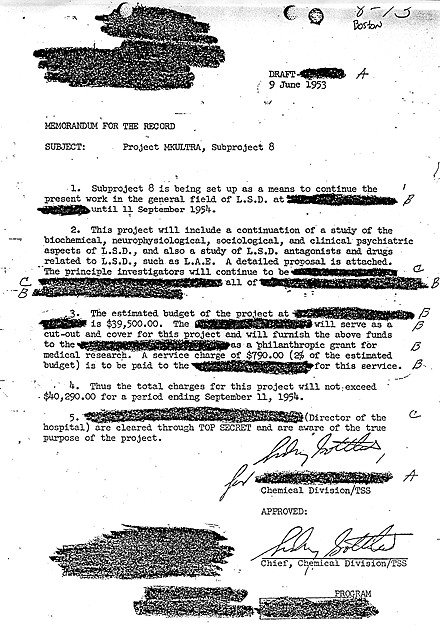
[edit]In the 1950s, the CIA investigated LSD (lysergic acid diethylamide) as part of its Project MKUltra. In the same period, the US Army undertook the secret Edgewood Arsenal human experiments which grew out of the U.S. chemical warfare program and involved studies of several hundred volunteer test subjects. Britain was also investigating the possible use of LSD and the chemical BZ (3-quinuclidinyl benzilate) as nonlethal battlefield drug-weapons.[1] The United States eventually weaponized BZ for delivery in the M43 BZ cluster bomb until stocks were destroyed in 1989. Both the US and Britain concluded that the desired effects of drug weapons were unpredictable under battlefield conditions and gave up experimentation.
Reports of drug weapons associated with the Soviet bloc have been considered unreliable given the apparent absence of documentation in state archives.[6][2][7]
See also
[edit]References
[edit]- ^ a b Dando M, Furmanski M 2006. Mid-spectrum incapacitant programs. In: Wheelis M et al. (eds). Deadly cultures: biological weapons since 1945. Cambridge, US: Harvard University Press.
- ^ a b Lee, Martin (May 1982). "Mad, Mad War". Mother Jones. p. 18. Retrieved 21 May 2013.
- ^ (2010). Journal of Pharmacy & Bioallied Sciences, 2(3), 166–178. [1]
- ^ Price, David A. (2003), Love and Hate in Jamestown: John Smith, Pocahontas, and the Heart of a New Nation, New York: Knopf, pg 204.
- ^ Ketchum, James S. (October 2012). Chemical Warfare Secrets Almost Forgotten. WestBow Press. pp. 14–. ISBN 978-1-4772-7589-4.
- ^ Douglass JD 1999 Red cocaine – the drugging of America and the west. London and New York: Edward Harle Limited.
- ^ Rózsa L 2009 A psychochemical weapon considered by the Warsaw Pact: a research note. Substance Use & Misuse, 44, 172-178. Archived 2011-07-21 at the Wayback Machine accessed: 30-03-2009.
External links
[edit]Psychochemical warfare
View on GrokipediaDefinition and Conceptual Foundations
Core Principles and Distinctions
Psychochemical warfare entails the use of psychopharmacological agents to induce temporary cognitive and perceptual impairments in adversaries, aiming to incapacitate combatants without inflicting death or lasting physical harm. Core principles center on exploiting biochemical pathways in the central nervous system to provoke states of delirium, hallucination, disorientation, or behavioral disruption, thereby rendering affected individuals incapable of effective military action. This methodology seeks to achieve tactical advantages through reversible effects, with dosages calibrated for incapacitation rather than lethality, as demonstrated in U.S. Army research on agents like BZ, where median incapacitating doses produced confusion lasting 72 to 96 hours without significant mortality.[10][11] The strategic rationale emphasizes selectivity in targeting mental faculties over bodily functions, minimizing collateral damage to non-combatants and infrastructure while facilitating potential enemy capture or surrender. Military doctrine classifies such agents as incapacitants, defined by their capacity to reduce operational effectiveness through transient disabilities, contrasting with persistent threats from conventional explosives or toxins. Historical precedents, such as ancient applications of emetics like hellebore roots to disorient foes, underscore the enduring principle of psychological debilitation via chemical means, though modern iterations prioritize precision in onset, duration, and recovery to align with operational controllability.[11] Key distinctions separate psychochemical warfare from lethal chemical warfare, which employs agents like sarin or VX to cause systemic toxicity, respiratory paralysis, or organ failure, often resulting in high fatality rates. Psychochemicals, by contrast, focus on psychomimetic effects—such as LSD's serotonin-mediated perceptual alterations or BZ's anticholinergic blockade leading to amnesia and ataxia—intended for non-permanent disruption, with lower toxicity profiles that avoid the ethical and legal prohibitions on mass casualty weapons under frameworks like the Chemical Weapons Convention.[11][7][12] Unlike psychological warfare, which relies on informational tactics to erode morale or sow doubt without physiological intervention, psychochemical methods deliver direct biochemical payloads via aerosols, ingestion, or inhalation to enforce involuntary neural changes, bypassing volitional resistance. This differentiates them further from biological agents, which propagate via replication and infection, whereas psychochemicals act as discrete chemical entities with predictable pharmacokinetics, though individual variability in susceptibility can undermine reliability in field applications.[10]Strategic Rationale and First-Principles Justification
Psychochemical warfare derives its foundational logic from the centrality of human cognition and decision-making in combat effectiveness; by chemically inducing temporary disruptions such as hallucinations, delirium, or panic, adversaries can be rendered combat-ineffective without requiring direct physical confrontation or destruction of material assets.[10] This approach leverages the vulnerability of neural processes to exogenous compounds, enabling a form of "selective malfunctioning of the human machine" that targets psychological faculties over structural integrity.[10] From causal principles, such agents exploit the brain's reliance on stable biochemistry for perception and volition, potentially achieving strategic paralysis at lower logistical costs than kinetic munitions, as the effects dissipate without permanent alteration to personnel or terrain.[13] Militarily, the rationale emphasizes high-probability incapacitation—targeting at least 99% efficacy with mortality under 0.5% and serious morbidity below 1%—to facilitate operations in constrained environments like urban settings or mixed civilian-combatant zones, where lethal force risks escalation or backlash.[13] Agents like BZ, with an incapacitating dose 40 times below lethal thresholds, were pursued for their capacity to induce multi-day delirium, allowing forces to seize objectives while minimizing post-engagement casualties and preserving enemy manpower for potential capitulation.[10] This contrasts with conventional arms by reducing infrastructure damage and enabling reversible denial of areas, theoretically aligning with objectives that prioritize control over annihilation.[14] Proponents in mid-20th-century U.S. programs, such as those at Edgewood Arsenal, justified development as a "noble cause" offering "more humane instruments of warfare" amid Cold War tensions, aiming to counter perceived Soviet advances in similar technologies without resorting to "wholesale killing" or mass property destruction.[10] Empirical testing on thousands of subjects validated the potential for psychochemicals to evoke "fear, panic, hysteria," disrupting organized resistance, though unpredictability in dispersal and dosage response limited operational reliability.[10] Strategically, this positions psychochemicals as a deterrent or force multiplier in asymmetric conflicts, where psychological demoralization can compel surrender more efficiently than attrition.[13]Historical Development
Ancient and Pre-Modern Applications
In ancient warfare, one of the earliest documented applications of psychochemical agents involved the deliberate use of "mad honey," produced from rhododendron flowers containing grayanotoxins, which cause nausea, vertigo, hallucinations, and temporary paralysis lasting up to 48 hours. During the retreat of the Greek mercenary force known as the Ten Thousand in 401 BCE, as described in Xenophon's Anabasis, soldiers foraging in the Colchis region (modern Georgia) consumed large quantities of this honey, resulting in mass incapacitation; affected troops exhibited crawling, vomiting, and delirium, enabling local Heptakometes tribesmen to rout them without significant resistance.[15] This episode illustrates the tactical exploitation of naturally occurring psychotoxins for defensive ambushes and area denial, leveraging environmental resources to disorient invaders rather than relying on lethal force.[16] A more intentional offensive deployment occurred in 67 BCE, when Mithridates VI of Pontus, facing Roman legions under Pompey the Great near the Black Sea, ordered the placement of mad honey in strategic locations to poison enemy foragers and water sources. Roman soldiers who ingested it suffered acute symptoms including convulsions, loss of coordination, and hallucinatory states, compelling Pompey's forces to withdraw temporarily and disrupting their advance; ancient sources attribute thousands of casualties to this method, underscoring its efficacy in asymmetric warfare against superior numbers.[16] Pliny the Elder corroborated these effects in his Naturalis Historia (ca. 77 CE), noting that even small amounts induced "madness" and prostration, with locals harvesting the honey specifically for such purposes.[15] Mithridates' familiarity with poisons—stemming from his personal regimen of mithridatism, involving daily sublethal doses to build immunity—likely informed this strategy, blending pharmacological knowledge with battlefield deception.[16] Evidence for psychochemical applications against enemies remains sparse beyond these cases, as most ancient records emphasize lethal poisons like aconite on arrows or irritant smokes from burning arsenic compounds, which caused physical distress rather than targeted mental disruption.[8] In nomadic warrior societies such as the Scythians (ca. 8th–3rd centuries BCE), archaeological finds of cannabis-infused braziers in burial sites confirm Herodotus' accounts (Histories, ca. 440 BCE) of inhaling hemp vapors for euphoric intoxication, potentially aiding ritual preparation for combat, though direct use as a weapon against foes lacks attestation.[17] Similarly, theories of deliriant plants like datura or belladonna applied to projectiles for inducing confusion in Mesoamerican or Indian warfare appear in ethnographic analogies but lack corroborated ancient battle records, highlighting the challenges in distinguishing ritual psychotropics from tactical agents.[18] Pre-modern examples, extending into the medieval period, are equally limited but include hypothesized self-administration by combatants for psychological enhancement, as with Norse berserkers (ca. 8th–11th centuries CE), elite Viking warriors described in sagas like the Ynglinga Saga as entering uncontrollable fury (berserkergang). While some interpretations posit ingestion of Amanita muscaria mushrooms or henbane seeds to trigger hallucinatory rage and pain insensitivity, pharmacological analyses indicate these substances more often produce sedation or ataxia than combat utility, and no contemporary texts explicitly reference drugs; adrenaline, alcohol, or psychological conditioning provide simpler explanations consistent with eyewitness accounts.[19] Such practices, if occurring, represent endogenous psychochemical augmentation rather than exogenous warfare, reflecting cultural adaptations for morale over enemy incapacitation. Overall, ancient and pre-modern psychochemical tactics prioritized opportunistic intoxication via contaminated provisions, constrained by the era's rudimentary delivery methods and reliance on foraging vulnerabilities.[1]20th-Century Military Research
In the mid-20th century, the United States Army Chemical Corps initiated extensive research into psychochemical agents at Edgewood Arsenal, Maryland, focusing on incapacitating substances that could disrupt enemy cognition without lethality. From 1955 to 1975, approximately 6,720 military volunteers were exposed to 254 different chemicals, including hallucinogens like LSD and deliriants such as BZ (3-quinuclidinyl benzilate), as part of the Medical Research Volunteer Program aimed at evaluating psychochemical warfare potential.[20][21] Early LSD tests from 1955 to 1960 revealed unpredictable effects, leading researchers to prioritize more reliable anticholinergics like BZ, which induced temporary delirium and was deemed feasible for aerosol delivery in military scenarios.[7][14] Concurrent with Army efforts, the CIA's Project MKULTRA, launched in 1953, explored LSD and other psychochemicals for interrogation and potential battlefield incapacitation, building on a 1949 concept paper by L. Wilson Greene advocating "psychochemical warfare" to induce mass psychological disruption.[2] These programs tested agents on human subjects, including unwitting civilians in some MKULTRA subprojects, to assess behavioral control and disorientation effects, though operational deployment was limited by variability in responses and delivery challenges.[22] By the 1960s, BZ was standardized and stockpiled by the U.S. military as a non-lethal incapacitant, with field trials demonstrating incapacitation durations of up to 72 hours at doses around 0.5 mg.[10] British research at Porton Down paralleled U.S. efforts, with LSD experiments conducted from the early 1950s, including MI6-commissioned trials in 1953-1954 on servicemen to evaluate its potential as a truth serum or incapacitant.[23] In the 1960s, Porton Down tested LSD on Royal Marines during field exercises, such as Operation Hardcastle in 1961, observing profound disorientation and hallucinations that rendered troops combat-ineffective for hours, though ethical concerns and inconsistency curbed further weaponization.[24] These studies emphasized aerosol dissemination for area denial but highlighted risks of blowback on friendly forces. Soviet and Warsaw Pact programs also investigated psychochemicals during the Cold War, with declassified documents indicating consideration of agents like BZ analogs for non-lethal warfare by the early 1960s.[25] Hungary was tasked in 1962 with countermeasures research against psychotropics but declined, reflecting broader Eastern Bloc interest in incapacitants as alternatives to lethal gases, though specific agent developments remained opaque and less documented than Western efforts.[25][26] Overall, 20th-century research underscored psychochemicals' tactical promise for temporary debilitation but revealed practical limitations in predictability, ethics, and control, influencing later treaty prohibitions on such agents under the 1993 Chemical Weapons Convention.Cold War Programs and Testing
The United States Central Intelligence Agency launched Project MKULTRA in 1953 as a clandestine program to investigate mind-control techniques, including the administration of psychochemical agents such as LSD to unwitting subjects for potential use in interrogation and psychological operations during the Cold War.[27] The program encompassed over 150 subprojects conducted at universities, hospitals, and prisons, with testing on an undetermined number of individuals, including military personnel, without informed consent, driven by fears of Soviet advances in behavioral manipulation.[22] Declassified documents reveal experiments aimed at exploiting hallucinogenic effects to induce confusion and compliance, though efficacy for warfare remained unproven amid ethical violations exposed in 1975 Senate hearings.[27] Parallel to MKULTRA, the U.S. Army Chemical Corps at Edgewood Arsenal in Maryland ran experiments from 1955 to 1975 under the Medical Research Volunteer Program, exposing approximately 7,000 soldiers to psychochemicals to evaluate incapacitation for battlefield use.[28] Agents tested included LSD for its disorienting properties and BZ (3-quinuclidinyl benzilate), a potent anticholinergic hallucinogen designed to render troops combat-ineffective for up to 72 hours by causing delirium, dry mouth, and blurred vision without lethality.[29] These trials, often involving aerosol delivery simulations, assessed physiological and psychological impacts, with BZ stockpiled as a potential non-lethal weapon until its 1969 discontinuation due to inconsistent effects and logistical challenges in deployment.[7] Soviet and Warsaw Pact research into psychochemicals mirrored Western efforts, with declassified documents indicating consideration of such agents as warfare tools to incapacitate adversaries through altered cognition and perception, though specific testing details remain sparse compared to U.S. disclosures.[30] In the UK, Porton Down facilities explored incapacitating chemicals in the 1960s, focusing on non-lethal agents to disrupt enemy forces, but programs emphasized nerve agents like sarin over pure psychochemicals, with limited public evidence of hallucinogen trials.[31] Overall, Cold War testing highlighted psychochemicals' potential for temporary disruption but revealed practical barriers, including unpredictable dosing and vulnerability to countermeasures like protective gear.[7]Post-Cold War Uses and Incidents
During the 2002 Moscow theater hostage crisis, Russian special forces deployed an aerosolized incapacitating agent on October 26 to subdue approximately 40 Chechen militants holding over 850 hostages in the Dubrovka Theater.[32] The operation, codenamed "Nord-Ost," involved pumping the gas through the ventilation system, leading to the militants' incapacitation but also the deaths of 130 hostages, primarily from respiratory failure and overdose effects, exacerbated by inadequate medical response including delayed antidote administration.[33] Analysis of victim urine and clothing samples identified the agent as a mixture of carfentanil (a potent fentanyl analog) and remifentanil, both synthetic opioids acting on the central nervous system to induce rapid sedation and unconsciousness, though Russian authorities have not officially confirmed the exact formula.[34] This incident highlighted the challenges of dosing such agents in enclosed spaces, as the lack of precise delivery control resulted in a hostage mortality rate exceeding 15%, far higher than intended for non-lethal incapacitation.[35] The use of fentanyl derivatives in this context represented a post-Cold War application of incapacitating chemicals outside traditional battlefield warfare, framed by Russia as a law enforcement counterterrorism measure rather than prohibited chemical weaponry under the 1993 Chemical Weapons Convention (CWC), which permits certain riot control agents but debates the status of potent sedatives.[36] Opioids like carfentanil, with potency up to 10,000 times that of morphine, cause central nervous system depression leading to immobility and unconsciousness, distinguishing them from earlier psychochemicals like BZ that induce hallucinations and delirium; however, their deployment underscored ongoing interest in calmative agents for hostage rescue despite risks of unintended lethality.[37] No comparable large-scale military or paramilitary uses of psychochemicals have been verifiably documented in subsequent operations, such as those in Iraq, Afghanistan, or Syria, where allegations of chemical agent employment focused on lethal nerve or choking agents rather than incapacitants.[38] Post-2002, international scrutiny intensified around incapacitating agents, with the incident prompting calls for CWC clarification on "calmatives" as potential warfare prohibitions, yet no further confirmed operational deployments occurred amid ethical, technical, and legal constraints.[39] Research into non-lethal psychochemical alternatives persisted in limited military programs, but empirical field applications remained absent, reflecting a shift toward kinetic or non-chemical incapacitation methods in asymmetric conflicts.[40]Agents, Mechanisms, and Delivery
Classes of Psychochemical Agents
Psychochemical agents, intended for temporary incapacitation through disruption of cognitive and perceptual functions, are broadly classified into four categories: stimulants, depressants, psychedelics, and deliriants. This taxonomy derives from their primary effects on the central nervous system, with military research emphasizing agents that achieve incapacitation at low doses while maintaining high safety margins (typically 5- to 100-fold between effective and lethal doses).[41] Stimulants enhance alertness and motor activity but require high concentrations for aerosol delivery, rendering them impractical for widespread battlefield use. Examples include amphetamines and cocaine, which at incapacitating levels risk convulsions or cardiovascular overload rather than reliable behavioral disruption.[41] Depressants induce sedation and reduced responsiveness, targeting inhibitory neural pathways to impair coordination and decision-making. Agents such as barbiturates, morphine, and potent opioids like etorphine or fentanyl exemplify this class, with incapacitating doses (e.g., ID50 around 0.1-1 mg/kg for fentanyl derivatives) often approaching lethal thresholds due to respiratory depression, yielding safety ratios as low as 10-20:1.[41] The 2002 Moscow theater hostage crisis demonstrated fentanyl-based aerosol deployment, incapacitating over 900 individuals but resulting in approximately 130 deaths from overdose or complications, highlighting operational risks.[14] Psychedelics alter sensory perception and induce hallucinations via serotonin receptor agonism, leading to distorted reality and erratic behavior. Lysergic acid diethylamide (LSD), with an incapacitating dose of approximately 2.5 µg/kg, was extensively tested by the U.S. military from 1959 to 1965 for its potential to disorient troops without physical harm, though effects proved unpredictable and duration (8-12 hours) limited tactical utility.[41] Other examples include psilocybin and mescaline, which similarly provoke perceptual overload but lack reliable antagonists for reversal.[14] Deliriants, often anticholinergics, produce profound confusion, amnesia, and motor incoordination by blocking muscarinic acetylcholine receptors. The prototypical agent, 3-quinuclidinyl benzilate (BZ), standardized by the U.S. Army in 1966, has an ID50 of 6.2 µg/kg via inhalation, onset in 30-60 minutes, and effects persisting 24-72 hours, including dry mouth, blurred vision, and hallucinatory delirium reversible by physostigmine.[41] Natural analogs like scopolamine (sevenfold more centrally potent than atropine) share these traits but with shorter durations. BZ's environmental stability and high safety margin (over 50:1) made it a focus of Cold War programs, though field deployment challenges persisted.[14]Biochemical Mechanisms of Action
Psychochemical agents in warfare primarily disrupt central nervous system function by targeting neurotransmitter receptors, inducing temporary incapacitation through delirium, hallucinations, or perceptual distortions without causing permanent lethality in intended doses.[42] These effects stem from interference with cholinergic and serotonergic signaling pathways, which regulate cognition, perception, and autonomic responses.[43] A key class involves anticholinergics like 3-quinuclidinyl benzilate (BZ), a glycolate ester that acts as a competitive antagonist at muscarinic acetylcholine receptors (M1-M5 subtypes) in both central and peripheral nervous systems.[29] By blocking acetylcholine binding, BZ inhibits postsynaptic signaling, leading to parasympathetic suppression, cognitive impairment, and symptoms such as confusion, amnesia, and vivid hallucinations; its potency exceeds that of atropine, with effects persisting 72-96 hours due to slow dissociation from receptors.[44] [45] Serotonergic agents, such as lysergic acid diethylamide (LSD), operate via partial agonism at 5-HT2A receptors, located on cortical pyramidal neurons, which modulates glutamate release and neural excitability to produce altered sensory processing and ego dissolution.[46] This receptor activation, with high affinity (Ki ≈ 3-5 nM), disrupts default mode network activity, contributing to hallucinations and distorted time perception, though LSD's military evaluation in the 1950s-1960s highlighted variable onset (30-90 minutes) and duration (8-12 hours).[29] [47]| Agent | Primary Target | Key Effects on Biochemistry |
|---|---|---|
| BZ | Muscarinic ACh receptors | Competitive blockade of ACh, cholinergic hypoactivity, delirium |
| LSD | 5-HT2A serotonin receptors | Partial agonism, enhanced cortical signaling, perceptual alteration |