Hubbry Logo
search
logo
1811353

Puster Valley

logo
Community Hub0 Subscribers
Read side by side
from Wikipedia

The Puster Valley[1][2] (Italian: Val Pusteria [ˈval pusteˈriːa]; German: Pustertal, Ladin: Val de Puster) is one of the largest longitudinal valleys in the Alps that runs in an east-west direction between Lienz in East Tyrol, Austria, and Mühlbach near Brixen in South Tyrol, Italy. The South Tyrolean municipalities of the Puster Valley constitute the Puster Valley district.

Key Information

Puster Valley

[edit]
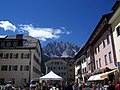
The Puster Valley at Bruneck

The Puster Valley is located in the western part of the Periadriatic Seam, which separates the Southern Limestone Alps from the Central Eastern Alps, as well as most of the limestone Alps from the central gneiss and slate peaks of the range's central section. East of Sillian, the Puster Valley leaves the Peradriatic Line (which moves into the Gail valley) and turns to the northeast towards Lienz.

Half of the valley drains to the west to the Adriatic via the Adige river; the other half drains to the east to the Black Sea via the Danube. The watershed lies in the shallow valley floor called Toblacher Feld (Conca di Dobbiaco). The Rienz river flows westwards through the Puster Valley and the Drau river flows eastwards into East Tyrol. The eastern part of the valley on the upper Drava is called Upper Puster Valley.

The towns in the Puster Valley are located between 750 and 1,180 meters (2,460 and 3,870 ft) above sea level. The most important of these towns in the western valley are Welsberg-Taisten, Olang, and Bruneck; the most important in the eastern valley are Toblach, Innichen, Sexten, and Sillian.

The largest tributaries of the Rienz river form the Antholzer Bach, the Ahr, the Pragser Bach, the Gsieser Bach, the Gran Ega, the Pfunderer Bach, and the Lüsenbach. The Puster Valley's largest side valley is the Tauferer Ahrntal. The Drau's largest eastern tributaries are the Sextner Bach and the Villgraten-Bach.

History

[edit]

The Puster Valley was inhabited since prehistoric times as finds belonging to the Iron Age have been found in that area. In more recent times this zone was inhabited by people belonging to the Illyrian stock: they were called "Saevates" by the Romans (hence the name "Sebatum" of the Roman station of today's Saint Lawrence.) In the 6th century, the Celtic invaders merged with the Illyrian population.[3] Around the end of the I century B.C, the Rienz valley was mainly used by the Romans as an arterial road to connect the north-eastern regions of the Empire. The Puster Valley belonged to the imperial province of Noricum, and the local populations, during the four centuries of the domination of Rome, began to assimilate the customs, the language and finally the Christian religion. In the 5th century the Goths, the Baiuvarii and the Slavs decided to descend in this area, with consequent conflicts between Baiuvarii and Slavs, which ended with the Baiuvarii victory. In the course of their westward migration, the Slavs settled in East Tyrol and left visible traces in the place names. In the 10th century the Puster Valley started to belong to the Pustrissa countship, firstly mentioned in 974 as Pustrissa and Pustrussa;[4] in 1091 the countship was ceded by the Emperor Henry IV to the Bishop of Brixen and in the 16th century the Hapsburg took possession of it. During the Napoleonic era, following the Austrian defeat at Austerlitz and the treaty of Pressburg in 1805, the entire region passed to the Bavaria: the Tyroleans, led by Andreas Hofer, repeatedly fought against the Bavarian domination.[5] After Napoleon's fall, the Puster valley was reunited with Austria and, following the World War I, it was assigned to Italy.[6]

Opening in 1871 the Puster Valley Railway uses the relative simple landscape to avoid climbing steep slopes.

Puster Valley District

[edit]
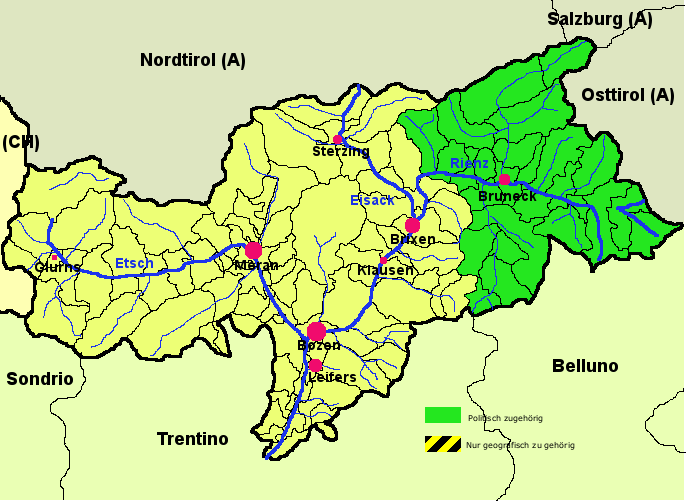
Map of the Puster Valley.

The Puster Valley District (Italian: Comprensorio della Val Pusteria; German: Bezirksgemeinschaft Pustertal) was founded in 1969 with the merger of 26 municipalities. Its combined area is 2,071 km² and its population is over 73,000. Its main town is Bruneck. According to the 2001 census, 80.96% of the population of the valley speak German, 13.40% Ladin, and 5.64% Italian as their native language.[7]

The following municipalities are part of the Puster Valley District:

[edit]

References

[edit]
[edit]
Revisions and contributorsEdit on WikipediaRead on Wikipedia
from Grokipedia
The Puster Valley (German: Pustertal; Italian: Val Pusteria) is one of the principal longitudinal valleys of the Eastern Alps, extending approximately 100 km in an east-west direction from near Bressanone in the west to Lienz in East Tyrol, Austria, in the east, and lying primarily within South Tyrol province, northern Italy.[1] It encompasses an area of 2,068 km² and supports a population of about 83,371 residents, the majority of whom speak German as their primary language in this historically Tyrolean region. The valley's geography features a diverse alpine landscape shaped by the Drava River, with broad meadows and forests in the lower sections giving way to steep slopes and peaks exceeding 3,000 meters, including segments of the Dolomites designated as a UNESCO World Heritage site since 2009.[2] Its economy centers on tourism, leveraging winter skiing at resorts like Plan de Corones and summer activities such as hiking and cycling amid landmarks including Lago di Braies, Lago di Dobbiaco, and the Tre Cime di Lavaredo; agriculture, particularly dairy and forestry, supplements this in rural areas.[3] Bruneck (Brunico), the largest settlement, functions as the administrative and commercial core, hosting cultural events and preserving medieval architecture amid a bilingual Italian-German milieu reflective of South Tyrol's autonomous status.[4]

Geography and Environment

Location and Physical Features

The Puster Valley forms a prominent east-west longitudinal valley in the Eastern Alps, situated mainly in South Tyrol, northern Italy, with its eastern extension crossing into East Tyrol, Austria.[5] It stretches approximately 100 kilometers, beginning near the confluence of the Aurina and Rienz rivers close to Bruneck (Brunico) in the west and extending eastward to the vicinity of Lienz amid the Lienzer Dolomites.[6] This orientation positions the valley as a key transverse feature separating the Central Eastern Alps from the Dolomites, facilitating historical and modern transit routes across the Alpine barrier.[7] The valley's hydrology is dominated by the Rienz River, which originates from the confluence of tributaries including the Aurina River near Bruneck at an elevation of about 800 meters and flows eastward roughly 90 kilometers to join the Drava River near Lienz, ultimately contributing to the Danube basin.[8] Flanked to the north by the Zillertal Alps, reaching peaks over 3,000 meters, and to the south by the Puster Alps and extensions of the Dolomites—some inscribed as UNESCO World Heritage sites—the valley features steep escarpments rising to 2,500–3,500 meters on both sides.[9] Elevations within the valley floor range from 750 to 1,200 meters, creating a broad, U-shaped glacial trough conducive to settlements along its axis.[10] Prominent sub-valleys branch off, such as the Defereggen Valley to the south in the Austrian portion near Lienz, embedded within the Hohe Tauern National Park and framed by the Deferegger Mountains.[11] Other lateral valleys like the Ahrn Valley to the north further delineate the basin's boundaries, enhancing its topographic complexity with side arms that access higher alpine terrain.[12]

Geology, Climate, and Ecology

The Puster Valley's landscape bears the hallmarks of Pleistocene glaciation, featuring a pronounced U-shaped cross-section carved by advancing ice sheets during the Last Glacial Maximum and subsequent phases.[13][14] Sedimentary bedrock predominates, with dolostone and limestone formations exposed in the surrounding massifs, contributing to the rugged topography of steep valley walls and elevated plateaus typical of the Southern Limestone Alps.[15][16] Climatically, the valley experiences a continental regime moderated by its alpine setting, with average January temperatures near -5°C in lowland areas like Bruneck, supporting extensive snow cover for winter activities, and summer highs reaching 23–25°C. Annual precipitation totals around 1,100 mm, varying with elevation and orographic lift, while föhn winds—especially north föhn events—induce abrupt warming, reduced humidity, and gusts that can elevate temperatures by over 10°C in hours.[17][18][19] Ecologically, the terrain's elevation span from valley floors at approximately 800 m to peaks exceeding 3,000 m fosters zoned biodiversity, including larch-dominated coniferous forests at mid-slopes and sparse alpine vegetation higher up. Key fauna adapted to these gradients encompass chamois, marmots, and ibex in rocky terrains, alongside predators like golden eagles; such assemblages reflect resilience to seasonal extremes and habitat fragmentation inherent to alpine ecosystems.[20][21][22]

History

Prehistoric and Ancient Periods

The Puster Valley, situated in the Eastern Alps, exhibits evidence of human occupation dating back to the Mesolithic period following the retreat of glaciers around 10,000 BCE, with hunter-gatherer activities concentrated at high-altitude sites such as the Staller Saddle pass near Antholz, where lithic tools and faunal remains indicate seasonal mobility and exploitation of alpine resources.[23] These findings reflect broader patterns of post-glacial recolonization in South Tyrol, where Mesolithic groups adapted to montane environments through hunting red deer and ibex, as corroborated by isotopic analyses of remains from nearby alpine contexts showing dietary reliance on local fauna from approximately 8000 BCE.[24] Transition to Neolithic practices, including early agriculture and pastoralism, emerged around 5000–4000 BCE in the region, though direct evidence in the Puster Valley remains limited to scattered pollen records and tools suggesting rudimentary farming and animal husbandry amid challenging terrain.[25] Bronze Age activity intensified with fortified hilltop settlements and metallurgical evidence, as seen in excavations at San Lorenzo di Sebato revealing bronze artifacts and burial sites indicative of emerging social hierarchies and trans-Alpine exchange networks for copper and tin by circa 2000–1000 BCE.[26] During the Iron Age (circa 1000–15 BCE), the valley hosted tribes affiliated with the Norici, a Celtic-influenced group from Noricum, whose presence at sites like San Lorenzo is attested by iron tools, weapons, and pottery fragments, pointing to fortified villages and participation in salt and metal trade routes across the Alps.[26] Raetic-speaking peoples, possibly overlapping or adjacent, contributed linguistic and cultural elements, with inscriptions and stelae from broader South Tyrol suggesting ritual practices and defensive structures amid interactions with Etruscan and Illyrian influences.[27] Roman expansion reached the Puster Valley during the campaigns of Drusus and Tiberius in 15 BCE, subjugating local tribes and incorporating the area into the province of Raetia by 16–15 BCE as a buffer against Germanic incursions, with the valley serving as a strategic corridor for military logistics.[27] Key infrastructure included the Via Norica, a Roman road traversing the valley from Aquileia to the Rhineland, facilitating trade in amber, metals, and slaves; remnants near San Lorenzo di Sebato highlight waystations like Mansio Sebatum, a postal and accommodation hub established in the 1st century CE, where excavations have uncovered barracks, baths, inscriptions, and coins evidencing civilian and military coexistence until the 4th century CE.[26][27] Burial sites and votive offerings, including altars to Jupiter and local deities, underscore syncretic Roman-local cults and economic integration via alpine passes, with sparse but confirmatory artifacts like fibulae and amphorae indicating sustained connectivity to imperial networks.[27]

Medieval Era and Habsburg Rule

The Puster Valley's feudal structures solidified by the 10th century, with the region incorporated into the Holy Roman Empire as part of the Pustrissa countship, first documented in 974, which supported trade networks linking the Brenner Pass to eastern Alpine routes.[28] Early ecclesiastical influence was evident through ties to the Bishopric of Aguntum, with probable church centers emerging in locales like St. Lorenzen, laying groundwork for later bishoprics such as Brixen (established 970) that exerted temporal authority over valley territories.[28] These developments positioned the valley as a conduit for commerce and migration within imperial frameworks, though under fragmented comital rule by houses like the Meinhardiner. In 1363, the Habsburg dynasty acquired the County of Tyrol, encompassing the Puster Valley, via the bequest of the childless Margaret Maultasch (Margarete Maultasch) to Duke Rudolph IV, marking a pivotal shift to centralized Habsburg governance.[29] [30] This integration fostered administrative stability, encouraging German-speaking settlement amid ongoing Latin and Slavic influences, while bolstering local economies through mining ventures—such as silver and copper extraction in broader Tyrolean domains—and fortified trade paths.[31] The Habsburgs' strategic control extended to the upper Puster Valley's Gorizia-held enclaves around Lienz, fully consolidated by 1500 under Maximilian I, enhancing defensive cohesion against external threats.[32] Tensions arose periodically, as in the 1525 German Peasants' War, when revolts erupted in the Puster and Eisack valleys under leaders like Michael Gaismair, protesting feudal burdens and ecclesiastical privileges before Habsburg forces suppressed them.[33] [34] The valley also contributed to Habsburg defenses, serving as a frontier bulwark against Ottoman incursions from Hungarian territories in the 16th century, with local militias and fortifications aiding broader imperial resistance.[35] Overall, Habsburg rule from 1363 onward imposed enduring stability, embedding the Puster Valley within Tyrol's proto-modern administrative and economic systems until the Napoleonic upheavals.

Modern Annexation and Ethnic Tensions

The Puster Valley, comprising the upper Drava River basin in what became the Italian province of South Tyrol, was annexed to Italy under the Treaty of Saint-Germain-en-Laye, signed on 10 September 1919 between the Allied Powers and Austria.[36] Article 27 of the treaty ceded the southern portions of the former Habsburg Crown Land of Tyrol south of the Brenner Pass, including the predominantly German-speaking Puster Valley, despite local majorities favoring retention under Austria; a 1910 Austrian census recorded approximately 93% of South Tyrol's population as German-speakers, with only 3% Italians.[37] This transfer disregarded ethnic self-determination principles articulated in Woodrow Wilson's Fourteen Points, prioritizing Italy's strategic claims to the Alps as a "natural frontier."[38] Fascist policies under Benito Mussolini intensified ethnic tensions through systematic Italianization efforts starting in the mid-1920s. Geographer Ettore Tolomei, appointed to oversee "onomastic restitution," mandated the replacement of German toponyms with Italian equivalents across South Tyrol, including in the Puster Valley—renaming Bruneck to Brunico and Innichen to San Candido, among others—erasing linguistic markers of Germanic heritage.[39] German-language use was prohibited in public administration, courts, media, and education, with all German schools closed by 1923-1924; this prompted the covert operation of Katakombenschulen (catacomb schools) in private homes to teach children in German, evading fascist surveillance and fines.[40] Land expropriations targeted German-speaking farmers, redistributing properties to Italian settlers incentivized by state subsidies, aiming to alter demographics; by the 1930s, thousands of southern Italians had been relocated to the region, exacerbating resentment among locals who viewed these measures as cultural erasure rather than integration.[41][42] These suppressions fostered organized resistance, culminating in the formation of the South Tyrolean People's Party (SVP) on 7 December 1948 as the primary political vehicle for German-speakers.[43] The SVP, drawing on pre-war autonomist traditions, demanded implementation of the 1948 Autonomy Statute's protections for linguistic minorities, including proportional representation and cultural safeguards, amid ongoing disputes over unfulfilled Paris Agreement (1946) provisions for South Tyrolean self-governance.[44] While Italian authorities cited national unity, German-speakers perceived the party's advocacy as essential to countering residual fascist-era biases in centralized Roman policies, with SVP securing electoral majorities to press for devolution.[45]

Post-War Autonomy and Conflicts

Following the Second World War, the German-speaking population of the Puster Valley, integrated into Italy since 1919, experienced heightened ethnic grievances over cultural assimilation policies and limited self-governance, fueling irredentist aspirations toward Austria. These tensions culminated in a violent separatist campaign during the 1950s and 1960s, primarily orchestrated by the Befreiungsausschuss Südtirol (BAS), an underground group seeking reunification through sabotage. The BAS conducted hundreds of attacks, targeting infrastructure such as electricity pylons and rail lines across South Tyrol, including areas encompassing the Puster Valley; the operations, spanning roughly 1956 to 1969, inflicted substantial property damage but resulted in no direct fatalities from the bombings themselves, though they provoked retaliatory violence from Italian extremists.[46] The escalation prompted international mediation under the 1946 Gruber-De Gasperi Agreement, but persistent unrest necessitated further negotiations, leading to the Second Autonomy Statute of 1972. This statute devolved significant powers from the central Italian government to the province, establishing ethnic proportionality in public employment, education, and administration—ensuring representation aligned with linguistic demographics—and granting fiscal autonomy, whereby approximately 90% of locally collected taxes remain in South Tyrol for regional use.[43][47] Implementation of the statute correlated with economic divergence from the Italian national trajectory; South Tyrol's GDP per capita, which had lagged in the immediate post-war era, rose to exceed the Italian average by about 30% within decades, driven by retained fiscal resources funding infrastructure, agriculture, and tourism in valleys like the Puster. This prosperity—evidenced by the province achieving Italy's highest per capita GDP, at 157% of the EU average in recent figures—causally mitigated separatist incentives by fostering material stability and reducing grievances over resource extraction by Rome.[48][49] By the 1980s, irredentism waned as empirical gains from autonomy solidified loyalty to the Italian framework over reunification demands; the South Tyrolean People's Party (SVP), dominant among German-speakers, abandoned explicit secessionism, prioritizing statute enforcement amid referenda and consultations affirming provincial status within Italy. In the Puster Valley, this shift manifested in local stabilization, with ethnic conflicts yielding to cooperative governance, underscoring how targeted autonomy addressed causal roots of unrest without territorial reconfiguration.[50]

Administration and Demographics

Administrative Structure

The Puster Valley is administratively integrated into the Autonomous Province of Bolzano (South Tyrol), where it constitutes the Puster Valley District, encompassing multiple municipalities governed under provincial oversight.[51] This district is subdivided into the Western Puster Valley (Unterpustertal), centered around Bruneck as the administrative capital, and the Eastern Puster Valley (Oberpustertal), extending toward the Austrian border with key municipalities such as Toblach. Municipal governance occurs at the local level through elected mayors and councils, handling services like urban planning and infrastructure, while coordinating with provincial authorities on broader policies.[52] Under the 1972 Second Statute of Autonomy for Trentino-Alto Adige/Südtirol, the province exercises exclusive legislative and administrative powers in domains including education—such as maintaining separate school systems by linguistic group—and cultural preservation, enabling region-specific adaptations that prioritize local ethnic and linguistic dynamics over centralized Italian directives.[53][54] These competencies stem from negotiated protections formalized in the statute to address post-World War II ethnic tensions, granting South Tyrol fiscal and decisional autonomy exceeding that of standard Italian regions.[43] Local inter-municipal cooperation manifests in consortia addressing shared needs, exemplified by the Pustertal Wastewater Consortium, which owns and oversees five treatment plants and a main collector serving 14 municipalities across 1,176 km²—equivalent to 10% of the province's area—managed operationally by ARA Pustertal AG to ensure compliant effluent discharge and sludge processing.[55][56] This entity exemplifies decentralized environmental governance, with recent expansions in sludge-to-energy facilities enhancing sustainability without relying on provincial-wide mandates.[57]

Population Composition and Languages

The Puster Valley comprises approximately 84,600 residents as of December 31, 2023, distributed across 26 municipalities spanning 2,071 square kilometers.[58] Population density remains low at around 41 inhabitants per square kilometer, reflecting a predominantly rural settlement pattern with clustered villages and alpine hamlets, punctuated by urban centers such as Bruneck (population over 16,000).[58] This structure supports traditional agrarian lifestyles, though proximity to tourism hubs influences localized growth in service-oriented towns. Linguistically, the valley's residents are overwhelmingly German-speaking, with historical census data indicating over 80% declaring German as their mother tongue, a figure likely higher in rural municipalities based on municipal-level declarations. Italian speakers constitute under 10%, concentrated in administrative or commercial roles, while Ladin is marginal, present only in trace amounts in peripheral valleys like Antholz. Daily communication favors local Tyrolean dialects (Pustertalerisch), a South Bavarian variant resilient to standardization efforts, even as provincial law mandates bilingual (German-Italian) public signage and services.[59] Demographic trends show an aging population, with the share of residents over 65 exceeding 20% in many municipalities, driven by low fertility rates (around 1.3 births per woman, below Italy's 1.24 national average) and modest net migration.[60] Immigration remains limited compared to Italy's southern regions, with foreign-born individuals comprising less than 10% of the total, primarily EU nationals in seasonal tourism or agriculture roles, preserving ethnic and linguistic homogeneity.[60]

Economy

Primary Sectors: Agriculture and Industry

The primary sector in the Puster Valley relies heavily on dairy farming, supported by alpine pastures that sustain cattle husbandry and cheese production. Family-operated farms predominate, producing milk processed into regional specialties such as Val Pusteria mountain cheese, made from fresh cow's milk and aged for at least 60 days to develop its characteristic aroma.[61] Protected designations like Pusterer Käse highlight the area's focus on traditional, small-batch dairy output, with cooperatives and alpine dairies such as the Tre Cime facility transforming local milk into hard cheeses and other products using methods rooted in historical practices.[62] Forestry complements agriculture, with farms managing woodlands for timber alongside meadow grazing, contributing to sustainable wood resources amid the valley's coniferous forests.[63] Crop cultivation includes hardy varieties suited to the valley's elevation, such as potatoes, grains, and vegetables grown on limited arable land for farm consumption and local markets, though less dominant than in lower South Tyrolean valleys where apple production accounts for about 10% of the European Union's total output.[64] In the broader South Tyrol context, the primary sector employs roughly 8% of the workforce, far exceeding Italy's national average of around 3%, reflecting the valley's retention of labor-intensive farming amid modernization.[65] This employment share underscores agriculture's role in local GDP, bolstered by direct sales and EU-recognized quality standards that emphasize ecological management of pastures.[66] Industrial activities remain small-scale and tied to natural resources, with woodworking enterprises processing local timber into furniture and crafts, leveraging the valley's forested terrain. Textile production, historically linked to alpine wool from sheep and goats, persists in niche workshops, though output is modest compared to pre-industrial eras.[67] The sector has shifted from early 20th-century mining, exemplified by the Predoi copper operations that ceased in the late 1980s after peaking mid-century, toward lighter manufacturing integrated with agribusiness for value-added processing like dairy equipment or wood-derived products.[68] Overall, these primaries contribute to South Tyrol's economic resilience, with industry firms numbering over 5,000 province-wide as of 2019, though valley-specific operations prioritize sustainability over expansion.[69]

Tourism and Service Industries

Tourism constitutes the dominant economic driver in the Puster Valley, with the sector centered on winter sports at the Kronplatz ski area and summer hiking in the surrounding Dolomites. The Kronplatz resort features 121 kilometers of ski slopes served by modern cable cars, attracting skiers primarily from Germany, Austria, and Italy.[70] In the 2022-2023 winter season, the valley recorded 5.2 million overnight stays, marking a 21.6% increase from the prior year and underscoring its appeal for alpine activities.[71] Annually, the Puster Valley accounts for approximately 31% of South Tyrol's total overnight stays, with 11.5 million registered in 2024 alone, reflecting its extensive infrastructure of over 76,700 beds—30.2% of the province's capacity.[72][73] The service sector, encompassing hotels, restaurants, and transport, employs around 60% of the local workforce, bolstered by seasonal peaks in visitor numbers that drive revenue through accommodations and lift operations.[74] Post-COVID recovery has demonstrated resilience, with overnight stays surpassing pre-pandemic levels by 2024, fueled by strong demand from domestic Italian and German markets amid broader European travel rebounds.[75] In July and August 2025, the valley captured 32.1% and 31.4% of provincial stays, respectively, highlighting sustained summer hiking appeal despite minor monthly fluctuations.[76][77] This growth has solidified tourism's role in economic stability, supported by investments in cable car systems and hospitality facilities.

Culture and Society

Linguistic Identity and Traditions

The Puster Valley's linguistic identity centers on its German-Tyrolean roots, where the predominant language is a Southern Bavarian dialect variant known as Pustertalerisch, characterized by phonetic shifts and vocabulary distinct from standard High German or Italian. This dialect dominates everyday interactions, with residents favoring it over Italian in familial, social, and commercial settings, fostering a cultural continuity tied to historical Alpine migrations and Habsburg-era settlement patterns. Provincial autonomy provisions enable separate German-language education systems, from primary schools to vocational training, which resist linguistic assimilation by prioritizing dialect immersion alongside standard German, thereby preserving oral traditions against broader Italian national norms.[78] Cultural traditions reinforce this identity through communal practices like Schützen festivals, organized by the Schützenbezirk Pustertal's 34 rifle companies, which host annual shooting competitions, parades in traditional attire, and brass band performances commemorating Tyrolean self-defense heritage dating to the 16th century. These events, such as the Gesamtpustertaler Schützentreffen, emphasize marksmanship and folklore, drawing over 1,200 active members and underscoring resistance to cultural homogenization. Similarly, Törggelen customs in autumn involve communal gatherings at Buschenschänke taverns for freshly pressed grape juice (Suser), roasted chestnuts, speck, and rye bread, originating from medieval harvest rituals that celebrate agrarian self-sufficiency and seasonal cycles.[79][80][81] Folk music further embodies these traditions, featuring yodeling techniques derived from Alpine herding calls and accompaniment on stringed instruments like the zither in local ensembles during village feasts. Dialectal literature, including poetry and prose by regional authors capturing valley-specific idioms, appears in periodicals and community publications, while German-medium radio and print media sustain narrative continuity. These elements collectively affirm an empirical preference for German usage exceeding 80% in daily life, as evidenced by historical census declarations, distinguishing Puster Valley practices from Italian mainland conventions.[82]

Religious and Social Dynamics

The Puster Valley exhibits a strong Roman Catholic character, with the faith dominating community life and institutions, as the region largely evaded the Protestant Reformation's impact during the early modern period.[83] Prominent Catholic sites include Bruneck's Parish Church, consecrated with a notable crucifix sculpted by Michael Pacher in the late 15th century and housing South Tyrol's largest organ, installed in 1983.[84] A small Protestant minority endures, linked to 16th-century Anabaptist influxes from neighboring areas, though comprising less than 2% of the provincial population.[85] Social structures prioritize family stability and communal solidarity, reinforced by Catholic teachings on marriage and reinforced by regional divorce rates that, while aligned with Italy's national crude rate of approximately 1.6 per 1,000 inhabitants in recent years, reflect conservative norms in practice.[86] Volunteerism forms a cornerstone of social organization, with South Tyrol's 306 fire brigades engaging 19,601 members—about one in three residents in volunteer roles province-wide—handling emergencies and fostering local cohesion.[87] Historically, the Catholic Church wielded influence in shaping autonomy efforts, with clergy advocating non-violent paths during mid-20th-century negotiations, contributing to stable ethnic relations without endorsing irredentism.[88] This role stemmed from the Church's embedded position in Tyrolean society, prioritizing cultural preservation over confrontation.[89]

Infrastructure and Connectivity

Transportation Networks

The Puster Valley Railway, a single-track standard-gauge line, connects Fortezza (Franzensfeste) to Innichen (San Candido), with extensions linking to Lienz in Austria and integrating with the Brenner route from Innsbruck. Construction began under the Austro-Hungarian Südbahn-Gesellschaft, with initial operations from Villach to Fortezza commencing in November 1871, enabling efficient cross-Alpine trade in timber, agriculture, and early industrial goods between northern Europe and Italy. This infrastructure historically boosted regional commerce by reducing transit times and costs compared to wagon roads, fostering economic ties across the Tyrolean borderlands. As of 2025, the line undergoes major electrification and modernization, resulting in closures from December 2024 through January 2026, supplemented by replacement bus services between Brixen/Bressanone, Fortezza, and Bruneck/Brunico.[90][91] The Strada Statale 49 (SS49), part of European route E66, parallels the railway as the primary highway traversing the valley from west to east, facilitating freight and passenger vehicles to the Austrian border at Lienz. This route supports daily cross-border commuting and seasonal tourism influxes, though winter snow leads to temporary closures of adjacent high-elevation passes like the Staller Saddle, redirecting traffic to the main valley corridor. While capable of heavier loads than pre-railway paths, its freight volume remains modest, prioritizing tourism-related transport over bulk industrial shipping, reflecting the valley's economic orientation.[92] Cycling networks enhance sustainable connectivity, with the Pustertal Cycle Path extending approximately 80 kilometers along the Rienz and Drava rivers from Mühlbach near Brixen to Lienz, crossing into Austria as part of the Drau Cycle Route. These paved, traffic-separated trails accommodate families and e-bikers, promoting low-impact trade in local products and bolstering year-round tourism without straining motorized infrastructure. Bus services from the Südtirol Mobil network complement rail and road options, integrating valley towns into South Tyrol's broader public transit system for efficient regional access.[93][94]

Modern Developments in Utilities

The ARA Pustertal AG, responsible for wastewater treatment in the Puster Valley, commissioned a sludge drying and thermal valorization facility at its Tobl plant in St. Lorenzen during the 2010s, with ongoing optimizations in the 2020s enabling on-site mineralization of dried sewage sludge to close the internal loop and minimize external disposal. This infrastructure processes sludge from 14 municipalities, achieving over 92% operational availability in 2022 and producing inert residues equivalent to about 8% of input volume for recycling in landfill capping.[95][96][97] Complementing waste management, biogas production at ARA Pustertal facilities, including the Unteres Pustertal plant, has advanced through projects like OptDigest, launched in 2022 and yielding results by 2023 that optimize anaerobic digestion for higher renewable energy output from wastewater and associated organic wastes such as food and beverage residues. These efforts convert methane into heat and electricity via combined heat and power units, harnessing the valley's distributed sewage infrastructure for localized energy generation amid South Tyrol's broader renewable targets.[98][99][100] Renewable expansions in the Puster Valley include biogas integration from agricultural and treatment sources, supporting farm-level efficiency, while hydro and solar capacities align with provincial goals exceeding 75% renewable coverage by 2020, though site-specific hydro upgrades remain tied to legacy infrastructure like early 20th-century plants. Broadband initiatives under Italy's Ultra Broadband Strategy, extended through 2026, target remote valley areas to enable precision agriculture technologies, though coverage in the Puster Valley relies on ongoing fiber deployments by regional providers.[100][101][102]

Contemporary Challenges

Tourism Growth and Environmental Impacts

Tourism in the Puster Valley has experienced steady growth, with the broader South Tyrol region recording 37.1 million overnight stays in 2024, a 2.6% increase from the previous year, driven by attractions like the Kronplatz ski resort and hiking trails.[75] Locally, the sector serves as an economic driver, securing jobs in rural areas and supporting family-run businesses, which constitute over 90% of enterprises in the valley.[103] This growth contributes significantly to the provincial economy, where tourism accounts for approximately 11% of GDP through direct effects, with indirect impacts amplifying its role in sustaining fiscal autonomy under South Tyrol's special statute.[104][105] Despite these benefits, expanding visitor numbers—exceeding 7 million arrivals province-wide in recent years—have strained natural resources, including soil erosion along popular hiking paths due to heavy foot traffic and trail degradation.[106] Water usage for artificial snow production in ski areas and increased demand during peak seasons further pressure local supplies, while habitat fragmentation affects biodiversity in the valley's Alpine ecosystems, part of the UNESCO-listed Dolomites.[107] However, no formal delisting threats have materialized for the site, and provincial guest taxes—generating funds for conservation—help mitigate impacts through targeted environmental projects.[108] Local businesses have opposed proposals for strict caps on accommodations, arguing in 2023-2025 debates that such measures could undermine job stability without addressing root causes like seasonal peaks, emphasizing tourism's role in countering rural depopulation.[103][104] While some residents express concerns over overtourism's social costs, empirical data shows conservation efforts, including trail maintenance and habitat restoration funded by levies, have prevented widespread biodiversity collapse, supporting claims that measured growth preserves rather than alarms the valley's viability.[109][110]

Political and Economic Debates

The autonomy framework of South Tyrol, encompassing the Puster Valley, has empirically driven economic outperformance, with provincial GDP per capita reaching 62,100 euros in 2023—roughly 1.5 times Italy's national average of around 40,000 euros.[49] [111] This disparity stems from extensive local fiscal powers, including retention of a significant share of tax revenues, enabling investments in infrastructure and education that sustain high productivity in sectors like tourism and manufacturing prevalent in the Puster Valley. Unemployment remains structurally low at 2% as of 2024, far below Italy's 7.6% rate, reflecting efficient labor market policies insulated from national rigidities. [112] Proponents of enhanced regional self-reliance, including business associations in the Puster Valley, critique episodic central Italian interventions—such as uniform national labor or fiscal mandates—as disruptive to localized economic dynamism, arguing they erode the comparative advantages built since the 1972 autonomy statute's implementation.[48] These groups advocate for minimal federal oversight to preserve incentives for entrepreneurship, citing historical precedents like the 1960s ethnic tensions, where demands for greater devolution resolved unrest through power transfers rather than confrontation, stabilizing the region without reverting to irredentist agitation.[113] In recent years (2020–2025), debates have intensified around balancing climate initiatives with economic deregulation, as provincial policies promote sustainability networks while valley-based enterprises resist stringent EU-aligned restrictions on development, fearing impacts on tourism-dependent growth.[114] Local data underscore ethnic stability, with proportional representation ensuring German-speakers' 62% demographic hold without resurgence of Austrian irredentist narratives, as autonomy's safeguards have empirically quelled separatist sentiments since the 1970s.[50]

References

User Avatar
No comments yet.