Hubbry Logo
Flat no-leads packageFlat no-leads packageMain
Open search
Flat no-leads package
Community hub
Flat no-leads package
logo
8 pages, 0 posts
0 subscribers
Be the first to start a discussion here.
Flat no-leads package
from Wikipedia
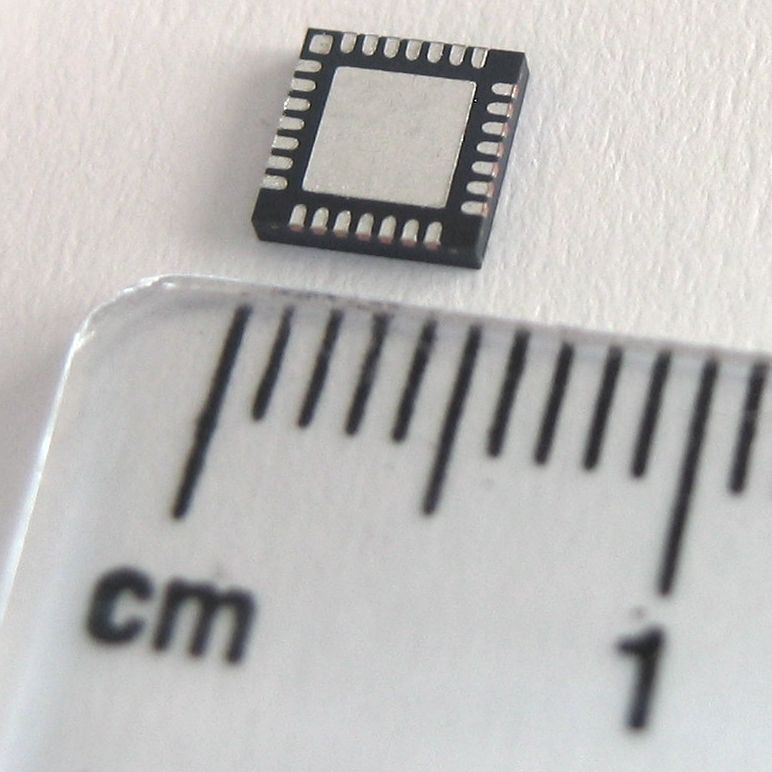
28-pin QFN, upside down to show contacts and thermal/ground pad

Flat no-leads packages such as quad-flat no-leads (QFN)[1] and dual-flat no-leads (DFN) physically and electrically connect integrated circuits to printed circuit boards. Flat no-leads, also known as micro leadframe (MLF) and SON (small-outline no leads), is a surface-mount technology, one of several package technologies that connect ICs to the surfaces of PCBs without through-holes. Flat no-lead is a near chip scale plastic encapsulated package made with a planar copper lead frame substrate. Perimeter lands on the package bottom provide electrical connections to the PCB.[1] Flat no-lead packages usually, but not always, include an exposed thermally conductive pad to improve heat transfer out of the IC (into the PCB). Heat transfer can be further facilitated by metal vias in the thermal pad.[2] The QFN package is similar to the quad-flat package (QFP), and a ball grid array (BGA).

Flat no-lead cross-section

[edit]
QFN side view.

The figure shows the cross section of a flat no-lead package with a lead frame and wire bonding. There are two types of body designs, punch singulation and saw singulation.[3] Saw singulation cuts a large set of packages in parts. In punch singulation, a single package is moulded into shape. The cross section shows a saw-singulated body with an attached thermal head pad. The lead frame is made of copper alloy and a thermally conductive adhesive is used for attaching the silicon die to the thermal pad. The silicon die is electrically connected to the lead frame by 1–2 thou diameter gold wires.

The pads of a saw-singulated package can either be completely under the package, or they can fold around the edge of the package.

Different types

[edit]

Two types of QFN packages are common: air-cavity QFNs, with an air cavity designed into the package, and plastic-moulded QFNs with air in the package minimized.

Less-expensive plastic-moulded QFNs are usually limited to applications up to ~2–3 GHz. It is usually composed of just 2 parts, a plastic compound and copper lead frame, and does not come with a lid.

In contrast, the air-cavity QFN is usually made up of three parts; a copper leadframe, plastic-moulded body (open, and not sealed), and either a ceramic or plastic lid. It is usually more expensive due to its construction, and can be used for microwave applications up to 20–25 GHz.

QFN packages can have a single row of contacts or a double row of contacts.

Advantages

[edit]

This package offers a variety of benefits including reduced lead inductance, a small sized "near chip scale" footprint, thin profile and low weight. It also uses perimeter I/O pads to ease PCB trace routing, and the exposed copper die-pad technology offers good thermal and electrical performance. These features make the QFN an ideal choice for many new applications where size, weight, thermal and electrical performance are important.

Design, manufacturing, and reliability challenges

[edit]

Improved packaging technologies and component miniaturization can often lead to new or unexpected design, manufacturing, and reliability issues. This has been the case with QFN packages, especially when it comes to adoption by new non-consumer electronic OEMs.

Design and manufacturing

[edit]

Some key QFN design considerations are pad and stencil design. When it comes to bond pad design two approaches can be taken: solder mask defined (SMD) or non-solder mask defined (NSMD). A NSMD approach typically leads to more reliable joints, since the solder is able to bond to both the top and sides of the copper pad.[4] The copper etching process also generally has tighter control than the solder masking process, resulting in more consistent joints.[5] This does have the potential to affect the thermal and electrical performance of the joints, so it can be helpful to consult the package manufacturer for optimal performance parameters. SMD pads can be used to reduce the chances of solder bridging, however this may affect overall reliability of the joints. Stencil design is another key parameter in QFN design process. Proper aperture design and stencil thickness can help produce more consistent joints (i.e. minimal voiding, outgassing, and floating parts) with proper thickness, leading to improved reliability.[6]

There are also issues on the manufacturing side. For larger QFN components, moisture absorption during solder reflow can be a concern. If there is a large amount of moisture absorption into the package then heating during reflow can lead to excessive component warpage. This often results in the corners of the component lifting off the printed circuit board, causing improper joint formation. To reduce the risk of warpage issues during reflow a moisture sensitivity level of 3 or higher is recommended.[7] Several other issues with QFN manufacturing include: part floating due to excessive solder paste under the center thermal pad, large solder voiding, poor reworkable characteristics, and optimization of the solder reflow profile.[8]

Reliability

[edit]

Component packaging is often driven by the consumer electronics market with less consideration given to higher reliability industries such as automotive and aviation. It can therefore be challenging to integrate component package families, such as the QFN, into high reliability environments. QFN components are known to be susceptible to solder fatigue issues, especially thermomechanical fatigue due to thermal cycling. The significantly lower standoff in QFN packages can lead to higher thermomechanical strains due to coefficient of thermal expansion (CTE) mismatch as compared to leaded packages. For example, under accelerated thermal cycling conditions between -40 °C to 125 °C, various quad flat package (QFP) components can last over 10,000 thermal cycles whereas QFN components tend to fail at around 1,000-3,000 cycles.[7]

Historically, reliability testing has been mainly driven by JEDEC,[9][10][11][12] however this has primarily focused on die and 1st level interconnects. IPC-9071A[13] attempted to address this by focusing on 2nd level interconnects (i.e. package to PCB substrate). The challenge with this standard is that it has been more adopted by OEMs than component manufacturers, who tend to view it as an application-specific issue. As a result there has been much experimental testing and finite element analysis across various QFN package variants to characterize their reliability and solder fatigue behavior.[14][15][16][17][18][19][20]

Serebreni et al.[21] proposed a semi-analytical model to assess the reliability QFN solder joints under thermal cycling. This model generates effective mechanical properties for the QFN package, and calculates the shear stress and strain using a model proposed by Chen and Nelson.[22] The dissipated strain energy density is then determined from these values and used to predict characteristic cycles to failure using a 2-parameter Weibull curve.

Comparison to other packages

[edit]

The QFN package is similar to the quad flat package, but the leads do not extend out from the package sides. It is hence difficult to hand-solder a QFN package, inspect solder joint quality, or probe lead(s).

Variants

[edit]

Different manufacturers use different names for this package: ML (micro-leadframe) versus FN (flat no-lead), in addition there are versions with pads on all four sides (quad) and pads on just two sides (dual), thickness varying between 0.9–1.0 mm for normal packages and 0.4 mm for extremely thin. Abbreviations include:

Package Description Manufacturer
DFN dual flat no-lead package Atmel, ROHM Semiconductor
DG1677-2 quad flat no-lead package Mini-Circuits
DQFN dual quad flat no-lead package Atmel
cDFN iC-Haus
TDFN thin dual flat no-lead package
UTDFN ultra-thin dual flat no-lead package
XDFN extremely thin dual flat no-lead package
QFN quad flat no-lead package Amkor Technology
QFN-TEP quad flat no-lead package with top-exposed pad
TQFN thin quad flat no-lead package
LLP leadless leadframe package National Semiconductor
LPCC leadless plastic chip carrier ASAT Holdings
MLF micro-leadframe Amkor Technology and Atmel
MLPD micro-leadframe package dual
MLPM micro-leadframe package micro
MLPQ micro-leadframe package quad
DRMLF dual-row micro-leadframe package Amkor Technology
DRQFN dual-row quad flat no-lead Microchip Technology
VQFN/WQFN very thin quad flat no-lead Texas Instruments and others (such as Atmel, ROHM Semiconductor)
HVQFN Heatsink Very-thin Quad Flat package
UDFN ultra dual flat no-lead Microchip Technology
UQFN ultrathin quad flat no-lead Texas Instruments and Microchip Technology
Micro lead frame package

Micro lead frame package (MLP) is a family of integrated circuit QFN packages, used in surface mounted electronic circuits designs. It is available in 3 versions which are MLPQ (Q stands for quad), MLPM (M stands for micro), and MLPD (D stands for dual). These package generally have an exposed die attach pad to improve thermal performance. This package is similar to chip scale packages (CSP) in construction. MLPD are designed to provide a footprint-compatible replacement for small-outline integrated circuit (SOIC) packages.

Micro lead frame (MLF) is a near CSP plastic encapsulated package with a copper leadframe substrate. This package uses perimeter lands on the bottom of the package to provide electrical contact to the printed circuit board. The die attach paddle is exposed on the bottom of the package surface to provide an efficient heat path when soldered directly to the circuit board. This also enables stable ground by use of down bonds or by electrical connection through a conductive die attach material.

A more recent design variation which allows for higher density connections is the dual row micro lead frame (DRMLF) package. This is an MLF package with two rows of lands for devices requiring up to 164 I/O. Typical applications include hard disk drives, USB controllers, and wireless LAN.

See also

[edit]

References

[edit]
[edit]
Revisions and contributorsEdit on WikipediaRead on Wikipedia
from Grokipedia
A flat no-leads package is a leadless surface-mount (IC) encapsulation that features a planar lead frame with exposed terminal pads on the bottom for electrical connections and often a central exposed pad for thermal dissipation and grounding. The quad flat no-leads (QFN) is a common type of flat no-leads package. This near chip-scale package connects the die to a (PCB) via solderable pads, typically using or flip-chip technology for die attachment, and is encapsulated in a thin molding compound. Flat no-leads packages, such as QFN and dual flat no-leads (DFN), are square or rectangular in shape, with dimensions ranging from 0.35 mm to 2.10 mm in height and body sizes as small as 3 mm x 3 mm, making them ideal for high-density applications. Key features of QFN packages include the leadless design, which eliminates protruding pins and reduces package inductance by up to 79% compared to traditional leaded packages like SOIC, while providing excellent thermal performance through the exposed pad that lowers thermal impedance by 48% to 75%. The structure typically incorporates a copper alloy lead frame coated with matte tin (Sn) or Ni-Pd-Au plating for solderability, an epoxy die attach, and compliance with JEDEC standards such as MO-241 for reliability. Variants of QFN include punch-type (singulated from individual molds) and sawn-type (from mold arrays), as well as specialized forms like thermally enhanced QFN (TQFN) or very thin QFN (VQFN). QFN packages offer significant advantages in electronics manufacturing, including a small footprint that saves up to 88% in board area relative to larger packages like TSSOP, low cost due to simplified assembly, and enhanced electrical performance with reduced resistance and capacitance. Their lightweight and thin profile—often under 1 mm thick—facilitate high-volume production using standard (SMT) processes, while the exposed pad improves mechanical strength and heat sinking for power-sensitive devices. Common applications span such as smartphones and players, automotive systems, industrial controls, RF and wireless modules, DC-DC converters, and circuits, where space constraints and thermal management are critical. Developed as a compact alternative to leaded packages, flat no-leads packages like QFN have become widely adopted since the late 1990s for their balance of performance, reliability, and manufacturability in Pb-free environments.

Introduction and Fundamentals

Definition and History

A flat no-leads package is a near chip-scale encapsulated package constructed using a planar lead frame substrate, with perimeter lands on the bottom surface providing electrical connections to the (PCB) and an exposed die pad enabling direct and ground attachment. This design eliminates traditional gull-wing leads found in earlier packages, allowing for a smaller footprint while maintaining reliable solderability and enhanced heat dissipation. The flat no-leads package emerged in the late 1990s as an evolution from quad flat packages (QFP), addressing the growing demand for and higher integration density in electronics driven by the rise of and consumer devices. pioneered the format with its MicroLeadFrame (MLF) package, introduced in the late 1990s as a leadframe-based alternative offering superior electrical and thermal performance at lower cost compared to conventional leaded packages. By the early 2000s, the package gained widespread adoption among semiconductor manufacturers, including Texas Instruments, which introduced QFN variants for logic devices to support portable applications like PDAs and cell phones, further propelled by needs for reduced package size and improved efficiency in high-density circuits.

Basic Structure and Components

The flat no-leads (FNL) package consists of several core physical and material components that enable its compact, leadless design. At the heart is the silicon die, which serves as the semiconductor chip containing the integrated circuit. This die is mounted onto a copper lead frame, a thin metal substrate that provides structural support and electrical connectivity. The lead frame features a half-etch process on one side, where portions are selectively etched to create exposed contacts that lie flush with the package bottom, facilitating direct surface-mount attachment without protruding leads. The assembly is encapsulated by a molding compound, typically an epoxy resin, which protects the internal elements from environmental factors while maintaining a thin profile. Additionally, the exposed pads on the lead frame receive a solderable finish, such as electroless nickel/palladium/gold (ENEPIG) plating, to ensure reliable wetting and bonding during assembly. Internally, the layout centers on the die's attachment to an exposed central pad on the using epoxy adhesive, which can be non-conductive for electrical isolation or conductive for enhanced grounding. The die connects to the peripheral leads of the via , employing fine gold or aluminum wires for electrical interconnection, or alternatively through flip-chip methods using solder bumps for higher-density applications. This configuration allows for efficient signal routing within the package while minimizing and resistance. Externally, the FNL package presents a flat top surface formed by the molding compound, providing a uniform profile suitable for automated handling. On the bottom, exposed peripheral pads serve as electrical contacts, while a central thermal pad—corresponding to the exposed die attach area—enables direct heat dissipation to the underlying substrate. These features contribute to the package's overall near-chip-scale footprint and enhanced thermal management.

Types and Configurations

Quad Flat No-leads (QFN)

The Quad Flat No-leads (QFN) package is a surface-mount encapsulation characterized by a square or rectangular body with electrical contacts exposed along all four sides, eliminating protruding leads for direct attachment to a . This design enables a compact , supporting pin counts typically ranging from 8 to over 100, depending on the application requirements and body size. For instance, higher-density configurations accommodate up to 128 pins or more in larger formats, while smaller variants suit low-pin-count devices. A standard QFN configuration includes a central exposed thermal pad on the bottom surface, which facilitates heat dissipation by soldering directly to the PCB or via structure. QFN packages are produced in variants differentiated by singulation method: saw-singulated types, which involve a molded array of units with a saw , offer precise edges and are common for multi-row pin arrangements; punched variants, formed by individual molding and mechanical punching from a strip, provide rounded corners and are suited for single-row designs. These options influence edge finish and cost but maintain the core leadless profile. Naming conventions for QFN packages generally follow a format indicating the pin count and body dimensions, such as QFN-32 for a 32-pin device in a 5 mm × 5 mm body, allowing designers to quickly identify compatibility with PCB layouts. Variations may include additional descriptors like pitch (e.g., 0.5 mm) or row count, but the base nomenclature prioritizes pin quantity for standardization across manufacturers. This contributes to the package's overall compactness, reducing board space compared to leaded alternatives.

Dual Flat No-leads (DFN) and Others

The Dual Flat No-leads (DFN) package is a leadless surface-mount encapsulation featuring electrical contacts located solely on two opposite sides of its rectangular body, making it a near chip-scale package (CSP) with a low profile typically ranging from 0.35 to 2.10 mm in height. This configuration utilizes a leadframe where the die is wire-bonded and attached to an exposed pad on the bottom for enhanced and electrical performance, similar to the shared pad in quad variants. DFN packages are particularly suited for linear integrated circuits due to their compact footprint, often measuring less than 1 mm × 1 mm up to 12 mm × 12 mm, and reduced parasitics from the short interconnect paths. The Small Outline No-leads () package serves as a common example and synonym for DFN, characterized by the same two-sided contact arrangement and leadframe-based design without protruding leads. In /DFN structures, the leadframe is typically sawn or punched during singulation, resulting in flush terminals that enable direct attachment to the PCB, with options for wettable flanks to improve inspection and reliability. Compared to four-sided configurations, DFN leadframes employ narrower frames and simplified perimeter lands to accommodate the dual-side layout, optimizing space for devices with fewer I/O requirements. Other variants of flat no-leads packages include the Very thin Quad Flat No-leads (VQFN), which maintains a quad-sided base but achieves ultra-low profiles as thin as 0.4 mm for space-constrained designs, sometimes configured with terminations on only two sides to function as a DFN equivalent. The array QFN (aQFN), an advanced subtype, features grid-like pads with multiple rows of terminals beneath the package, allowing higher pin counts while preserving the leadless, exposed-pad architecture of standard flat no-leads. These subtypes differ in leadframe design through enhanced multi-row etching or stamping processes, enabling greater I/O density without increasing the overall package height.

Physical and Electrical Characteristics

Cross-Section and Dimensions

The cross-section of a flat no-leads package, such as the Quad Flat No-leads (QFN), reveals a layered structure beginning from the top with an epoxy molding compound (EMC) that encapsulates the internal components for protection and environmental sealing. Beneath the mold cap lies the semiconductor die, which is attached to a central exposed die pad using an epoxy die attach material, providing mechanical support and thermal conduction. Wire bonds connect the die's contact pads to the surrounding lead frame fingers, enabling electrical interconnections. The lead frame features a half-etch design, where the inner portions are embedded within the molding compound, while the outer portions are exposed on the bottom surface as flat terminal pads for surface-mount soldering; this configuration also exposes the die pad centrally on the underside to facilitate heat dissipation. Standard dimensions for flat no-leads packages adhere to outlines, with MO-220 serving as the primary specification for QFN variants, defining parameters like overall body outline, terminal dimensions, and tolerances. Body sizes typically range from 2 mm × 2 mm for compact, low-pin-count devices up to 12 mm × 12 mm for higher-density applications, allowing scalability based on complexity. Package thickness generally falls between 0.5 mm and 1.0 mm, with common profiles at 0.75 mm or 0.85 mm to balance board space and manufacturability. Terminal pad pitch is standardized at 0.4 mm to 0.5 mm, ensuring compatibility with automated assembly processes and precise PCB land patterns.

Thermal and Electrical Performance

Flat no-leads packages, such as QFN and DFN, exhibit superior thermal performance primarily due to the exposed die pad on the bottom of the package, which facilitates direct heat transfer to the (PCB) when soldered. This design creates a low-resistance thermal path from the die to the PCB, often enhanced by thermal vias that conduct heat to inner layers or a , significantly improving dissipation compared to leaded packages. The junction-to-ambient thermal resistance, denoted as θJA, quantifies this performance and is typically in the range of 20-50 °C/W for common QFN sizes, varying with package dimensions, board configuration, and airflow; for instance, a 7x7 mm HVQFN36 achieves approximately 28 °C/W on a four-layer board under natural convection, while smaller 14- to 20-pin QFNs range from 30 to 52 °C/W on JEDEC-standard boards. This metric is defined by the equation θJA = (Tj - Ta) / P, where Tj is the junction temperature, Ta is the ambient temperature, and P is the power dissipation, allowing designers to predict operating temperatures based on environmental conditions and load. Electrically, flat no-leads packages benefit from short signal paths inherent to their leadless structure, resulting in low parasitic , typically 0.5-1 nH per pin, which minimizes in high-frequency applications. This reduced , combined with low (around 0.3-0.4 pF per pin), supports better and faster switching speeds compared to traditional leaded alternatives.

Advantages and Applications

Key Advantages

Flat no-leads packages, such as Quad Flat No-leads (QFN), offer significant size and weight reductions compared to traditional leaded packages like Quad Flat Packages (QFP). Their near chip-scale footprint eliminates protruding leads, resulting in a compact form factor that can be up to 50% smaller in area; for instance, a 32-pin QFN typically occupies a 5 mm × 5 mm space, while an equivalent QFP requires 7 mm × 7 mm or more. This leadless design also minimizes overall weight, making these packages ideal for space-constrained and portable without compromising functionality. In terms of cost-effectiveness, flat no-leads packages utilize a simpler leadframe structure that reduces material usage and streamlines the manufacturing process by avoiding the need for lead forming and trimming. This leads to lower production costs, particularly in high-volume applications, where the absence of external leads decreases assembly complexity and material waste. Additionally, options like wire bonding further cut expenses compared to traditional bonding while maintaining reliable conductivity. Performance advantages stem from the minimal lead length in flat no-leads packages, which reduces parasitic inductance and , enabling faster signal speeds and improved . The exposed central pad facilitates superior by allowing direct heat dissipation to the PCB, often through conductive die attach materials like silver-loaded , resulting in lower junction temperatures during operation. These attributes collectively enhance overall reliability and efficiency in demanding electronic systems.

Typical Applications

Flat no-leads packages, particularly quad flat no-leads (QFN) variants, are extensively employed in for their compact form factor, enabling integration into space-constrained devices such as smartphones and wearables. In smartphones, QFN-packaged integrated circuits (PMICs) handle and battery charging efficiently, supporting high-density circuit boards. Wearables like smartwatches utilize QFN for microcontrollers and sensors, where the package's small footprint facilitates slim profiles without compromising performance. In automotive and industrial sectors, these packages support robust operation in demanding conditions, including elevated temperatures and vibrations. Automotive applications include engine control units (ECUs), advanced driver-assistance systems (ADAS) modules, and sensors, where QFN's reliability aids in real-time processing for safety features like anti-lock braking systems. Industrial uses encompass microcontrollers and sensors in equipment, programmable logic controllers (PLCs), and harsh-environment monitoring devices, benefiting from the package's in variable thermal cycles. For RF and wireless applications, flat no-leads packages excel in high-frequency circuits due to minimized parasitics, making them suitable for amplifiers and transceivers. QFN is commonly used in RF power amplifiers for base stations and systems, as well as transceivers in modules, where low supports up to millimeter-wave frequencies. In high-power RF setups, the exposed pad provides thermal advantages for sustained operation.

Design and Manufacturing

Design Considerations

In designing flat no-leads (FNL) packages, such as quad flat no-leads (QFN) and dual flat no-leads (DFN), engineers prioritize pad configurations to ensure reliable joints and dissipation while minimizing defects like bridging or voids. The exposed on the package bottom, which serve as both electrical contacts and thermal interfaces, must be sized to match the (PCB) land patterns precisely, typically with a solderable area that aligns to the exposed pad dimensions and includes at least 0.25 mm clearance from perimeter lands to prevent shorting. Non-solder mask-defined (NSMD) are recommended, with mask openings 0.12–0.15 mm larger than the land to enhance fillet formation and improve joint integrity during . A critical aspect of pad involves the half-etch on the leadframe, where the leads are partially etched to create locking features for the encapsulant while exposing the bottom for . The half-etch depth is typically about half the lead thickness—for standard 0.127 mm thick leads—to balance mechanical adhesion and solderability without compromising lead strength. This etching, usually performed from the top side, recesses the lead ends slightly from the package edge, ensuring no visible solder fillet is needed post-reflow for reliability. Designs should comply with standards such as MO-220 for package outlines and tolerances. Material selection plays a pivotal role in achieving compatible thermal and mechanical properties across the package components. Leadframes are commonly fabricated from copper alloy C194, valued for its high electrical conductivity (65% IACS minimum), tensile strength (typically 300-450 MPa depending on temper), and formability, which support fine-pitch leads and exposed pads in FNL designs. For the epoxy mold compound (EMC), low coefficient of (CTE) formulations—typically 7-12 ppm/°C—are chosen to approximate the die's CTE of approximately 2.6 ppm/°C, thereby reducing thermomechanical stresses at the die-attach and lead interfaces during temperature cycling. Layout rules on the PCB further optimize FNL package performance, particularly for heat management through the exposed thermal pad. Thermal vias, with diameters of 0.30–0.33 mm and spaced on a 1.20 mm grid, should be placed directly beneath the thermal pad to channel heat to internal s, enhancing power dissipation by approximately 20% compared to pad-only designs. These vias, plated with at least 35 μm , integrate the thermal pad with the ground plane for both electrical grounding and uniform thermal spreading, often requiring multiple layers in multilayer PCBs to avoid hotspots.

Manufacturing Processes

The manufacturing of flat no-leads packages, such as Quad Flat No-leads (QFN) and Dual Flat No-leads (DFN), begins with the preparation of the leadframe, which serves as the foundational structure for electrical connections and thermal dissipation. The leadframe is typically fabricated from through either stamping or processes. Stamping involves to form the frame's outline and features, while —often photochemical—precisely removes unwanted material to create half-etched areas for exposed pads and terminals, enabling better wetting during assembly. Following leadframe preparation, the die is attached to the central die pad using die attach materials. Common methods include adhesives for conductive or non-conductive , which provide mechanical stability and conductivity, or preforms for enhanced in high-power applications. This step ensures the die is securely positioned and electrically grounded if required. Next, wire establishes interconnections between the die's bond pads and the leadframe's inner leads, typically using or wires in a ball or wedge process to achieve reliable electrical pathways. Encapsulation follows to protect the internal components from environmental factors. This is achieved through , where molding compound is injected under heat and pressure into a mold cavity containing the assembled leadframe strip, forming a solid plastic body that encapsulates the die, wires, and inner leads while exposing the outer terminals and die pad on the bottom. The molded array is then subjected to singulation to separate individual packages. For saw-singulated packages, a high-speed saw cuts through the molded strip along predefined lines, suitable for bulk processing; alternatively, punch singulation uses mechanical tooling to shear packages from the frame, often preferred for thinner profiles to minimize stress. To enhance solderability, the exposed terminals and die pad receive surface finishes such as matte tin plating, which provides a uniform, low-cost layer for reliable , or (ENIG), offering corrosion resistance and compatibility with fine-pitch bonding. These finishes are applied post-singulation via or immersion processes. Final assembly to a (PCB) involves , primarily . , often SAC305 alloy, is applied to the PCB pads using a with apertures matched to the package footprint (typically 100-150 μm thick). The QFN or DFN is then placed onto the paste with high-precision alignment, and the assembly undergoes infrared or convection reflow at peak temperatures around 235-260°C to form robust bottom-side joints. Underfill is rarely required due to the package's low standoff and self-supporting design but may be applied in high-reliability scenarios to mitigate thermal cycling stresses.

Reliability and Challenges

Reliability Factors

Flat no-leads packages, also known as quad flat no-leads (QFN) packages, exhibit favorable moisture sensitivity characteristics, typically classified under levels 1 through 3 according to the IPC/ J-STD-020 standard, which defines the classification for nonhermetic surface mount devices based on their susceptibility to moisture-induced damage during . These levels indicate unlimited floor life at ≤30°C/85% relative humidity for MSL 1, up to 168 hours for MSL 2, and 48 hours for MSL 3, allowing robust handling in standard assembly environments without mandatory baking for lower sensitivities. Preconditioning tests, as outlined in JESD22-A113, simulate board assembly by subjecting packages to temperature-humidity exposures followed by three cycles of 260°C reflow, ensuring reliability assessment on as-shipped products. The exposed central pad in flat no-leads packages aids in thermal management. This design feature supports endurance in JESD22-A104 temperature cycling tests, which alternate between extremes such as -40°C to 125°C at rates of 1 to 3 cycles per hour to evaluate component and subassembly reliability under . High-temperature storage reliability is further verified under JESD22-A103, baking samples at 150°C for up to 1000 hours to assess material stability without operational bias. Reliability predictions for flat no-leads packages incorporate acceleration factors derived from the Arrhenius model, which quantifies temperature effects on failure rates through the equation AF=exp[Eak(1Tu1Ts)]A_F = \exp\left[\frac{E_a}{k} \left( \frac{1}{T_u} - \frac{1}{T_s} \right) \right], where EaE_a is the activation energy, kk is Boltzmann's constant, TuT_u is the use temperature, and TsT_s is the stress temperature in Kelvin. This model enables extrapolation of accelerated test data to field conditions, such as in high-temperature operating life tests. Manufacturing-induced stresses, like those from molding or plating, can influence these factors but are mitigated through standardized qualification flows.

Common Failure Modes and Mitigation

One common failure mode in flat no-leads (FNL) packages, also known as quad flat no-leads (QFN) packages, is solder joint cracking, which arises from coefficient of thermal expansion (CTE) mismatch between the package materials and the printed circuit board assembly (PCBA) during temperature cycling. This mismatch induces thermal stresses that propagate cracks in the solder joints, particularly at the corners of the package where strain concentrations are highest. Another prevalent issue is interfacial delamination, often occurring during the reflow soldering process due to hygrothermal stresses from absorbed moisture vaporizing and exerting pressure at material interfaces. Delamination weakens the package structure, potentially leading to die paddle lift-off or paddle cracking. Voiding under the exposed thermal pad is also frequent, resulting from outgassing of flux volatiles in the solder paste during reflow, which traps gas bubbles and reduces thermal and electrical conductivity. Excessive voiding, typically exceeding 50% of the pad area, can impair heat dissipation and increase electrical resistance. To mitigate solder joint cracking, underfill materials are applied around the package periphery to encapsulate the joints, distributing stresses more evenly and enhancing resistance to thermal cycling. For prevention, pre-bake treatments at 125°C for 24-48 hours remove absorbed moisture, minimizing the "popcorn effect" where causes internal during reflow. Optimized reflow profiles, with peak temperatures controlled between 240-260°C and extended time above liquidus (typically 60-90 seconds), allow controlled and reduce both and voiding risks by ensuring uniform melting without excessive . Voiding under the thermal pad can be addressed through preforms or via plugging in the PCB to increase volume and provide escape paths for gases, achieving void levels below 20% in high-reliability applications. These findings underscore the need for process-specific adaptations to balance void control and residue management in FNL packages.

Comparisons with Alternatives

Versus Leadframe Packages

Flat no-leads packages, commonly known as QFNs, provide substantial reductions in size and profile compared to traditional leadframe-based packages such as quad flat packages (QFPs) and small outline integrated circuits (SOICs) with equivalent (I/O) counts. These leadless designs achieve footprints that are typically 30-50% smaller, enabling more compact PCB layouts without sacrificing pin density. For instance, a 32-lead QFN occupies approximately 25 mm² (5 mm × 5 mm), representing a 70% reduction relative to a comparable 32-lead QFP at 81 mm² (9 mm × 9 mm). In terms of height, QFNs measure 0.4-1.0 mm thick, significantly thinner than the 1.4-2.0 mm profiles of many QFPs and the 1.75-2.65 mm of SOICs, which facilitates lower-profile assemblies in space-constrained applications. Regarding cost and manufacturing complexity, flat no-leads packages simplify production by eliminating the need for lead forming and bending associated with gull-wing or J-lead structures in QFPs and SOICs, potentially lowering material and assembly expenses through reduced leadframe usage. This leadless approach also streamlines surface-mount technology (SMT) processes, as the bottom pads enable direct soldering without coplanarity issues common in leaded packages. However, these benefits come with increased PCB design complexity, necessitating precise routing for pad alignment, solder mask definition, and thermal vias to ensure reliable connections and avoid bridging. Overall, the smaller form factor of QFNs can further offset costs by minimizing PCB real estate requirements. In performance aspects, flat no-leads packages demonstrate lower parasitic effects than SOICs due to their short, direct interconnections, which reduce lead inductance by 50-79% (e.g., 1.1 nH per pin in a 20-lead QFN versus 5.0 nH in a SOIC equivalent). This results in improved and higher-frequency operation compared to the longer leads in leadframe designs. Thermally, performance is similar to leadframe packages if no exposed pad is present, but many QFN variants incorporate a central exposed die pad soldered to the PCB for enhanced heat dissipation, achieving thermal resistances (θJA) 48-75% lower than SOICs or QFPs (e.g., 29.9°C/W for a 20-lead QFN).

Versus Chip-Scale Packages

Flat no-leads packages, exemplified by quad flat no-leads (QFN), strike a balance in footprint efficiency relative to other leadless chip-scale packages such as wafer-level chip-scale packages (WLCSP) and fine-pitch (BGA) variants. WLCSP realizes a 1:1 die-to-package ratio for the smallest footprint among these options, achieving up to an 80% area reduction over equivalent I/O count QFNs (e.g., 5.1 mm² versus 25 mm² for 30-32 pins). In contrast, flat no-leads packages exceed the die size slightly due to the encircling leadframe but maintain a near-chip-scale profile that is easier to handle during assembly than fine-pitch BGAs, which demand specialized equipment for alignment and inspection. On reworkability, flat no-leads packages outperform BGAs owing to their exposed peripheral pads, which enable straightforward visual and optical inspection without tools, simplifying defect identification and repair processes compared to the concealed ball array in BGAs. However, they introduce greater PCB routing challenges than WLCSP, as the perimeter-only pad layout limits inner-layer access and often requires additional thermal vias, whereas WLCSP's under-die array supports denser interconnects but at the expense of finer pitches (e.g., 0.4-0.5 mm) that complicate trace without microvias. Cost-wise, flat no-leads packages incur lower tooling and production expenses than BGAs by forgoing substrates and ball-attachment steps, making them more economical for mid-range pin counts. They also deliver higher assembly yields than WLCSP for mid-complexity integrated circuits, where wafer-level processes in WLCSP are prone to issues like fine-pitch misalignment and underfill defects that reduce overall efficiency. Electrical performance similarities exist across these leadless chip-scale packages, with minimal interconnect lengths supporting low parasitic and for high-speed applications.

References

Add your contribution
Related Hubs
User Avatar
No comments yet.