


Community hub
Recent from talks
Contribute something
Nothing was collected or created yet.
RIM-67 Standard
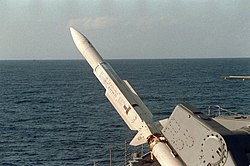
View on WikipediaThe RIM-67 Standard ER (SM-1ER/SM-2ER) is an extended range surface-to-air missile (SAM) with a secondary anti-ship capability, originally developed for the United States Navy (USN). The RIM-67 was developed as a replacement for the RIM-8 Talos, a 1950s system deployed on a variety of USN ships, and eventually replaced the RIM-2 Terrier as well, since it was of a similar size and fitted existing Terrier launchers and magazines. The RIM-66 Standard MR was essentially the same missile without the booster stage, designed to replace the RIM-24 Tartar. The RIM-66/67 series thus became the US Navy's universal SAM system, hence the designation "Standard Missile".
Key Information


RIM-67A SM-1 Extended Range
[edit]The RIM-67A (SM-1ER Block I) was the Navy's replacement for RIM-8 Talos missile. Improved technology allowed the RIM-67 to be reduced to the size of the earlier RIM-2 Terrier missile. Existing ships with the Mk86 guided missile fire control system, or "Terrier" were adapted to employ the new missile in place of the older RIM-2 Terrier missile. Ships that switched from the RIM-2 Terrier to the RIM-67A were still referred to as Terrier ships even though they were equipped with the newer missile. [citation needed]
RIM-67B and RIM-156 SM-2 Extended Range
[edit]The second generation of Standard missile, the Standard Missile 2, was developed for the Aegis Combat System, and the New Threat Upgrade (NTU) program that was planned for existing Terrier and Tartar ships. The destroyer USS Mahan served as the test platform for the development of the CG/SM-2 (ER) missile program project. The principal change over the Standard Missile 1 is the introduction of inertial guidance for each phase of the missile's flight except the terminal phase where semi-active homing was retained. This design change was made so that missiles could time share illumination radars and enable equipped ships to defend against saturation missile attacks. [citation needed]
Terrier ships reequipped as part of the New Threat Upgrade were refit to operate the RIM-67B (SM-2ER Block I) missile. [citation needed]
The RIM-156A Standard SM-2ER Block IV with the Mk 72 booster was developed to compensate for the lack of a long range SAM for the Ticonderoga class of Aegis cruisers. The Mk72 booster allows the RIM-156A to fit into the Mark 41 Vertical Launching System. This configuration can also be used for Terminal phase Ballistic Missile Defense.[2]
_on_1_March_1983_(6370831).jpg)
There was a plan to build a nuclear armed standard missile mounting a W81 nuclear warhead as a replacement for the earlier Nuclear Terrier missile (RIM-2D). The USN rescinded the requirement for the nuclear armed missile in the 1980s, and the project was canceled.[3]
The Standard can also be used against ships, either at line-of-sight range using its semi-active homing mode, or over the horizon using inertial guidance and terminal infrared homing.[4]
RIM-174 Standard Missile 6 ERAM is a new generation of Standard extended range missiles, which became operational in 2013.[5]
As of April 2025, the Navy is considering phasing out the SM-2 series and replacing them with the PAC-3 MSE variant of the MIM-104 Patriot missile system, which can be fired from the same VLS systems but is available in greater numbers, can be produced faster, requires fewer interceptors fired to achieve a kill, and has sufficient maneuverability to engage surface-skimming targets as close as 1km away from the launch vessel (a part of the engagement envelope that the SM-6, which must first boost to high altitudes and dive on a target, cannot engage in as it requires a greater minimum distance).[6]
Operational history
[edit]During the Iran–Iraq War (1980–1988) the United States deployed Standard missiles to protect its navy, as well as other ships in the Persian Gulf from the threat of Iranian attacks. According to the Iranian Air Force, its F-4 Phantom IIs were engaged by SM-2ERs but managed to evade them, with one aircraft sustaining non-fatal damage due to shrapnel.[7] During the same war the United States Navy mistakenly shot down an Iranian civilian airliner, Iran Air Flight 655 using two SM-2 missiles.[8]
On April 18, 1988, during Operation Praying Mantis, the frigate USS Simpson fired four RIM-66 Standard missiles and the cruiser USS Wainwright fired two RIM-67 Standard missiles at Joshan, an Iranian Kaman-class (La Combattante II type) missile boat. The attacks destroyed the Iranian ship's superstructure but did not sink it. [citation needed]
Deployment
[edit]

RIM-67 Standard was deployed on ships of the following classes, replacing the RIM-2 Terrier, and it never was VLS-capable. All of the ships used the AN/SPG-55 for guidance. The Mk10 guided missile launching system was used as the launching system. New Threat Upgrade equipped vessels operated the RIM-67B which used inertial guidance for every phase of the intercept except for the terminal phase where the AN/SPG-55 radar illuminates the target.
- USS Long Beach SM-1ER later SM-2ER with NTU.
- Farragut-class destroyers SM-1ER later SM-2ER with NTU.
- Leahy-class cruisers SM-1ER later SM-2ER with NTU.
- USS Bainbridge SM-1ER later SM-2ER with NTU.
- Belknap-class cruisers SM-1ER later SM-2ER with NTU.
- USS Truxtun SM-1ER later SM-2ER with NTU.
- Italian cruiser Vittorio Veneto SM-1ER Only.
The RIM-156 Standard Block IV, is a version that has been developed for the Aegis Combat System it has a smaller compact sized booster stage for firing from the Mk41 Vertical Launching System. Like the earlier RIM-67B it employs inertial/command guidance with terminal semi-active homing.
- Ticonderoga-class cruisers (VLS units only)
- Arleigh Burke-class destroyers
Variants
[edit]
| Designation | Block | Notes |
|---|---|---|
| RIM-67A | SM-1ER Block I | Terrier Upgrade
|
| RIM-67B | SM-2ER Block I | New Threat Upgrade. Entered service in 1980.
|
| RIM-67C | SM-2ER Block II | New Threat Upgrade
|
| RIM-67D | SM-2ER Block III | New Threat Upgrade
|
| RIM-156A
(ex-RIM-67E) |
SM-2ER Block IV | Designed for Aegis VLS ships. Initial Operational Capability was declared in August 1999.
|
| RIM-156B | SM-2ER Block IVA | Designed for modified Aegis VLS ships capable of tracking both TBM's and aircraft.
Cancelled as a part of the whole NATBMD program in December 2001. |
Gallery
[edit]-
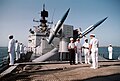 Blue training missiles on the rails of a MK-10 GMLS on USS Josephus Daniels
 -
 USS Worden showing the Mk 10 GMLS. Note the launcher at left, the blast doors behind launcher where the missiles exit the launcher feeder and AN/SPG-55 radars at middle right.
 -
 An SM-2ER in the magazine area, on a ready service ring of the Mk-10 GMLS on Mahan
 -
 The guided-missile destroyer USS Curtis Wilbur launches a RIM-156 Standard SM-2 ER missile while conducting torpedo evasion maneuvers during Multi-Sail 2009
,_circa_in_July_1990_(6468165).jpg)
_on_1_July_1986_(6421956).jpg)
_on_1_March_1983_(6370832).jpg)
_launches_a_Standard_Missile-2_while_conducting_torpedo_evasion_maneuvers_during_Multi-Sail_2009.jpg)
See also
[edit]- RIM-2 Terrier – predecessor
- RIM-8 Talos – predecessor
- RIM-24 Tartar
- AGM-78 Standard ARM
- RIM-66 Standard Medium Range
- RIM-161 Standard SM-3
- RIM-174 Standard ERAM – successor
References
[edit]- ^ "US Navy: Standard Missile". US Navy. Retrieved 16 December 2022.
- ^ Aegis BMD Project Office. Standard missile. Accessed September 26, 2009.
- ^ "Raytheon RIM-67 Standard ER". www.designation-systems.net.
- ^ Canadian Forces Maritime Command. Standard missile Archived 2007-12-09 at the Wayback Machine. Accessed June 5, 2006.
- ^ "Standard Missile 6 (SM-6) Achieves Initial Operational Capability". www.navsea.navy.mil. Archived from the original on 2014-11-03. Retrieved 2022-12-01.
- ^ Newdick, Thomas (2025-04-09). "Patriot PAC-3 Missile Puts Crosshairs On Replacing Navy's Long-Serving SM-2". The War Zone. Retrieved 2025-04-10.
- ^ "Iiaf - F-4". Archived from the original on 2008-03-18. Retrieved 2008-02-16.. Accessed October 7, 2007.
- ^ Fogarty, William (1988). "Formal Investigation into the Circumstances Surrounding the Downing of Iran Air Flight 655 on 3 July 1988" (PDF). United States Department of Defense. Archived from the original (PDF) on January 9, 2020.
External links
[edit]
- Raytheon Standard missile website, mfr of Standard missiles
- Designation systems.net - RIM-67
- FAS - SM-2ER
- GlobalSecurity.org - SM-2
- Navweaps.com
RIM-67 Standard
View on GrokipediaThe RIM-67 Standard was a ship-launched, extended-range surface-to-air missile developed by the United States Navy as part of the broader Standard Missile program initiated in 1963 to replace earlier systems such as the RIM-2 Terrier and RIM-8 Talos.[1][2] Designated initially as SM-1ER (RIM-67A) and entering service around 1970, it provided all-weather, supersonic defense against aircraft and missiles at ranges up to approximately 40 nautical miles and altitudes reaching 80,000 feet, with a booster for extended reach compared to the medium-range RIM-66 variant.[3][4] The missile featured semi-active radar homing guidance and was launched from Mk 10 twin-arm systems aboard cruisers and destroyers, evolving into the SM-2ER (RIM-67B) configuration by 1981 with enhanced electronics for better performance against low-altitude threats and electronic countermeasures.[5][6] Deployed on classes including Leahy, Belknap, and Charles F. Adams ships, it formed a cornerstone of fleet area air defense until the 1990s, when vertical launch system-compatible successors like the RIM-156A assumed its role amid the retirement of launcher-equipped vessels.[2]
Development
Origins and Program Initiation
The U.S. Navy initiated the Standard Missile program in 1963 to develop a unified family of surface-to-air missiles capable of replacing the RIM-2 Terrier long-range system and the RIM-24 Tartar medium-range system, thereby streamlining logistics, enhancing reliability, and improving performance against aerial threats including Soviet antiship missiles.[1][7] The effort addressed limitations in the older beam-riding guidance of predecessors by adopting semi-active radar homing, which allowed for greater flexibility in targeting and reduced susceptibility to electronic countermeasures.[7] This standardization across shipboard launchers, such as the Mk 10 and Mk 26 systems, was intended to support a range of platforms from destroyers to cruisers, while incorporating solid-propellant motors for quicker reaction times.[1] The RIM-67 emerged as the extended-range (ER) component of the initial SM-1 series, specifically designed to supersede the Terrier on larger surface combatants and eventually the RIM-8 Talos on cruisers.[1][3] Development emphasized an all-electric actuation system with solid-state electronics, slashing booster warm-up from 27 seconds to approximately 1.8 seconds, which enabled rapid salvo fire against saturation attacks.[3] Prototype test flights commenced in 1965, paving the way for the first production SM-1 missiles to enter operational service in 1967, with the RIM-67A SM-1ER variant achieving initial deployment around 1970 on Terrier-equipped ships.[1][3] This phase marked the transition from bespoke missile designs to a modular, upgradeable architecture that would underpin decades of naval air defense evolution.[7]Design Evolution and Key Technologies
The RIM-67 Standard missile program originated in 1963 as part of the U.S. Navy's effort to consolidate and upgrade surface-to-air missile systems, replacing the larger RIM-8 Talos and adapting to the dimensions of the RIM-2 Terrier while utilizing compatible launchers like the Mk 10 Guided Missile Launching System.[1][2] The initial RIM-67A (SM-1ER Block I) entered service in 1970, featuring a compact design reduced to Terrier proportions through advancements in materials and component integration, enabling deployment on cruisers and destroyers previously limited by Talos' bulk.[3][2] This evolution addressed reliability issues in predecessors by incorporating an all-electric actuation system for control surfaces, eliminating hydraulics, and adopting solid-state electronics with battery power, which slashed missile warm-up time from 27 seconds to approximately 1.8 seconds.[3] Subsequent iterations under the RIM-67 designation advanced guidance and propulsion for enhanced performance against evolving threats. The RIM-67B (SM-2ER Block I), introduced in 1980, integrated inertial midcourse guidance with a monopulse seeker for terminal semi-active radar homing, improving accuracy over the SM-1ER's command midcourse and beam-riding modes.[1] Further blocks, such as RIM-67C (SM-2ER Block II) in the 1980s, employed the Mk 70 booster to extend range to about 185 km, while RIM-67D (SM-2ER Block III) upgraded to the Mk 30 Mod 4 sustainer and Mk 45 Mod 8 target detection device for better low-altitude intercept capability.[1] These developments prioritized compatibility with legacy platforms while incorporating New Threat Upgrade features for saturation attack defense.[2] Key technologies centered on propulsion via a tandem solid-fuel configuration: an initial Mk 12 or Mk 70 booster for launch acceleration, followed by a Mk 30 sustainer dual-thrust motor providing sustained velocity up to 80,000 feet altitude and ranges of 73 km or more.[1][3] Guidance combined optional midcourse command updates from shipboard radars with terminal semi-active homing against illuminated targets, later augmented by inertial navigation to reduce radar dependency and enable over-the-horizon engagements.[1][2] Control systems relied on adaptive autopilots and electric fin actuators for maneuverability, contributing to the missile's 2,980-pound weight and 26-foot length profile optimized for magazine storage and rapid reload.[3]Technical Characteristics
Propulsion and Guidance Systems
The RIM-67 Standard missile utilizes a two-stage solid-propellant rocket propulsion system, comprising a booster stage for initial high-thrust acceleration and a sustainer stage for prolonged flight to achieve extended range capabilities beyond those of medium-range variants.[8] This configuration, with the booster providing rapid ascent and the sustainer maintaining velocity, enables ranges up to approximately 100-200 nautical miles depending on the variant and launch conditions.[2] The solid-fuel design ensures reliability, simplicity, and rapid launch readiness from shipboard systems like the Mk 10 launcher.[6] Guidance for the RIM-67 combines midcourse and terminal phases tailored to its extended range requirements. In the SM-1ER (RIM-67A) variant, midcourse guidance relies on radio command updates from the launching ship's fire control system to direct the missile toward a predicted intercept zone, transitioning to semi-active radar homing (SARH) in the terminal phase where the missile homes on radar reflections from the target illuminated by the ship's radar.[9] The SM-2ER (RIM-67B) variant incorporates an inertial navigation system with programmable autopilot for autonomous midcourse flight, reducing reliance on continuous command links, while retaining monopulse SARH for terminal guidance to enhance resistance against electronic countermeasures.[6][5] This dual-mode approach allows effective engagement of high-altitude, long-range threats such as aircraft and missiles.[10]Warhead, Range, and Performance Metrics
The RIM-67 Standard missile utilized a 137-pound (62 kg) high-explosive continuous-rod warhead, designed to generate a lethal fragmentation pattern against aerial targets through radial dispersion of metal rods upon detonation. This warhead was armed with a dual-mode fuze system incorporating both radar proximity detection for air bursts and contact initiation for direct impacts, enhancing lethality across varied engagement geometries.[11] Subsequent SM-2ER variants, such as Block IIIA, incorporated an upgraded warhead that directed fragment velocity toward the target for improved kinetic energy transfer and penetration.[6] Range capabilities distinguished the RIM-67 as an extended-range system relative to medium-range counterparts, with the RIM-67A (SM-1ER) achieving effective intercepts up to 80,000 yards (73 km) against air threats, supported by its dual-thrust sustainer and booster propulsion.[3] The RIM-67B (SM-2ER) extended this to approximately 200,000 yards (183 km), enabling defense against longer-lofted anti-ship missiles, though operational ranges were constrained by radar horizon, target dynamics, and launcher elevation.[5] In ballistic missile target roles, demonstrated ranges reached 275 km (150 nautical miles) at altitudes up to 85 km, underscoring the missile's kinematic potential under optimal conditions.[1] Key performance metrics included a maximum velocity exceeding Mach 3, facilitating rapid closure on high-speed maneuvering targets, and an engagement ceiling surpassing 80,000 feet (24 km) for high-altitude intercepts.[3] The missile's semi-active radar homing guidance, augmented by inertial midcourse updates in SM-2 variants, supported high-altitude, long-range acquisition with reported single-shot kill probabilities above 80% in controlled tests against drone surrogates, though combat-derived figures remain classified.[2] Total missile weight for the ER configuration approximated 2,980 pounds (1,350 kg) with booster, contributing to a launch-to-intercept timeline under 2 minutes for nominal profiles.[5]Variants
RIM-67A (SM-1ER)
The RIM-67A, also known as the Standard Missile-1 Extended Range (SM-1ER), served as the U.S. Navy's primary extended-range surface-to-air missile from the late 1960s, designed to replace the larger RIM-8 Talos while matching the dimensions of the RIM-2 Terrier for compatibility with existing Mk 10 launchers.[2][1] Initiated under the broader Standard Missile program in 1963 to unify replacements for Terrier and Tartar systems, the RIM-67A incorporated a solid-fuel booster stage (Hercules MK 12) beneath the MK 30 sustainer motor, enabling greater range than the medium-range RIM-66 SM-1MR counterpart, which lacked the booster.[1][4] Service entry occurred in 1968, with full deployment by 1970 on platforms equipped with the AN/SPG-55 radar and Mk 86 fire control system.[4][3] Key advancements in the RIM-67A included an all-electric actuation system replacing hydraulics, solid-state electronics for enhanced reliability, and a battery-powered design that reduced launcher warm-up time from 26 seconds in predecessors to approximately 1 second.[4][3] Guidance relied on semi-active radar homing, with the missile illuminated by shipboard radars until impact, supporting intercepts of aircraft, missiles, and surface targets.[2] The "wooden round" concept allowed missiles to remain in storage for up to three years without testing, improving logistical efficiency.[4]| Parameter | Specification |
|---|---|
| Length | 7.98 m (26 ft 2 in) |
| Weight | 1,341 kg (2,980 lb) |
| Diameter | 34 cm (13.5 in) |
| Wingspan | 1.58 m (62 in) |
| Range | 65 km (35-40 nm) |
| Maximum Altitude | 24,380 m (80,000 ft) |
| Speed | Mach 2.5 |
| Warhead | 113 kg (250 lb) continuous rod (MK 51) |
| Propulsion | MK 30 sustainer + MK 12 booster (solid fuel) |
RIM-67B (SM-2ER)
The RIM-67B, designated SM-2ER Block I, was the initial extended-range variant of the Standard Missile-2 family, introduced as part of the U.S. Navy's New Threat Upgrade (NTU) program to enhance fleet air defense against advanced aerial threats.[5] It entered operational service in 1981, replacing earlier SM-1ER missiles like the RIM-67A by incorporating an inertial navigation system for the midcourse flight phase, which allowed for more efficient radar resource management compared to the beam-riding guidance of predecessors.[5] [1] This upgrade enabled the missile to receive command updates to a designated "homing basket" near the target's projected position, reducing the need for continuous illumination and improving resilience against saturation attacks.[5] [2] Guidance transitioned to semi-active radar homing in the terminal phase using the AN/SPG-55 radar for illumination, maintaining compatibility with Mk 10 launch systems on NTU-refitted ships such as destroyers and cruisers.[2] The RIM-67B featured a programmable autopilot for optimized flight paths, marking it as the first U.S. tactical missile with full inertial guidance integration.[5] Propulsion relied on a dual-thrust solid-propellant sustainer (Mk 30 Mod 2) augmented by a separate booster, achieving speeds up to Mach 3.5 and supporting engagements at altitudes exceeding 80,000 feet.[1] [5]| Characteristic | Specification |
|---|---|
| Length (without booster) | 26.2 feet (7.9 m)[5] |
| Diameter | 13.5 inches (34 cm)[5] |
| Wingspan | 62 inches (1.6 m)[5] |
| Weight | 2,980 lb (1,341 kg)[5] |
| Warhead | 250 lb (113 kg) continuous rod[5] |
| Range | 7,000–200,000 yards (6.4–183 km)[5] |