


Community hub
Recent from talks
Contribute something
Nothing was collected or created yet.
Red Bull RB1
View on Wikipedia | This article needs additional citations for verification. (August 2022) |
 David Coulthard driving the RB1 during the 2005 Canadian Grand Prix | |||||||||
| Category | Formula One | ||||||||
|---|---|---|---|---|---|---|---|---|---|
| Constructor | Red Bull | ||||||||
| Designers | David Pitchforth (Managing Director - Technical) Ian Pocock (Engineering Director) Rob Taylor (Chief Designer) Chris Hammond (Head of Vehicle Science) Ben Agathangelou (Head of Aerodynamics) Alex Hitzinger (Engine Chief Designer - Cosworth) | ||||||||
| Predecessor | Jaguar R5 | ||||||||
| Successor | RB2 | ||||||||
| Technical specifications | |||||||||
| Chassis | Carbon fibre monocoque | ||||||||
| Engine | Cosworth TJ2005 3.0-litre 90° V10 naturally-aspirated mid engined | ||||||||
| Transmission | Red Bull 7-speed sequential | ||||||||
| Power | 915 hp (682.3 kW) @ 19,000 rpm | ||||||||
| Fuel | BP | ||||||||
| Lubricants | Castrol | ||||||||
| Tyres | Michelin Oz Wheels | ||||||||
| Competition history | |||||||||
| Notable entrants | Red Bull Racing | ||||||||
| Notable drivers | 14.  David Coulthard David Coulthard15.  Christian Klien Christian Klien15.  Vitantonio Liuzzi Vitantonio Liuzzi | ||||||||
| Debut | 2005 Australian Grand Prix | ||||||||
| Last event | 2005 Chinese Grand Prix | ||||||||
| |||||||||
| Constructors' Championships | 0 | ||||||||
| Drivers' Championships | 0 | ||||||||
The Red Bull RB1 (originally known as Jaguar R6) is a Formula One racing car designed by Jaguar Racing for use in the 2005 season. However, with the Red Bull buyout of the Jaguar Racing team, it was used instead by Red Bull Racing. The Red Bull RB1 was officially launched at Circuito de Jerez, Spain on 7 February.
Design
[edit]The chassis was designed by Mark Smith, Rob Taylor and Ben Agathangelou and the car's engine was a Cosworth TJ2005 3.0 litres (183 cu in) V10. The RB1 was the technically last-ever car built by Jaguar Racing but rebadged as Red Bull Racing after the energy drinks manufacturer bought the Jaguar Racing team in late 2004.
The RB1 is rather traditional and conservative, therefore, although only partially detaching itself from its Jaguar ancestor, it presents some characterizing elements. The nose is particularly raised from the ground and the front wing has a distinct spoon shape, with a sinuous shape and very similar to that of the Renault. The side bulkheads, similarly to the system of deflectors placed behind the front wheels, follow the layout of the old car and are inspired by those of Ferrari, especially in the detail of the flow diverters, taking on the characteristic shark tooth shape in the lower part. The mouth of the sides is very similar to the old Jaguar while the rear part appears very different, abandoning the curious vent system of the R5 in favor of a more traditional design featuring long fins, chimneys and exhaust fairings.
The chassis stands out for its accentuated height from the ground, which presupposes the search for maximum aerodynamic load: the bonnet has been slightly modified as, although the squared air intake inherited from the R5 is maintained, in the area of the roll-bar a small profile has been added.
Racing history
[edit]_in_practice_at_USGP_2005.jpg)
Briton David Coulthard drove for the entire season, with Austrian Christian Klien and Italian Vitantonio Liuzzi sharing the other car. Liuzzi raced in four of the rounds, with Klien racing in the other 15 rounds. The team had two test drivers: American Scott Speed and Swiss driver Neel Jani.
The RB1's best result was a fourth-place finish on its debut at the 2005 Australian Grand Prix in Melbourne, and at the 2005 European Grand Prix held at the Nürburgring. Both results were achieved by David Coulthard. Christian Klien's best finish was fifth at the season finale in Shanghai. Vitantonio Liuzzi's best finish in the RB1 was eighth in his debut race, the 2005 San Marino Grand Prix at Imola.
The chassis was reused for the Toro Rosso STR1 in 2006.
Sponsorship and livery
[edit]The main colours used for the livery reflect those typical of the can of the Red Bull energy drink, i.e. blue, used as a base, and grey, used for the wing profiles as on the bargeboards, on the flow diverters in front of the rear wheels, on the profile upper part of the front wing and lower part of the rear wing. On the tip of the nose and in the area between the airscope and the bonnet there is the logo with the two red bulls charging on the yellow disc; they are positioned so that one is on the right side and one on the left side and that they both point towards the front of the car. Three thin bands also run along the sides (red, blue and gray from top to bottom) which start from the bulls positioned on the nose, continue along the sides of the survival cell and on the bellies and end in the rear part of the bonnet. Finally, there are motifs that recall the checkered flag on the nose, on the bonnet and on the outside of the rear wing bulkheads. Another sponsor is tire supplier Michelin.
For the Monaco Grand Prix the two RB1s compete with a special livery aimed at promoting the film Star Wars: Episode III - Revenge of the Sith and, for this race, the pit crew dressed up as Imperial Stormtroopers. Compared to the original one, it features decorative flames on the sides and an image of the character Darth Vader appears on the nose. Furthermore, the team logos located on the rear wing and on the bellies are replaced by those of the Star Wars franchise.
The Wings for Life logo was seen on the barge boards of the cars in Britain, Germany, Hungary and Belgium.
Later uses
[edit]The RB1 was featured in Episode 5 of Season 14 of Top Gear, where it was used by both Jeremy Clarkson and Coulthard for one of their car art projects. They started by shooting paintballs from the car's exhaust and one of the paintballs hits Clarkson in his nether region, causing the two to use an aluminium canvas instead. They later soaked the car in ultraviolet paint, which caused Coulthard's visor to be blurry.[1]
Media
[edit]
-
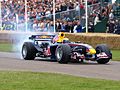 Sébastien Buemi demonstrating a RB1 at the 2008 Goodwood Festival of Speed.

Complete Formula One results
[edit](key) (results in bold indicate pole position; races in italics indicate fastest laps)
| Year | Entrant | Engine | Tyres | Drivers | 1 | 2 | 3 | 4 | 5 | 6 | 7 | 8 | 9 | 10 | 11 | 12 | 13 | 14 | 15 | 16 | 17 | 18 | 19 | Points | WCC |
|---|---|---|---|---|---|---|---|---|---|---|---|---|---|---|---|---|---|---|---|---|---|---|---|---|---|
| 2005 | Red Bull Racing | Cosworth TJ2005 V10 | M | AUS | MAL | BHR | SMR | ESP | MON | EUR | CAN | USA | FRA | GBR | GER | HUN | TUR | ITA | BEL | BRA | JPN | CHN | 34 | 7th | |
| David Coulthard
|
4 | 6 | 8 | 11 | 8 | Ret | 4 | 7 | DNS | 10 | 13 | 7 | Ret | 7 | 15 | Ret | Ret | 6 | 9 | ||||||
| Christian Klien
|
7 | 8 | Ret | 8 | DNS | Ret | 15 | 9 | Ret | 8 | 13 | 9 | 9 | 9 | 5 | ||||||||||
| Vitantonio Liuzzi
|
8 | Ret | Ret | 9 |
References
[edit]External links
[edit]


 | This Formula One–related article is a stub. You can help Wikipedia by adding missing information. |
Red Bull RB1
View on GrokipediaDevelopment
Team Acquisition and Background
In November 2004, Red Bull GmbH, the Austrian energy drink company, acquired Jaguar Racing from Ford Motor Company for a nominal fee of approximately £1, marking the company's entry into Formula One as a team owner rather than a sponsor.[9][10] This purchase came just hours before Jaguar's planned closure, securing around 340 jobs at the team's Milton Keynes headquarters and allowing Red Bull to inherit the existing infrastructure without a full startup from scratch.[11] The acquisition led to a swift rebranding of the team to Red Bull Racing, with the Milton Keynes facility undergoing updates to align with the company's branding, including the integration of Red Bull's marketing ethos into team operations.[12] Prior to this move, Red Bull had built its motorsport presence through sponsorships, notably a seven-year partnership with Sauber from 1995 to 2001, a sponsorship of Jaguar Racing in 2004, and a shorter stint supporting Arrows from 2001 to 2002, which provided valuable insights into the sport's commercial dynamics.[13][11][14] To lead the new outfit, Red Bull appointed 31-year-old Christian Horner as team principal in January 2005, making him the youngest in Formula One history at the time and setting the stage for the team's organizational structure.[15] The RB1, Red Bull Racing's debut car, evolved directly from Jaguar's R6 chassis, which had been in development before the sale.[16]Design Process and Launch
Following the acquisition of Jaguar Racing in November 2004, Red Bull Racing adapted the Jaguar R6 chassis into its inaugural Formula One car, the RB1, through minor modifications focused on rebranding and initial setup to align with the new team's operations.[2] These changes were limited, preserving the core structure developed under Jaguar while incorporating Red Bull's branding elements, such as updated livery applications.[3] The design process was overseen by key personnel including chief engineer Mark Smith, chief designer Rob Taylor, and head of aerodynamics Ben Agathangelou, who coordinated the engineering evolution during a compressed development timeline from late 2004 to early 2005.[17][18] This period involved intensive efforts to resolve post-acquisition integration challenges, including team restructuring and alignment of technical resources under new management led by Christian Horner.[19] The RB1 made its official debut on 7 February 2005 at the Circuito de Jerez in Spain, marking Red Bull Racing's entry into Formula One.[20] During the launch event, the car completed initial shakedown laps and filming sessions to verify basic functionality and capture promotional footage ahead of the season.[21][22]Technical Specifications
Chassis and Aerodynamics
The Red Bull RB1 featured a carbon fibre monocoque chassis, constructed in-house to serve as the primary structural element, with the Cosworth TJ2005 V10 engine integrated as a fully stressed member to enhance rigidity and weight distribution. This design adhered to the 2005 FIA regulations, prioritizing lightweight construction while maintaining safety standards through layered composite materials for impact absorption. The complete chassis, including the driver, weighed approximately 600 kg, allowing for optimal ballast placement to achieve balanced handling under varying track conditions.[3][2] Aerodynamically, the RB1 employed a raised nose configuration that elevated the front end to reduce proximity to the ground, minimizing unwanted underbody turbulence and facilitating cleaner airflow to downstream elements. The front wing adopted a spoon-shaped profile with a dipped central section and long chord elements, suspended from the nose via extended drop plates to generate initial downforce while directing vortices outward for improved efficiency. Endplates on the wing incorporated stepped footplates to manage airflow separation, contributing to overall stability at high speeds. The sidepod layout followed a traditional chimney-style arrangement, where exhaust outlets were routed over the radiators, drawing inspiration from the Ferrari F2004's approach to integrate thermal management with aerodynamic loading for enhanced cooling and subtle downforce gains.[6] The suspension system consisted of a double wishbone arrangement at both ends, utilizing upper and lower carbon fibre wishbones connected to cast titanium uprights for precise wheel control. The front featured pushrod actuation with torsion bar springing, an anti-roll bar, and Koni dampers to optimize camber and toe changes during cornering. At the rear, a pushrod setup provided similar components but with coil springs, allowing for a lower center of gravity and better packaging around the drivetrain while maintaining compliance over uneven surfaces. This hybrid configuration balanced mechanical grip with aerodynamic sensitivity.[3][6] Key dimensions included a wheelbase of 3,058 mm, which supported agile maneuverability, and an overall length of around 5,300 mm, compact enough to navigate tight circuits while accommodating the era's aerodynamic demands. The engine's integration into the chassis layout further refined the rearward weight bias, aiding traction without compromising the monocoque's structural integrity.[6][23]Powertrain and Performance
The Red Bull RB1 utilized the Cosworth TJ2005 engine, a 3.0-litre naturally aspirated V10 with a 90-degree vee angle, 40 valves, and electronic fuel injection managed by Pi Research.[3] This power unit, constructed with an aluminium block and heads, alloy pistons, and a steel crankshaft, delivered approximately 900 horsepower at a peak of 18,000 rpm, with torque around 410 Nm at 12,500 rpm.[23][24] The engine's high-revving design reflected the 2005 Formula One regulations limiting displacement to 3.0 litres while emphasizing rev limits up to 18,000 rpm for maximum output.[25] Complementing the engine was a Red Bull-developed 7-speed semi-automatic sequential transmission, featuring paddle-operated gear shifts and a longitudinally mounted high-pressure hydraulic system for rapid power changes.[26] The gearbox incorporated an AP Racing triple-plate pull-type clutch for efficient engagement, contributing to seamless acceleration and driveability in rear-wheel-drive configuration.[3] This setup ensured compatibility with the mid-engine layout, optimizing weight distribution and power delivery. The RB1 ran on Michelin tires, selected for their grip and handling characteristics under 2005 F1 tire rules.[3] Fuel was supplied by Castrol Racing Fuel, paired with Castrol lubricants to maintain engine reliability and performance during races.[3] Overall, the powertrain enabled the car to achieve top speeds around 340 km/h on high-speed circuits and 0-100 km/h acceleration in under 3 seconds, aligning with the capabilities of V10-era Formula One machinery.[27]2005 Season
Drivers and Team Setup
For the 2005 Formula One season, Red Bull Racing retained David Coulthard as its primary driver, bringing his extensive experience from the previous year's Jaguar team to provide stability for the newcomers.[28] Coulthard, a veteran with over a decade in the sport, was paired with Christian Klien, another holdover from Jaguar who had shown promise as a rookie in 2004.[28] To bolster depth, the team signed Vitantonio Liuzzi from its junior program as the third driver, allowing him to compete in select races while supporting development efforts.[29] Leadership was placed under Christian Horner, who was appointed team principal in early January 2005, just weeks before the season opener.[30] At 31, Horner represented a fresh approach, having previously led the Arden International team in junior formulas. Key staff transitions from the Jaguar era included Tony Purnell and David Pitchforth, who initially oversaw the handover after Red Bull's acquisition but departed shortly before the season, paving the way for Horner's vision and new technical appointments.[30] This restructuring aimed to integrate Red Bull's branding and resources while retaining core engineering talent from Jaguar to accelerate the team's competitiveness. Pre-season preparations centered on the RB1's rollout and testing at Circuito de Jerez in Spain, where the car made its public debut on February 7, 2005, serving as an initial shakedown run piloted by Coulthard.[31] The session focused on basic systems validation, followed by official testing from February 9 to 11, involving all three drivers to gather baseline data on the Cosworth-powered chassis ahead of the Australian Grand Prix.[31] These activities underscored the team's emphasis on reliability and adaptation during the transition year. Red Bull's entry was backed by a substantial investment, with the company committing around $100 million (approximately £55 million) for the 2005 season, covering operations, development, and infrastructure upgrades at the Milton Keynes facility inherited from Jaguar.[9] This funding enabled the acquisition of the team for a nominal £1 fee while supporting a competitive budget that facilitated the RB1's integration and the expanded driver lineup.[32]Race Results and Highlights
The Red Bull RB1 contested all 19 rounds of the 2005 Formula One World Championship, the team's inaugural season, entering as a rebranded former Jaguar outfit. The car recorded no race wins, pole positions, or fastest laps, yet demonstrated competitive potential with a total of 34 points, securing seventh place in the Constructors' Championship standings. Best results included fourth-place finishes for David Coulthard at the Australian and European Grands Prix, alongside Christian Klien's career-best fifth place at the Chinese Grand Prix.[33] The season opened promisingly at the Australian Grand Prix, where the RB1 achieved a double points finish—Coulthard in fourth and Klien in seventh—yielding the team's highest single-race haul of 7 points and signaling a solid debut for the new entrant. Mid-season challenges arose from reliability problems, including engine failures and accidents, which hampered progress and led to multiple retirements, particularly during the European swing. Despite these setbacks, the RB1 showed flashes of speed on varied circuits, contributing to the team's respectable mid-field positioning. David Coulthard provided the backbone of the team's results with consistent performances, amassing 24 points across 19 starts and often extracting the maximum from the RB1's capabilities. Christian Klien, sharing duties with substitute Vitantonio Liuzzi in three early races, added 9 points and highlighted his potential in the Hungarian Grand Prix, recovering from an opening-lap collision and barrel-roll to finish seventh, demonstrating resilience. Liuzzi contributed the remaining 1 point with an eighth-place finish at San Marino.[34]| Race | Circuit | Coulthard Position/Status | Klien/Liuzzi Position/Status | Team Points |
|---|---|---|---|---|
| Australian GP | Melbourne | 4th | 7th (Klien) | 7 |
| Malaysian GP | Sepang | 6th | 8th (Klien) | 4 |
| Bahrain GP | Sakhir | 8th | Ret (engine, Klien) | 1 |
| San Marino GP | Imola | 11th | 8th (Liuzzi) | 1 |
| Spanish GP | Barcelona | 8th | Ret (collision, Liuzzi) | 1 |
| Monaco GP | Monaco | Ret (accident) | 12th (Liuzzi) | 0 |
| European GP | Nürburgring | 4th | Ret (Klien) | 5 |
| Canadian GP | Montreal | 7th | 9th (Klien) | 2 |
| United States GP | Indianapolis | DNS (tyre protest) | DNS (tyre protest, Klien) | 0 |
| French GP | Magny-Cours | 10th | 15th (Klien) | 0 |
| British GP | Silverstone | 13th | 15th (Klien) | 0 |
| German GP | Hockenheim | 7th | 9th (Klien) | 2 |
| Hungarian GP | Hungaroring | Ret (accident) | 7th (Klien) | 2 |
| Turkish GP | Istanbul | 7th | 9th (Klien) | 2 |
| Italian GP | Monza | 15th | 13th (Klien) | 0 |
| Belgian GP | Spa | Ret (engine) | 9th (Klien) | 0 |
| Brazilian GP | Interlagos | Ret (accident) | 9th (Klien) | 0 |
| Japanese GP | Suzuka | 6th | 9th (Klien) | 3 |
| Chinese GP | Shanghai | 9th | 5th (Klien) | 4 |