


Community hub
Recent from talks
Contribute something
Nothing was collected or created yet.
Incomplete gamma function
View on Wikipedia

_in_the_complex_plane_from_-2-2i_to_2%2B2i_with_colors_created_with_Mathematica_13.1_function_ComplexPlot3D.svg)
In mathematics, the upper and lower incomplete gamma functions are types of special functions which arise as solutions to various mathematical problems such as certain integrals.
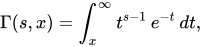
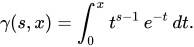
Their respective names stem from their integral definitions, which are defined similarly to the gamma function but with different or "incomplete" integral limits. The gamma function is defined as an integral from zero to infinity. This contrasts with the lower incomplete gamma function, which is defined as an integral from zero to a variable upper limit. Similarly, the upper incomplete gamma function is defined as an integral from a variable lower limit to infinity.
Definition
[edit]The upper incomplete gamma function is defined as: whereas the lower incomplete gamma function is defined as: In both cases s is a complex parameter, such that the real part of s is positive.
Properties
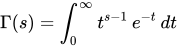
[edit]By integration by parts we find the recurrence relations and Since the ordinary gamma function is defined as we have and




Continuation to complex values
[edit]The lower incomplete gamma and the upper incomplete gamma function, as defined above for real positive s and x, can be developed into holomorphic functions, with respect both to x and s, defined for almost all combinations of complex x and s.[1] Complex analysis shows how properties of the real incomplete gamma functions extend to their holomorphic counterparts.
Lower incomplete gamma function
[edit]Holomorphic extension
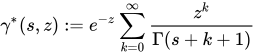
[edit]Repeated application of the recurrence relation for the lower incomplete gamma function leads to the power series expansion: [2] Given the rapid growth in absolute value of Γ(z + k) when k → ∞, and the fact that the reciprocal of Γ(z) is an entire function, the coefficients in the rightmost sum are well-defined, and locally the sum converges uniformly for all complex s and x. By a theorem of Weierstrass,[3] the limiting function, sometimes denoted as ,[4] is entire with respect to both z (for fixed s) and s (for fixed z),[1] and, thus, holomorphic on C × C by Hartogs' theorem.[5] Hence, the following decomposition[1] extends the real lower incomplete gamma function as a holomorphic function, both jointly and separately in z and s. It follows from the properties of and the Γ-function, that the first two factors capture the singularities of (at z = 0 or s a non-positive integer), whereas the last factor contributes to its zeros.





Multi-valuedness
[edit]The complex logarithm log z = log |z| + i arg z is determined up to a multiple of 2πi only, which renders it multi-valued. Functions involving the complex logarithm typically inherit this property. Among these are the complex power, and, since zs appears in its decomposition, the γ-function, too.
The indeterminacy of multi-valued functions introduces complications, since it must be stated how to select a value. Strategies to handle this are:
- (the most general way) replace the domain C of multi-valued functions by a suitable manifold in C × C called Riemann surface. While this removes multi-valuedness, one has to know the theory behind it;[6]
- restrict the domain such that a multi-valued function decomposes into separate single-valued branches, which can be handled individually.
The following set of rules can be used to interpret formulas in this section correctly. If not mentioned otherwise, the following is assumed:
Sectors
[edit]Sectors in C having their vertex at z = 0 often prove to be appropriate domains for complex expressions. A sector D consists of all complex z fulfilling z ≠ 0 and α − δ < arg z < α + δ with some α and 0 < δ ≤ π. Often, α can be arbitrarily chosen and is not specified then. If δ is not given, it is assumed to be π, and the sector is in fact the whole plane C, with the exception of a half-line originating at z = 0 and pointing into the direction of −α, usually serving as a branch cut. Note: In many applications and texts, α is silently taken to be 0, which centers the sector around the positive real axis.
Branches
[edit]In particular, a single-valued and holomorphic logarithm exists on any such sector D having its imaginary part bound to the range (α − δ, α + δ). Based on such a restricted logarithm, zs and the incomplete gamma functions in turn collapse to single-valued, holomorphic functions on D (or C×D), called branches of their multi-valued counterparts on D. Adding a multiple of 2π to α yields a different set of correlated branches on the same set D. However, in any given context here, α is assumed fixed and all branches involved are associated to it. If |α| < δ, the branches are called principal, because they equal their real analogues on the positive real axis. Note: In many applications and texts, formulas hold only for principal branches.
Relation between branches
[edit]The values of different branches of both the complex power function and the lower incomplete gamma function can be derived from each other by multiplication of ,[1] for k a suitable integer.

Behavior near branch point
[edit]The decomposition above further shows, that γ behaves near z = 0 asymptotically like:

For positive real x, y and s, xy/y → 0, when (x, y) → (0, s). This seems to justify setting γ(s, 0) = 0 for real s > 0. However, matters are somewhat different in the complex realm. Only if (a) the real part of s is positive, and (b) values uv are taken from just a finite set of branches, they are guaranteed to converge to zero as (u, v) → (0, s), and so does γ(u, v). On a single branch of γ(b) is naturally fulfilled, so there γ(s, 0) = 0 for s with positive real part is a continuous limit. Also note that such a continuation is by no means an analytic one.
Algebraic relations
[edit]All algebraic relations and differential equations observed by the real γ(s, z) hold for its holomorphic counterpart as well. This is a consequence of the identity theorem, stating that equations between holomorphic functions valid on a real interval, hold everywhere. In particular, the recurrence relation [2] and ∂γ(s, z)/∂z = zs−1 e−z [2] are preserved on corresponding branches.
Integral representation
[edit]The last relation tells us, that, for fixed s, γ is a primitive or antiderivative of the holomorphic function zs−1 e−z. Consequently, for any complex u, v ≠ 0, holds, as long as the path of integration is entirely contained in the domain of a branch of the integrand. If, additionally, the real part of s is positive, then the limit γ(s, u) → 0 for u → 0 applies, finally arriving at the complex integral definition of γ[1]


Any path of integration containing 0 only at its beginning, otherwise restricted to the domain of a branch of the integrand, is valid here, for example, the straight line connecting 0 and z.
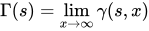
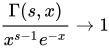
Limit for z → +∞
[edit]Real values
[edit]Given the integral representation of a principal branch of γ, the following equation holds for all positive real s, x:[7]

s complex
[edit]This result extends to complex s. Assume first 1 ≤ Re(s) ≤ 2 and 1 < a < b. Then where[8] has been used in the middle. Since the final integral becomes arbitrarily small if only a is large enough, γ(s, x) converges uniformly for x → ∞ on the strip 1 ≤ Re(s) ≤ 2 towards a holomorphic function,[3] which must be Γ(s) because of the identity theorem. Taking the limit in the recurrence relation γ(s, x) = (s − 1) γ(s − 1, x) − xs − 1 e−x and noting, that lim xn e−x = 0 for x → ∞ and all n, shows, that γ(s, x) converges outside the strip, too, towards a function obeying the recurrence relation of the Γ-function. It follows for all complex s not a non-positive integer, x real and γ principal.


Sectorwise convergence
[edit]Now let u be from the sector |arg z| < δ < π/2 with some fixed δ (α = 0), γ be the principal branch on this sector, and look at

As shown above, the first difference can be made arbitrarily small, if |u| is sufficiently large. The second difference allows for following estimation: where we made use of the integral representation of γ and the formula about |zs| above. If we integrate along the arc with radius R = |u| around 0 connecting u and |u|, then the last integral is where M = δ(cos δ)−Re s eIm sδ is a constant independent of u or R. Again referring to the behavior of xn e−x for large x, we see that the last expression approaches 0 as R increases towards ∞. In total we now have: if s is not a non-negative integer, 0 < ε < π/2 is arbitrarily small, but fixed, and γ denotes the principal branch on this domain.



Overview
[edit]is:
- entire in z for fixed, positive integer s;
- multi-valued holomorphic in z for fixed s not an integer, with a branch point at z = 0;
- on each branch meromorphic in s for fixed z ≠ 0, with simple poles at non-positive integers s.
Upper incomplete gamma function
[edit]As for the upper incomplete gamma function, a holomorphic extension, with respect to z or s, is given by[1] at points (s, z), where the right hand side exists. Since is multi-valued, the same holds for , but a restriction to principal values only yields the single-valued principal branch of .



When s is a non-positive integer in the above equation, neither part of the difference is defined, and a limiting process, here developed for s → 0, fills in the missing values. Complex analysis guarantees holomorphicity, because proves to be bounded in a neighbourhood of that limit for a fixed z.

To determine the limit, the power series of at z = 0 is useful. When replacing by its power series in the integral definition of , one obtains (assume x,s positive reals for now): or[4] which, as a series representation of the entire function, converges for all complex x (and all complex s not a non-positive integer).


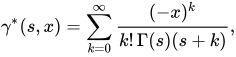
With its restriction to real values lifted, the series allows the expansion:

When s → 0:[9] ( is the Euler–Mascheroni constant here), hence, is the limiting function to the upper incomplete gamma function as s → 0, also known as the exponential integral .[10]


By way of the recurrence relation, values of for positive integers n can be derived from this result,[11] so the upper incomplete gamma function proves to exist and be holomorphic, with respect both to z and s, for all s and z ≠ 0.


is:
- entire in z for fixed, positive integral s;
- multi-valued holomorphic in z for fixed s non zero and not a positive integer, with a branch point at z = 0;
- equal to for s with positive real part and z = 0 (the limit when ), but this is a continuous extension, not an analytic one (does not hold for real s < 0!);
- on each branch entire in s for fixed z ≠ 0.


Special values
[edit]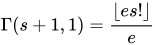
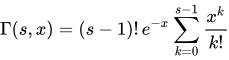

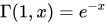






Here, is the exponential integral, is the generalized exponential integral, is the error function, and is the complementary error function, .



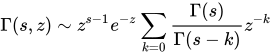
Asymptotic behavior
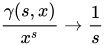
[edit]- as ,
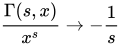
- as and (for real s, the error of Γ(s, x) ~ −xs / s is on the order of O(xmin{s + 1, 0}) if s ≠ −1 and O(ln(x)) if s = −1),
- as an asymptotic series where and .[13]
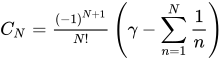
- as an asymptotic series where and , where , where is the Euler-Mascheroni constant.[13]
- as ,
- as ,
- as an asymptotic series where and .[14]











Evaluation formulae
[edit]The lower gamma function can be evaluated using the power series expansion:[15] where is the Pochhammer symbol.


An alternative expansion is where M is Kummer's confluent hypergeometric function.

Connection with Kummer's confluent hypergeometric function
[edit]When the real part of z is positive, where has an infinite radius of convergence.


Again with confluent hypergeometric functions and employing Kummer's identity,

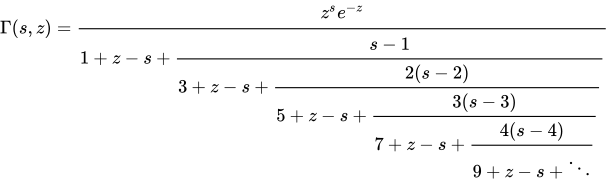
For the actual computation of numerical values, Gauss's continued fraction provides a useful expansion:
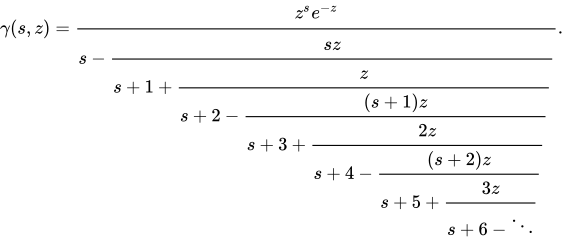
This continued fraction converges for all complex z, provided only that s is not a negative integer.
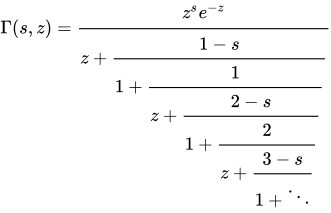
The upper gamma function has the continued fraction[16] and[citation needed]
Multiplication theorem
[edit]The following multiplication theorem holds true[citation needed]:

Software implementation
[edit]The incomplete gamma functions are available in various of the computer algebra systems.
Even if unavailable directly, however, incomplete function values can be calculated using functions commonly included in spreadsheets (and computer algebra packages). In Excel, for example, these can be calculated using the gamma function combined with the gamma distribution function.
- The lower incomplete function:
= EXP(GAMMALN(s))*GAMMA.DIST(x,s,1,TRUE). - The upper incomplete function:
= EXP(GAMMALN(s))*(1-GAMMA.DIST(x,s,1,TRUE)).


These follow from the definition of the gamma distribution's cumulative distribution function.
In Python, the Scipy library provides implementations of incomplete gamma functions under scipy.special, however, it does not support negative values for the first argument. The function gammainc from the mpmath library supports all complex arguments.
Regularized gamma functions and Poisson random variables
[edit]Two related functions are the regularized gamma functions: is the cumulative distribution function for gamma random variables with shape parameter and scale parameter 1.
![{\displaystyle {\begin{aligned}P(s,x)&={\frac {\gamma (s,x)}{\Gamma (s)}},\\[1ex]Q(s,x)&={\frac {\Gamma (s,x)}{\Gamma (s)}}=1-P(s,x).\end{aligned}}}](https://wikimedia.org/api/rest_v1/media/math/render/svg/aec55e479ed11354fd61908d46ba0982e317b45f)


When is an integer, is the cumulative distribution function for Poisson random variables: If is a random variable then


This formula can be derived by repeated integration by parts.
and are implemented as gammainc[17] and gammaincc[18] in scipy.

Derivatives
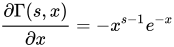
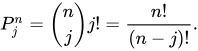
[edit]Using the integral representation above, the derivative of the upper incomplete gamma function with respect to x is The derivative with respect to its first argument is given by[19] and the second derivative by where the function is a special case of the Meijer G-function This particular special case has internal closure properties of its own because it can be used to express all successive derivatives. In general, where is the permutation defined by the Pochhammer symbol: All such derivatives can be generated in succession from: and This function can be computed from its series representation valid for , with the understanding that s is not a negative integer or zero. In such a case, one must use a limit. Results for can be obtained by analytic continuation. Some special cases of this function can be simplified. For example, , , where is the Exponential integral. These derivatives and the function provide exact solutions to a number of integrals by repeated differentiation of the integral definition of the upper incomplete gamma function.[20][21] For example, This formula can be further inflated or generalized to a huge class of Laplace transforms and Mellin transforms. When combined with a computer algebra system, the exploitation of special functions provides a powerful method for solving definite integrals, in particular those encountered by practical engineering applications (see Symbolic integration for more details).

![{\displaystyle {\frac {\partial ^{2}\Gamma (s,x)}{\partial s^{2}}}=\ln ^{2}x\Gamma (s,x)+2x\left[\ln x\,T(3,s,x)+T(4,s,x)\right]}](https://wikimedia.org/api/rest_v1/media/math/render/svg/442e90c89d5cb3dcacb43c280856a293ea7ce2bb)







![{\displaystyle T(m,s,z)=-{\frac {\left(-1\right)^{m-1}}{(m-2)!}}\left.{\frac {d^{m-2}}{dt^{m-2}}}\left[\Gamma (s-t)z^{t-1}\right]\right|_{t=0}+\sum _{n=0}^{\infty }{\frac {\left(-1\right)^{n}z^{s-1+n}}{n!\left(-s-n\right)^{m-1}}}}](https://wikimedia.org/api/rest_v1/media/math/render/svg/ff7973ef460907c11d7079ee2d7d9edec221796a)





Indefinite and definite integrals
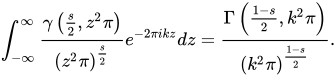
[edit]The following indefinite integrals are readily obtained using integration by parts (with the constant of integration omitted in both cases): The lower and the upper incomplete gamma function are connected via the Fourier transform: This follows, for example, by suitable specialization of (Gradshteyn et al. 2015, §7.642).
![{\displaystyle {\begin{aligned}\int x^{b-1}\gamma (s,x)\,dx&={\frac {1}{b}}\left(x^{b}\gamma (s,x)-\gamma (s+b,x)\right),\\[1ex]\int x^{b-1}\Gamma (s,x)\,dx&={\frac {1}{b}}\left(x^{b}\Gamma (s,x)-\Gamma (s+b,x)\right).\end{aligned}}}](https://wikimedia.org/api/rest_v1/media/math/render/svg/9168e1bcd7e2356ed5db1ef1df7ca3f54e39e4e5)
Notes
[edit]- ^ a b c d e f "DLMF: §8.2 Definitions and Basic Properties ‣ Incomplete Gamma Functions ‣ Chapter 8 Incomplete Gamma and Related Functions". dlmf.nist.gov.
- ^ a b c "DLMF: §8.8 Recurrence Relations and Derivatives ‣ Incomplete Gamma Functions ‣ Chapter 8 Incomplete Gamma and Related Functions". dlmf.nist.gov.
- ^ a b Donald E. Marshall (Autumn 2009). "Complex Analysis" (PDF). Math 534 (student handout). University of Washington. Theorem 3.9 on p.56. Archived from the original (PDF) on 16 May 2011. Retrieved 23 April 2011.
- ^ a b "DLMF: §8.7 Series Expansions ‣ Incomplete Gamma Functions ‣ Chapter 8 Incomplete Gamma and Related Functions". dlmf.nist.gov.
- ^ Paul Garrett. "Hartogs' Theorem: separate analyticity implies joint" (PDF). cse.umn.edu. Retrieved 21 December 2023.
- ^ C. Teleman. "Riemann Surfaces" (PDF). berkeley.edu. Retrieved 21 December 2023.
- ^ "DLMF: §5.2 Definitions ‣ Properties ‣ Chapter 5 Gamma Function". dlmf.nist.gov.
- ^ "DLMF: §4.4 Special Values and Limits ‣ Logarithm, Exponential, Powers ‣ Chapter 4 Elementary Functions". dlmf.nist.gov.
- ^ see last eq.
- ^ "DLMF: §8.4 Special Values ‣ Incomplete Gamma Functions ‣ Chapter 8 Incomplete Gamma and Related Functions". dlmf.nist.gov.
- ^ "DLMF: 8.4 Special Values".
- ^ Weisstein, Eric W. "Incomplete Gamma Function". MathWorld. (equation 2)
- ^ a b Bender & Orszag (1978). Advanced Mathematical Methods for Scientists and Engineers. Springer. Bibcode:1978amms.book.....B.
- ^ "DLMF: §8.11 Asymptotic Approximations and Expansions ‣ Incomplete Gamma Functions ‣ Chapter 8 Incomplete Gamma and Related Functions". dlmf.nist.gov.
- ^ "DLMF: §8.11 Asymptotic Approximations and Expansions ‣ Incomplete Gamma Functions ‣ Chapter 8 Incomplete Gamma and Related Functions". dlmf.nist.gov.
- ^ Abramowitz and Stegun p. 263, 6.5.31
- ^ "scipy.special.gammainc — SciPy v1.11.4 Manual". docs.scipy.org.
- ^ "scipy.special.gammaincc — SciPy v1.11.4 Manual". docs.scipy.org.
- ^ K.O. Geddes, M.L. Glasser, R.A. Moore and T.C. Scott, Evaluation of Classes of Definite Integrals Involving Elementary Functions via Differentiation of Special Functions, AAECC (Applicable Algebra in Engineering, Communication and Computing), vol. 1, (1990), pp. 149–165, [1]
- ^ Milgram, M. S. (1985). "The generalized integro-exponential function". Math. Comp. 44 (170): 443–458. doi:10.1090/S0025-5718-1985-0777276-4. MR 0777276.
- ^ Mathar (2009). "Numerical Evaluation of the Oscillatory Integral over exp(i*pi*x)*x^(1/x) between 1 and infinity". arXiv:0912.3844 [math.CA]., App B
References
[edit]- Abramowitz, Milton; Stegun, Irene Ann, eds. (1983) [June 1964]. "Chapter 6.5". Handbook of Mathematical Functions with Formulas, Graphs, and Mathematical Tables. Applied Mathematics Series. Vol. 55 (Ninth reprint with additional corrections of tenth original printing with corrections (December 1972); first ed.). Washington D.C.; New York: United States Department of Commerce, National Bureau of Standards; Dover Publications. ISBN 978-0-486-61272-0. LCCN 64-60036. MR 0167642. LCCN 65-12253. "Incomplete Gamma function". §6.5.
- Allasia, Giampietro; Besenghi, Renata (1986). "Numerical calculation of incomplete gamma functions by the trapezoidal rule". Numer. Math. 50 (4): 419–428. doi:10.1007/BF01396662. S2CID 121964300.
- Amore, Paolo (2005). "Asymptotic and exact series representations for the incomplete Gamma function". Europhys. Lett. 71 (1): 1–7. arXiv:math-ph/0501019. Bibcode:2005EL.....71....1A. doi:10.1209/epl/i2005-10066-6. MR 2170316. S2CID 1921569.
- G. Arfken and H. Weber. Mathematical Methods for Physicists. Harcourt/Academic Press, 2000. (See Chapter 10.)
- DiDonato, Armido R.; Morris, Jr., Alfred H. (December 1986). "Computation of the incomplete gamma function ratios and their inverse". ACM Transactions on Mathematical Software. 12 (4): 377–393. doi:10.1145/22721.23109. S2CID 14351930.
- Barakat, Richard (1961). "Evaluation of the Incomplete Gamma Function of Imaginary Argument by Chebyshev Polynomials". Math. Comp. 15 (73): 7–11. doi:10.1090/s0025-5718-1961-0128058-1. MR 0128058.
- Carsky, Petr; Polasek, Martin (1998). "Incomplete Gamma F_m(x) functions for real and complex arguments". J. Comput. Phys. 143 (1): 259–265. Bibcode:1998JCoPh.143..259C. doi:10.1006/jcph.1998.5975. MR 1624704.
- Chaudhry, M. Aslam; Zubair, S. M. (1995). "On the decomposition of generalized incomplete Gamma functions with applications to Fourier transforms". J. Comput. Appl. Math. 59 (101): 253–284. doi:10.1016/0377-0427(94)00026-w. MR 1346414.
- DiDonato, Armido R.; Morris, Jr., Alfred H. (September 1987). "ALGORITHM 654: FORTRAN subroutines for computing the incomplete gamma function ratios and their inverse". ACM Transactions on Mathematical Software. 13 (3): 318–319. doi:10.1145/29380.214348. S2CID 19902932. (See also www.netlib.org/toms/654).
- Früchtl, H.; Otto, P. (1994). "A new algorithm for the evaluation of the incomplete Gamma Function on vector computers". ACM Trans. Math. Softw. 20 (4): 436–446. doi:10.1145/198429.198432. S2CID 16737306.
- Gautschi, Walter (1998). "The incomplete gamma function since Tricomi". Atti Convegni Lincei. 147: 203–237. MR 1737497.
- Gautschi, Walter (1999). "A Note on the recursive calculation of Incomplete Gamma Functions". ACM Trans. Math. Softw. 25 (1): 101–107. doi:10.1145/305658.305717. MR 1697463. S2CID 36469885.
- Gradshteyn, Izrail Solomonovich; Ryzhik, Iosif Moiseevich; Geronimus, Yuri Veniaminovich; Tseytlin, Michail Yulyevich; Jeffrey, Alan (2015) [October 2014]. "8.35.". In Zwillinger, Daniel; Moll, Victor Hugo (eds.). Table of Integrals, Series, and Products. Translated by Scripta Technica, Inc. (8 ed.). Academic Press, Inc. pp. 908–911. ISBN 978-0-12-384933-5. LCCN 2014010276.
- Jones, William B.; Thron, W. J. (1985). "On the computation of incomplete gamma functions in the complex domain". J. Comput. Appl. Math. 12–13: 401–417. doi:10.1016/0377-0427(85)90034-2. MR 0793971.
- "Incomplete gamma-function", Encyclopedia of Mathematics, EMS Press, 2001 [1994]
- Mathar, Richard J. (2004). "Numerical representation of the incomplete gamma function of complex-valued argument". Numerical Algorithms. 36 (3): 247–264. arXiv:math/0306184. Bibcode:2004NuAlg..36..247M. doi:10.1023/B:NUMA.0000040063.91709.58. MR 2091195. S2CID 30860614.
- Miller, Allen R.; Moskowitz, Ira S. (1998). "On certain Generalized incomplete Gamma functions". J. Comput. Appl. Math. 91 (2): 179–190. doi:10.1016/s0377-0427(98)00031-4.
- Paris, R. B. (2010), "Incomplete gamma function", in Olver, Frank W. J.; Lozier, Daniel M.; Boisvert, Ronald F.; Clark, Charles W. (eds.), NIST Handbook of Mathematical Functions, Cambridge University Press, ISBN 978-0-521-19225-5, MR 2723248.
- Paris, R. B. (2002). "A uniform asymptotic expansion for the incomplete gamma function". J. Comput. Appl. Math. 148 (2): 323–339. Bibcode:2002JCoAM.148..323P. doi:10.1016/S0377-0427(02)00553-8. MR 1936142.
- Press, WH; Teukolsky, SA; Vetterling, WT; Flannery, BP (2007). "Section 6.2. Incomplete Gamma Function and Error Function". Numerical Recipes: The Art of Scientific Computing (3rd ed.). New York: Cambridge University Press. ISBN 978-0-521-88068-8. Archived from the original on 15 April 2021. Retrieved 9 August 2011.
- Takenaga, Roy (1966). "On the Evaluation of the Incomplete Gamma Function". Math. Comp. 20 (96): 606–610. doi:10.1090/S0025-5718-1966-0203911-3. MR 0203911.
- Temme, Nico (1975). "Uniform Asymptotic Expansions of the Incomplete Gamma Functions and the Incomplete Beta Function". Math. Comp. 29 (132): 1109–1114. doi:10.1090/S0025-5718-1975-0387674-2. MR 0387674.
- Terras, Riho (1979). "The determination of incomplete Gamma Functions through analytic integration". J. Comput. Phys. 31 (1): 146–151. Bibcode:1979JCoPh..31..146T. doi:10.1016/0021-9991(79)90066-4. MR 0531128.
- Tricomi, Francesco G. (1950). "Sulla funzione gamma incompleta". Ann. Mat. Pura Appl. 31: 263–279. doi:10.1007/BF02428264. MR 0047834. S2CID 120404791.
- Tricomi, F. G. (1950). "Asymptotische Eigenschaften der unvollst. Gammafunktion". Math. Z. 53 (2): 136–148. doi:10.1007/bf01162409. MR 0045253. S2CID 121234109.
- van Deun, Joris; Cools, Ronald (2006). "A stable recurrence for the incomplete gamma function with imaginary second argument". Numer. Math. 104 (4): 445–456. doi:10.1007/s00211-006-0026-1. MR 2249673. S2CID 43780150.
- Winitzki, Serge (2003). "Computing the Incomplete Gamma Function to Arbitrary Precision". In Vipin Kumar; Marina L. Gavrilova; Chih Jeng Kenneth Tan; Pierre L'Ecuyer (eds.). Computational Science and Its Applications — ICSSA 2003. International Conference on Computational Science and Its Applications, Montreal, Canada, May 18–21, 2003, Proceedings, Part I. Lecture Notes in Computer Science. Vol. 2667. pp. 790–798. doi:10.1007/3-540-44839-x_83. ISBN 978-3-540-40155-1. MR 2110953.
- Weisstein, Eric W. "Incomplete Gamma Function". MathWorld.
External links
[edit]


Incomplete gamma function
View on GrokipediaDefinitions
Lower incomplete gamma function
The lower incomplete gamma function, denoted , is defined for complex parameters with and nonnegative real by the improper integral This representation highlights its role as a truncated version of the complete gamma function , capturing the contribution from the lower limit of integration up to . The function is entire in for fixed and increases monotonically from to as . An equivalent power series expansion, valid for all and , is which follows from term-by-term integration of the exponential series within the defining integral. This series converges absolutely and provides a practical computational tool for small to moderate , with the first few terms yielding accurate approximations in such regimes. Additionally, admits a representation in terms of the confluent hypergeometric function of the first kind , given by for , linking it to broader hypergeometric theory. A normalized form, often denoted , represents the regularized lower incomplete gamma function and satisfies for , with as . This normalization is particularly useful in probabilistic interpretations.Upper incomplete gamma function
The upper incomplete gamma function, denoted , is defined as the improper integral where and the path of integration lies in the right half-plane, avoiding the origin and the negative real axis to ensure principal values.[1] This representation captures the "tail" of the gamma function integral from to infinity, contrasting with the lower incomplete gamma function that integrates from 0 to . The definition originates from early 19th-century extensions of Euler's integral for the gamma function, formalized by Adrien-Marie Legendre in his 1811 work Exercices de calcul intégral.[7] For and not on the branch cut, satisfies the fundamental partitioning relation where is the lower incomplete gamma function and is the complete gamma function; this equality extends by analytic continuation to all complex except the non-positive integers .[1] The function is entire in for fixed and holomorphic in in the complex plane minus the branch cut along the negative real axis, with the principal branch defined such that .[1] A normalized form, often used in probability and statistics, is the complementary cumulative distribution function which satisfies , where is the regularized lower incomplete gamma function.[1] This normalization facilitates numerical evaluation and asymptotic analysis.[2]Fundamental Properties
Relation to the complete gamma function
The lower incomplete gamma function and the upper incomplete gamma function are related to the complete gamma function by the fundamental identity which holds for , , and .[1] This relation arises directly from the integral representations, as the path from to combined with the path from to (along the positive real axis) yields the full integral defining .[1] The normalized (or regularized) incomplete gamma functions provide a probabilistic interpretation of this relation: satisfying under the same conditions on and .[1] These normalized forms express the incomplete gamma functions as fractions of the complete gamma function, facilitating computations and analyses where the total integral serves as a scaling factor.[1] For complex arguments, the relation continues to hold when principal values are taken, with integration paths avoiding the non-positive real axis and the origin (except for the endpoint in ).[1] This ensures the additivity persists in the analytic continuation of the functions.[1]Recurrence relations
The incomplete gamma functions satisfy linear recurrence relations that mirror the functional equation of the complete gamma function, . These relations are obtained by integrating the defining integrals by parts and hold for and complex away from the branch cut. They facilitate numerical evaluation, series expansions, and connections to other special functions.[8] For the lower incomplete gamma function, the first-order forward recurrence is This allows computation of from , with the exponential term providing the boundary contribution from the upper limit in the integral definition. A similar relation holds in the backward direction, though numerical stability favors forward recursion for increasing when is not too large.[8] The upper incomplete gamma function obeys the complementary first-order recurrence where the positive sign reflects the integration by parts starting from the lower limit at . Backward recursion is often preferred for the upper function to avoid overflow in asymptotic regimes.[8] Both the lower and upper incomplete gamma functions satisfy the same second-order linear homogeneous recurrence with denoting either or . This relation, analogous to the three-term recurrence for confluent hypergeometric functions, enables stepping in the parameter by two units and is useful for deriving continued fractions or solving differential equations satisfied by these functions.[8] Higher-order recurrences extend these to integer steps . For the lower incomplete gamma, where is the Pochhammer symbol. The corresponding formula for the upper incomplete gamma replaces the subtracted sum with an added one: These generalized relations are particularly valuable for generating sequences of values in asymptotic expansions or when combining with the multiplication theorem for the gamma function.[8]Analytic Continuation
Extension to complex arguments
The incomplete gamma functions admit analytic continuation to complex arguments and , extending their integral definitions beyond the positive real axis. The lower incomplete gamma function is defined as where the integration path is any curve from 0 to that lies in the complex plane except for the origin and the non-positive real axis, ensuring the principal value.[1] Similarly, the upper incomplete gamma function is with the path from to avoiding the non-positive real axis. These representations hold without restrictions on the paths as long as the integrand remains analytic along them, allowing continuation to the entire complex plane minus branch cuts.[1] For the principal branch, the argument of is taken in , and uses the principal logarithm with branch cut along the negative real axis. This makes multi-valued when is not an integer, with the monodromy relation for integer , reflecting the encircling of the branch point at .[1] The upper incomplete gamma satisfies ensuring consistency with the complete gamma function .[1] The normalized lower incomplete gamma, , is entire in both and , providing a single-valued analytic continuation.[1] Analytically, for fixed with , is analytic in except for the branch cut along the non-positive real axis, while is entire in . Extension to introduces poles in at for nonnegative integers , with residues . Numerical representations for complex arguments often employ power series, asymptotic expansions, or connections to the confluent hypergeometric function, facilitating computation across the complex plane.[1]Branch structure and multi-valuedness
The incomplete gamma functions, both lower and upper , admit analytic continuation to complex arguments for fixed , but exhibit multi-valued behavior due to the inherent logarithm in the integrand . This arises primarily from the endpoint at in the defining integrals, leading to branch points at and . The functions are meromorphic in but multi-valued in unless is a non-negative integer, in which case they reduce to single-valued elementary functions.[1] The principal branch is conventionally defined such that the functions are analytic in the complex -plane excluding the branch cut along the non-positive real axis . On this branch, the argument of satisfies , and the values along the cut from above () and below () differ, reflecting the discontinuity. For the upper incomplete gamma, is continuous from above along the cut, ensuring consistency with the real positive axis values where the integral representation holds without ambiguity. This choice aligns with standard numerical implementations and facilitates computation via series or asymptotic expansions in the cut plane.[9] Multi-valuedness manifests through monodromy when encircling the branch point at counterclockwise along a closed path not enclosing . For the lower incomplete gamma, the value transforms as indicating a multiplicative factor from the contribution in its series representation . For the upper incomplete gamma, the relation is where the additional term accounts for the contribution from the complete gamma function when the integration path from to encircles the origin. These relations hold for and demonstrate that the functions on different Riemann sheets differ by integer multiples of in the logarithmic phase. The branch structure at follows from the asymptotic behavior, where large expansions involve the complementary error function or Stirling-like series, but the multi-valuedness is fully captured by the finite branch point at . In practice, the principal sheet provides the values matching the real-axis integrals for , with extensions to other sheets obtained via the monodromy formulas. This framework ensures rigorous handling in applications involving complex contours, such as in quantum mechanics or statistical distributions.[9]Special Values and Identities
Particular evaluations
The incomplete gamma function yields closed-form expressions in several special cases, particularly when the parameter is a positive integer, a half-integer, or zero, often connecting to other elementary or special functions such as the error function, complementary error function, and exponential integral. These evaluations are derived from the integral definitions via integration by parts, series expansions, or known identities for related functions.[10] For , the functions simplify to elementary forms: valid for . These follow directly from the integral representation . When is a positive integer (), repeated integration by parts leads to finite sums involving the partial exponential series. Equivalently, shifting the index for convenience, for and . Here, the sum is the th partial sum of the Taylor series for . These expressions highlight the connection to the cumulative distribution function of the Poisson distribution with parameter . For the half-integer case , the functions relate to the Gaussian error integrals. Specifically, where and , for with the principal branch. Higher half-integers () can be obtained recursively using the relation , yielding expressions as finite sums of terms involving and powers of . The upper incomplete gamma for connects to the exponential integral function: defined as the Cauchy principal value for . This case is singular at , as diverges, but the integral converges for . For non-positive integers (), the upper incomplete gamma admits an expression involving the exponential integral and a finite alternating sum: valid for . The normalized lower incomplete gamma (taken in the limiting sense, as has poles) simplifies to . These forms arise from analytic continuation and handle the poles at non-positive integers.Multiplication theorem
The multiplication theorem for the incomplete gamma function, first presented by Tricomi in 1950, provides a series expansion that relates the lower incomplete gamma function evaluated at a scaled argument to its value at the original argument and a sum involving higher-order terms. This identity is particularly useful for deriving expansions and understanding the analytic continuation of the function. For the lower incomplete gamma function , where is a fixed complex parameter, the theorem states: with the series converging for arbitrary complex and the left-hand side analytic in .[11] Tricomi derived this by manipulating power series representations, interpreting it as a multiplication formula analogous to those for other special functions. A companion result, not explicitly stated by Tricomi but proven subsequently, holds for the upper incomplete gamma function . It is given by: valid for , and can be extended analytically.[11] This form arises from similar series manipulations and is applied in expansions of the exponential integral , where connects to .90100-5) These theorems extend the classical Gauss multiplication formula for the complete gamma function to its incomplete counterparts, facilitating numerical evaluations and asymptotic analyses in regions where direct integration is challenging.[11]Asymptotic Behavior
Expansions for large arguments
For large positive arguments with fixed parameter , the upper incomplete gamma function admits an asymptotic expansion that captures its rapid decay. This expansion is derived from integration by parts and takes the form of a divergent series, useful for approximation when is sufficiently large compared to . The leading behavior is as , with higher-order terms given by where is the falling factorial, and the remainder satisfies as in the sector for any fixed and fixed . This series is asymptotic, meaning the error decreases initially as more terms are added but eventually diverges for fixed , optimal truncation occurring around . The first few terms illustrate the structure: for , the term is 1; for , ; for , , and so on, reflecting successive integrations by parts of the defining integral . This expansion is particularly effective for , where becomes negligible compared to the complete gamma function , implying with relative error . For complex arguments, the expansion holds in the specified sector, avoiding the branch cut along the negative real axis, and provides uniform control over the remainder via Darboux methods or Watson's lemma. In applications such as tail probabilities for the gamma distribution, this asymptotic quantifies rare events for large thresholds.[12] When both and are large with fixed and away from 1, Laplace's method yields complementary expansions. For (i.e., ), , where and , with coefficients satisfying a recurrence. This uniform expansion bridges the fixed- large- regime and the transition region near . For , a similar form applies to the lower incomplete gamma. These are essential for high-parameter regimes in statistics and physics.Expansions for small arguments
For small values of the argument , the lower incomplete gamma function can be expanded in a power series that converges for all finite when : [13] This expansion arises from the integral definition by term-by-term integration of the Taylor series for , yielding coefficients involving the reciprocal of the rising factorial in the denominator.[13] Equivalently, the normalized lower incomplete gamma has the form [13] which highlights its connection to the series representation of the confluent hypergeometric function of the first kind, though the direct power series is often used for computational purposes when is small.[13] The upper incomplete gamma function for small is obtained by subtraction from the complete gamma function: [13] valid under the same conditions on (with ). As , , with the series providing the leading corrections of order .[13] For practical evaluation, truncating the series after a few terms suffices when , as higher powers diminish rapidly; for example, with and , the first term approximates with error less than .[13] These expansions are particularly useful for asymptotic analysis near the origin and in numerical libraries, where they complement continued fraction representations for larger arguments.[13]Evaluation Methods
Series and continued fraction representations
The incomplete gamma function admits power series expansions that are particularly useful for small values of the argument . For the lower incomplete gamma function, defined as with , the series representation is which converges for all finite and . This form arises from term-by-term integration of the exponential series within the integral definition. Equivalently, the regularized lower incomplete gamma expands as valid under the same conditions and useful for numerical evaluation when is not too large. The upper incomplete gamma function has a complementary series derived from the above: converging for and all finite . Alternative expansions exist, such as one in terms of modified Bessel functions for : where is the modified Bessel function of the first kind and are coefficients from the exponential series, applicable for . These series are efficient for computation when or moderately small, but may require acceleration techniques for larger . Continued fraction representations provide an alternative for evaluating the incomplete gamma functions, especially for larger , offering rapid convergence in certain regions. For the regularized lower incomplete gamma, a continued fraction form is \Gamma(a+1) e^z \gamma^*(a,z) = \cfrac{1}{1 - \cfrac{z}{a+1 + \cfrac{z}{a+2 - \cfrac{(a+1)z}{a+3 + \cfrac{2z}{a+4 - \cfrac{(a+2)z}{a+5 + \cfrac{3z}{a+6 - \cdots}}}}}}, with partial numerators (for ) alternating in sign with denominators involving adjustments, converging for and suitable for the forward or modified Lentz's method in numerical algorithms. This representation stems from Gauss's continued fraction for the ratio of hypergeometric functions, linked to the incomplete gamma via confluent hypergeometric representations. For the upper incomplete gamma, the continued fraction is z^{-a} e^z \Gamma(a,z) = \cfrac{1/z}{1 + \cfrac{(1-a)/z}{1 + \cfrac{1/z}{1 + \cfrac{(2-a)/z}{1 + \cfrac{2/z}{1 + \cfrac{(3-a)/z}{1 + \cfrac{3/z}{1 + \cdots}}}}}}, valid for , with partial numerators and alternating, and denominators of 1. This form converges quickly for large and is preferred in computational libraries for the tail probability in statistical applications, as it avoids overflow issues in the series expansions. Both continued fractions are derived from the asymptotic theory of confluent hypergeometric functions and have been analyzed for convergence properties in works on special function approximations.[14]Connection to confluent hypergeometric functions
The incomplete gamma functions, both lower and upper , admit representations in terms of confluent hypergeometric functions, which provide alternative avenues for analysis and computation, particularly through series expansions and asymptotic behaviors.[15] The confluent hypergeometric function of the first kind, denoted or Kummer's function, satisfies the differential equation , and serves as a fundamental solution that generalizes many special functions.[16] For the lower incomplete gamma function, the relation is given by valid for . This expression leverages the series representation of , where denotes the Pochhammer symbol, allowing the incomplete gamma to be computed via a hypergeometric series truncated appropriately for small . The regularized lower incomplete gamma, , simplifies to , where is the regularized confluent hypergeometric function. The upper incomplete gamma function connects to the second solution of the confluent hypergeometric equation, the Tricomi function , via This holds under the principal branch conditions for complex arguments, with behaving asymptotically as for large in . Such representations facilitate the study of the incomplete gamma's analytic continuation and branch structure, as the confluent functions' multi-valuedness aligns with the incomplete gamma's behavior across the negative real axis.[16] Further connections arise through Whittaker functions, which are scaled variants of confluent hypergeometric functions: and . Thus, and offering utility in problems involving quantum mechanics and diffusion processes where Whittaker functions naturally emerge. These identities, rooted in the confluent limit of Gauss's hypergeometric function, underscore the incomplete gamma's role as a special case within the broader hypergeometric hierarchy.Numerical computation and software
The numerical computation of the incomplete gamma functions and relies on a combination of series expansions, continued fractions, and asymptotic approximations, selected based on the values of the parameters and to ensure accuracy and efficiency. For small relative to , the lower incomplete gamma function is effectively evaluated using its power series representation , which converges rapidly when .[17] This series is particularly suitable for the regime where direct integration or Taylor expansion is feasible, avoiding overflow issues by normalizing terms incrementally. Conversely, for larger , the upper incomplete gamma function benefits from continued fraction expansions, such as the Lentz-Thompson-Barnett algorithm applied to the representation , which provides stable convergence for and is less prone to cancellation errors than series methods.[17] Asymptotic expansions are crucial for large arguments, where the Stirling series or saddle-point approximations yield high accuracy with few terms. For instance, when is large, , valid for , allowing computation with relative errors below machine precision for .[17] Uniform asymptotics, such as those involving the parameter , extend this to large with fixed , using expansions like where , derived from Laplace's method for integrals.[17] These methods are often combined in hybrid algorithms: series for small , continued fractions for intermediate, and asymptotics for large, with careful handling of the transition regions to minimize round-off errors, as detailed in Temme's comprehensive analysis.[17] In software libraries, the incomplete gamma functions are implemented with these techniques to support double-precision floating-point arithmetic. The GNU Scientific Library (GSL) provides functions likegsl_sf_gamma_inc_P(a, x) for the regularized lower form , using a combination of series for and continued fractions otherwise, achieving full machine accuracy across the real plane for , .[18] SciPy's scipy.special.gammainc(a, x) computes the regularized lower incomplete gamma, employing Temme's algorithm for the unnormalized case and Lentz's method for the upper, with benchmarks showing relative errors under for typical inputs.[19] MATLAB's gammainc(x, a) and igamma(a, z) support both regularized and unnormalized variants, utilizing series expansions for small arguments and asymptotic series for large, including symbolic computation for exact results when inputs are integers.[20] The Boost.Math library offers gamma_p(a, z) for the regularized lower form, implemented in C++ with policy-based error handling, drawing on the same core methods and validated against Cody's test suite for 53-bit precision compliance.[21] These implementations prioritize portability and performance, often accelerating computations for integer via recurrence relations.