Hubbry Logo
RinkballRinkballMain
Open search
Rinkball
Community hub
Rinkball
logo
8 pages, 0 posts
0 subscribers
Be the first to start a discussion here.
Contribute something
Rinkball
Rinkball
from Wikipedia

Rinkball is a winter team sport played on ice with ice skates and is most popular in Finland, where it is known as kaukalopallo. This ball sport originated in Sweden in the 1960s and from there landed in Finland in the 1970s.

Key Information

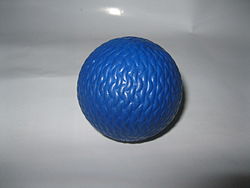
The objective of a game is to score more goals than the opposing team. A bandy ball is used, but the ball is slightly smaller and blue instead of the orange or cerise used in bandy. Rinkball sticks are a sport specific design.

Rinkball combines elements of bandy, rink bandy, and ice hockey, but is now a separately organized sport after developing its own organizing bodies, codifying its own rules, and having designed its own sport-specific equipment.

History

[edit]

The sport was initially formed as a practice drill for bandy players in Sweden who were using indoor ice hockey rinks in the summer half of the year when the weather was too hot for outdoor ice fields even with artificial ice. The first Finnish championships were held in 1975. However, the sport didn't come to the attention of the wider public in Finland until the 1980s with the first Finland-Sweden international game played in 1984. In 1990, a rinkball game between the men's Finnish rinkball team and the newly crowned national Swedish bandy champion team, Västerås SK Bandy, resulted in a blowout with the rinkball team winning 13–3. This event helped further the fact that the two sports, bandy and rinkball, had become very different games.[1]

Rinkball rules

[edit]

Rules for rinkball are set in Finland and there are also separate rules for the Championship Series.

The playing time is 3 × 20 minutes of effective playing time, i.e. the clock is stopped with game breaks (men's league and 1st division). In the lower series, the playing time is 2 × 30 minutes of running time. In that case, the clock will only be stopped during overtime or a penalty shot, or if there is a longer delay in the game e.g. in the case of a player being injured. Even in running time, the clock will be stopped during the last 2 minutes of the match for all interruptions.

The team may have a maximum of 17 or 20 players on their roster and two goalkeepers (depending on the series) of which one goalkeeper and five field players may be on the ice at a time. The team has the opportunity to pull and replace the goalkeeper with another player.

Checking is prohibited and players are not allowed to lift an opposing player's stick.[citation needed] There is no offsides in rinkball.

Rinkball equipment

[edit]

Mandatory equipment for field players includes a helmet, neck guard, ice skates, and a rinkball stick.

Ball

[edit]

The ball used is like a bandy ball but is 6 centimeters in diameter, weighs about 60 grams, and is blue in color.

Sticks

[edit]

Rinkball sticks have a sport–specific design and come in one length, roughly just over a metre long, giving shorter players an offensive edge while enabling taller players to dominate defensively.[1] Rinkball sticks bear a closer resemblance to ice hockey sticks than they do to bandy sticks.

Ice skates

[edit]

Rinkball does not have an ice skate designed specifically for the sport. The players either use bandy skates or ice hockey skates, with bandy skates being the most prevalent.

Goalkeeper

[edit]

Mandatory equipment for the goalkeeper involves skates, a helmet with a face shield or mask, a neck guard, and goalkeeper shin guards or knee pads (width up to 28 cm). The goalkeeper has a catch glove or "fin" in each hand, the palm of which must be able to be spread completely open, so that its diameter must not exceed 28 cm at any point. The maximum width of the bracelet is 15 cm. The goalkeeper does not have a stick.

National championships

[edit]

In Finland, the national rinkball championships is the Kaukalopallon SM-sarja [fi].

International

[edit]

The International Rinkball Federation (IRF) was founded in 1992 with Russia, Hungary and Switzerland among its first founding members. Sweden, Norway, the United States and Canada did not join in the beginning.[1] By the late 1990s the international organization included Russia, Sweden, Kazakhstan, Estonia, Switzerland, Hungary, Finland, and the United States.[2]

The first Rinkball World Championship for men was held in Omsk, Russia, in 1998.[2]

The sport's largest national organization is in Finland. Known as the Finnish Rinkball Federation to English speakers,[3] it has 1,000 teams, including women, men and children. Play is divided into eight male divisions, two female divisions, and children's play is divided by age.[4]

Notable people

[edit]

See also

[edit]

References

[edit]
[edit]
Revisions and contributorsEdit on WikipediaRead on Wikipedia
from Grokipedia
Rinkball is a winter team sport played on an ice hockey rink by two teams of six players each (five field players and one goaltender), who use skates and specialized sticks to direct a small, hard rubber ball into the opponent's net while adhering to rules that emphasize skill over physical contact, such as prohibiting body checking and eliminating offside infractions. Originating in Sweden during the 1960s as a training variant of bandy to adapt the sport to smaller indoor rinks, rinkball—known as kaukalopallo in Finland—quickly gained traction there in the 1970s through local tournaments and associations, evolving into a distinct discipline with modified equipment and gameplay. By the 1980s, it had expanded to include international competitions, such as matches between Finland and Sweden in 1984, and the sport's growth in Finland led to the establishment of the Finnish Rinkball Federation in 1990, which oversees numerous clubs and divisions for men, women, and youth. The International Rinkball Federation (IRF) was founded in 1992, with Finland, Russia, Hungary, and Switzerland as initial members, promoting world championships and standardizing rules that feature 3 × 20-minute effective playing periods (or 2 × 30 minutes), penalties resulting in power plays or free shots, and goaltenders using gloves without sticks. While primarily popular in Finland, where it supports community events, school programs, and age-group tournaments up to 75 years old, rinkball remains niche internationally but continues to foster accessible, fast-paced ice play focused on passing and shooting. As of the mid-2010s, Finland had around 2,500 licensed players.

Overview

Description

Rinkball is a winter played on ice rinks using ice skates, in which two teams compete to score goals by striking a with sticks into the opponent's net. The game emphasizes speed, skill, and precise stick handling, with physical contact restricted to avoid or tackling. Matches are conducted on standard ice hockey rinks measuring approximately 60 meters by 30 meters, though dimensions can range from 45m x 26m to 61m x 30m, enclosed by boards. Each team fields six players on the ice: five field players and one goalkeeper. Players use ice skates, wooden or composite sticks with a blade width of up to 67 mm, and a blue rubber ball about 6 cm in diameter weighing 58-62 grams. The goalkeeper employs gloves rather than a stick, and all participants must wear neck protectors. Rinkball incorporates elements from , such as the use of a and stick-based play, and from through its confined format, while adopting ice hockey's skates and rink dimensions. It distinguishes itself with a instead of a puck and the absence of offside rules, promoting continuous play without positional restrictions. In , the sport's primary center, it is known as kaukalopallo.

Popularity and Participation

Rinkball is predominantly popular in , where the sport, known locally as kaukalopallo, boasts over 1,000 registered teams across more than 200 clubs under the oversight of the Suomen Kaukalopalloliitto (as of the early ) and engages thousands of active players spanning all ages and genders. The federation organizes competitive structures that include eight men's divisions, two women's divisions, and multiple youth categories, fostering broad accessibility and sustained involvement. This widespread participation underscores rinkball's status as a key winter in the country, with community events emphasizing its fun, social nature and the concept of a "kaukisperhe" (rinkball family) that builds camaraderie among players; annual tournaments can involve up to 80,000 participants. Women's participation in is notably inclusive, featuring dedicated leagues and tournaments such as the Naisten SM-turnaus, an annual national championship held at venues like Lohjan Kisakallio, which attracts teams from across the country and guarantees multiple games per participant to encourage engagement. This event, scheduled for April 26, 2026, requires player licenses and a participation fee, highlighting organized support for female athletes at both competitive and recreational levels. programs further enhance the sport's reach, with initiatives like the Virtuaalinen Kaukiskoulukiertue targeting elementary schools to introduce rinkball through educational and interactive sessions, promoting and team skills among children. Beyond , rinkball sees growing but comparatively smaller participation in , , , , , and , all of which are founding or active members of the International Rinkball Federation (IRF), founded in 1992. These nations host national leagues and contribute to international competitions, though the sport's player base remains modest relative to Finland's scale. Globally, rinkball functions as a niche activity primarily confined to Nordic and Eastern European regions, with its reliance on indoor ice rinks offering opportunities for expansion in areas with established skating infrastructure.

History

Origins in Sweden

Rinkball, known initially as hockeybockey in , emerged in the as an adaptation of designed for indoor practice on rinks during the off-season. This development allowed players to extend their training time on smaller, enclosed ice surfaces, blending elements of with the confined dimensions of hockey arenas. The sport's hybrid nature arose from the need to accommodate 's flowing playstyle within the narrower boundaries of standard rinks, typically measuring 60 meters by 30 meters. Early play was informal, primarily within Swedish bandy clubs, where it served as a skill-building exercise rather than a competitive format. Participants used traditional bandy equipment, including the small, orange and curved wooden sticks, directly on hockey rink ice without modifications to the surface or goals. This setup emphasized technical proficiency in stickhandling and passing, mirroring bandy's emphasis on over physical contact, though no standardized rules existed at the outset. By the early , rinkball gained recognition as a distinct variant in , marked by the official name change from hockeybockey to rinkbandy. This shift facilitated the establishment of basic guidelines tailored to its indoor format, setting the stage for organized club activities while retaining its roots in training.

Introduction to Finland

Rinkball arrived in in the late 1960s and , brought over from where it had emerged as a variant of adapted for smaller indoor ice rinks. The sport's adoption was swift, facilitated by Finland's widespread availability of enclosed ice facilities originally built for and , as well as the nation's established bandy-playing culture that provided a familiar foundation for players and organizers. Local matches began in villages and towns, quickly expanding into organized series and weekend tournaments that attracted dozens of teams by the late . The first Finnish national championships took place in 1975, contested under the local name kaukalopallo and administered initially through the Finnish Bandy Association, which marked the 's formal organization and integration into the national sports landscape. This inaugural event helped standardize rules and foster competitive structures, transitioning rinkball from informal play to a recognized competitive discipline. By the mid-1970s, participation had grown sufficiently to support ongoing national series, laying the groundwork for broader development. Rinkball experienced rapid expansion throughout the , with the formation of dedicated leagues and the refinement of rules and equipment to distinguish it further from traditional . A pivotal moment came in with the first international match between and , which heightened public interest and showcased the sport's growing competitiveness on an international stage. Finnish teams, such as Palokan Pyry and Hakunilan Riento, even ventured abroad to compete in events like the 1987 North American Cup in , further solidifying the sport's infrastructure. A landmark exhibition match in 1990, where Finland decisively defeated Sweden 13–3, underscored the nation's emerging dominance and accelerated rinkball's independence from bandy governance, paving the way for the establishment of the Finnish Rinkball Federation later that year. This victory not only boosted domestic enthusiasm but also highlighted Finland's role as the sport's leading proponent during its early international phase.

International Expansion

Rinkball's international expansion gained momentum in the as the sport spread beyond its Scandinavian origins to and other nations with established traditions. Note that while rinkball is distinct from (a variant under the using traditional equipment), both share roots in and have overlapping international interest. The formation of the International Rinkball Federation (IRF) in 1992 marked a pivotal step, with founding members including , , , and , enabling coordinated efforts to promote the game globally. This early involvement of , leveraging its strong infrastructure—a related popular in the region—facilitated rapid adoption and organization of competitive play. The expansion culminated in the inaugural men's , hosted in , , in 1998, which drew teams from multiple countries and highlighted the sport's growing cross-border appeal. By the 2000s, rinkball had extended further to countries like , , , and , where the shared heritage of provided a natural foundation for introducing the smaller-rink variant, attracting players familiar with stick-and-ball dynamics on ice. These nations, already active in through national federations and leagues, integrated rinkball into their winter sports ecosystems, often using existing facilities. Despite these advances, rinkball remains challenged by limited media coverage and visibility outside , constraining its broader global recognition. Recent initiatives, supported by the International Bandy Federation (FIB), have focused on youth development to sustain momentum. As of 2025, the sport exhibits steady, niche growth internationally, with European tournaments serving as primary platforms for competition and cultural exchange among bandy-influenced nations.

Rules and Gameplay

Objective and Team Setup

The objective of rinkball is to score more goals than the opposing team by striking the into their net using a stick, while adhering to rules that prohibit body contact. Players must not push, hit, tackle, or otherwise use deliberate body contact to obstruct opponents, though incidental leaning on a ball carrier is permitted. Each fields a maximum of six players on the at one time, consisting of five field players and one . A 's roster may include up to 22 players total, with no more than 20 field players and two goalkeepers. Substitutions are unlimited and can occur at any time during play, provided they take place in the designated bench area without disrupting active play; improper substitutions result in a two-minute penalty. Field player positions are fluid, with no fixed formations required, allowing emphasis on passing, shooting, and defensive coverage across the entire rink. Unlike , there is no offsides rule, enabling unrestricted play from end to end while the ball remains in motion. This setup promotes continuous, open gameplay similar to but adapted to smaller rinks.

Match Duration and Structure

In rinkball, the standard format for elite men's competitions, such as the SM-sarja, consists of three 20-minute effective periods, totaling 60 minutes of play, during which the clock stops on every referee's whistle for interruptions like goals, penalties, or stoppages. This structure emphasizes continuous action and precise timing, similar to . In contrast, lower divisions and women's leagues typically use two 30-minute running time halves, where the clock runs continuously except in the final two minutes of each half, which switch to effective time to ensure accurate completion. For example, women's SM tournaments may adjust to shorter halves of 15 or 20 minutes depending on the round, with the last minute effective. Intermissions between periods or halves last 10 to , allowing teams to regroup, with teams changing ends after each break in elite play to alternate shooting directions. Face-offs restart play at the center circle following goals, the start or end of periods, or other stoppages, with players positioned at least 5 meters away to prevent interference. Rinkball is played on an measuring 45 to 61 meters in length and 26 to 30 meters in width, with the standard size matching international dimensions of 60 meters by 30 meters; the boards along the sides stand 100 to 122 cm high. Goals are positioned at each end, measuring 122 cm high by 183 cm wide, with a depth of 60 to 100 cm, facilitating fast-paced scoring opportunities for the six players per team on the ice.

Penalties and Rules Violations

Rinkball prohibits and aggressive physical contact, such as tackling opponents into the boards, to maintain a focus on skillful play similar to . Infractions like tripping, slashing, , holding, or rough play that endangers opponents result in penalties, typically leading to power plays where the offending team plays for 2 to 5 minutes. These rules emphasize fair play and prevent injuries on the confined . Minor penalties, lasting 2 minutes, are assessed for less severe violations including , delaying the game, or minor stick infractions like without intent to injure; the penalized player serves time in the penalty box, allowing the opposing a numerical advantage, such as 5-on-4. Major penalties, lasting 5 minutes, apply to more dangerous actions like violent play or deliberate interference, and cannot be terminated early by a goal scored by the non-penalized . Game misconduct or match penalties result in immediate ejection for extreme offenses, such as intentional injury attempts, often accompanied by a 5-minute served by a teammate. In both Finnish and Swedish competitions, a cannot have more than two players penalized simultaneously, with additional infractions deferred until one expires. Free hits are awarded for most rule violations outside severe cases, taken from the spot of the infraction or the nearest designated point, with opponents required to retreat 5 meters. Within the goalie area, indirect free hits are used for fouls like obstructing the , where the ball must touch another player or the boards before a can be scored. Failure to properly execute a , such as opponents encroaching, incurs an additional 2- or 3-minute penalty depending on the . Penalty shots are granted for deliberate fouls in the that prevent a clear -scoring chance, such as handballing the ball or intentionally displacing the ; the shot is taken from the center line with only the shooter and on the ice initially, and a counts if scored directly or on a within the area. Personal misconduct penalties of 10 minutes may also be issued for repeated offenses like diving or abusive language, served by a without reducing team strength. These mechanisms ensure disciplined gameplay across national variations, with Finnish rules under the Suomen Kaukalopalloliitto specifying 2- and 5-minute durations, while Swedish guidelines from the Svenska Bandyförbundet emphasize 3-minute exclusions for many infractions.

Equipment

Ball

The standard ball in Rinkball is blue rubber, measuring 6 cm in diameter and weighing between 58 and 62 grams when unused. This design is similar to the but features a bounce height of 15 to 30 cm when dropped from 1.5 m onto , optimizing performance for indoor rink surfaces. The solid rubber construction provides durability against repeated impacts on , while the blue coloration ensures high visibility against the rink background. All balls must be made from an approved material meeting these specifications to maintain fair play. Before each match, the home team supplies the with sufficient approved balls for use throughout the game. If the ball leaves the playing area or strikes the ceiling, rendering it unplayable, the immediately replaces it with a new one, and play resumes via a boundary shot from the exit point. There are no additional prescribed maintenance procedures beyond verifying compliance with the standard specifications prior to games.

Sticks

In Rinkball, the stick serves as the primary tool for field players to control, pass, and shoot the . Sticks are constructed from wood or similar materials. The width ranges from 55 to 67 mm (including tape), with a maximum of 22 cm and depth of 20 mm. The overall outer must not exceed 135 cm. All edges must be rounded for , with no metal reinforcements or attachments allowed. The stick's color must differ from that of the to maintain during play. Regulations enforce strict compliance through pre-match and in-game inspections by referees, who verify dimensions and condition to prevent unsafe or unfair equipment. Field players are required to use a stick at all times; participating without one or continuing with a broken stick results in penalties, and any broken fragments must be immediately removed from the to avoid hazards. Goalkeepers do not use sticks, relying instead on gloves and other protective gear for handling. These rules ensure equitable play while emphasizing the stick's role in precise manipulation, such as in passes and shots.

Skates and Protective Gear

In Rinkball, all field players are required to wear skates while on the , ensuring mobility on the rink surface. Skates must lack sharp points or other dangerous features. Protective gear for field players emphasizes safety. Helmets are mandatory for all players and must be CE-marked models with the original chin strap. Full face guards are required for juniors in categories including Naisten, A-tytöt, B-juniorit, and younger. Neck guards are also mandatory. Gloves must be kaukalopallo or style, with no dangerous seams. All equipment must bear where applicable. Uniforms must match within the team, with visible numbers: minimum 20 cm high on the back, 8 cm on sleeves, or 5 cm on the . Common additional equipment includes shin guards and elbow pads, though not mandatory. Referees inspect equipment for compliance before and during games, imposing penalties for non-regulation or missing items.

Goalkeeper Equipment

In Rinkball, goalkeepers do not use a stick, distinguishing their role from field players who rely on it for control and play. Instead, they employ specialized hand protection for blocking and catching the , including gloves with strict dimensional limits: the strap may not exceed 20.32 cm in width or 10.16 cm in height, the overall circumference measures no more than 114.3 cm along the outer edge (including the strap), and the length along the pocket bottom is capped at 46 cm. Goalkeepers may also utilize standard Rinkball gloves as alternatives. Protective headgear is mandatory, consisting of a CE-marked with an integrated full-face , where the 's ventilation holes must not exceed 55 mm in diameter. A , suitable for Rinkball or goalkeepers or field players, is also required, though not needed if already incorporated into the assembly. Leg protection includes shin guards or knee pads, with any attached padding limited to 28 cm in width when secured to the leg. The goalkeeper's jersey must be a distinct color from both teams. Removing the during play incurs a penalty for improper equipment. All equipment must comply with general safety standards, such as CE marking where applicable.

Competitions

National Championships

In Finland, the national championships for rinkball, known as kaukalopallo, have been contested annually since 1975, initially under the Finnish Bandy Federation before the establishment of the dedicated Suomen Kaukalopalloliitto in 1990. The premier men's competition is the Kaukalopallon SM-sarja, which adopted its current league format in 1990 following earlier tournament-style events. This series features a Grand Prix (GP) model with three preliminary sub-tournaments during the season, after which the top four teams advance to a single-elimination playoff culminating in finals to determine the champion. Bewe Sport from Helsinki holds the record with nine titles, including victories in 1996, 1997, 1999, 2001, 2002, 2003, 2007, 2008, and 2010. Recent men's champions include RC Pajulahti in the 2023–2024 season and Team No Control in 2024–2025, with the latter defeating RC Pajulahti 7–6 in the final. Women's national championships are held separately as the Naisten SM-turnaus, an open tournament format that emphasizes accessibility for club and recreational teams. The 2024–2025 edition, hosted at Kisakallio in , was won by Hockeybockey Ladies, who defeated in the final; the next tournament is scheduled for April 26, 2026, at the same venue. Age-group nationals, known as Ikämiesten SM-turnaukset, cater to veteran players in categories such as 35–50 years and 55–75 years, with separate events determining champions in each bracket. These tournaments promote lifelong participation, with the 2025–2026 editions set for April in Peurunka/Suolahti (35–50v) and Toivala (55–75v). Outside , national-level competitions are less formalized. In , where the sport is called rinkboll, domestic play occurs through regional leagues such as the Stockholms Rinkboll-Liga, established in 2017, which organizes club championships but lacks a centralized national series. Russian rinkball features participation in international events under the Russian Bandy Federation, but structured domestic leagues remain underdeveloped compared to 's system.

International Tournaments

The premier international competition in rinkball is the Men's , inaugurated in , , in 1998, where won the title. This event marked the sport's formal global debut, organized by the International Rinkball Federation (IRF), which had been established in 1992 following international matches in the 1980s, particularly between and . Subsequent men's world championships were held in the late 1990s and early 2000s, with winning the 2000 title in , , establishing dominance through multiple victories; no championships have been recorded since 2000 as of 2025. Typical participation included 6–8 nations, primarily from , featuring powerhouses such as , , and in a format consisting of round-robin group stages followed by playoff elimination rounds. Other international events encompass European club tournaments and occasional mixed-gender exhibitions, while women's internationals remain emerging with limited structured competitions.

Organizations

National Governing Bodies

The Suomen Kaukalopalloliitto, the national governing body for rinkball in , was established in 1990 following the separation of rinkball from the Finnish Bandy Federation to form an independent organization. It oversees key domestic competitions such as the SM-sarja league, coordinates youth development initiatives including school-based programs like the Kaukiskoulukiertue, and currently supports over 1,000 registered players across various levels. The federation also promotes major events, such as the 2026 SM-turnaus scheduled for March 28 in , to foster participation and growth. In addition to its competitive and developmental roles, the Suomen Kaukalopalloliitto standardizes rules for all domestic play, provides referee training through structured programs, and engages in community outreach to expand rinkball's accessibility, particularly in rural areas where the sport maintains strong support. As the largest national body for the sport, it serves as a model for organization and promotion in regions where rinkball enjoys significant popularity. The Svenska Rinkbollförbundet, 's historical national organization for rinkboll (the Swedish term for rinkball), originated alongside the sport's development in the 1970s and was formally registered in 1993 to manage domestic leagues and player pathways. Rinkboll activities in Sweden continue through regional structures that handle league operations and development, reflecting the sport's roots as a variant. The national governing body in was established as a founding member of the International Rinkball Federation in 1992, while joined later; both emphasize regional expansion and integration with traditions to build local participation. These organizations focus on adapting rinkball for broader adoption in bandy-strong areas, including rule alignment with existing infrastructure and initiatives for and . National bodies in other member countries, such as and , promote the sport through local leagues and participation in international events.

International Federation

The International Rinkball Federation (IRF), founded in 1992 and headquartered in , , serves as the global governing body for the sport of rinkball. Among its initial founding members were , , , and . The IRF's primary responsibilities include organizing international competitions, such as the first men's World Championships held in , , in 1998; establishing and approving official rules, as evidenced by the 1996 regulations it endorsed; and fostering the sport's development across member nations. As of recent records, the federation comprises seven member countries: , , , , , , and , with national governing bodies serving as affiliates. In the 2020s, the IRF has continued efforts to expand participation, including initiatives to include more nations and promote women's involvement in the , though rinkball remains predominantly concentrated in its core European and Central Asian members. The organization actively works toward broader international recognition, building on its role in coordinating global standards and events.

Notable Figures

Players

Riikka Sallinen stands out as a pioneering Finnish athlete in rinkball, contributing significantly to the early growth of women's involvement in the sport as part of her broader career spanning , , and . In 1989, at age 16, she secured the Finnish national championship (SM-kulta) in rinkball while playing for a key team, marking a standout achievement in her multi-sport dominance that year, which also included titles in the other three disciplines. Sallinen's success helped elevate rinkball's visibility for female players, and she amassed over 20 SM medals across her various sports before retiring in 2019. Among Finnish men's players, standout performers have emerged from dominant SM-sarja teams, such as Bewe Sport from , which has claimed nine national championships between 1996 and 2010, including victories in 1996, 1997, 1999, 2001–2003, 2007, 2008, and 2010. Representative examples include Petteri Toikka, who was named the league's player of the year for the 2010–2011 season while with RB-93, recognized for his scoring prowess and overall impact. Other award winners from the era, like Jarkko Käkränen as top forward, underscore the high level of talent in Finland's top league during the and . Rinkball's player demographics are overwhelmingly Finnish, with the sport's national federation managing competitive leagues and over 1,000 teams across various levels. International participation has included players from , notably as hosts and competitors in the inaugural men's in in , fostering early cross-border talent development. has contributed emerging players to global events since the late 1990s, adding to the sport's gradual expansion beyond .

Coaches and Contributors

Finnish pioneers in the 1970s and 1980s adapted training drills from Swedish to suit smaller rinks, laying the tactical foundations for rinkball as it gained traction in . These coaches emphasized speed and puck control suited to confined spaces, influencing early competitive play and contributing to the sport's distinct identity separate from traditional . Their work was instrumental in preparing teams for the inaugural international matches between and in 1984, which marked rinkball's emergence on the global stage. The establishment of the Suomen Kaukalopalloliitto in 1990 represented a pivotal contribution by key organizers from founding clubs Bewe Sport, Lippis-79 in , and Helsingin , who sought independence from the broader federation to focus on rinkball's growth. These contributors refined rules on a near-yearly basis during the , modifying equipment like sticks for better puck handling and adjusting offside and penalty guidelines to enhance flow and safety on rinks. Their efforts also extended to youth development, introducing structured programs that boosted participation among young and built a sustainable talent pipeline. On the international front, officials from the International Rinkball Federation (IRF), founded in 1992 by representatives from , , , and , drove the sport's expansion by organizing world championships and harmonizing rules across nations. Swedish bandy coaches from the onward indirectly shaped early rinkball tactics through the original training exercises that evolved into the sport, emphasizing endurance and positional play adapted for indoor ice. These contributors addressed participation gaps by promoting inclusive programs, including efforts to integrate women's teams into competitive structures during the 1990s.

References

Add your contribution
Related Hubs
Contribute something
User Avatar
No comments yet.