Hubbry Logo
WhirlyballWhirlyballMain
Open search
Whirlyball
Community hub
Whirlyball
logo
8 pages, 0 posts
0 subscribers
Be the first to start a discussion here.
Whirlyball
Whirlyball
from Wikipedia

Whirlyball is a team sport that combines elements of basketball and jai alai with players riding "Whirlybugs", small electric vehicles similar to bumper cars. Because play requires a special court, it is played in only a handful of locations in the United States and Canada.

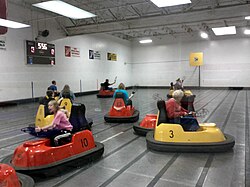
Amateur whirlyball game in progress

The game

[edit]

A WhirlyBall team consists of five players. Players rides a Whirlybug and carries a scoop, with which to pass the ball, usually a Wiffle ball, or shoot at the goal, a circular target above the two opposite ends of the court. A score in Whirlyball is called a "Whirlic".

Players are not allowed to leave their cars or to touch the ball with their hands. Other than that, almost anything is allowed, within certain bounds of safety, e.g., one is not allowed to ram a player from behind (four-point penalty).

The scoops provided for recreational use are manufactured by Mangum's company, Flo-Tron Enterprises, while many players at the national level prefer to use a Trac Ball scoop due to the lighter weight. In order to use a Trac Ball scoop, players must use an industrial-strength heat gun to mold the scoop to fit the ball.

Game origins and rules

[edit]

The game was first invented in Utah in the 1960s by Stan Mangum. Whirlyball is a sport that combines lacrosse, bumper cars, and some aspects of basketball.[1] It features two teams of five players riding Whirlybugs, which are specialized bumper cars that offer more agility and steering ability.

The game is played on a court that allows for movement in the Whirlybugs, with the goal of players scoring the ball by making it into a target found on a backboard. The Chicago area of Illinois is a prominent area for whirlyBall enthusiasts and features many possible venues for players to try their hand at this game.[citation needed] Other whirlyball locations include Canada, Colorado, Florida, Kansas, Michigan, Minnesota, Ohio, Texas, Washington and Wisconsin, with Illinois and Minnesota being the states that have multiple locations. The only restriction that the sport of whirlyball has is the height of the players. In order to be eligible to play whirlyball the players must stand at the height of four feet, six inches or taller. Players shorter than this height are prohibited from playing this sport. According to Flo-tron Enterprises, Inc., the sole company that makes whirlyBall products and the Whirlybug, the game is meant to be a competitive team sport that can be played at any level.[2][unreliable source?] The highest level played in whirlyball is the international level.

Whirlybug

[edit]

A Whirlybug is similar to an electric bumper car. It is round, with a bumper going all the way around. Unlike most bumper cars, however, power is not provided by an overhead grid, but rather by alternating conducting plates that make up the floor of the court.[3] Whirlybugs are more complex than traditional bumper cars, but this is necessary, as an overhead grid would obstruct play. A Whirlybug is steered by a handle that looks like a crank. This handle allows steering not just side to side, but also backwards.[4]

One of the downsides to a Whirlybug's controls is the difficulty beginners will almost certainly have with them. One reason is that there is technically no reverse, which can make for an extremely difficult situation for a beginner who has run into a wall. A player must apply the throttle as they are twisting the handle in either direction. After a single rotation, the drive train reverses, and the car moves away from the wall. More experienced players may simply twist the crank a single time and then apply the throttle. The other problem with steering is that Whirlybugs often do not center the crank automatically, making it difficult for beginners to recover from a very tight turn or from "reverse". Once the particulars of the steering are learned—usually in one or two games—the controls tend to be easy to use.

Terminology

[edit]
  • Whirlic: A score in whirlyball is two points.
  • Power Shot: Comparable to a lay-up in basketball.
  • Slashing: Hitting an opponent scoop while going for the ball. In league play there is a two-point penalty.
  • Pillow Block: Driving the Whirlybug into an opponent's bumper and attempting to slow them down by remaining there.
  • Roll-Off: While contacting an opponent's bumper, player does a 360-degree roll-off turn and continues momentum.
  • Wall Bouncing: Running into the wall and spinning around to advance oneself or lose an opponent.
  • Bounce Passing: Bouncing the ball off the floor while passing it to a teammate.
  • The Back Door: The area to the side of the key where people frequently lurk to make a quick move to the basket.
  • Key: The area directly under the basket and is similar to basketball.
  • Dirty Whirly: Bumping an opponent from behind causing them to do a 180-degree turn around and continue backwards.

Popularity

[edit]

Whirlyball is played as a competitive sport with organized leagues, but it is more commonly played for entertainment. Many whirlyball locations have a sports bar atmosphere, offering billiards and other tabletop games to play between matches.

References

[edit]
[edit]
Revisions and contributorsEdit on WikipediaRead on Wikipedia
from Grokipedia
Whirlyball is a mechanized that combines elements of , hockey, , and , in which players drive small electric vehicles called WhirlyBugs while using handheld scoops to pass and shoot a whiffle ball into elevated goals with 16-inch openings resembling backboards. Invented in the early 1960s in , , by Stan Mangum, the game originated from an idea sparked when his teenage son Kim accidentally hit a with a stick while riding a , leading to the development of a hybrid activity blending vehicular maneuvering with ball-handling skills. The commercial pursuit of Whirlyball began in 1979, with Mangum engineering durable, battery-powered WhirlyBugs capable of 360-degree steering and a maximum speed of 4 miles per hour, designed to withstand collisions without the hazards of traditional . Games are typically played in teams of five on a 4,000-square-foot enclosed rink, where players must adhere to rules prohibiting hand contact with the outside the vehicle, ramming opponents at high speeds, or unsafe handling, with penalties ranging from point deductions to fines for damages. Scoring occurs by propelling the into the opponent's color-coded backboard—two points for standard shots and three for those taken from behind a designated line—with possession switching after each goal and time limits on ball advancement to maintain pace. The sport emphasizes , , and controlled chaos, often described as "the world's only totally mechanized ." Whirlyball gained popularity in the 2000s as a corporate team-building activity, with facilities across the and hosting events for companies like and ; as of the mid-2000s, this contributed to annual revenue growth of about 15% through bookings that accounted for 80% of facility usage. Today, venues pair the game with dining, , and other amusements, appealing to groups for social events while maintaining its core appeal as a high-energy, skill-based diversion limited to speeds of 4 for safety.

Gameplay

Objective and Rules

Whirlyball is a competitive in which two teams of up to five players each maneuver electric-powered Whirlybugs—bumper car-like vehicles equipped with plastic scoops—to throw a 16-inch into the opponent's goal, an elevated backboard featuring a circular opening, while defending their own. The core objective is to score more points than the opposing team by accurately launching the ball through the goal, combining elements of , hockey, and in a fast-paced, contact-allowed environment limited to vehicle bumping. Games are structured as timed matches lasting 15 to 30 minutes of continuous play, often divided into multiple periods in league formats, with a running clock and no timeouts during casual sessions. In tournaments, play may continue until a team reaches a target score, though most recreational games end at the time limit regardless of score; is rare in non-competitive play but can include shootouts for ties in organized events. After each goal, possession immediately turns over to the opposing team to maintain flow. Fundamental rules require all players to remain seated in their Whirlybugs with seatbelts fastened throughout the game, using only the attached scoops to handle, pass, or shoot the ball—no contact with hands, feet, or any body part is permitted, and the ball must not touch the player or vehicle except via the scoop. Vehicle-to-vehicle bumping is allowed for defense and positioning, but excessive ramming, head-on collisions, or physical contact between players incurs fouls; penalties for violations like leaving the vehicle, , or improper ball handling award 1 to 8 points to the non-offending team based on severity. Additional regulations include possession limits—a 20-second hold per player, a 30-second team (reduced in final minutes), and a 5-second rule to clear the goal area—to prevent delays, with turnovers enforced for non-compliance. Goals score two points for standard shots and three points for shots taken from behind the half- line, emphasizing precision over power in a confined court space. Teams field a maximum of five players, often including one player defending the goal while others focus on offense and midfield play, with substitutions allowed only during stoppages like scores or penalties to keep the game dynamic.

Court Layout

The standard Whirlyball court is a rectangular enclosed arena measuring 80 feet in length by 50 feet in width, providing approximately 4,000 square feet of playing space. The court is fully enclosed by 10-foot-high walls fitted with padded bumpers to contain the WhirlyBugs and the plastic ball while absorbing impacts from collisions. The floor is constructed of smooth panels that are electrified with low-voltage current, typically 24 to 28 volts, to power the vehicles without posing risks to players who may dismount. A half-court line runs parallel to the end walls, dividing the space for rule enforcement such as possession and shot clocks. The court design eliminates traditional out-of-bounds areas, with play confined entirely by the padded walls except for the goals at each end. Each consists of a circular opening 15 inches in diameter, centered on the end wall's backboard and elevated for targeting, surrounded by protective netting that electronically registers scores upon contact. While official courts adhere to the 80-by-50-foot standard, some recreational venues utilize slightly smaller layouts to fit available space, though these maintain the core enclosed and padded structure. Safety features emphasize collision mitigation, including the padded walls, vehicle safety belts, and low-speed operation limits, with referees monitoring from an elevated position to enforce boundaries and prevent injuries.

Strategies

Offensive strategies in Whirlyball center on coordinated ball movement and positioning to create scoring opportunities. Players pass the between teammates using the plastic scoops while simultaneously driving their WhirlyBugs to maintain possession and advance toward the target. Effective passing mimics a precise, dart-like motion to ensure accuracy amid the constant motion of the vehicles, allowing teams to set up shots from optimal distances for higher point values, such as three points from beyond the designated line. Teams exploit the fixed speed of the WhirlyBugs—capped at 4 —to outmaneuver defenders by circling or feinting directions, creating openings for clear shots at the backboard target. Defensive strategies emphasize disruption and protection of the area without violating contact rules. Defenders use the body of their WhirlyBug to block incoming shots or intercept passes by positioning strategically in passing lanes, leveraging the vehicles' maneuverability for quick adjustments. Side-on bumping is permitted to jostle opponents and dislodge the ball, but head-on or rear collisions draw penalties, requiring players to time contacts carefully to avoid infractions like aggressive hits. Near the target, a dedicated defender often shadows the area to prevent easy shots, while the as a whole maintains a compact formation to limit offensive space. Team coordination is essential for success, with players specializing in roles such as offensive forwards focused on scoring and defensive blockers prioritizing disruption. Communication enables plays like give-and-go maneuvers, where a player passes to a teammate and immediately repositions for a return pass to evade coverage. During penalties, such as those for slashing or delay of game, the opposing team gains a advantage, allowing numerical superiority to press the attack or tighten defense. Common techniques include utilizing the court's walls for ball rebounds to redirect shots unexpectedly and intentionally missing a scoop ("wiffing") to fake passes and draw defenders out of position. Skill development prioritizes precise vehicle control—such as mastering 360-degree turns with the steering handle—and scoop accuracy over physical athleticism, as the game's design levels the playing field regardless of speed or strength. Elite players, as seen in competitive leagues, refine these elements for national-level play, emphasizing tactical precision over brute force.

Equipment

Whirlybug Design

The Whirlybug is the central vehicle in Whirlyball, a compact, electric-powered cart designed for agile movement on the playing court while enabling players to handle and propel a . Invented by Stan Mangum in the early 1960s in as part of the sport's development, it draws inspiration from but incorporates specialized engineering for team-based gameplay. Key features of the Whirlybug include a maximum speed of 4 miles per hour to maintain balanced play and safety, with controls consisting of a foot pedal for acceleration and a joystick-like crank for steering that allows 360-degree maneuverability, including forward, reverse, and pivoting motions. The vehicle is equipped with a hand-held plastic scoop resembling a jai alai cesta, held in the player's free hand to catch, pass, and shoot the ball, facilitating precise ball handling during navigation. Its padded exterior and low center of gravity support controlled bumping between players, essential for defensive strategies without excessive risk. The Whirlybug's construction emphasizes durability and impact resistance, with a robust frame capable of withstanding repeated collisions on the enclosed . Power is supplied via a low-voltage electrified floor system, an innovation by Mangum that eliminates overhead grids or onboard batteries in standard models, ensuring reliable operation without trailing cables or fumes; early prototypes included battery-powered versions. Each unit seats a single player, promoting individual control within team dynamics. Safety is integrated through built-in bumpers around the perimeter, a that must remain fastened during play (violation incurs penalties), and the vehicle's inherent stability to prevent tipping. Regular maintenance involves inspections of the electrical contact points, steering mechanisms, and structural integrity to comply with official standards, with no player modifications permitted to preserve uniformity and . Since its inception, the Whirlybug's has remained largely unchanged, with minor post-1960s updates focused on enhancing material durability and refining the electrified power transfer for longer-lasting performance in commercial venues. This stability has allowed seamless integration with Whirlyball courts, where the vehicle's maneuverability supports fluid ball handling and strategic positioning.

Protective Gear

Players in Whirlyball must wear safety belts provided with the Whirlybugs to secure themselves during , preventing ejection during collisions or turns. This requirement ensures players remain in their vehicles at all times unless directed otherwise by a , minimizing risks from the high-contact nature of the . Eye are recommended and available at some venues to enhance ball visibility and protect against potential impacts from the . The low-speed operation of Whirlybugs, capped at 4 mph, reduces the severity of collisions, but the combination of vehicle bumping and fast-moving balls necessitates these basic safety measures to guard against head, face, and body injuries. Venues typically provide the essential safety belts, while players are encouraged to consider additional personal protection like padded clothing if they have concerns about contact, though no standardized mandatory gear beyond seatbelts is universally enforced across facilities.

History

Invention and Early Development

Whirlyball was invented in 1962 by Stan Mangum, an automotive shop owner in , who drew inspiration from observing his son Kim playfully striking a tin can with a stick while goofing around in a at the shop. This sight prompted Mangum to conceptualize a blending elements of , , and , where players would maneuver in small, agile vehicles to score goals. As Mangum later reflected, "It struck me that hockey had been played on horses, on elephants, on skates—but it had never been played from a ." Early prototypes emerged from Mangum's workshop experiments in the mid-1960s, utilizing modified go-kart-like vehicles initially powered by gas and battery systems for gas-free operation attempts. These initial tests involved informal play sessions in Salt Lake City-area facilities, where participants adapted standard polo mallets for ball handling amid vehicle collisions. The designs prioritized agility and safety, evolving from basic bumper car modifications into the foundational Whirlybug vehicles. Development faced significant challenges, particularly in stabilizing the vehicles for precise control during high-speed maneuvers and ensuring consistent power without regulatory issues or player discomfort. Mangum, already holding for other inventions, iterated on to avoid the and fumes of engines, conducting trial-and-error adjustments through local recreational groups. No formal for the full game concept was filed in the , as focus remained on practical prototyping rather than legal protection. Whirlyball's creation coincided with the surge in novelty sports during the 1960s, exemplified by the popularity of roller derby, which emphasized spectacle and physicality in emerging entertainment venues.

Commercialization and Expansion

Flo-Tron Enterprises was founded in 1979 in Salt Lake City, Utah, by Kim Mangum, marking the beginning of formalized commercialization efforts for Whirlyball, transitioning the concept from informal invention to a structured business venture focused on equipment development and game standardization. The company, led by members of the Mangum family, secured a trademark for "Whirlyball" in 1982, protecting the name for amusement park apparatus including specialized equipment sold as a unit. Early efforts included engineering the Whirlybug vehicles for durability and 360-degree maneuverability, developing battery-powered prototypes such as a set of 12 machines provided to Walt Disney for evaluation in Anaheim, California, and innovating the low-voltage electrified floor to replace earlier gas and battery systems plagued by fumes and recharging issues. Commercial expansion accelerated through a model, with the first licensed venue opening in 1987 in , under operator Rick Morad, who secured exclusive rights within a 10-mile radius. Flo-Tron sold geographic licenses for Whirlyball equipment and operations, enabling operators to establish venues that integrated the sport with food and beverage services, arcade games, and complementary activities like to drive revenue. By the early , growth continued with the opening of a prominent facility in , in 1993, which served as a flagship for further Midwest expansion and helped popularize the sport in urban markets. The saw the network expand to over a dozen U.S. locations, reaching approximately 19 centers across the and by 2006. The business model emphasized high-investment venues, with setup costs ranging from $700,000 to $1 million per site to accommodate courts, equipment, and amenities, positioning Whirlyball as a corporate team-building and entertainment destination. International efforts included limited entries into , though success remained concentrated in . Challenges arose from liability risks inherent to motorized gameplay, prompting enhancements such as the shift from gas-powered Whirlybugs—which caused indoor ventilation issues—to electric models for better player comfort and reduced hazards. Economic downturns in the further strained growth, leading to renovations and operational adjustments at existing sites to sustain the roughly two dozen centers operational by the early , rather than aggressive new openings. As of 2024, there are approximately 8 venues remaining in .

Popularity

Venues and Facilities

As of 2025, Whirlyball operates approximately 12 active facilities across the , primarily concentrated in the Midwest and select other regions. These include multiple locations in the , such as the original site in , established in 1993 (now closed), along with Naperville and Vernon Hills in ; Brookfield in ; in ; in ; the Twin Cities area (Bloomington and Maple Grove) in ; and in Washington. Each venue typically features one to two indoor courts designed for the game, often integrated into larger entertainment complexes. Whirlyball facilities are indoor arenas equipped with standard court setups, including padded walls and scoring systems, and are commonly paired with adjacent lounges, dining areas, and additional amenities like bowling lanes or arcade games to facilitate events. Pricing generally ranges from $25 to $40 per player per game, with court rentals billed hourly (around $179 to $229 for 8-15 players, accommodating four 15-minute games per hour), and venues are accessible to the public, group outings, and corporate bookings for team-building or parties. Internationally, Whirlyball's presence remains limited, with a few operational sites in , such as The E Zone in , which offers the game alongside other activities, but no permanent facilities in as of 2025 despite occasional pilot programs. Following temporary closures during the 2020 , Whirlyball venues recovered by implementing enhanced hygiene protocols, including increased sanitization of equipment and courts, which supported a return to full operations by late 2020 in core locations. In June 2024, the company filed for subchapter V protection to restructure amid rising costs and effects, but core operations continued. In 2024, Chicago-area sites marked the company's 30th anniversary with events like the "Totally '90s" themed parties across multiple locations and the National WhirlyBall Tournament at Vernon Hills, which drew participants and increased visibility. The 2025 National WhirlyBall Tournament was held in . While some 1990s-era venues, such as those in , , , and , have closed due to rising operational costs and impacts, core markets like and the remain operational despite financial challenges, with ongoing expansions in amenities.

Leagues and Cultural Impact

Whirlyball features regional amateur leagues primarily in major U.S. cities, with organized play centered around 5-on-5 coed adult competitions held multiple times per year. In the Chicago area, leagues such as the Whirlyball Rebels operate at venues in Chicago and Vernon Hills, welcoming players of all skill levels for competitive yet recreational games, while the S3 Simply Social Sports organization runs seasonal Whirlyball leagues in late fall, winter, and other periods. Similar amateur leagues exist in locations like Texas and Cleveland, often hosted by local Whirlyball facilities to foster community engagement. National tournaments remain rare but occur annually, exemplified by the WhirlyBall Nationals held in Vernon Hills, Illinois, in June 2024, marking the sport's 40th anniversary and drawing teams from across the country. Whirlyball has carved a niche in corporate team-building since the early 2000s, with companies adopting it for events that emphasize collaboration and low-pressure competition. Venues offer customizable packages including food, beverages, and audiovisual setups to accommodate groups from small teams to large crowds, promoting skills like communication and strategy in a fun environment. Beyond professional settings, it serves as a popular choice for birthday parties, social outings, and family gatherings, appealing particularly to non-athletes due to its 4-mile-per-hour speed limit and emphasis on enjoyment over physical prowess. Media coverage has highlighted Whirlyball's evolution and appeal, with a 2006 feature describing it as a "corporate game plan" for team development. In 2024, ABC7 Chicago covered the sport's 30th anniversary celebrations at its original Lombard location, noting its growth into a multifaceted staple. The game promotes inclusivity by requiring minimal athletic skill, allowing broad participation while enforcing safety rules such as prohibitions on rear-end collisions to maintain a strong record with few reported incidents. As of 2025, Whirlyball sustains steady niche popularity through ongoing events and expansions, though discussions of e-sports adaptations have not led to implementations.

Terminology

Key Game Terms

In Whirlyball, the scoop is the essential curved plastic tool resembling a small or basket that players use to catch, control, and throw the toward the target. Players must select a scoop from the court wall before play begins, and rules prohibit using it to hit or block opponents aggressively, with violations resulting in penalties. The bump refers to legal vehicle-to-vehicle contact between WhirlyBugs, allowing players to disrupt opponents by jostling their position during active play, though head-on or rear-end collisions are penalized to ensure safety, typically awarding 4 points to the opposing team. Scooping is a foul where a player uses the scoop to hit another player or , resulting in a penalty of 2 points to the opposing team. Ramming occurs when a player drives into an opponent in a head-on or manner, penalized with points to the opposing team and potential player removal for repeated offenses.

Player Roles

In competitive Whirlyball leagues, teams consist of five players each, often with specialized roles emphasizing coordination between offense and defense while maneuvering in WhirlyBugs. The ie is stationed near the , primarily responsible for blocking incoming shots using extended reach and positioning to prevent scoring, often leveraging height advantages for effective coverage. The three forwards operate as the offensive core, advancing the through passing and positioning for shots on the opponent's goal, handling the majority of ball movement and scoring attempts across the . These players must balance speed, accuracy in wrist shots, and numerical superiority to outmaneuver defenses, requiring patience and precise car control during plays. Supporting the goalie, the single defender shadows opposing forwards, intercepting passes and using tactical bumps or blocks to disrupt offensive momentum while focusing on defensive responsibilities. This position aids in slowing attackers and maintaining defensive structure, often employing blocks to control space without excessive contact. The captain serves as a leader, directing on-court calls, strategy adjustments, and team communication, typically among experienced players to ensure adaptive decision-making during games. Substitutes function as bench players who enter the game to relieve fatigued teammates, assuming an assigned role upon substitution. They help sustain team performance over multiple periods, with entries managed between plays to minimize disruptions.

References

Add your contribution
Related Hubs
User Avatar
No comments yet.