

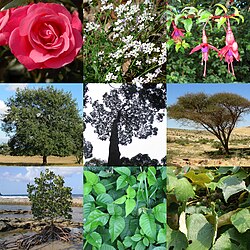

Rosids
View on Wikipedia
| Rosids Temporal range:
| |
|---|---|

| |
| Various modern rosid species | |
Scientific classification 
| |
| Kingdom: | Plantae |
| Clade: | Tracheophytes |
| Clade: | Angiosperms |
| Clade: | Eudicots |
| Clade: | Superrosids |
| Clade: | Rosids |
| Orders[1] | |
The rosids are members of a large clade (monophyletic group) of flowering plants, containing about 70,000 species,[2] more than a quarter of all angiosperms.[3]
The clade is divided into 16 to 20 orders, depending upon circumscription and classification. These orders, in turn, together comprise about 140 families.[4]
Fossil rosids are known from the Cretaceous period. Molecular clock estimates indicate that the rosids may have originated in the Aptian or Albian stages of the Cretaceous, between 125 and 99.6 million years ago.[5][6]
Today's broadleaved forests are dominated by rosid species, which in turn help with diversification in many other living lineages. Additionally, rosid herbs and shrubs are a significant part of arctic/alpine and temperate floras. The clade also includes some aquatic, desert and parasitic plants.[7]
Name
[edit]The name is based upon the name "Rosidae", which had usually been understood to be a subclass. In 1967, Armen Takhtajan showed that the correct basis for the name "Rosidae" is a description of a group of plants published in 1830 by Friedrich Gottlieb Bartling.[8] The clade was later renamed "Rosidae" and has been variously delimited by different authors. The name "rosids" is informal and not assumed to have any particular taxonomic rank like the names authorized by the ICBN. The rosids are monophyletic based upon evidence found by molecular phylogenetic analysis.[citation needed]
Relationships
[edit]The rosids and Saxifragales form the superrosids clade.[2][9] This is one of three groups that comprise the Pentapetalae (core eudicots minus Gunnerales),[10] the others being Dilleniales and the superasterids (Berberidopsidales, Caryophyllales, Santalales, and asterids).[9]
Classification
[edit]Three different definitions of the rosids were used. Some authors included the orders Saxifragales and Vitales in the rosids.[11] Others excluded both of these orders.[9] The circumscription used in this article is that of the APG IV classification, which includes Vitales, but excludes Saxifragales.[1]
Thus, the rosids consist of two groups: the order Vitales and the eurosids. The eurosids, in turn, are divided into two groups: fabids (Fabidae, eurosids I) and malvids (Malvidae, eurosids II).[1]
Orders
[edit]The rosids consist of 17 orders. In addition to Vitales, there are eight orders in fabids and eight orders in malvids. Some of the orders have only recently been recognized.[9] These are Vitales,[12] Zygophyllales,[13] Crossosomatales,[14] Picramniales,[15] and Huerteales.[16]
Phylogeny
[edit]The phylogeny of rosids shown below is adapted from the Angiosperm Phylogeny Website.[9]
The nitrogen-fixing clade contains a high number of actinorhizal plants (which have root nodules containing nitrogen fixing bacteria, helping the plant grow in poor soils). Not all plants in this clade are actinorhizal, however.[17]
References
[edit]- ^ a b c Angiosperm Phylogeny Group (2016). "An update of the Angiosperm Phylogeny Group classification for the orders and families of flowering plants: APG IV". Botanical Journal of the Linnean Society. 181 (1): 1–20. doi:10.1111/boj.12385.
- ^ a b Wang, Hengchang; Moore, Michael J.; Soltis, Pamela S.; Bell, Charles D.; Brockington, Samuel F.; Alexandre, Roolse; Davis, Charles C.; Latvis, Maribeth; Manchester, Steven R.; Soltis, Douglas E. (10 March 2009), "Rosid radiation and the rapid rise of angiosperm-dominated forests", Proceedings of the National Academy of Sciences, 106 (10): 3853–8, Bibcode:2009PNAS..106.3853W, doi:10.1073/pnas.0813376106, PMC 2644257, PMID 19223592
- ^ Scotland, Robert W.; Wortley, Alexandra H. (2003), "How many species of seed plants are there?", Taxon, 52 (1): 101–4, Bibcode:2003Taxon..52..101S, doi:10.2307/3647306, JSTOR 3647306
- ^ Soltis, Douglas E.; Soltis, Pamela S.; Peter K. Endress; Mark W. Chase (2005), Phylogeny and Evolution of the Angiosperms, Sunderland, Massachusetts, US: Sinauer, ISBN 978-0-87893-817-9
- ^ Davies, T.J.; Barraclough, T.G.; Chase, M.W.; Soltis, P.S.; Soltis, D.E.; Savolainen, V. (2004), "Darwin's abominable mystery: Insights from a supertree of the angiosperms", Proceedings of the National Academy of Sciences, 101 (7): 1904–9, Bibcode:2004PNAS..101.1904D, doi:10.1073/pnas.0308127100, PMC 357025, PMID 14766971
- ^ Magallón, Susana; Castillo, Amanda (2009), "Angiosperm diversification through time", American Journal of Botany, 96 (1): 349–365, doi:10.3732/ajb.0800060, PMID 21628193
- ^ Folk, Ryan A.; Sun, Miao; Soltis, Pamela S.; Smith, Stephen A.; Soltis, Douglas E.; Guralnick, Robert P. (March 2018). "Challenges of comprehensive taxon sampling in comparative biology: Wrestling with rosids". American Journal of Botany. 105 (3): 433–445. doi:10.1002/ajb2.1059. hdl:2027.42/143800. ISSN 0002-9122. PMID 29665035.
- ^ Reveal, James L. (2008), "A Checklist of Family and Suprafamilial Names for Extant Vascular Plants", Home page of James L. Reveal and C. Rose Broome
- ^ a b c d e Stevens, Peter F. (2001), Angiosperm Phylogeny Website
- ^ Cantino, Philip D.; Doyle, James A.; Graham, Sean W.; Judd, Walter S.; Olmstead, Richard G.; Soltis, Douglas E.; Soltis, Pamela S.; Donoghue, Michael J. (2007), "Towards a phylogenetic nomenclature of Tracheophyta" (PDF), Taxon, 56 (3): 822–846, doi:10.2307/25065865, JSTOR 25065865, archived from the original on July 5, 2008
- ^ Burleigh, J. Gordon; Hilu, Khidir W.; Soltis, Douglas E. (2009), "Inferring phylogenies with incomplete data sets: a 5-gene, 567-taxon analysis of angiosperms", BMC Evolutionary Biology, 9 (1), File 7: 61, Bibcode:2009BMCEE...9...61B, doi:10.1186/1471-2148-9-61, PMC 2674047, PMID 19292928
- ^ Reveal, James L. (1995), "Newly required suprageneric names in vascular plants", Phytologia, 79 (2): 68–76 See p. 72
- ^ Chalk, L. (1983), "Wood structure", in Metcalfe, C.R.; Chalk, L. (eds.), Wood Structure and Conclusion of the General Introduction, Anatomy of the Dicotyledons, vol. II (2nd ed.), Clarendon Press, pp. 1–51 [1-2 by C. R. Melcalfe], ISBN 978-0-19-854559-0
- ^ Kubitzki, Klaus, ed. (2007), "Introduction to Crossosomatales", Flowering Plants. Eudicots: Berberidopsidales, Buxales, Crossosomatales, Fabales p.p., Geraniales, Gunnerales, Myrtales p.p., Proteales, Saxifragales, Vitales, Zygophyllales, Clusiaceae Alliance, Passifloraceae Alliance, Dilleniaceae, Huaceae, Picramniaceae, Sabiaceae, The Families and Genera of Vascular Plants, vol. IX, Springer, ISBN 978-3-540-32219-1
- ^ Hutchinson, John (1979) [1973], The Families of Flowering Plants (3rd ed.), Oxford University Press, ISBN 9783874291606
- ^ Worberg, Andreas; Alford, Mac H.; Quandt, Dietmar; Borsch, Thomas (2009), "Huerteales sister to Brassicales plus Malvales, and newly circumscribed to include Dipentodon, Gerrardina, Huertea, Perrottetia, and Tapiscia", Taxon, 58 (2): 468–478, Bibcode:2009Taxon..58..468W, doi:10.1002/tax.582012
- ^ Wall, Luis Gabriel (2000), "The actinorhizal symbiosis", Journal of Plant Growth and Regulation, 19 (2): 167–182, Bibcode:2000JPGR...19..167W, doi:10.1007/s003440000027, hdl:11336/71779, PMID 11038226, S2CID 12887261
External links
[edit] Media related to Rosids at Wikimedia Commons


Rosids
View on GrokipediaOverview
Definition and Scope
The rosids constitute a large monophyletic clade of flowering plants within the eudicots, encompassing approximately 90,000 species and representing about 25% of all angiosperm diversity.[3] This clade is primarily defined by robust molecular evidence demonstrating shared evolutionary ancestry, including sequence similarities in mitochondrial, plastid, and nuclear genes that support its unity as a distinct lineage.[7] The taxonomic boundaries of the rosids are delineated by phylogenetic analyses that consistently recover the group as cohesive, with internal structure comprising several major subclades united by these molecular signatures.[8] Within the broader context of angiosperms, the rosids form one of the two principal clades of core eudicots alongside asterids; superrosids encompass the rosids plus Saxifragales.[9] The core definition of rosids relies on molecular synapomorphies, such as specific gene duplications in MADS-box transcription factors that underpin floral development and diversification patterns unique to this group.[10] These genetic events, occurring early in eudicot evolution, provide key evidence for the clade's monophyly beyond morphological traits.[11] In contemporary taxonomic delimitations, the rosids, recognized in the APG IV classification as including 17 orders and 135 families, comprise fabids and malvids along with basal lineages such as Vitales and the COM clade (Crossosomatales, Oxalidales, Malpighiales, and Celastrales).[9]Significance
The rosids encompass approximately 90,000 species, representing about 25% of all angiosperm diversity, and occupy diverse habitats ranging from tropical rainforests to temperate zones, achieving prominence in temperate and subtropical biomes worldwide.[3][12] This broad distribution enables rosids to drive terrestrial biodiversity patterns, as seen in their prevalence in biomes like broadleaved forests and mangroves, which connect terrestrial and aquatic ecosystems.[13][14] Rosids include numerous economically vital crop plants, such as apples and other fruits from the Rosaceae family in Rosales, beans and legumes from Fabaceae in Fabales, and cotton from Malvaceae in Malvales, which collectively support global agriculture and fiber production.[13] Furthermore, species like Arabidopsis thaliana from Brassicaceae in Brassicales serve as foundational model organisms for genetic research, facilitating advances in plant developmental biology and genomics.[2] In ecosystems, rosids play a pivotal role as foundational species, often forming the structural backbone of forests and wetlands, while their extensive floral diversity supports complex pollination networks involving insects, birds, and other animals.[4][13] For instance, many rosid families exhibit specialized floral traits that promote entomophily, enhancing biodiversity through mutualistic interactions with pollinators.[15] The scientific significance of rosids lies in their utility for studying eudicot evolution, bolstered by high species sampling in genomic projects that reveal patterns of diversification, polyploidy, and adaptive radiation across this clade.[16][17] These resources have enabled detailed phylogenomic analyses, providing insights into ancient whole-genome duplications and the origins of core eudicot lineages.[18]Taxonomy
Etymology
The term "rosids" designates a major monophyletic clade within the eudicots, informally named in the Angiosperm Phylogeny Group (APG) II classification system of 2003 to reflect phylogenetic relationships revealed by molecular data. This nomenclature built upon the pre-existing subclass name "Rosidae," adapting it to an unranked clade in the shift from morphology-based to DNA-supported taxonomy. The subclass Rosidae was originally established by Armen Takhtajan in 1967 as part of his phylogenetic system of flowering plants, grouping diverse dicotyledonous orders unified by shared traits such as polypetalous corollas and specific gynoecial features, with Rosales as a core order. Later systems, like Arthur Cronquist's 1981 classification, retained Rosidae as a subclass encompassing about 18 orders and over 60,000 species, emphasizing its centrality in dicot diversity. Linguistically, the prefix "ros-" traces to the Latin rosa, the classical word for "rose," which itself derives from ancient Greek rhódon (ῥόδον), likely borrowed via Old Persian warda into Indo-European languages, symbolizing the flower's cultural and botanical prominence. In early taxonomy, this root highlighted the order Rosales, named after the family Rosaceae (the roses), whose hypanthium-bearing flowers and drupaceous or pomaceous fruits exemplified the group's morphological archetype. The ending "-idae" follows the International Code of Nomenclature for algae, fungi, and plants (ICN), which mandates this suffix for subclass names to denote hierarchical groupings derived from a principal taxon. As molecular phylogenetics advanced in the late 20th century, the APG consortium repurposed "rosids" (lowercase to indicate informality) in 2003 to describe the clade's eurosid and malvid subclades, moving away from rigid ranks while preserving the historical nod to rose-centered classifications. This evolution underscores the transition from Linnaean hierarchies to cladistic nomenclature, where clade names like "rosids" prioritize monophyly over traditional boundaries.Historical Development
The concept of rosids originated in early 19th-century botanical classifications, where Augustin Pyramus de Candolle grouped plants with rose-like flowers and fruits into the order Rosales as part of his natural system, emphasizing shared morphological traits such as compound leaves and syncarpous ovaries. This grouping, detailed in de Candolle's Prodromus Systematis Naturalis Regni Vegetabilis (starting 1824), built on earlier artificial systems by Linnaeus and Jussieu, incorporating families like Rosaceae, Leguminosae, and Saxifragaceae based on overall similarity rather than strict phylogenetic relationships. Subsequent botanists, including John Lindley and George Bentham, refined these ideas in the mid-19th century, expanding Rosales to include more diverse woody and herbaceous forms while maintaining a focus on floral and fruit structures.[19] By the late 20th century, Arthur Cronquist formalized the subclass Rosidae in his 1981 monograph An Integrated System of Classification of Flowering Plants, encompassing 18 orders and 116 families defined primarily by morphological features such as syncarpous gynoecia with axile placentation, often accompanied by perigynous or epigynous flowers and tricolpate pollen. Cronquist's system, which treated Rosidae as a major dicot subclass parallel to Asteridae, integrated evolutionary principles with phenetic similarities, estimating over 60,000 species and highlighting ecological dominance in temperate regions. This approach contrasted with earlier systems by providing a comprehensive framework that accounted for transitional forms between orders like Rosales and Myrtales.[20][21] In the 1980s, Rolf Dahlgren proposed an alternative hierarchical structure in his revised classification, elevating rosid-like groups to the superorder Rosiflorae within the subclass Rosidae, comprising 12 orders and 38 families such as Fagales, Rosales, and Proteales, with emphasis on chemical and anatomical correlations alongside morphology. Dahlgren's A Revised System of Classification of the Angiosperms (1980) used a multidimensional diagram to illustrate adaptive radiations, incorporating data on secondary metabolites like tannins and flavonoids to support alliances within Rosiflorae.[22][23] The advent of molecular phylogenetics in the 1990s disrupted traditional views, as analyses of plastid genes like rbcL revealed the paraphyly of Cronquist's and Dahlgren's Rosidae, with core rosid lineages nested among non-rosid dicots such as Geraniales and Myrtales. Key studies, including Chase et al.'s 1993 large-scale rbcL survey of over 500 taxa, demonstrated that traditional Rosidae excluded vital clades like Vitales and formed a grade rather than a monophyletic group, prompting the recognition of eurosids I (fabids) and eurosids II (malvids) as informal monophyletic subsets. This shift culminated in the Angiosperm Phylogeny Group's inaugural 1998 classification, which abandoned ranked subclasses for unranked clades and defined rosids as a major eudicot lineage based on combined molecular evidence from rbcL, atpB, and 18S rDNA, encompassing about 70,000 species in 17 orders while excluding paraphyletic elements.[24][25]Current Classification
The current classification of rosids adheres to the Angiosperm Phylogeny Group IV (APG IV) framework, established in 2016, which defines rosids as a monophyletic clade within the core eudicots encompassing approximately 90,000 species across 17 orders.[3] This system recognizes rosids as comprising two primary subclades—fabids (previously eurosids I, including eight orders such as Fabales, Rosales, and Fagales) and malvids (previously eurosids II, including eight orders such as Malvales, Brassicales, and Myrtales)—with Vitales positioned as the sister group to the core rosids.[8] As of 2025, APG IV remains the authoritative standard, with no formal APG V update published, though phylogenomic analyses continue to support this structure with minor refinements in ordinal relationships. Recent phylogenomic studies as of 2023 continue to support this 17-order framework with minor refinements in relationships.[26][27] The delimitation of the rosids clade relies heavily on molecular phylogenetic evidence, particularly from nuclear genes like RPB2 (encoding the second-largest subunit of RNA polymerase II), which has been instrumental in resolving deep eudicot divergences and confirming rosid monophyly through shared sequence patterns and paralog duplications. Additional markers, such as mitochondrial matR sequences, further corroborate the clade's boundaries by distinguishing rosids from adjacent groups like asterids. In APG IV revisions, certain families formerly associated with rosids, such as those in Saxifragales (e.g., Saxifragaceae), were excluded and reassigned to the independent saxifragales clade based on incongruent molecular and morphological data.[28][7][8] The hierarchical structure under APG IV organizes rosids at the top level, subdivided into fabids and malvids, which in turn contain the recognized orders and their constituent families (totaling around 140 families across the clade). This nested arrangement emphasizes monophyly, with fabids often linked by traits like nitrogen-fixing symbioses in some lineages and malvids by mucilage production, though the classification prioritizes molecular phylogeny over morphology.[8][16]List of Orders
The rosids, as defined in the APG IV classification, encompass 17 orders distributed across three main lineages: the basal order Vitales and the two derived subclades known as fabids (formerly eurosids I) and malvids (formerly eurosids II). This structure reflects molecular phylogenetic analyses that resolve rosids as a monophyletic group within the core eudicots, with fabids comprising the largest portion of diversity at approximately 60,000 species. Recent phylogenomic studies using large-scale nuclear gene datasets have largely confirmed this ordinal framework while refining interordinal relationships, particularly supporting the stability of fabid and malvid divisions.[26]Vitales
Vitales serves as the sister group to the fabids-malvids clade, consisting of a single family, Vitaceae, with around 1,000 species primarily of climbing vines and lianas. This order is notable for economically significant members like grapes (Vitis vinifera) and includes genera such as Cissus and Ampelopsis, which are widespread in tropical and temperate regions.Fabids
The fabids include eight orders and represent the most species-rich lineage within rosids, featuring diverse habits from trees and shrubs to herbs and vines. Key orders highlight agricultural importance, such as legumes and fruit-bearing plants.- Zygophyllales: Comprises two families, Zygophyllaceae (around 285 species of herbs and shrubs, including creosote bush, Larrea) and Krameriaceae (guayacán, Krameria, ~70 species of parasitic shrubs).
- Celastrales: Encompasses seven families with about 1,300 species, dominated by Celastraceae (staff trees, ~1,000 species) and including Lepidobotryaceae and Parnassiaceae.
- Oxalidales: Contains five families and roughly 1,000 species, with Oxalidaceae (wood sorrels, Oxalis, ~500 species) as the largest, alongside Connaraceae (climbing shrubs) and Elaeocarpaceae (trees with drupaceous fruits).
- Fabales: Features three families totaling over 24,000 species, led by Fabaceae (legumes, ~19,500 species including beans, peas, and soybeans) and Polygalaceae (milkworts, ~1,000 species).
- Rosales: Includes nine families with about 9,000 species; prominent are Rosaceae (roses, apples, strawberries, ~2,900 species), Moraceae (figs, mulberries, ~1,100 species), and Rhamnaceae (buckthorns, ~900 species).
- Malpighiales: One of the largest orders with 36 families and ~16,000 species, featuring Euphorbiaceae (spurges, ~6,000 species), Passifloraceae (passionflowers, ~750 species), Salicaceae (willows and poplars, ~1,200 species), and Violaceae (violets, ~900 species).
- Cucurbitales: Comprises seven families and ~8,000 species, dominated by Cucurbitaceae (cucumbers, gourds, ~800 species) and Begoniaceae (begonias, ~1,800 species).
- Fagales: Contains eight families with ~1,100 species, including Fagaceae (oaks, beeches, ~1,000 species), Betulaceae (birches, hazels, ~150 species), and Juglandaceae (walnuts, ~60 species).
Malvids
The malvids comprise eight orders with diverse tropical and temperate representatives, emphasizing fiber, fruit, and ornamental plants; Crossosomatales, for instance, has been consistently placed here in post-APG IV phylogenomic analyses.[29]- Geraniales: Includes two families and approximately 900 species, with Geraniaceae s.l. (geraniums and allies, ~800 species) as the largest, and Francoaceae (~100 species).
- Myrtales: Encompasses nine families totaling ~14,000 species, led by Myrtaceae (myrtles, eucalypts, guavas, ~5,500 species) and Melastomataceae (~5,800 species of tropical shrubs).
- Crossosomatales: A small order with seven families and ~60 species of shrubs and small trees, including Crossosomataceae (crossosomas) and Staphyleaceae (bladdernuts).
- Picramniales: Consists of one family, Picramniaceae, with ~50 species of neotropical trees related to Sapindales.
- Sapindales: Features nine families and ~7,000 species, including Sapindaceae (soapberries, lychees, ~1,600 species), Rutaceae (citrus, rue, ~1,600 species), and Anacardiaceae (cashews, sumacs, ~850 species).
- Huerteales: Contains four families with ~150 species, such as Dipentodontaceae and Tapisciaceae, mostly tropical trees.
- Malvales: Includes nine families and ~9,000 species, dominated by Malvaceae s.l. (mallows, cotton, cacao, and former Sterculiaceae, ~4,200 species).
- Brassicales: Comprises 17 families with ~14,000 species, featuring Brassicaceae (mustards, cabbage, ~4,000 species), Capparaceae (capers, ~480 species), and Caricaceae (papayas, ~50 species).