Hubbry Logo
SS Lane VictorySS Lane VictoryMain
Open search
SS Lane Victory
Community hub
SS Lane Victory
logo
8 pages, 0 posts
0 subscribers
Be the first to start a discussion here.
SS Lane Victory
SS Lane Victory
from Wikipedia
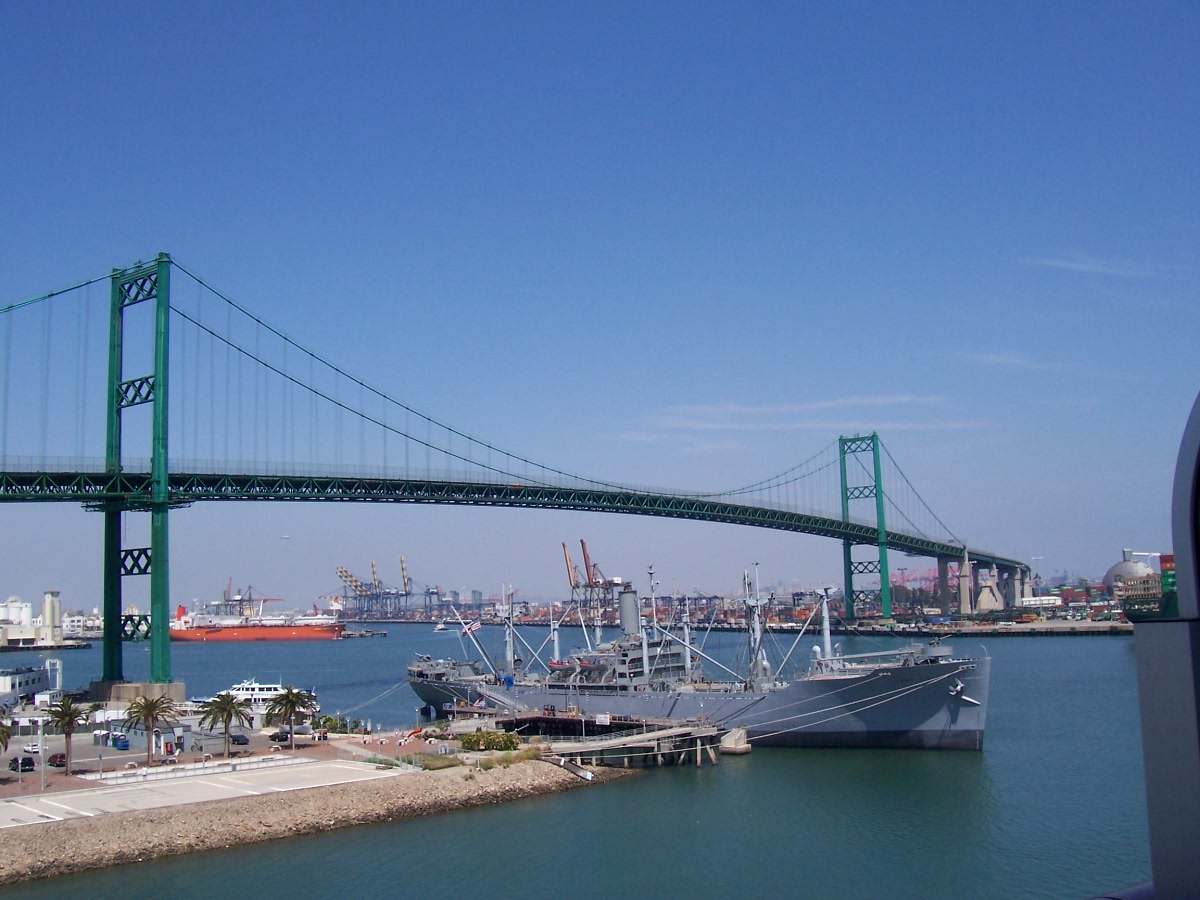
SS Lane Victory at its previous berth by the Vincent Thomas Bridge.
History
United States
NameSS Lane Victory
NamesakeLane College
OwnerAmerican President Lines
OperatorAmerican President Lines
BuilderCalifornia Shipbuilding (Calship)
Launched1945 Los Angeles, California
Maiden voyageJune 27, 1945
In service1945
Home portSan Pedro, California
Identification
StatusMuseum Ship
General characteristics
Class & typeVC2-S-AP2 Victory Ship
Tonnage10,750 long tons deadweight (DWT)
Length455 feet
Beam62 feet
Draft28 feet 6 inches
Propulsion
Speed17 knots
Range23,500 miles
Capacity500,000 cubic feet (approximate)
Complement62 United States Merchant Marine and United States Navy Armed Guard
Armament
Aircraft carriednone
Aviation facilitiesnone
Lane Victory
SS Lane Victory is located in the Los Angeles metropolitan area
SS Lane Victory
SS Lane Victory is located in California
SS Lane Victory
SS Lane Victory is located in the United States
SS Lane Victory
LocationBerth 52, Port of San Pedro, San Pedro, California
Coordinates33°43′02″N 118°16′24″W / 33.71722°N 118.27333°W / 33.71722; -118.27333
Built1945
ArchitectCalifornia Shipbuilding Corporation
NRHP reference No.90002222
Significant dates
Added to NRHP14 December 1990[1]
Designated NHL14 December 1990[2]

SS Lane Victory is an American Victory-class cargo ship used in World War II, the Korean War and Vietnam War. The ship was preserved in 1989 to serve as a museum ship in the San Pedro area of Los Angeles, California. As a rare surviving Victory ship, she was designated a U.S. National Historic Landmark.

SS Lane Victory was named after Lane College, which was established as a high school for black youths in 1882 at Jackson, Tennessee, by Isaac Lane, a bishop of the Colored Methodist Episcopal Church in America.

World War II

[edit]

Lane Victory was built in Los Angeles by the California Shipbuilding Corporation and launched on May 31, 1945. On her first voyage, June 27, 1945, Lane Victory carried war supplies in the Pacific. The War Shipping Administration gave the operations of the ship to the American President Lines. United States Merchant Mariners operated the ship. The United States Navy Armed Guard, who manned the ship's guns, worked as signalmen and radiomen. She made two Pacific cruises, beginning July 10, 1945, to Manus Island, and the second starting August 30, 1945, to Guam, Saipan and Hawaii. The trip to Guam was to bring food to the island. On the way Lane Victory sailed through a typhoon and was tossed around for 14 days. On February 27, 1946, her second voyage ended. With the end of World War II, she started shipping aid. In March 1946 she started delivering goods to Europe under the Marshall Plan. With the end of the aid plan, on May 11, 1948 Lane Victory was laid up at Suisun Bay, California.

Korean War

[edit]

In 1950 Lane Victory was taken out of storage and by October 1950 was back in service. She was then deployed to evacuate Korean civilians and United Nations personnel at Wonsan, North Korea. During December 1950 she evacuated over 3,800 U.S. troops and 1,100 vehicles from Hungnam while under attack during the Battle of Chosin Reservoir. Lane Victory offloaded troops, vehicles and cargo as the cruiser USS Saint Paul and destroyers laid down a covering fire. After unloading she evacuated 7,010 men, women and children, taking them south to safety. When the ship arrived 7,011 passengers disembarked, as a baby had been born during the voyage.[3] On October 10, 1953, she was laid up in Suisun Bay, California, storage.[4] An annual Korean War tribute day is held aboard SS Lane Victory in honor of those saved.

Vietnam War

[edit]

In 1966 the ship was restored to duty again for the Vietnam War. She also saw duty during the conflict moving ammunition and supplies to and from the war zone in Vietnam. On April 29, 1970 Lane Victory was laid up again at Suisun Bay for storage in the National Defense Reserve Fleet.

During her three-war career, she traveled through the Far East Pacific, made a few transatlantic crossings and one circumnavigation of the globe.

Post-war

[edit]

Because of the ship's excellent condition in storage at Suisun Bay, the Maritime Administration decided to set aside Lane Victory for preservation. President Ronald Reagan signed into law H.R. 2032 on October 18, 1988, which turned over the ship to the United States Merchant Marine Veterans of World War II. Joe Vernick, John Smith and a group of Merchant Marine veterans had worked for years for the ship to be released from the Reserve Fleet.

Volunteers from the United States Merchant Marine Veterans of World War II worked for three years to restore the ship to working condition after she had sat, slowly deteriorating, in Suisun Bay for nearly two decades. Many upgrades were performed in order to bring Lane Victory up to Coast Guard standards. She was drydocked in 1992, and her hull was found to be sound. On September 10, 1992, her sea trials started and proved her seaworthy.[5][6]

In May 1994 Lane Victory sailed south along the Baja Peninsula with the intention of joining the Liberty ship SS Jeremiah O'Brien on the 50th Anniversary of D-Day in France. On May 2, 1994, she passed the Sailing Vessel Blythe Spirit about 500 feet off the starboard side according to the day log of S/V Blythe Spirit. This encounter was just north of Cabo San Lucas. Before reaching the Panama Canal the Lane Victory had engine problems that prevented it from going across the Atlantic Ocean in time to arrive for the D-Day Anniversary. It was reported on the Maritime Mobile Service Net later in May that the Victory Ship had chosen to return after repairs were completed to a California port to await the return of the Jeremiah O'Brien.[7]

In June 1994 Lane Victory participated in a mock Normandy invasion in the Santa Barbara Channel in celebration of the 50th anniversary of D-Day. In September 1994 she escorted the Liberty ship SS Jeremiah O'Brien from San Pedro to San Francisco in celebration of Jeremiah O'Brien's return from her voyage to Normandy.

On October 9, 2007, SS Lane Victory received a Special Heritage Award from the World Ship Trust in San Diego.

She serves as a training facility for the Los Angeles County Fire Department, Los Angeles City Fire Department, local law enforcement agencies, FBI, the U.S. Coast Guard and other United States Armed Forces.

  • Of the 534 Victory-class cargo ships completed, only three remain working – SS Lane Victory at Los Angeles, SS American Victory at Tampa, Florida, and SS Red Oak Victory at Richmond, California.

Museum ship

[edit]

After her 1988 acquisition by the U.S. Merchant Marine Veterans of World War II, Lane Victory was towed to the Port of Los Angeles in San Pedro on June 12, 1989. She was turned into a museum and work ship again. In 1990 Lane Victory was designated a National Historic Landmark. A volunteer crew maintain and operate the ship and her two onboard museums. On September 13, 2000, Congress passed Resolution 327,[8] recognizing SS Lane Victory as a representative of the service and sacrifices of the U.S. Merchant Marine to the nation during times of conflict: "Whereas vessels of the United States merchant marine fleet, such as the S.S. LANE VICTORY, provided critical logistical support to the Armed Forces by carrying equipment, supplies, and personnel necessary to maintain war efforts"[9]

In February 2012 she moved from Berth 94 in Los Angeles Harbor by the Vincent Thomas Bridge to Berth 46 in Los Angeles Harbor at the end of Harbor Boulevard-Miner Street, south of the bridge. She was reopened to the public on February 17, 2012.[10][11] She was moved, again, to Berth 49 in early 2013 as Berth 46 was being converted into a future super cruise ship dock.

USGS Satellite picture taken March 29, 2004. SS Lane Victory is now at the near end of the dock on the left side. Berth 49 is to the left of the boat with the zig-zag white wake trail.

Usage in Hollywood

[edit]

Lane Victory has been used in a number of movies, TV shows and commercials because of her excellent working condition.[12] The ship's wakes were used in the 1997 blockbuster movie Titanic for the titular ocean liner's wakes.[13] She also served as the setting for the climax of the comedy film The Pest the same year. Other films in which the ship appeared are: Black Ops (Deadwater) (2008), Flags of Our Fathers (2006), GI Jane (1997), Pearl Harbor (2001), The Thin Red Line (1998), U-571 (2000) and Twin Sitters (1994) (note: this is a partial list)

The ship was featured in Visiting... with Huell Howser Episode 406.[14]

Some TV shows she was featured in are: Alias, Baywatch, California Gold, JAG, Mail Call (episode #70), MacGyver, Murder She Wrote, the National Geographic Channel, NCIS, Port Chicago Mutiny (TV movie), Return of the Pirates (History Channel), Special Ops Mission and Unsolved Mysteries. In the Season 6 King of the Hill episode "Returning Japanese: Part 2" (2002), Cotton is sent back to the U.S. aboard Lane Victory. The History Channel series Mail Call episode 6/04, "Lane Victory", was an hour long episode about the ship and the World War II Merchant Marine,. (note: this is a partial list)

In 1999, the ship was used in a Ford Super Duty commercial and Disney's "Golden Dreams" commercial. (note: this is a partial list)

The ship was also used in the official music video of Alemeda & Doechii's song "Beat A B!tch Up".[15]

The engine housed in Lane Victory's forward hold exhibit space was used as the engine for the fictitious gunboat USS San Pablo in The Sand Pebbles (1966).[16]

Awards

[edit]

Lane Victory earned one ribbon for World War II service, two for Korean War service – United Nations Korea Medal & Republic of Korea Presidential Unit Citation – and one for Vietnam War service.

[edit]

See also

[edit]

References

[edit]
[edit]
Revisions and contributorsEdit on WikipediaRead on Wikipedia
from Grokipedia
The SS Lane Victory is an American VC2-S-AP2 Victory-class cargo ship built during , which served as a vital supply vessel in the Pacific theater of that war, the , and the before being preserved as a fully operational and docked at the in San Pedro, . Constructed by the California Shipbuilding Corporation at in under Maritime Commission hull number V-794, the ship was launched on May 31, 1945, just months before the end of in the Pacific, and named in honor of , a historically institution founded in 1882 in . Her maiden voyage began on June 27, 1945, transporting munitions to Allied forces in the as part of the U.S. Merchant Marine's critical role in sustaining wartime logistics. During the Korean War, the Lane Victory—operated by the American President Lines—played a heroic role in humanitarian efforts, evacuating 7,009 Korean civilians from the port of in December 1950 as part of the amid the Chinese intervention, an operation that saved countless lives during the chaotic retreat of forces. In the , she resumed service in September 1966, delivering cargo to support U.S. and Allied troops until being decommissioned and placed in the Fleet in 1970, after which she was laid up in the at , . Recognized for her excellent condition and historical significance, the ship was acquired in (with preservation efforts beginning in 1982) by the U.S. Merchant Marine Veterans of as a living memorial to the often-overlooked contributions of merchant mariners, who faced high risks to maintain supply lines across three major conflicts. Towed to San Pedro in June 1989, extensive volunteer-led restoration efforts—supported by congressional funding and President —transformed her into a operated by the nonprofit Lane Victory Maritime Center, earning designation as a on December 14, 1990. Today, the SS Lane Victory remains one of only three operational Victory ships in the world, offering public tours, educational programs, and seasonal cruises—such as voyages to Catalina Island with historical reenactments—while also serving as a filming location for movies like Titanic (1997) and various television productions. Her preservation highlights the enduring legacy of the U.S. Merchant Marine, with ongoing maintenance by a dedicated volunteer ensuring her and original features, including wartime armament mounts, are maintained for future generations.

Construction and Design

Building and Launch

The SS Lane Victory was constructed by the California Shipbuilding Corporation (CalShip) at its Terminal Island yard in Los Angeles, California, as part of the United States Maritime Commission's emergency shipbuilding program during World War II. This effort aimed to produce fast, reliable cargo vessels to sustain Allied supply lines amid escalating wartime demands for merchant tonnage. The ship, designated hull number V-794, was one of 534 Victory-class vessels built overall, featuring a standardized VC2-S-AP2 design optimized for rapid prefabricated assembly and higher speed than earlier Liberty ships. Construction began with the on April 5, 1944, reflecting the program's emphasis on by skilled yard workers. The vessel was launched on May 31, 1945, just weeks before the end of in the Pacific, and delivered to the War Shipping Administration on June 27, 1945, for immediate service. As a merchant marine ship, Lane Victory entered operational status upon delivery, without a formal naval commissioning ceremony. The ship was named in honor of , a historically Black institution founded in 1882 in , by Bishop Isaac Lane, a self-educated former enslaved person and fifth bishop of the Colored Methodist Episcopal Church. This naming choice by the Maritime Commission underscored African American contributions to education and the war effort, aligning with a broader practice of honoring U.S. educational institutions through the series.

Specifications and Features

The SS Lane Victory is a VC2-S-AP2 Victory-class , measuring 455 feet 3 inches in , with a beam of 62 feet, a depth of hold of 38 feet, and a loaded draft of 28 feet. Her welded steel hull features a straight raked stem, cruiser stern, and semi-V-shaped bow, with a 70-foot parallel midbody for stability during long ocean transits. Fully loaded, she displaces 15,200 tons, providing a of approximately 10,600 tons for cargo. Compared to the earlier ships, Victory-class vessels like the Lane Victory incorporated improvements such as a fully welded hull and enhanced speed capabilities. Propulsion is provided by a cross-compound, double-reduction geared rated at 6,000 shaft horsepower, driving a single manganese bronze measuring 18 feet 3 inches in with four blades. Two oil-fired boilers generate steam at 525 psi and 750°F, enabling a top speed of 17 knots and a cruising range of approximately 23,500 nautical miles. Engineering redundancies include a double bottom for and , seven watertight bulkheads extending to the main deck, and electric systems for and handling to support extended voyages without frequent calls. The ship has five cargo holds designed for general , with a total capacity of about 500,000 cubic feet, including provisions for ammunition storage in dedicated magazines within the holds. handling is facilitated by three masts equipped with 14 five-ton booms, one 30-ton boom, and one 50-ton heavy-lift boom, along with 12 electric winches, allowing efficient loading of bulk goods, vehicles, and munitions. Hold dimensions vary, with Nos. 3 and 4 measuring 22 feet 4 inches by 36 feet to accommodate larger items. During wartime service, the Lane Victory was armed with one 5-inch/38 caliber gun mounted aft for surface defense, one 3-inch/50 caliber gun forward for anti-aircraft protection, and eight 20 mm Oerlikon cannons distributed along the decks. These weapons, operated by a dedicated Armed Guard detachment, provided defensive capabilities against and while prioritizing the ship's primary role. Crew accommodations supported 62 officers and merchant mariners in the midships house, with berths on the cabin and boat decks for officers and pipe berths on the main deck for enlisted personnel. An additional 28 Armed Guard members were quartered in the poop deckhouse, while a bay on the main deck portside included pipe berths for medical needs. Living facilities featured an oil-burning with ranges, separate areas, and basic amenities suited for prolonged sea duty, emphasizing functionality over comfort to maintain operational efficiency.

Military Service

World War II Operations

The SS Lane Victory, a Victory-class cargo ship, embarked on its maiden voyage on June 27, 1945, departing from Port Hueneme, California, laden with munitions and supplies destined for the Pacific Theater at the war's end. The vessel reached Manus Island in the Admiralty Islands on July 10, 1945, supporting Allied operations in the region amid ongoing hostilities. Its design, featuring a robust steam turbine propulsion system capable of speeds up to 17 knots, facilitated rapid transits across vast Pacific distances despite the logistical challenges of wartime convoys. On August 30, 1945, shortly after Japan's surrender, the ship commenced its second voyage, transporting food and other essential supplies to ports in the western Pacific, including , Saipan, and . This mission encountered severe wartime hazards, including a 14-day that tested the crew's resilience, though the vessel sustained no direct combat damage from potential threats, which had diminished in the late Pacific Theater. These two Pacific cruises underscored the ship's role in sustaining Allied efforts during the transition from combat to postwar stabilization. After completing these missions, the ship was decommissioned and placed in the at , , on May 11, 1948, marking the end of its World War II-era service.

Korean War Operations

Following its post-World War II lay-up, the SS Lane Victory was reactivated in October 1950 to support operations during the . The ship then conducted multiple supply runs, transporting essential cargo from ports on the U.S. West Coast to key Korean harbors such as Pusan and Inchon, helping sustain Allied forces amid the conflict's logistical demands. A pivotal role came during the desperate UN retreat in December 1950, as Chinese forces advanced. The Lane Victory participated in the —also known as the Christmas Eve Exodus—evacuating 7,009 Korean civilians from on December 7, including many women and children fleeing communist advances, under covering fire from U.S. vessels including the USS St. Paul, USS Charles S. Sperry, and USS Zellars; the ship also handled the transport of approximately 3,800 U.S. troops, 1,100 vehicles, and over 10,000 tons of cargo during the operation. This operation, part of the larger east coast withdrawal involving ports like and , saved countless lives under intense combat conditions. In recognition of these evacuation efforts, the SS Lane Victory received the Republic of Korea Presidential Unit Citation. The vessel continued limited service until after the July 1953 armistice, when it was deactivated and placed in lay-up.

Vietnam War Operations

The SS Lane Victory was reactivated in September 1966 and assigned to the Military Sea Transportation Service (MSTS) to support logistics operations during the . As one of approximately 100 Victory-class ships recalled from the , it played a key role in delivering essential across the Pacific. The vessel primarily transported ammunition, general supplies, and other from U.S. West Coast ports to and additional bases in , contributing to the 95% of Armed Forces supplies delivered by MSTS ships during the conflict. These missions involved multiple trans-Pacific voyages, with the ship's original design features—such as its booms and winches—facilitating efficient loading and unloading of hazardous like explosives at busy ports. Operations continued through 1970, navigating hazardous coastal and inland waters where MSTS vessels faced threats from enemy mines, as evidenced by attacks on similar ships like the SS Cuba Victory in 1968. On April 29, 1970, after completing its final voyage, the SS Lane Victory was decommissioned and placed in the . For its participation in these Southeast Asian logistics efforts, the ship's crew qualified for the Merchant Marine Vietnam Service Ribbon, awarded to mariners serving in Vietnamese waters between July 4, 1965, and August 15, 1973.

Post-War Career

Merchant Service

Following , the SS Lane Victory returned to peacetime merchant service under operators such as , engaging in intermittent commercial charters primarily along Pacific trade routes. These voyages involved transporting and general to support reconstruction efforts and commercial trade in and the South Pacific, contributing to the ship's role in the broader post-war economic recovery. In the 1950s and early 1960s, after its reactivation, the vessel continued in commercial operations managed by entities like the Pacific Coast Transport Company, focusing on shipments across trans-Pacific lanes to ports in the . This period included a government-chartered mission in support of the space program, where on August 11, 1960, the ship recovered the from the Discoverer XIII satellite. This marked a shift from wartime to standard merchant marine duties, with the ship handling diverse cargoes in its five holds to meet growing demand for American exports in the region. Such service underscored the Victory-class ships' adaptability to peacetime commerce, though operations were sporadic due to the vessel's intermittent lay-up in reserve fleets between charters. Throughout its merchant career, the SS Lane Victory served under various commercial operators until the late . These journeys highlighted the ship's endurance in networks, traversing the Pacific and beyond to deliver essential goods.

Final Deactivation

Following the end of her service in the , the SS Lane Victory was decommissioned and placed in the at , , on April 29, 1970. As the last operational , she joined hundreds of other inactive merchant vessels maintained by the Maritime Administration for potential national defense needs. To preserve the ship in a state of readiness, standard mothballing procedures were applied as part of her entry into the . These included dehumidification of interior spaces to control at 35-40% and prevent atmospheric , contact preservation through the application of special oils and coatings on machinery and metal surfaces to inhibit rust, and via an impressed electrical current to safeguard the hull against electrolytic in the saltwater environment. The ship's engines and propulsion systems were drained, cleaned, disconnected from service, and treated with preservatives to avoid deterioration, with no operational testing conducted during lay-up. Periodic maintenance was performed by the Maritime Administration to sustain the vessel's seaworthiness and structural integrity while in inactive status. This involved routine inspections, minor repairs, and preservation updates to address environmental threats like and . In recognition of her historical contributions, the 106th U.S. passed H. Con. Res. 327 on , 2000, honoring the service of the U.S. Merchant Marine in wartime and citing the SS Lane Victory as an exemplar of vessels that delivered essential equipment, supplies, and personnel to support the Armed Forces across multiple conflicts. The SS Lane Victory remained inactive in the for over a decade, with no further deployments, until 1982 when the U.S. Merchant Marine Veterans of launched formal acquisition efforts to designate her as a to merchant mariners and Navy Armed Guard personnel. These initiatives, supported by congressional advocacy, concluded her period of reserve storage and ended her active operational career.

Preservation and Museum Status

Acquisition and Restoration

In 1988, the SS Lane Victory was selected for preservation from the , where it had been laid up since 1970 in deteriorating conditions. On October 18, President Ronald Reagan signed H.R. 2032 into law, conveying the vessel to the Veterans of World War II, a composed of merchant marine veterans dedicated to honoring their service. This transfer, facilitated by the Maritime Administration, marked the beginning of efforts to transform the ship into a living memorial and operational . Restoration work commenced in 1989 after the ship was towed from near to Berth 94 in the at San Pedro, California. Led by volunteers from the veterans' organization, the project focused on critical repairs to return the vessel to seaworthiness, including a comprehensive overhaul of the boilers, engines, and other machinery to meet modern U.S. Coast Guard standards. In 1990, the ship underwent dry-docking for extensive hull repairs to address corrosion and structural wear accumulated during years of inactivity. These efforts were entirely volunteer-driven, relying on donated labor from hundreds of maritime enthusiasts and veterans, as well as fundraising campaigns that gathered thousands of dollars through public donations and events. On December 14, 1990, amid ongoing restoration, the SS Lane Victory was designated a by the U.S. Department of the Interior, recognizing its significance as one of the last surviving operational Victory ships and its role in three major U.S. wars. By 1992, the restoration achieved its goal, with the ship certified seaworthy after three years of intensive work. To commemorate the revival and the veterans' sacrifices, the vessel embarked on its first post-restoration cruise on October 3, 1992, carrying passengers on a "" voyage that highlighted its historical operations.

Current Operations and Recent Developments

The SS Lane Victory operates as a under the management of the Lane Victory Maritime Center, a volunteer-run , at Berth 52 in the , San Pedro, , since March 2022. The vessel serves as a living memorial to the U.S. Merchant Marine and Naval Armed Guard, offering self-guided public tours on Wednesdays and Saturdays from 10 a.m. to 4 p.m., with Sundays available by appointment; docent-led tours can be arranged for groups, emphasizing the ship's historical role in wartime . In addition to public access, the ship functions as a training platform for emergency responders, including fire departments, police teams, K-9 units, and personnel, providing hands-on scenarios for maritime operations. The museum hosts educational programs focused on Merchant Marine history, accommodating school groups, ROTC units, and summer camps through onboard exhibits and demonstrations, while also serving as a venue for over 150 annual events such as weddings, fundraisers, and historical commemorations to generate revenue for preservation. Although the ship has a history of annual cruises to demonstrate its operational capabilities—such as the planned 1994 sail for the D-Day 50th anniversary, which was ultimately aborted due to engine failure—its cruise schedule has been temporarily suspended as of 2025 pending repairs. In 2025, the SS Lane Victory marked its 80th launch anniversary with a major celebration on August 10, integrated into the annual Spirit of '45 event, featuring special exhibits on WWII merchant service, guest speakers including veterans, live performances, classic car displays, and WWII reenactments to honor the ship's legacy. Ongoing restoration efforts included priming and painting work on the bridge and signal decks by mid-2025, aimed at preserving structural integrity, though a 2025 Port of Los Angeles audit highlighted funding shortfalls that have prevented necessary drydocking and limited the ship's ability to maintain full seaworthiness. Volunteers, numbering in the dozens and requiring no prior maritime experience, handle daily operations, maintenance, and event staffing, with the organization facing persistent financial challenges including annual net losses exceeding $200,000 since 2020 and low cash reserves of under $1,000 as of late 2024. To address these, the Maritime Center relies on donations, memberships, and targeted campaigns such as the 2025 Giving Tuesday initiative to fund periodic maintenance and potential reactivation of sailing activities, while the ship remains open to visitors as of November 2025.

Cultural Impact

Usage in Film and Media

The SS Lane Victory has been a popular filming location due to its authentic World War II-era appearance, which suits period dramas and naval scenes. In the 1997 blockbuster Titanic, directed by James Cameron, the ship provided exterior shots for the aftermath of the sinking, including debris-strewn water sequences filmed in its vicinity. It also stood in for U.S. naval vessels during the attack sequences in the 2001 film Pearl Harbor, capturing the chaos of the historical event with its operational deck and rigging. Additional appearances include the comedy The Pest (1997), where the climax unfolds aboard the ship as a hijacked vessel, G.I. Jane (1997), featuring interior and deck scenes during military training sequences, The Thin Red Line (1998), U-571 (2000), and Flags of Our Fathers (2006). On television, the Lane Victory has portrayed various ships in procedural and action series. It appeared in episodes of , serving as a backdrop for beachside rescue operations involving maritime elements, JAG, a military legal drama, for scenes depicting naval investigations and shipboard life, , , Alias, and NCIS: Los Angeles, notably in the 2010 episode "Hunted," where agents conduct operations on a setting. The ship's has historical ties to media, as the triple-expansion engine now exhibited was used for interior shots in the 1966 film The Sand Pebbles, simulating the gunboat USS San Pablo's machinery. The Lane Victory has also appeared in documentaries highlighting its preservation and onboard life. In 1996, it was featured in episode 406 of Visiting... with , where host joined a volunteer on a cruise to explore the ship's restoration and daily operations. Filming activities generate revenue through location fees, which support the ship's maintenance and operations, including dock usage at Berth 94 in San Pedro; these proceeds contribute to preservation efforts without specified public dock fees. As of November 2025, there have been no major new film productions utilizing the ship since 2010, though it continues to host occasional television, commercial shoots, and unnamed filming events in September and October 2025.

Awards and Recognition

The SS Lane Victory received military honors reflecting its service across three major conflicts as a U.S. Merchant Marine vessel. For its operations, the ship qualified its crew for the , awarded to Merchant Mariners for service from December 7, 1941, to July 25, 1947. During the , it earned the United Nations Korea Medal and the Republic of Korea Presidential Unit Citation for participation in designated campaigns and support to forces from June 25, 1950, to July 27, 1953, including its pivotal role in evacuating 7,009 civilians from in December 1950. The vessel also received the for deployments between July 1, 1966, and March 28, 1973. On the civilian front, the Lane Victory has been honored for its enduring contributions to maritime preservation. It was designated a by the on December 14, 1990, acknowledging its status as one of the last operational Victory ships and its historical significance. In 2000, the U.S. passed H.Con.Res. 327, a resolution honoring the ship's logistical support to U.S. forces in wartime, including its transport of equipment, supplies, and personnel during , the , and the . The vessel received the World Ship Trust Special Heritage Award in 2007 for its restoration efforts. Further recognition came in 2012 with the Museum Ship of the Year Award from the Steamship Historical Society of America, celebrating its role as a . No additional formal awards have been bestowed since 2012, though the ship was prominently featured in 2025 events marking its 80th anniversary, including the "Spirit of '45" commemoration.

References

Add your contribution
Related Hubs
User Avatar
No comments yet.