

STS-131
View on Wikipedia
 Canadarm2 grapples the MPLM Leonardo in Discovery's payload bay, prior to berthing | |
| Mission type | ISS logistics |
|---|---|
| Operator | NASA |
| COSPAR ID | 2010-012A |
| SATCAT no. | 36507 |
| Mission duration | 15 days, 2 hours, 47 minutes, 9 seconds[1][2][3] |
| Distance travelled | 10,029,810 kilometres (6,232,235 mi) |
| Orbits completed | 238 |
| Spacecraft properties | |
| Spacecraft | Space Shuttle Discovery |
| Launch mass | 2,051,031 kilograms (4,521,749 lb)[4](total) 121,047 kilograms (266,864 lb) (orbiter) |
| Landing mass | 102,039 kilograms (224,957 lb) |
| Crew | |
| Crew size | 7 |
| Members | |
| Start of mission | |
| Launch date | April 5, 2010, 10:21:22 UTC[5][6] |
| Launch site | Kennedy, LC-39A |
| End of mission | |
| Landing date | April 20, 2010, 13:08:35 UTC |
| Landing site | Kennedy, SLF Runway 15 |
| Orbital parameters | |
| Reference system | Geocentric |
| Regime | Low Earth |
| Perigee altitude | 320 kilometres (200 mi) |
| Apogee altitude | 346 kilometres (215 mi) |
| Inclination | 51.6° |
| Period | 90 minutes |
| Docking with ISS | |
| Docking port | PMA-2 (Harmony forward) |
| Docking date | April 7, 2010, 07:44 UTC |
| Undocking date | April 17, 2010, 12:52 UTC |
| Time docked | 10 days, 5 hours, 8 minutes |

 Seated: James Dutton (left) Alan Poindexter (right), Standing (l-r): Rick Mastracchio, Stephanie Wilson, Dorothy Metcalf-Lindenburger, Naoko Yamazaki (JAXA) and Clayton Anderson | |
STS-131 (ISS assembly flight 19A)[7] was a NASA Space Shuttle mission to the International Space Station (ISS). Space Shuttle Discovery launched on April 5, 2010, at 6:21 am from LC-39A, and landed at 9:08 am on April 20, 2010, on runway 33 at the Kennedy Space Center's Shuttle Landing Facility.[5] The mission marked the longest flight for Space Shuttle Discovery and its 38th and penultimate flight.
The primary payload was a Multi-Purpose Logistics Module loaded with supplies and equipment for the International Space Station. The mission also removed and replaced an ammonia tank assembly outside the station on the S1 truss. STS-131 furthermore carried several on-board payloads; this mission had the most payloads since STS-107. It is also the last shuttle mission with a crew of 7.
Crew
[edit]| Position[8] | Astronaut | |
|---|---|---|
| Commander | Alan Poindexter Second and last spaceflight | |
| Pilot | James Dutton Only spaceflight | |
| Mission Specialist 1 | Richard Mastracchio Third spaceflight | |
| Mission Specialist 2 Flight Engineer |
Dorothy M. Metcalf-Lindenburger Only spaceflight | |
| Mission Specialist 3 | Stephanie Wilson Third spaceflight | |
| Mission Specialist 4 | Naoko Yamazaki, JAXA Only spaceflight | |
| Mission Specialist 5 | Clayton Anderson Second and last spaceflight | |
Notes:
| ||
Crew seat assignments
[edit]| Seat[13] | Launch | Landing |  Seats 1–4 are on the flight deck. Seats 5–7 are on the mid-deck. |
|---|---|---|---|
| 1 | Poindexter | ||
| 2 | Dutton | ||
| 3 | Mastracchio | Anderson | |
| 4 | Metcalf-Lindenburger | ||
| 5 | Wilson | ||
| 6 | Yamazaki | ||
| 7 | Anderson | Mastracchio | |
Mission payload
[edit]Multi-Purpose Logistics Module Leonardo
[edit]The primary payload of STS-131 was the Multi-Purpose Logistics Module (MPLM) Leonardo.[14] The MPLM was filled with food and science supplies for the International Space Station (ISS). The MPLM also carried the third and final Minus Eighty Degree Laboratory Freezer for ISS (MELFI), Window Orbital Research Facility (WORF), one Crew Quarters Rack, the Muscle Atrophy Resistive Exercise (MARES) rack, Resupply Stowage Racks (RSRs), and Resupply Stowage Platforms (RSPs).[15]
Lightweight Multi-Purpose Equipment Support Structure Carrier
[edit]The Lightweight Multi-Purpose Equipment Support Structure Carrier (LMC) carried a refurbished Ammonia Tank Assembly (ATA) to the ISS. The refurbished ATA was removed from the Space Station and returned for use on this mission during STS-128. It was swapped with an empty tank which will ride home on the LMC.[15]

| Location | Cargo | Mass |
|---|---|---|
| Bays 1–2 | Orbiter Docking System EMU 3008 / EMU 3017 |
1,800 kilograms (4,000 lb) ~260 kilograms (570 lb) |
| Bay 4P | Shuttle Power Distribution Unit (SPDU) |
~18 kilograms (40 lb) |
| Bay 7S | ROEU 751A umbilical | 127 kilograms (280 lb) |
| Bays 7–12 | Leonardo (MPLM FM-1) | 12,371 kilograms (27,273 lb) |
| Bay 13 | Lightweight MPESS Carrier (LMC) | 1,764 kilograms (3,889 lb) |
| Starboard Sill | Orbiter Boom Sensor System | 382 kilograms (842 lb) |
| Port Sill | Canadarm | 410 kilograms (900 lb) |
| Total: | 15,332 kilograms (33,801 lb) |
TriDAR
[edit]This mission was the second flight of the TriDAR, a 3D dual-sensing laser camera, intended for potential use as an autonomous rendezvous and docking sensor. TriDAR provides guidance information that can be used to guide a vehicle during rendezvous and docking operations in space. TriDAR does not rely on any reference markers, such as reflectors, positioned on the target spacecraft. To achieve this, it relies on a laser based 3D sensor and a thermal imager. Geometric information contained in successive 3D images is matched against the known shape of the target object to calculate its position and orientation in real-time. The TriDAR tracked the ISS position and orientation from the shuttle during docking, undocking, and flyaround operations.[16]
Mission milestones
[edit]

The mission marked:[17]
- 162nd NASA crewed space flight
- 131st shuttle mission since STS-1
- 38th flight of Discovery
- 33rd shuttle mission to the ISS
- 106th post-Challenger mission
- 18th post-Columbia mission
- 35th and last night launch of a shuttle, 22nd night launch from launch pad 39A
- 2nd "descending node" entry since 2003
Shuttle processing
[edit]Space Shuttle Discovery was moved from its hangar in the Orbiter Processing Facility (OPF) 3 to the nearby Vehicle Assembly Building (VAB) on February 22, 2010.[18][19] The rollover was completed around 10:30 EST. According to NASA, the rollover occurred a day earlier than announced to take advantage of favorable weather in advance of poor conditions forecasted on the next day.[20][21]
An earlier plan to move Discovery into the VAB on February 12, 2010, was delayed because of cold weather at the Kennedy Space Center.[6][22] For the rollover, temperatures in the VAB had to be above 45 °F (7 °C) for more than twelve hours because Discovery was not attached to any heating purges to protect its systems from potential damage from the cold.[23]
Space Shuttle Discovery began its trip, known as the rollout, to LC-39A at 23:58 EST on March 2, 2010. The complete shuttle stack and mobile launcher platform were secured to the LC-39A structure at 6:49 EST on March 3, 2010.[24] The 3.4 mi (5.5 km) trek took 6 hours 51 minutes to complete. The rollout was delayed 24 hours by the threat of lightning from a passing cold front. That weather moved away, and the stiff wind gusts blowing on Florida's Space Coast on the next day were not a factor for the rollout. Ahead of the rollout, engineers noticed some damage caused by birds to the External Tank (ET-135), which was repaired inside the VAB. Birds had managed to reach the tank, and pecked away at the Thermal Protection System (TPS) foam.[25]
-
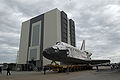 Space Shuttle Discovery rolls toward the Vehicle Assembly Building.
 -
 Space Shuttle Discovery at Launch Pad 39A.
 -
 International Space Station (bottom right) passes over the Cape 15 minutes prior to launch.


Mission timeline
[edit]April 5 (Flight Day 1 – Launch)
[edit]Discovery lifted off successfully at 06:21 EDT, marking this launch as the last night launch in the Space Shuttle program. After the 8 1/2-minute ride to space, Discovery's seven person crew began configuring the orbiter from a launch vehicle to an orbital vehicle. Commander Alan Poindexter and pilot Jim Dutton, with help from mission specialist 2 Dorothy Metcalf-Lindenburger, also performed a series of engine firings or burns to adjust their speed and refine their path to the International Space Station. While the engine burns were going on, the rest of the crew opened the payload bay doors, set up the computers and Ku band antenna. The antenna suffered a failure during normal checkout and setup on orbit.[26] Due to the failure, the normal downlink of imagery of the external tank was not completed.[27] The crew on board will monitor the inspections of the thermal protection system (TPS) in real time and will note any spots of interest and let the ground know while downlinking the imagery after docking.[28] The dish antenna also serves as a radar antenna, measuring the distance to the space station.
-
 The failed Ku band dish antenna
 -
 Discovery lifts off Launch Pad 39A
 -
Launch video (9 min 55 secs)


April 6 (Flight Day 2 – Inspections)
[edit]The seven person crew of STS-131 was awakened to begin their first full day in space on Flight Day 2. Due to the lack of Ku-band communication, changes to the crews daily plan were read up for them to write out. After their post sleep activities, commander Alan Poindexter and pilot Jim Dutton fired Discovery's Orbital Maneuvering System (OMS) engines to correct and further refine the shuttle's path to the ISS. Astronauts Naoko Yamazaki and Dorothy Metcalf-Lindenburger began activating and checking out the Shuttle Remote Manipulator System (SRMS) also known as the Canadarm.[29] While Metcalf-Lindenburger and Yamazaki were working with Canadarm, Stephanie Wilson was getting equipment together and set up to record the inspections of the shuttle's heat shield.[30] The inspections were recorded so they could be downlinked to the ground once docked to the ISS. Once all that work was done, commander Poindexter and pilot Dutton joined Metcalf-Lindenburger, Yamazaki, and Wilson to conduct the inspection of the shuttle's heat shield. While the inspection was going on, Rick Mastracchio and Clayton Anderson were on the mid-deck of Discovery checking out the Extravehicular Mobility Units (EMU) and getting them ready for their three spacewalks. The last portion of the crew day was spent preparing and checking out all of the tools used during rendezvous.
April 7 (Flight Day 3 – Docking)
[edit]Space Shuttle Discovery successfully docked with the space station at 07:44 UTC (03:44 EDT) on April 7, 2010, as the two spacecraft sailed 220 miles above the Caribbean.[31][32] The crew performed six successful engine firings to set up the on-time docking. Prior to docking commander Poindexter guided Discovery through the standard Rendezvous Pitch Maneuver (RPM). Station commander Oleg Kotov and flight engineer T.J. Creamer took more than 350 photos of Discovery's heat shield. Once Discovery docked to the International Space Station (ISS), a series of leak checks were done on both sides of the hatch by the shuttle and station crews. The hatches between the two vehicles were opened at 09:11 UTC (05:11 EDT), which was 30 minutes earlier than planned.[33] Once the hatches were opened the STS-131 crew got a safety briefing from the station crew, then began to transfer items that would be needed for later in the day and early on flight day 4. Two items that were transferred were the two EMUs that will be used for the three spacewalks. The crew also completed a grapple of the Orbiter Boom Sensor System (OBSS) with the Space Station Remote Manipulator System (SSRMS) also known as Canadarm2. Once the OBSS was grappled it was unberthed from the starboard sill of the space shuttle payload bay, and handed off to the SRMS. Throughout the day, after docking to the station, the shuttle crew began downlinking all of the inspection video from flight day 2, and launch imagery and video.
-
 Aft portion of Discovery, including the three main engines, during the RPM.
 -
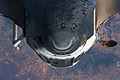 View of the underside of the crew cabin of Discovery during the RPM.
 -
 Discovery approaches the Space Station for docking.
 -
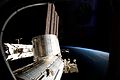 Kibo, photographed by a crew member while Discovery was docked with the station.


April 8 (Flight Day 4 – MPLM ingress)
[edit]On flight day 4, Stephanie Wilson and Naoko Yamazaki grappled and berthed the Multi-purpose Logistics Module (MPLM) Leonardo.[34] The MPLM was berthed to the station at 04:24 UTC (00:24 EDT). The hatches were opened by station flight engineer Soichi Noguchi and shuttle mission specialist Clayton Anderson at 11:58 UTC (07:58 EDT). The joint STS-131/Expedition 23 crews began transferring cargo from the MPLM, with the first item being a Rate Gyro Assembly (RGA) which will be replaced on the first spacewalk of the mission. During flight day 4, commander Alan Poindexter did several in-flight interviews. Commander Poindexter was joined by mission specialists Rick Mastracchio and Stephanie Wilson. The interviews were with the Tom Joyner Radio Show, WVIT-TV and Fox News Radio.[35] At the end of the day, Mastracchio and Anderson entered the Quest airlock and begin breathing pure oxygen for an hour, while the atmospheric pressure inside the airlock was lowered to 10.2 psi. This procedure is known as the pre-breathe protocol and is done before every spacewalk, to purge nitrogen from the blood stream and prevent decompression sickness.[36]
-
 Stephanie Wilson and Naoko Yamazaki in the Cupola.
 -
 Wilson in the US lab
 -
 Robotic workstation
 -
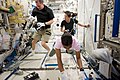 The crew sorting out blueprints in the Japanese Experiment Module
 -
 Wilson relaxing in the Cupola


April 9 (Flight Day 5 – EVA 1)
[edit]Flight day 5 saw the completion of the first spacewalk by Rick Mastracchio and Clayton Anderson.[37] The pair released the new ammonia tank assembly for transfer to station for installation on a later spacewalk. They also removed an experiment from outside on the Kibo Exposed Facility, replaced a Rate Gyro Assembly (RGA) and performed several get-ahead tasks. The spacewalking pair was assisted by the SSRMS which was operated by pilot Jim Dutton and mission specialist Stephanie Wilson. While the spacewalk took place, Naoko Yamazaki was assisted by commander Alan Poindexter, and the Expedition 23 crew to move several of the large science racks from the MPLM Leonardo to their new location on the ISS.[38]
-
Highlights from the first spacewalk (21 mins 43 secs).
-
 Mastracchio during EVA 1.
 -
 The crew enjoying time off


April 10 (Flight Day 6 – Transfers)
[edit]Flight day 6 was dedicated to transferring supplies from the MPLM Leonardo and the Space Shuttle mid-deck. The crews transferred the Windows Observational Research Facility (WORF) to the Destiny lab. Mission specialist Naoko Yamazaki, along with flight engineer Soichi Noguchi also transferred the Express Rack 7 (ER7) to its final location. During the crews morning, a smoke alarm sounded in the Russian segment of the station, which prompted the joint crew to move into emergency procedures. However the alarm was false and was cleared within a couple of minutes and all normal work resumed. Mission specialists Clay Anderson, Rick Mastracchio and Stephanie Wilson conducted in-flight interviews with Nebraska Public Radio, CBS Newspath and Radio Network and KETV-TV in Omaha, Nebraska.[39] Later in the day commander Alan Poindexter, pilot Jim Dutton and mission specialist Dorothy Metcalf-Lindenburger talked with students at the Naval Postgraduate School in Monterey, California. At the end of the crews work day, the joint crew got together and reviewed the procedures for the second spacewalk. After the procedures review spacewalkers Clay Anderson and Rick Mastracchio entered the Quest airlock, closed the hatch and lowered the inside pressure to 10.2 psi. The pair also breathed pure oxygen for an hour while the pressure was being lowered.[40]
-
Flight Day 6 highlights (19 minutes 58 seconds).
-
 Dorothy Metcalf-Lindenburger inside the MPLM Leonardo.
 -
 Stephanie Wilson with technical blueprints in Node 1


April 11 (Flight Day 7 – EVA 2)
[edit]On flight day 7, astronauts Clay Anderson and Rick Mastracchio performed their second spacewalk of the STS-131 mission. Mastracchio and Anderson exited the airlock at 05:30 UTC, a full 45 minutes ahead of the planned time, and spent 7 hours and 26 minutes outside the ISS.[41] The pair removed the old Ammonia Tank Assembly (ATA) from the S1 truss and installed the new ATA. Anderson and Mastracchio ran into a small problem when one of the four bolts that holds the tank in place wouldn't turn. They loosened the other three and tried them all again and the fourth bolt was successfully tightened. The two spacewalkers helped guide the SSRMS to temporarily stow the old ATA on the truss structure. The new ATA had its electrical connections made, but the fluid connections were deferred until the third spacewalk since the EVA was behind the time-line. Mastracchio and Anderson also installed two radiator grapple fixture stowage beams on the P1 truss. While Anderson and Mastracchio were outside, members of the STS-131 crew continued transferring items from Space Shuttle Discovery's mid-deck and the MPLM Leonardo. Overall, the crew had completed about half of the transfer work.
-
Highlights from the second spacewalk (23 mins 54 secs)
-
 Group photo while in the cupola observing the EVA
 -
 Mastracchio during EVA 2.


April 12 (Flight Day 8 – Off duty)
[edit]
The joint STS-131/Expedition 23 crews had the morning off on flight day 8. After their morning off the crews continued their transfer activities, which are more than seventy percent complete. The crews also conducted several PAO events, including VIP events with Roscosmos, Russian president Dmitry Medvedev, RSC Energia, the Japanese Aerospace Exploration Agency (JAXA), Japanese students, astronaut Mamoru Mohri, and Japanese dignitaries. Later, commander Alan Poindexter, pilot Jim Dutton, and mission specialists Dorothy Metcalf-Lindenburger and Stephanie Wilson participated in an in-flight interview with several American media outlets including Fox News, ABC World News, and MSNBC. While the PAO events took place, Rick Mastracchio and Clay Anderson were preparing the spacesuits and tools they will use for the third and final spacewalk. Later in the day the pair will have a procedures review with other members of the ISS and shuttle crews. After the review, they will enter the airlock, close the hatch and lower the pressure to 10.2 psi and breathe pure oxygen for their campout.[42]
April 13 (Flight Day 9 – EVA 3)
[edit]On flight day 9, Rick Mastracchio and Clay Anderson completed the third and final spacewalk of the STS-131 mission. Their tasks included hooking up the ammonia and nitrogen lines to the new Ammonia Tank Assembly (ATA), installing the old ATA in the shuttle's payload bay, retrieving some Micro-Meteoroid Orbital Debris (MMOD) shields, bolting a grapple bar (which had been removed from the old ATA) onto the new ATA, and preparation of some cables on the Z1 truss and tools to be used during STS-132. During the installation of the old ATA in Discovery's payload bay, the spacewalkers had some problems securing a bolt on the ATA to the LMC.[43] The spacewalk took 6 hours and 24 minutes, bringing the total EVA time to 20 hours and 19 minutes. While the EVA was going on, commander Alan Poindexter and mission specialist Naoko Yamazaki continued transferring items from the MPLM to the ISS. Transfer is more than seventy-five percent complete.
-
Highlights from flight day 9 (38 mins 14 secs).
-
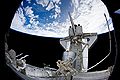 Mastracchio and Anderson working in Discovery's aft payload bay during EVA 3.
 -
 Clayton Anderson during EVA 3.
 -
 Stephanie Wilson and James Dutton in the US lab robotic workstation area


April 14 (Flight Day 10 – Final transfers/off duty)
[edit]The crew of STS-131 continued with transfer activities on the morning of flight day 10. The morning was devoted largely to transferring items to the MPLM Leonardo. There are only a few items awaiting transfer to Space Shuttle Discovery's mid-deck left. The crew enjoyed an hour long mid-day meal with the Expedition 23 crew. The entire joint crew took part in a crew photo, which was followed by a joint crew news conference with U.S., Russian and Japanese media. Later in the day, commander Alan Poindexter, mission specialists Dorothy Metcalf-Lindenburger, Stephanie Wilson, and Clayton Anderson took time out to talk with students from Eastern Guilford High School in Gibsonville, North Carolina and with third and fourth graders from that school district. The majority of the crews afternoon was spent off duty.[44]
-
 Naoko Yamazaki eats a snack in the Kibo laboratory.
 -
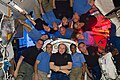 STS-131 and Expedition 23 crew members gather for a group portrait.


April 15 (Flight Day 11 – MPLM unberthing)
[edit]On flight day 11, the MPLM Leonardos hatches were closed at 07:38 UTC (03:38 EDT) and the MPLM was unberthed from the nadir or Earth facing port of the Harmony node at 20:24 UTC (16:24 EDT). It was placed in a low hover, about 3 feet (0.91 m) above Shuttle Discovery's payload bay. This was done because the MPLM was unberthed from Harmony later than planned. The delay in unberthing was caused by a set of bolts on the Common Berthing Mechanism (CBM) getting stuck due to a broken pin. The crew will finish putting Leonardo in the payload bay on flight day 12, prior to the docked late inspection.[45] The crews conducted some transfer operations between the ISS and shuttle mid-deck, which brings the overall transfer operations to ninety-four percent complete for the mission.
April 16 (Flight Day 12 – Late inspection)
[edit]
On flight day 12, the crew of Space Shuttle Discovery secured the MPLM Leonardo in the payload bay for return to Earth.[46] Mission specialist Dorothy Metcalf-Lindenburger activated the latches to secure Leonardo in the payload bay at 07:15 UTC (03:15 EDT). After Leonardo was secured, Metcalf-Lindenburger, pilot Jim Dutton began the late inspection of Discovery's heat shield. The pair were joined by commander Alan Poindexter and mission specialist Naoko Yamazaki to complete the inspection of the shuttle's Reinforced Carbon-Carbon (RCC) panels on the wings and nose and the heat-resistant tiles. The scan, which takes about 7 hours, was completed 3 hours ahead of schedule,[47] and it was done while still docked to the International Space Station (ISS) due to the loss of the shuttle's Ku-Band antenna.[48]
April 17 (Flight Day 13 – Undocking)
[edit]Space Shuttle Discovery successfully undocked from the International Space Station (ISS) at 12:52 UTC (08:52 EDT).[49] Discovery was docked to the ISS for 10 days, 5 hours, and 8 minutes. After Discovery departed from the ISS, pilot Jim Dutton took control of the shuttle and performed a fly around of the space station. The undocking was preceded by a farewell ceremony, where shuttle commander Alan Poindexter and station commander Oleg Kotov said farewells on behalf of their crews.[50] After undocking the shuttle crew stowed the Orbiter Boom Sensor System (OBSS) and the Shuttle Remote Manipulator System (SRMS) since they will not be needed for the rest of the flight. The crew was also informed that Discovery's heat shield was cleared for re-entry into Earth's atmosphere.[51]
-
Space Shuttle Discovery flies around the ISS after undocking (44 mins 7 secs).
-
 Discovery separates from the Space Station.
 -
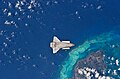 The underside of Discovery soon after post-undocking relative separation.
 -
 ISS seen from Discovery after undocking.


April 18 (Flight Day 14 – Landing prep)
[edit]On flight day 14, the crew of Space Shuttle Discovery began their final preparations for landing. The crew packed and stowed away items they no longer need for the rest of the flight. Throughout the day, commander Alan Poindexter and pilot Jim Dutton completed a series of checkouts of flight systems. These checks include 2 firings of the Reaction Control System (RCS) jets and a test of the Flight Control System (FCS). Once those checkouts were complete the pair began doing communications checkouts with the Merritt Island tracking station and tracking stations at the White Sands Space Harbor in New Mexico and Dryden Flight Research Center at Edwards Air Force Base. The crew also took time out of their day to conduct an in-flight interview with WBZ-AM in Boston, Massachusetts; the Associated Press; and KEZI-TV in Eugene.[52]
April 19 (Flight day 15 – First landing opportunity)
[edit]The crew of STS-131 awoke for flight day 15 and began their deorbit preparations. These preparations include closing the payload bay doors, activating the Flash Evaporator System (FES) and getting into their Advanced Crew Escape Suits (ACES). The crew got as far as "fluid loading", where the crew consumes a set quantity of fluids to counteract the effects of gravity, in their deorbit preps. The crew was informed of the one orbit wave off about one hour prior to the deorbit burn. After the crew was told of the wave off, they held in their procedures to see if they would be given a go for the second landing opportunity. However, they were not given a go for the second chance and the crew began backing out of their deorbit preps. Both landing chances were waved off due to bad weather at the Kennedy Space Center.[53]
April 20 (Flight day 16 – Landing)
[edit]Space Shuttle Discovery landed at 09:08 EDT (13:08 UTC) on runway 33 at Florida's Kennedy Space Center following a two-week mission in space.[54][55]
-
Landing video (7 mins 49 secs).
-
 Discovery lands on runway 33 at KSC ending the STS-131 mission.
 -
 Flyover cities during the landing.
 -
 Crew on the tarmac.


Spacewalks
[edit]At least three spacewalks were planned for this mission.[2] The main objectives for the three EVAs were as follows:
| EVA[56] | Spacewalkers[57] | Start (UTC) | End (UTC) | Duration |
|---|---|---|---|---|
| EVA 1 | Rick Mastracchio Clayton Anderson |
April 9, 2010 05:31 |
April 9, 2010 11:58 |
6 hours 27 minutes |
| The crew inside used the station's robotic arm to remove a new ammonia tank from shuttle's payload bay and temporarily stow it on the station. The spacewalkers then retrieved a seed experiment from outside the Japanese laboratory, installed a grapple bar to the new ammonia tank on the station's truss and replaced a failed gyroscope that is part of the station's navigation system, along with several get-ahead tasks. | ||||
| EVA 2 | Mastracchio Anderson |
April 11, 2010 05:30 |
April 11, 2010 12:56 |
7 hours 26 minutes |
| Crew members, using the station's arm, removed an empty ammonia tank from the station's truss and temporarily stowed it on an equipment cart. The new tank was then installed and electrical connections were made to it. The station's arm then temporarily stowed the old tank on another part of the station's structure until the mission's third spacewalk. | ||||
| EVA 3 | Mastracchio Anderson |
April 13, 2010 06:14 |
April 13, 2010 12:36 |
6 hours 24 minutes |
| Using the station's arm, the crew moved the old tank into the shuttle's payload bay for return to Earth. The spacewalkers also removed a grapple bar from the old ammonia tank and attached it to the new one. The pair then relocated a foot restraint and some tools and prepared some cables for the STS-132 mission. | ||||
Wake-up calls
[edit]NASA began a tradition of playing music to astronauts during the Gemini program, which was first used to wake up a flight crew during Apollo 15. Each track is specially chosen, often by their families, and usually has a special meaning to an individual member of the crew, or is applicable to their daily activities.[58][59]
See also
[edit]
References
[edit] This article incorporates public domain material from websites or documents of the National Aeronautics and Space Administration.
- ^ Legler, Robert D.; Bennett, Floyd V. (September 2011). "Space Shuttle Missions Summary" (PDF). NASA. p. 2-226. hdl:2060/20110001406. TM-2011-216142. Archived (PDF) from the original on March 31, 2025. Retrieved August 11, 2025.
- ^ a b "Remaining Space Shuttle Missions" (PDF). NASA. September 2009. FS-2009-05-051-KSC. Archived from the original (PDF) on March 24, 2010. Retrieved December 8, 2009.
- ^ Bergin, Chris (April 10, 2010). "STS-131: NASA managers plan out extra docked day late inspections". NASASpaceflight. Archived from the original on February 23, 2025. Retrieved April 10, 2010.
- ^ "STS-131 Press Kit" (PDF). NASA. April 2010. Archived (PDF) from the original on May 16, 2025. Retrieved March 26, 2010.
- ^ a b Ryba, Jeanne, ed. (February 16, 2010). "NASA's Shuttle and Rocket Launch Schedule". NASA. Archived from the original on February 17, 2010. Retrieved February 16, 2010.
- ^ a b Bergin, Chris (February 15, 2010). "STS-131: Cold weather delays flow – DDO constraint pushes launch into April". NASASpaceflight. Archived from the original on April 24, 2025. Retrieved February 16, 2010.
- ^ Kauderer, Amiko, ed. (September 24, 2009). "Consolidated Launch Manifest". NASA. Archived from the original on March 7, 2009. Retrieved October 16, 2009.
- ^ Trinidad, Katherine; Cloutier-Lemasters, Nicole, eds. (December 5, 2008). "NASA Assigns Astronaut Crews for Future Space Shuttle Missions" (Press release). NASA. 08-321. Archived from the original on August 11, 2025. Retrieved December 6, 2008.
- ^ Spotts, Peter (April 5, 2010). "After space shuttle launch: three spacewalks, among other chores". The Christian Science Monitor. Archived from the original on December 26, 2024. Retrieved April 12, 2010.
- ^ Garber, Steve, ed. (April 7, 2010). "Women in Space". NASA. Archived from the original on April 14, 2010. Retrieved April 12, 2010.
- ^ Kauderer, Amiko, ed. (March 8, 2010). "Preflight Interview: Naoko Yamazaki, Mission Specialist" (Press release). NASA. Archived from the original on March 15, 2010. Retrieved March 11, 2010.
- ^ "Впервые в космосе одновременно окажутся четыре женщины" [Four Women will Fly in Space for the First Time in the History] (in Russian). Roscosmos. April 3, 2010. Archived from the original on March 28, 2013. Retrieved April 3, 2010.
- ^ "STS-131". Spacefacts.de. Archived from the original on August 8, 2025. Retrieved April 25, 2024.
- ^ "STS-131 Crew Patch". NASA. August 26, 2009. STS131-S-001. Archived from the original on August 11, 2025. Retrieved February 19, 2010.
- ^ a b Gebhardt, Chris (February 22, 2009). "STS-131: Discovery's Logistics Flight Baselined by PRCB". NASASpaceflight. Archived from the original on June 24, 2025. Retrieved March 9, 2010.
- ^ "Canadian Content on Shuttle Mission STS-131" (Press release). Canadian Space Agency. March 29, 2010. Archived from the original on December 28, 2024. Retrieved April 8, 2010.
- ^ Harwood, William (February 28, 2010). "STS-131 Quick-Look 2". CBS News. Archived from the original on December 26, 2024. Retrieved April 7, 2010.
- ^ "Two Shuttles, Two Crews on the Move". NASA. February 22, 2010. Archived from the original on February 22, 2010. Retrieved February 23, 2010.
- ^ Cooper, Ben (February 2010). "Discovery gets ready for tank and boosters". Spaceflight Now. Archived from the original on April 23, 2025. Retrieved February 25, 2010.
- ^ Bergin, Chris; Gebhardt, Chris (February 22, 2010). "One in, one out – Discovery and Endeavour tag for next mission". NASASpaceflight. Archived from the original on July 8, 2025. Retrieved February 22, 2010.
- ^ Malik, Tariq (February 23, 2010). "NASA Prepares Shuttle Discovery for April Launch". Space.com. Archived from the original on June 20, 2025. Retrieved February 26, 2010.
- ^ Dean, James (February 10, 2010). "Cold weather delays Discovery's rollover to VAB". The Flame Trench. Florida Today. Archived from the original on June 6, 2011. Retrieved February 23, 2010.
- ^ Bergin, Chris (February 15, 2010). "STS-131: Cold weather delays flow – DDO constraint pushes launch into April". NASASpaceflight. Archived from the original on April 24, 2025. Retrieved April 7, 2010.
- ^ Ray, Justin (March 3, 2010). "Discovery perched atop launch pad for April flight". Spaceflight Now. Archived from the original on February 22, 2025. Retrieved March 3, 2010.
- ^ Bergin, Chris (March 3, 2010). "STS-131: Discovery rolls out to Pad 39A – ET repaired following bird vandalism". NASASpaceflight. Archived from the original on January 25, 2025. Retrieved March 3, 2010.
- ^ Harwood, William (April 5, 2010). "Discovery's Ku-band antenna likely lost for the mission". Spaceflight Now. Archived from the original on July 1, 2025. Retrieved April 6, 2010.
- ^ Bergin, Chris (April 5, 2010). "STS-131: Crew begin FD2 inspections, without KU capability". NASASpaceflight. Archived from the original on January 19, 2025. Retrieved April 6, 2010.
- ^ Yembrick, John; Thomas, Candrea, eds. (April 5, 2010). "NASA's Shuttle Discovery Heads to Station After Predawn Launch" (Press release). NASA. 10-076. Archived from the original on May 17, 2025. Retrieved April 5, 2010.
- ^ "STS-131 MCC Status Report #03". NASA. April 6, 2010. STS-131-03. Archived from the original on April 9, 2010. Retrieved April 7, 2010.
- ^ Harwood, William (April 6, 2010). "Crew inspects shuttle, but data downlink has to wait". Spaceflight Now. Archived from the original on December 26, 2024. Retrieved April 7, 2010.
- ^ "STS-131 MCC Status Report #04" (Press release). NASA. April 6, 2010. STS-131-04. Archived from the original on April 10, 2010. Retrieved April 7, 2010.
- ^ Harwood, William (April 7, 2010). "Shuttle Discovery docks to space station right on time". Spaceflight Now. Archived from the original on March 28, 2025. Retrieved April 8, 2010.
- ^ Gebhardt, Chris (April 7, 2010). "Discovery docks with ISS following successful Ku Band workaround". NASASpaceflight. Archived from the original on March 17, 2025. Retrieved April 7, 2010.
- ^ Harwood, William (April 8, 2010). "Delivery van pulls up to the International Space Station". Spaceflight Now. Archived from the original on December 28, 2024. Retrieved April 9, 2010.
- ^ "STS-131 MCC Status Report #06" (Press release). NASA. April 7, 2010. STS-131-06. Archived from the original on November 27, 2022. Retrieved April 9, 2010.
- ^ "STS-131 MCC Status Report #07" (Press release). NASA. April 8, 2010. STS-131-07. Archived from the original on April 11, 2010. Retrieved April 8, 2010.
- ^ Gebhardt, Chris (April 8, 2010). "STS-131 EVA-1 completed – No FI required for Discovery's clean TPS". NASASpaceflight. Archived from the original on July 12, 2025. Retrieved April 10, 2010.
- ^ "STS-131 MCC Status Report #09" (Press release). NASA. April 9, 2010. STS-131-09. Archived from the original on April 11, 2010. Retrieved April 9, 2010.
- ^ Harwood, William (April 10, 2010). "Astronauts discuss upcoming spacewalks, space summit". Spaceflight Now. Archived from the original on January 18, 2025. Retrieved April 11, 2010.
- ^ "STS-131 MCC Status Report #11" (Press release). NASA. April 10, 2010. STS-131-11. Archived from the original on April 12, 2010. Retrieved April 10, 2010.
- ^ "STS-131 MCC Status Report #13" (Press release). NASA. April 11, 2010. STS-131-13. Archived from the original on April 13, 2010. Retrieved April 11, 2010.
- ^ "STS-131 MCC Status Report #15" (Press release). NASA. April 12, 2010. STS-131-15. Archived from the original on April 15, 2010. Retrieved April 12, 2010.
- ^ "STS-131 MCC Status Report #17" (Press release). NASA. April 13, 2010. STS-131-17. Archived from the original on March 16, 2021. Retrieved April 13, 2010.
- ^ "STS-131 MCC Status Report #19" (Press release). NASA. April 14, 2010. STS-131-19. Archived from the original on April 15, 2010. Retrieved April 14, 2010.
- ^ "STS-131 MCC Status Report #22" (Press release). NASA. April 15, 2010. STS-131-22. Archived from the original on April 19, 2010. Retrieved April 15, 2010.
- ^ Harwood, William (April 16, 2010). "Discovery crew puts away module, scans heat shield". Spaceflight Now. Archived from the original on April 22, 2025. Retrieved April 18, 2010.
- ^ Bergin, Chris (April 16, 2010). "STS-131: Discovery berths MPLM and completes DLI ahead of undocking". NASASpaceflight. Archived from the original on February 19, 2025. Retrieved April 18, 2010.
- ^ "STS-131 MCC Status Report #24" (Press release). NASA. April 16, 2010. STS-131-24. Archived from the original on April 18, 2010. Retrieved April 16, 2010.
- ^ Harwood, William (April 17, 2010). "Departing Discovery leaves station stocked with supplies". Spaceflight Now. Archived from the original on December 26, 2024. Retrieved April 20, 2010.
- ^ Bergin, Chris (April 17, 2010). "STS-131: Discovery undocks – STORRM and TriDAR highlighted". NASASpaceflight. Archived from the original on July 12, 2025. Retrieved April 20, 2010.
- ^ "STS-131 MCC Status Report #26" (Press release). NASA. April 17, 2010. STS-131-26. Archived from the original on November 27, 2022. Retrieved April 17, 2010.
- ^ "STS-131 MCC Status Report #28" (Press release). NASA. April 18, 2010. STS-131-28. Archived from the original on April 20, 2010. Retrieved April 19, 2010.
- ^ "STS-131 MCC Status Report #30" (Press release). NASA. April 19, 2010. STS-131-30. Archived from the original on April 22, 2010. Retrieved April 19, 2010.
- ^ William Harwood (April 20, 2010). "Shuttle Discovery safely returns to Florida spaceport". Spaceflightnow. Retrieved April 21, 2010.
- ^ Bergin, Chris; Sloss, Philip (April 20, 2010). "STS-131: Discovery returns home for perfect landing at KSC". NASASpaceflight. Archived from the original on May 19, 2025. Retrieved April 21, 2010.
- ^ "STS-131 Mission Summary" (PDF). NASA. April 2010. Archived from the original (PDF) on March 25, 2010. Retrieved March 25, 2010.
- ^ "STS-131 Mission Information". NASA. Archived from the original on February 8, 2010. Retrieved February 5, 2010.
- ^ "Chronology of Wakeup Calls". NASA. August 2, 2005. Archived from the original on April 7, 2010. Retrieved April 5, 2010.
- ^ "STS-131 Wakeup Calls". NASA. Archived from the original on January 16, 2016.
External links
[edit]
- NASA's Space Shuttle page
- Time-lapse photography video of Discovery's preparation and launch for STS-131
- Video tour of STS-131 on LC-39A one month before launch
Space Shuttle Discovery (OV-103) | ||
|---|---|---|
| Completed flights | .jpg) | |
| Status |
| |
| On display | ||
| Related |
| |
See also: ISS expeditions, Uncrewed ISS flights | ||
| 1998–2004 |
|  |
| 2005–2009 | ||
| 2010–2014 | ||
| 2015–2019 |
| |
| 2020–2024 |
| |
| Since 2025 | ||
| Future |
| |
| Individuals | ||
| Vehicles |
| |
| ||
STS-131
View on GrokipediaMission Background
Overview
STS-131 (ISS assembly flight 19A) was the 131st Space Shuttle mission, the 33rd dedicated to the International Space Station, and the 162nd NASA crewed spaceflight.[4][1][3] The mission launched aboard Space Shuttle Discovery from Launch Complex 39A at NASA's Kennedy Space Center on April 5, 2010, at 06:21 EDT, marking Discovery's 38th flight and the final nighttime launch of the Space Shuttle program.[5][6][7] Discovery docked with the ISS on April 7, 2010, to deliver essential supplies and hardware. The mission concluded with a landing at Kennedy Space Center on April 20, 2010, at 09:08 EDT, after a duration of 15 days, 2 hours, 47 minutes, and 10 seconds, completing 238 orbits and traveling 10,029,810 kilometers.[7][1][8] The primary objectives focused on resupplying the ISS using the Leonardo Multi-Purpose Logistics Module, replacing a starboard ammonia tank assembly on the S1 truss during three spacewalks, and testing the TriDAR autonomous rendezvous sensor for future missions.[4][9] These efforts supported ongoing ISS assembly and maintenance as the Shuttle program approached its conclusion.[1]Objectives
The primary objective of STS-131 was to deliver and install a refurbished Ammonia Tank Assembly (ATA) on the S1 truss of the International Space Station (ISS) to ensure the continued functionality of the station's cooling systems, with the old ATA being removed and stored on the Lightweight Multi-Purpose Experiment Support Structure Carrier (LMC) for return to Earth.[4] This replacement was critical for maintaining the thermal control system that dissipates heat from the ISS's electronics and habitats.[4] A key resupply objective involved transferring approximately 12,371 kilograms (27,274 pounds) of supplies, equipment, and science payloads from the Leonardo Multi-Purpose Logistics Module (MPLM) to the ISS, including food provisions, water, spare parts, and specialized racks such as the Minus Eighty-Degree Laboratory Freezer for ISS (MELFI-3) for biological sample storage, the Muscle Atrophy Research and Exercise System (MARES) for studying human muscle response in microgravity, the Window Observational Research Facility (WORF) for Earth and space observations, a crew quarters rack to enhance living accommodations, and utilization racks like EXPRESS Rack No. 7 for ongoing experiments.[4] These transfers, estimated to require about 100 combined hours of work between the shuttle middeck and MPLM, aimed to sustain the six-person Expedition 23 crew by providing essential logistical support and advancing scientific research in areas like human physiology and materials science.[4] The mission also featured a technology demonstration objective to test the TriDAR (Triangulation and LiDAR Automated Rendezvous and Docking) system, a 3D laser camera and thermal imager designed to enable autonomous shuttle-to-ISS rendezvous without relying on traditional GPS or reference markers, marking its second flight evaluation.[4] Secondary goals included conducting three extravehicular activities (EVAs), each planned for 6.5 hours and led by mission specialists Rick Mastracchio and Clayton Anderson, to facilitate the ATA replacement, retrieve payloads such as the Lightweight Adapter Plate Assembly and Japanese Experiment Module SEED, and maximize overall cargo handling efficiency while supporting Expedition 23 operations.[4]Crew
Composition and Roles
The STS-131 crew consisted of seven astronauts, representing a mix of NASA personnel and an international partner from the Japan Aerospace Exploration Agency (JAXA).[4] This composition included Commander Alan G. Poindexter, a U.S. Navy captain on his second spaceflight after serving as pilot on STS-122 in 2008; Pilot James P. Dutton Jr., a U.S. Air Force colonel on his first spaceflight; and five mission specialists: Richard Mastracchio, on his third flight following STS-106 (2000) and STS-118 (2007), serving as lead for extravehicular activities (EVAs); Dorothy Metcalf-Lindenburger, a former teacher-astronaut on her first flight; Stephanie Wilson, on her third flight after STS-121 (2006) and STS-120 (2007); Naoko Yamazaki, a JAXA astronaut on her first flight; and Clayton C. Anderson, on his second flight after a 152-day stay aboard the International Space Station (ISS) during Expedition 15 in 2007, acting as the mission's ISS liaison.[4]| Crew Member | Role | Agency/Branch | Flight Experience |
|---|---|---|---|
| Alan G. Poindexter | Commander | NASA/USN | 2nd (STS-122) |
| James P. Dutton Jr. | Pilot | NASA/USAF | 1st |
| Richard Mastracchio | Mission Specialist (EVA Lead) | NASA | 3rd (STS-106, STS-118) |
| Dorothy Metcalf-Lindenburger | Mission Specialist | NASA | 1st |
| Stephanie Wilson | Mission Specialist | NASA | 3rd (STS-121, STS-120) |
| Naoko Yamazaki | Mission Specialist | JAXA | 1st |
| Clayton C. Anderson | Mission Specialist (ISS Liaison) | NASA | 2nd (ISS Expedition 15) |