


Community hub
Recent from talks
Contribute something
Nothing was collected or created yet.
Saab 32 Lansen
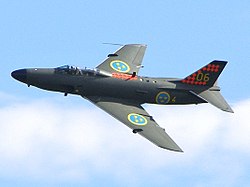
View on WikipediaThe Saab 32 Lansen (English: Lance[Nb 1][3]) is a two-seat, transonic military aircraft designed and manufactured by the Swedish aircraft manufacturer Saab AB.
Key Information


In late Autumn 1946, development of the Lansen began as a successor to the Saab B 18/S 18 attack aircraft. In December 1948, an initial contract for the design and mockup of Saab's proposed P1150 design was issued. As the design was refined, plans to use the indigenous STAL Dovern turbojet engine were put aside due to technical difficulties in favour of the license-built Rolls-Royce Avon powerplant. On 3 November 1952, the first prototype performed its maiden flight. In 1953, series production of the type began, after flight testing and several refinements.
Deliveries of the Lansen to the Swedish Air Force (Flygvapnet) took place between 1955 and 1960. It was the service's first twin-seat jet aircraft as well as the first equipped with an integrated search radar. Three principal variants of the Lansen were produced, these being for attack (A 32A), fighter (J 32B), and reconnaissance (S 32C) missions. Later built aircraft were equipped with a more powerful model of the Avon engine and increasingly capable electronics. During its lengthy operational life, the Lansen also served in secondary roles, including as an electronic warfare platform, target tug, and research aircraft. The majority were retired during the 1990s following the end of the Cold War.
Development
[edit]In Autumn 1946, the Saab company began internal studies aimed at developing a replacement aircraft for the Saab B 18/S 18 as Sweden's standard attack aircraft.[4] In 1948, Saab was formally approached by the Swedish Government with a request to investigate the development of a turbojet-powered strike aircraft, to replace a series of 1940s vintage attack, reconnaissance and night-fighter aircraft in the Flygvapnet: the B 18/S 18, J 21R/A 21R and J 30 (de Havilland Mosquito). Out of several differing design studies performed, including a twin-engine aircraft intended to be powered by a pair of de Havilland Ghost turbojet engines, Saab settled on a single-engine design, which was initially designated the P1150.[5]
Its basic design also drew upon materials obtained from Switzerland, including drawings on Messerschmitt's P.1101, P.1110, P.1111 and P.1112 projects. SAAB's project manager Frid Wänström retrieved these secret papers from Switzerland to Sweden in 1945. The documents originated from Messerschmitt engineers who fled to Switzerland at the end of the Second World War. Among them were the engineer and aerodynamicist Hermann Behrbohm, who joined Saab's core team around the Saab 29 Tunnan and upcoming aircraft like the Saab 32 Lansen and Saab 35 Draken.[citation needed]
On 20 December 1948, a phase one contract for the design and mock-up of the proposed aircraft was issued, formally initiating development work upon the P1150.[4][6] The requirements laid out by the Swedish Air Force for the P1150 were demanding: it had to be able to attack anywhere along Sweden's 2,000 km (1,245 miles) of coastline within one hour of launch from a central location. It had to be capable of being launched in any weather conditions and at day or night.[5] In response, Saab elected to develop a twin-seat aircraft with a low-mounted wing, and equipped with advanced electronics.[6] The P1150 broke new grounds for the Swedish Air Force, being their first two-seat jet aircraft, and the first to carry a built-in search radar.[7]
Saab had initially envisaged powering the P1150 with the indigenously produced STAL Dovern turbojet engine. Both timescale and technical difficulties encountered during the development of the Dovern resulted in the Swedish government electing to substitute the intended Dovern engine with the license-built Rolls-Royce Avon Series 100 turbojet engine instead, designated RM.5.[4][5] The single Avon engine provided the Saab A 32A with a thrust to weight ratio of about 0.3, and enabled the aircraft to be roughly 10,000lb heavier than the twin engine Saab 18 it replaced. The later-produced J 32B interceptor variant received the upgraded and significantly more powerful RM6A Avon engine instead.[8]
On 3 November 1952, the first P1150 prototype conducted its first flight.[5][9] The design of the prototypes had initially featured both Fowler flaps and a leading edge slot. This slot was discarded as unnecessary after trials with the prototypes and never appeared on subsequent production aircraft. Triangular fences were added near the wing roots during flight testing in order to improve airflow when the aircraft was being flown at a high angle of attack.[4][10] A small batch of P1150 prototypes completed design and evaluation trials. In 1953, series production of the newly designated Saab 32 Lansen began. Development work on the project involved more than 2,000,000 man-hours in total.[4]
In 1955, the first production A 32A Lansen attack aircraft were delivered to the Swedish Air Force. Deliveries of this variant proceeded through to mid 1958, at which point manufacturing activity switched to the other two variants of the Lansen, the J 32B and S 32C. These two models differed substantially from the first. The J 32 B was fitted with a new engine for greater flight performance, and new navigation and fire control systems.[4][11] On 7 January 1957, the first J 32 B Lansen conducted its maiden flight. On 26 March 1957, the first S 32C Lansen performed its first flight. Production of the Lansen continued until May 1960.[4]
Design
[edit]_1.JPG)
The Saab 32 Lansen had a straightforward general arrangement, being one of the first aircraft in the world to be specifically developed to fly attack missions.[5] From the outset, it was designed to effectively accommodate the installation of electronic warfare and weapons systems. The aircraft could be armed with a total of four 20 mm cannon, and wing pylons for various calibers of rockets and assorted bombs. The J 32 variant carried four 30 mm ADEN cannons. The A 32 ("A" stands for attack) had an armament of four 20 mm Bofors m/49 cannon hidden under flaps in the nose.[1] The J 32 differed substantially from the other variant, Saab describing it as "to all intents a new aircraft", being fitted with a more powerful engine and newer armaments and a different radar.[6]
The Lansen's nose contained the Ericsson mapping and navigation radar, the forward antenna housed in a large blister fairing underneath the fuselage, directly forward of the main landing gear. This radar worked in conjunction with the Rb 04C anti-ship missile, one of the earliest cruise missiles in western service. The attack variant of the Lansen could carry up to two RB04 missiles, one underneath each wing.[12][Nb 2] On the reconnaissance variant of the Lansen, up to six cameras could be installed in the place of the four cannon.[Nb 3] The camera bodies required the installation of chin blisters on the upper fuselage of the nose. The Lansen could carry up to 12 M62 flash bombs for night photography.[14]

The fuselage of the Lansen was relatively well streamlined, being the first aircraft for which the outer skin curvature and joints between skin panels had been defined by mathematical calculation in order to reduce drag, achieved via an early application of computer technology.[15] The wing had a 10 per cent laminar profile and a 35° sweep. Hydraulically-boosted ailerons and large Fowler flaps on the wings comprised the primary flight control surfaces, as did the hydraulically assisted elevators of the powered tailplane. Four airbrakes were on the sides of the rear fuselage.[10]
The Lansen had a tricycle undercarriage with a single wheel on all of the landing gear.[16] Other wing features include one-section stall fences on the outer-thirds of the wing, a pitot tube on the right wingtip, and three underwing hardpoints.[16] To test the 35° sweepback design of the Lansen's wing, a half-scale wing was mounted on a Saab Safir, designated Saab 202 Safir.[17]
The Lansen was powered by a single afterburning Svenska Flygmotor RM5 turbojet engine, which was a license-produced Rolls-Royce Avon RA.3/Mk.109 engine manufactured by Svenska Flygmotor.[18] For easy maintenance access to the engine, the aircraft's entire aft fuselage was detachable.[10] The air intakes for the engine were located just forwards and above the wing. The two-man pilot and navigator crew were contained in a pressurised cockpit, equipped with a single-piece clamshell canopy. A second windscreen separated the cockpit in between the pilot and navigator, to protect the latter in case of inadvertent jettisoning of the canopy.[10][16]
Operational history
[edit]On 25 October 1953, a SAAB 32 Lansen attained a Mach number of at least 1.12 while in a shallow dive, exceeding the sound barrier.[10] In December 1955, deliveries of the A 32A attack variant began, allowing the swift retirement of the last piston-powered B 18 bomber from Swedish service shortly thereafter. According to Bill Gunston and Peter Gilchrist, the A 32A proved to be extremely effective, both in terms of serviceability and the accuracy of its armaments.[1] Between 1958 and 1960, 54 S32 C reconnaissance aircraft were manufactured.[13] On 2 May 1960, the last Lansen was delivered to the Flygvapnet .[1]

One intended use for the A 32A was as an aerial delivery system for nuclear or chemical weapons. In the 1950s and 1960s, Sweden operated a nuclear weapons program, however never produced such weapons.[19]
Accidents destroyed a third of all Lansens during 25 years of service, killing 100 crew, along with 7 civilians in Vikbo.[20] The accidents were due to a combination of technical faults, the aircraft not being ready for service, and training deficiencies in regards to flying at night and in adverse weather.[20]
In the 1960 Vikbo crash, pilot Uno Magnusson's A 32A suffered an engine outage, and ejected before crashing into a farmhouse, killing all seven civilian occupants.[20] The crash was due to a known fault which occurred when a drop tank was fitted; the fighter variant J32 B had been forbidden from using the drop tank.[20] Replacement parts to correct the fault were available at the base but had not yet been fitted. The crash's causes were suppressed from the public by the Flygvapnet press office. As the victims were civilians, they were not included in official accident statistics.[20]
The A 32 Lansen was Sweden's last purpose-built attack aircraft. In June 1971, the replacement of the A 32A formally began, the more advanced Saab 37 Viggen being slowly used to take over its attack responsibilities.[Nb 4] As the type was gradually being replaced by more modern types, the Saab 32 continued to be operated into the late 1990s as target tugs and electronic warfare platforms, with 20 J 32Bs converted for these duties.[1][6] In 2010, at least two Lansens were still operational, having the sole task of taking high altitude air samples for research purposes in collaboration with the Swedish Radiation Safety Authority. One of these collected volcanic ash samples in mid 2010.[22] As of April 2020, all aircraft have been withdrawn from active service.[6]
Variants
[edit]

- A 32A
- Ground-attack and maritime-strike version. 287 aircraft built between 1955 and 1957.[23] Retired in 1978. Armed with four 20 mm Bofors m/49 cannons and could carry two SAAB RB 04 missiles, unguided rocket pods and a variety of different bombs up to 3x600 kg bombs. Equipped with Radarvarnare F9/5 Radar warning receiver and Box-3 chaff dispenser.[24]
- J 32B
- All-weather fighter version, initially operated only for bad weather and night fighter duties. Two prototypes and 118 production aircraft built[23] between 1958 and 1960. Retired in 1973. Armed with four 30 mm ADEN guns, Rb 24 missiles (license-built AIM-9 Sidewinder), or 75 mm unguided rocket pods. J 32B was powered by more powerful Svenska Flygmotor RM6A (Rolls-Royce Avon Mk 47A) engine.
- S 32C
- Specialized maritime and photo reconnaissance version developed from A 32A. 45 aircraft built[23] between 1958 and 1959. Retired in 1978. Equipped with PS-432/A radar with extended range and with six cameras – two SKa 23 (Fairchild K-47), one SKa 15 (Williamson F49 Mk 2) and three SKa 16 (Vinten F95).
- J 32D
- Target tug version. Six J 32B were modified.[23] Retired in 1997.
- J 32E
- ECM (electronic warfare and countermeasures) version, used also for ECM training. Fourteen J 32B were modified.[23] Retired in 1997. Aircraft was equipped with jamming system G 24 in one of three versions (for L, S or C bands) used for jamming ground and naval radars. Adrian (for S and C bands) and Petrus (for X band) pods were used for jamming aerial radars.
- J 32AD
- Project of day fighter version from 1953 as interim solution between the J 29 Tunnan and J 35 Draken, designated J 32AD ("D" stands for Dag [day]). Aircraft was lighter, without radar and armed with four 20 mm and one 30 mm guns in nose and different missiles. None built, 120 Hawker Hunter fighters bought instead.
- J 32U
- Project of fighter version from 1954 ("U" stands for utveckling [development]) with much better performance than J 32B. Aircraft was equipped with more powerful Rolls-Royce RA 19R engine and had improved wing design. None built.
- J 32S/J16
- In 1969, at the Norrbotten Wing (F 21), 4 aircraft of the J32B version were modified to become a kind of snow remover by using the heat from the engine to melt snow and ice. The wings and the tail was removed and a small cabin was added on top of the fuselage. Where the engine outlet had been, there was now a square pipe, which lead the air down to the ground. The type was tested and evaluated at F 21 until 1971, when the project was cancelled. The project was cancelled due to low efficiency and a very high fuel-consumption. There was also a problem with the welding in the pipe. The naming of the version is pretty simple, J32S (S stands for Snö [Snow]) and J16, simply because half of the aircraft was removed in order to create the J32S.
Surviving aircraft
[edit]One aircraft has been restored to flying condition and takes part in air force shows. This is a J32D model which was formerly 32606, now registered as SE-RME. Production number 32543 is flying under registration SE-RMD as of 2017, for the Swedish Air Force Historic Flight.[25]
Additionally, a number of non flying airframes are on static display at various museums and (former) air force bases.
- #32070: Gate guardian at Skaraborg Wing (F 7) in Såtenäs.
- #32085: In a museum at former Hälsinge Wing (F 15) in Söderhamn.
- #32127: On display by the drive way to the civilian terminal in Halmstad. Consists of parts from 32127, 32094 and, after the overhaul in 2019, the rear part of 32035.[26]
- #32151: In a museum at former Blekinge Wing (F 17) in Kallinge.
- #32197: At the Swedish Air Force Museum in Linköping.
- #32259: Gate guardian at former Västgöta Wing (F 6) in Karlsborg
- #32284: On display at the Estrella Warbirds Museum in Paso Robles, US.
- #32510: On display in the Österreichisches Luftfahrtmuseum at Graz airport, Austria.[27]
- #32512: In a museum at the former Göta Wing, today Aeroseum, Säve, Göteborg.
- #32543: On display in Museum of Aeronautics and Astronautics (Madrid) (F 3) in Cuatro Vientos, Madrid, Spain.
Operators
[edit]

Specifications (J 32B)
[edit]

| External videos | |
|---|---|
 Footage of a SAAB J32 B Lansen of the Swedish Airforce Historic Flight Footage of a SAAB J32 B Lansen of the Swedish Airforce Historic Flight | |
| Documentary on the J32 Lansen |
Data from The Great Book of Fighters,[28] Combat Aircraft since 1945[2]
General characteristics
- Crew: 2
- Length: 14.94 m (49 ft 0 in)
- Wingspan: 13 m (42 ft 8 in)
- Height: 4.65 m (15 ft 3 in)
- Wing area: 37.4 m2 (403 sq ft)
- Airfoil: NACA 64A010[29]
- Empty weight: 7,500 kg (16,535 lb)
- Max takeoff weight: 13,500 kg (29,762 lb)
- Powerplant: 1 × Svenska Flygmotor RM6A afterburning turbojet engine, 47 kN (11,000 lbf) thrust dry, 65.3 kN (14,700 lbf) with afterburner
Performance
- Maximum speed: 1,200 km/h (750 mph, 650 kn)
- Range: 2,000 km (1,200 mi, 1,100 nmi)
- Service ceiling: 15,000 m (49,000 ft)
- Rate of climb: 100 m/s (20,000 ft/min)
Armament
- Guns: 4 × 30 mm ADEN cannons 90 rounds each
- Rockets: 4 × 75 mm air-to-air rocket pods
- Missiles: 4 × Rb 24 air-to-air missiles
See also
[edit]Aircraft of comparable role, configuration, and era
Related lists
References
[edit]Notes
[edit]- ^ The names of Swedish combat aircraft, like Viggen or Draken, are in the definite form.
- ^ The RB 04 missile would use the Lansen's radar for target lock-on and for the missile's initial programming; after launch it would use its own active terminal homing with no further reliance on the aircraft's radar.[1]
- ^ The initial camera configuration included two SKa 17 cameras with 5.1 inch lenses and two SKa 18 with 36.2 inch lenses. In 1962, the configuration was updated to a single SKa 15 camera with a 3.9 inch lens, three SKa 16 cameras with 3.9 inch lenses, and two Ska 23 cameras with 23.6 inch lenses.[13]
- ^ Since the early 1960s, the Swedish Air Force had developed the Viggen as the specified successor to the Lansen in the attack role.[21]
Citations
[edit]- ^ a b c d e f g Gunston and Gilchrist 1993, p. 136.
- ^ a b Wilson 2000, p. 122.
- ^ Nilsson, Axel (13 January 2012). "JAS 39 Gripen − Milestones". Projects. Swedish Defence Materiel Administration. Archived from the original on 22 February 2014. Retrieved 12 February 2014.
Swedish naming of aircraft
- ^ a b c d e f g Saab 30 December 1960. p. 1017.
- ^ a b c d e Gunston and Gilchrist 1993, p. 134.
- ^ a b c d e "Saab 32 Lansen." Archived 2016-01-26 at the Wayback Machine Saab, 14 December 2015.
- ^ Wagner 2009, p. 53.
- ^ Gunston and Gilchrist 1993, pp. 134–136.
- ^ "700 m.p.h. Saab." Flight International, 7 November 1952. p. 580.
- ^ a b c d e Gunston and Gilchrist 1993, p. 135.
- ^ Aviation Week, vol. 66, McGraw-Hill, 1957, p. 73.
- ^ Gunston and Gilchrist 1993, pp. 135–36.
- ^ a b Wagner 2009, p. 55.
- ^ Wagner 2009, pp. 54–55.
- ^ Gunston and Gilchrist 1993, pp. 134–35.
- ^ a b c Wagner 2009, p. 54.
- ^ Ford 1994, p. 45
- ^ Wagner 2009, pp. 53–54.
- ^ Agrell, Wilhelm (2002), Svenska Förintelsevapen: Utvecklingen av Kemiska och Nukleära Stridsmedel 1928–1970 (in Swedish), Lund, SE: Historiska Media, ISBN 91-89442-49-0.
- ^ a b c d e "Haveriet" (in Swedish). SE: Fokus. Oct 2010. Retrieved 18 January 2015.
- ^ "Saab 37: Sweden's New Manned Weapon System." Flight, p. 1010. 27 December 1962.
- ^ Alpman, Marie. "Askprovtagning görs med Lansen" Swedish. NyTeknik, 6 May 2010. Retrieved: 2 September 2010.
- ^ a b c d e Forsgren 2010, pp. 68–69.
- ^ Speciel Förarinstruktion A32A (PDF) (144 ed.). KUNGL FLYGFÖRVALTNINGEN. p. 87, 88. Retrieved 25 April 2024.
- ^ "Aircraft SE-RMD Data". Airport-Data. 5 May 2017. Retrieved 31 May 2023.
- ^ Jönsson, Sven-Erik (8 December 2019). "Vad händer på FMTS (gamla F 14) med Lansen?". Svensk Flyghistorisk Förening. Retrieved 8 December 2019.
- ^ "Luftfahrtmuseum: welcome". www.luftfahrtmuseum.at. Retrieved 17 April 2023.
- ^ Green, William and Gordon Swanborough. The Great Book of Fighters. St. Paul, Minnesota: MBI Publishing, 2001. ISBN 0-7603-1194-3.
- ^ Lednicer, David. "The Incomplete Guide to Airfoil Usage". m-selig.ae.illinois.edu. Retrieved 16 April 2019.
Bibliography
[edit]- Erichs, Rolph et al. The Saab-Scania Story. Stockholm: Streiffert & Co., 1988. ISBN 91-7886-014-8.
- Ford, Daniel (Winter 1994). "Enduring Gem: SAAB's long serving Safir trainer". Air Enthusiast. No. 56. pp. 45–51. ISSN 0143-5450.
- Forsgren, Jan. "Database: Saab 32 Lansen". Aeroplane, November 2010, vol 38 no. 11, issue 451. pp. 64–74.
- Gunston, Bill and Peter Gilchrist. Jet Bombers: From the Messerschmitt Me 262 to the Stealth B-2. Osprey, 1993. ISBN 1-85532-258-7.
- "Saab: Sweden's Advanced Combat Aircraft." Flight International, 30 December 1960. pp. 1017–20.
- Taylor, John W.R. "Saab 32 Lansen (Lance)." Combat Aircraft of the World from 1909 to the present. New York: G.P. Putnam's Sons, 1969. ISBN 0-425-03633-2.
- This Happens in the Swedish Air Force (brochure). Stockholm: Information Department of the Air Staff, Flygstabens informationsavdelning, Swedish Air Force, 1983.
- Wagner, Paul J. Air Force Tac Recce Aircraft: NATO and Non-aligned Western European Air Force Tactical Reconnaissance Aircraft of the Cold War. Dorrance Publishing, 2009. ISBN 978-1-4349-9458-5.
- Wilson, Stewart. Combat Aircraft since 1945. Fyshwick, Australia: Aerospace Publications, 2000. ISBN 1-875671-50-1.
External links
[edit]
- Saab 32 Lansen – an Overview
- The photo flying Saab J32D Lansen in Swedish colours is operated by heritage flight of the Flygvapnet (Swedish Air Force) – 2012.
- Ekstrand, O. "Swedish Test Flying." Flight, p. 704. 12 November 1954.
Saab 32 Lansen
View on GrokipediaDevelopment
Background and Requirements
Following World War II, Sweden's policy of armed neutrality prompted a strong emphasis on indigenous defense production to ensure self-reliance in military aviation, avoiding dependence on foreign suppliers amid emerging Cold War tensions. This approach was reinforced by the rapid obsolescence of existing aircraft like the Saab B 18, a twin-engine bomber and reconnaissance platform from the 1940s that had become inadequate for modern threats despite its wartime service in the Flygvapnet (Swedish Air Force).[4][2] In response, the Flygförvaltningen (Swedish Air Board) issued formal requirements in December 1948 for a new multi-role aircraft under Project P1150, envisioned as a successor to the B 18 and capable of ground attack, reconnaissance, and all-weather interception roles. The specifications demanded transonic performance to enable strikes anywhere along Sweden's extensive 2,000 km coastline within one hour of takeoff from central bases, with operations viable in day, night, or adverse weather conditions, and potential adaptability for nuclear weapon delivery in future variants.[2][5][4] These needs aligned with global trends in early jet technology, including swept-wing configurations for high-speed stability and integration of airborne radar for all-weather capability, prompting Saab to begin internal studies as early as late 1946 to explore single- versus twin-engine layouts before settling on a single-engine design. Led by chief designer Erik Bratt at Saab's Linköping facility, the project drew on advanced aerodynamic modeling, including wind tunnel tests with modified Saab Safir aircraft to validate a 35-degree swept wing.[6][7][1] This conceptual phase laid the groundwork for prototyping, with the first flight occurring in 1952.[2]Prototyping and Testing
The development of the Saab 32 Lansen began with the construction of four prototypes under the P1150 project designation, initiated in the early 1950s to meet Swedish Air Force requirements for an all-weather attack aircraft. These prototypes, numbered 32-1 through 32-4, underwent extensive ground testing at Saab's facilities in Linköping, including structural load assessments and systems integration to validate the airframe's integrity under operational stresses.[8][2] The first prototype (32-1) achieved its maiden flight on November 3, 1952, piloted by Saab test pilot Bengt Olow from Linköping, marking Sweden's first flight of a twin-seat transonic jet with integrated radar. Initial flight trials focused on basic handling and stability, revealing satisfactory low-speed performance but prompting refinements to the 35-degree swept-wing configuration for better high-angle-of-attack airflow. To support these aerodynamic evaluations, Saab conducted wind tunnel tests using a half-scale model of the wing mounted on a Saab 91 Safir light aircraft, confirming the design's transonic capabilities before full-scale implementation.[1][8][2] Engine integration posed early challenges, as the originally planned STAL Dovern RM4 turbojet faced development delays and was canceled in 1952; the prototypes were thus equipped with the license-built Rolls-Royce Avon Series 100 (RM5), providing 44.1 kN (4,500 kgf) of thrust to enable the required performance envelope.[9] Flight testing progressed to high-speed regimes, with the prototypes routinely exceeding Mach 0.9 in dives during 1953 trials, culminating in a supersonic milestone on October 25, 1953, when one achieved at least Mach 1.12 in a shallow dive—the first such feat by a Swedish-built aircraft. These tests addressed transonic stability issues through minor modifications, such as adding triangular fences near the wing roots to mitigate airflow disruptions at high angles of attack.[4][2][8] Avionics and safety systems were iteratively tested across the prototypes, including integration of the French-designed PS-431/A search radar for all-weather operations and ground-based evaluations of the ejection seat mechanism. One prototype served as a dedicated testbed for ejection seat trials, simulating high-speed ejections to ensure crew survivability in combat scenarios, while radar performance was validated through external facility simulations to confirm target acquisition in adverse conditions. By late 1954, these efforts had resolved key handling discrepancies, paving the way for production certification.[2][10]Production Decisions
Following the successful prototype tests that validated the aircraft's performance, the Swedish Air Force placed an initial production order for the Saab 32 Lansen in 1953, designating it for series manufacturing as the A 32A attack variant. This contract called for 300 aircraft to meet the Flygvapnet's requirements for all-weather strike capabilities, with production authorized shortly after the prototypes' evaluation confirmed their transonic potential and structural integrity. By 1954, the order was expanded to encompass additional variants, increasing the total commitment to 450 units to cover fighter, reconnaissance, and related roles amid evolving Cold War threats.[2][8] Manufacturing commenced at Saab's primary facility in Linköping, Sweden, in 1955 and continued through 1960, leveraging the company's established expertise in jet production from prior projects like the J 29 Tunnan. The assembly process emphasized streamlined workflows, including the use of interchangeable modular sections for the fuselage and wings, which facilitated efficient adaptation across variants while minimizing tooling changes and reducing overall lead times. However, production faced setbacks due to supply chain issues with the licensed Rolls-Royce Avon turbojet engines sourced from the United Kingdom—initially designated as the RM 5 after the cancellation of a domestic RM 4 design—and complexities in integrating radar and other avionics, which postponed the first operational deliveries to Flygvapnet squadrons until late 1955.[1][2][11] In total, 450 Saab 32 Lansen aircraft were completed under these contracts, comprising 287 A 32A dedicated attack models delivered primarily between 1955 and 1958, 118 J 32B all-weather fighters produced from 1958 to 1960, and 45 S 32C reconnaissance platforms assembled in 1958 and 1959. This output represented a significant industrial achievement for Saab, scaling from experimental builds to a multi-role fleet that bolstered Sweden's neutral defense posture during the 1950s.[2][12][8]Design
Airframe and Aerodynamics
The Saab 32 Lansen was configured as a two-seat, low-wing monoplane with a 35-degree swept-back wing design, conventional empennage, and retractable tricycle landing gear to support its transonic performance requirements.[13][3] The aircraft measured 14.94 meters in length, with a wingspan of 13.0 meters and a height of 4.65 meters, providing a wing area of 37.4 square meters for balanced lift and stability.[3][13] Its airframe employed all-metal construction primarily using aluminum alloys, incorporating powered flight controls and a pressurized cockpit to enable operations at higher altitudes.[13] Select structural elements included steel reinforcements to accommodate potential heavy ordnance loads, while the total external payload capacity was up to 2,000 kg across six underwing hardpoints.[2] Aerodynamic enhancements focused on transonic efficiency, featuring leading-edge slats and full-span trailing-edge flaps for improved low-speed handling and takeoff/landing characteristics.[2] The fuselage adopted an area-ruled profile to reduce wave drag near the speed of sound, complementing the swept-wing layout for smoother transonic flight transitions.[7] The two-crew arrangement placed the pilot forward and the radar operator aft in a tandem configuration under a single-piece canopy, with the cockpit pressurized for crew comfort during extended missions.[3][1] From 1956 onward, the aircraft was equipped with Martin-Baker ejection seats to enhance crew survivability.[2]Propulsion and Performance
The Saab 32 Lansen was powered by a single Svenska Flygmotor turbojet engine, a license-built derivative of the British Rolls-Royce Avon series, tailored for Swedish production as the RM5 or RM6 designation. Early attack variants, such as the A 32A, utilized the RM5A2 (Avon Mk 105 equivalent), delivering 34.6 kN of dry thrust, with an optional Swedish-developed afterburner boosting output to 47 kN for short durations. Later fighter and reconnaissance models, including the J 32B, incorporated the more powerful RM6A (Avon Mk 200 series), providing 47 kN dry thrust and up to 65.3 kN with afterburner.[2][14][3] Internal fuel capacity stood at approximately 4,800 liters, stored in wing and fuselage tanks, with provisions for up to three external drop tanks totaling an additional 1,500 liters to extend operational radius during missions. This configuration supported a combat range of around 1,000 km, extending to 2,000 km with drop tanks fitted, prioritizing endurance for all-weather strike and interception roles over long ferry distances.[15][3] Performance metrics underscored the Lansen's transonic prowess, enabled by its swept-wing airframe, achieving a maximum speed of 1,200 km/h (Mach 1.15 at high altitude, with supersonic speeds attainable in dives) and a service ceiling of 15,000 m. The aircraft demonstrated a climb rate of 100 m/s (19,685 ft/min) and required a takeoff run of 1,200 m under loaded conditions, offering reliable short-field operations from austere bases. Compared to contemporaries like the Republic F-84 Thunderjet, the Lansen provided superior all-weather performance and speed, with better high-altitude interception capabilities despite similar thrust-to-weight ratios.[3][4][13]Armament and Avionics
The Saab 32 Lansen was equipped with a fixed armament that varied by variant: the A 32A attack version featured four 20 mm Bofors m/49 cannons in the nose (180 rounds per gun), while the J 32B fighter and S 32C reconnaissance variants used four 30 mm ADEN cannons (90-150 rounds per gun).[3][2] The aircraft featured six underwing hardpoints capable of carrying up to 2,000 kg of external stores, including Rb 24 air-to-air missiles (license-built AIM-9 Sidewinders), Rb 04 anti-ship missiles, 75 mm unguided rocket pods, conventional bombs, or even nuclear weapons for strategic strike roles in the attack variants.[2] These configurations enabled versatile mission profiles, from air interception to ground and maritime attack, with the Lansen's transonic performance supporting effective weapon delivery at low altitudes.[4] Avionics on the Lansen integrated advanced electronic systems for its era, including a radio compass for navigation and an Identification Friend or Foe (IFF) transponder to distinguish allied aircraft during operations.[2] The attack variant (A 32A) incorporated the PS 431/A radar, a French-designed X-band system built under license in Sweden, providing terrain-following and mapping capabilities for low-level strikes.[2] In the all-weather interceptor variant (J 32B), an Ericsson PS 03/A radar with a detection range of approximately 120 km enabled beyond-visual-range target acquisition in adverse conditions, paired with the SAAB S6 analog fire-control computer for guiding missiles and cannons, though its analog nature restricted fully autonomous beyond-visual-range engagements.[4] The J 32B also featured a Hughes AN/AAR-4 infrared search and track (IRST) sensor on select aircraft to complement radar for heat-seeking targets.[2] The reconnaissance variant (S 32C) utilized a specialized suite in its modified nose, including SKa 32 series cameras for vertical and oblique photography, alongside a side-looking airborne radar (SLAR) derived from the PS 432/A system for ground mapping over extended ranges.[4] Later upgrades to the Lansen fleet, particularly in the J 32E electronic countermeasures (ECM) conversion, added radar warning receivers, signal-homing units, and external ECM pods such as the Petrus/Adrian jammers operating in the X-band, along with chaff dispensers to counter enemy radar-guided threats.[2] These enhancements extended the platform's utility into electronic warfare roles through the 1970s.[3]Operational History
Service Introduction and Roles
The Saab 32 Lansen entered service with the Swedish Air Force (Flygvapnet) in late 1955, with the first deliveries of the A 32A attack variant occurring in December to the F 17 wing at Kallinge Airbase, marking the beginning of a phased replacement for the earlier J 29 Tunnan fighter and A 29 attack aircraft.[5][16] This transition addressed the need for a more advanced transonic platform capable of multi-role operations during the Cold War era, with initial equipping focusing on southern and central Swedish wings to bolster coastal defense capabilities.[2] By early 1956, additional A 32A units were supplied to F 6 at Karlsborg, F 7 at Såtenäs, F 14 at Halmstad, and F 17, enabling rapid integration into operational squadrons.[1] The Lansen fulfilled diverse roles across its variants, serving primarily as a ground attack platform in the A 32A configuration, which emphasized dive bombing missions against naval and land targets with precision-guided munitions and unguided rockets.[5] The J 32B all-weather fighter variant, introduced in 1958, focused on intercepting Soviet bombers during night or adverse weather conditions, equipped with advanced radar and four 30 mm Aden cannons for defensive patrols over Swedish airspace.[2] Meanwhile, the S 32C reconnaissance version conducted high-altitude missions over the Baltic Sea, utilizing nose-mounted cameras and electronic sensors to monitor Soviet naval movements without entering hostile airspace.[5] Training for Lansen pilots followed a structured syllabus emphasizing twin-engine jet handling, all-weather navigation, and weapon delivery, often using dual-control J 32B modifications for conversion from propeller-driven types like the Tunnan.[2] Squadron organization typically involved three to four flights per squadron, with each wing operating multiple squadrons; by 1960, approximately 19 squadrons across the Flygvapnet were equipped with the Lansen, supporting a total production of around 450 units.[5][2] This widespread adoption facilitated a smooth transition to the supersonic Saab 35 Draken in the early 1960s, where Lansens served as interim trainers and target tugs during Draken rollout.[1] Over its service life until 1997, the Lansen fleet accumulated more than 500,000 flight hours, underscoring its reliability in routine patrols and exercises.[5]Incidents and Operational Challenges
During its service with the Swedish Air Force from 1955 to 1997, the Saab 32 Lansen was involved in numerous accidents, resulting in over 100 crew fatalities and seven civilian deaths. Approximately one-third of the roughly 450 aircraft produced were lost to accidents over the type's service life.[6] These incidents were largely attributed to technical failures in the aircraft's complex systems and challenges with operations in adverse conditions, including night flying and poor weather, compounded by initial pilot training limitations.[17] A notable incident involving civilian casualties occurred on 26 October 1960, when A 32A serial 32051 crashed into a farmhouse at Vikbo after engine failure, killing seven civilians on the ground following the pilot's ejection. Another significant event took place on 28 May 1963, when two A 32A Lansens (serial numbers 32021 and 32260) from F 17 wing collided mid-air during a training exercise involving rocket firing, killing all four crew members.[18] Engine failures were a recurring issue, particularly in the 1970s; for example, on 13 August 1970, A 32A serial 32188 suffered a fuel system malfunction leading to engine loss and a crash in the Baltic Sea, with the pilot ejecting safely.[19] Similar events included takeoff engine failure in A 32A 321252 on 31 May 1970, resulting in two crew fatalities, and a leaking fuel pump causing power loss in A 32A 32099 on 14 June 1971, with the crew ejecting safely.[20][21] The Lansen's Ps 02/A radar, integral to its all-weather capabilities, exhibited reliability problems in icing conditions, contributing to operational challenges and some accidents during low-level flights in northern Sweden's harsh climate.[22] The aircraft's overall accident rate was high, estimated at one loss per 5,000 flight hours, due to the integration of advanced avionics, radar, and armament systems that increased mechanical complexity.[6] Accident investigations by the Swedish Air Force prompted safety upgrades, including improved ejection seat mechanisms to prevent parachute entanglement issues observed in cases like the 25 February 1965 crash of J 32B 32508, and wiring modifications to address electrical faults identified in early prototypes and operational aircraft.[23][22] As non-combat platforms in Sweden's neutral policy, the Lansen suffered no losses in wartime engagements.[1] By the 1980s, aging airframes from the 1950s production runs imposed significant maintenance burdens, with increased inspections and part replacements required to sustain the fleet in target-towing and electronic warfare roles until final retirement.[24]Retirement and Post-Military Uses
The retirement of the Saab 32 Lansen from frontline service in the Swedish Air Force occurred in phases, beginning with the A 32A attack variant, which was withdrawn in 1978 and replaced by the Saab JA 37 Viggen.[3] The J 32B interceptor variant lingered longer in operational roles, with the final combat units phased out by the mid-1990s, culminating in complete military withdrawal by 1997.[1] This decommissioning aligned with the broader transition to advanced platforms like the JAS 39 Gripen, which assumed the Lansens' multi-role responsibilities.[25] After their combat retirement, several Lansen airframes transitioned to secondary non-combat duties, extending their utility into the post-Cold War era. The J 32D target towing variant, derived from converted J 32B airframes, continued supporting training exercises until 1997, while preserved examples operated by the Swedish Air Force Historic Flight performed airborne target towing on contract at the Vidsel test range through the 2000s.[4][26] In a notable civilian adaptation, modified Lansen aircraft flew specialized sampling missions in 2010 to assess the volcanic ash cloud from Iceland's Eyjafjallajökull eruption, aiding European airspace safety evaluations over the continent.[27] Following these roles, most surviving airframes were demilitarized, with the bulk scrapped and a handful repurposed for ground-based instruction in Swedish aviation maintenance and training programs to preserve institutional knowledge.[28] The Lansen's enduring legacy in these capacities underscored its robust design, influencing ongoing heritage and educational efforts in Swedish military aviation.[2]Variants
Primary Production Variants
The primary production variants of the Saab 32 Lansen were the A 32A attack aircraft, the J 32B all-weather interceptor, and the S 32C reconnaissance aircraft, with a total of 455 units manufactured for the Swedish Air Force between 1955 and 1960.[1] The A 32A represented the initial production model, emphasizing day attack operations against ground and maritime targets. A total of 287 aircraft were built from 1955 to 1958, equipped with optical sighting systems rather than radar to support precision strikes using 20 mm cannons, bombs, rockets, and anti-ship missiles.[29][2] These aircraft were distributed to Attack Wings F 6 (Karlsborg), F 7 (Såtenäs), F 14 (Halmstad), and F 17 (Kallinge).[1] The J 32B adapted the Lansen airframe for all-weather interception duties, incorporating advanced avionics for night and low-visibility engagements. Production totaled 118 aircraft from 1958 to 1960, featuring the Ps 03/A radar for target detection and four 30 mm ADEN cannons as primary armament, supplemented by AIM-9 Sidewinder missiles on underwing pylons.[29][2] Deliveries went to Fighter Wings F 1 (Västerås), F 12 (Kalmar), F 4 (Frösunda), and F 21 (Luleå).[1] The S 32C focused on reconnaissance and intelligence collection, particularly over maritime areas. A total of 45 aircraft were built from 1958 to 1959 based on the A 32A design but as new production models, outfitting them with up to six cameras (such as SKA 15 and SKA 23 models) in an extended nose bay, electronic intelligence (ELINT) equipment, and the PS-431/A radar for surface surveillance, along with provisions for photoflash bombs and flares.[30] All S 32C aircraft served with Reconnaissance Wing F 11 (Nyköping).[1]Proposed and Modified Variants
Several proposed variants of the Saab 32 Lansen were considered during its development in the early 1950s to address specific operational needs, but most were ultimately not pursued due to shifting priorities toward more advanced designs like the Saab 35 Draken and Saab 37 Viggen.[2] The J 32AD was envisioned as a single-seat daytime fighter to serve as an interim replacement for the earlier Saab J 29 Tunnan, featuring a lighter airframe without radar, armed with four 20 mm cannons and one 30 mm cannon, along with provisions for rockets and unguided missiles.[4] This proposal emerged around 1953 but was cancelled in favor of the supersonic Draken, reflecting the Swedish Air Force's emphasis on higher performance aircraft amid evolving Cold War threats.[2] Another unbuilt design, the J 32U, aimed to enhance the Lansen's transonic capabilities as a utility fighter based on the J 32B production model. It would have incorporated a more powerful Rolls-Royce RA 19R engine, revised wing assemblies with increased sweep, and a supplementary rocket engine for improved climb and acceleration.[4] Like the J 32AD, the J 32U never progressed beyond the drawing board, abandoned due to high development costs and the strategic pivot to the Draken and Viggen programs, which promised superior speed and versatility.[2] Proposals for dedicated trainer and anti-ship configurations, such as a J 32S with dual controls in the rear cockpit or adaptations of the J 32B to carry Rb 04 anti-ship missiles, were evaluated but not produced, as existing variants like the A 32A already fulfilled maritime strike roles effectively with the Rb 04, and training needs were met through rudimentary dual-control modifications on operational aircraft.[8] These ideas were set aside primarily because of budgetary constraints and the rapid obsolescence of subsonic designs in the face of supersonic alternatives.[2] In terms of implemented modifications, the J 32E electronic countermeasures (ECM) variant represented a significant upgrade to extend the Lansen's utility into the electronic warfare domain. Starting in 1972, 15 J 32B fighters were converted to J 32E standard, replacing the nose radar with a G 24 radar-jamming pod, adding chaff dispensers, and integrating signal-homing equipment for ECM missions and training.[2] These aircraft served until 1997, providing essential electronic warfare support during a period when newer platforms like the Viggen were still integrating similar capabilities, though their retirement was driven by escalating maintenance costs.[2] Similarly, six J 32B airframes were modified in 1972 into J 32D target tugs to support gunnery and missile training for later-generation aircraft. Equipped with towing gear but retaining much of the original fighter configuration, the J 32Ds operated until 1997, filling a niche role after the primary variants were phased out.[2] No full-scale conversions to unmanned target drones occurred, as the manned tug configuration proved sufficient for Swedish Air Force requirements into the late 1990s.[4]Operators
Swedish Air Force Operations
The Saab 32 Lansen entered service with the Swedish Air Force (Flygvapnet) in 1955, equipping up to 12 squadrons for the A 32A and peaking at 7 squadrons for the J 32B across multiple air wings during its operational lifespan through 1997. Initial deliveries of the A 32A attack variant went to southern wings including F 6 at Karlsborg, F 7 at Såtenäs, F 14 at Halmstad, and F 17 at Kallinge, where it formed the backbone of ground-attack units focused on maritime interdiction. The J 32B fighter variant peaked at seven squadrons, primarily at F 1, F 3, F 7, F 9 in Göteborg, F 10 in Ängelholm, and F 13 in Norrköping, emphasizing all-weather interception roles.[1][2][28] Organizational changes reflected evolving Cold War priorities, with Lansen squadrons transitioning from primary attack and fighter duties in the 1950s–1960s to secondary reconnaissance (S 32C), electronic countermeasures (J 32D/E), and target towing roles by the 1970s as the Saab 35 Draken and Saab 37 Viggen supplanted them in front-line service. Wings like F 10 consolidated ECM operations, while F 7 retained training and demonstration units into the 1990s, adapting to reduced force structures amid post-Cold War budget constraints. This flexibility extended the type's utility across 42 years, with squadrons restructured to integrate upgraded avionics and weapons without major fleet overhauls.[2][31] Tactically, the A 32A excelled in low-level strikes over the Baltic Sea, designed for rapid penetration of enemy radar coverage to target Soviet naval assets with rockets, bombs, and anti-ship missiles, maintaining Sweden's defensive posture against amphibious threats. The J 32B supported Quick Reaction Alert (QRA) intercepts, leveraging its PS-02/A radar for night and adverse-weather engagements of potential intruders along neutral airspace boundaries. Under Sweden's armed neutrality doctrine, Lansen-equipped squadrons conducted joint exercises with NATO observers, such as multinational air defense drills in the 1960s–1980s, to showcase interoperability while avoiding formal alliances.[32][1][2] Logistically, maintenance was handled through Saab facilities and Air Force workshops, where specialized overhauls extended airframe life and integrated upgrades like improved engines and ECM pods, minimizing downtime for dispersed squadrons. Domestic production by Saab AB ensured supply chain independence, benefiting from localized manufacturing and reduced foreign dependency.[33][2] Personnel training emphasized the Lansen's tandem two-seat cockpit, which enabled efficient conversion of over 1,000 pilots across variants, with the rear seat allowing instructors to guide novices through low-altitude navigation, radar intercepts, and weapon delivery in simulated combat scenarios. This configuration proved vital for building proficiency in instrument flight and formation tactics, contributing to the type's low attrition rate beyond early teething issues.[2][32]Export Interest and Attempts
Despite its advanced design and proven performance in Swedish service, the Saab 32 Lansen generated interest from several nations in the 1950s, including Norway, Denmark, the Netherlands, Switzerland, Yugoslavia, Argentina, Venezuela, and India, where Saab conducted marketing efforts and demonstrations at airshows. However, these efforts failed to secure any orders, as prospective buyers ultimately selected alternatives such as the Lockheed F-104 Starfighter or Mikoyan-Gurevich MiG-21 due to geopolitical alignments, timing, and competitive pricing.[8] The United Kingdom and United States also evaluated the Lansen for potential technology sharing and adoption, but British export controls on the licensed Rolls-Royce Avon engine, which powered the aircraft, prevented any transfers or joint ventures. Saab promoted the Lansen as a neutral alternative to Cold War bloc aircraft, leveraging Sweden's non-aligned status, and proposed an export-optimized J 32E variant with enhanced avionics and armament options tailored for foreign operators. Ultimately, no exports were realized, a outcome attributed to the rapid evolution of jet technology and intense international competition; this experience informed Saab's approach to subsequent designs like the J 35 Draken, emphasizing greater export potential from the outset.[8]Preservation
Surviving Aircraft
As of 2025, approximately 30 Saab 32 Lansen aircraft are known to survive in various states of preservation, with the majority on static display in Swedish museums and three maintained in airworthy condition by the Swedish Air Force Historic Flight (SwAFHF) based at Såtenäs Air Base. These airworthy aircraft include J 32B serial numbers 32542 (SE-RMD), 32606 (SE-RME), and 32620 (SE-RMF), which participate in air shows across Europe, including an appearance at Karlstad Airshow in 2025.[34] The last operational flight of a Lansen not affiliated with heritage groups occurred in mid-2010, when one was used to collect volcanic ash samples from the Eyjafjallajökull eruption in collaboration with the Swedish Radiation Safety Authority.[1][27] Key examples of surviving aircraft include J 32B serial number 32542, maintained in airworthy condition by SwAFHF with its original 1970s paint scheme intact and capability for radiation sampling missions. Another airworthy J 32B, registered SE-RME with serial 32606 (a former J 32D target tug), returned to flight in 2018 after extensive restoration. The third airworthy example is J 32B serial 32620 (SE-RMF). At the Flygvapenmuseum in Linköping, J 32B 32541 is preserved on static display, showcasing the fighter variant's avionics and armament configuration. An A 32A attack variant, serial 32197, is also on exhibit there, representing the type's maritime strike role. Additionally, an unidentified A 32A Lansen is held in storage at the Flygvapenmuseum, preserved for potential future restoration.[35][36][37][38][39][26][40] Restoration efforts for airworthy examples have been led by the Swedish Air Force Historic Flight, an organization dedicated to maintaining operational Swedish military aircraft heritage. No Lansen preservation projects are documented outside Sweden and the United States, where an A 32A (construction number 32284) is under restoration for static display at Estrella Warbirds Museum in California. Many surviving airframes exhibit corrosion from decades of coastal and maritime operations, particularly those based at squadrons like F 17 at Kallinge near the Baltic Sea; spare parts for maintenance are occasionally sourced from recovered wrecks of the approximately 150 Lansens lost in accidents during their service life.[12][17]Museum and Display Examples
Several preserved Saab 32 Lansen aircraft are featured in Swedish museums, serving as key exhibits that highlight the aircraft's role in Cold War-era Swedish air defense and attack operations. The Flygvapenmuseum in Linköping, the official museum of the Swedish Air Force located at Malmen Air Base, displays multiple variants including the J 32E electronic warfare model (serial 32612) and the A 32A attack variant, allowing visitors to explore the aircraft's technical evolution and historical significance through static presentations and contextual displays on Swedish aviation development.[41][42] At the Aeroseum in Göteborg, housed in a former Cold War underground hangar, a J 32E Lansen (serial 32512) is part of an exhibit titled "Lansen – Sweden's Speartip," which emphasizes the aircraft's multi-role capabilities in ground attack, reconnaissance, and fighter missions, with interactive elements illustrating its operational environment during the 1950s to 1990s.[43][44] Other notable displays include an S 32C Lansen (serial 32940) at the F 11 Museum in Nyköping, integrated into exhibits on the Swedish Air Force's F 11 Wing history and Cold War readiness, and a J 32B at the Gotland Flygmuseum in Visby, showcased outdoors to represent regional defense contributions.[45][46] These installations often tie into broader narratives of Swedish military aviation innovation, with preserved airframes providing tangible links to the Lansen's service legacy. Preserved Lansens also contribute to public engagement through airshows and heritage flights operated by the Swedish Air Force Historic Flight, which maintains airworthy examples for demonstrations that educate audiences on the aircraft's transonic performance and tactical versatility.[47][26]Specifications
General Characteristics (J 32B)
The J 32B was the all-weather fighter variant of the Saab 32 Lansen, designed as a two-seat aircraft to accommodate a pilot and a weapons systems officer or navigator for intercept and reconnaissance missions in adverse conditions.[3] This configuration emphasized tandem seating for improved visibility and operational efficiency during night and bad-weather operations.[2] Key physical dimensions of the J 32B included a length of 14.94 m, a wingspan of 13.00 m, a height of 4.65 m, and a wing area of 37.4 m², contributing to its transonic performance and stability.[3] The aircraft's empty weight was 7,500 kg, while its maximum takeoff weight reached 13,500 kg, allowing for a useful load capacity that supported its multi-role capabilities without excessive structural strain.[3] Internal fuel capacity stood at 3,780 L, enabling a combat radius suitable for Swedish Air Force defense needs, supplemented by optional drop tanks for extended ferry flights. The J 32B featured five external hardpoints—four under the wings and one on the centerline—capable of carrying up to 2,000 kg of stores, though optimized for air-to-air missiles and reconnaissance pods in its fighter role. Propulsion was provided by a single Svenska Flygmotor RM6A afterburning turbojet engine, a licensed production of the Rolls-Royce Avon Mk 47A, delivering 65.3 kN of thrust with afterburner to achieve the necessary speed and climb rates for intercept duties.[48]| Characteristic | Specification |
|---|---|
| Crew | 2 |
| Length | 14.94 m |
| Wingspan | 13.00 m |
| Height | 4.65 m |
| Wing area | 37.4 m² |
| Empty weight | 7,500 kg |
| Max takeoff weight | 13,500 kg |
| Internal fuel | 3,780 L |
| Hardpoints | 5 (4 underwing, 1 centerline) |
| Engine | 1 × RM6A (Avon Mk 47A) at 65.3 kN (with afterburner) |
Armament and Performance (J 32B)
The J 32B variant of the Saab 32 Lansen was optimized for all-weather interception roles, delivering strong performance metrics suited to Cold War-era threats. It attained a maximum speed of 1,200 km/h at 3,000 m altitude, powered by the upgraded Svenska Flygmotor RM6A afterburning turbojet engine.[3] This speed capability allowed the aircraft to pursue and engage high-velocity targets effectively within Swedish airspace. The aircraft's ferry range extended to 2,200 km with auxiliary fuel tanks, supporting long-distance deployments or transits, while its combat radius reached 550 km on internal fuel with a standard loadout.[49] Additional performance figures included a rate of climb of 100 m/s, enabling rapid ascent to operational altitudes, and a service ceiling of 15,400 m for high-altitude patrols. The J 32B also demonstrated robust maneuverability with g-limits of +6/-3, suitable for dogfighting and evasive actions.[3] Armament centered on offensive firepower for air-to-air engagements, featuring four 30 mm ADEN cannons mounted in the nose with 150 rounds per gun, providing sustained fire against enemy bombers or fighters.[8] For missile armament, it could carry up to four Rb 24 (license-built AIM-9 Sidewinder) infrared-guided air-to-air missiles on underwing pylons, enhancing beyond-visual-range capabilities introduced in the late 1950s. The external stores capacity supported up to 1,500 kg of ordnance, including bomb racks or unguided rocket pods as alternatives to missiles, though the fighter configuration prioritized air superiority over ground attack loads seen in the A 32A variant.[3] These features, combined with the J 32B's avionics and radar systems, underscored its role as a versatile interceptor.References
- https://commons.wikimedia.org/wiki/Category:Saab_32_Lansen_at_Flygvapenmuseum
- https://commons.wikimedia.org/wiki/Category:Saab_A_32_Lansen_32197
- https://commons.wikimedia.org/wiki/File:Saab_32_Lansen_vr.jpg
- https://commons.wikimedia.org/wiki/Category:Saab_32_Lansen_museum_aircraft