Hubbry Logo
Shorea robustaShorea robustaMain
Open search
Shorea robusta
Community hub
Shorea robusta
logo
8 pages, 0 posts
0 subscribers
Be the first to start a discussion here.
Shorea robusta
Shorea robusta
from Wikipedia

Shorea robusta
Scientific classification Edit this classification
Kingdom: Plantae
Clade: Tracheophytes
Clade: Angiosperms
Clade: Eudicots
Clade: Rosids
Order: Malvales
Family: Dipterocarpaceae
Genus: Shorea
Species:
S. robusta
Binomial name
Shorea robusta
Synonyms

Vatica robusta

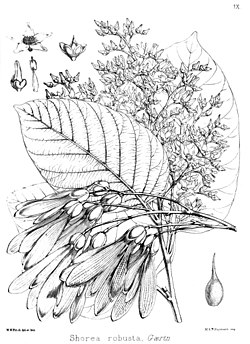
Shorea robusta, the sal tree,[2] sāla, shala, sakhua,[3] or sarai,[4] is a species of tree in the family Dipterocarpaceae. The tree is native to India, Bangladesh, Nepal, Tibet and across the Himalayan regions.[5]

Evolution

[edit]

Fossil evidence from lignite mines in the Indian states of Rajasthan and Gujarat indicate that sal trees (or at least a closely related Shorea species) have been a dominant tree species of forests of the Indian subcontinent since at least the early Eocene (roughly 49 million years ago), at a time when the region otherwise supported a very different biota from the modern day. Evidence comes from the numerous amber nodules in these rocks, which originate from the dammar resin produced by the sal trees.[6]

Description

[edit]
Sal forests in Purulia, India

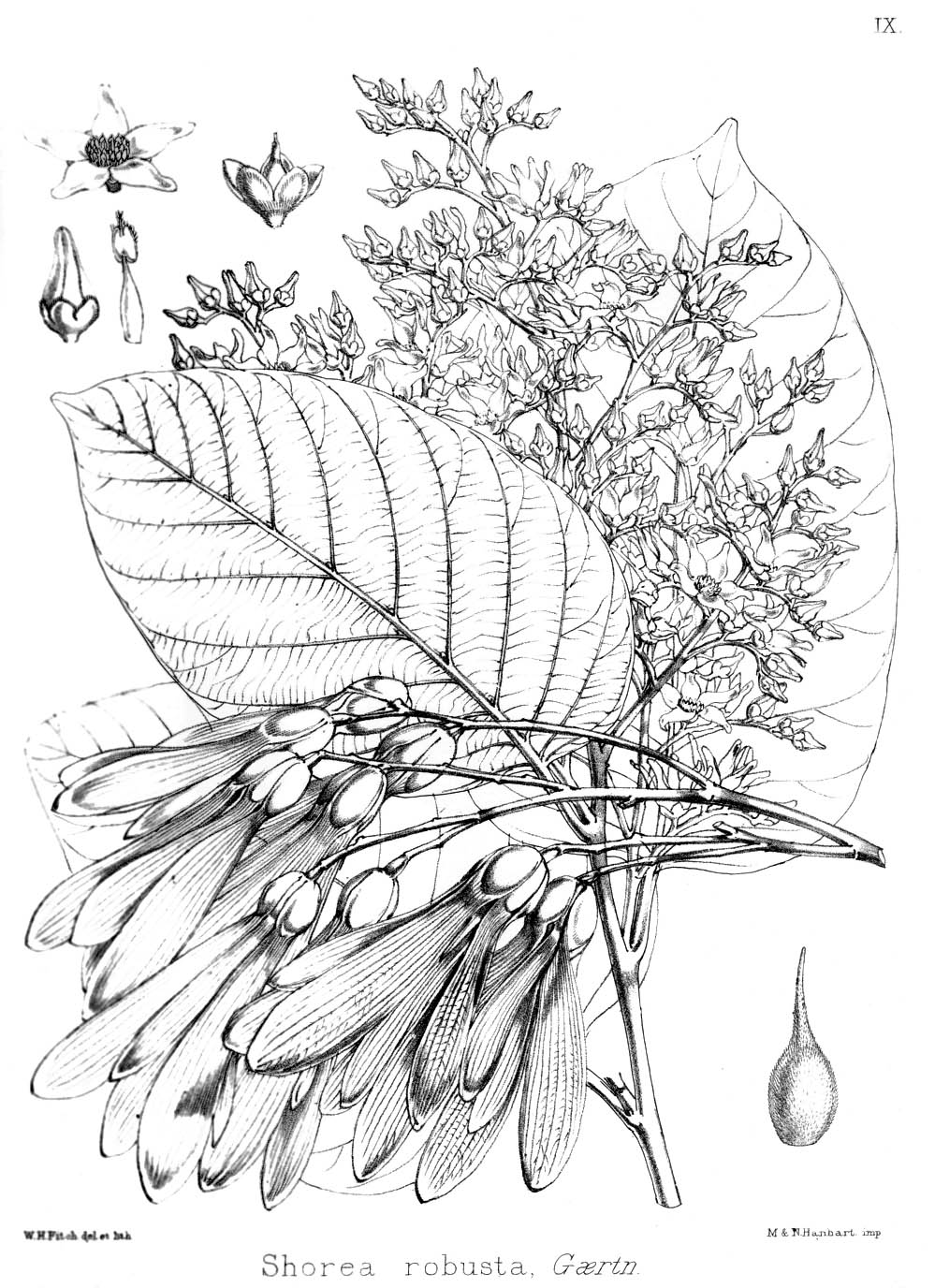
Shorea robusta can grow up to 40 metres (130 feet) tall with a trunk diameter of 2 metres (6.6 feet).[7] The leaves are 10–25 cm long and 5–15 cm broad. In wetter areas, sal is evergreen; in drier areas, it is dry-season deciduous, shedding most of the leaves from February to April, leafing out again in April and May.

The sal tree is known also as sakhua in northern India, including Madhya Pradesh, Odisha and Jharkhand.[8][9] It is the state tree of two Indian states – Chhattisgarh and Jharkhand.[10][circular reference]

Distribution and habitat

[edit]

This tree is native to the Indian subcontinent, ranging south of the Himalaya, from Myanmar in the east to Nepal, India and Bangladesh. In India, it extends from Chhattisgarh, Assam, Bengal, Odisha and Jharkhand west to the Shivalik Hills in Haryana, east of the Yamuna. The range also extends through the Eastern Ghats and to the eastern Vindhya and Satpura ranges of central India.[11] It is often the dominant tree in the forests where it occurs. In Nepal, it is found mostly in the Terai region from east to west, especially, in the Sivalik Hills (Churia Range) in the subtropical climate zone. There are many protected areas, such as Chitwan National Park, Bardia National Park and Shuklaphanta National Park, where there are dense forests of huge sal trees. It is also found in the lower belt of the Hilly region and Inner Terai.

Culture

[edit]

Hinduism

[edit]

In Hindu tradition, the sal tree is sacred. The tree is also associated with Vishnu.[12] The tree's common name, sal, comes from the word shala, which means 'rampart' in Sanskrit.[12]

Jains state that the 24th tirthankara, Mahavira, achieved enlightenment under a sal.[citation needed]

Some cultures in Bengal worship Sarna Burhi, a goddess associated with sacred groves of Sal trees.[13]

There is a standard decorative element of Hindu Indian sculpture which originated in a yakshini grasping the branch of a flowering tree while setting her foot against its roots.[14] This decorative sculptural element was integrated into Indian temple architecture as salabhanjika or "sal tree maiden", although it is not clear either whether it is a sal tree or an asoka tree.[15] The tree is also mentioned in the Ramayana—specifically, where Lord Rama (on request of deposed monkey-king Sugriva for proof he can kill Sugriva's older half-brother Vali) is asked to pierce seven sals in a row with a single arrow (which is later used to kill Vali, and still later to behead Ravana's brother Kumbhakarna)

In the Kathmandu Valley of Nepal, one can find typical Nepali pagoda temple architectures with very rich wooden carvings, and most of the temples, such as Nyatapola Temple, are made of bricks and sal tree wood.[citation needed]

Buddhism

[edit]
Queen Mahamāyā giving birth to the Buddha under sala tree while grasping the branch.

Buddhist tradition holds that Queen Māyā of Sakya, while en route to her grandfather's kingdom, gave birth to Gautama Buddha while grasping the branch of a sal tree or an Ashoka tree in a garden in Lumbini in south Nepal.[16][17]

Also according to Buddhist tradition, the Buddha was lying between a pair of sal trees when he died:

Then the Blessed One with a large community of monks went to the far shore of the Hiraññavati River and headed for Upavattana, the Mallans' sal-grove near Kusinara. On arrival, he said to Ven. Ananda, "Ananda, please prepare a bed for me between the twin sal-trees, with its head to the north. I am tired, and will lie down."[18]

The sal tree is also said to have been the tree under which Koṇḍañña and Vessabhū, respectively the fifth and twenty-fourth Buddhas preceding Gautama Buddha, attained enlightenment.

In Buddhism, the brief flowering of the sal tree is used as a symbol of impermanence and the rapid passing of glory, particularly as an analog of sic transit gloria mundi. In Japanese Buddhism, this is best known through the opening line of The Tale of the Heike – a tale of the rise and fall of a once-powerful clan – whose latter half reads "the color of the sāla flowers reveals the truth that the prosperous must decline." (沙羅雙樹の花の色、盛者必衰の理を顯す, sharasōju no hana no iro, jōshahissui no kotowari wo arawasu),[19] quoting the four-character idiom jōsha hissui (盛者必衰) from a passage in the Humane King Sutra, "The prosperous inevitably decline, the full inevitably empty" (盛者必衰、実者必虚, jōsha hissui, jissha hikkyo?).

Confusion with cannonball tree and other trees

[edit]

In Asia, the sal tree is often confused with the Couroupita guianensis or cannonball tree, a tree from tropical South America introduced to Asia by the British in the 19th century. The cannonball tree has since then been planted at Buddhist and Hindu religious sites in Asia in the belief that it is the tree of sacred scriptures. In Sri Lanka, Thailand and other Theravada Buddhist countries it has been planted at Buddhist monasteries and other religious sites. In India the cannonball tree has been planted at Shiva temples and is called Shiv Kamal or Nagalingam since its flowers are said to resemble the hood of a Nāga (divine cobra) protecting a Shiva lingam.[17][20] An example of a cannonball tree erroneously named 'sal tree' is at the Pagoda at the Royal Palace of Phnom Penh in Cambodia.[21]

In Japan the sal tree of Buddhist scriptures is identified as the deciduous camellia (Stewartia pseudocamellia), called shāra, 沙羅, from Sanskrit śāla.[17]

The sal tree is also said to be confused with the Ashoka tree (Saraca asoca).[22]

Uses

[edit]

Sal is one of the most important sources of hardwood timber in India, with hard, coarse-grained wood that is light in colour when freshly cut, but becomes dark brown with exposure. The wood is resinous and durable, and is sought after for construction, although not well suited to planing and polishing. The wood is especially suitable for constructing frames for doors and windows.

Making of sal leave plate.

The dry leaves of sal are a major source for the production of leaf plates and bowls called patravali in India and Nepal. The used leaves/plates are readily eaten by goats and cattle. In Nepal, its leaves are used to make local plates and vessels called "tapari", "doona" and "bogata" in which rice and curry is served. However, the use of such "natural" tools have sharply declined during the last decade.[citation needed]

Sal tree resin is known as sal dammar or Indian dammar,[23] ṛla in Sanskrit. It is used as an astringent in Ayurvedic medicine,[24] burned as incense in Hindu ceremonies, and used to caulk boats and ships.[23]

Sal seeds and fruit are a source of lamp oil and vegetable fat. The seed oil is extracted from the seeds and used as cooking oil after refining.

[edit]

See also

[edit]

References

[edit]
[edit]
Revisions and contributorsEdit on WikipediaRead on Wikipedia
from Grokipedia
Shorea robusta, commonly known as the sal tree, is a large species in the family, characterized by its impressive stature reaching up to 50 meters in height and a trunk diameter of up to 5 meters, with dark brown, deeply fissured bark, simple shiny oval leaves 10-25 cm long, yellowish-white flowers in racemose panicles, and winged fruits 1.3-1.5 cm long. Native to the , including , , , and , it thrives in tropical moist forests under climates with a 4-8 month , demonstrating strong resistance and the ability to coppice effectively. Ecologically dominant, S. robusta forms extensive sal covering approximately 13% of India's forest area (as of 2021) and about 121,000 hectares in , supporting diverse undergrowth species and wildlife such as the while facing threats from and ; it is currently listed as Near Threatened by the IUCN (2025). The tree holds significant economic value for its durable, termite-resistant timber used in , furniture, railway sleepers, and poles, with annual harvestable stock in alone estimated at 1.13 million cubic meters. Its seeds yield an edible oil employed in cooking and production, while the , known as sal damar, serves in varnishes, paints, and traditional medicines. Leaves provide for and are used by indigenous communities for plates and , and the tree's phytochemicals, including asiatic acid, oligomers, and , underpin its pharmacological properties such as , , anti-inflammatory, analgesic, antidiabetic, and hepatoprotective effects validated in various studies. In cultural contexts, S. robusta is revered in , with its leaves used in rituals, and it plays a vital role in sustaining livelihoods in rural through and non-timber forest products.

Taxonomy and nomenclature

Taxonomy

Shorea robusta is the accepted binomial name for the species, originally described as Shorea robusta C.F. Gaertn. in 1805, with a notable being Dryobalanops robusta (Oken) Pierre. It belongs to the family , within the order , and is classified under the broader clades of Tracheophytes (vascular ) and Magnoliophyta (flowering ). The Shorea, to which S. robusta belongs, following a taxonomic revision of the tribe Shoreae, now comprises 47 accepted species, predominantly distributed across in tropical rainforests, though a small number occur in , including S. robusta and S. tumbuggaia (with species such as S. roxburghii and S. assamica now transferred to the genus Anthoshorea). The traces its evolutionary origins to the Eocene epoch, with fossil evidence from amber-preserved indicating early diversification driven by tectonic movements between and , as detailed in a phylogenomic study. Phylogenetically, Shorea robusta is positioned within the subfamily Dipterocarpoideae of , specifically in the tribe Shoreae, a group that has become ecologically dominant in Southeast Asian tropical forests through adaptations such as mast fruiting, which synchronizes irregular, massive production to enhance and dispersal in predator-saturated environments. This evolutionary strategy has contributed to the family's prominence in old-growth tropical ecosystems.

Etymology and common names

The genus Shorea was named after Sir John Shore, who served as of the British East India Company in from 1793 to 1798; the name was established by the botanist and validly published by Carl Friedrich von Gaertner. The specific epithet robusta derives from the Latin word for "robust" or "strong," reflecting the tree's sturdy trunk, resilient form, and durable wood. The is commonly known as sal in and Nepali, in , sakhua in Maithili and Bhojpuri, and sarai in some regional dialects of ; in , a variant name is sakhuwa.

Description

Morphology

Shorea robusta is a large to semi-evergreen that typically reaches heights of 18–32 m, with exceptional specimens up to 50 m, and a trunk of up to 5 m in exceptional specimens. The bole is straight and cylindrical, often unbranched for the first 25 m, with a buttressed base in mature individuals, and the bark is gray to dark reddish-brown, fissured and flaky, measuring 2.5–5 cm thick, providing fire resistance. The leaves are simple and alternate, ovate to elliptic or oblong, 10–25 cm long and 5–15 cm wide, leathery with a shiny glabrous surface, though bearing stellate glandular trichomes on the upper . New leaves emerge reddish before turning green, with a prominent midvein and 12–14 pairs of lateral veins. Flowers are creamy-white to yellowish, 5-petaled and about 1–1.5 cm long, arranged in terminal or axillary panicles up to 25 cm long. The fruit is a winged nut, ovoid and 1.3–1.5 cm long with a 1 cm diameter, enclosed by five unequal calyx wings: three longer ones 5–8 cm and two shorter 3–3.5 cm. In its growth habits, S. robusta forms gregarious stands with an elongated crown in youth that becomes rounded and spreading at maturity. It develops a deep early and reaches reproductive maturity around 15 years, full commercial maturity in 50–60 years, with a lifespan exceeding 200 years.

Reproduction

Shorea robusta produces hermaphroditic flowers that are self-incompatible, promoting to maintain . The species exhibits supra-annual mast flowering, characterized by synchronized, gregarious blooming across populations every 3–5 years, often triggered by preceding conditions that may be influenced by climatic events such as El Niño. Flowering typically occurs from March to , with protandrous anthers releasing pollen before the stigmas become receptive, further reducing . Pollination in S. robusta is primarily anemophilous (by ), facilitated by an release mechanism triggered by gusty winds during the . Although some earlier studies suggested a role for (Thysanoptera), recent research indicates as the dominant vector, aligning with the dipterocarp family's adaptations during mass flowering events in some species. Fruit development follows successful , with woody capsules maturing from May to July. These feature persistent calyx lobes that expand into unequal wings—three larger outer ones and two smaller inner ones—enabling wind-mediated dispersal as the samara-like structures autorotate during fall. The seeds are recalcitrant, unable to tolerate , and maintain viability for only 7–10 days post-dispersal, during which they face intense predation from such as weevils and bruchids, as well as vertebrates, leading to substantial losses in natural settings. Natural regeneration of S. robusta primarily occurs via direct seed germination under favorable moist conditions shortly after dispersal, though success is limited by the seeds' brief viability and predation pressures. The species also regenerates vigorously through , where basal shoots emerge from felled stumps, and less commonly via vegetative means such as root suckers, which sprout from damaged roots and contribute to clonal spread in disturbed areas.

Distribution and ecology

Geographic distribution

Shorea robusta, commonly known as sal, is native to the , extending from the Himalayan foothills through parts of , , , , and southeastern in . In , it occurs prominently in states such as , , , , , , and , forming extensive stands in the Gangetic plains and central highlands. In , the species dominates the region and extends into the Siwalik Hills and mid-hill river valleys. Its elevational range spans approximately 100 to 1,500 meters above , where it thrives in lowland to submontane zones. Sal-dominated forests cover approximately 11–14 million hectares across its native range, with sal forests in alone accounting for about 10–13 million hectares. Key protected areas harboring substantial populations include in , a with vast sal woodlands, and Valmiki Tiger Reserve in , , where sal forms the primary canopy in moist deciduous habitats spanning over 800 km². These regions highlight the species' role in biodiversity hotspots along the Indo-Nepal border. Within its native range, S. robusta is cultivated in plantations for timber production, including in and through historical forestry initiatives dating back to the mid-20th century, often in mixed stands with species like (Tectona grandis). There are no reports of widespread invasiveness from these plantings, as the species remains confined to managed areas without significant ecological disruption. Fossil evidence, including pollen and wood remains from Eocene to sediments, indicates that S. robusta or closely related species had a broader distribution across , with records from deposits in and red-bed formations in , suggesting an ancient presence before modern range contraction.

Habitat and

Shorea robusta thrives in moist and dry deciduous forests across tropical and subtropical regions of the , typically at elevations ranging from 100 to 1,500 meters above . It prefers well-drained sandy to clayey loam soils that are fertile and avoid waterlogging, with tolerance for lateritic substrates but sensitivity to prolonged flooding. Optimal growth occurs in areas receiving annual rainfall of 1,200 to 2,000 mm, predominantly during monsoons, and under temperatures between 20 and 40°C, though it can endure summer highs up to 45°C in subtropical zones. As a dominant canopy species in sal forests, Shorea robusta often constitutes 60-80% of the tree layer, shaping the structure of these ecosystems and associating with species such as Terminalia spp. and Lagerstroemia parviflora to form mixed deciduous stands. It plays a crucial ecological role by providing and foraging grounds for diverse , including nesting sites for the and supporting epiphytic orchids like Spiranthes himalayensis as well as over 60 lichen species. Additionally, these forests contribute significantly to , with above-ground biomass reaching 123-487 Mg/ha and vegetation carbon stocks of 58-234 Mg C/ha, enhancing soil stability and nutrient cycling through leaf litter decomposition. The species engages in symbiotic interactions that bolster its resilience, including dual mycorrhizal associations with both arbuscular (AM) and ectomycorrhizal (ECM) fungi, which facilitate nutrient uptake in nutrient-poor soils. Mast seeding events synchronize fruit production across populations, influencing dynamics and promoting episodic regeneration. Its thick, fire-resistant bark enables survival and after surface fires, allowing rapid regrowth with subsequent rains and maintaining dominance in fire-prone habitats. In moister environments, it exhibits semi-evergreen tendencies, while in drier areas, it becomes fully to conserve water during seasonal droughts.

Conservation

Status

Shorea robusta is assessed as Near Threatened on the , having been up-listed from Least Concern in the October 2025 update, primarily due to widespread habitat degradation and fragmentation across its range, despite its extensive distribution spanning over 10 million hectares of forest in alone. The previous Least Concern designation, in place since 1998, reflected the species' large and resilient populations in tropical dry deciduous forests. Regionally, Shorea robusta holds varying national conservation statuses. In , it is classified as endangered under the Master Plan for the Sector, reflecting concerns over overexploitation and regeneration challenges in forests. In , the species receives protection through state-level schedules and the Indian Forest Act of 1927, which regulates harvesting in reserved and protected forests where Sal dominates. Export restrictions on unprocessed Sal timber and further support conservation efforts by limiting . Population estimates indicate millions of mature trees across its native range, with densities varying from 300–600 individuals per in intact stands, contributing to overall stability in protected areas like national parks. However, numbers are declining in fragmented landscapes outside reserves due to anthropogenic pressures, though regeneration remains viable in managed forests.

Threats and management

Shorea robusta forests face multiple threats, primarily from anthropogenic activities and environmental changes. Deforestation for agriculture, infrastructure development, and timber extraction has led to substantial habitat loss, with India experiencing a 6% decrease in overall tree cover (equivalent to 2.33 million hectares) since 2000, significantly impacting Sal-dominated ecosystems in the Indo-Gangetic plains. Overexploitation of non-timber products, including resin (used for incense and varnishes) and seeds (harvested for oil and butter), exacerbates degradation, as unsustainable tapping reduces tree vigor and regeneration potential. Climate change poses additional risks through altered precipitation patterns and increased drought frequency, which disrupt mast seeding cycles and heighten seedling mortality during post-monsoon dry periods. Invasive species, such as Chromolaena odorata, further threaten natural regeneration by competing with Sal seedlings for resources and suppressing recruitment in forest gaps. Regional challenges are pronounced in core distribution areas. In and , illegal logging remains rampant, driven by demand for high-value Sal timber, leading to unreported losses in and central Indian forests. Conservation management strategies emphasize community involvement and restoration techniques. In , community forestry programs, including leasehold systems, empower local user groups to manage Sal forests sustainably, reducing illegal extraction and promoting regeneration through regulated harvesting and protection. India's assisted natural regeneration (ANR) initiatives, such as those in Kumaun Himalayan forests, enhance seedling establishment by clearing invasive undergrowth and protecting young trees, resulting in higher densities compared to unmanaged sites. integration, combining Sal with crops like or in degraded areas, supports diversification while maintaining tree cover and . Ongoing monitoring efforts utilize advanced tools for effective conservation. via MODIS time-series data enables precise mapping and of Sal forest cover, facilitating early intervention against . Genetic conservation through ex situ seed banks, such as those managed under national programs, preserves diversity by storing viable Shorea robusta to counter and risks.

Cultural significance

In Hinduism

In , the sal tree (Shorea robusta), known as shala in , holds sacred status and is particularly associated with Lord Vishnu, symbolizing strength and divine protection. Mythological narratives describe Lord Rama, an incarnation of Vishnu, demonstrating his prowess by piercing seven sal trees with a single arrow during his exile, underscoring the tree's representation of resilience and the triumph of over adversity. The sal tree features prominently in Hindu rituals and festivals, where its leaves are used as offerings to invoke blessings for and renewal. The tree's wood, valued for its and resistance to decay, has been employed in temple construction across the . Additionally, the bark is used in Ayurvedic practices, which are intertwined with Hindu traditions, for its medicinal properties in treating ailments such as wounds and ulcers. Sal groves, referred to as sala vana in ancient texts, are regarded as holy sites embodying the presence of deities and serving as natural sanctuaries for and . These groves, often protected as abodes of village gods, reflect Hindu ecological reverence, where cutting the trees is taboo to avoid . In contemporary practice, sal trees are safeguarded within devrais—sacred groves in regions of and —managed by communities to preserve while upholding religious taboos against exploitation, ensuring the tree's enduring spiritual legacy.

In Buddhism

In Buddhist tradition, the sal tree (Shorea robusta) is deeply intertwined with pivotal events in the life of Gautama Buddha, symbolizing the cycle of birth, enlightenment, and transcendence. According to ancient accounts, Queen Māyā, Buddha's mother, gave birth to Siddhartha Gautama while standing and grasping the branch of a sal tree in the royal garden of , present-day , around 563 BCE. This miraculous birth, where the infant emerged from her right side and took seven steps while lotus flowers bloomed beneath his feet, underscores the tree's role as a divine witness to the advent of the future enlightened one. The sal tree also marks the site of Buddha's , his final passing into nirvana, in (ancient Kusinārā), , circa 483 BCE. As described in the , the Buddha instructed his attendant Ānanda to prepare a bed for him between two twin sal trees in the sāla grove of the Mallas, where he lay on his right side facing north. At that moment, the trees burst into full bloom out of season, their flowers showering upon the Buddha in homage, an event interpreted as a natural tribute to his attainment of ultimate liberation from samsara. Symbolically, the sal tree embodies impermanence (anicca) and the fleeting nature of existence in Buddhist doctrine, particularly through its brief, vibrant flowering period, which mirrors the rapid passage of glory and life. This motif appears in , such as the Bhadda-sāla Jātaka (No. 465), where a sal tree spirit sacrifices itself for the greater good, illustrating themes of selflessness and unity among beings. In , the sal tree features prominently in sculptural reliefs on stupas and temple walls, often depicted with figures like Māyā grasping its to represent and auspicious beginnings; such motifs are evident in Andhra Pradesh's ancient sites. Sal trees are also revered and planted in sacred precincts, including the gardens surrounding the Mahābodhi Temple in , evoking the tree's hallowed associations despite Buddha's enlightenment occurring under a related bodhi tree species.

Other cultural uses

In tribal communities of , such as the Oraon and Munda, the sal tree (Shorea robusta) holds a central place in as a life-giver and protector, symbolizing birth, sustenance, and resilience against adversity. Local narratives portray it as the first tree to emerge on , providing , oxygen, and nourishment to humanity, with ancestors relying on its leaves for and fruits for to ensure survival in forested environments. This mythic role underscores the tree's enduring presence, encapsulated in tribal sayings like "hazaar saal khada, hazaar saal pada, phir bhi nahi sada" (standing for a thousand years, lying for a thousand more, yet never truly fades), highlighting its unbreakable bond with community life. The sal tree features prominently in tribal weddings and social ceremonies, where its branches or altar serve as essential elements for rituals, believed to complete the union and invoke blessings for prosperity; for instance, among the Oraon, a sal branch is often wound with white thread to symbolize village unity during matrimonial rites. In art and crafts, sal leaves are stitched into patravali or disposable plates, a centuries-old practice in rural documented in ancient texts like the , used for serving meals at community feasts, weddings, and daily gatherings to enhance the sensory experience of eating while promoting sustainability. Additionally, the bark yields natural dyes for coloring and fabrics, producing hues with good fastness properties when mordanted, a technique employed by tribal artisans for traditional textiles. Sal groves function as vital community markers in villages, acting as communal gathering spaces for social cohesion and cultural transmission. The festival in exemplifies this, a multi-day spring celebration honoring the sal's blooming as a harbinger of renewal, where villagers perform dances, offer flowers as prasad, and share rice beer to foster bonds and pray for bountiful harvests and protection from calamities. among Adivasis integrate the sal tree into , where it appears in non-medicinal tales of , origin myths, and lessons on resilience, preserving generational about ecological interdependence.

Economic uses

Timber and wood products

The wood of Shorea robusta, commonly known as sal, is characterized by its hardness and heaviness, with a specific ranging from 0.83 to 0.93 g/cm³ at 12% moisture content. The heartwood is dark reddish-brown, while the sapwood is lighter and paler, contributing to its aesthetic appeal in finished products. This timber exhibits high durability, with natural resistance to and decay fungi, making it suitable for long-term structural applications without extensive chemical treatments. The coarse texture and high content can make it challenging to work with, as it tends to split during nailing and is difficult to plane or turn, though it saws easily. Harvesting of S. robusta timber typically involves selective to maintain health, with rotations for high forests spanning 80 to 160 years to allow for natural regeneration and growth. is conducted periodically, starting at 5 years and repeating every 5 to 10 years thereafter, to promote diameter growth in remaining trees. Mature trees in managed stands can yield substantial volumes, with mean annual increments around 5.87 m³/ha in Nepalese forests under 120-year rotations. The coppices well, supporting shorter 30- to 40-year rotations in systems or taungya setups. Due to its strength and resistance to wear, S. robusta timber is widely used in for beams, , frames, and heavy structural elements in houses and bridges. It serves as a preferred for sleepers, ties, and coaches, as well as poles, posts, and components subject to high stress. In furniture and , it provides durability for household items, while production utilizes its stable properties for paneling. Additionally, it finds application in agricultural implements and projects. Sustainability efforts for S. robusta timber focus on balancing extraction with conservation, as discussed in a 2024 review of Indian sal forests, which highlights government-community collaborations for conservation, afforestation, and non-timber industries to sustain yields and ecosystem services like carbon sequestration. These practices aim to mitigate overexploitation while preserving the species' role in regional economies.

Non-timber products

Shorea robusta yields several valuable non-timber products, primarily extracted from its bark, , leaves, and other parts, contributing significantly to local economies in its native range across . The , known as sal dammar or dhuna, is obtained by tapping the bark through incisions that expose resin ducts, allowing the to collect. This is widely used in the production of , varnishes, and due to its adhesive properties and ability to form durable coatings. Annual yields from a mature tree typically range from 1 to 2 kg, though higher outputs up to 4 kg have been recorded under optimal tapping conditions. The seeds of Shorea robusta are another key non-timber resource, harvested primarily during the tree's mast years when production is abundant. These seeds contain 10–20% oil, extracted through pressing or methods, yielding a semi-solid known as sal butter. This oil serves as an for cooking, a base for soaps, and a for lamps, while its stability makes it suitable for as a substitute. The residual kernel, after oil extraction, is processed into cattle feed due to its protein and carbohydrate content. Leaves and bark provide additional utilitarian products with both traditional and commercial applications. The broad, durable leaves are commonly used to fashion disposable plates, cups, and wrappers by stitching or pressing, offering an eco-friendly alternative to disposables in rural and ceremonial contexts; they also serve for roofs in traditional . The bark is rich in , extracted for tanning to produce firm, durable hides, and is employed in traditional processes to impart reddish-brown hues to fabrics when mordanted. Other parts of the tree contribute minor products, including flowers that provide abundant for honey production by local populations, supporting apiculture in sal-dominated forests.

Misidentification

Confusion with cannonball tree

In parts of Asia, particularly and , the cannonball tree () from the family Lecythidaceae has been widely misidentified as the sal tree (Shorea robusta) from the family, leading to both being locally referred to as "sal." This error stems in part from where the cannonball tree's round, woody fruits are confused with the sal tree's winged samaras, despite their unrelated dispersal mechanisms and overall morphology. The cultural ramifications of this mix-up are significant in Buddhist traditions, where erroneous claims depict the Buddha's birth and occurring under the cannonball tree rather than the true sal. Visual appeal, including the cannonball tree's large, pinkish flowers with hooded stamens resembling a cobra's hood (), has prompted its planting in temple courtyards across and beyond, further entrenching the confusion in religious iconography and floral offerings mistaken for sal blossoms. Botanically, the two species differ markedly: the cannonball tree is a deciduous species native to the tropical in , featuring heavy, cannonball-shaped fruits up to 25 cm in diameter that fall to the ground and split open irregularly to release seeds dispersed by gravity and animals. By contrast, Shorea robusta is a semi-deciduous to indigenous to the and Himalayan foothills, with small, fragrant white-yellow flowers and lightweight, winged fruits adapted for wind dispersal. Historically, the misidentification originated in the late during British colonial rule, when C. guianensis was introduced to Sri Lanka's Royal Botanic Gardens at in 1881 as an ornamental exotic and subsequently disseminated to Buddhist sites without proper taxonomic distinction. This led to errors in early 20th-century botanical literature and illustrations in South and Southeast Asian contexts, where names were swapped, allowing the confusion to spread across Buddhist .

Similar species

Shorea robusta shares its range with several morphologically similar trees, particularly other members of the family and unrelated species in tropical forests of , but key diagnostic features allow for differentiation in the field. The leaves are simple, alternate, ovate-oblong, measuring 10–25 cm long and 5–15 cm broad, with a leathery texture; they are glabrous and shiny above but bear stellate glandular trichomes on the lower surface and along the branchlets, a trait typical of the but useful for confirming identity among Dipterocarps. The is an indehiscent nut, 1.3–1.5 cm long, enclosed by the persistent calyx that enlarges into five unequal wings (the three outer ones broader and 5–7.5 cm long), facilitating wind dispersal and serving as a primary identifier distinct from non-winged or differently structured fruits in look-alikes. Within the genus Shorea, species like those in southern exhibit overlapping wood anatomy and production, but S. robusta is differentiated by its large stature (up to 35 m tall with a trunk of 2–2.5 m) and habit in moist to dry forests, contrasting with smaller, often congeners adapted to wetter, habitats. Other Dipterocarps, such as Vatica lanceifolia, may appear similar due to comparable family-level bark texture in young trees, but V. lanceifolia is a smaller (up to 12 m tall) confined to southern and northeastern Indian forests below 900 m , with smooth, pale grayish-green mottled bark, elliptic-lanceolate leaves (10–23 × 3–8 cm) that are below, and spherical nuts lacking prominent calyx wings. Unrelated deciduous trees like Terminalia tomentosa (syn. T. elliptica) co-occur in mixed sal forests and share broad, elliptic-ovate leaves (5–15 cm long) and a habit, potentially leading to confusion in leaf-only identifications; however, T. tomentosa produces distinctly winged nuts (2.5–4 cm long) with two lateral wings arising directly from the fruit body in the family, unlike the calyx-derived wings of S. robusta, and it favors similar dry deciduous to mixed forests up to 1,400 m elevation. Lannea coromandelica, another potential look-alike in drier woodland edges and hill forests (100–1,800 m), has a crooked, smaller stature (5–30 m tall) and compound leaves, contrasting sharply with the simple leaves of S. robusta; its drupaceous fruits (8–12 mm, non-winged) further distinguish it from the winged calyces of Dipterocarps, though both occur in disturbed dry habitats. Field identification often relies on these combined traits: the presence of stellate hairs on the abaxial surface and petioles, deep longitudinal furrows in the grayish-brown bark of mature trees, and the characteristic unequal calyx wings on fruits, which are absent or differently configured in confusable species.

References

Add your contribution
Related Hubs
User Avatar
No comments yet.