Hubbry Logo
Self-assemblySelf-assemblyMain
Open search
Self-assembly
Community hub
Self-assembly
logo
8 pages, 0 posts
0 subscribers
Be the first to start a discussion here.
Contribute something
Self-assembly
Self-assembly
from Wikipedia
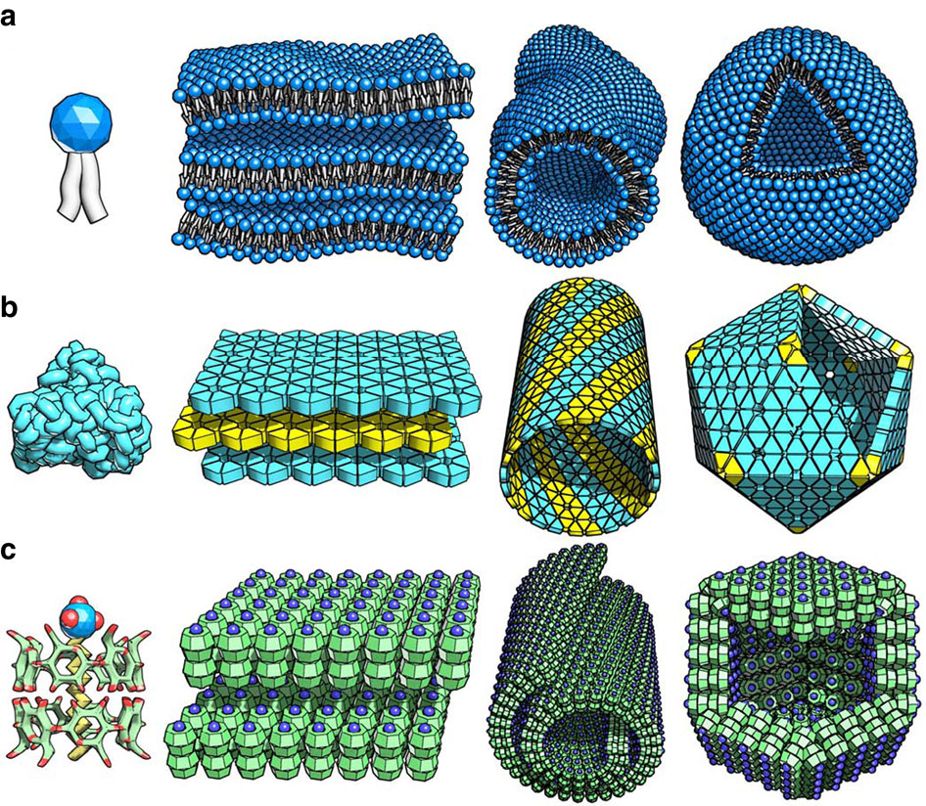
Self-assembly of lipids (a), proteins (b), and (c) SDS-cyclodextrin complexes. SDS is a surfactant with a hydrocarbon tail (yellow) and a SO4 head (blue and red), while cyclodextrin is a saccharide ring (green C and red O atoms).
Transmission electron microscopy image of an iron oxide nanoparticle. Regularly arranged dots within the dashed border are columns of Fe atoms. Left inset is the corresponding electron diffraction pattern. Scale bar: 10 nm.[1]
Iron oxide nanoparticles can be dispersed in an organic solvent (toluene). Upon its evaporation, they may self-assemble (left and right panels) into micron-sized mesocrystals (center) or multilayers (right). Each dot in the left image is a traditional "atomic" crystal shown in the image above. Scale bars: 100 nm (left), 25 μm (center), 50 nm (right).[1]
STM image of self-assembled Br4-pyrene molecules on Au(111) surface (top) and its model (bottom; pink spheres are Br atoms).[2]

Self-assembly is a process in which a disordered system of pre-existing components forms an organized structure or pattern as a consequence of specific, local interactions among the components themselves, without external direction. When the constitutive components are molecules, the process is termed molecular self-assembly.

AFM imaging of self-assembly of 2-aminoterephthalic acid molecules on (104)-oriented calcite.[3]

Self-assembly can be classified as either static or dynamic. In static self-assembly, the ordered state forms as a system approaches equilibrium, reducing its free energy. However, in dynamic self-assembly, patterns of pre-existing components organized by specific local interactions are not commonly described as "self-assembled" by scientists in the associated disciplines. These structures are better described as "self-organized", although these terms are often used interchangeably.

In chemistry and materials science

[edit]
The DNA structure at left (schematic shown) will self-assemble into the structure visualized by atomic force microscopy at right.

Self-assembly in the classic sense can be defined as the spontaneous and reversible organization of molecular units into ordered structures by non-covalent interactions. The first property of a self-assembled system that this definition suggests is the spontaneity of the self-assembly process: the interactions responsible for the formation of the self-assembled system act on a strictly local level—in other words, the nanostructure builds itself.

Although self-assembly typically occurs between weakly-interacting species, this organization may be transferred into strongly-bound covalent systems. An example for this may be observed in the self-assembly of polyoxometalates. Evidence suggests that such molecules assemble via a dense-phase type mechanism whereby small oxometalate ions first assemble non-covalently in solution, followed by a condensation reaction that covalently binds the assembled units.[4] This process can be aided by the introduction of templating agents to control the formed species.[5] In such a way, highly organized covalent molecules may be formed in a specific manner.

Self-assembled nano-structure is an object that appears as a result of ordering and aggregation of individual nano-scale objects guided by some physical principle.

A particularly counter-intuitive example of a physical principle that can drive self-assembly is entropy maximization. Though entropy is conventionally associated with disorder, under suitable conditions [6] entropy can drive nano-scale objects to self-assemble into target structures in a controllable way.[7]

Another important class of self-assembly is field-directed assembly. An example of this is the phenomenon of electrostatic trapping. In this case an electric field is applied between two metallic nano-electrodes. The particles present in the environment are polarized by the applied electric field. Because of dipole interaction with the electric field gradient the particles are attracted to the gap between the electrodes.[8] Generalizations of this type approach involving different types of fields, e.g., using magnetic fields, using capillary interactions for particles trapped at interfaces, elastic interactions for particles suspended in liquid crystals have also been reported.

Regardless of the mechanism driving self-assembly, people take self-assembly approaches to materials synthesis to avoid the problem of having to construct materials one building block at a time. Avoiding one-at-a-time approaches is important because the amount of time required to place building blocks into a target structure is prohibitively difficult for structures that have macroscopic size.

Once materials of macroscopic size can be self-assembled, those materials can find use in many applications. For example, nano-structures such as nano-vacuum gaps are used for storing energy[9] and nuclear energy conversion.[10] Self-assembled tunable materials are promising candidates for large surface area electrodes in batteries and organic photovoltaic cells, as well as for microfluidic sensors and filters.[11]

Distinctive features

[edit]

At this point, one may argue that any chemical reaction driving atoms and molecules to assemble into larger structures, such as precipitation, could fall into the category of self-assembly. However, there are at least three distinctive features that make self-assembly a distinct concept.

Order

[edit]

First, the self-assembled structure must have a higher order than the isolated components, be it a shape or a particular task that the self-assembled entity may perform. This is generally not true in chemical reactions, where an ordered state may proceed towards a disordered state depending on thermodynamic parameters.

Interactions

[edit]

The second important aspect of self-assembly is the predominant role of weak interactions (e.g. Van der Waals, capillary, , hydrogen bonds, or entropic forces) compared to more "traditional" covalent, ionic, or metallic bonds. These weak interactions are important in materials synthesis for two reasons.

First, weak interactions take a prominent place in materials, especially in biological systems. For instance, they determine the physical properties of liquids, the solubility of solids, and the organization of molecules in biological membranes.[12]

Second, in addition to the strength of the interactions, interactions with varying degrees of specificity can control self-assembly. Self-assembly that is mediated by DNA pairing interactions constitutes the interactions of the highest specificity that have been used to drive self-assembly.[13] At the other extreme, the least specific interactions are possibly those provided by emergent forces that arise from entropy maximization.[6]

Building blocks

[edit]

The third distinctive feature of self-assembly is that the building blocks are not only atoms and molecules, but span a wide range of nano- and mesoscopic structures, with different chemical compositions, functionalities,[14] and shapes.[15] [16] Research into possible three-dimensional shapes of self-assembling micrites examines Platonic solids (regular polyhedral). The term 'micrite' was created by DARPA to refer to sub-millimeter sized microrobots, whose self-organizing abilities may be compared with those of slime mold.[17][18] Recent examples of novel building blocks include polyhedra and patchy particles.[14] Examples also included microparticles with complex geometries, such as hemispherical,[19] dimer,[20] discs,[21] rods, molecules, as well as multimers. These nanoscale building blocks can in turn be synthesized through conventional chemical routes or by other self-assembly strategies such as directional entropic forces. More recently, inverse design approaches have appeared where it is possible to fix a target self-assembled behavior, and determine an appropriate building block that will realize that behavior.[7]

Thermodynamics and kinetics

[edit]

Self-assembly in microscopic systems usually starts from diffusion, followed by the nucleation of seeds, subsequent growth of the seeds, and ends at Ostwald ripening. The thermodynamic driving free energy can be either enthalpic or entropic or both.[6] In either the enthalpic or entropic case, self-assembly proceeds through the formation and breaking of bonds,[22] possibly with non-traditional forms of mediation. The kinetics of the self-assembly process is usually related to diffusion, for which the absorption/adsorption rate often follows a Langmuir adsorption model which in the diffusion controlled concentration (relatively diluted solution) can be estimated by the Fick's laws of diffusion. The desorption rate is determined by the bond strength of the surface molecules/atoms with a thermal activation energy barrier. The growth rate is the competition between these two processes.

Examples

[edit]

Important examples of self-assembly in materials science include the formation of molecular crystals, colloids, lipid bilayers, phase-separated polymers, and self-assembled monolayers.[23][24] The folding of polypeptide chains into proteins and the folding of nucleic acids into their functional forms are examples of self-assembled biological structures. Recently, the three-dimensional macroporous structure was prepared via self-assembly of diphenylalanine derivative under cryoconditions, the obtained material can find the application in the field of regenerative medicine or drug delivery system.[25] P. Chen et al. demonstrated a microscale self-assembly method using the air-liquid interface established by Faraday wave as a template. This self-assembly method can be used for generation of diverse sets of symmetrical and periodic patterns from microscale materials such as hydrogels, cells, and cell spheroids.[26] Yasuga et al. demonstrated how fluid interfacial energy drives the emergence of three-dimensional periodic structures in micropillar scaffolds.[27] Myllymäki et al. demonstrated the formation of micelles, that undergo a change in morphology to fibers and eventually to spheres, all controlled by solvent change.[28]

Properties

[edit]

Self-assembly extends the scope of chemistry aiming at synthesizing products with order and functionality properties, extending chemical bonds to weak interactions and encompassing the self-assembly of nanoscale building blocks at all length scales.[29] In covalent synthesis and polymerization, the scientist links atoms together in any desired conformation, which does not necessarily have to be the energetically most favoured position; self-assembling molecules, on the other hand, adopt a structure at the thermodynamic minimum, finding the best combination of interactions between subunits but not forming covalent bonds between them. In self-assembling structures, the scientist must predict this minimum, not merely place the atoms in the location desired.

Another characteristic common to nearly all self-assembled systems is their thermodynamic stability. For self-assembly to take place without intervention of external forces, the process must lead to a lower Gibbs free energy, thus self-assembled structures are thermodynamically more stable than the single, unassembled components. A direct consequence is the general tendency of self-assembled structures to be relatively free of defects. An example is the formation of two-dimensional superlattices composed of an orderly arrangement of micrometre-sized polymethylmethacrylate (PMMA) spheres, starting from a solution containing the microspheres, in which the solvent is allowed to evaporate slowly in suitable conditions. In this case, the driving force is capillary interaction, which originates from the deformation of the surface of a liquid caused by the presence of floating or submerged particles.[30]

These two properties—weak interactions and thermodynamic stability—can be recalled to rationalise another property often found in self-assembled systems: the sensitivity to perturbations exerted by the external environment. These are small fluctuations that alter thermodynamic variables that might lead to marked changes in the structure and even compromise it, either during or after self-assembly. The weak nature of interactions is responsible for the flexibility of the architecture and allows for rearrangements of the structure in the direction determined by thermodynamics. If fluctuations bring the thermodynamic variables back to the starting condition, the structure is likely to go back to its initial configuration. This leads us to identify one more property of self-assembly, which is generally not observed in materials synthesized by other techniques: reversibility.

Self-assembly is a process which is easily influenced by external parameters. This feature can make synthesis rather complex because of the need to control many free parameters. Yet self-assembly has the advantage that a large variety of shapes and functions on many length scales can be obtained.[31]

The fundamental condition needed for nanoscale building blocks to self-assemble into an ordered structure is the simultaneous presence of long-range repulsive and short-range attractive forces.[32]

By choosing precursors with suitable physicochemical properties, it is possible to exert a fine control on the formation processes that produce complex structures. Clearly, the most important tool when it comes to designing a synthesis strategy for a material, is the knowledge of the chemistry of the building units. For example, it was demonstrated that it was possible to use diblock copolymers with different block reactivities in order to selectively embed maghemite nanoparticles and generate periodic materials with potential use as waveguides.[33]

In 2008 it was proposed that every self-assembly process presents a co-assembly, which makes the former term a misnomer. This thesis is built on the concept of mutual ordering of the self-assembling system and its environment.[34]

At the macroscopic scale

[edit]

The most common examples of self-assembly at the macroscopic scale can be seen at interfaces between gases and liquids, where molecules can be confined at the nanoscale in the vertical direction and spread over long distances laterally. Examples of self-assembly at gas-liquid interfaces include breath-figures, self-assembled monolayers, droplet clusters, and Langmuir–Blodgett films, while crystallization of fullerene whiskers is an example of macroscopic self-assembly in between two liquids.[35][36] Another remarkable example of macroscopic self-assembly is the formation of thin quasicrystals at an air-liquid interface, which can be built up not only by inorganic, but also by organic molecular units.[37][38] Furthermore, it was reported that Fmoc protected L-DOPA amino acid (Fmoc-DOPA)[39][40] can present a minimal supramolecular polymer model, displaying a spontaneous structural transition from meta-stable spheres to fibrillar assemblies to gel-like material and finally to single crystals.[41]

Self-assembly processes can also be observed in systems of macroscopic building blocks. These building blocks can be externally propelled[42] or self-propelled.[43] Since the 1950s, scientists have built self-assembly systems exhibiting centimeter-sized components ranging from passive mechanical parts to mobile robots.[44] For systems at this scale, the component design can be precisely controlled. For some systems, the components' interaction preferences are programmable. The self-assembly processes can be easily monitored and analyzed by the components themselves or by external observers.[45]

In April 2014, a 3D printed plastic was combined with a "smart material" that self-assembles in water,[46] resulting in "4D printing".[47]

Consistent concepts of self-organization and self-assembly

[edit]

People regularly use the terms "self-organization" and "self-assembly" interchangeably. As complex system science becomes more popular though, there is a higher need to clearly distinguish the differences between the two mechanisms to understand their significance in physical and biological systems. Both processes explain how collective order develops from "dynamic small-scale interactions".[48] Self-organization is a non-equilibrium process where self-assembly is a spontaneous process that leads toward equilibrium. Self-assembly requires components to remain essentially unchanged throughout the process. Besides the thermodynamic difference between the two, there is also a difference in formation. The first difference is what "encodes the global order of the whole" in self-assembly whereas in self-organization this initial encoding is not necessary. Another slight contrast refers to the minimum number of units needed to make an order. Self-organization appears to have a minimum number of units whereas self-assembly does not. The concepts may have particular application in connection with natural selection.[49] Eventually, these patterns may form one theory of pattern formation in nature.[50]

See also

[edit]

References

[edit]

Further reading

[edit]
[edit]
Revisions and contributorsEdit on WikipediaRead on Wikipedia
from Grokipedia
Self-assembly is a process in which individual components, such as molecules, nanoparticles, or colloids, spontaneously organize into ordered structures or patterns without external guidance or intervention. This phenomenon is driven by intrinsic interactions among the components, often seeking to minimize free energy, and occurs across scales from the molecular to the macroscopic. In nature, self-assembly underpins essential biological processes, including the folding of proteins into functional three-dimensional shapes and the formation of bilayers that constitute cell membranes. These natural systems demonstrate , where simpler units assemble into increasingly complex architectures, such as viral capsids or cytoskeletal filaments. In chemistry and , self-assembly enables the creation of synthetic nanostructures with tailored properties, such as supramolecular polymers or block copolymer micelles, through non-covalent interactions like hydrogen bonding, hydrophobic effects, and van der Waals forces. Researchers have harnessed these principles to design responsive materials that adapt to environmental stimuli, including changes or temperature shifts, for applications in systems where nanoparticles encapsulate therapeutics and release them at targeted sites. In , self-assembly facilitates the bottom-up fabrication of devices, such as nanostructures for precise molecular patterning or colloidal crystals for photonic applications, offering advantages over top-down manufacturing in terms of scalability and complexity. Beyond biomedicine and electronics, self-assembly principles extend to environmental and energy technologies, including the development of self-healing materials and efficient catalysts derived from assembled metal-organic frameworks. Theoretical models, such as those for algorithmic self-assembly using DNA tiles, provide frameworks for predicting and controlling assembly outcomes, bridging biology, chemistry, and computation. Ongoing research emphasizes multifunctional hybrids that combine biological and synthetic components, paving the way for innovations in regenerative medicine and sustainable manufacturing.

Introduction

Definition and Scope

Self-assembly refers to the spontaneous organization of individual components into ordered structures or patterns as a result of specific, local interactions among the components themselves, without the need for external direction or templating. This process relies on the inherent properties of the building blocks, such as their chemical affinities or physical forces, to drive the formation of complex architectures under appropriate conditions. The scope of self-assembly spans a vast range of length scales, from molecular dimensions (nanometers) to macroscopic assemblies (millimeters and beyond), and is inherently interdisciplinary, drawing from chemistry, , physics, and to explain and harness emergent order in diverse systems. In chemistry and , it enables the creation of nanostructures like micelles or crystals; in , it underpins processes such as , where polypeptide chains spontaneously adopt functional three-dimensional conformations. Across these fields, self-assembly provides a bottom-up strategy that contrasts with top-down fabrication methods, such as , by building complexity incrementally from simple components rather than carving or etching from bulk materials. Key prerequisites for self-assembly include the nature of the assembly process, which can be reversible or irreversible. Reversible assembly allows components to dissociate and reassociate, enabling error correction and dynamic restructuring, whereas irreversible assembly involves permanent bonding that consumes available subunits without reversal. Additionally, self-assembly can be static, occurring as a system approaches thermodynamic equilibrium to minimize free energy, or dynamic, persisting in non-equilibrium conditions driven by continuous energy input, such as chemical reactions or external fields. These distinctions highlight how self-assembly generates complexity from simplicity, often favored thermodynamically in equilibrium scenarios.

Historical Development

The concept of self-assembly emerged from early 19th-century observations of spontaneous organization in chemical and physical systems, particularly in processes where molecules arranged into ordered lattices without external direction. For instance, protein crystallization was first documented in 1840, highlighting the intrinsic tendency of biomolecules to form structured aggregates under suitable conditions. By the late , colloidal systems provided further evidence of , as exemplified by the discovery of Liesegang rings in 1896, where diffusion-driven precipitation reactions produced periodic banded structures in gels, illustrating through reaction-diffusion mechanisms. In the mid-20th century, foundational work in polymer chemistry advanced understanding of self-assembly at larger scales. Paul Flory's 1953 treatise, Principles of Polymer Chemistry, elucidated the conformational statistics and phase behaviors of polymer chains, including their tendency to coil and crystallize, laying the groundwork for later models of polymeric self-organization such as the Flory-Huggins theory of mixing. This period also saw the formalization of , with Jean-Marie Lehn coining the term in 1978 to describe non-covalent interactions leading to organized molecular assemblies beyond covalent bonds, earning him the 1987 . Key milestones in the 1980s and 1990s shifted focus toward programmable self-assembly for . Nadrian Seeman's 1982 proposal of junctions and lattices introduced as a programmable scaffold for rigid nanostructures, founding the field of structural . In the 1990s, George Whitesides' reviews, such as his 1991 article on , emphasized its potential for synthesizing nanostructures via equilibrium-driven associations, influencing applications in materials and interfaces. Post-2000, self-assembly integrated deeply with through interdisciplinary frameworks, exemplified by the U.S. (NNI), announced in 2000 and implemented starting in 2001, to which NSF contributed $216.7 million for broad nanoscale research, including for nanoscale device fabrication. This initiative built on thermodynamic principles of reversible interactions to enable hierarchical structures, marking self-assembly's transition to a core paradigm in modern nanoscience.

Fundamental Principles

Thermodynamic and Kinetic Foundations

Self-assembly processes are fundamentally driven by thermodynamic principles that favor the minimization of the Gibbs free energy, ΔG=ΔHTΔS\Delta G = \Delta H - T \Delta S, where ΔH\Delta H represents the change in enthalpy due to intermolecular bonds and interactions, TT is the absolute temperature, and ΔS\Delta S is the change in entropy. In typical systems, ΔH\Delta H is negative from favorable enthalpic contributions such as hydrogen bonding, electrostatic attractions, or van der Waals forces, stabilizing the assembled state. Entropy changes can oppose assembly by reducing molecular disorder, but solvent effects often compensate; for instance, in aqueous environments, the hydrophobic effect increases solvent entropy as nonpolar molecules aggregate, releasing structured water molecules. Under equilibrium conditions, self-assembly proceeds reversibly to the state of minimum free energy, where the system achieves a balance between association and dissociation. The strength of molecular associations is quantified by the equilibrium association constant KaK_a, related to the standard free energy change by Ka=eΔG/RTK_a = e^{-\Delta G^\circ / RT}, with RR as the . This exponential dependence highlights how even small changes in ΔG\Delta G^\circ can dramatically shift the equilibrium toward assembled structures, enabling precise control through or solvent adjustments. Kinetic factors determine the pathway and rate at which equilibrium is approached, often involving an initial step followed by growth. faces an barrier ΔG\Delta G^* arising from the unfavorable of small clusters, typically on the order of 70–140 kBTk_B T for viral capsids under weak conditions, where kBk_B is Boltzmann's constant. The rate of barrier crossing follows the , k=AeEa/RTk = A e^{-E_a / RT}, with AA as the and EaE_a (often ΔG\Delta G^*) as the ; this governs both rates and subsequent growth kinetics, which accelerate with increasing . In non-equilibrium self-assembly, continuous energy input sustains structures away from thermodynamic minima through dissipation, as seen in ATP-fueled biological processes like actin polymerization. Here, the excess chemical potential Δμ\Delta \mu from ATP hydrolysis drives growth while increasing defect rates, with design principles linking assembly size, growth velocity, and energy consumption via relations such as σ2/v2D/N\sigma^2 / \langle v \rangle^2 \geq D / N, where σ2\sigma^2 is growth rate variance, vv is velocity, DD is relative entropy, and NN is structure size. This dissipation enables dynamic, transient assemblies not accessible at equilibrium.

Key Interactions and Building Blocks

Self-assembly processes rely on non-covalent interactions to direct the organization of molecules into ordered structures without external intervention. These interactions are reversible and relatively weak, allowing for dynamic equilibration and adaptability. Primary types include hydrogen bonding, which forms between electronegative atoms and hydrogen attached to similar atoms, providing directional specificity with typical strengths of 5-30 kcal/mol in various environments. Van der Waals forces, encompassing dispersion, dipole-dipole, and induced dipole interactions, operate over short distances with energies of approximately 0.5-5 kcal/mol, contributing to overall cohesion in dense assemblies. π-π stacking occurs between aromatic rings, stabilizing planar motifs with interaction energies of 1-10 kcal/mol through overlap of π-electron clouds. The , prominent in aqueous systems, drives nonpolar components to aggregate by reducing solvent-exposed surface area, with an effective free energy contribution of about 1-2 kcal/mol per methylene (-CH₂-) group buried. Building blocks for self-assembly are designed to exploit these interactions, often classified by their or flexibility. Rigid molecules, such as disc-shaped or rod-like entities, favor crystalline or columnar arrangements due to their geometric constraints, enhancing packing efficiency. In contrast, flexible molecules like , with amphiphilic heads and tails, self-organize into micelles or bilayers via hydrophobic segregation and headgroup repulsion. Dendrimers, highly branched macromolecules with a core, iterative branches, and peripheral functional groups, serve as versatile building blocks for hierarchical assembly, enabling encapsulation and controlled release in nanostructures. Specificity in these assemblies is frequently governed by shape complementarity, where the geometric fit between components maximizes favorable contacts and minimizes steric clashes, akin to enzyme-substrate recognition. Encoding structural information in self-assembling systems involves orthogonal interactions, which are mutually independent and non-interfering, facilitating multi-component assemblies with precise control. This approach allows simultaneous operation of distinct motifs, such as combining hydrogen bonding with metal-ligand coordination, to build complex architectures from diverse subunits. Traditional lock-and-key mechanisms rely on a single, highly specific complementary pair for binary recognition, limiting scalability, whereas programmable motifs—using sequence-defined oligomers like peptides or DNA—enable information-rich designs that dictate hierarchical order through combinatorial specificity. Error correction enhances the fidelity of self-assembly by leveraging dynamic exchange, where transient bonds break and reform, favoring thermodynamically stable configurations over kinetic traps. In dynamic systems, incorrect aggregates dissociate via reversible interactions, allowing components to redistribute and amplify the correct structure. This principle is central to dynamic , where libraries of interconverting species self-select optimal assemblies under equilibrium conditions.

Self-Assembly in Chemistry and Materials Science

Supramolecular Chemistry

Supramolecular chemistry encompasses the self-assembly of discrete molecular architectures through non-covalent interactions, enabling the formation of complex structures such as host-guest complexes, rotaxanes, and catenanes. Host-guest complexes involve a host molecule that selectively binds a guest via complementary shapes and interactions, mimicking biological recognition processes. Rotaxanes feature a linear molecule threaded through a macrocycle, stabilized by bulky end groups to prevent dissociation, while catenanes consist of interlocked rings akin to chain links. These concepts were pioneered by Jean-Marie Lehn, whose work on supramolecular systems, including cryptands and coronands for alkali metal ion binding, earned him the 1987 Nobel Prize in Chemistry shared with Donald J. Cram and Charles J. Pedersen for developing molecules with structure-specific interactions of high selectivity. Prominent examples of self-assembled cages include those developed by Makoto Fujita in the 1990s, utilizing metal-ligand coordination to form nanoscale polyhedral structures. In 1995, Fujita reported a self-assembled M₆L₄ coordination cage, approximately 2 nm in diameter, constructed from six palladium(II) ions and four tris-bipyridyl ligands, capable of encapsulating guest molecules like carboxylates within its cavity. These cages demonstrate high symmetry and stability due to the directional nature of coordination bonds. Complementing this, based on rotaxanes and catenanes were advanced by , whose template-directed syntheses enabled controlled motion and switching, contributing to his 2016 shared with Jean-Pierre Sauvage and Bernard L. Feringa for designing and synthesizing . Design strategies in supramolecular self-assembly often rely on template-directed synthesis to guide component orientation and prevent kinetic traps. In formation, for instance, π-π stacking and hydrogen bonding serve as templates to position macrocycles on axles before end-capping. Metal-ligand coordination is another key approach, particularly for constructing helicates and grids; helicates form when linear bis-bidentate ligands wrap around metal ions in a helical fashion, as seen in Lehn's copper(I) double helicates from oligobipyridine strands, exhibiting self-recognition to selectively assemble homochiral complexes. Grids, such as Lehn's [2×2] or [3×3] metallosupramolecular arrays, arise from angular ligands coordinating to transition metals, yielding rectangular or square architectures with potential for information storage due to redox-switchable states. Despite these advances, challenges persist in achieving and stability for supramolecular assemblies in solution. Many coordination cages suffer from poor aqueous due to hydrophobic and metals, limiting biological applications and requiring solubilizing groups like sulfonates. Stability issues arise from competing coordination or ligand exchange, which can disassemble structures under non-ideal conditions, necessitating careful selection of inert metals and protective environments. These hurdles underscore the need for robust, reversible interactions, such as those involving hydrogen bonding, to maintain integrity without covalent fixation. Recent developments as of 2025 include dynamic self-assembly pathways in dendrimers, enabling reversible transitions between lamellar vesicles and other morphologies, and the formation of supramolecular nanosheets from carpyridine monomers that assemble controllably based on solution wetness.

Nanostructured Materials

Nanostructured materials in chemistry and are engineered through self-assembly techniques that leverage colloidal particles and polymeric building blocks to form ordered architectures with tailored optical, electronic, and mechanical properties. Colloidal self-assembly and block copolymer microphase separation represent key approaches, enabling the creation of extended solid-state structures such as superlattices, thin films, and periodic arrays. These methods exploit intermolecular forces and phase behaviors to achieve nanoscale precision, distinct from discrete molecular assemblies. Colloidal self-assembly organizes nanoparticles into superlattices via evaporation-induced or electrostatic mechanisms. In evaporation-induced assembly, removal concentrates particles at air-liquid interfaces or substrates, promoting long-range ordering; for instance, dodecanethiol-capped nanoparticles (6 nm) form hexagonal monolayers through rapid evaporation in drop-casting setups. This process, demonstrated early with CdSe quantum dots forming face-centered cubic (fcc) superlattices, relies on ligand-mediated attractions that stabilize ordered phases over disordered ones. Electrostatic assembly, conversely, drives organization through charge interactions; oppositely charged nanoparticles, such as those with tailored alkanethiol ligands, assemble into body-centered cubic (bcc) or CsCl-type superlattices when charge ratios and screening lengths are optimized, as seen with and silver nanocrystals forming micrometer-sized diamond-like crystals at electroneutrality. These techniques yield robust, polycrystalline films with domain sizes exceeding micrometers, governed by underlying thermodynamic phase behaviors that favor entropy-driven packing in compatible s. Representative examples highlight the versatility of these methods. Silica spheres self-assemble into photonic crystals through vertical deposition, where capillary forces during solvent evaporation arrange monodisperse particles (e.g., 200-300 nm) into close-packed lattices exhibiting iridescent colors and photonic bandgaps for optical applications. Carbon nanotubes form aligned bundles via electrostatic and interactions; single-walled nanotubes functionalized with quaternary ions assemble into linear, micrometer-long structures under a DC electric (~40-100 V), enabling deposition as oriented films for . Block copolymer micelles achieve nanostructuring through micro, where immiscible blocks segregate into periodic domains while covalent links prevent macroscopic . Common morphologies include lamellae (alternating layers) for symmetric compositions and cylinders (hexagonal arrays) for asymmetric ones, with the order-disorder transition (ODT) occurring when the product of the Flory-Huggins interaction parameter and , χN\chi N, exceeds the critical value of 10.5 in . This threshold, predicted by self-consistent field theory, marks the onset of ordered phases from a disordered melt, as validated in polystyrene-block-polybutadiene systems forming lamellar domains with periods of 10-50 nm. Post-2000 advances have integrated biomolecular templates into these strategies, notably DNA-guided assembly for nanowires. Building on DNA-mediated nanoparticle aggregation introduced in 1996, where thiolated oligonucleotides link nanoparticles (13 nm) into reversible aggregates via complementary base pairing, subsequent work has extended this to linear nanowires by templating metal deposition along DNA strands. For example, DNA scaffolds direct the electroless reduction of silver or palladium ions into conductive nanowires with diameters of 10-20 nm and lengths up to microns, achieving resistivities approaching bulk metals through optimized and growth. These hybrid approaches combine the programmability of DNA with colloidal precision, enabling hierarchical nanostructures for sensing and interconnects. Recent progress as of 2025 encompasses the self-assembly of low-molecular-weight into nanostructured macroscopic materials via controlled dissolution and regeneration, and single-step aerosol-based production of magnetic nanostructures with anisotropic properties.

Self-Assembly in Biology

Molecular Biomolecules

Self-assembly at the molecular level in biomolecules primarily involves the folding of proteins and nucleic acids, driven by non-covalent interactions that stabilize specific three-dimensional structures essential for biological function. In proteins, this process is exemplified by folding, where a linear polypeptide chain adopts its native conformation through intramolecular interactions. Christian Anfinsen's experiments on ribonuclease A demonstrated that the amino acid sequence alone determines the final structure, a principle known as Anfinsen's dogma or the thermodynamic hypothesis, as the denatured protein refolds spontaneously upon removal of denaturants in vitro. This self-assembly is guided by the minimization of free energy, but the vast conformational space poses a challenge highlighted by the Levinthal paradox: a random search through all possible configurations for a 100-residue protein would take longer than the age of the universe, even at rapid sampling rates. To resolve this, the energy landscape theory posits a funnel-shaped potential surface, where the native state lies at the bottom, and folding proceeds via a biased downhill path that avoids exhaustive sampling through local minima corresponding to partially folded intermediates. Nucleic acids exhibit analogous self-assembly, with DNA forming the iconic double helix through base pairing. James Watson and Francis Crick proposed the structure in 1953, revealing how adenine-thymine and guanine-cytosine pairs stabilize two antiparallel strands via hydrogen bonds and stacking interactions, enabling genetic information storage and replication. RNA, in contrast, folds into more complex single-stranded structures featuring motifs such as stem-loops (A-form helices closed by loops), bulges, and pseudoknots, which facilitate functions like catalysis in ribozymes and recognition in regulatory elements; these motifs are stabilized by similar non-covalent forces and are evolutionarily conserved across ribosomal and transfer RNAs. For designing DNA-based nanostructures, Nadrian Seeman introduced immobile junctions in 1982, where branched DNA molecules with sticky ends assemble into rigid, non-migrating four-way junctions, mimicking Holliday junctions but fixed to prevent branch migration and enable higher-order lattices. Representative examples of biomolecular self-assembly include virus capsids and amyloid fibrils. Viral capsids assemble from coat protein subunits into icosahedral shells with quasi-equivalent symmetry, as described by Donald Caspar and Aaron Klug's theory, which classifies structures using triangulation numbers (T) to accommodate 60T subunits while minimizing strain through geometric principles. In contrast, amyloid fibrils form pathological aggregates in diseases like Alzheimer's, where proteins such as amyloid-β self-assemble into β-sheet-rich fibrils via hydrophobic and hydrogen bonding interactions, propagating templated misfolding. These processes occur in aqueous environments, where non-covalent forces—hydrogen bonds, van der Waals interactions, electrostatics, and the hydrophobic effect—dominate, as water solvates polar groups and drives burial of non-polar residues to minimize entropy loss. Kinetic barriers in folding are often overcome by molecular chaperones, such as Hsp70 and GroEL, which provide kinetic assistance by binding unfolded states to prevent aggregation and facilitate productive pathways without altering the thermodynamic minimum.

Cellular and Tissue Structures

Self-assembly plays a crucial role in the formation of organelles within cells, where lipid molecules spontaneously organize into bilayers to create membranes. Amphiphilic lipids, with hydrophilic heads and hydrophobic tails, self-assemble through hydrophobic interactions and van der Waals forces, forming stable bilayer structures that encapsulate cellular compartments such as the plasma membrane and organelle envelopes. This process is driven by thermodynamic minimization of free energy, resulting in curved or flat bilayers depending on lipid composition and environmental conditions. In parallel, cytoskeletal organelles like microtubules emerge from the polymerization of tubulin dimers, exhibiting dynamic instability—a non-equilibrium behavior where microtubules alternate between phases of growth and rapid depolymerization. This seminal mechanism, first described in 1984, allows microtubules to explore cellular space and maintain structural integrity through stochastic switching influenced by GTP hydrolysis. At the supracellular level, self-assembly extends to the (ECM), a dynamic network of proteins and polysaccharides that provides mechanical support and guides tissue architecture. and other ECM components, such as , self-assemble via multivalent interactions, forming fibrillar networks that integrate with cell surfaces through . This assembly is hierarchical, starting from molecular nucleation and progressing to bundled fibers that confer tissue stiffness and elasticity. In developmental , reaction-diffusion mechanisms, as theorized by in 1952, underpin pattern formation in tissues like limb buds, where morphogen gradients drive periodic structures such as digit spacing through activator-inhibitor dynamics. Turing's model has been applied to explain self-organizing patterns in vertebrate limb development, where differential diffusion rates of signaling molecules lead to stable spatial arrangements. Representative examples illustrate these principles in biological contexts. Bacterial biofilms form through self-assembly of microbial communities embedded in a self-produced polymeric matrix, where cells adhere via pili and extracellular polymeric substances (EPS) like and proteins, creating resilient, three-dimensional structures that protect against environmental stresses. In embryogenesis, molecules such as cadherins mediate selective aggregation of cells into tissues; for instance, E-cadherin homophilic interactions drive compaction of the morula and subsequent by sorting cells based on adhesion strength. These processes are powered by non-equilibrium drivers, including and energy dissipation in the , where —continuous addition of subunits at one filament end and loss at the other—sustains directed assembly against . and filaments, such as those referenced briefly from molecular building blocks, exhibit fueled by ATP/GTP , enabling persistent motion and reorganization in living tissues.

Self-Assembly in Physics and Soft Matter

Colloidal and Liquid Crystal Systems

Colloidal self-assembly in soft matter systems typically involves the spontaneous organization of micron-sized particles, such as microspheres, into ordered lattices driven by entropic and electrostatic forces. Sedimentation under gravity allows monodisperse colloids to settle and crystallize into face-centered cubic (FCC) or hexagonal close-packed structures, mimicking atomic crystallization but observable in real time due to the particles' Brownian motion. This process is particularly effective for nearly hard-sphere suspensions, where volume fraction increases lead to fluid-to-crystal transitions around 0.49–0.58 packing density. Seminal experiments by Pusey and van Megen in 1986 confirmed this phase behavior using sterically stabilized polystyrene spheres, establishing colloids as model systems for studying nucleation and growth kinetics. A prominent example of colloidal crystals is the structure, formed by self-assembly of silica microspheres into periodic arrays that exhibit Bragg diffraction of visible light, producing . In artificial opals, evaporation-induced assembly or arranges spheres into three-dimensional lattices with lattice constants on the order of 200–300 nm, enabling photonic band gaps for wavelengths in the visible to near-infrared range. These diffraction effects arise from the contrast between the spheres and surrounding medium, as quantified by , nλ=2dsinθn \lambda = 2 d \sin \theta, where dd is the interplane spacing. High-quality opals have been fabricated with domain sizes exceeding millimeters, demonstrating scalability for photonic applications. Depletion interactions significantly influence colloidal assembly by generating effective attractions between larger particles in the presence of smaller, non-adsorbing depletants like polymers or nanoparticles. The Asakura-Oosawa model, introduced in 1958, describes this as an entropic effect: depletants are excluded from a thin shell around each , creating an imbalance that drives particles together when their separation is less than the depletant . The resulting potential is square-well-like, with depth proportional to depletant concentration and range set by depletant size, promoting or at low colloid volume fractions. This model has been validated experimentally in polymer-colloid mixtures, where it predicts thresholds accurately. Specific examples of engineered colloidal self-assembly include DNA-linked colloids, where single-stranded DNA strands grafted to particle surfaces hybridize to form programmable bonds, directing assembly into clusters, chains, or lattices with sub-micrometer precision. A key demonstration in 2005 showed reversible aggregation of polystyrene microspheres into micrometer-scale structures by temperature-controlled DNA melting, achieving binding strengths tunable from 10 to 100 kBTk_B T. This approach leverages Watson-Crick base pairing for specificity, enabling hierarchical assembly beyond isotropic interactions. Liquid crystals represent another cornerstone of self-assembly in , where anisotropic molecules or particles align into phases balancing order and fluidity. The nematic phase is characterized by long-range orientational order of molecular axes without positional periodicity, resulting in and responsiveness to external fields. Smectic phases introduce layering, with smectic-A featuring alignment and positional order along one dimension, while smectic-C allows tilt. These phases emerge from competition between translational and rotational entropy, often in thermotropic systems where temperature tunes the isotropic-nematic transition. The Maier-Saupe theory, developed in 1958–1959, provides a mean-field framework for the nematic phase by modeling anisotropic van der Waals interactions as a quadrupolar potential, predicting a transition at a critical Maier-Saupe parameter of approximately 2.36, in agreement with experimental clearing temperatures for rod-like mesogens. Lyotropic liquid crystals, prevalent in surfactant systems, self-assemble under solvent influence, forming concentration-dependent phases that encapsulate hydrophobic and hydrophilic regions. Surfactants like phospholipids or block copolymers organize into lamellar bilayers at low concentrations, transitioning to hexagonal (cylindrical micelles) or cubic (bicontinuous networks) phases as packing frustration increases, governed by the critical packing parameter v/(al)v / (a l), where vv is hydrophobic volume, aa headgroup area, and ll tail length. These structures, such as hexagonal phases in cetyltrimethylammonium bromide solutions, exhibit viscosities orders of magnitude higher than isotropic micelles and have been exploited for templating nanomaterials. Reviews highlight their thermodynamic stability across water contents from 20% to 80%, with phase diagrams mapping self-assembly pathways.

Phase Transitions and Patterns

In self-assembly processes within physics and systems, order-disorder transitions represent fundamental phase changes where structured arrangements emerge or dissolve due to or external parameters. These transitions are analogous to magnetic phase changes modeled by the Ising framework, where spins align below a critical , mimicking particle ordering in self-assembling colloids or binary fluids. In binary mixtures, critical points mark the boundary between miscible and phase-separated states, driven by competing interactions that lead to spontaneous domain formation, as seen in simulations of mixtures with short-range attractions and long-range repulsions. Such transitions highlight how proximity to criticality amplifies fluctuations, enabling self-assembly into periodic or clustered structures without external templating. Pattern formation often arises from instabilities in reaction-diffusion systems, where spatial variations in concentration and reactivity generate periodic motifs through and inhibition. The Gierer-Meinhardt model exemplifies this, positing an activator-inhibitor dynamics that destabilizes uniform states to produce spotted or striped patterns via Turing bifurcations. Classic examples include Liesegang rings, formed by periodic precipitation in gel media under diffusion-limited reaction fronts, resulting in banded deposits from waves. Similarly, Bénard cells emerge in convecting fluids heated from below, where buoyancy-driven instabilities self-organize into hexagonal convection rolls, a dissipative pattern sustained by energy dissipation. These mechanisms underscore how far-from-equilibrium conditions foster self-assembled spatial order from initial homogeneity. Fractal and dendritic growth patterns in self-assembly stem from diffusion-limited processes, where aggregating particles form branching structures with scale-invariant morphology. The (DLA) model captures this by simulating random walks of diffusing particles adhering to a growing cluster, yielding dimensions around 1.7 in two dimensions that reflect irreversible attachment kinetics. This framework explains dendritic patterns in electrodeposition or , where growth is dominated by solute rather than surface kinetics, leading to ramified aggregates with indicating roughness at all scales. Advances in the 2010s and 2020s have explored in systems, where drive nonequilibrium assemblies beyond passive . In bacterial swarms, collective generates dynamic bands and vortices through density-dependent speed variations, analogous to in synthetic active colloids. These patterns, often exhibiting , demonstrate how energy input sustains spatiotemporal order, with swarm edges propagating as unstable fronts that coarsen into stable configurations. The 2025 motile roadmap reviews ongoing progress in non-equilibrium self-organization and outlines future challenges for designing living-like active materials.

Macroscopic and Engineered Self-Assembly

Physical Macroscale Phenomena

In granular materials, self-assembly manifests through spontaneous segregation and clustering processes driven by mechanical agitation, such as in where larger particles rise to the surface despite expectations from differences. This phenomenon, known as the Brazil nut effect, occurs when a of particles of varying sizes is subjected to or shear, leading to the upward migration of larger intruders due to and void filling mechanisms. In settings, such as those simulated in rotating drums or observed in natural granular flows, large particles segregate to the while smaller ones percolate downward, enhancing flow mobility and influencing dynamics. Crystallization represents another key macroscale self-assembly process in non-living systems, where ordered structures emerge from disordered precursor solutions or vapors through diffusion-controlled growth. Snowflake formation exemplifies this, as diffuses onto nuclei in supersaturated air, producing intricate hexagonal symmetries via (DLA), a process that generates branched, fractal-like patterns at scales from micrometers to centimeters. Similarly, formations like geodes arise from sequential within cavities in volcanic or sedimentary rocks, where silica-rich fluids deposit layers of and other minerals, self-organizing into concentric bands and through episodic precipitation and . These structures maintain order over macroscopic dimensions, with geodes reaching diameters of up to several meters, due to sustained geochemical gradients that prevent premature . Distinct examples of macroscale self-assembly include clusters and wind-driven dunes, both governed by energy minimization principles akin to those in . In clusters, films self-assemble into polyhedral arrangements following Plateau's laws, where surfaces meet at 120-degree angles along edges and four edges converge at vertices at tetrahedral angles (approximately 109.5 degrees), stabilizing clusters of dozens of bubbles with area. dune patterns, such as barchans or transverse dunes, emerge from the interaction of with erodible , where saltating grains create instabilities that amplify into rhythmic undulations spanning tens to hundreds of meters, self-organizing through feedback between and . Scaling self-assembly from microscopic to macroscopic regimes presents significant challenges, primarily due to the loss of order from , defects, and external perturbations that disrupt long-range correlations. In physical systems like granular flows or , achieving uniform assembly over large volumes requires precise control of environmental parameters, such as vibration amplitude or levels, yet defects often propagate, limiting scalable order to hierarchical structures rather than perfect lattices. These issues highlight the need for hybrid approaches that leverage spontaneous processes while mitigating entropy-driven disorder at extended scales.

Directed and Hierarchical Assembly

Directed self-assembly techniques employ external guides, such as templates or fields, to control the formation of ordered structures from molecular building blocks, enabling precise patterning beyond spontaneous processes. These methods leverage physical or chemical cues to direct the orientation and positioning of assembling components, achieving higher fidelity in complex architectures. For instance, can align block copolymer (BCP) domains by inducing dielectric , promoting perpendicular cylinder orientations in thin films for applications. Similarly, exploit the diamagnetic or paramagnetic properties of materials to orient anisotropic particles or polymer chains in block copolymers, yielding long-range order over macroscopic areas. Combined and further enhance control, facilitating the assembly of composite films with periodic microstructures from suspended particles. Lithographic patterning serves as a key templating strategy, where pre-defined surface patterns—created via electron-beam or —guide the self-assembly of BCPs into registered arrays. This directed self-assembly (DSA) of BCPs, such as polystyrene-block-polymethylmethacrylate (PS-b-PMMA), conforms to chemical or topographical templates, reducing defects and enabling sub-10 nm feature sizes for fabrication. In chemo-epitaxy, neutral and preferential wetting layers on substrates direct BCP into aligned lattices, with process yields exceeding 99% for line-space patterns over 300 mm wafers. Hierarchical assembly builds multi-level structures sequentially, analogous to biological systems, where primary assembly at the molecular scale (e.g., polymerization into oligomers) precedes secondary nano-scale organization (e.g., or formation), followed by tertiary micro-scale aggregation into functional motifs. This progression is evident in metal-organic frameworks (MOFs), where primary coordination bonds form secondary porous cages that assemble into tertiary networks via supramolecular interactions, yielding tunable porosities for . In supramolecular polymers, primary non-covalent bonds (e.g., hydrogen bonding) drive secondary helical structures, which further organize into tertiary , as seen in peptide-based systems achieving ordered bundles with controlled . A prominent example is BCP for integrated circuits, where DSA patterns sub-10 nm lines and vias, surpassing traditional limits; for instance, high-χ BCPs like PS-b-P4VP yield defect-free gratings with 8 nm half-pitch, transferable to via for fabrication. In , 3D-printed scaffolds direct hierarchical self-assembly of cells and ; polycaprolactone scaffolds printed with self-assembling peptide hydrogels promote stem cell differentiation into osteochondral tissues, forming layered nano-fibrils (secondary) within micro-porous matrices (tertiary) to mimic native extracellular matrices. In the 2020s, trends emphasize AI-optimized designs for directed hierarchical assembly in , where algorithms predict and refine modular assembly pathways for adaptive structures. These approaches integrate DSA principles with robotic fabrication, enabling scalable production of reconfigurable soft grippers and walkers.

Technological and Biomedical Uses

Self-assembled monolayers (SAMs) have emerged as a key platform in electronic devices, particularly for sensors, where they enable precise surface functionalization to enhance sensitivity and selectivity. By forming ordered molecular layers on substrates like or , SAMs facilitate the immobilization of biomolecules such as enzymes or antibodies, allowing for the development of biosensors that detect analytes at low concentrations through electrochemical or optical signals. This tunability stems from the ability to control terminal functional groups and chain lengths, making SAMs versatile for applications in chemical and biological sensing. In organic photovoltaics, self-assembly plays a crucial role in optimizing the morphology of active layers, leading to improved charge separation and transport. Recent advancements have achieved power conversion efficiencies exceeding 20%, as demonstrated in binary organic solar cells using non-fullerene acceptors with self-assembled interlayers that reduce interfacial losses. For instance, self-assembled monolayers as hole-transport layers have enabled efficiencies over 20% by enhancing alignment and minimizing recombination. In , self-assembly underpins liposomal drug delivery systems, which encapsulate therapeutics within bilayers to improve targeting and reduce systemic toxicity. A seminal example is Doxil, the first FDA-approved liposomal formulation of in 1995, which utilizes polyethylene glycol-coated liposomes to achieve prolonged circulation and enhanced tumor accumulation via the . These self-assembled vesicles protect sensitive drugs from degradation and enable controlled release, significantly advancing outcomes. Self-assembly also drives the fabrication of scaffolds in , where peptides or proteins spontaneously form nanofibrous networks that mimic the to support , proliferation, and differentiation. Techniques like by self-assembly (TESA) leverage fibroblasts to deposit their own collagen-rich matrices, creating scaffold-free constructs suitable for skin or regeneration without synthetic additives. Peptide-based hydrogels, such as those from β-sheet-forming sequences, provide biocompatible environments that promote three-dimensional tissue formation. Emerging applications include , where dynamic networks like vitrimers incorporate self-assembly principles to enable repair through bond exchange. Vitrimers, featuring covalent adaptable networks, achieve high healing efficiencies—up to 96% at —while maintaining mechanical strength, as seen in epoxy-based formulations that reform crosslinks under mild conditions. In biomedicine, advances in self-assembling nanoparticles for mRNA vaccines have progressed significantly by 2025, with lipid nanoparticles (LNPs) designed for room-temperature assembly to enhance stability and delivery efficiency. These LNPs reduce lipid content while improving , potentially lowering vaccine dosages and costs for broader accessibility. For sustainability, bio-inspired self-assembly has led to innovative membranes for , drawing from natural filtration systems like aquaporins. Amphiphilic block copolymers self-assemble into nanoporous structures that selectively transport water while rejecting contaminants, achieving high flux rates in applications. Supramolecular fiber membranes, inspired by protein assemblies, offer self-healing and antifouling properties, enabling efficient removal of dyes and from .

Computational Modeling and Simulation

Computational play a crucial role in predicting and designing self-assembly processes by bridging atomic-scale interactions with mesoscale and macroscopic phenomena. These techniques enable researchers to explore thermodynamic and kinetic pathways that are often inaccessible experimentally, providing insights into without physical synthesis. By simulating particle interactions under various conditions, models reveal optimal assembly conditions and potential defects, guiding the rational design of self-assembling materials. Molecular dynamics (MD) simulations, particularly all-atom approaches, offer high-fidelity representations of self-assembly at the atomic level. In all-atom MD, every atom is explicitly modeled, allowing for detailed capture of intramolecular and intermolecular forces, including van der Waals, electrostatic, and bonded interactions. Software like GROMACS facilitates these simulations through efficient algorithms for large systems, enabling the study of self-assembly in solvated environments over timescales up to microseconds. Force fields such as AMBER parameterize these interactions based on quantum mechanical data and empirical fitting, accurately reproducing lipid bilayer self-assembly and peptide aggregation dynamics. For instance, AMBER has been used to simulate the spontaneous formation of phospholipid bilayers from random dispersions, highlighting the role of hydrophobic effects in driving assembly. Coarse-grained (CG) models reduce computational complexity by grouping atoms into effective "beads," making them ideal for mesoscale self-assembly over longer timescales and larger length scales. Dissipative particle dynamics (DPD) is a prominent CG method that incorporates hydrodynamic effects through soft, repulsive interactions and dissipative forces, simulating the of amphiphilic molecules in solution. The Martini force field, developed for biomolecular systems, maps four to six heavy atoms per bead and has been extensively applied to predict formation and self-assembly with improved transferability across solvents. These models balance accuracy and efficiency, often bridging all-atom details with continuum descriptions to forecast phase behaviors in systems. Key examples illustrate the predictive power of these simulations. In protein self-assembly, AlphaFold's architecture has revolutionized folding predictions by achieving near-experimental accuracy for single-chain structures, informing multi-subunit assembly pathways through energy landscape analysis. methods complement MD by sampling configurational space to construct phase diagrams, such as those for colloidal rods where critical points for nematic ordering emerge from entropy-driven interactions. In the 2020s, has integrated with traditional simulations for inverse design, where neural networks optimize particle shapes or interaction potentials to target specific assembled structures. These approaches, often using or generative models, accelerate the discovery of self-assembling motifs for colloidal crystals by iteratively refining designs based on simulated outcomes. Such hybrid methods enhance conceptual understanding of assembly hierarchies while minimizing trial-and-error in material engineering.

Distinction from Self-Organization

Self-assembly is defined as the autonomous formation of stable, ordered structures from individual components through specific, reversible interactions, typically reaching a state. In contrast, self-organization encompasses the of global order from local interactions governed by simple rules, often in systems far from equilibrium where continuous energy dissipation is required to maintain the structure. These definitions highlight self-assembly's focus on component-specific architectures, such as the precise arrangement of molecules, while self-organization emphasizes collective behaviors arising from decentralized dynamics without predefined templates. Although both processes generate without external templating, key differences lie in their thermodynamic contexts and reversibility. Self-assembly processes are generally equilibrium-driven and reversible, allowing structures to disassemble if conditions change, as seen in many molecular and colloidal systems. , however, frequently occurs in dissipative systems that rely on non-equilibrium conditions and energy throughput to sustain order, rendering the structures inherently unstable once the energy flow ceases—a concept central to Prigogine's work on dissipative structures, for which he received the 1977 . Overlaps exist in hybrid scenarios where self-assembly contributes to self-organized patterns, but the distinction underscores self-assembly's static, energy-minimizing nature versus self-organization's dynamic, entropy-producing character. Illustrative examples clarify this boundary. The formation of a crystal lattice, where atoms or molecules spontaneously arrange into a periodic structure via intermolecular forces, exemplifies self-assembly as an equilibrium process that minimizes free energy. Conversely, the development of cells in a layer heated from below, known as Bénard cells, demonstrates : hexagonal patterns emerge through heat-driven instabilities in an open, far from equilibrium. These cases show how self-assembly yields predefined, stable configurations, while produces adaptive patterns dependent on ongoing environmental fluxes. Consistent theoretical frameworks for these distinctions were established by Grégoire Nicolis and in their 1977 monograph, which delineates as arising from fluctuations in non-equilibrium systems, contrasting with the equilibrium pathways of assembly. This work provides a foundational basis for understanding how order can emerge reversibly in closed systems (self-assembly) or irreversibly in open ones (), influencing subsequent research in physics and .

Emergence in Complex Systems

Emergence in complex systems refers to the phenomenon where interactions among simple components give rise to properties or behaviors at higher levels that are not predictable from the individual parts alone, often described as the whole being greater than the sum of its parts. This process involves multi-scale feedback loops, where local interactions propagate across scales to produce global patterns or functions. In self-assembling systems, these loops enable the spontaneous formation of ordered structures from disordered components, fostering complexity without centralized control. Self-assembly serves as a foundational mechanism for building in biological complex adaptive systems, where basic units aggregate to create emergent collective behaviors. For instance, in ant colonies, individual ants follow local rules such as response and physical contact, leading to the self-assembly of dynamic structures like bridges or rafts that enhance group survival and foraging efficiency. Similarly, in neural networks, synaptic connections self-assemble through activity-dependent mechanisms during development, resulting in emergent computational capabilities such as and that exceed the function of isolated neurons. These examples illustrate how self-assembly provides the structural scaffold for multi-agent interactions to yield higher-order . Key theoretical frameworks underscore self-assembly's role in emergence. Stuart Kauffman's concept of autocatalytic sets, introduced in his 1993 work, posits that in sufficiently diverse networks, self-sustaining cycles emerge where molecules catalyze each other's production, forming the basis for life's complexity from prebiotic self-assembly. Complementing this, Per Bak's 1987 sandpile model demonstrates , where incremental additions to a system—analogous to assembling particles—lead to avalanches at a critical threshold, explaining scale-invariant patterns in natural self-assembling processes like geological formations or neural firing. These theories highlight how self-assembly drives phase transitions toward critical states that amplify emergent phenomena. Post-2000 interdisciplinary connections have integrated self-assembly with and , revealing how nonlinear dynamics and graph topologies underpin emergent robustness. Chaos theory provides tools to model sensitive dependencies in self-assembling networks, such as unpredictable yet bounded trajectories in molecular assemblies, while analyzes connectivity motifs that facilitate and resilience in self-assembled biological structures. These links have advanced understanding of how self-assembly in complex systems navigates the "edge of chaos," balancing order and adaptability to produce innovative outcomes across scales.

References

Add your contribution
Related Hubs
Contribute something
User Avatar
No comments yet.