Hubbry Logo
PolyoxometalatePolyoxometalateMain
Open search
Polyoxometalate
Community hub
Polyoxometalate
logo
8 pages, 0 posts
0 subscribers
Be the first to start a discussion here.
Contribute something
Polyoxometalate
Polyoxometalate
from Wikipedia

Polyoxometalates (POMs) are a group of inorganic anionic molecular metal oxides.

Formation

[edit]

The oxides of d0 metals such as V2O5, MoO3, WO3 dissolve at high pH to give orthometalates, VO3−4, MoO2−4, WO2−4. For Nb2O5 and Ta2O5, the nature of the dissolved species at high pH is less defined, but these oxides also form polyoxometalates.

As the pH is lowered, solutions of orthometalates give oxide–hydroxide compounds such as WO3(OH) and VO3(OH)2−. These species condense via the process called olation. The replacement of terminal M=O bonds, which in fact have triple bond character, is compensated by the increase in coordination number. The nonobservation of polyoxochromate cages is rationalized by the small radius of Cr(VI), which may not accommodate octahedral coordination geometry.[1]

Condensation of the MO3(OH)n species entails loss of water and the formation of M−O−M linkages. The stoichiometry for hexamolybdate is shown:[2]

6 MoO2−4 + 10 HCl → [Mo6O19]2− + 10 Cl + 5 H2O

An abbreviated condensation sequence illustrated with vanadates is:[1][3][4]

4 VO3−4 + 8 H+ → V4O4−12 + 4 H2O
5 V4O4−12 + 12 H+ → 2 V10O26(OH)4−2 + 4 H2O

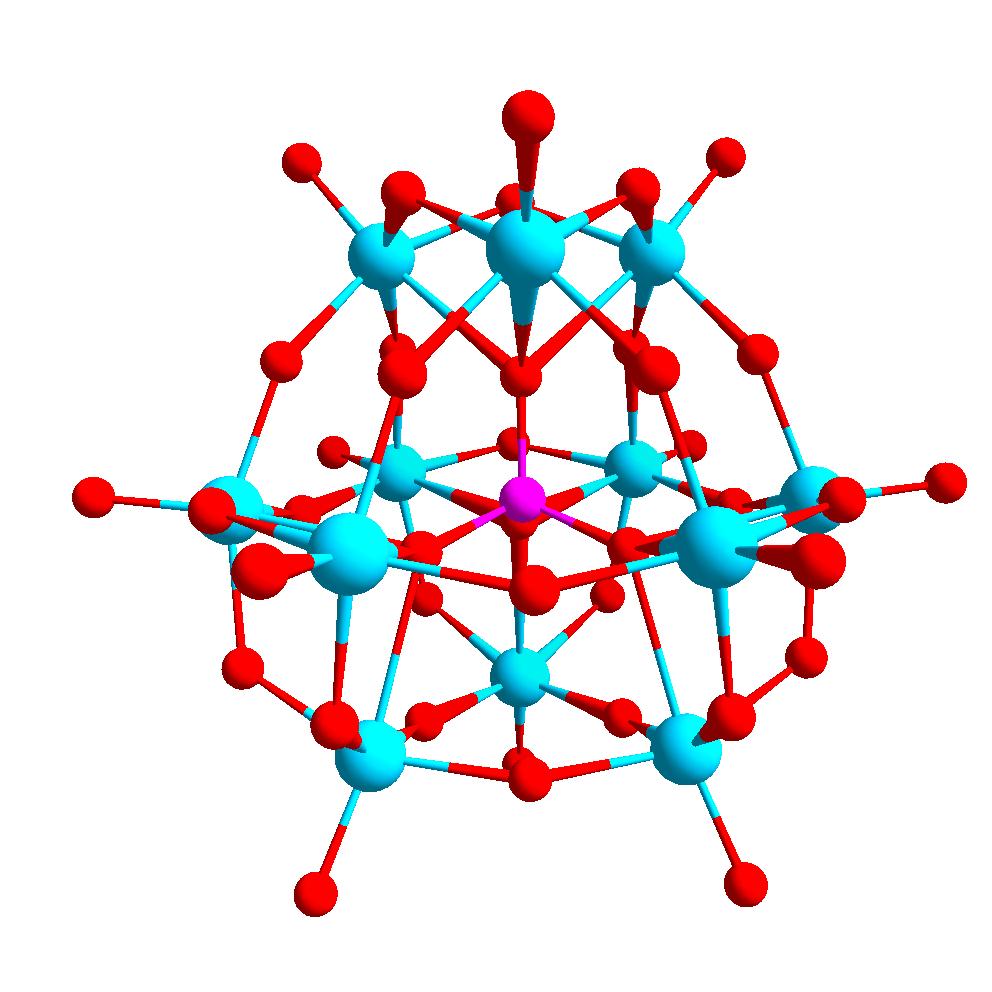
When such acidifications are conducted in the presence of phosphate or silicate, heteropolymetalate can result. For example, the phosphotungstate anion [PW12O40]3− consists of a framework of twelve octahedral tungsten oxyanions surrounding a central phosphate group.

History

[edit]
Dr. James F. Keggin, the discoverer of the Keggin structure

Ammonium phosphomolybdate, [PMo12O40]3− anion, was reported in 1826.[5] The isostructural phosphotungstate anion was characterized by X-ray crystallography 1934. This structure is called the Keggin structure after its discoverer.[6]

The 1970s witnessed the introduction of quaternary ammonium salts of POMs.[2] This innovation enabled systematic study without the complications of hydrolysis and acid/base reactions. The introduction of 17O NMR spectroscopy allowed the structural characterization of POMs in solution.[7]

Ramazzoite, the first example of a mineral with a polyoxometalate cation, was described in 2016 in Mt. Ramazzo Mine, Liguria, Italy.[8]

Structure and bonding

[edit]

The typical framework building blocks are polyhedral units, with 6-coordinate metal centres. Usually, these units share edges and/or vertices. The coordination number of the oxide ligands varies according to their location in the cage. Surface oxides tend to be terminal or doubly bridging oxo ligands. Interior oxides are typically triply bridging or even octahedral.[1] POMs are sometimes viewed as soluble fragments of metal oxides.[7]

Recurring structural motifs allow POMs to be classified. Iso-polyoxometalates (isopolyanions) feature octahedral metal centers. The heteropolymetalates form distinct structures because the main group center is usually tetrahedral. The Lindqvist and Keggin structures are common motifs for iso- and heteropolyanions, respectively.

Polyoxometalates typically exhibit coordinate metal-oxo bonds of different multiplicity and strength. In a typical POM such as the Keggin structure [PW12O40]3−, each addenda center connects to single terminal oxo ligand, four bridging μ2-O ligands and one bridging μ3-O deriving from the central heterogroup.[9] Metal–metal bonds in polyoxometalates are normally absent and owing to this property, F. Albert Cotton opposed to consider polyoxometalates as form of cluster materials.[10] However, metal-metal bonds are not completely absent in polyoxometalates and they are often present among the highly reduced species.[11]

Polymolybdates and tungstates

[edit]

The polymolybdates and polytungstates are derived, formally at least, from the dianionic [MO4]2- precursors. The most common units for polymolybdates and polyoxotungstates are the octahedral {MO6} centers, sometimes slightly distorted. Some polymolybdates contain pentagonal bipyramidal units. These building blocks are found in the molybdenum blues, which are mixed valence compounds.[1]

Polyoxotechnetates and rhenates

[edit]
The structure of the polyanion [Tc20O68]4−

Polyoxotechnetates form only in strongly acidic conditions, such as in HTcO4 or trifluoromethanesulfonic acid solutions. The first empirically isolated polyoxotechnetate was the red [Tc20O68]4−. It contains both Tc(V) and Tc(VII) in ratio 4: 16 and is obtained as the hydronium salt [H7O3]4[Tc20O68]·4H2O by concentrating an HTcO4 solution.[12] Corresponding ammonium polyoxotechnetate salt was recently isolated from trifluoromethanesulfonic acid and it has very similar structure.[13] The only polyoxorhenate formed in acidic conditions in presence of pyrazolium cation. The first empirically isolated polyoxorhenate was the white [Re4O15]2−. It contains Re(VII) in both octahedral and tetrahedral coordination.[14]

Mixed polyoxo(technetate-rhenate) [Tc4O4(H2O)2(ReO4)14]2- polyanion crystals that contain Tc(V) and Re(VII)were also isolated [15] and structurally characterized.

Polyoxotantalates, niobates, and vanadates

[edit]

The polyniobates, polytantalates, and vanadates are derived, formally at least, from highly charged [MO4]3- precursors. For Nb and Ta, most common members are M
6
O8−
19
(M = Nb, Ta), which adopt the Lindqvist structure. These octaanions form in strongly basic conditions from alkali melts of the extended metal oxides (M2O5), or in the case of Nb even from mixtures of niobic acid and alkali metal hydroxides in aqueous solution. The hexatantalate can also be prepared by condensation of peroxotantalate Ta(O
2
)3−
4
in alkaline media.[16] These polyoxometalates display an anomalous aqueous solubility trend of their alkali metal salts inasmuch as their Cs+ and Rb+ salts are more soluble than their Na+ and Li+ salts. The opposite trend is observed in group 6 POMs.[17]

The decametalates with the formula M
10
O6−
28
(M = Nb,[18] Ta[19]) are isostructural with decavanadate. They are formed exclusively by edge-sharing {MO6} octahedra (the structure of decatungstate W
10
O4−
32
comprises edge-sharing and corner-sharing tungstate octahedra).

Heteroatoms

[edit]

Heteroatoms aside from the transition metal are a defining feature of heteropolymetalates. Many different elements can serve as heteroatoms but most common are PO3−
4
, SiO4−
4
, and AsO3−
4
.

Giant structures

[edit]
Two views of a [Mo154(NO)14On]z- cluster, omitting water and counter ions. Also shown is the X-ray powder pattern for the salt.

Polyoxomolybdates include the wheel-shaped molybdenum blue anions and spherical "keplerates". The cluster [Mo154O420(NO)14(OH)28(H2O)70]20− consists of more than 700 atoms. The anion is in the form of a tire (the cavity has a diameter of more than 20 Å) and an large inner and outer surface.

Oxoalkoxometalates

[edit]

Oxoalkoxometalates are clusters that contain both oxide and alkoxide ligands.[20] Typically they lack terminal oxo ligands. Examples include the dodecatitanate Ti12O16(OPri)16 (where OPri stands for an alkoxy group),[21] the iron oxoalkoxometalates[22] and iron[23] and copper[24] Keggin ions.

Sulfido, imido, and other O-replaced oxometalates

[edit]

The terminal oxide centers of polyoxometalate framework can in certain cases be replaced with other ligands, such as S2−, Br, and NR2−.[5][25] Sulfur-substituted POMs are called polyoxothiometalates. Other ligands replacing the oxide ions have also been demonstrated, such as nitrosyl and alkoxy groups.[20][26]

Polyfluoroxometalate are yet another class of O-replaced oxometalates.[27]

Other

[edit]

Numerous hybrid organic–inorganic materials that contain POM cores,[28][29][30]

Illustrative of the diverse structures of POM is the ion CeMo
12
O8−
42
, which has face-shared octahedra with Mo atoms at the vertices of an icosahedron.[31]

Uses

[edit]

POMs are employed as commercial catalysts for oxidation of organic compounds.[32][33]

Research

[edit]

Lanthanides can behave like Lewis acids and perform catalytic properties.[34] Lanthanide-containing polyoxometalates show chemoselectivity[35] and are also able to form inorganic–organic adducts, which can be exploited in chiral recognition.[36]

POM-based aerobic oxidations have been promoted as alternatives to chlorine-based wood pulp bleaching processes,[37] a method of decontaminating water,[38] and a method to catalytically produce formic acid from biomass (OxFA process).[39] Polyoxometalates have been shown to catalyse water splitting.[40]

Molecular electronics

[edit]

Some POMs exhibit unusual magnetic properties,[41] which has prompted visions of many applications. One example is storage devices called qubits.[42] non-volatile (permanent) storage components, also known as flash memory devices.[43][44]

Drugs

[edit]

Potential antitumor[45] and antiviral drugs.[46] The Anderson-type polyoxomolybdates and heptamolybdates exhibit activity for suppressing the growth of some tumors. In the case of (NH3Pr)6[Mo7O24], activity appears related to its redox properties.[47][48] The Wells-Dawson structure can efficiently inhibit amyloid β (Aβ) aggregation in a therapeutic strategy for Alzheimer's disease.[49][50] antibacterial[51] and antiviral uses.

See also

[edit]

References

[edit]

Further reading

[edit]
Revisions and contributorsEdit on WikipediaRead on Wikipedia
from Grokipedia
Polyoxometalates (POMs) are a diverse class of discrete, anionic metal-oxo clusters composed primarily of early transition metals such as (Mo), (W), (V), (Nb), and (Ta) in their highest oxidation states, interconnected by oxygen atoms and often incorporating central s like (P), (Si), or (As). These molecular entities form well-defined, nanoscale structures, including archetypal frameworks such as the Keggin ([XM12O40]n-), Dawson ([X2M18O62]m-), and Anderson-Evans ([XM6O24]p-) polyoxoanions, where X represents the heteroatom and M the addenda metal. The history of POMs traces back to the early , with the first report of a phosphomolybdate by in 1826, followed by structural elucidations in the 20th century, including James F. Keggin's 1933 determination of the [PW12O40]3- structure via X-ray diffraction and Barrie Dawson's 1953 work on phosphotungstates. Over the decades, synthetic advances have expanded the library to thousands of compounds, incorporating nearly all elements of the periodic table and enabling giant clusters like the molybdenum-based "nanowheel" [Mo154(NO)14O420(OH)28(H2O)70]25±5-. POMs are renowned for their tunable physicochemical properties, including high activity with reversible multi-electron transfers, tunable and , structural stability in aqueous and organic media, and capabilities for hosting guest ions or molecules, which arise from their mixed-valence states and oxo-metal frameworks. These attributes underpin the broad applications of POMs across multiple disciplines, serving as efficient catalysts in oxidation reactions, , and electrocatalysis for processes like hydrogen evolution and in . In , certain POMs exhibit antiviral, antibacterial, and anticancer activities due to their and ability to inhibit enzymes. Additionally, their magnetic, electronic, and behaviors enable uses in , such as in devices, sensors, and spintronic components, with ongoing research focusing on hybrid POM-based composites for enhanced performance.

Fundamentals

Definition and Nomenclature

Polyoxometalates (POMs) are discrete anionic molecular metal oxide clusters composed of early transition metals in high oxidation states, primarily Mo(VI), , V(V), Nb(V), and Ta(V), coordinated to oxygen ligands and often incorporating main-group heteroatoms. These polynuclear coordination complexes form through the condensation of metal-oxo polyhedra, such as MO6 octahedra or MO5 square pyramids, sharing oxo bridges to create extended frameworks that mimic the structures of bulk metal oxides at the molecular scale. POMs are classified into two primary categories based on composition: isopolyoxometalates, which contain only addenda atoms from early transition metals without heteroatoms, and heteropolyoxometalates, which incorporate one or more heteroatoms (typically from main-group elements like P, Si, or B) within the cluster core. Isopolyoxometalates tend to be smaller and less stable, while heteropolyoxometalates are more robust and diverse, often featuring saturated structures where all coordination sites are occupied or lacunary (deficient) forms with vacancies for further functionalization. This reflects their assembly from {MOx}n- building units, where the heteroatoms stabilize larger assemblies. The general formula for POMs is \ce[XmMnOp]q\ce{[X_m M_n O_p]^{q-}}, where X represents the heteroatom(s) (m ≥ 0), M denotes the addenda metal atom(s), O is oxygen, and q is the overall negative charge. Nomenclature follows conventional trivial names for archetypal structures, often honoring their discoverers—such as the Lindqvist structure \ceM6O19n\ce{M6O19^{n-}} (hexameric wheel), Keggin \ceXM12O40n\ce{XM12O40^{n-}} (α-Keggin with ), and Dawson \ceX2M18O62n\ce{X2M18O62^{n-}} (dimeric form)—while systematic IUPAC naming describes the full connectivity using additive coordination nomenclature, e.g., dodeca-μ-oxo for shared edges. These names facilitate communication in research, though systematic variants are used for precise structural elucidation. The stability of POMs in arises from their high negative and the robust network of oxo bridges, which confer kinetic inertness, particularly for - and molybdenum-based clusters under acidic conditions. This allows them to persist without over wide ranges, though stability decreases with reducing agents or extreme shifts.

Formation and Synthesis

Polyoxometalates (POMs) primarily form through processes involving the of oxometalate s, such as (MoO₄²⁻) or (WO₄²⁻), in aqueous solutions under acidic conditions. This entails the removal of molecules and the formation of metal-oxygen-metal (M-O-M) linkages, leading to the buildup of polynuclear clusters from mononuclear . The process is thermodynamically driven by the of oxo ligands, which facilitates nucleophilic attacks and oligomerization, resulting in stable anionic clusters. A representative example is the formation of the octamolybdate , where eight units condense as follows: 8MoO42+12H+[Mo8O26]4+6H2O8 \mathrm{MoO_4^{2-}} + 12 \mathrm{H^+} \to [\mathrm{Mo_8O_{26}}]^{4-} + 6 \mathrm{H_2O} This reaction exemplifies the general acidification-induced assembly observed in isopolyoxometalates, with equilibrium constants indicating high favorability under moderate acidity (log₁₀K ≈ 75 at 20°C). The speciation of POMs in solution is highly dynamic, featuring equilibria among monomers, dimers, and higher oligomers that shift based on environmental factors. Ionic strength modulates these equilibria by altering ion pairing and activity coefficients, often favoring larger clusters at higher concentrations or lower ionic strengths. For instance, in molybdate solutions, protonation leads to intermediates like heptamolybdate ([Mo₇O₂₄]⁶⁻) before further condensation to octamolybdate, with the distribution controlled by pH-dependent protonation steps. Temperature influences the kinetics of assembly, accelerating condensation at elevated levels while potentially destabilizing clusters above certain thresholds, such as 100°C for many molybdates. Counterions play a crucial role in stabilizing specific species and inducing precipitation; large organic cations like tetrabutylammonium promote isolation of discrete clusters, whereas small alkali ions like Na⁺ or K⁺ facilitate crystallization of salts. Synthetic strategies for POMs leverage these factors to achieve targeted assembly. Acidification of alkali metalate salts, such as or , with mineral acids (e.g., HCl or H₂SO₄) to 1–5 is the classical route, enabling controlled and isolation via or . Hydrothermal methods, involving sealed reactions at 100–200°C under autogenous pressure, enhance and yield larger or more complex clusters by promoting slower, more ordered . Template-directed assembly incorporates heteroatoms to direct structure formation; for example, ions template Keggin-type heteropolyoxometalates, as in the reaction: PO43+12WO42+24H+[PW12O40]3+12H2O\mathrm{PO_4^{3-}} + 12 \mathrm{WO_4^{2-}} + 24 \mathrm{H^+} \to [\mathrm{PW_{12}O_{40}}]^{3-} + 12 \mathrm{H_2O} This process, typically conducted by adding phosphoric acid to tungstate solutions at pH ≈ 2, relies on the heteroatom's charge and size to organize the addenda metal centers into the characteristic α-Keggin framework. Variations in pH (e.g., 1.5–4) and temperature (80–120°C) fine-tune the yield and isomer distribution, with counterions like K⁺ aiding precipitation of the final salt. These methods underscore the versatility of self-assembly in POM synthesis, allowing rational control over cluster size and composition through precise manipulation of reaction conditions.

Historical Development

Early Discoveries

The earliest observations of polyoxometalates date back to the 1820s, when reported the formation of a yellow precipitate upon reacting ammonium molybdate with excess , which he identified as . This compound, now recognized as a prototypical heteropolyoxometalate, marked the initial recognition of these anionic metal oxide clusters, though their complex structures were not yet understood. work laid the groundwork for subsequent investigations into similar - and tungsten-based species. In the late 19th and early 20th centuries, the influence of Alfred Werner's coordination theory, developed in the 1910s, provided a conceptual framework for viewing polyoxometalates as coordination compounds with metal-oxygen frameworks, shifting perceptions from simple salts to structured anionic complexes. This theoretical advancement facilitated early applications in , where was employed to precipitate proteins and alkaloids due to its ability to form insoluble complexes with basic groups in biomolecules. In the late 19th and early 20th centuries, researchers such as Alfred E. Turpin advanced systematic studies on phosphotungstates, including precipitation and compositional analyses, culminating in 1933 with James F. Keggin's first structural determination of the Keggin ion, [PW₁₂O₄₀]³⁻, via X-ray powder diffraction, revealing a cage-like arrangement of 12 tungsten-oxygen octahedra around a central phosphate group. Mid-20th century milestones included the elucidation of the Dawson structure in 1953, where Barrie Dawson confirmed the architecture of the [P₂W₁₈O₆₂]⁶⁻ ion through X-ray crystallography, featuring two fused Keggin-like units. Concurrently, efforts expanded to vanadium-based clusters; in 1972, Harry R. Allcock and colleagues synthesized and characterized organoimido derivatives of the Lindqvist-type polyoxomolybdate [Mo₆O₁₉]²⁻, demonstrating covalent modification potential and bridging early structural insights with synthetic innovation. These discoveries solidified polyoxometalates as a distinct class of compounds with tunable coordination environments, setting the stage for broader exploration while highlighting their utility in precipitation-based analytical techniques.

Modern Advances

In the 1970s and 1980s, Michael T. Pope and colleagues advanced the synthesis of polyoxotantalates, marking the first reported examples of these group V metal-based clusters, such as the Lindqvist-type [Ta6O19]^{8-}, through controlled and reactions in aqueous media. Concurrently, Achim Müller's group pioneered the construction of giant polyoxometalates (POMs) in the 1990s, exemplified by nanoscale Keplerate structures like {Mo132O372(CH3COO)30(H2O)72}^{42-}, which demonstrated unprecedented cluster sizes exceeding 3 nm in diameter and modular assembly principles. During this period, organo-functionalization emerged as a key innovation, with Pope's team introducing covalent linkages between POM frameworks and organic moieties, such as silane-anchored phosphotungstates, enabling tunable solubility and reactivity in non-aqueous environments. The 2000s saw significant progress in photocatalytic applications, driven by Toshihiro Yamase's exploration of polyoxomolybdates like [PMo12O40]^{3-} for visible-light-driven oxidation reactions, highlighting their versatility and charge-transfer excitations. Craig L. Hill's contributions further expanded this area, developing lacunary POMs as hosts for catalytically active metal centers, which facilitated selective epoxidations and demonstrated turnover numbers exceeding 10,000 in aerobic conditions. Synthetic breakthroughs included the first polyoxorhenates, such as [ReV4O22]^{6-}, isolated via hydrothermal methods, revealing rhenium's ability to form stable, high-nuclearity oxo clusters with potential in precursors. From the 2010s onward, research intensified on rare and -based POMs, with the 2021 characterization of the technetium polyoxometalate [Tc20O68]^{4-} resolving a longstanding mystery in Tc chemistry by confirming its polyanionic structure through single-crystal , featuring a cage-like assembly of 16 Tc(V) octahedra and 4 Tc(VII) tetrahedra. In 2022, the isolation of an ammonium polyoxotechnetate, specifically (NH4)4[Tc20O68] in media, enabled solution-phase studies and highlighted Tc's propensity for auto-reduction and polymerization under acidic conditions. By 2025, mixed-metal advancements culminated in the synthesis of [Tc4O4(H2O)2(ReO4)14]^{2-} crystals from pertechnetate and perrhenate solutions, representing the first group VII heterometallic POM and showcasing selective metal incorporation via autoreduction mechanisms. Parallel developments in the 2020s focused on metal-metal bonding within POM frameworks, with 2021 studies identifying unsupported Mo-Mo bonds in Dawson-type phosphomolybdates, which stabilized high-valent states and enhanced magnetic properties through delocalized electron pairs. This era also witnessed expansion into bio-inspired and nanoscale assemblies, such as enzyme-mimicking POM-peptide hybrids that replicate active sites of oxidoreductases, achieving biomimetic with efficiencies comparable to natural systems, and self-assembled POM nanorods for .

Structure and Bonding

Building Blocks

Polyoxometalates (POMs) are primarily constructed from condensed metal-oxygen polyhedra, with the fundamental building block being the {MO6}\{MO_6\} octahedron, where M typically represents early transition metals such as molybdenum (Mo), tungsten (W), or vanadium (V) in their highest oxidation states (e.g., MoVI^{\text{VI}}, WVI^{\text{VI}}, VV^{\text{V}}). These octahedra serve as the molecular fragments of metal oxides, enabling the formation of discrete, soluble clusters that bridge the gap between molecular coordination compounds and extended solid-state materials. The high oxidation states of the central metal ions are crucial for stabilizing the cluster architectures, as they promote strong metal-oxygen interactions and facilitate self-assembly under controlled conditions. The bonding within and between these {MO6}\{MO_6\} octahedra involves oxygen ligands in distinct roles: terminal oxo groups (M=O) form short, double-bond-like interactions that act as strong π\pi-electron donors to the metal center, enhancing stability, while bridging oxo ligands (M-O-M) connect adjacent octahedra through shared corners (vertex-sharing) or edges (edge-sharing) via μ2\mu_2-oxo bridges. This connectivity pattern allows for the propagation of the structure without face-sharing in most cases, preserving the integrity of the octahedral geometry. The oxo bridges are typically single bonds, with bond lengths around 1.8–2.2 Å for M-O-M, contrasting with the shorter terminal M=O bonds (1.6–1.8 Å). Assembly of these building blocks proceeds via reactions, often in acidic aqueous media, where and lead to the loss of molecules and the fusion of {MO6}\{MO_6\} units into larger aggregates such as rings, wheels, or closed cages. This process is reversible and pH-dependent, allowing dynamic equilibria that favor specific topologies based on reaction conditions. The resulting polyanionic clusters carry high negative charges (typically 4–40–), which are balanced by protons (forming heteropolyacids) or countercations such as metals (e.g., Na+^+, K+^+). In and systems, these principles underpin the formation of isopolyoxometalates, such as the octamolybdate \ce[Mo8O26]4\ce{[Mo8O26]^{4-}}. In reduced POMs, where metal centers like Mo adopt lower oxidation states (e.g., MoV^{\text{V}}, d1^1 configuration), the {MO6}\{MO_6\} octahedra undergo significant geometric distortions due to the Jahn-Teller effect, which lifts degeneracy in the t2g_{2g} orbitals and elongates specific axial M-O bonds (up to 0.2–0.3 Å longer than equatorial bonds). This distortion stabilizes the electronic structure and can propagate through the cluster, influencing overall reactivity and magnetic properties, as seen in super-reduced molybdenum-based POMs where local Jahn-Teller effects drive metal-metal .

Isopolyoxometalates

Isopolyoxometalates represent a subclass of polyoxometalates consisting solely of early centers (typically , , , Nb, or Ta) coordinated to oxygen atoms, forming discrete anionic clusters without incorporation of heteroatoms. These structures arise from the of metal units, such as [MO₆] octahedra, under controlled aqueous conditions, often exhibiting octahedral or related geometries that confer notable and hydrolytic stability compared to mononuclear species. Their formation and persistence in solution are pH-dependent, with and variants showing particular robustness across a range of acidic to neutral environments due to the high oxidation states of the metals (+6 for and ). Prominent examples among molybdate clusters include the Lindqvist-type hexamolybdate [Mo₆O₁₉]²⁻, a compact superoctahedral anion comprising six edge-sharing [MoO₆] octahedra centered around a shared oxygen atom, first structurally characterized in the mid-20th century and widely studied for its symmetry and reactivity. Larger molybdate assemblies, such as the octamolybdate [Mo₈O₂₆]⁴⁻, demonstrate isomerism, with the α-isomer featuring a more symmetric arrangement of eight [MoO₆] octahedra and the β-isomer involving a rotational twist that alters bond lengths and electronic properties, enabling interconversion under thermal or chemical conditions. clusters parallel these, with the Lindqvist [W₆O₁₉]²⁻ sharing structural similarities to its analog but exhibiting greater inertness to reduction, and the [W₁₂O₃₉]⁶⁻ fragment serving as a key building block in larger assemblies due to its ditungstate-derived core. The decatungstate [W₁₀O₃₂]⁴⁻, formed by edge- and corner-sharing of [WO₆] units, stands out for its photocatalytic stability and ability to generate under irradiation. Vanadate clusters, such as the decavanadate [V₁₀O₂₈]⁶⁻, adopt a cage-like from ten edge-sharing [VO₆] octahedra, displaying biological relevance through inhibition of enzymes like and stability in mildly acidic media ( 4–7). Niobate and tantalate variants are rarer but include the Lindqvist hexaniobate [Nb₆O₁₉]⁸⁻ and hexatantalate [Ta₆O₁₉]⁸⁻, both high-charge anions synthesized via alkaline of peroxo precursors, with the tantalate showing enhanced resistance to and greater in owing to weaker Nb–O versus Ta–O bonds. while a recent breakthrough revealed the polyoxotechnetate [Tc₂₀O₆₈]⁴⁻ in , a large, centrosymmetric assembly resolving long-standing questions about technetium's polyanionic chemistry in superacid media. These clusters' stability often stems from delocalized charge and minimal strain in metal-oxygen frameworks, though vanadium-based ones are more prone to transformations than or counterparts.

Heteropolyoxometalates

Heteropolyoxometalates (HPOMs) are a subclass of polyoxometalates that incorporate one or more heteroatoms, typically from main-group elements, into their metal-oxygen frameworks, distinguishing them from isopolyoxometalates by the templating role of these heteroatoms in stabilizing the structure. Common heteroatoms include in the +5 (P(V)), (Si(IV)), (B(III)), and (As(V)), which coordinate tetrahedrally or otherwise to oxygen atoms within the . These heteroatoms serve as central templates around which shells of addenda metal atoms, primarily (Mo(VI)) or (W(VI)), assemble through oxo bridges, forming robust, nanoscale anionic with defined stoichiometries. The most prevalent structures in HPOMs are the Keggin and Dawson types. The Keggin anion has the general formula [XM12O40]n[XM_{12}O_{40}]^{n-} (where X is the and M is Mo or W), consisting of a central linked to four {M3O13}\{M_3O_{13}\} trimetalate units via oxygen atoms, resulting in a compact, approximately spherical with high . In contrast, the Dawson structure, with the formula [X2M18O62]n[X_2M_{18}O_{62}]^{n-}, features two central bridged by oxygen and surrounded by two polar caps and an equatorial belt of addenda atoms, yielding a more elongated, spindle-like form that often exhibits greater stability under certain conditions. These assemblies rely on the heteroatom's ability to direct the condensation of metal-oxo species, with the overall charge balanced by counterions in salts. Lacunary HPOMs arise from the removal of one or more addenda metal atoms from saturated structures like Keggin or Dawson, creating defects or vacancies that expose coordination sites for further functionalization while retaining the template. For instance, mono- or dilacunary Keggin species, such as [α[\alpha-PW11O39]7_{11}O_{39}]^{7-}, maintain structural integrity but gain reactivity at the defect sites, enabling coordination to transition metals or organic ligands. Representative examples include the phosphomolybdate anion [PMo12O40]3[\mathrm{PMo_{12}O_{40}}]^{3-}, a Keggin-type cluster widely studied for its solubility and redox activity, and the silicotungstate [SiW12O40]4[\mathrm{SiW_{12}O_{40}}]^{4-}, valued for its thermal stability in acidic media. The nature of the heteroatom significantly modulates electronic properties; smaller or higher-charge heteroatoms like P(V) shift redox potentials to more positive values, facilitating easier reduction of the addenda metals compared to larger ones like Si(IV), as observed in cyclic voltammetry studies of Keggin tungstates. Similarly, the heteroatom influences Brønsted acidity, with phosphorus-based HPOMs exhibiting stronger protonation strengths (e.g., H3_3PW12_{12}O40_{40} approaching superacid levels) than silicon analogs due to enhanced polarization of surrounding oxo groups.

Specialized Structures and Derivatives

Specialized polyoxometalates extend beyond classical architectures through the incorporation of larger assemblies, ligand substitutions, and hybrid integrations, enabling unique structural motifs and functional tunability. Giant wheel-shaped clusters, such as the molybdenum-based [Mo_{138}O_{408}(H_2O){74}]^{14-}, represent nanoscale ring structures assembled from multiple {Mo{38}} building units, achieving diameters on the order of 2.5 nm and incorporating 138 metal centers. These structures, synthesized under controlled acidic conditions in the 1990s by Achim Müller and colleagues, exemplify self-assembly principles in polyoxometalate chemistry, with the wheel motif stabilized by hydrogen-bonded water ligands on the periphery. Further advancements have yielded even larger nanoscale cages, such as compressed molybdenum blue rings reduced from 154 to 54 metal atoms, demonstrating the flexibility of ring archetypes to accommodate up to 100 or more metals while maintaining structural integrity. Derivatized polyoxometalates involve partial replacement of oxo ligands with alternative groups, altering electronic properties and solubility. Oxoalkoxo variants, like the methoxy-substituted heptamolybdate [Mo_7O_{24}(OMe)6]^{6-}, feature edge-sharing MoO_6 octahedra with peripheral alkoxide bridges, synthesized via methanolysis of parent molybdates to enhance organic compatibility. Sulfido derivatives, such as [Mo_3S_4O_9]^{2-}, incorporate sulfur atoms in cluster cores, mimicking bioinorganic motifs and exhibiting electron-rich character due to the softer S donors, as revealed by DFT studies on spin distribution. Imido replacements, where NR groups (R = alkyl or aryl) substitute terminal or bridging oxos, further diversify these systems; for instance, the Lindqvist-type [Mo_6O{17}(NAr)_2]^{2-} (Ar = 2,6-(CH_3)_2C_6H_3) displays shortened Mo-N bonds and modified redox potentials, achieved through imido transfer reactions. These substitutions generally increase hydrolytic stability and enable regioselective functionalization, as demonstrated in multi-imido Keggin derivatives. Hybrid polyoxometalates integrate organic components or mixed metals to create multifunctional assemblies. Organically linked variants, such as POM-porphyrin conjugates, covalently tether polyoxometalates to units via or imido bridges, facilitating directed in bio-inspired systems; a notable example is the Ru-porphyrin-POM hybrid that mimics photosynthetic charge separation with efficient multi-electron storage. Mixed-metal clusters incorporating and , like the 2025-reported [Tc₄O₄(H₂O)₂(ReO₄)₁₄]²⁻, arise from autoreduction processes under aqueous conditions, yielding unprecedented Group VII heterometallic POMs with tunable oxidation states and polymerization tendencies. Other specialized derivatives include polyoxopalladates (POPs), which substitute Pd^{II} for traditional addenda atoms, forming discrete clusters like nanostar [Pd^{II}{13}O_8(PO_4)8]^{6-} or wheel-shaped assemblies with over 70 variants reported since , characterized by Pd-O-Pd linkages and catalytic relevance. Nitrido derivatives embed high-valent M≡N units (M = Os, Re, Cr) into polyoxometalate frameworks, such as [PW{11}O{39}(OsN)]^{4-}, synthesized via activation and exhibiting nitrene-transfer reactivity akin to enzymatic processes. Metal-metal bonded polyoxometalates, a emerging class reviewed in 2021, feature direct M-M interactions (e.g., Re-Re or Cr-Cr bonds) within oxide clusters, enabling low-oxidation-state stabilization and novel magnetic properties through reductive assembly pathways.

Properties and Characterization

Physical and Chemical Properties

Polyoxometalates (POMs) exhibit remarkable physical properties that stem from their molecular cluster architecture. They demonstrate high in and polar solvents due to their anionic and hydrophilic oxygen-rich surfaces, enabling facile dissolution and solution-phase processing. Many POMs, particularly Keggin-type structures, maintain thermal stability up to approximately 400–500 °C, beyond which or phase transitions may occur, allowing their use in high-temperature environments. Structurally, POMs are nanoscale entities, typically ranging from 1 to 5 nm in diameter, which contributes to their discrete molecular behavior akin to molecular metal oxides. Chemically, POMs are characterized by strong Brønsted acidity, with heteropolyacids like H₃PMo₁₂O₄₀ displaying pKₐ values below 0, arising from the delocalized negative charge on the cluster framework. They undergo reversible multi-electron processes, such as the Mo(VI)/Mo(V) reductions in molybdates, which involve up to 24 electrons per cluster without disrupting the core structure, underpinning their electron-sponge capabilities. This activity also manifests as pseudocapacitive behavior in electrochemical contexts, where fast, surface-confined charge storage occurs via sequential electron transfers. Stability profiles of POMs are highly pH-dependent, showing hydrolytic resistance in acidic media where the protonated forms prevent dissociation, but they decompose under basic conditions through lacunary fragment formation or metal leaching. equilibria govern their speciation, with lower favoring intact clusters via of oxometalate units. Optically and electronically, POMs feature ligand-to-metal charge transfer (LMCT) bands in the UV-Vis spectrum, typically appearing as intense absorptions between 200 and 310 nm due to O → M transitions, which impart color to the clusters. Reduced forms, such as those after Mo(VI) to Mo(V) conversion, exhibit from unpaired d-electrons, enabling studies of their electronic structure.

Analytical Techniques

Single-crystal diffraction serves as the cornerstone for determining the precise three-dimensional geometries, bond lengths, and coordination environments of polyoxometalate (POM) clusters in the solid state, enabling the elucidation of complex architectures such as Keggin or Wells-Dawson units. This technique is particularly valuable for validating synthetic products and identifying subtle structural variations, though it requires high-quality single crystals, which can be challenging to obtain for certain POM derivatives. In solution, where many POMs exhibit dynamic , () spectroscopy provides critical insights into connectivity and equilibrium distributions; for instance, ^{31}P NMR detects heteroatom incorporation in phosphotungstates with chemical shifts typically between -15 and -2.5 ppm relative to 85% H_3PO_4, while ^{183}W NMR probes environments in shifts from +260 to -670 ppm, necessitating concentrated samples (~1 M) due to the low natural abundance of ^{183}W. Other nuclei like ^{51}V (shifts -400 to -600 ppm vs. VOCl_3) and ^{17}O (shifts 1200 to -100 ppm, often requiring isotopic enrichment) further aid in mapping - or oxygen-based . Spectroscopic techniques offer complementary vibrational and electronic information. identifies characteristic metal-oxo stretches in the 700-1000 cm^{-1} region, distinguishing terminal M=O bonds (~950-1000 cm^{-1}) from bridging M-O-M modes (~700-900 cm^{-1}), which is useful for confirming cluster integrity in both solid and solution phases. enhances this by providing non-destructive analysis in aqueous media, with peaks such as 939 cm^{-1} for [Mo_7O_{24}]^{6-} indicating symmetric vibrations less affected by solvent. captures ligand-to-metal charge transfer transitions in the 190-400 nm range, monitoring pH-dependent stability; for example, a shift from 263 nm for [PW_{12}O_{40}]^{3-} at pH 1 to 252.5 nm at pH 3.5 signals decomposition. Electrospray ionization mass spectrometry (ESI-MS) detects intact anionic clusters via isotopic patterns (e.g., from W or Mo isotopes), though it risks dissociation during ionization, as seen with [W_7O_{24}]^{6-} fragmenting to [W_6O_{19}]^{2-}. Additional methods address , local structure, and stability aspects. quantifies multi-electron potentials, revealing the electron-storage capacity of POMs, with reversible waves often observed in non-aqueous solvents to probe accessibility. (EXAFS) spectroscopy determines metal-oxygen bond distances (~1.7-2.2 Å for W-O) and coordination numbers in amorphous or solution samples, complementing X-ray diffraction for disordered systems. evaluates thermal stability by tracking weight loss from water or desorption, typically showing decomposition above 300-500 °C depending on the cluster. Characterization of POMs presents specific challenges, particularly for reduced forms that are air-sensitive and prone to reoxidation, necessitating inert-atmosphere handling during electrochemical or spectroscopic measurements. , such as with ^{17}O or ^{18}O, is employed in NMR and to track oxygen exchange dynamics and distinguish surface versus bulk processes, though it requires specialized synthesis and increases experimental .

Applications

Catalysis

Polyoxometalates (POMs) are widely employed as catalysts in oxidation reactions due to their tunable properties and ability to activate oxidants. In particular, peroxo-POMs, such as those derived from the Keggin anion [PW12O40]3- coordinated with (H2O2), facilitate the epoxidation of alkenes under mild conditions, achieving high selectivity for products without over-oxidation. These systems operate via oxygen transfer mechanisms where peroxo ligands bound to the POM framework donate oxygen atoms to the substrate, often in aqueous or biphasic media to enhance . Moreover, POMs enable the use of green oxidants like molecular oxygen (O2), as seen in vanadium-substituted POMs that catalyze the aerobic oxidation of alcohols to carbonyl compounds, minimizing waste generation. Acid catalysis represents another cornerstone application of POMs, leveraging their strong Brønsted acidity comparable to . Keggin-type POMs, such as H3PW12O40, excel in reactions like of aromatics and esterification of carboxylic acids, where the protonated oxygen atoms on the POM surface act as active sites. These catalysts often exhibit bifunctional behavior, combining and sites to promote tandem processes, such as the oxidative esterification of aldehydes, where the POM simultaneously activates the substrate and oxidant. The thermal stability and recyclability of POMs make them preferable over traditional mineral acids, particularly in industrial-scale operations. Mechanistic insights into POM catalysis highlight processes involving reduced addenda atoms, such as in lacunary POMs where metal centers like or undergo reversible cycles to propagate catalytic turnover. Heterogenization strategies further enhance practicality by immobilizing POMs on supports like silica or metal-organic frameworks, preventing leaching and enabling easy recovery while maintaining activity over multiple cycles. For instance, silica-supported has been shown to sustain catalytic performance in hydration reactions with high turnover numbers. Recent post-2020 advancements have expanded POM catalysis into , where visible-light-responsive POM hybrids, often incorporating organic dyes or semiconductors, drive selective transformations under ambient conditions. These systems achieve high efficiency in reactions like the photocatalytic oxidation of sulfides to sulfoxides using O2. In conversion, POMs demonstrate remarkable selectivity for upgrading platform chemicals, such as the acid-catalyzed dehydration of to 5-hydroxymethylfurfural with yields over 90% in media. Such developments underscore the versatility of POMs in sustainable , bridging homogeneous and heterogeneous paradigms.

Biomedical Uses

Polyoxometalates (POMs) have garnered significant attention for their potential in biomedical applications due to their tunable structures, , and multifaceted interactions with biological systems. These anionic metal-oxo clusters exhibit antiviral, anticancer, and antibacterial properties, often through targeted inhibition of key enzymes or disruption of cellular processes in pathogens and diseased cells. Their low profiles in mammalian cells further enhance their therapeutic promise, positioning POMs as candidates for novel treatments in infectious diseases and . In antiviral applications, POMs demonstrate broad-spectrum activity by interfering with viral replication cycles. Decavanadate, a polyoxovanadate cluster, inhibits HIV-1 , preventing viral DNA synthesis and exhibiting potent anti-HIV-1 and HIV-2 effects with minimal . Recent post-2019 studies have expanded this to respiratory viruses, including ; for instance, sodium polyoxotungstate (POM-1) blocks the nuclear import of influenza viral ribonucleoprotein (vRNP), reducing replication of H1N1, H3N2, and oseltamivir-resistant strains with EC50 values of 0.52 μM in and 0.82 μM in MDCK cells and no significant below 55.56 μM. These findings highlight POMs' efficacy against evolving viral threats. As of 2025, ongoing research continues to explore POMs for emerging viral threats. Anticancer research on POMs focuses on their ability to induce selective cell death in tumor cells. Certain vanadium-based POMs, such as decavanadate, mimic insulin signaling to promote and metabolic modulation, which can indirectly support in insulin-responsive cancer cells by altering energy pathways. More directly, derivatives of [Mo8O26]4-, like biotin-conjugated polyoxomolybdates, target tumor cells via receptor-mediated uptake, inducing in breast () and liver (HepG2) cancer lines with IC50 values of 0.082 mM and 0.091 mM, respectively, while sparing normal cells due to enhanced selectivity from the moiety. Post-2019 studies confirm these clusters' role in arrest and , filling gaps in antitumor mechanisms. POMs also show promise as antibacterials, particularly in hybrids that amplify membrane disruption. Studies since 2018 on POM-silver (Ag) nanocomposites reveal synergistic effects where POMs stabilize Ag nanoparticles, enhancing their penetration into bacterial membranes and generating (ROS) to cause and cell lysis in both Gram-positive and Gram-negative strains, such as Escherichia coli and Staphylococcus aureus, with minimum inhibitory concentrations below 10 μg/mL. These hybrids maintain low toxicity to human cells, with selectivity indices exceeding 10, making them viable for wound dressings or coatings. The biomedical efficacy of POMs stems from several key mechanisms. Electrostatic interactions between their anionic surfaces and positively charged biomolecules facilitate binding to viral enzymes, bacterial surfaces, or tumor receptors, enabling targeted delivery. ROS generation, often via redox-active metal centers like or , induces leading to or microbial death without excessive damage to host tissues. Additionally, POMs serve as versatile vectors for , encapsulating therapeutics like anticancer agents to improve and while protecting payloads from degradation. Emerging developments in the include POM integration into (PDT), where clusters like molybdenum-based POMs act as photosensitizers under near-infrared light, producing for precise tumor ablation with minimal invasiveness. Ongoing trials and models post-2019 underscore antitumor advancements, such as enhanced PDT efficacy in xenograft models, bridging preclinical gaps toward clinical translation. As of November 2025, preclinical studies report improved stability in POM-PDT hybrids.

Materials and Electronics

Polyoxometalates (POMs) have emerged as versatile components in due to their tunable properties and structural rigidity, enabling applications as single-molecule magnets (SMMs). For instance, polyoxovanadate clusters, such as those incorporating frameworks, exhibit paramagnetic behavior suitable for SMMs, where the localized spins on centers contribute to and slow relaxation of magnetization. Lanthanide-substituted POMs, like dysprosium-based polyoxomolybdates, further enhance SMM performance by providing strong fields that stabilize high-spin states, achieving barriers to magnetization reversal exceeding 100 K in some cases. In charge storage devices, POMs serve as pseudocapacitive electrodes in supercapacitors, leveraging their multi-electron transfer capabilities for high specific ; hybrid POM-carbon composites, for example, demonstrate capacitances up to 500 F/g with improved cycling stability over 10,000 cycles. Hybrid materials combining POMs with metal-organic frameworks (MOFs) expand their utility in electronics and , particularly for gas storage and luminescent applications. POM@MOF composites, such as those encapsulating Keggin-type POMs within Zr-based MOFs, exhibit enhanced CO2 adsorption capacities reaching 4 mmol/g at ambient conditions, attributed to the synergistic of the MOF scaffold and the polarizable POM clusters that facilitate gas binding. Post-2014 developments in luminescent POM-organic frameworks include dual-emissive systems like EuW10@UiO-67, where the POM acts as a sensitizer for Eu(III) emission, yielding quantum efficiencies above 20% and temperature-dependent for sensing applications up to 373 . These hybrids maintain structural integrity under operational stresses, with recent examples showing reversible quenching for nitroaromatic detection. Magnetic properties of POMs are particularly pronounced in spin cluster assemblies within giant POM structures, where high-nuclearity clusters like Ln30-embedded polyoxotungstates display ferrimagnetic among ions, leading to blocking temperatures around 5 K. Advances in SMM have been driven by 2021 studies on metal-metal bonds in POMs, such as Cr-Cr or Mo-Mo linkages in reduced clusters, which introduce direct exchange interactions that suppress quantum tunneling and elevate relaxation barriers to over 50 K, enabling potential use in spintronic devices. In conductivity applications, POM doping enhances charge transport in photoelectrochemical (PEC) cells; for example, POMs deposited on N-doped carbon layers over BiVO4 photoanodes improve water oxidation efficiency by 3-fold, reaching densities of 2 mA/cm² at 1.23 V vs. RHE, due to facilitated extraction and suppressed recombination. Recent perovskite-POM solar materials incorporate POMs as additives to passivate defects, improving power conversion efficiencies up to approximately 25% in hybrid cells while retaining high stability, through strengthened lattice interactions and reduced migration.

Emerging Applications

Polyoxometalates (POMs) are increasingly explored for emerging applications in , environmental sensing, and advanced , leveraging their tunable properties and structural versatility to address challenges in and precision detection. Recent developments focus on hybrid POM materials that enhance performance in these nascent fields, with potential to transition from laboratory prototypes to practical technologies. In energy storage, POMs show promise in batteries and pseudocapacitors due to their multi-electron transfer capabilities. For instance, phosphomolybdate (PMo₁₂)-based hybrids with reduced graphene oxide (RGO) achieve high specific capacities in lithium-ion batteries, attributed to the POM's ability to accommodate multiple electron/ion pairs. Similarly, in pseudocapacitors, PMo₁₂ integrated with polypyrrole and carbon nanotubes delivers high capacitance with excellent cycle stability over 10,000 cycles, enabling high-capacity hybrid electrodes for 2020s energy devices. POMs also contribute to fuel cells and metal-air batteries, where hybrids like PVIM–CoPOM/NCNT exhibit low charge-discharge potential gaps and high energy densities, supporting efficient proton and electron transport. Advances in POM-based metal-organic frameworks (POMOFs) further boost supercapacitor performance, with Cu₂SiW₁₂O₄₀@HKUST-1 reaching 5096.5 F/g, though challenges like POM leaching persist. For sensing applications, POMs enable sensitive detection through redox-mediated changes, particularly in colorimetric and electrochemical platforms. Colorimetric sensors exploit POM redox shifts for heavy metal ions, such as lead and mercury, where Keggin-type POMs like SiW₁₂O₄₀⁴⁻ form colored complexes upon interaction, achieving detection limits in the nanomolar range for . Electrochemical sensors based on POM hybrids, including those with carbon nanotubes, detect with high selectivity and low limits of detection (e.g., 1.1 nM for bromate analogs), leveraging multi-electron for amplified signals. In biosensing, POM-enzyme conjugates enhance enzyme-mimicking activity; for example, Co₂W₁₁/MWCNTs hybrids serve as glucose biosensors with a 1.21 μM limit, while PVIM-Co₅POM/N-MPC platforms detect at 1 fM via stabilized biocatalytic . These systems offer robust performance in physiological conditions, with strong anti-interference capabilities. In nanotechnology, POMs facilitate self-assembly into advanced nanostructures for imaging and energy applications. Encapsulation of POM clusters like {PW₁₂} within single-walled carbon nanotubes forms one-dimensional heterostructures, resembling self-assembled nanotubes, which enhance capacitive energy storage with 328.6 F/g capacity and 91.3% retention over 10,000 cycles due to protected redox sites. POM-assisted synthesis also produces silicon quantum dots and nanowires from wafers, enabling tunable optoelectronic properties for bioimaging. Furthermore, quantum dot-POM conjugates, such as SiW₁₂O₄₀ with visible-light-responsive dots, support photo-induced electron transfer for potential imaging probes in phototherapy, where POMs boost stability and light harvesting. Aspirational uses of POMs extend to and . Functionalized POMs, such as those with metal centers, activate CO₂ for capture and reduction, converting it to value-added chemicals via electrocatalytic pathways with high selectivity under harsh conditions, as demonstrated in post-2020 studies on Keggin and Dawson structures. In sustainable chemistry, computational approaches including optimize POM architectures for green processes like , providing data-driven insights into tunability and host-guest interactions to accelerate catalyst development. These efforts highlight POMs' role in AI-assisted materials discovery for carbon-neutral technologies, with advances reported as of 2025.

References

Add your contribution
Related Hubs
Contribute something
User Avatar
No comments yet.