Hubbry Logo
logo
Semantron
Community hub

Semantron

logo
0 subscribers
Read side by side
from Wikipedia
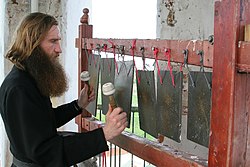
A Russian monk playing a semantron

The semantron (Greek: σήμαντρον) is a percussion instrument used in Eastern, Oriental Orthodox and Eastern Catholic monasteries to summon the monastics to prayer or at the start of a procession.

It is also known as a semandron, semanteriom (σημαντήριον), simantra (σήμαντρα), xylon (ξύλον) and talanto (ταλαντο). In other languages, it is called as follows: Romanian: toacă; Russian: било, bilo; Bulgarian, Macedonian, Serbian: клепало, klepalo; Arabic: ناقوس, nāqūs; Armenian: կոչնակ, kochnak or gochnag.

Description

[edit]

The instrument comes in three main varieties: portable, consisting of a long wooden plank held in the player's non-dominant hand and struck with a wooden mallet in the dominant; a larger, heavier, fixed timber block suspended by chains and struck by one or two mallets; and a fixed metal variety, often horseshoe-shaped and struck by a metal mallet.[1]

The semantra are usually suspended by chains from a peg in the proaulion (porch of the catholicon) or perhaps outside the refectory door, or on a tree in the courtyard.[2]

Portable wooden-made

[edit]
A portable semantron at Mușunoaiele Monastery, Fitionești, Romania. The mallet is visible behind the plank.

In the portable wooden form, at the centre of the instrument's length, each edge is slightly scooped out to allow the player to grasp it by the left hand, while he or she holds a small wooden (or sometimes iron) mallet in the right, with which to strike it in various parts and at various angles, eliciting loud, somewhat musical sounds (κροῦσμα, krousma).[2] Although simple, the instrument nonetheless produces a strong resonance and a variety of different intonations, depending on the thickness of the place struck and the intensity of the force used, so that quite subtle results can be obtained.[3]

A portable wooden semantron standing in the catholicon of Djurdjevi Monastery, Serbia

Fixed wooden-made

[edit]
Fixed wooden semantron at Lupșa Monastery, Romania

The fixed wooden semantron is made of a long, well-planed piece of timber, usually heart of maple (but also beech), from 12 feet (3.7 m) and upwards in length, by 1+12 feet (46 cm) broad, and 9 inches (23 cm) in thickness.[2]

Metal-made

[edit]

A metal semantron, smaller than those of wood, is usually hung near the entrance of the catholicon (the monastery's main church).[4] The metal variety is made of iron or brass (ἁγιοσίδηρα, hagiosidera / клепало, klepalo);[5] formed of slightly curved metal plates, these give out a sound not unlike that of a gong.[2]

Use

[edit]

In the traditional monastic ritual, before each service the assigned player takes a wooden semantron and, standing before the west end of the catholicon, strikes on it three hard and distinct blows with the mallet. He then proceeds round the outside of the church, turning to the four quarters and playing on the instrument by striking blows of varying force on different parts of the wood at uneven intervals, always winding up the "tune" with three blows similar to those at the beginning.[6] Where there is a metal semantron, it is customary to strike it after the wooden one has been played.[7] The semantron is sounded every midnight for night offices (Midnight Office and Matins);[6] this is done by the candle-lighter (κανδηλάπτης, kandilaptis).[2]

[edit]

History

[edit]
12th-13th century A.D., Sicily. A man plays the semantron, detail of larger artwork from the Madrid Skylitzes, Madrid, National Library, codex vitr. 26-2, folio 28v.

Origin & Byzantine rite

[edit]

While continuing in daily use at monasteries and sometimes featuring at funerals for their deep notes sounded at long intervals, as well as at other services, semantra have played a long-lasting part in Orthodox history. Their origin has been traced to at least the beginning of the 6th century, when the semantron had replaced the trumpet as the agent of convocation in the monasteries of Palestine and Egypt, including Saint Catherine's in the Sinai; the rhythms struck on wood were soon vested with the aural memory of rhythmic blasts from earlier trumpets, an iconography of trumpeting that was eventually transferred to the zvon of Russian bells.[8]

Of Levantine and Egyptian origin, its use flourished in Greece and specifically on Mount Athos before spreading among Eastern Orthodox regions in what are now Bulgaria, Romania, Moldova, Serbia, Montenegro, Bosnia and Herzegovina and North Macedonia. It both predates and substitutes for bells, which were, according to one account, first introduced to the East in 865 by the Venetians, who gave a dozen to Emperor Michael III,[6] being used to call worshipers to prayer.

The joy shown at Constantinople on the occasion of the translation of the relics of St. Anastasius, who was martyred in 628, was shown by the beating of xyla. In the Life of St. Theodosius the Archimandrite, written by John Moschus during the 610s, one reads of some Eutychian monks of the party of Severus who, to disturb Theodosius (c. 423–529) at his devotion, "beat the wood" at an unwonted hour. St. Sabas (439–532) rose for his devotions "before the hour of striking."[2]

Larger and smaller semantra have been used, the smaller being sounded first, followed by the larger, then by those of iron. Theodore Balsamon (12th century), in a treatise on the subject, compares the sounding of the little, great and iron semantra to the preaching of the Law and of the Gospel, and the Last Trumpet. He also says that the congregations were summoned by three semantra in monasteries, and only by one large one in parish churches.[2] Moreover, he emphasises the persistence of the semantron in the East as a symbolic manifestation of difference with the Latin West (it remains unclear if some isolated practices in the West such as the Basque txalaparta are associated with the pre-schism liturgy); in Byzantium, the use of bells did not really gather momentum until after the Fourth Crusade (1202–1204),[9] and at the 1453 Fall of Constantinople semantra still outnumbered bells by a five-to-one ratio.[10]

Semantra, from their size and shape, furnished formidable weapons, and were sometimes so used with fatal effect in a church brawl.[2][8][11]

Ottoman Empire

[edit]

One reason why semantra continue to be used in southeastern Europe in particular is that the ringing of bells was outlawed during Ottoman times under Islamic rule, forcing monasteries to use the semantron instead; the practice then became customary.[11][12]

Modern-period use by country

[edit]

Bulgaria

[edit]

In Bulgaria it largely fell into disuse after independence.

Russia

[edit]

In Russia, the techniques for playing the bilo were retained in bell-ringing rubrics, and it could still be heard in more remote, rural areas at the time of the Revolution.[3] Today, its use is restricted to the Altai region and Siberia, as well as Old Believer sketes, the latter retaining the aloofness toward outsiders that has characterised the group since it broke away from the main body of the Russian Orthodox Church (see Raskol).[13][14] Also, a semantron may be in use because the monastery cannot afford a bell.[14]

Syriac Orthodox

[edit]

The Syrian Orthodox hold the semantron in great veneration, based on an ancient tradition that Noah invented it. According to the story, God told him: "Make for yourself a bell of box-wood, which is not liable to corruption, three cubits long and one and a half wide, and also a mallet from the same wood. Strike this instrument three separate times every day: once in the morning to summon the hands to the ark, once at midday to call them to dinner, and once in the evening to invite them to rest". The Syriacs strike their semantra when the liturgy is about to begin and when it is time to summon the people to public prayer. Their tradition also links the sound of the wood to the wood of the Garden of Eden that caused Adam to fall when he plucked its fruit, and to the nailing to the wood of the cross of Jesus Christ, come to atone for Adam's transgression.[15]

Modern composers

[edit]

Modern classical composers who have written for the instrument include Iannis Xenakis, James Wood[16] and Michael Gordon.[17]

References

[edit]

Bibliography

[edit]
Revisions and contributorsEdit on WikipediaRead on Wikipedia
from Grokipedia
The semantron (Greek: σήμαντρον, meaning "signal") is a traditional percussion instrument used in Eastern Orthodox, Oriental Orthodox, and Eastern Catholic churches and monasteries to summon the faithful to prayer services, meals, or processions.[1][2] It typically consists of an elongated wooden plank, suspended horizontally or vertically and struck rhythmically with a wooden mallet to produce a deep, resonant, gong-like sound that carries over distances.[1][2] Less commonly, metal versions are employed, particularly in Greek and Balkan Orthodox monasteries.[2] The semantron's origins lie in early Byzantine Christianity, with written evidence of its use dating to the 6th century, as referenced in an encomium to Saint Theodosius that describes its striking alongside chanting to gather communities.[3] By the 7th century, it was a standard tool in monasteries for calling monks to prayer, the library, or refectory, as detailed in Leontios of Neapolis's Life of Symeon the Fool of Emesa.[3] Possibly influenced by Jewish liturgical traditions or Levantine practices, it replaced earlier convocation methods like trumpets and remained the primary summons throughout Byzantine history for over a millennium.[2][3] From its early centers in the Eastern Mediterranean, the semantron spread to Mount Athos, Greece, and then to the Balkans, Romania, and Russia, where it symbolized Orthodox continuity amid the later introduction of bells in the medieval period.[2][3] In some traditions, its simpler, echoing tone contrasts with the fuller peal of bells, evoking Eastern Christian identity.[2][4] Today, it persists in monastic settings, its distinctive rhythm—often played in varying patterns for different occasions—serving both practical and symbolic roles in preserving ancient liturgical soundscapes.[1][2]

Terminology

Etymology

The term semantron derives from the Late Greek sēmantron (σημαντρον), meaning "sign" or "signal," rooted in the Ancient Greek noun sēma (σῆμα), which denotes a "sign," "marker," or "tomb," and connected to the verb sēmainō (σημαίνω), "to signify" or "to indicate."[1] This etymological foundation reflects the instrument's primary function as a liturgical signal in Eastern Christian contexts. In Byzantine ecclesiastical terminology, the word evolved to specifically designate the wooden or metal board struck to summon monastics or congregants, distinguishing it from secular signaling devices.[5] The earliest documented uses of the term and its associated practices appear in 6th-century monastic texts from the Near East, particularly in Palestine, where it began replacing earlier auditory signals such as trumpets for convoking communities to prayer. For instance, in an encomium by Theodore, Bishop of Petra (ca. 6th century), for St. Theodosios the Cenobiarch (d. 529), the phrase "krouein to xylon" ("to strike the wood") describes the act of summoning monks, marking an early shift toward formalized wooden signaling in Palestinian lauras and monasteries.[5] Over time, the term underwent phonetic and orthographic adaptations in Byzantine and post-Byzantine Greek, appearing as sēmantērion (σημαντήριον) in 7th-century texts by Sophronios of Jerusalem (d. 638), emphasizing its role in announcing divine services.[5] In modern Greek, it persists as sēmantron (σημάντρον), retaining its core meaning while adapting to contemporary pronunciation and occasionally referring to both the instrument and the act of striking it.[6] This linguistic continuity underscores the semantron's enduring place in Orthodox liturgical language, from ancient signaling roots to its specialized ecclesiastical application.

Variant Names

The semantron is known by various names in different linguistic and cultural contexts within Eastern and Oriental Orthodox traditions, reflecting local adaptations of the instrument while preserving its liturgical function. In Romanian Orthodox practice, it is commonly referred to as the toacă, a term denoting the wooden percussion board struck to summon monks or parishioners to prayer. In Russian Orthodox contexts, the instrument is typically called the bilo (било), derived from the Old Russian root meaning "to beat," emphasizing the action of striking it with a mallet; this name is used for both wooden and metal versions, though the term semantron may appear in more formal liturgical Greek-influenced settings.[7][8] Among Slavic traditions, such as in Serbian and Bulgarian Orthodox churches, variants like klepalo (клепало) are employed, particularly for the wooden form, highlighting regional phonetic shifts from the Greek original.[9] In Arabic-speaking Oriental Orthodox communities, the semantron is designated as nāqūs (ناقوس), a term historically applied to wooden clappers or boards used to call the faithful, predating the widespread adoption of bells in these regions.[2][10] Similarly, in Syriac Orthodox usage, it retains a close transliteration as simantron (ܣܝܡܢܛܪܘܢ), underscoring the instrument's ancient roots in early Christian monastic practices across the Near East.[11] In some Orthodox traditions, including monastic settings, it is also termed xylon (ξύλον), meaning "wood" in Greek, to denote its traditional wooden construction and distinguish it from later metal adaptations.[4] Additionally, the related term talanton (τάλαντον) appears in some Byzantine texts as a synonym for the semantron.[2]

Description

Wooden Semantra

Wooden semantra are constructed from resonant hardwoods, such as heartwood of maple or beech, chosen for their durability and ability to produce clear tones.[12] These materials allow the instrument to withstand repeated striking while maintaining acoustic integrity over time. Lengths vary based on intended use, ranging from approximately 2 to 12 feet, with shorter versions suited for portability and longer ones for stationary installations.[12][2] The portable form consists of a long, narrow wooden plank, often held over the shoulder by a cord or in the player's hand, and struck with a wooden mallet, facilitating use during processions or in smaller monastic settings where mobility is essential.[2][12] This design emphasizes simplicity and ease of transport, often featuring a well-planed surface to optimize sound projection without added complexity. In contrast to metal variants, wooden portable semantra yield a resonant tone suitable for intimate gatherings.[2] Fixed wooden semantra take the form of a suspended horizontal timber block, commonly installed in monastery courtyards to serve larger communities. These are secured by ropes, chains, or iron supports from a structure, such as a peg, tree, or crosspiece, which allows the wood to vibrate freely and amplifies resonance for broader audibility.[2] The suspension enhances the instrument's projection, enabling the sound to reach distant areas within monastic grounds.[2] Acoustically, wooden semantra generate a deep, resonant tone that carries effectively over distances, providing a solemn call without the shrill quality associated with metal counterparts. This resounding quality, often described as loud yet harmonious when rhythmically played, stems from the wood's natural density and the instrument's planar shape, which facilitates sustained vibrations.[2]

Metal Semantra

Metal semantra, used alongside wooden forms particularly in Greek and Balkan Orthodox monasteries, serve as durable alternatives in environments where resistance to weathering is essential.[13][2] These fixed installations prioritize resilience, often employed in monastic and church settings to withstand frequent use over extended periods.[2] Typically crafted from iron, though brass is also used, metal semantra are forged into a horseshoe or semi-circular shape, facilitating secure fixed installation by suspension from chains or supports.[13][12] They are mounted either vertically or horizontally, often near the church entrance or in a dedicated overhang, and are struck with a mallet to generate their distinctive tone.[2][12] This construction contrasts with portable wooden variants by emphasizing permanence and industrial strength.[12] In terms of dimensions, metal semantra commonly measure 3 to 6 feet in arc length, making them suitable for larger ecclesiastical spaces or regions prone to humidity and decay that could compromise wooden instruments.[12] Acoustically, they produce a sharper, more piercing sound with a bell-like resonance, differing from the deeper thud of wood and enabling clearer, varied rhythmic patterns for signaling assemblies.[2][12] This brighter timbre enhances projection in open-air or expansive interiors.[12]

Liturgical Role and Symbolism

Practical Use in Services

The semantron serves as a primary instrument for summoning monks, clergy, and faithful to prayer services, processions, and communal meals within Eastern Orthodox, Oriental Orthodox, and Eastern Catholic traditions, particularly in monastic settings where its resonant strikes carry across large distances without the need for electronic amplification.[2][12] In daily liturgical routines, it is typically sounded at key intervals aligned with the canonical hours: for instance, at midnight to call the community to the Midnight Office and Matins, before sunset for Vespers, and during the daytime Hours such as the First, Third, Sixth, and Ninth.[14][15] This timing ensures the faithful gather promptly for the full cycle of services, which may extend through the night and day in strict monastic observance.[12] In performance, the semantron is struck rhythmically with mallets—often wooden for softer tones or metal for sharper resonance—using patterns that vary by context to convey urgency or solemnity. A slow, measured rhythm, such as gradual strikes building in a chant-like motif (e.g., echoing Greek phrases like "To ta-lan-ton"), signals routine calls like Vespers or meals, while faster, more intense sequences alert to emergencies or processions.[2][12] Smaller semantra are often sounded first, followed by larger wooden or metal ones, creating a progressive auditory hierarchy that ensures the call is heard throughout the monastery or parish grounds.[14] These patterns, performed by designated monastics or sacristans, can last several minutes and are audible over expansive areas, making the semantron especially practical in remote or acoustically challenging environments.[14] The semantron integrates seamlessly with other liturgical instruments, frequently used alongside bells in parishes or as a substitute in monasteries adhering to traditions that limit or prohibit bell-ringing, thereby maintaining continuity in summoning without altering the acoustic landscape.[12] In such settings, it may precede bell tolls for services like the Divine Liturgy, with its wooden or metallic strikes providing a foundational call that transitions into more elaborate peals.[14] This complementary role underscores its enduring utility in fostering communal rhythm and discipline during worship.

Symbolic and Theological Interpretations

In the Syriac Orthodox tradition, the semantron holds profound biblical significance, particularly as a symbol of salvation through wood. An ancient legend attributes its invention to Noah, whom God commanded to fashion the instrument from cypress wood along with a matching mallet, striking it three times daily to summon the animals into the ark and thereby ensure their preservation from the flood.[16] This narrative underscores the semantron's role as an emblem of divine rescue and communal gathering in the face of catastrophe, with the wood itself evoking themes of redemption—extending to the tree in the Garden of Eden that precipitated humanity's fall and the wood of Christ's Cross that restored it.[17] Theological interpretations in Byzantine canon law further enrich the semantron's symbolism, particularly through the 12th-century writings of Theodore Balsamon, Patriarch of Antioch. Balsamon likened the striking of different types of semantra to key stages of salvation history: the small wooden semantron to the Old Testament as a shadow and foretoken of divine law; the large wooden semantron to the New Testament's proclamation of evangelical truth; and the bronze semantron to the eschatological warning of the Last Days and Christ's Second Coming, akin to the trumpet's blast in apocalyptic scripture.[17] These associations portray the instrument not merely as a practical call but as a liturgical echo of scriptural progression from promise to fulfillment and final judgment. Beyond specific typologies, the semantron functions in broader Orthodox theology as a sēma—a Greek term denoting a sign or signal—that invokes divine summons and fosters ecclesial unity. Its resonant strikes are perceived as awakening the faithful to spiritual vigilance, much like angelic trumpets heralding the end times or Christ's call to battle invisible demonic forces, thereby uniting the community in prayerful communion with the divine.[17] This auditory sign reinforces the semantron's essence as a bridge between earthly ritual and heavenly reality, emphasizing collective repentance and eschatological hope. In historical and cultural contexts, the semantron acquired layered perceptions of resilience amid adversity. During the Ottoman period, its persistent use in Orthodox communities—despite restrictions on bell-ringing under Islamic law, as per the Pact of ʿUmar—served as a subtle emblem of resistance, preserving Eastern Christian identity against both Ottoman dominance and Latin influences.[18] In modern Western encounters, however, the instrument's stark, percussive timbre has often been interpreted as an "othering" sound, evoking exoticism or disruption and highlighting perceptual divides between Eastern Orthodox acoustics and familiar European bell traditions.[18]

Historical Development

Origins in Early Christianity

The semantron emerged in the 6th century as a wooden percussion instrument used to summon monks to prayer in early Christian monastic communities, particularly in the deserts of Palestine and Egypt. Earliest documented evidence appears in patristic writings, such as those of Cyril of Scythopolis (d. after 559), who describes the canonarches striking the semantron to awaken the brethren in Palestinian lavras.[5] Similarly, Theodore, bishop of Petra (mid-6th century), references the practice of "striking the wood" (κρούειν τὸ ξύλον) to call monks for communal services, portraying it as a signal for spiritual vigilance.[5] These accounts, drawn from hagiographical texts like the Life of Sabas, indicate the semantron's role in organizing daily liturgical life among remote, often illiterate ascetics who relied on audible cues rather than written notices.[5] Prior to the widespread adoption of church bells in the mid-12th century in the Byzantine East, the semantron served as the primary signaling device, supplanting earlier methods such as trumpets or wooden clappers that had been used in monastic convocations.[5] Its simplicity—a long plank of wood suspended and struck with a mallet—made it ideal for austere desert settings, where it echoed across vast distances to gather dispersed hermits without the need for complex metallurgy or infrastructure.[5] This pre-bell era underscores the instrument's practicality in early cenobitic and eremitic traditions, as evidenced in 6th-century texts emphasizing communal assembly in isolated locales.[5] By the 7th century, the semantron had spread from its Egyptian and Palestinian origins to the broader Eastern Christian world, as reflected in the Spiritual Meadow of John Moschos (ca. 550–619), who details its routine use by the precentor in Palestinian monasteries to mark prayer times.[5] Sophronios of Jerusalem (d. 638) further attests to its symbolic resonance, likening the sound to angelic trumpets heralding judgment, thereby integrating it into theological interpretations of eschatological assembly.[5] These patristic references to "wooden boards" for summoning provide indirect archaeological hints, confirming the instrument's foundational role in monastic discipline before its evolution into more varied forms.[5]

Byzantine and Ottoman Periods

During the Byzantine Empire, the semantron saw widespread adoption between the 9th and 11th centuries, becoming a standard instrument for summoning the faithful to prayer in both monastic and urban ecclesiastical settings. It was particularly integrated into the liturgical rites of monasteries on Mount Athos, where it served as a primary call to divine services, meals, and communal gatherings. By the mid-11th century, fixed forms of the semantron had emerged to accommodate larger basilicas and cathedrals, including variations in size for different volumes and contexts.[17] The introduction of metal semantra, typically bronze, occurred by the mid-11th century, likely driven by the need for greater durability in densely populated urban environments where wooden versions might wear quickly from frequent use. These metal variants produced a resonant tone suitable for echoing through cityscapes, complementing the wooden types without fully supplanting them in monastic traditions.[17] Liturgical codification of the semantron's rhythms and usage was formalized in typika, or service books, by the 12th century, with influential examples from monasteries like Stoudios and Euergetis specifying precise striking patterns for morning prayers, vespers, and other offices. These documents standardized the instrument's role across Byzantine ecclesiastical life, ensuring consistency in its theological and practical application.[17] In the Ottoman era from the 15th to 19th centuries, the semantron's use persisted among Orthodox Christians following the 1453 conquest of Constantinople, when Sultan Mehmed II banned bell-ringing for non-Muslim communities to maintain Islamic dominance in the soundscape, as outlined in restrictions echoing the Pact of ʿUmar. More tolerated than bells but occasionally restricted in the capital, the semantron became a potent symbol of resilient faith under persecution, employed in regions like Mount Athos, Cyprus, Jerusalem, and the Balkans to gather worshippers discreetly.[19]

Modern Usage and Adaptations

Following the achievement of independence in Greece and various Balkan states during the early 19th century, the semantron experienced a partial revival alongside the widespread introduction of church bells in urban and newly established Orthodox communities, while its use persisted prominently in remote monasteries where traditional practices endured.[2] Western travelers documented its continued role in summoning monastics to prayer at sites like Mar Saba in Palestine during this period, highlighting its resilience in monastic settings amid broader liturgical shifts.[2] In the 20th century, the semantron's practice faced significant suppression under communist regimes in Eastern Europe, including Russia and Bulgaria, where religious expression was curtailed and church bells were often banned or destroyed starting around 1935.[20] In these contexts, the instrument was employed secretly in surviving sketes and monasteries as a discreet alternative to bells, sometimes improvised by striking doors or wood to avoid detection, thereby preserving its liturgical function amid persecution that closed most churches and monasteries by the mid-20th century.[12] Following the fall of communist rule in the late 1980s and early 1990s, there was a broader revival of Orthodox traditions, including the semantron, as thousands of parishes reopened and monastic life resurged.[20] The instrument has been adopted in Orthodox diaspora communities in the New World, particularly within American monasteries, where it continues to call monastics to prayer and maintains ties to Eastern traditions.[21] Since the 2000s, digital recordings of semantron rhythms have emerged for educational purposes, capturing its melodic patterns in monastic settings to disseminate Orthodox liturgical sounds globally.[12] While metal variants became more common in Greek and Balkan monasteries during the 20th century, traditional wooden forms remain preferred in contemporary practice to preserve acoustic authenticity.[2]

Contemporary Practices

Regional Variations

In Bulgaria, portable wooden forms of the semantron, known locally as klepalo, remain dominant in rural monasteries, where they are struck to summon monks and faithful to services. For instance, at the Rila Monastery, a monk rhythmically knocks a wooden semantron with a hammer to announce prayer times, reflecting traditional Balkan monastic practices.[22] In Russia, the semantron is termed bilo, often in fixed wooden forms, and its use persists among Old Believer communities in isolated sketes, particularly in the Altai region and Siberia, where it maintains pre-reform liturgical customs. These groups retain the instrument's traditional role in calling to prayer, emphasizing seclusion and continuity with 17th-century practices.[23] Among the Syriac Orthodox Church in the Middle East, variants of the semantron known as nāqūs—often metal sheets or bars struck with mallets—are employed, aligning with ancient Aramaic liturgical rites. Mount Athos in Greece serves as a standard of purity for semantron use in Eastern Orthodox monasticism, where both wooden and metal versions are struck in precise rhythms to gather brothers for prayer, preserving Athonite traditions as a model for global Orthodox practice.[24] In Romania, the toacă represents a specialized wooden clapper variant, frequently portable and carried during vespers to encircle the church, calling nuns or monks with resonant beats that evoke spiritual urgency.[25]

Musical Compositions and Performers

In the realm of 20th-century avant-garde music, the semantron has been integrated into experimental compositions to evoke percussive textures and spatial effects. Iannis Xenakis prominently featured wooden and metal simantras—variants of the semantron—in his 1969 work Persephassa for six percussionists, where they contribute to dense, resonant layers amid rotating ensembles of performers.[26] Similarly, British composer James Wood incorporated the simantra into pieces like Cloud-Polyphonies (1980s), drawing on ethnographic inspirations to blend its resonant strikes with custom-built instruments for timbral exploration.[27] Traditional performers continue to preserve the semantron's rhythms through monastic recordings and ensemble practices. Monks at Mount Athos have documented varied striking patterns in archival audio captures, such as those featured on the album Athos: Echoes from the Holy Mountain (2024), which includes original monastic sounds evoking the instrument's call to prayer.[28] Modern ensembles, including the Byzantine Choir associated with the School of Social Theology and Christian Ministry at Aristotle University of Thessaloniki, incorporate the semantron in performances of Orthodox liturgical music to underscore chants and processions.[29] Composed rhythms for the semantron often adapt traditional notation systems to structured services, emphasizing symbolic patterns like triple beats representing the Holy Trinity in Orthodox contexts. Since the 1980s, experimental scores have blended these rhythms with Western percussion, as seen in works by composers like Art Jarvinen, whose Chasing the Devil (1995) for multiple simantrons merges ritualistic strikes with amplified ensembles for ritualistic intensity.[12] Recordings of the semantron have proliferated on digital platforms since the 2010s, making its hypnotic resonances accessible beyond monastic walls; for instance, user-uploaded videos from Mount Athos monasteries on YouTube, starting around 2011, showcase live performances and have garnered millions of views.[30]

References

User Avatar
No comments yet.