Hubbry Logo
Senufo peopleSenufo peopleMain
Open search
Senufo people
Community hub
Senufo people
logo
8 pages, 0 posts
0 subscribers
Be the first to start a discussion here.
Senufo people
Senufo people
from Wikipedia

The Senufo people, also known as Siena, Senefo, Sene, Senoufo, and Syénambélé, are a West African ethnolinguistic group. They consist of diverse subgroups living in a region spanning the northern Ivory Coast, the southeastern Mali and the western Burkina Faso.[1][2][3] One sub-group, the Nafana, is found in north-western Ghana.[4]

Key Information

The Senufo people are predominantly animists,[3] with some who are Muslims.[5] They are regionally famous for their handicrafts, many of which feature their cultural themes and religious beliefs.[6]

Demographics and languages

[edit]
Approximate distribution of Senufo people in Ivory Coast, Mali, Burkina Faso and Ghana

In the 1980s, estimates placed the total ethnic group population of Senufo people somewhere between 1.5 and 2.7 million.[7] A 2013 estimate places the total over 3 million, with majority of them living in Ivory Coast in places such as Katiola, and some 0.8 million in southeastern Mali.[2][3][5] Their highest population densities are found in the land between the Black Volta river, Bagoe River and Bani River.[1]

Their kinship organization is matrilineal. Typically, the Senufo people are studied in three large subgroups that have been relatively isolated.[8] The northern Senufo are called "Supide or Kenedougou", found near Odienne, and who helped found an important kingdom of West Africa and challenged Muslim missionaries and traders. The southern Senufo are the largest group, numbering over 2 million, who allowed Muslim traders to settle within their communities in the 18th century who actively proselytized, and about 20% of the southern Senufo are Muslims. The third group is very small and isolated from both northern and southern Senufo.[1] Some sociologists such as the French scholar Holas mentions fifteen identifiable sub-groups of Senufo people, with thirty dialects and four castes scattered between them.[4]

The term Senufo refers to a linguistic group comprising roughly thirty related dialects within the larger Gur language family.[9] It belongs to the Gur-branch of the Niger-Congo language family, and consists of four distinct languages namely Palaka(also spelt Kpalaga), Djimini(also spelt Dyimini), and Senari in Côte d'Ivoire and Suppire( also spelt Supyire) in Mali, as well as Karaboro in Burkina Faso.[10][11][12] Within each group, numerous subdivisions use their own names for the people and language; the name Senufo is of external origin. Palaka separated from the main Senufo stock well before the 14th century ad; at about that time, with the founding of the town of Kong as a Bambara trade-route station, the rest of the population began migrations to the south, west, and north, resulting in the present divisions.The Senufo speaking people range from 800,000 to one million and live in agricultural based communities predominately located in the Côte d'Ivoire, West Africa, Africa.[13]

Korhogo, an ancient town in northern Ivory Coast dating from the 13th century, is linked to the Senufo people. This separation of languages and sub-ethnic groups may be linked to the 14th-century migrations with its founding along with the Bambara trade-route.[11]

History

[edit]
Senufo people traditionally have lived in circular shaped mud huts, agriculture historically is their main livelihood[14]

The Senufo people emerged as a group sometime within the 15th or 16th century.[8] They were a significant part of the 17th to 19th-century Kénédougou Kingdom (literally "country of the plain") with the capital of Sikasso. This region saw many wars including the rule of Daoula Ba Traoré, a cruel despot who reigned between 1840 and 1877.[2][15] The Islamisation of the Senufo people began during this historical period of the Kénédougou Kingdom, but it was the kings & chiefs who converted, while the general Senufo population refused.[2] Daoula Ba Traoré attempted to convert his kingdom to Islam, destroying many villages within the kingdom such as Guiembe and Nielle in 1875 because they resisted his views.[2] The Kénédougou dynastic rulers attacked their neighbors as well, such as the Zarma people and they in turn counterattacked many times between 1883 and 1898.[2]

The pre-colonial wars and violence led to their migration into Burkina Faso in regions that became towns such as Tiembara in Kiembara Department.[2] The Kénédougou kingdom and the Traoré dynasty were dissolved in 1898 with the arrival of French colonial rule.[15]

Slavery

[edit]

The Senufo people were both victims of and perpetrators of slavery as they victimized other ethnic groups by enslavement.[16] They themselves bought and sold slaves to Muslim merchants, Asante people and Baoulé people. As refugees from other West African ethnic groups escaped wars, states Paul Lovejoy, some of them moved into the Senufo lands, seized their lands and enslaved them.[16][17]

The largest demand for slaves initially came from the markets of Sudan, and for a long time, slave trading was one an important economic activity across the Sahel and West Africa, states Martin Klein. Sikasso and Bobo-Dioulasso were important sources of slaves captured who were then moved to Timbuktu and Banamba on their way to the Sudanese and Mauritanian slave markets.[18]

Those enslaved in Senufo lands worked the land, herds and served within the home. Their owner and his dependents also had the right to have sexual intercourse with female domestic slaves. The children of a female slave inherited her slave status.[19]

Kong Empire

[edit]

Society and culture

[edit]
The handicrafts of Senufo people[6]

The Senufo are predominantly an agricultural people cultivating corn, millet, yams, and peanut. Senufo villages consist of small mud-brick homes. In the rainy southern communities of Senufo, thatched roofs are common, while flat roofs are prevalent in dry desert-like north. The Senufo is a patriarchal extended family society, where arranged typically cousin marriage and polygyny has been fairly common, however, succession and property inheritance has been matrilineal.[8][11]

As agriculturalists, they cultivate a wide variety of crops, including cotton and cash crops for the international market. As musicians, they are world renowned, playing a multitude of instruments from: wind instruments (Aerophones), stringed instruments (Chordaphones) and percussive instruments (Membranophones). Senufo communities use a caste system, each division known as a Katioula.[20] In this system the farmers, known as Fo no, and the artisans at the opposite ends of the spectrum. The term artisan encompasses different individual castes within Senufo society including blacksmiths (Kule), carvers (Kpeene), brasscutters (Tyeli), potterers, and leather workers, whose lives revolve around the roles, responsibilities, and structures inhabited by the individual class.[20] Training to become an artisan takes about seven or eight years; commencing with an apprenticeship where the trainees create objects not associated with the religion of the Senufo, then culminating with an initiation process where they obtain the ability to create ritual object.[21]

Regionally, the Senufo are famous as musicians and superb carvers of wood sculpture, masks, and figurines.[11] The Senufo people have specialized their art and handicraft work by subgroups, wherein the art is learnt within this group, passed from one generation to the next. The Kulubele specialize as woodcarvers, the Fonombele specialize in blacksmith and basketry work, the Kpeembele specialize in brass casting, the Djelebele are renowned for leatherwork, the Tchedumbele are masters of gunsmith work, while Numu specialize in smithing and weaving.[4] Outside the artisan subgroups, the Senufo people have hunters, musicians, grave-diggers, diviners, and healers who are called the Fejembele.[4] Among these various subgroups, the leatherworkers or Djelebele are the ones who have most adopted Islam, although those who convert retain many of their animist practices.[4]

Traditionally, the Senufo people have been a socially stratified society, similar to many West African ethnic groups having castes.[22][23] These endogamous divisions are locally called Katioula, and one of the strata in this division includes slaves and descendants of slaves.[8] According to Dolores Richter, the caste systems in Africa found among Senufo people features "hierarchical ranking including despised lower castes, occupational specificity, ritual complementarity, endogamy, hereditary membership, residential isolation, and the political superiority of farmers over artisan castes".[4]

The Senufo people usually fall within four societies in their culture: Poro, Sandogo, Wambele, or Tyekpa. While all the societies fill particular roles in the governance and education of the Senufo people, the Poro and Sandogo.[20] Spirituality and divination are divided between these two gender-imperative societies with women falling under the Sando or Sandogo society, and men falling under the Poro society with the exception of men who are members of those of the women because of their mother.[9] These societies are the two that create the majority of commissioned Seunfo art.[24]

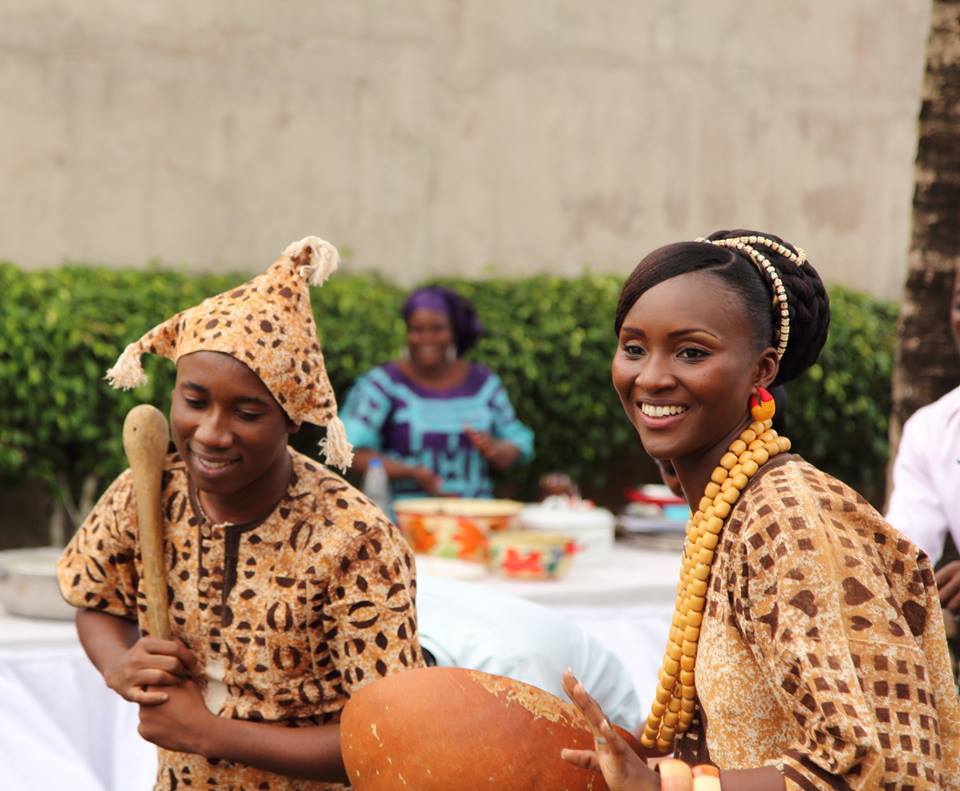
Typically, the Senufo villages are independent of each other, and each has a male secret society called Poro with elaborate initiation rituals in a patch of forest they consider as sacred.[2][4] The initiation rituals involve masks, figurines, and ritual equipment that the Senufo people carve and have perfected. The secrecy has helped the Senufo people to preserve their culture in the times of wars and political pressure. Senufo wear specially-crafted brass jewelry, such as those mimicking wildlife.[6]

"The main function of Poro is to guarantee a good relationship between the living world and the ancestors. Nerejao is an ancestress who is recognized as the true head of the Poro society. Divination, which is governed by the Sandogo society, is also an important part of Senufo religion. Although Sandogo is usually considered a women's society, men who are called to the profession and inherit through the matrilineal line are permitted to become diviners."[20]

Caryatid Figure used during tyekpa society funeral ceremonies along with Ceremonial Drums

The Sandogo are women diviners among the Senufo people. They have their own rituals and secret order.[25][26] In addition, the Senufo people have Wambele and Typka, who perform sorcery and rituals.[8]

Within Senufo culture, the female form is held above all others in terms of beauty and aesthetics and caryatid figures are seen with various cultural connotations.[24] This is tied into the worship of the spirit, "Ancient Mother", or the spirit, "mother", Maleeo, who is revered as the guiding entity by all Poro society initiates and members.[24][27] The goddess Maleeo has a partner, the god Kolocolo, who is seen as the identifying deity of the Sandogo, who granted the people marriage and this particular type of lineage to allow communication from humanity and the spirit world.[20] Caryatid figures are seen as representations of the role of women as spiritual mediators and the Sandogo use them in ceremonies as symbols of this bilateral celestial discourse.[24] Likewise, in the case of the Poro, there are writings about caryatid figures being used in ceremonies where they are brought out to commemorate advancement in the age-grade cycle,[24] as well as being used to raise funds by initiates of the society. Calved figures were used in a tyekpa funeral ceremony as dance sculpture, held upon the head of the dancers while the ceremony takes place.[24]

The traditional Senufo religion is a type of animism. This Senufo belief includes ancestral and nature spirits, who may be contacted. They believe in a Supreme Being, who is viewed in a dual female-male: an Ancient Mother, Maleeo or Katieleo, and a male Creator God, Kolotyolo or Koulotiolo.[8]

Influence

[edit]

The art of Senufo people inspired twentieth-century European artists such as Pablo Picasso and Fernand Léger.[28][29][30] The cubism and masks found in Senufo pieces were a significant influence for Pablo Picasso's African period.[31]

The term Senufo has become a category to art collectors and scholars, a symbolism for the artistic traditions of West Africa, starting with the early twentieth century. Old pieces of Senufo art are found in many leading museums of the world.[32]

Cornélius Yao Azaglo August, a photographer, created a photographical journal of Senufo people from 1955 onward.[33]

See also

[edit]

References

[edit]
[edit]
Revisions and contributorsEdit on WikipediaRead on Wikipedia
from Grokipedia
The Senufo are a West African ethnolinguistic group exceeding 2.5 million in population, distributed across northern Côte d'Ivoire, southeastern Mali, and southwestern Burkina Faso, where they share linguistic ties through dialects of the Gur language family. Predominantly agriculturalists, they cultivate staple crops such as yams, millet, corn, sorghum, and peanuts, alongside cash crops like cotton, employing practices including crop rotation and fallowing to sustain soil fertility in their savanna environments. Organized into kinship-based villages featuring clustered mud-brick dwellings, Senufo society integrates initiation associations—the male Poro and female Sando—which utilize wooden sculptures, masks, and figurines in rituals addressing divination, ancestral spirits, and harmony with nature to support farming prosperity and social order. Their artistic traditions, encompassing rhythmic pounders, ancestor figures, and ceremonial objects, reflect a profound engagement with cosmology and community rites, earning acclaim for technical mastery and symbolic depth in global collections. Despite encompassing diverse subgroups with varying dialects and customs, the Senufo maintain core cultural continuities amid influences from Islam, Christianity, and modernization.

Demographics and Languages

Population and Geographic Distribution

The Senufo people primarily inhabit northern Côte d'Ivoire, southeastern , and southwestern , occupying landscapes conducive to their agricultural lifestyle centered on yam, millet, and cultivation. Their geographic range spans the border regions of these countries, forming a cultural continuum disrupted by modern national boundaries. Key settlements include in Côte d'Ivoire, recognized as a traditional Senufo hub, as well as areas around Sikasso in and Mouhoun in . Population estimates for the Senufo total over 2.5 million, though figures vary across sources due to differences in subgroup delineation and census methodologies. In Côte d'Ivoire, where the majority reside, subgroups such as the Southern Senoufo account for approximately 2.1 million individuals, concentrated in the northern districts of Savanes and Woroba. In , Senufo and related Manianka groups constitute about 9.6% of the national population, equating to roughly 2.1 million people based on a 2023 estimate of Mali's total population at 22 million; these are mainly in the Sikasso Region. Smaller communities in , including Central and Niangolo Senoufo, number in the low hundreds of thousands, primarily in the west near the Ivorian border. These distributions reflect historical migrations and adaptations to the Volta Basin's , with densities higher in fertile northern Ivorian plains.

Linguistic Variations and Classification

The Senufo languages form a primary branch of the , which belong to the Niger-Congo . They exhibit typological features shared with other , such as a suffixal system and aspectual marking on verbs. Spoken primarily in northern Côte d'Ivoire, southeastern , and southwestern , these languages number approximately 15 distinct varieties, though some analyses count up to 30 closely related dialects depending on criteria for . Total speakers are estimated at 1.5 to over 2 million. Linguists classify the Senufo languages into three main subgroups: Northern, Central, and Southern, reflecting geographic and phonological divergences. The Northern subgroup, centered in , includes Suppire (also known as Supyire) and Mamara, with limited to other branches due to tonal and lexical differences. Central Senufo, dominant in Côte d'Ivoire, is represented by Senari (or Cenara), which encompasses about nine major dialects such as Cebaara, dividing speakers into further localized varieties. Southern Senufo varieties, spoken in southern Côte d'Ivoire regions, include Palaka and Dyimini, characterized by distinct phonetic inventories and vocabulary. These subgroups arose from historical migrations and interactions, with variations often tied to specific Senufo subgroups' territories, though cross-dialect borrowing occurs via trade and intermarriage. Classification debates have occasionally separated Senufo from core Gur due to unique innovations, but consensus maintains their inclusion as a coordinate branch to Central Gur.

Historical Development

Origins and Early Migrations

The Senufo people's origins trace to the savanna zones of , with oral traditions recounting their emergence from the region near in present-day , where groups sought more fertile lands for amid environmental pressures and . These early movements likely began over a millennium ago, involving southward expansions into transitional savanna-forest ecotones better suited for cultivating crops like millet, , and yams, which formed the basis of their . Significant migrations intensified around the , coinciding with broader regional dynamics such as establishments by Bambara groups and the Kong trading post's founding, which facilitated Senufo dispersal south, west, and north. Subgroups like the Palaka diverged prior to this period, fostering early diversification in dialects and customs, while main populations settled progressively, integrating with local communities through alliances with occupational specialists such as blacksmiths and herders. By the 15th and 16th centuries, Senufo had consolidated in core territories spanning northern Côte d'Ivoire, southeastern , and southwestern , establishing themselves as primary occupants amid sparse archaeological corroboration, relying instead on linguistic patterns—within the Northern Gur branch—and ethnographic records of autochthonous claims in these areas. This timeline aligns with the formation of distinct subgroups, reflecting adaptive responses to ecological niches rather than conquest-driven displacements.

Pre-Colonial Societies and Interactions

Pre-colonial Senufo societies centered on autonomous villages structured around lineages or quarters differentiated by origin, status, or occupation. Communal land ownership was overseen by village chiefs and elders, with oversight provided by a designated Master of the to mediate human-nature relations. These villages lacked centralized political authority, relying instead on consensus-driven councils of elders for governance and . The association functioned as a pivotal institution for male initiation, bridging lineage divisions and enforcing social norms across communities in northern Côte d'Ivoire, southeastern , and western . Boys progressed through multi-stage initiations in secluded sacred groves, lasting weeks to months, where senior members imparted genealogies, , cooperative labor, and deference to elders under the symbolic authority of the "Old Mother," an aspect of a female . elders exercised regulatory power, organizing rituals, masked performances, and funerary practices that reinforced communal obligations and historical continuity. Economic and cultural interactions with Manding-speaking Dyula traders involved symbiotic arrangements, with Senufo specializing in —cultivating yams, , , and —while Dyula enclaves handled long-distance , settling along routes within Senufo territories for centuries. This coexistence fostered partial cultural exchange, including some Senufo adoption of and practices due to the prestige of , yet Senufo communities predominantly retained animist beliefs and resisted wholesale Islamization or subordination to Dyula influence. Periodic tensions arose from Dyula ambitions for autonomy from Senufo chiefly oversight, though integration via land rights and occupational complementarity generally prevailed pre-colonially.

Colonial Encounters and Impacts

French military expeditions penetrated Senufo-inhabited territories in northwest Côte d'Ivoire during the 1890s, subjugating decentralized village communities lacking centralized political authority to resist effectively. By 1893, the Senufo regions were formally integrated into French colonial administration as part of Côte d'Ivoire, marking the onset of that prioritized resource extraction over local structures. This incorporation followed broader French advances in , where Senufo lands spanning Côte d'Ivoire, southeastern , and western (then Upper Volta) were divided among colonies without regard for ethnic continuities. The conquest precipitated immediate social upheavals, including waves of migration as communities fled military pacification campaigns and evaded labor demands. French administrators imposed head taxes, which by the early constituted up to 80% of colonial revenue in territories like Upper Volta, compelling Senufo farmers to engage in wage labor or production to meet fiscal obligations. Forced labor requisitions for projects, such as roads and railways, further strained , exacerbating food insecurity and prompting seasonal migrations to urban centers or neighboring regions. Economically, colonial policies shifted Senufo agrarian practices toward export-oriented cultivation, notably in northern Côte d'Ivoire, where French initiatives introduced plows and traction to boost yields despite initial resistance to mechanization. These innovations yielded mixed results; while some areas adopted tools enhancing productivity, the diminished incentives for intensification, allowing Senufo producers to exploit colonial perceptions of their supposed indolence to negotiate lighter production quotas. Artisanal castes faced competition from imported goods, though initiation societies persisted as adaptive institutions, incorporating elements of resistance while French ethnographers documented Senufo masks and sculptures, framing them within stereotypes of primitive authenticity that informed administrative stereotypes of Senufo as docile yet inscrutable. Culturally, the era compounded pre-existing pressures from Manding expansion, constituting a "double colonization" that eroded without fully supplanting animist cosmologies or systems. Missionaries made limited inroads, with Islamization confined largely to elites prior to French rule, and Christian conversions remaining marginal among Senufo villagers who maintained and Sandiki societies as bulwarks against assimilation. Colonial divide-and-rule tactics exploited divisions, favoring certain artisan groups for while marginalizing farmers, fostering intra-community tensions that outlasted formal independence. Overall, these encounters entrenched extractive institutions, with long-term demographic shifts evidenced by rural depopulation and urban labor flows persisting into the postcolonial period.

Post-Independence Trajectories

After in 1960, Senufo populations in d'Ivoire underwent substantial from northern regions to the southern forest zones, facilitated by government initiatives to expand cash crop cultivation, particularly cocoa and . This movement, building on colonial-era labor mobilization, supplied agricultural labor to the burgeoning under President Félix Houphouët-Boigny's administration, which prioritized economic growth and stability from 1960 to 1993. Senufo migrants, often from farming backgrounds, contributed to the "Ivorian ," characterized by annual GDP growth averaging 7-8% through the 1970s, though northern Senufo areas saw slower infrastructure development compared to the south. Regional disparities persisted, exacerbating north-south divides that fueled political instability, including the (2002–2007), where northern territories inhabited predominantly by Senufo and other northern ethnic groups fell under rebel control of the Forces Nouvelles, isolating them from the government-held south. The conflict disrupted Senufo agricultural activities, displaced communities, and intensified ethnic mobilization, with northern grievances over economic marginalization playing a role in the rebellion's support base; a brief second crisis in 2010–2011 further strained these areas before stability returned under President from 2011 onward. Post-conflict reconstruction emphasized reconciliation, but Senufo regions continue to face higher poverty rates, with northern Côte d'Ivoire's GDP per capita lagging behind national averages by approximately 20-30% as of the 2010s. In parallel, cultural adaptations emerged amid modernization and external influences. Post-colonial Senufo society has seen a gradual shift from traditional matrilineal kinship toward patrilineal structures in some subgroups, attributed to expanding Islamic proselytization—particularly among southern Senufo exposed to Dyula Muslim traders—and Western education systems. Initiation societies like remain active, preserving rituals and social cohesion, though urbanization and wage labor have eroded some communal practices. In Mali's Sikasso region and southwestern , where Senufo number around 630,000 and 100,000 respectively, post-1960 trajectories involved adaptation to national socialist policies under Mali's (1960–1968) and Burkina Faso's revolutionary governments, with emphasis on subsistence farming and limited integration into broader economies, amid periodic droughts and political coups.

Social Structure

Kinship Systems and Family Organization

The Senufo traditionally trace descent, , and succession through the matrilineal line, whereby clan membership and property rights pass from mothers to their children, emphasizing maternal ties as the primary social and economic framework. Despite this matrilineal descent, Senufo exhibits patriarchal elements, with men holding authority in and public roles, while women's influence manifests through control over lineage-based resources and ritual participation. Post-colonial influences have prompted shifts toward patrilineal practices in some communities, though matriliny persists in rural areas as a core identifier of identity and obligations. Family organization centers on the unit, housed in compounds known as katiola, which accommodate multiple generations under the leadership of the eldest male, typically including his sons, their wives, and children. These compounds function as self-contained economic and social entities, where labor is divided by gender—men focusing on farming and herding, women on processing crops and household management—fostering interdependence and collective responsibility for sustenance and rituals. Villages comprise clusters of such katiola aligned by matrilineal lineages, reinforcing communal ties through shared ancestry and mutual aid during harvests or ceremonies. Marriage is predominantly arranged by families to strengthen alliances and secure labor exchanges, with polygyny common among prosperous men to expand household productivity; bridewealth, often in livestock or yams, transfers to the bride's matrilineage as compensation for her labor contributions. Two main forms prevail: loborgho, a strategic union for status or wealth negotiated between kin groups, and tamaraga, a less formal elopement-based marriage driven by affection, though both integrate the bride into the husband's katiola while preserving her matrilineal rights. Cousin marriages, particularly cross-cousin types, are preferred to keep property within lineages, and initiation rites mark transitions into marital roles, embedding couples in broader kinship networks.

Caste Divisions and Occupational Roles

The Senufo exhibit a stratified characterized by endogamous divisions between farmers and , with farmers (senambele) forming the numerical majority and holding superior status as landowners and primary producers. (fijembele) constitute specialized subgroups, including blacksmiths (kule), wood carvers (kpeene), casters (tyeli or tubi), potters, and , whose occupations are hereditary and tied to ritual and with farmers. These groups typically reside in separate quarters and exchange crafted goods—such as tools, , and utensils—for agricultural produce, reflecting a patron-client dynamic rather than outright servitude. Farmers dominate occupational roles centered on , cultivating staple crops like yams, millet, , , and through slash-and-burn techniques, supplemented by , , and rope-making from local fibers. Men clear fields and perform heavy labor, while women process harvests, winnow grain, and manage household gardens; this division reinforces patrilineal and village autonomy. In contrast, artisans maintain technical monopolies: blacksmiths forge iron implements, weapons, and ritual objects, often invoking spiritual powers associated with fire and , which elevates their esteem despite social marginality among certain subgroups like the Senufo-Tagba, where they are termed tuntuns and revered for repairing community tools. Lower-status roles include musicians and praise-singers (gara or griot-like figures), who perform at initiations, funerals, and disputes, preserving oral traditions but ranking below due to their dependence on gifts rather than essential production. Ethnographic analyses, such as those by Dolores Richter, highlight hierarchical elements including occupational castes and occasionally despised subgroups, though Senufo divisions lack the barriers of Asian castes, emphasizing instead economic reciprocity and political alliances between farmers and . Slaves or captives historically augmented labor pools but were not formalized castes, often integrated via marriage or post-raids. This structure persists variably, influenced by modern markets eroding artisan .

Initiation Societies and Gender Dynamics

The Senufo maintain distinct societies that delineate and reinforce gender-specific roles within their patrilineal yet matrilineally influenced social structure. The society, exclusive to men, oversees the of boys into adulthood, beginning around age seven and culminating in full membership by approximately age twenty-eight. These rites involve prolonged seclusion in sacred groves, where initiates receive instruction in agricultural techniques, moral codes, leadership responsibilities, and ritual knowledge, fostering attributes such as courage, discipline, and communal authority. membership confers hierarchical status, with higher grades granting influence over village governance and , thereby embedding male dominance in public and political spheres. Parallel to Poro, women participate in associations like Sandogo and Tyekpa, which emphasize spiritual mediation, , and maternal duties. Sandogo, primarily a women's society, initiates females—often around —and trains them in interpreting omens through sculpted figures, such as those depicting the messenger python, to ensure between the living and ancestral spirits, particularly in family matters. Tyekpa, recognized among subgroups like the Fodonon Senufo, functions as a female counterpart focused on funerary rites and honoring motherhood; its ceremonies feature maternity sculptures symbolizing fertility and lineage continuity, carried by senior initiates during dances to commemorate deceased women and reinforce communal bonds through female agency in ritual performance. These societies cultivate complementary yet asymmetrical gender dynamics, with emphasizing male provision, protection, and aggression—evident in tests of endurance and secrecy—while women's groups prioritize relational and spiritual roles, such as resolving domestic conflicts via and performing celebratory dances like Ngoron to honor initiates. Though men occasionally inherit Sandogo roles matrilineally, the structures generally exclude cross-gender participation, perpetuating a division where male societies hold overt authority in secular affairs, balanced by female influence in esoteric and familial domains. This bifurcation, rooted in cosmological beliefs tying gender to creation myths of ancestral pairs, sustains social order by channeling initiates into predefined adult responsibilities, with violations of secrecy punishable by communal sanctions.

Economy and Livelihoods

Agricultural Practices and Subsistence Strategies

The Senufo people primarily sustain themselves through rain-fed in the zones of northern Côte d'Ivoire, southern , and southwestern , where they cultivate staple crops including yams, , millet, , , and . Yams serve as a central crop, particularly associated with labor and prestige in traditional systems, grown using labor-intensive techniques such as ridging and staking to support vines, though yields remain low under these conventional methods without modern inputs. Supplementary crops like groundnuts and diversify diets and provide resilience against seasonal variability. Cotton functions as the principal , integrated into farming rotations and promoted via agricultural policies since the colonial era, enabling Senufo households to access markets and purchase necessities, though it demands significant family labor and has led to shifts away from more labor-intensive staples like yams in some areas. divisions structure labor: men clear fields, plant yams and , and manage larger plots, while women tend secondary gardens, process harvests (e.g., rice, grinding grains), and handle small-scale livestock like and goats for protein and minor . Practices emphasize family-based and of soil types, with farmers classifying lands for suitability in growing yams, , or , supplemented by organic amendments where available. Beyond cropping, subsistence strategies incorporate limited , , and gathering of wild foods, alongside minimal , which together buffer against crop failures but constitute a smaller portion of caloric intake compared to farming. Tools remain rudimentary—hoes, machetes, and woven baskets—reflecting a reliance on manual methods over , which sustains ecological balance in fragile soils but constrains productivity and vulnerability to droughts. Recent extensions of sustainable techniques, such as improved pit planting with , are emerging but not yet widespread among traditional Senufo cultivators.

Artisan Production and Trade Networks

Senufo features specialized artisan castes, including blacksmiths, woodcarvers, casters, potters, weavers, and leatherworkers, who produce tools, household goods, and ritual objects essential for daily life and ceremonies. Blacksmiths, hereditary members of an endogamous group with their own chapters, forge iron implements such as the short-handled hoe (tiya), weapons, musical instruments, and sculptures for rituals and . Woodcarvers craft utensils, stools, and ceremonial masks like the Kpeli-yehe and Degele, as well as figures used in initiations and funerals. Brass casters create jewelry, charms, and ceremonial sculptures, with women from these households often specializing in for domestic use. Weavers produce textiles from spun —dyed by men—while basket weavers make mats and containers, and leatherworkers fashion shoes, , and amulets. These castes, viewed as divinely ordained yet lower in due to their association with magical powers, operate separately from farmers but integrate into the broader via distinct associations for each occupational group, including artisans and traders. Artisan goods circulate primarily through local markets, absorbing about 75% of production via foot transport for items like , tools, and textiles. Regional networks, dominated by Dioula and Malinke merchants, export Senufo crafts alongside agricultural products such as and . Pre-colonially, cowry shells functioned as in these exchanges, with traders—as a dedicated occupational group—facilitating integration of artisan outputs into wider economic transactions, including raffia textiles for legal and marital purposes.

Religion and Cosmology

Animist Foundations and Veneration

The traditional religion of the Senufo people is animistic, positing a spiritual essence in natural elements, animals, and objects, with a of beings influencing affairs. Central to this cosmology is a supreme , known variably as Koulotyelo or Koulo Tyolo, who is distant and rarely directly invoked, alongside a nurturing aspect called Katyelééó or "Ancient Mother," revered as protector of initiates and embodiments of . Worship primarily targets intermediary spirits, including bush spirits (ambivalent nature entities that can cause misfortune if offended) and ancestral spirits, through rituals aimed at maintaining harmony and securing blessings for , , and lineage continuity. Ancestor veneration forms the core of Senufo spiritual practice, viewing deceased kin as potent forces capable of aiding or harming the living based on ritual observance. Upon death, the is believed to linger for seven years, during which elaborate funerals—featuring like the kpeli-yehe and sculptures such as pombibele—guide it toward ancestral status or , ensuring its benevolent integration into the spirit realm. Failure to perform these rites properly risks ancestral wrath, manifesting as illness or crop failure, prompting sacrifices of animals, libations, and offerings to appease them. The society, a initiation association, institutionalizes ancestor cults by transmitting genealogies, histories, and esoteric knowledge in sacred groves, where elders invoke ancestral spirits during ceremonies to reinforce and moral codes. Complementarily, the female Sandogo society employs to communicate with ancestors and bush spirits, using brass or wooden figures on altars to diagnose imbalances and prescribe remedies. These practices underscore a causal view wherein empirical observance of rituals correlates with communal prosperity, as documented in ethnographic accounts of Senufo villages.

Secret Rites and Divinatory Practices

The Senufo people's secret rites are conducted through complementary initiation societies, the male-dominated and the female Sandogo, which enforce social norms, facilitate spiritual communication, and protect communal harmony. Poro rituals, particularly s for adolescent males, occur in secluded bush encampments over several months, imparting knowledge of cosmology, , and moral conduct through masked dances, processions with large wooden statues (95–150 cm high), and symbolic enactments that transition initiates to adulthood. These rites, veiled in secrecy to preserve esoteric power, culminate in ceremonies reinforcing matrilineal kinship and gender complementarity, often employing altar figures depicting idealized forms to embody societal teachings. Sandogo, a matrilineal women's society, oversees divinatory practices central to diagnosing spiritual imbalances and mediating with bush spirits. Diviners, trained within Sandogo, conduct consultations in dim, enclosed spaces, grasping the client's hand to interpret involuntary tremors as spirit responses, supplemented by rattles, found objects, or musical instruments to pose queries to entities. Shrines feature python effigies—the messenger spirit fo—alongside brass yawiige ornaments (e.g., or figurines) and wooden sculptures like ndebele or madeö figures, commissioned to appease ambivalent forces and prescribe offerings or protective amulets. Funeral rites, integral to both societies, invoke ancestors via secretive performances; Poro members deploy fire-spitter helmet masks and rhythm pounders in processions to honor the deceased and avert calamity, while Sandogo ensures purity through targeted divinations uncovering disputes or sorcery. The kafigeledjo method, employed in , deploys diviner-led ordeals to expose falsehoods, underscoring the rites' role in causal over mere . These practices, sustained across Senufo subgroups, adapt to local dialects but retain core animist linking human actions to spiritual repercussions.

Influences from Islam and Christianity

The Senufo people, while rooted in animist traditions centered on ancestor veneration and secret societies like , have experienced gradual exposure to primarily through the settlement of Muslim Dyula traders in southern communities starting in the , which facilitated cultural exchange and conversions. This contact has led to an estimated 25% of Senufo adopting , with missionary reports noting a rapid increase in adherence, particularly in northern areas bordering where Islamic pressures are stronger. Islamic influence has prompted shifts in , including a move from traditional matrilineal to patrilineal systems in some groups, as well as conversions often involving the rejection of Senufo names in favor of ones to signify religious commitment. These Islamic inroads have also eroded participation in indigenous rites, with a high influx of correlating to diminished involvement among , who increasingly view such practices as incompatible with monotheistic tenets or influenced by external systems. In regions like in Côte d'Ivoire, urban migration and interactions with Muslim migrants have further blended elements, though full remains limited, as Islamic adherence often supplants rather than merges with animist cosmology. Christian influences, introduced via colonial-era and modern efforts, have been more localized and less pervasive, affecting an estimated 5-10% of Southern Senufo and higher proportions in some Central subgroups where professing exceed 50%. Organizations such as the and Adventist Frontier Missions have established churches and trained local pastors among groups like the Syenara Senufo in , emphasizing evangelism to counter Islamic expansion before potential widespread conversion. Christian adoption has occasionally integrated with traditional practices, as seen in syncretic tendencies where animist rituals persist alongside , though evangelical efforts stress separation from spirit worship. Overall, Christianity's impact remains modest compared to , with growth tied to and urban outreach rather than mass conversions.

Cultural Expressions

Visual Arts: Masks, Sculptures, and Symbolism

Senufo visual arts encompass wooden masks and sculptures primarily crafted by artisan subgroups for use in initiation societies, emphasizing ritual efficacy over aesthetic display. These objects, often featuring abstracted human forms with motifs and geometric ornamentation, serve in funerary rites, elder commemorations, and puberty initiations among northern Côte d'Ivoire communities. Carvers employ hardwoods like , applying dark patinas through and oils to evoke spiritual potency and idealized physical composure. Masks, such as the kpeliyé type, depict slender female ideals with elongated faces, high foreheads, and protruding lips, incorporating patterns that denote beauty and . Worn exclusively by initiated men during dances, these masks—adorned with attachments and horn-like appendages symbolizing features or stylized legs—embody , moral purity, and the expulsion of death's lingering presence from villages. The kpeliyé's smooth, glossy surface mimics oiled skin, reinforcing themes of vitality and harmony between human and bush spirits, as performed at funerals to honor deceased elders and facilitate ancestral transitions. Sculptures include rhythm pounders (deble or siibele), abstract standing figures—typically female, occasionally paired with male counterparts—struck rhythmically against the ground to accompany songs in elder funerals and boys' initiations. These works, owned by specialized carvers, represent primordial ancestors known as Pombibele ("those who gave birth to children"), symbolizing marital union, fertility, and conduits to . Characterized by elongated necks, projecting breasts, and incised body designs evoking containment and self-mastery, they prioritize inner virtue over external form. Symbolism in Senufo draws from dualistic cosmologies, contrasting male-female principles, corporeal-spiritual realms, and life-death cycles through angular postures, jutting jaws, and composite animal-human motifs. Such elements underscore causal links between performance and communal equilibrium, with objects activating bush spirits (katrie) to enforce moral order and agricultural bounty. Attributions to "Senufo" style, however, reflect colonial-era generalizations, as production ties to specific subgroups across fluid ethnic boundaries in Côte d'Ivoire, , and .

Performing Arts: Music, Dance, and Oral Traditions

The Senufo employ a variety of percussion and melodic instruments in their musical practices, prominently featuring the , a gourd-resonated with 11 to 21 wooden keys tuned pentatonically, which accompanies rituals and social gatherings. Drums, including large society drums and ceremonial slit drums carved with symbolic motifs, signal initiations and summon ancestral spirits during funerals. Additional instruments such as tuned iron gongs, horns, and flutes contribute to ensembles that reinforce communal bonds and spiritual transitions. Dances among the Senufo are integral to initiation rites and funerary ceremonies, often performed by masked dancers within the Poro society, a male initiation group that historically restricted access to outsiders. The Boloy, or Dance of the Panther Men, originated as a secretive Poro ritual invoking protective spirits but has evolved into public performances preserving cultural identity amid modernization. Other forms include the n'goro and balafon-accompanied dances marking women's passage to adulthood, where rhythmic movements and chants transmit moral and cosmological knowledge. These performances, blending athleticism and symbolism, educate participants on obedience, tradition, and social harmony during multi-phase initiations lasting years. Oral traditions form the Senufo's primary repository of and cosmology, conveyed through myths, folktales, and proverbs recited by elders or society members rather than specialized griots. Creation narratives, such as those centering the bird as a primordial creator linked to and origins, vary across subgroups and are shared selectively in contexts to encode ethical lessons. Proverbs, often illustrated in carvings or motifs, distill on , tolerance, and community, as in collections emphasizing leadership through ethical speech. Folktales like "The of the Senufo" underscore the instrument's sacred role in ancestral communion, ensuring intergenerational transmission of identity despite limited written records. These narratives, orally variant and myth-infused, adapt to affirm Senufo autonomy amid historical migrations and external influences.

Modern Context and Challenges

Demographic Shifts and Urbanization

The Senufo, with an estimated population of around 2.1 million in Côte d'Ivoire, have long maintained a predominantly rural demographic profile, concentrated in northern villages centered on and compounds. However, national trends have induced notable shifts, as Côte d'Ivoire's urban population grew to 53.1% by 2023, reflecting an annual rate of 3.38% driven by economic pull factors and rural push pressures like land scarcity. In Senufo regions, this manifests through increasing commercialization around towns like , where young men increasingly migrate to larger cities such as for wage labor in trade, construction, or services, supplementing family incomes via remittances while depleting rural labor pools. Civil conflicts from 2002 to , which partitioned the and destabilized the north, accelerated these dynamics by displacing thousands from Senufo areas and fueling southward or urban migrations amid ethnic tensions over and resources exacerbated by prior influxes. Post-conflict recovery has seen uneven repopulation, with northern densities rising due to natural growth—contributing to Côte d'Ivoire's overall 2.5% annual increase—but offset by continued out-migration, as limited local opportunities in and yam farming fail to absorb youth cohorts. These shifts strain traditional patrilineal structures, as absenteeism erodes elder authority and initiation rites, fostering urban Senufo enclaves that blend village ties with city economies, though data on exact subgroup proportions remain sparse due to informal migration patterns.

Cultural Preservation versus Assimilation Pressures

The Senufo people face significant pressures from and economic migration, particularly since , which have eroded traditional communal structures and paternal authority within families. Young men increasingly relocate to urban centers for employment opportunities, diminishing the influence of elders and the role of the society in male initiation rites and social cohesion. This migration has also contributed to a decline in practices and group living arrangements that once defined Senufo villages. Post-colonial development in Côte d'Ivoire introduced manufactured goods and market-oriented economies, disrupting the self-sustaining traditional systems reliant on hand-farming crops such as , corn, millet, , and yams. These changes fostered and a desire for industrial-era advancements, often at the expense of harmonious environmental practices and traditions like and forging. The influx of into Senufo communities has further reduced participation in poro initiations, as competes with animist rituals central to . Despite these assimilation forces, preservation efforts persist through the secrecy of societies like , which maintain esoteric knowledge and rites amid external disruptions. Community-led initiatives protect sacred sites and funerary practices, such as elaborate elder burials in regions like Folona, , to honor ancestral transitions. recognitions, including extensions for balafon-related cultural expressions shared by Senufo in Côte d'Ivoire, , and , encourage rediscovery and safeguarding of intangible heritage against globalization. These measures, combined with ongoing artistic production, help counter erosion, though demographic shifts continue to challenge transmission to younger generations numbering around 2.1 million Southern Senufo in Côte d'Ivoire alone.

Regional Conflicts and Socioeconomic Developments

The northern regions of Côte d'Ivoire, home to the majority of Senufo communities, experienced significant disruption during the First Ivorian Civil War from September 2002 to March 2007, as rebel forces of the New Forces coalition seized control of the area north of the conflict line, including key Senufo centers like Korhogo. This division exacerbated ethnic and regional tensions, with Senufo agricultural lands suffering from reduced mobility, disrupted trade, and sporadic violence between government loyalists and northern insurgents. A post-election crisis in 2010-2011 further intensified instability in these zones, leading to thousands of displacements among northern populations, including Senufo groups, amid clashes over political control and resource access. In southeastern Mali and western Burkina Faso, where smaller Senufo subgroups reside, ongoing jihadist insurgencies since 2012 have spilled over into and operations, displacing communities and hindering cross-border trade vital to Senufo farming households. Ethnic Fulani herders and sedentary groups like the Senufo have clashed over land and water in central 's plateau regions bordering , with armed groups exploiting these tensions to recruit or coerce locals. By 2024, violence in the central had displaced over 2 million people across , , and neighboring areas, indirectly straining Senufo socioeconomic networks through flows and market disruptions. Senufo economies remain predominantly agrarian, centered on subsistence and cash crops such as , millet, yams, , and , with villages organized around clustered mud-brick homesteads to facilitate . Men typically clear fields and manage , while women handle processing, personal plots, and household labor, contributing to family income amid persistent exacerbated by Côte d'Ivoire's macroeconomic decline since the late . In northern Côte d'Ivoire's commune, lowland cultivation has emerged as a pathway for women's socioeconomic integration, enabling cash earnings and reduced dependence on male-headed households, though yields remain vulnerable to erratic rainfall and limited infrastructure. Post-conflict recovery in Côte d'Ivoire has driven uneven socioeconomic progress for Senufo communities, with national GDP growth averaging 7-8% annually from 2012 onward, fueled by agriculture and exports, yet northern regions lag due to deficits and historical marginalization. Migration to urban centers like for wage labor has increased among young Senufo men, depleting rural workforces and accelerating shifts from communal to individualized systems under state policies. In , Senufo households have diversified into off-farm activities like textile dyeing and rope-making, but insurgency-related insecurity continues to constrain and in , perpetuating cycles of low development.

References

Add your contribution
Related Hubs
User Avatar
No comments yet.