Hubbry Logo
Desert Battle Dress UniformDesert Battle Dress UniformMain
Open search
Desert Battle Dress Uniform
Community hub
Desert Battle Dress Uniform
logo
8 pages, 0 posts
0 subscribers
Be the first to start a discussion here.
Desert Battle Dress Uniform
from Wikipedia

The Desert Battle Dress Uniform (DBDU)[4] is a U.S. arid-environment camouflage battle uniform that was used by the United States Armed Forces from the early 1980s to the early to mid 1990s, most notably during the Persian Gulf War. Although the U.S. military has long since abandoned the pattern, it is still in widespread use by militaries across the world as of the early 2020s.

Key Information

Appearance

[edit]
A man modelling an early version of the DBDU on December 6, 1976.
DBDU trousers, featuring the chocolate-chip camouflage pattern

The Desert Battle Dress Uniform was designed in 1970[5] and uses a camouflage pattern known as the Six-Color Desert Pattern or colloquially as Chocolate-Chip Camouflage and Cookie Dough Camouflage. The camouflage received its nickname because it resembles chocolate-chip cookie dough. It is made up of a base pattern of light tan overlaid with broad swathes of pale green and wide two-tone bands of brown. Clusters of black and white spots are scattered over, to mimic the appearance of pebbles and their shadows. The cut of the DBDU is virtually identical to that of the Temperate BDU, retaining the ‘Elvis Collar’, and it was initially made with a ripstop 50% / 50% nylon-cotton (Nyco) blend.[6] An improved version, the Enhanced Desert BDU or EDBDU, was adopted in the early 1990s, in 100% ripstop cotton. DBDUs were used alongside PASGT helmet covers, ALICE rucksack covers, caps and boonie hats also made in the 6-color pattern. Most early DBDUs have an orange tint, with later versions, especially those issued before and during the Gulf War having a more reddish one.

History

[edit]
A drawing of U.S. Marines in the Persian Gulf War with the DBDU

Although the chocolate-chip camouflage became well known during the Persian Gulf War, it was originally designed decades prior, in 1960.[7] The U.S. Army, believing that it might one day become necessary to intervene in the Arab–Israeli conflicts, developed a test pattern using the deserts of the southwestern United States as a model. When the hostilities in the Middle East wound down, the test pattern was mothballed. Renewed interest in desert camouflage due to the US increasing its military presence in the Middle East in the late 1970s led to the project being revived. The formation of the U.S. Rapid Deployment Force (RDF) in 1979, with its remit to operate in the Middle East, and protect U.S. interests in the Persian Gulf region, saw the need for desert camouflage clothing to emerge again. In 1981, issue of the new Desert Battle Dress Uniform (DBDU) began, limited to elements of the new Rapid Deployment Force (RDF), formed to act as the US contingency response force for the Middle East. Units that took part in the annual Bright Star exercises with Egypt and the Multinational Force and Observers (MFO) responsible for monitoring the Sinai Peninsula were also issued the uniform. The six-color desert pattern entered service in 1981 at the same time as the woodland BDUs and would be worn in limited numbers by U.S. troops taking part in the biennial Bright Star exercises in Egypt during the 1980s, and by FORSCOM peacekeepers assigned to the Multinational Force and Observers in the Egyptian Sinai Desert, but was not issued in large numbers prior to the Persian Gulf War. However, there is evidence that the six-color desert pattern camouflage was in use before 1981 with photographs of American military personnel involved in Operation Eagle Claw in April 1980 using this camouflage pattern in the failed attempt to rescue U.S. embassy staff being held hostage in Iran.

The pattern was unpopular with American soldiers during the Gulf War.[8] Feedback from these users indicated that the design contrasted too much with the terrain, preventing the camouflage from blending in effectively. Anecdotal evidence suggested that the dark areas of the pattern warmed up more than the paler parts under desert sunlight, and retained the heat longer. The six colors were also more expensive to manufacture than three or four colors, and the need for a camouflage that would be suitable for use in any desert resulted in a requirement for a new desert camouflage uniform. The U.S. Army Natick Soldier Center began the search for a substitute. Samples of sand and earth from the Middle East were measured for optical and infrared reflectance, and seven trial patterns were created using these statistics. The patterns were evaluated in fourteen different desert locations and narrowed down to one favorite. The resulting "Desert Camouflage Pattern: Combat" was standardized in 1990, but was not ready before troops deployed to Saudi Arabia during the Persian Gulf War. Consequently, U.S. forces wore the six-color BDUs during the campaign. During that war, after initiatives by General Norman Schwarzkopf, the six-color Desert BDU was produced in 100% cotton poplin without reinforcement panels in order to improve comfort in hot desert conditions. A total of 500,000 improved cotton BDUs were ordered. However, cost concerns caused the cotton six-color Desert BDU to be discontinued shortly after the Persian Gulf War.[9]

U.S. Army

[edit]
Desert Battle Dress Uniform wearing Lieutenant General Robert C. Kingston, commanding general, US Central Command, fires a German built 7.62 mm G3 Heckler and Koch rifle during BRIGHT STAR '82, an exercise involving troops from the US, Egypt, Sudan, Somalia and Oman

With limited issuing dating back to the 1980 mission to the rescue American hostages in Iran, the DBDU was unique, in that when it was officially issued in 1981, the 6-color desert pattern was only issued in limited numbers to division personnel like the U.S. 82nd Airborne or 101st Airborne who deployed to Egypt and the Sinai desert to participate in the "Bright Star" exercise in December 1980. The DBDU was the U.S. Army's first fully functional desert combat pattern from 1981 to 1992.

U.S. Marine Corps

[edit]

Like the Army, the DBDU was seldom issued whenever Marines were deployed to participate in the "Bright Star" exercises, but became their standard arid combat uniform by 1985. The 6-color desert pattern was used by the U.S. Marine Corps from 1982 to 1995.

U.S. Air Force

[edit]

First issued in 1982 for their participation and deployments to arid regions, the DBDU became the United States Air Forces primary desert uniform from 1982 to 1993.

U.S. Navy

[edit]

Like its sister branches, The Navy began limited issue of the DBDU in the early 80s and became standard wide by 1985. It would remain the Navy's main desert combat uniform from the early '80s to the mid '90s.

U.S. Coast Guard

[edit]

The Coast Guard was the last branch to see remaining issue of the DBDU in the mid to late 1980s.

Replacement

[edit]

An initial batch of desert BDUs in the new camouflage scheme was en route to the Middle East when hostilities ceased.[10] The pattern, officially issued with the newer Desert Camouflage Uniform (DCU) in the early 1990s, consisted of a subtle blend of large pastel green and light tan shapes, with sparsely placed, narrow, reddish brown patches, leading the design to be unofficially nicknamed the “Coffee Stain” pattern.

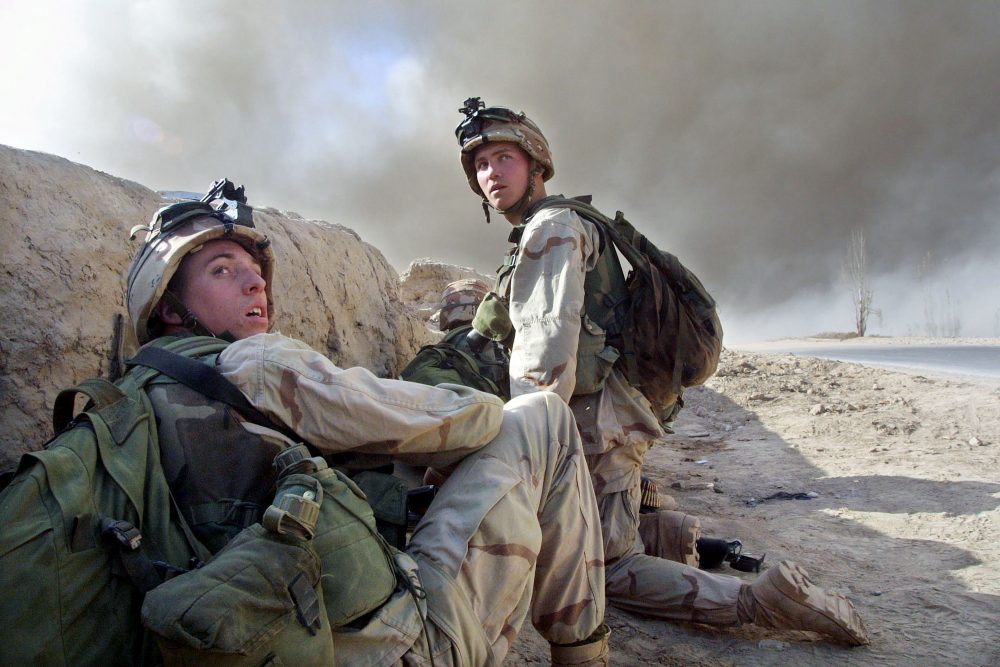
Both patterns were briefly used together during the transition period, most notably during Operation Restore Hope and Operation Gothic Serpent (some U.S. Army Rangers during the latter occasionally wore the newer three-color DCU's along with kevlar helmet covers retaining the old six-color pattern. The same dress was also worn by soldiers of the 10th Mountain Division during the Battle of Qala-i-Jangi in 2001).[11] During Operation Bright Star 1995, Third Army personnel wore the three-color uniform while troops from Fort Bragg (330th MCC) wore the six-color uniform for the 75-day exercise. In the 2003 invasion of Iraq, the U.S. military did not use the DBDU, and instead mostly used the DCU's tri-color pattern and to a lesser extent, the MARPAT camouflage pattern.

Legacy

[edit]
Iraqi soldiers in 2006 wearing DBDUs
David H. Petraeus meets with the Afghan Border Police Commander, General Abdul Khalil Bakhten, wearing the Saudi grey version

As of the early 2010s, the chocolate-chip pattern is still in widespread use across the world, long after the United States abandoned it. A uniform similar to the Desert Battle Dress Uniform was issued to the Iraqi National Guard before it was dissolved in 2004 and to the Iraqi security forces.

South Korean forces have used, in limited numbers since 1993, a variant with brown replacing the black in the original U.S. design; this South Korean design has also been tested in the United Arab Emirates.

The Oman National Guard use a pattern mixing chocolate-chip with 'amoeba', while the National Guards of both Saudi Arabia and Kuwait use a grey variation on the chocolate-chip design. The Saudis also use a grey, black, and white 'urban' variation and the police wear a blue version of the same design; Palestinian police also use a blue chocolate-chip patterned uniform.

The South African "Soldier 2000" pattern is similar to the U.S. design. A copy of the pattern, using tan, medium brown, bottle-green and greyish green, in addition to the black-on-white pebbles, is used in Kazakhstan.

Users

[edit]

See also

[edit]

References

[edit]

Bibliography

[edit]
[edit]
Revisions and contributorsEdit on WikipediaRead on Wikipedia
from Grokipedia
The Desert Battle Dress Uniform (DBDU) is a combat developed for arid and desert environments by the , featuring a distinctive six-color "" pattern consisting of tan, pale green, brown, and small irregular black and white spots to mimic rocky desert terrain. Introduced on a large scale in 1982 as part of a broader modernization effort, it included a loose-fitting with multiple pockets, straight-leg , and a soft , all constructed from a durable 50/50 cotton-nylon fabric treated for insect repellency and reduction. This design provided enhanced ventilation and mobility for soldiers in extreme heat while offering concealment during daylight and limited effectiveness at night. The DBDU's development began in the late 1970s, drawing from earlier camouflage experiments dating back to the , with the pattern finalized to address the shortcomings of standard woodland uniforms in sandy and rocky regions. Initially fielded in limited quantities around 1981, it gained prominence during Operation Desert Shield and Desert Storm in 1990–1991, where over 500,000 U.S. troops deployed to the wore it as the primary combat attire, earning its nickname from the speckled appearance resembling chocolate chips in cookie dough. However, feedback from the highlighted issues such as poor performance in open sandy areas and high production costs, leading to its replacement by the more versatile three-color (DCU) by 1992 for most desert operations. Despite its short primary service life, the DBDU remained authorized for wear until the broader phase-out of Battle Dress Uniforms starting in 2004, with final retirement in 2008, coinciding with the adoption of the digital-patterned (ACU). It influenced subsequent uniform designs by emphasizing environment-specific and was used by other nations, including allies during joint operations, while becoming an iconic symbol of U.S. military history in media and .

Design and Appearance

Camouflage Pattern

The six-color desert camouflage pattern, also known as the "Chocolate Chip" pattern due to its distinctive spotting, features a light tan base color representing desert sands, overlaid with broad curving bands of pale olive green and dark brown to simulate sparse and formations, along with small irregular clusters of black and white spots that disrupt outlines and mimic scattered pebbles or . This design incorporates six primary shades—light tan, tan, khaki (pale green), light brown, dark brown, and black—printed on the fabric to create a disruptive effect at various distances. The pattern's irregular motifs were engineered to break up the human silhouette, enhancing concealment in open arid landscapes. The rationale for the pattern's effectiveness lies in its ability to merge with the sandy expanses, rocky outcrops, and limited foliage typical of environments in the , providing visual disruption against both ground and aerial observation at ranges up to several hundred meters.

Materials and Construction

The Desert Battle Dress Uniform (DBDU) was constructed using a 50/50 cotton-nylon fabric, designed to offer tear resistance through its weave and breathability for arid, hot environments. This material composition also incorporated protection characteristics to reduce visibility to night-vision devices. The fabric was printed with the desert camouflage pattern directly onto the surface to ensure seamless integration of concealment with the uniform's structure. Key structural elements of the DBDU included multiple cargo pockets on both the jacket and pants for utility, with the pants featuring four standard pockets and two bellows-style leg pockets for expanded storage. Reinforced at the elbows and knees enhanced longevity under abrasion, while adjustable cuffs and tabs allowed for a customizable fit. attachments were incorporated on the jacket for securing name tapes, rank insignia, and identification panels, facilitating quick changes in field conditions. The overall design adopted a loose-fitting to accommodate layering with and other combat gear without restricting movement. A typical set weighed approximately 4 pounds, balancing portability with robustness.

Development and History

Origins and Design Process

The development of the Desert Battle Dress Uniform (DBDU) originated in the early as part of the U.S. Army's broader research aimed at addressing non-temperate environments, particularly arid regions, in anticipation of potential deployments to the and other desert theaters. In 1960, John H. Hopkins of the Mobility Equipment Research and Development Command (MERADCOM) designed an initial six-color desert pattern to create a disruptive scheme suitable for sandy and rocky terrains. This effort was managed under MERADCOM's branch, which focused on and personnel concealment in harsh climates. Lessons from the , where standard temperate camouflage proved inadequate for diverse terrains, underscored the need for specialized arid patterns that could break up silhouettes effectively in open deserts. This prompted desert-specific testing in the late 1960s, including field observations during the overseen by MERADCOM and the U.S. Army Natick Laboratories, with MERADCOM collaborating to refine the pattern using analytical methods like Kubelka-Munk modeling for color formulation on /cotton fabrics. Early prototypes emphasized lightweight construction and multi-environment adaptability, incorporating feedback from field observations on visibility reduction at longer ranges. Field trials intensified in the 1970s under the Army's MASSTER program, involving the 2nd Armored Division at Fort Hood, , where fifty experimental six-color uniforms were evaluated for efficacy against detection in real conditions. These tests, conducted in 1972 and 1975, assessed blending with local soils and rocks, leading to adjustments in and fabric durability. Natick Laboratories' contributions were pivotal, producing detailed reports on and uniform performance. The design process culminated in 1976 with the finalization of the DBDU standards, as documented in Natick's TR 76-34-CEMEL, which outlined protective clothing suitable for operations based on trial data. This report, approved for public release in June 1976, confirmed the six-color pattern's effectiveness in disrupting outlines while providing essential features like heat dissipation. DTIC documents from the era, including evaluations of pattern efficacy, highlighted Natick and MERADCOM's joint role in transitioning prototypes to standardized uniforms.

Initial Issuance and Testing

The Desert Battle Dress Uniform (DBDU) was initially issued in 1981 to units of the U.S. Rapid Deployment Force (RDF), a new formation established to enable rapid response to potential threats in the amid rising geopolitical tensions in the region. This limited distribution focused on outfitting the RDF with both daytime and nighttime variants of the uniform to enhance readiness for arid operations, marking the first operational deployment of the six-color camouflage pattern. The issuance stemmed from earlier design efforts originating in the to address the need for effective concealment. Initial testing of the DBDU emphasized environmental trials in hot, sandy conditions typical of desert terrains, conducted primarily in the U.S. Southwest to assess the uniform's durability under extreme heat and abrasion, its effectiveness against varied sandy and rocky backgrounds, and feedback on comfort and mobility. These evaluations involved ground observers rating prototype uniforms for blending capabilities through pairwise comparisons at distances of about 25 meters across multiple sites with sparse vegetation and soil tones ranging from light buff to dark brown, including locations such as , . Statistical analysis, including ANOVA and Duncan's multiple range test, confirmed superior performance of select prototypes in concealment, though further trials in Middle Eastern environments were recommended due to differences in terrain lightness and vegetation density. Feedback from these early tests prompted modifications to improve functionality, such as the addition of waist adjustment tabs in for better fit during prolonged wear and alterations to collar design from the wider version to enhance overall usability. Production scaled up modestly from prototype sets tested around 1980 to full uniform ensembles by , supporting broader RDF equipping while maintaining limited overall distribution to refine the design based on field input.

Adoption by U.S. Military Branches

U.S. Army

The U.S. Army began limited issuance of the Desert Battle Dress Uniform (DBDU) in 1980 to select units conducting desert training, with broader adoption occurring from 1981 to 1992 as the service's standard arid-environment . This timeline aligned with the Army's need for specialized following developments in desert pattern design during the . The DBDU featured a six-color "chocolate chip" pattern on a 50/50 cotton-nylon fabric, designed for concealment in sandy and rocky terrains. Under Army Regulation (AR) 670-1, the DBDU was designated as the authorized uniform for arid operations, issued as organizational clothing to personnel when prescribed by commanders for year-round on-duty wear in desert conditions. It was classified as a utility and field uniform, not part of the standard personal clothing bag, and required loose-fitting construction with the coat worn outside the trousers and bloused into boots if applicable. Insignia on the DBDU was limited to subdued items, including spice-brown block lettering on khaki backing for name tapes and U.S. Army tapes, with no sew-on badges permitted to maintain low visibility. The regulation emphasized its use solely for duty purposes, prohibiting wear during travel or off-installation except in transit between quarters and duty stations. Army-specific adaptations included integration of the DBDU within the broader (BDU) system, allowing units to pair it with M81 woodland-pattern components for operations in transitional or mixed environments where full desert camouflage was impractical. Variants evolved over time, with the original six-color daytime pattern gradually supplemented by a three-color desert camouflage starting in the late , while retaining compatibility with cold-weather parkas and night-pattern trousers for extended utility. The six-color version remained authorized until stocks were depleted, ensuring a phased transition without disrupting supply chains. Training integration mandated DBDU wear for desert-focused exercises, emphasizing its role in preparing soldiers for arid conditions through practical application in field maneuvers and environmental adaptation drills. This policy reinforced the uniform's operational readiness under AR 670-1, focusing on its durability and effectiveness in simulated desert scenarios.

U.S. Marine

The U.S. Marine integrated the Desert Battle Dress Uniform (DBDU) into its combat attire during the early to support operations in arid environments, aligning with the ' emphasis on expeditionary mobility and rapid deployment capabilities. The six-color "chocolate chip" pattern, featuring shades of tan, brown, and pale green on a 50/50 nylon-cotton fabric, was designed for concealment in desert terrains and issued as organizational property to Marines assigned to such areas. This uniform facilitated the ' doctrine of versatile, amphibious-to-land transitions, enabling units to maintain readiness for global contingencies without specialized overhauls. By 1983, Marine Corps uniform regulations authorized the DBDU for field exercises, work details, and training in desert conditions, underscoring its role in preparing expeditionary forces for prolonged operations in hot, sandy regions. The uniform's lightweight construction and camouflage effectiveness supported the mobility required for Marine Expeditionary Units, allowing Marines to conduct maneuvers akin to those in joint desert exercises like those in the . Production and issuance ramped up from 1981 onward, with the DBDU remaining the standard desert combat uniform until its replacement by the in the early 1990s. The DBDU's adoption reflected the Corps' focus on practical, multi-environment readiness, as it was routinely worn during pre-deployment training to simulate transitions from maritime to scenarios. Initial limited issuance occurred in 1981 to joint forces preparing for arid deployments, paving the way for broader distribution by 1982. This integration enhanced the Corps' operational flexibility, ensuring could deploy swiftly to regions like the while maintaining and durability suited to expeditionary demands.

U.S. Air Force

The U.S. Air Force adopted the (DBDU), featuring the six-color "" camouflage pattern, in the early 1980s as part of broader Department of Defense efforts originating in 1981 to standardize arid-environment attire for deployments to desert regions. This uniform was primarily issued to for base defense and pararescue units within , who operated at desert installations such as those in the , emphasizing support roles in ground security and personnel recovery rather than frontline infantry combat. Air Force-specific adaptations included lighter-weight fabric variants designed for aircrew survivability and compatibility with flight suits, allowing integration during ejection or ground operations in hot climates. Uniform standards were governed by Air Force Instruction (AFI) 36-2903, which outlined wear, maintenance, and authorization for the DBDU in desert environments, with performance evaluations conducted at to assess heat tolerance and mobility in high-temperature conditions. Issuance remained limited in scope from 1982 to 1993, after which the Air Force transitioned toward the three-color for continued desert use.

U.S. Navy

The U.S. adopted the (DBDU) in the early , issuing it to selected units tasked with desert missions as part of preparations for operations in arid regions under U.S. Central Command. This six-color "" camouflage pattern, made of 50/50 cotton-nylon fabric, provided effective concealment in sandy and rocky environments and was integrated into naval and expeditionary roles. Following Operation Desert Storm, the Navy transitioned to the three-color (DCU), which featured lighter fabric, but the original DBDU remained in use for specific contexts through the mid-1990s. Standardization of the DBDU occurred around 1985 for Navy SEAL teams and expeditionary forces, enabling its deployment in littoral and ground-based operations where naval personnel interfaced with arid terrains. Navy SEALs wore the DBDU during Operation Desert Storm (1990-1991) to train forces and support liberation efforts in , while Seabees utilized it for construction and support tasks in . In subsequent operations, such as the 1992-1993 Somalia intervention, SEALs integrated the uniform into Task Force Ranger activities, including the Battle of Mogadishu on October 3-4, 1993. The uniform's design emphasized durability for special warfare demands, with modifications like added panels on DCU variants to accommodate mission-specific gear. Navy policies for DBDU wear followed U.S. Navy Uniform Regulations (NAVPERS 15665 series), with local operational commanders determining usage based on mission requirements and authorizing subdued patches initially, transitioning to desert-colored by 1998. Emphasis was placed on integration with evolving patterns, such as the DCU, to maintain compatibility with forces while prioritizing operational effectiveness in desert settings. Issuance focused primarily on special warfare units like SEALs and Seabees.

U.S. Coast Guard

The U.S. adopted the Desert Battle Dress Uniform (DBDU) in a limited capacity during the mid-to-late , primarily for specialized operational roles such as units and maritime law enforcement teams in arid environments. This issuance aligned with the broader U.S. military's rollout of the six-color "" pattern uniform in the early , but the received it later as the final branch to incorporate the design for desert missions. The DBDU was used by deployable teams conducting harbor defense, coastal warfare, and Department of Defense liaison duties, reflecting the service's non-combat focus on security and rather than frontline warfighting. Adaptations for Coast Guard use included unit-specific patches on the left sleeve, such as tridents, seahorses, and dolphins for units (e.g., PSU 301's sea horse emblem and PSU 312's design), authorized at the discretion of local commanders. These uniforms were worn with Marine Corps-style eight-point covers, boonie hats, or combat helmets, and early versions followed standards under AR 670-1 before transitioning to service-specific subdued . Direct embroidery on shirts was prohibited, with Velcro-mounted elements introduced later; a single qualification badge was permitted, though enforcement varied. Compatibility with the Coast Guard's blue working uniforms was maintained through modular accessories like the operational dress jacket, ensuring versatility for mixed-environment duties. Regulations governing DBDU wear fell under COMDTINST M1020.6 (series), the Coast Guard's Uniform Regulations manual, which outlined operational dress standards, including for mission-specific needs. Additional guidance came from COMMANDANT INSTRUCTION 1020.10 (1995), authorizing patches, with overall policy directed by local operational commanders to suit environmental and tactical requirements. for desert operations occurred at facilities like the , supporting preparation for deployable teams in counter-narcotics and border scenarios. Issuance remained minimal, targeted at a few thousand personnel across specialized units rather than widespread service-wide adoption. This scale underscored the DBDU's niche role in the Coast Guard's mission set, distinct from the larger procurements for or Marine Corps deployments. By the mid-1990s, the DBDU was phased out in favor of the three-color (DCU), which saw broader use in later operations before eventual replacement.

Operational Deployment

Major Conflicts

The Desert Battle Dress Uniform (DBDU) achieved its most prominent deployment during the (), serving as the primary arid-environment for U.S. Armed Forces in Operations Desert Shield and Desert Storm. Introduced to counter the sandy and rocky terrains of the region, the DBDU equipped coalition troops, including the full strength of the comprising 19,505 Marines and Navy personnel by February 1991. Initial issuances began in mid-September amid supply challenges, with full distribution completed by early through redistribution efforts, ensuring all personnel were outfitted for defensive preparations, training exercises, and the ground offensive commencing on February 24, . The uniform's six-color "" pattern provided essential concealment in desert conditions, though it was often layered under Mission Oriented Protective Posture (MOPP) gear during chemical threat alerts, which proved cumbersome and heat-retaining. Following the , the DBDU continued in service during the (1992–1993), notably in Operations Restore Hope and Gothic Serpent as part of U.S. humanitarian and efforts. U.S. forces, including elements of the , received desert battle dress uniforms tailored for Somalia's arid and dusty environment, supporting tasks such as securing aid distribution and urban patrols in . These operations marked a transitional phase where the DBDU coexisted briefly with emerging three-color desert patterns. The adoption of the DBDU across U.S. military branches had facilitated its broad application in these major conflicts, enabling consistent arid for multinational operations. In the early phases of the (2003), the DBDU saw limited residual use among U.S. troops as stocks from prior conflicts were drawn upon, though it was largely supplanted by the three-color (DCU) for better adaptation to the theater's varied terrain. This deployment underscored the uniform's phased obsolescence, with shortages during the invasion highlighting reliance on older inventory amid rapid mobilization.

Specific Operations and Transitions

The (DBDU) saw its first major fielding during the Bright Star exercises in during the early 1980s, where U.S. forces tested the uniform's performance in arid environments alongside multinational partners. Specifically, soldiers from the 1st Battalion, 505th wore an early version of the DBDU—known for its six-color "" pattern—during Bright Star '82 in April 1982, evaluating its suitability for rapid deployment and interoperability in Middle Eastern operations. These exercises, hosted biennially by the U.S. and since 1980, focused on enhancing joint readiness and coordination among allied militaries, providing critical feedback on the DBDU's design for desert combat scenarios. During Operation Restore Hope in from 1992 to 1993, U.S. troops utilized a mix of the DBDU and the emerging (DCU), reflecting an in-field transition to updated desert attire amid humanitarian and missions. The DBDU's six-color pattern, developed for rocky terrains like those in , proved less effective in 's sandy expanses, prompting units to incorporate early DCU issues for better blending, though logistical constraints led to varied uniform wear across the . This operation, following the broader context of the , highlighted practical challenges in uniform adaptability during non-traditional deployments. The DBDU was also used in the (MFO) missions in the during the 1980s and , providing operational experience in prolonged desert environments. Post-Gulf War evaluations of the DBDU in 1991 and 1992 revealed shortcomings in its efficacy against sandy and open desert backgrounds, driving experiments with alternative patterns at facilities like the Belvoir Research, Development, and Engineering Center. These assessments, informed by combat feedback from Operations Desert Shield and Desert Storm, narrowed options from multiple prototypes tested across 14 desert sites to favor a simplified three-color scheme—light tan, pale green, and brown—for improved concealment and production efficiency. The resulting pattern became the basis for the DCU, addressing the DBDU's visibility issues in fluid, real-world arid operations.

Replacement and International Use

Phasing Out in U.S. Forces

The (DCU), featuring an improved three-color "coffee stain" pattern, was introduced in limited quantities in 1989 and fully standardized across U.S. military branches by 1991 to address limitations of the earlier six-color (DBDU). This transition was driven by feedback from the 1991 , where the DBDU's pattern provided effective concealment in rocky terrains but stood out against smoother sands and varied desert environments, reducing overall blending capabilities. The U.S. Army initiated the phase-out of the DBDU in 1991-1992, leading the adoption of the DCU with full implementation by 1995, while the U.S. Marine Corps completed its transition by the same year. Surplus DBDU stocks were disposed of through Defense Reutilization and Marketing Office (DRMO) programs, which facilitated the redistribution and demilitarization of excess military property. The DBDU remained authorized for wear until 2005 and saw limited use from storage for training purposes until the final wear-out date in 2008, when it was fully retired in favor of newer camouflage systems such as the .

Adoption by Foreign Militaries

Following the 1991 , Iraqi forces made limited use of captured or surplus U.S. Desert Battle Dress Uniforms (DBDUs) featuring the six-color "chocolate chip" camouflage pattern. After the 2003 U.S.-led invasion and the reformation of the , a locally produced copy of the U.S. six-color pattern became the first general-issue camouflage design for the new forces, with production continuing into the 2010s to equip units operating in arid environments. Several other nations adopted the DBDU or close variants for standard issue or training in conditions. The Saudi Arabian Armed Forces introduced a copy of the U.S. six-color "" pattern in the late or early , which served as standard through the 2000s and continues in limited use by border guards as of 2025. similarly employed a grey-dominant version of the pattern during the to 2000s, suited to local terrain. South Korean troops wore U.S.-issue DBDUs during early deployments to in 2003 for medical and engineering units. Palestinian special units of the have used copies of the six-color pattern. adopted variants in the early 2000s for specialized units. Acquisition of DBDUs by foreign militaries typically occurred via U.S. programs, such as excess defense articles provided under foreign assistance initiatives, commercial purchases of surplus stock from U.S. suppliers, and licensed manufacturing agreements that enabled local production of the pattern. These methods allowed allies in arid regions to rapidly integrate effective without developing proprietary designs. As of 2025, active use of the DBDU and its variants remains limited among foreign militaries, primarily in reserve forces, units, or law enforcement agencies operating in desert or semi-arid areas of the and , where modern multi-environment patterns have largely supplanted it.

Legacy and Influence

Impact on Modern Uniforms

The Desert Battle Dress Uniform (DBDU), with its six-color pattern, saw limitations revealed during the 1990–1991 deployments in sandy desert environments, prompting the development of a simplified three-color variant known as the (DCU). This evolution reduced the palette to tan, pale olive, and brown for broader arid applicability, directly succeeding the DBDU by 1992 and addressing feedback from those operations. The DCU's design principles influenced subsequent patterns, including the Universal Camouflage Pattern (UCP) adopted in 2004 with the (ACU), which attempted a digital adaptation for multiple terrains but ultimately led to the (OCP) in 2015 after proving ineffective in deserts. Beyond direct lineage, the DBDU's emphasis on terrain adaptation shaped hybrid patterns like MultiCam, developed in 2002 by Crye Precision to perform across desert, woodland, and transitional zones, drawing from operational lessons in varied Middle Eastern environments where rigid desert schemes like the DBDU faltered. Similarly, it informed the Arid Regions Pattern 1 (AOR-1), a digital desert scheme created for U.S. Naval Special Warfare in the early 2000s, optimizing concealment in coastal and sandy arid areas through pixelated disruption. The DBDU also contributed to the rise of digital desert designs, such as the Marine Pattern (MARPAT) desert variant introduced in 2002, which applied pixelation to enhance visual breakup in open deserts, building on analog limitations observed in earlier patterns. Doctrinally, the DBDU's introduction in the marked a pivotal shift toward environment-specific uniforms in U.S. forces, moving away from universal green schemes to tailored for arid operations, a that drove the Army's 2004 camouflage overhaul aiming for modular systems but reinforcing specialized needs. Technically, its nylon-cotton blend established durability standards carried forward into the ACU's flame-resistant variants and the (NWU), ensuring tear resistance and breathability in modern designs.

Cultural and Collectible Significance

The Desert Battle Dress Uniform (DBDU) earned its popular nickname due to the distinctive spotting in its six-color desert camouflage pattern, which resembles chocolate chips embedded in cookie dough. This moniker gained widespread recognition during media coverage of the 1991 , where the uniform's iconic appearance became synonymous with U.S. forces in arid theaters. In popular media, the DBDU has appeared in films depicting Gulf War-era operations, notably in the 1999 movie , where characters portrayed by and others wore authentic desert camouflage fatigues to evoke the conflict's aesthetic. The uniform's pattern also features in video games, including the Call of Duty series, as the "Choco" camouflage skin based on the six-color desert design, used in titles like Modern Warfare 3 for weapon and operator customization. On the collectible market, surplus DBDU items from military disposals are commonly sold through online platforms like and at specialized shows, appealing to historians and enthusiasts. Complete sets including , , and accessories are typically affordable, with prices varying by condition and authenticity as of November 2025. Beyond military contexts, the DBDU has found adoption in civilian applications, particularly among and enthusiasts who value its realistic desert patterning for simulated scenarios. Survivalists and preppers also utilize the for its durable construction and effectiveness in arid environments during outdoor training or preparedness activities.

References

Add your contribution
Related Hubs
User Avatar
No comments yet.