Hubbry Logo
Patrol capPatrol capMain
Open search
Patrol cap
Community hub
Patrol cap
logo
8 pages, 0 posts
0 subscribers
Be the first to start a discussion here.
Patrol cap
Patrol cap
from Wikipedia
U.S. Army Rangers wearing "Ranger Roll" patrol caps, 1986

A patrol cap, also known as a field cap or soft cap, is a soft kepi constructed similarly to a baseball cap, with a stiff, rounded visor but featuring a flat top, worn by military personnel of some countries in the field when a combat helmet is not required.[1]

History

[edit]

U.S. Military

[edit]

M1951 Field Cap and Ridgeway Cap

[edit]
Two officers wearing the M1951 Field Cap-Anyang South Korea, Lt. Green and Captain Ray

The M1951 Field Cap, introduced with the M1951 Uniform, was a derivative of the M1943 Field Cap, part of the M1943 Uniform.[2][1][3] The M1951 cap was worn in the Korean War, where it became known as the "patrol cap" by the US Army Rangers there.[1] It was constructed of wind-resistant olive-drab cotton poplin, and had a flannel wool panel that folded down to cover the ears and the back of the head.[1] It was soft enough to be worn underneath an M1 helmet.[1]

M1951 Ridgeway Cap

During the Korean War, the cap was replaced by the Ridgway Cap (named for General Matthew Ridgway), a stiffened version of the M1951 made by Falcon or Louisville Cap Company and known as the "Jump-Up" or "Spring-Up" cap.[1] The hat became famous outside America after being worn by Fidel Castro. The patrol cap was replaced altogether in 1962 with a baseball-like "Cap, Field (Hot Weather)"; during the Vietnam War in-country troops were issued the boonie hat from 1967.[4][5]

In 1980, the Army introduced the Battle Dress Uniform (BDU), which featured a patrol cap similar to the M1951 Field Cap, including the wool panel to cover the ears, except it was in Woodland camouflage. The BDU was replaced, starting in 2004, with the Army Combat Uniform (ACU).

Starting on June 14, 2001, Army Chief of Staff General Eric Shinseki made the black beret the standard headgear for Soldiers in the garrison environment, with the exception of Airborne, Ranger and Special Forces units, which had been authorized to wear their own unique berets since the early 1980s. On June 14, 2011, the M1951/ACU soft patrol cap became once again the primary headgear for all Soldiers as the duty uniform headgear after a 10-year hiatus in favor of the beret, according to Army Directive 2001-11.[6]

Modern patrol caps

[edit]

In 1981, following the introduction of the M81 Battle Dress Uniform, the patrol cap was reintroduced.[7] The patrol cap continues to be worn with the Army Combat Uniform, introduced in 2004.[8] The materials are 50% cotton, 50% nylon blend.[7] It has been available in different variants and patterns, such as hot weather models which have eliminated the ear flaps.[7] Patrol caps are frequently modified with a "Ranger Roll", inspired by a common practice by U.S. Army Rangers in the 75th Ranger Regiment, in which the sides of the cap are rolled downward, removing the rigid "flat" top; though this is against regulations.[9][10][11] Other unauthorized, but common styles of wear include the "Duckbill", the "MLB" and the "Wash and Wear".[11]

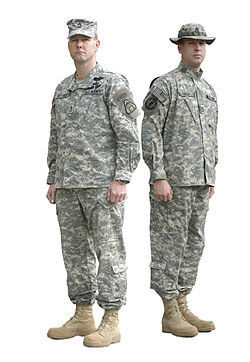
Patterns have included US Woodland, Six color desert camouflage (DBDU), Three color desert camouflage (DCU), Universal Camouflage Pattern (UCP), and Operational Camouflage Pattern (OCP).[7][8] The ACU patrol cap features a velcro-backed patch on the back with the soldier's name printed on it and a small internal pocket, the soldier's rank insignia is pinned on the front, as seen in the image below.

Cuban Revolutionary Armed Forces

[edit]
Former President of Cuba Fidel Castro meeting President of Russia Vladimir Putin while wearing a solid color olive drab Cuban Revolutionary Armed Forces uniform with a patrol cap in December 2000.

The Ridgeway Cap, a stiffened version of the M1951 Patrol Cap made famous after being worn by Fidel Castro, is a standard issue cap in the Cuban Revolutionary Army, and Cuban Revolutionary Air and Air Defense Force. American style patrol caps were worn by Cuban soldiers before, and during the Cuban Revolution. After the Revolution, the patrol cap kept being issued to Cuban military personnel. It is most commonly seen in solid color olive drab, but Cuban patrol caps with camouflage patterns like the grey lizard pattern have been made.[12]

Russia

[edit]

The Russian army adopted the patrol cap when it adopted the woodland pattern Flora camouflage and then EMR camouflage VKBO uniforms in the early 2000s. There are two versions, a plain one worn by conscripts and a more elaborate one worn by kontrakniki and officers.

See also

[edit]

References

[edit]
Revisions and contributorsEdit on WikipediaRead on Wikipedia
from Grokipedia
The patrol cap is a soft, military-style headgear characterized by a stiff, rounded visor, a flat or slightly rounded crown, and an adjustable strap or band at the rear, designed primarily for field and garrison use when a helmet is not required. It serves as standard headgear for the U.S. Army Combat Uniform (ACU) in non-combat environments, featuring a circular top crown, side crown with an outside band, and a hook-and-loop pad on the back for attaching nametapes or insignia. Typically constructed from durable, breathable fabrics such as 50% nylon and 50% cotton blends in camouflage patterns matching the uniform, it provides sun protection via its visor while allowing for quick donning and removal. The patrol cap's origins trace back to , evolving from the M-1943 field cap introduced in the latter stages of the conflict as part of the U.S. Army's utility uniform. It was formalized as the M-1951 Field Cap during the (1950–1953), where U.S. Army Rangers nicknamed it the "patrol cap" due to its use during reconnaissance and patrol missions; this version was made from wind-resistant olive cotton twill with a stiffened bill for durability in rugged conditions. Subsequent iterations adapted to changing uniforms, including the (BDU) in the 1980s, the ACU in 2004 with (UCP), and the (OCP) uniform starting in 2015, reflecting advancements in fabric technology and modular design for infrared resistance and environmental adaptability. In current U.S. Army regulations under AR 670-1 and DA PAM 670-1 as of 2025, the patrol cap must be worn straight on the head with the band parallel to the ground, positioned two finger widths above the eyebrows and snug without gaps or bulges, and it may include subdued rank insignia centered on the front. While primarily associated with the , similar soft field caps with visors—often called garrison or field caps—appear in other armed forces, such as the British Army's combat cap in (MTP) or equivalents in allies, emphasizing its role in providing practical, low-profile head protection across modern . Its versatility has made it a staple, replacing more formal options like berets in many daily and training scenarios since the early .

Overview

Definition and Characteristics

The patrol cap is a soft, unstructured cap that resembles a but features a flat crown and a stiff, rounded . It is also known as a field cap or soft cap, serving as a practical alternative to more rigid in military contexts. Key characteristics of the patrol cap include its lightweight construction suited for field operations, ability to provide sun protection without the bulk or rigidity of helmets, and compact design that allows for easy folding and storage in pockets or cargo pouches. It is typically worn straight on the head with the positioned low over the eyes during patrols, , or other non-combat duties, emphasizing functionality over formality. The primary purposes of the patrol cap center on its utility in tactical and everyday environments, where it replaces more ceremonial or dressier caps for while maintaining a low-profile appearance. Its design evolved from kepi-style headwear used in early 20th-century militaries, originating in U.S. field uniforms as a simple, effective cover. Compared to similar headwear, the patrol cap is softer and less floppy than boonie hats, which feature wide, flexible brims for broader shade coverage; it has a flatter crown than rounded caps; and it is considerably less formal than structured service caps with peaked visors.

Materials and Construction

The patrol cap's materials have evolved to balance durability, comfort, and functionality in field environments. Early versions, such as the M1943 field cap, were primarily constructed from wind-resistant olive-drab fabric, often with a wool lining for added warmth. Modern U.S. Army patrol caps, aligned with the (ACU), utilize a 50% and 50% ripstop blend, which provides enhanced tear resistance and quick-drying capabilities compared to all- predecessors. For hot weather variants like the Improved Hot Weather Combat Uniform (IHWCU), the composition shifts to 57% and 43% ripstop, prioritizing breathability in arid conditions. Construction techniques emphasize practicality and reinforcement for rugged use. The cap features stitched seams throughout for flexibility and strength, with a reinforced incorporating a plastic insert to maintain stiffness and provide sun protection without adding bulk. Patrol caps are produced in fixed sizes ranging from 6 3/8 to 8 inches in 1/8-inch increments, designed to fit snugly and comfortably around the largest part of the head without bulging or gaps. These methods ensure the cap's flat crown and side panels conform snugly without bulging, as specified in uniform regulations. Durability features are integral to the patrol cap's design for prolonged field exposure. Military-grade fabrics often receive Quarpel treatments for water repellency, enabling the cap to shed moisture quickly and reduce risk during deployments. In flame-resistant uniform ensembles, such as the Flame Resistant (FRACU), the nylon-cotton is treated to meet fire-retardant standards, protecting wearers in hazardous environments. The material's inherent UV resistance from synthetic components helps prevent fading and degradation under extended sunlight, while the overall construction supports machine-washable maintenance to uphold standards in operational settings. Over time, materials have shifted from wool-blended linings in II-era designs, which offered insulation but limited ventilation, to lightweight synthetic-cotton hybrids post-1980s, improving comfort and performance in diverse climates like hot and humid regions. This progression reflects advancements in for applications, focusing on reduced weight and enhanced moisture management without compromising structural integrity.

Design Features

Shape and Components

The patrol cap features a core structure comprising a circular top , a side with an outside band, a forward-curving for shade, and soft sides without ear flaps, creating a simple yet effective form for military headgear. This emphasizes a low-profile through its unstructured , which lies flat against the head to minimize visibility during patrols. The extends straight across the , curving forward to provide sun protection without obstructing the wearer's field of vision, and is reinforced with durable materials to retain its shape under use. The crown fits snugly to promote comfort during extended wear. Functionally, the cap's geometry supports operational needs, while sizing ensures a snug and secure placement without distortion or gaps, fitting comfortably around the largest part of the head. Contemporary models often include a hook-and-loop closure at the rear for secure attachment of accessories, maintaining the cap's intended form. Sizing follows standard military hat measurements, with fits available from 6 7/8 to 8 to accommodate head circumferences of approximately 21 1/2 to 25 inches.

Insignia and Customization

The patrol cap features standard designed to identify the wearer's rank, name, and service affiliation while adhering to strict military regulations as of 2021. In the U.S. Army, subdued grade —such as chevrons for enlisted personnel or bars for officers—is worn centered on the front of the cap, oriented left to right and top to bottom, using pin-on or sew-on methods. A nametape embroidered with the soldier's last name in black is centered on the rear hook-and-loop pad, serving as a primary identifier. No unit patches or branch-of-service tapes, such as "U.S. ARMY," are authorized on the patrol cap itself; these are reserved for or chest placement on the . Attachment methods emphasize modularity and uniformity, with hook-and-loop () fasteners standard for quick removal and replacement of on modern (OCP) patrol caps. is permitted as an optional permanent method at the wearer's expense, but only for authorized items like grade and nametapes; sewing unit patches, tabs, or flags onto the cap is explicitly prohibited to maintain a clean profile. Regulations under AR 670-1 and DA Pam 670-1 forbid unauthorized modifications, including personal logos, non-standard embroidery, or alterations that change the cap's shape or color, ensuring all elements conform to operational standards. These play a symbolic role in denoting , unit affiliation, and individual identity within the chain of command, facilitating rapid recognition in both and field environments. Customization is tightly regulated by service branch, with U.S. Army guidelines in AR 670-1 specifying placement to avoid covering the and requiring a straight, snug fit parallel to the ground. In the U.S. Navy, sewn-on or pin-on rank are authorized on the patrol cap for personnel serving with other services, centered similarly to Army standards. The U.S. permits officers to wear metal grade or embroidered rank on the front of OCP patrol caps, while enlisted members display only a nametape on the rear, with no additional front allowed. Across branches, subdued colors are mandated for settings to reduce visibility, and morale patches remain unauthorized except in commander-approved training scenarios.

History

Early Development in U.S. Military

The origins of the patrol cap in the U.S. military trace back to pre-World War II precursors, including field caps from the and the overseas cap integral to uniforms. Influenced by European designs, the overseas cap—modeled after French headgear—was adopted in 1918 for the as a lightweight, foldable alternative to the bulky , facilitating easier transport and wear under helmets during overseas deployment. This soft, practical design emphasized mobility and comfort in field conditions, laying foundational characteristics for later iterations such as the patrol cap's rounded shape and . During , the M1943 field cap emerged as a direct ancestor to the modern patrol cap, introduced by the U.S. Army Corps to accompany herringbone twill uniforms across European and Pacific theaters. Development began with initiation in October 1942 and design in early 1943, focusing on a windproof, water-repellent construction with a sun visor for versatile protection. Key events included 1943 trials by the Corps for lightweight headwear, culminating in formal approval on July 13, 1943, after evaluation by the Quartermaster Board to ensure suitability for temperate, cold, and environments. Standardized alongside the M1943 field jacket, it replaced multiple prior field caps and the rigid garrison cap in forward areas, prioritizing field practicality and helmet compatibility over formal wear. Post-World War II refinement came with the 1951 adoption of the M1951 Field Cap, informally known as the Ridgeway Cap, under General Matthew Ridgway's leadership as commander of the Eighth Army during the . Ridgway mandated its use to instill discipline and a sharper appearance among troops, with the cap's softer construction enhancing mobility and comfort in harsh winter conditions compared to earlier rigid designs. The MQ-1 variant, featuring earflaps and pile lining, proved particularly functional for cold weather, worn under helmets for added warmth and protection. This evolution solidified the patrol cap's role as essential field , building on WWII innovations for improved effectiveness.

Post-WWII Evolution

Following , the patrol cap evolved from the M1951 field cap, which had been criticized for its floppy appearance and led to the informal "Ridgway cap" modifications with internal stiffeners for a more structured look. In the 1960s during the era, the patrol cap faced temporary replacement by the for better ventilation in jungle environments, but it was reintroduced in 1962 as the "Cap, Field (Hot Weather)" with a baseball-style shape made from olive green shade 106 / blend fabric lacking earflaps. This design aimed to address hot weather needs alongside the Tropical Combat Uniform introduced in 1963, though it was often disliked for poor heat dissipation and aesthetics. By the 1980s and 1990s, the patrol cap integrated with the (BDU) system, featuring woodland camouflage patterns in /cotton ripstop fabric for enhanced durability and concealment in temperate operations. It was standardized as the utility cap under AR 670-1, authorizing year-round wear for all personnel with the BDU starting in 1981 and formalized in the 1992 regulation update. In the 2000s, post-9/11 Global War on Terrorism (GWOT) operations drove modifications for greater modularity in uniform systems, culminating in the 2004 adoption of the (ACU) paired with the patrol cap in the Universal Camouflage Pattern (UCP) for multi-environment utility. The ACU patrol cap fully replaced the BDU version by 2006, emphasizing interchangeable components. Further updates in 2015 transitioned to the (OCP) on the patrol cap and ACU for superior concealment across terrains, addressing UCP's limitations. Key milestones included GWOT-inspired enhancements in 2001 for modular uniform adaptability amid rapid deployments, and a 2019 mandate requiring OCP across all branches by October 1, phasing out UCP entirely.

International Adoption

The Revolutionary Armed Forces adopted an austere olive-green uniform including a field cap immediately following the 1959 revolution, often associated with Fidel Castro's signature style and suited for and field operations in tropical terrain. Cuban troops wore these caps during international interventions, including support for Angolan operations in the and , where they complemented olive drab attire in combined guerrilla and conventional roles. In the , a similar field cap known as the —featuring a soft crown, stiff visor, and ventilation holes—was issued to airborne units (VDV) starting in the 1970s for hot-weather deployments, evolving from its 1938 origins for tropical districts. The design gained prominence during the Soviet-Afghan War (1979–1989), where VDV paratroopers used it alongside uniforms for its lightweight protection against sun and dust in arid environments. Adaptations included padded, ear-flapped variants for VDV in colder climates, providing insulation while maintaining the flat-top profile for helmet compatibility during jumps and patrols. The patrol cap design spread to other militaries through post-colonial exchanges and U.S. military aid programs, influencing NATO allies in the late 20th century. In the British Army, patrol-style caps were adopted as part of the Combat Soldier 95 (CS95) system in the mid-1990s, using Disruptive Pattern Material (DPM) for temperate environments.

Military Usage

United States Armed Forces

In the United States Army, the patrol cap serves as the standard headgear for wear with the Army Combat Uniform (ACU) and Operational Camouflage Pattern (OCP) in garrison environments, positioned straight on the head with the cap band parallel to the ground and grade insignia centered and visible on the front. It is prohibited in field or deployed settings where pinned-on badges are not authorized, including when body armor and the combat helmet are worn, to ensure safety and uniformity per AR 670-1. The integrates the patrol cap with the (NWU), particularly Types II and III, as optional headgear when the helmet is not in use, featuring attachments for rank and nametapes to facilitate rapid adjustments during operations. It may also be worn with physical training (PT) uniforms at the commander's discretion, emphasizing quick-change capabilities for mixed environments. In the United States Air Force, the patrol cap aligns with the OCP utility uniform and the phased-out (ABU), worn straight on the head outdoors unless in designated "no hat" areas, with for nametapes on the rear and spice brown rank insignia for officers on the front to support swift customization. It is optional for PT uniforms, where alternative headgear like watch caps may substitute, per DAFI 36-2903. The employs green or woodland camouflage variants of the patrol cap (also known as the 8-point utility cover) with the Marine Corps Combat Utility Uniform (MCCUU), adhering to stricter grooming standards that prohibit coverage or visibility under the cap to maintain a neat appearance. Across all branches, patrol caps undergo daily inspections for signs of wear, such as fraying or discoloration, with replacement when unserviceable to preserve functionality, and non-regulation colors or modifications are strictly banned under uniform codes like AR 670-1, DAFI 36-2903, and MCO 1020.34H. involves washing in water with mild and tumble drying on low heat, avoiding starching or ironing to prevent damage.

Other National Militaries

In the Forces, patrol caps—referred to as soft caps—are standard for field uniforms worn during routine training, maneuvers, exercises, and patrols. These caps incorporate branch-of-service metallic and colored on , reflecting revolutionary organizational structure, and are designed for everyday operational use without specific modifications for Cuba's , where average temperatures range from 25–27°C with high humidity. The employ similar field caps in their summer and winter uniforms for units such as and , often paired with the traditional striped undershirt as part of layered cold-weather attire. Wool-blend variants provide insulation for operations, emphasizing durability in extreme low-temperature environments during patrols and missions. In the Australian Defence Force, patrol-style caps in patterns are utilized during joint multinational exercises, offering practical sun protection and compatibility with operational gear in diverse terrains. Similarly, the deploys desert camouflage variants of field caps for border patrols in arid regions like , prioritizing breathability and low visibility in sandy, high-heat conditions. In the Iranian (IRGC), personnel wear baseball-style caps as part of field uniforms.

Variations and Adaptations

Camouflage and Pattern Variations

The patrol cap's patterns are designed to provide effective concealment by blending with specific environments, from dense forests to arid deserts and urban settings, enhancing tactical effectiveness during operations. These patterns have evolved to address the demands of varied terrains, with the cap's fabric incorporating disruptive shapes and colors that break up the human silhouette. In the United States military, the pattern, introduced with the (BDU) in the 1980s, features a mix of green, brown, tan, and black shades suited for temperate woodland environments, allowing soldiers to merge with forested or transitional landscapes. Following post-2000 uniform shifts, the Universal Camouflage Pattern (UCP) was adopted for the from 2004 to 2014, employing a digital gray-dominant design intended for versatility across urban, desert, and woodland areas, but it faced significant criticism for poor concealment, performing worse than alternatives like the Marine desert pattern in Army tests. In 2015, the (OCP), based on the W2 design, became the standard, featuring scale-like disruptive elements in earth tones that effectively break up outlines in diverse settings such as transitional woodlands, grasslands, and croplands, improving concealment over its predecessor. Internationally, the employ the EMR (Edinaya Maskirovochnaya Rascvetka), known as "Digital Flora," on patrol caps, a pixelated with and hues optimized for temperate zones like forests and mixed , providing robust visual disruption in seasonal foliage. The use the (MTP) on their combat patrol caps, a modified variant with multi-scale shapes in tan, , , and dark earth tones, enabling effective concealment during global deployments across arid, woodland, and transitional environments. Technical advancements in these patterns include the integration of (IR)-suppressing dyes, such as IR-absorbing in the print, which reduce visibility under devices by minimizing near-IR reflectance and mimicking natural backgrounds up to 900 nm wavelengths. Some variants incorporate reversible designs, with one side in green for summer foliage and the other in brown for autumnal or transitional terrains, allowing quick adaptation without changing . The development of these patterns is driven by the need to adapt to specific terrains, such as tan-dominant schemes for desert operations that emphasize sandy and rocky hues to evade detection in open expanses, or gray-scale urban patterns that blend with concrete and shadowed cityscapes. Research at the U.S. Army Natick Soldier Research, Development and Engineering Center (NSRDEC, formerly Natick Labs) has tested such adaptations, evaluating patterns like Desert Brush for arid zones and Urban Track for city environments through field trials to quantify concealment efficacy against visual and sensor detection.

Civilian and Commercial Versions

In the , the patrol cap's utilitarian design gained traction in fashion, where brands adapted its soft, structured shape for urban casual looks, often replacing military insignia with bold logos. Supreme, a leading streetwear label founded in 1994, exemplified this trend by releasing military camp caps—direct stylistic nods to the patrol cap—in collections like the Spring/Summer 2020 version and Fall/Winter 2025 iteration, which featured embroidered motifs and drove hype through limited drops. Nike contributed similarly through collaborations and its ACG line, incorporating patrol-inspired profiles in moisture-wicking fabrics for blends, aligning with the decade's fusion of military aesthetics and hip-hop influences. Civilian adaptations for outdoor recreation emphasize functionality without tactical elements, using quick-dry, breathable materials for activities like hiking and fishing. Patagonia offers the P-6 Label Trad Cap, a patrol cap variant crafted from 100% organic cotton canvas with a brim made from recycled fishing nets (NetPlus® material), providing UPF 50+ sun protection and ventilation for extended outdoor exposure; it is sold through retailers like REI for non-military users seeking sustainable headwear. Similarly, brands like TRU-SPEC produce cotton or polyester patrol-style caps marketed for camping, hiking, and fishing, featuring adjustable straps and eyelets for airflow to enhance comfort in recreational settings. Commercial production of civilian patrol caps focuses on affordability and personalization, with mass-market versions predominantly using blends for durability and low cost, often customizable through services for logos or monograms. Global headwear sales, including these styles, surged post-2020 amid the boom, with the market growing from USD 28.20 billion in 2025 at a 5.80% CAGR, driven by for versatile casual accessories. Cultural portrayals in modern war films, such as depictions of U.S. forces in post-9/11 conflicts, have elevated the patrol cap's visibility in civilian contexts by associating it with rugged, everyday heroism, subtly boosting its adoption in without adhering to subdued military colors.

References

Add your contribution
Related Hubs
User Avatar
No comments yet.