


Community hub
Recent from talks
Contribute something
Nothing was collected or created yet.
Couch
View on Wikipedia

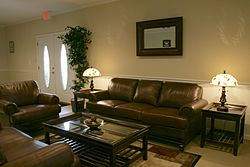
A couch, also known as a sofa, settee, chesterfield, or davenport, is a cushioned piece of furniture that can seat multiple people. It is commonly found in the form of a bench with upholstered armrests and is often fitted with springs and tailored cushion and pillows.[1][2] Although a couch is used primarily for seating, it may be used for sleeping.[3] In homes, couches are normally put in the family room, living room, den, or lounge. They are sometimes also found in non-residential settings such as hotels, lobbies of commercial offices, waiting rooms, and bars. Couches can also vary in size, color, and design.
Etymology
[edit]The term couch originally denoted an item of furniture for lying or sleeping on.[4][5] Couch is predominantly used in North America, Australia, South Africa, and Ireland, whereas the terms sofa and settee (U and non-U) are most commonly used in the United Kingdom and India.[6] The word couch originated in Middle English from the Old French noun couche, which derived from the verb meaning "to lie down".[7]
The word sofa comes from the Turkish[8][9][10][11] language and is derived from the Arabic word suffah ("ledge/bench"), cognates with the Aramaic word sippa ("mat").[12] Nathan Bailey in his Dictionarium Britannicum (1730) defines sofa as a "a sort of alcove much used in Asia ... furnished with rich carpets and cushions."[13]
The word settee or setee comes from the Old English word setl, which was used to describe long benches with high backs and arms, but is now generally used to describe small upholstered seating structures.[14] Both "sofa" and "settee" terms came into use in the beginning of the 18th century. Originally the settee defined a smaller sofa, but by the 20th century the distinction was lost.[13]
Other terms which can be synonymous with the above definition are divan, davenport, lounge, and canapé.[2] In Canadian English, the word chesterfield is used to describe any couch or sofa,[15] particularly among older Canadians. According to a 1992 survey conducted in the Golden Horseshoe region of Ontario, the term is quickly vanishing.[16]
Types
[edit]

The most common types of couches include the two-seater, sometimes referred to as a loveseat, and the sofa. The loveseat is designed for seating two people, while the sofa has more than two cushion seats. A sectional sofa, often just referred to as a "sectional", is formed from multiple sections (typically two, three, or four) and usually includes at least two pieces which join at an angle of 90 degrees or slightly greater. Sectional sofas are used to wrap around walls or other furniture.
Other variants include the divan, the fainting couch (backless or partial-backed) and the canapé (an ornamental three-seater). To conserve space, some sofas double as beds in the form of sofa beds, daybeds, or futons.

A furniture set consisting of a sofa with two matching chairs[17] is known as a "chesterfield suite"[18] or "living-room suite".[19] In the UK, the word chesterfield was used to refer to any couch in the 1900s. A chesterfield now describes a deep buttoned sofa, usually made from leather, with arms and back of the same height. The first chesterfield, with its distinctive deep buttoned, quilted (or "tufted"[20]) leather upholstery and lower seat base, was commissioned by Philip Stanhope, 4th Earl of Chesterfield (1694–1773).
Materials
[edit]A couch consists of a frame, springs, padding, and a covering. The frame is usually made of wood, but can also be made of steel, plastic or laminated boards. Sofa padding is made from foam, down, feathers, fabric or a combination thereof. Sofa coverings are usually made out of soft leather, corduroy or linen. Couches commonly have springs under the padding for more support, although some don't.[21]
Image gallery
[edit]-
 A two-seater upholstered loveseat
 -
 A leather couch
 -
 Sofa steel production malayer
 -
 An upholstered couch
 -
 English Settee, c. 1770
 -
 Roman style couch for reclining


See also
[edit]- Bean bag chair
- Chaise longue, a similar elongated piece intended for a single person
- Couch potato
- Davenport (sofa)
- Divan (furniture)
- Klippan (sofa)
- Ottoman (furniture)
- Settle (furniture), wooden furniture with similar usage
- Slipcover
- Wing chair
- Window seat (type of sofa)
Citations
[edit]- ^ "Couch". Dictionary.com (American Heritage Dictionary). Retrieved 2012-08-15.
- ^ a b "Couch". The Free Dictionary By Farlex. Retrieved 2012-05-12.
- ^ "Couch". Merriam-Webster. Retrieved 2012-05-12.
- ^ Harrison, Molly (1971). People and furniture: a social background to the English home. Ernest Benn. p. 55. ISBN 978-0-8747-10373.
- ^ Lennox, Doug (2007). "Home, Hearth, and Family". Now You Know Big Book of Answers. Dundurn. ISBN 978-1-55002-741-9. Retrieved June 20, 2018 – via Google Books.
- ^ "couch noun". Oxford Collocations Dictionary. Retrieved June 19, 2020.
- ^ AMHER, couch: Middle English from Old French culche, couche > couchier, coucher.
- ^ "sofa", Wiktionary, 2022-07-03, retrieved 2022-07-06
- ^ "sofa | Etymology, origin and meaning of sofa by etymonline". www.etymonline.com. Retrieved 2022-07-06.
- ^ "Definition of SOFA". www.merriam-webster.com. Retrieved 2022-07-06.
- ^ "Sofa, Couch or Settee: The History Of Where Each Word Came From". 18 October 2018.
- ^ AMHER, sofa: Turkish, from Arabic suffah, from Aramaic sippa, sippəta.
- ^ a b Gloag & Edwards 1991, p. 597, Settee.
- ^ "Definition of settee | Dictionary.com". www.dictionary.com. Retrieved 2020-10-02.
- ^ Barber, Katherine, ed. (2004). Canadian Oxford Dictionary (Second ed.). Oxford University Press. p. 264. ISBN 978-0-19-541816-3.
any couch or sofa
- ^ Chambers, J. K. "The Canada-U.S. border as a vanishing isogloss: the evidence of chesterfield". Journal of English Linguistics; 23 (1995): 156–66, excerpt at chass.utoronto.ca Archived 2007-09-12 at the Wayback Machine.
- ^ "Three-piece-suite". Cambridge Dictionaries Online. Retrieved 2012-05-12.
- ^ "Chesterfield suite". Merriam-Webster. Retrieved 2012-05-12.
- ^ "Living room suite". Cambridge Dictionaries Online. Retrieved 2012-05-12.
- ^ Wade, Olin (2022-07-24). "What is the purpose of tufting?". www.remodelormove.com. Retrieved 2024-08-04.
- ^ Kramer, Jennifer. "How products are made". encyclopedia.com. Retrieved 22 June 2022.
General and cited references
[edit]- Gloag, John; Edwards, Clive (1991). A Complete Dictionary of Furniture. Woodstock, N.Y: Overlook Books. ISBN 0-87951-414-0.
Further reading
[edit]- Campbell, Gordon (2006). "Sofa". The Grove Encyclopedia of Decorative Arts. Vol. 2. Oxford University Press. p. 369. ISBN 978-0-19-518948-3.
External links
[edit] The dictionary definition of couch at Wiktionary

| International | |
|---|---|
| National | |
| Other | |

Couch
View on GrokipediaEtymology and Terminology
Etymology
The word "couch" derives from the Old French noun couche, meaning "a bed" or "layer," dating to the 12th century, which itself stems from the verb couchier or colchier, "to lie down" or "to lay."[2] This Old French term evolved from the Latin collocāre, composed of com- ("together") and locāre ("to place"), literally signifying "to place or lay down" in a arranged manner.[2][10] The verb form entered Middle English around 1300, initially denoting "to spread or overlay" something, such as in embroidery or laying a surface, before extending to the act of reclining.[2][1] As a noun, "couch" first appeared in English in the mid-14th century, referring to a bed or structure for lying upon, with the earliest known uses describing simple bed-like forms.[2][1] By the 17th century, its meaning had shifted to denote a long seat designed for reclining at full length, marking the transition toward its modern furniture connotation.[2][11] This evolution reflected broader influences from French upholstery traditions, where terms like couche informed early designs for resting furniture, though "couch" later distinguished itself from synonyms such as "sofa" in English usage.[2] In the 17th century, the term gained prominence in English as couches became fashionable upholstered pieces in France and England, often adapted from bed forms for daytime lounging.[12] The verb "to couch" also saw specialized medical application during this period, though the procedure of "couching" a cataract—dislodging the lens to restore vision—originated in ancient India around 600 BCE and spread globally; in English medical texts, it referred to depressing the cataractous lens, underscoring the word's persistent association with positioning for rest or treatment.[13]Terminology
A couch is an upholstered piece of furniture designed for seating or reclining, typically accommodating multiple people and featuring a backrest and armrests.[14] This distinguishes it from chairs or benches by its capacity for group seating and comfort-oriented padding.[15] Common synonyms for couch include "sofa," "settee," "davenport," and "chesterfield," each carrying subtle historical or stylistic connotations. A sofa refers to a similar upholstered seat with a back and arms, often implying a more structured form. The term settee denotes a long bench-like seat with a high back and arms, originating from Old English "setl" for a seat. Davenport emerged around 1900 in the United States, named after the A.H. Davenport Company in Massachusetts, which popularized large, convertible upholstered sofas suitable for reclining or sleeping.[16] Chesterfield describes a deeply button-tufted leather sofa with equal-height arms and back, named after Philip Stanhope, the 4th Earl of Chesterfield, a 18th-century British statesman who commissioned such designs for upright posture.[17] Regional variations in terminology reflect cultural and linguistic preferences. In American English, "couch" predominates for casual, everyday seating furniture, while "sofa" is often reserved for more formal or elegant pieces.[18] Conversely, in British English, "sofa" is the standard term for such items, with "couch" less commonly used and sometimes implying a more relaxed or medical context, and "settee" favored in some northern or working-class dialects.[19] These differences arise from historical word adoption, with "couch" gaining traction in North America for its connotation of lounging.[20] In the furniture industry, terms like couch and sofa are often used interchangeably without strict legal distinctions, though organizations such as the American Home Furnishings Alliance (AHFA) adhere to general standards for upholstered seating that emphasize safety and construction uniformity across nomenclature.[21] For instance, industry guidelines focus on load-bearing capacity and stability for pieces seating two or more people, regardless of the label applied.History
Ancient and Medieval Origins
The earliest precursors to the couch appear in ancient Egyptian furniture, where low wooden platforms served as multi-purpose seating and reclining surfaces in domestic and funerary contexts. These structures, often elevated at one end with a graceful curving profile, were crafted from imported woods like cedar and ebony, sometimes adorned with ivory or gold inlays for elite use. Archaeological finds from tombs, such as those in the Valley of the Kings dating to the New Kingdom (c. 1550–1070 BCE), reveal examples with lion-head terminals and woven reed matting, functioning as both beds and couches for resting or ceremonial display.[22][23] In ancient Greece, the klinē emerged as a specialized reclining couch central to the symposion, a social gathering for elite men involving drinking, discussion, and entertainment, flourishing around 500 BCE during the Archaic and Classical periods. Constructed primarily from wood with bronze reinforcements for durability and ornate fittings, the klinē featured a raised frame with cushions for comfort, allowing participants to recline on their left side while facing inward toward a central table. Evidence from vase paintings and literary descriptions, such as those in Plato's Symposium, illustrates their arrangement in rooms (andrones) along the walls, typically seven to nine klinai per space to accommodate pairs of symposiasts. These couches symbolized status and intellectual pursuit, with luxurious variants incorporating ivory or silver accents reserved for the wealthy.[24] The Romans adapted the Greek klinē into the lectus, integral to the triclinium dining arrangement, which became a hallmark of elite Roman homes by the 1st century CE. The lectus triclinaris, or banqueting couch, consisted of three U-shaped units arranged around a table, made of wood with carved animal-leg supports—often lion or griffin forms—and padded with cushions or bolsters covered in dyed fabrics. Frescoes from Pompeii, preserved by the eruption of Vesuvius in 79 CE, depict these couches in vibrant domestic scenes, showing carved legs, draped coverings, and use during convivia (banquets) for reclining and socializing. Such designs emphasized hierarchy, with the lectus summus (highest couch) for honored guests, and materials like citrus wood or bronze for added prestige.[25][26] During the medieval period in Europe, couch-like furniture evolved into simpler bench-couches among Anglo-Saxon communities (c. 5th–11th centuries CE), reflecting practical needs in timber-scarce environments. These were long wooden benches with integrated backs or armrests, often placed along hall walls for communal seating during feasts, as described in texts like Beowulf. In the Byzantine Empire (6th–10th centuries CE), more elaborate examples featured ivory-inlaid wooden frames, drawing on classical traditions for ecclesiastical and imperial settings; surviving panels from Constantinople workshops show geometric and figural carvings enhancing couches used in audience halls or liturgical spaces. These inlays, sourced from elephant ivory traded via Mediterranean routes, denoted luxury and continuity with Roman aesthetics.[27][28]Modern Evolution
The modern evolution of the couch began during the Renaissance in 16th-century Italy, where designers revived classical forms inspired by ancient Roman and Greek precedents, adapting them to contemporary interiors. This period saw the emergence of upholstered daybeds known as lettucci, which served as precursors to the modern couch, often featuring carved wooden frames with cushions in silk, velvet, or leather for comfort and status display in affluent homes. Architect Andrea Palladio, active in the Veneto region, influenced this trend through his emphasis on symmetry and proportion in furnishings that complemented his villas, promoting larger-scale seating that echoed antique klinai while incorporating Renaissance opulence.[29][30] The transition to the fully upholstered modern couch occurred in late 17th-century France around the 1680s, when padded sofas were introduced at the Palace of Versailles under Louis XIV. These innovations featured complete upholstery on all sides with luxurious fabrics and cushions, enabling communal lounging and influencing Baroque interiors across Europe. By the 18th century, styles evolved into Rococo and neoclassical forms, with cabriole legs and ornate carvings, as seen in Louis XV and XVI furniture that emphasized comfort and elegance in salons.[5][31] In the 19th century, Victorian innovations in Britain transformed couch construction, prioritizing comfort and durability amid rising middle-class demand. A key advancement was the introduction of coil spring suspension systems, first patented by Samuel Pratt in 1828 for elastic beds and cushions, which provided resilient support under upholstery and enabled deeper, more inviting seating. These springs, refined in subsequent patents like John Samuel Crofton's 1834 design, allowed for mass-upholstered sofas with button-tufted backs and arms, as seen in the iconic Chesterfield style, blending functionality with ornate detailing in mahogany or rosewood frames. This era marked a shift toward ergonomic design, making couches essential parlor fixtures in urban households.[32][33] The 20th century brought modernist revolutions, particularly through the Bauhaus school in 1920s Germany, where Marcel Breuer pioneered tubular steel frames for furniture, emphasizing industrial materials and minimalism. Breuer's designs, such as the 1925-1926 armchair prototypes, extended to sofas with sleek, cantilevered steel tubing upholstered in fabric or leather, rejecting ornate wood in favor of geometric simplicity suited to modern living spaces. Later, mid-century Scandinavian design in the 1950s, exemplified by Arne Jacobsen's Swan Sofa of 1958 for the SAS Royal Hotel in Copenhagen, introduced organic curves and molded forms in foam and fabric, balancing functionality with sculptural elegance for public and domestic use.[34][35][36] Post-World War II mass production in the United States accelerated couch accessibility, with the 1950s witnessing the rise of modular designs that allowed reconfiguration for flexible interiors. Influenced by wartime manufacturing efficiencies, companies like Knoll and Herman Miller produced sectional sofas in affordable materials like plywood and foam, as in Vladimir Kagan's 1950s curved modular pieces, which catered to suburban growth and emphasized adaptability over fixed opulence. This era democratized high-design seating, integrating it into everyday American homes through streamlined production techniques.[37][38]Design and Types
Structural Components
The frame serves as the foundational skeleton of a couch, providing the overall shape, stability, and load-bearing capacity to support the weight of users and prevent structural failure over time.[39] It typically consists of interconnected wooden or engineered elements joined at corners and rails, with reinforcements to distribute forces evenly across the base and sides. Within the frame, components like sinuous springs—continuous S-shaped wires attached horizontally—enhance resilience by flexing to absorb and redistribute weight, thereby improving longevity and preventing sagging in high-use areas.[40][41] Seat cushions form the primary support layer for the sitter's lower body, offering a comfortable interface that contours to thighs and hips while maintaining spinal alignment. They can be integrated as fixed elements for a seamless, tailored appearance or designed as removable units to facilitate cleaning, rotation, and replacement, enhancing user accessibility and maintenance. Ergonomically, the seat depth—commonly ranging from 21 to 24 inches—allows for proper thigh support without excessive pressure on the knees, promoting lumbar health by encouraging a neutral posture that aligns the lower back with the backrest.[39][42][43] The backrest provides ergonomic alignment for the upper body, cradling the spine and shoulders to reduce strain during prolonged sitting. It functions to distribute upper-body weight rearward, preventing forward slouch and supporting natural curvature, with designs varying from upright and firm for formal seating to reclined for relaxation. Arms act as lateral supports, offering resting points for elbows and arms that contribute to overall balance and comfort, while also defining the couch's width and aesthetic boundaries.[41][39] Legs or the base ensure stability and elevation, anchoring the couch to the floor and raising it to an optimal height for easy access, typically preventing direct floor contact to allow for airflow and cleaning. These components integrate to form the couch's core anatomy, which can be adapted into various configurations such as sectionals or loveseats.[42][41]Common Types
Common types of couches vary by size, configuration, and functionality, often tailored to specific room sizes and user needs. These designs typically incorporate basic structural components such as frames, seats, backs, and arms to form distinct forms suitable for residential or commercial spaces. The loveseat is a compact two-seater couch, measuring approximately 50 to 70 inches in width, making it ideal for smaller rooms like apartments or intimate seating areas.[44] Originating in 17th-century Europe as "double-chairs" for upper-class individuals with voluminous attire, it evolved into an intimate two-seater by the 19th century, emerging in parlors and formal sitting rooms as a space-efficient alternative to larger sofas, allowing two people to sit closely while maintaining a sense of privacy.[45] Sectional couches consist of modular units arranged in L- or U-shaped configurations, offering flexibility for customizing layouts in larger living spaces. Popularized during the 1960s amid the rise of mid-century modern design and the hippie movement, these couches allow for reversible sections that can be rearranged to suit different room orientations or group seating needs.[46][47] Recliner couches feature mechanized mechanisms with integrated footrests, enabling users to adjust the backrest and leg support for enhanced comfort during relaxation or viewing. Electric models, incorporating motors for smooth operation, were introduced as power reclining mechanisms, with some designs allowing recline angles up to 150 degrees for near-flat positioning.[48][49] Futon couches draw from Japanese traditions as convertible pieces that transform from a seated couch to a flat bed, providing multifunctional utility in compact living environments. Adapted in the United States post-1970s by Japanese immigrants and embraced for their affordability, these designs often use wooden frames paired with layered cotton mattresses for support and portability.[50][51] Sofa beds, also known as sleeper sofas or sofabeds, are couches featuring a hidden mattress that can be pulled out or extended for conversion into a bed. Conversion typically involves removing the seat cushions, lifting a metal frame from beneath the seating area, and unfolding it to reveal and extend the mattress, providing sleeping accommodation for occasional guests in multifunctional spaces. This design prioritizes comfortable daily seating while offering bed functionality without the visible folding frame characteristic of futons.[52][53] Among stylistic variations, the Chesterfield couch is distinguished by its deep button-tufting on the back and arms, typically measuring 78 to 90 inches in width for three-seaters, and suits formal settings like offices or traditional living rooms where elegance is prioritized. In contrast, the Lawson couch employs loose, removable back cushions over a pitched frame, with dimensions around 72 to 88 inches wide, favoring casual, everyday use in family rooms due to its relaxed, customizable comfort.[54][55][56][57]Choosing Between a Sofa and a Sectional
When deciding between a traditional sofa and a sectional couch, key factors include room size, seating needs, lifestyle and usage, arrangement flexibility, and budget constraints. A traditional sofa is generally more suitable for smaller or medium-sized rooms, accommodating 2-3 people, supporting formal or versatile setups, allowing easier rearrangement within the space, and involving lower cost and maintenance requirements.[58][59] A sectional couch is better suited to larger or open-plan spaces, providing seating for 4 or more people, facilitating casual family lounging and gatherings, and offering modular configurations such as L-shaped or U-shaped designs for adaptable layouts.[60][58] Essential considerations include measuring the available space to prevent overcrowding, evaluating primary usage patterns (formal entertaining versus casual, high-traffic family activities), recognizing that sectionals are well-suited to cozy environments but may restrict movement and pathways, and noting that sofas promote better flow and can be effectively paired with complementary pieces such as chairs or ottomans.[59][60]Materials and Manufacturing
Frame and Upholstery Materials
The frame of a couch serves as its foundational structure, typically constructed from either hardwoods or engineered woods to balance durability, weight, and cost. Hardwoods such as kiln-dried oak are favored for their superior strength and longevity, providing a robust support that resists warping and sagging under regular use.[61][62] Engineered woods like plywood offer a more cost-efficient alternative, achieving similar stability at a lower price point while being lighter and easier to manufacture in consistent dimensions.[55][63] Upholstery fabrics for couches are broadly categorized into natural and synthetic types, each with distinct properties influencing comfort, maintenance, and aesthetics. Natural fabrics like cotton and wool provide breathability and a soft, organic feel, making them ideal for environments where airflow and hypoallergenic qualities are prioritized, though wool can be susceptible to moth damage without proper treatment.[64][65] Synthetic options such as polyester and microfiber excel in durability, stain resistance, and affordability, retaining color and shape over time with minimal upkeep, but they may feel less breathable in warmer climates.[66][67][68] Leather upholstery, derived primarily from cowhide, varies significantly by processing method, affecting its resilience and visual appeal. Full-grain leather, which retains the complete outer layer of the hide, offers exceptional durability and develops a natural patina over time, typically measuring 1.2-1.6 mm in thickness for optimal strength without excessive rigidity.[69][70] In contrast, bonded leather, made from ground leather scraps bonded with polyurethane, provides a budget-friendly option that mimics the look of higher-grade leathers but is less resilient and prone to cracking under prolonged wear.[71][72] Filling materials inside couch cushions determine seating support and plushness, with foam and feathers being the most common choices. High-resiliency polyurethane foam, often at a density of 2.5 lb/ft³, delivers firm, long-lasting support that rebounds effectively after compression, suitable for high-traffic areas.[73][74] Down feathers, typically from goose or duck, create a luxurious, soft sink-in sensation for back and accent cushions, though they require periodic fluffing to maintain shape.[75][76] Sustainability in couch materials has gained prominence, particularly with the increased adoption of recycled polyester in upholstery since the 2010s, driven by efforts to repurpose plastic waste and reduce environmental impact. This shift aligns with broader industry trends, as the U.S. Environmental Protection Agency reports that textile waste, including from furniture, reached significant volumes by 2018, with recycling rates at 14.7% overall, highlighting the potential for recycled synthetics to divert materials from landfills. As of 2024, textile waste has increased by over 50% since 2017, with recycling rates remaining around 15%, prompting greater integration of bio-based materials such as soy-derived foams and plant-based alternatives to leather in upholstery designs.[77][78][79][80][81]Production Processes
The production of couches begins with the design phase, where designers utilize computer-aided design (CAD) software to create detailed 3D models of prototypes, allowing for precise visualization of dimensions, aesthetics, and functionality.[82] These models facilitate iterative refinements based on ergonomic testing, such as assessments of seating stability and user comfort, often guided by standards like ISO 7173, which specifies methods for evaluating the strength, durability, and stability of seating structures, including easy chairs and sofas.[83] Virtual prototyping in CAD enables early detection of issues like posture support or load distribution without physical builds, reducing development time and material waste.[84] Frame assembly follows, involving the construction of the structural base using either wooden joinery or metal welding, depending on the design specifications. For wooden frames, techniques such as dovetail joints are employed at corners and connections to enhance durability, as these interlocking trapezoidal shapes provide superior resistance to tensile forces and prevent separation under repeated use.[85] Metal frames, common in modern modular couches, are welded using MIG or TIG methods to ensure robust seams capable of supporting weights up to 300 pounds per seat.[86] Once the frame is complete, the suspension system is installed; traditional 8-way hand-tied springs involve manually knotting individual coils to the frame in eight directions for even weight distribution and resilience, offering longevity of 15-20 years in high-end pieces, while automated alternatives like sinuous or zigzag springs use machine-pressed steel wires for faster, cost-effective assembly in mass-market production.[87] Upholstery application then integrates the frame with padding and coverings through a multi-step process of pattern cutting, sewing, and stuffing. Fabric or leather is laid out and cut using computerized cutters or templates to match the frame's contours precisely, minimizing waste and ensuring seam alignment.[88] Covers are sewn on industrial machines with reinforced stitching for high-wear areas like seat edges, followed by stuffing layers of foam, fiber, or down; padding is typically built to 4-6 inches thick in seat cushions to achieve optimal comfort and support, balancing firmness for spinal alignment with softness for pressure relief.[89] The finishing stage encompasses rigorous quality inspections, including fire resistance testing per ASTM E1537, which evaluates heat release rates and smoke production when exposed to a smoldering cigarette or open flame to ensure compliance for public and residential use.[90] Pieces are then packaged with protective wrapping for shipping. Mass production lines, influenced by Fordist assembly principles since the 1950s, have streamlined these processes through conveyor systems and specialized workstations, enabling output of thousands of units weekly while maintaining standardization.[91] Customization options distinguish bespoke couches, handcrafted to client specifications like unique dimensions or fabrics, from ready-made models produced in standard sizes for immediate availability. Bespoke production typically involves 4-12 weeks lead time to accommodate design consultations, material sourcing, and artisanal assembly, whereas ready-made items can ship within days from inventory.[92]Usage and Cultural Aspects
Domestic and Commercial Use
In domestic settings, couches are primarily placed in living rooms to provide comfortable family seating, often arranged to face each other or a central focal point to facilitate conversation and social interaction.[93] These pieces typically serve multifunctional roles, such as accommodating TV viewing during family gatherings or providing a space for napping and relaxation.[94] With proper care, a standard couch in a home environment has an average lifespan of 7 to 15 years, influenced by factors like usage frequency and material quality.[95] Commercially, couches are deployed in various high-traffic environments to enhance comfort and functionality. In office lounge areas, they create informal break spaces that promote employee well-being and collaboration, often configured in modular setups for flexibility.[96] Hotel lobbies utilize grouped sofas and loveseats to offer welcoming seating for guests awaiting check-in or socializing, emphasizing durability for continuous use.[97] In theater auditoriums, row-style couch seating is designed with a typical 36-inch seat pitch to ensure adequate legroom and sightlines in performance venues handling large audiences.[98] To support accessibility, many commercial couches feature low-profile designs with seat heights of approximately 17 to 19 inches to facilitate easier transfers for individuals with mobility impairments, aligning with general best practices for wheelchair accessibility.[99] Basic maintenance for couches involves regular vacuuming to remove dust and debris, ideally performed weekly using an upholstery attachment to prevent buildup.[100] Spot-cleaning should follow fabric-specific codes, such as "W" for water-based cleaners, which allow mild detergent solutions diluted in water for treating stains without risking fabric damage.[101]Cultural and Symbolic Roles
In art and media, the couch has served as a potent symbol of introspection and power dynamics. Sigmund Freud's psychoanalytic couch, gifted by a patient around 1890 in Vienna and used until he left for London in 1938, became an emblem of the therapeutic process, representing vulnerability and the subconscious mind as patients reclined out of view of the analyst.[102] This iconography permeated popular culture, influencing depictions in literature and film where the couch signifies psychological exploration. Similarly, the "casting couch" trope emerged in Hollywood during the 1920s, originating from real industry scandals and first depicted in the 1924 silent pornographic film The Casting Couch, symbolizing exploitation and the commodification of aspiring actors' bodies for career advancement.[103] Socially, the couch has embodied shifting markers of status and community. In Victorian parlors of the mid-19th century, sofas formed essential components of matching seven-piece sets, showcasing wealth through ornate craftsmanship and serving as displays of social refinement in formal receiving spaces.[104] By contrast, in the 1960s counterculture communes, couches evolved into multifunctional hubs of shared living, symbolizing egalitarian creativity, self-expression, and rejection of materialism as residents repurposed them for sleeping, dining, and artistic gatherings.[105] Globally, couch analogs reflect diverse cultural seating traditions. In Japanese homes, the zaisu—a legless chair with a backrest—aligns with tatami floor culture, promoting low-level relaxation under kotatsu tables and embodying minimalist harmony with living spaces since traditional times.[106] In Middle Eastern majlis, floor-level seating arrangements using cushions and low sofas foster communal dialogue and hospitality, recognized by UNESCO as a vital social space for exchanging news and hosting guests, rooted in Bedouin tent practices.[107] In modern contexts, the couch intersects with sustainability and digital connectivity. Post-2000 designs increasingly incorporate eco-conscious materials like recycled fabrics and natural fibers, aligning with broader environmental movements to reduce furniture's ecological footprint through durable, non-toxic production.[81] Additionally, "couch surfing," originating in 1999 from traveler Casey Fenton's initiative to connect with locals for free stays, has symbolized global cultural exchange and anti-consumerist hospitality via an online platform that facilitates interpersonal bonds beyond commercial lodging.[108]References
- https://en.wiktionary.org/wiki/couch