Hubbry Logo
SologneSologneMain
Open search
Sologne
Community hub
Sologne
logo
8 pages, 0 posts
0 subscribers
Be the first to start a discussion here.
Sologne
Sologne
from Wikipedia
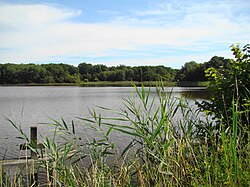
The pond of Sologne between the communes of Lassay-sur-Croisne and Pruniers-en-Sologne.

Sologne (/səˈlɔɪn/; French pronunciation: [sɔlɔɲ] ) is a natural region in Centre-Val de Loire, France, extending over portions of the departements of Loiret, Loir-et-Cher and Cher. Its area is about 5,000 square kilometres (1,900 sq mi). To its north is the river Loire, to its south the river Cher, while the districts of Sancerre and Berry are to its east.[1] Its inhabitants are known as the Solognots (masculine) and Solognotes (feminine).

Its name is thought to derive either from the Latin sœcalonia ("rye country") or sabulonia ("sandy country").

Location of the Sologne (red ring) in France

Geography

[edit]

The Sologne is watered by the Cosson and the Beuvron, tributaries of the Loire, and the Sauldre, a tributary of the Cher, all three having a west-south-westerly direction. The pools and marshes which are characteristic of the region are due to the impermeability of its soil, which is a mixture of sand and clay.[1]

The main towns of Sologne are:

History

[edit]

In the middle of the 19th century Napoleon III led the way in the reclamation of swamps, the planting of pines and other trees and other land alterations. Arable farming and stock-raising are fairly flourishing in the Sologne, but there is little manufacturing activity, the cloth manufacture of Romorantin being the chief industry. Game is abundant, and the region owes much of its revived prosperity to the creation of large sporting estates.[1]

Cultural references

[edit]

References

[edit]
Revisions and contributorsEdit on WikipediaRead on Wikipedia
from Grokipedia
Sologne is a natural region in central , situated south of the River within the departments of , , and , encompassing an area of approximately 500,000 hectares. This flat, slightly undulating plateau, formed as a geological basin known as a from the Beauce platform, features a complex mosaic of poor, wet soils composed of clay and granitic sands eroded from the , leading to frequent flooding and the creation of around 3,000 artificial ponds. Historically, Sologne has been inhabited since the late , with evidence of rural settlements, but it experienced prosperity during the followed by centuries of economic decline marked by poverty, epidemics, and abandonment due to challenging terrain and poor infrastructure. Revitalization began in the mid-19th century through state and private initiatives, including drainage projects, pine plantations covering 36% of the land, and the construction of roads, railways (such as the Orléans-Vierzon line in 1847), and canals like the Sauldre Canal completed in 1870, which integrated the region into broader commercial networks and spurred agricultural and industrial growth. The region's economy, once based on , , and pisciculture in medieval ponds, transformed in the with the rise of production using local clays, marling to improve , and , alongside cereals, crops, and on clayey areas. Today, it emphasizes sustainable across vast woodlands—the second largest in after the Landes—ecotourism drawn to its biodiversity-rich wetlands, heathlands, and forests supporting species like the European beaver and crested newt, and hunting on large estates, while small towns like host limited in sectors such as automotive and wood processing. The low of approximately 45 inhabitants per square kilometer (as of 2013) reflects its rural character, with bourgs evolving into functional hubs featuring architecture and modern housing from laws like the 1928 Loucheur Act.

Geography

Location and Extent

Sologne is a natural region situated in central within the administrative region, encompassing approximately 5,000 km² (1,900 sq mi). It extends across portions of three departments: to the north and west, centrally, and to the south and east. The region's boundaries are defined by major rivers and neighboring areas: the Loire River forms the northern limit, the Cher River the southern boundary, while the eastern edge approaches and the historic province, and the western reaches extend toward the urban centers of and . The extent varies by definition, with the natural region approximately 5,000 km² and the site covering 3,462 km². Sologne lacks formal administrative status as a distinct entity, instead functioning as a cohesive historical and shaped by its geography and ; prominent communes within it include , serving as a central hub, Salbris in the southeast, and La Ferté-Saint-Aubin in the northwest. The name "Sologne" originates from the Latin Secalonia (or Sœcalonia), denoting " country" in reference to its past cultivation of , though an alternative links it to Sabulonia, suggesting "sandy country" due to its soil characteristics.

Physical Features

Sologne constitutes a predominantly flat formed by ancient deposits from the and rivers, characterized by gentle undulations and elevations ranging from 70 to 180 meters, with no significant hills or mountains. This low-relief terrain results from sedimentary processes that have created a landscape of subtle variations rather than dramatic landforms. The region's soils are primarily sandy-clay types, with 51% sandy and 36% sandy-clay compositions, overlying an impermeable clay subsoil that contributes to their acidic and hydromorphic nature—58% of soils exhibit waterlogging traits. These characteristics lead to poor natural drainage, fostering the development of extensive marshes, peat bogs, and ponds across low-lying areas, where water retention is common due to the underlying clay barrier. Heaths and moors also prevail in these damp zones, enhancing the wetland-dominated profile of the plain. Forests cover about 40% of Sologne's surface, totaling around 144,000 to 210,000 hectares depending on the subregion, comprising a mix of plantations and woods that dominate the landscape. Heaths and moors account for an additional 15%, bringing wooded and open natural cover to nearly 50% of the area. and prairies occupy roughly 25-33%, while ponds and marshes, including approximately 3,000 artificial étangs spanning 12,000 hectares (about 2.4% of the total area), fill much of the remaining space in wetter depressions. Human interventions in the significantly altered Sologne's original extent through extensive drainage projects, including the of canals and the creation of artificial ponds to manage water flow and reclaim land for and . Concurrently, large-scale plantings were undertaken to afforest sandy and marshy bottomlands, transforming vast tracts of open heath and into managed woodlands and reducing the pristine coverage. These modifications, driven by efforts to combat flooding and expand productive land, have shaped the contemporary mosaic of forests, marshes, and arable fields.

Climate and Hydrology

Sologne experiences a temperate characterized by mild winters and warm summers, influenced by its proximity to the Atlantic Ocean and the . Average winter temperatures ( to February) range from 3°C to 5°C, with occasional frost but rare extremes below -5°C, while summer highs (June to August) typically reach 20°C to 25°C, occasionally exceeding 30°C during heatwaves. Annual precipitation averages 700 to 750 mm, distributed relatively evenly throughout the year but with peaks in autumn and spring, contributing to the region's lush vegetation. The of Sologne is defined by its low permeability soils, which lead to high humidity levels—often exceeding 80% in winter—and frequent in the lowlands, particularly during cooler months when moisture from the numerous water bodies condenses. The region is drained by several rivers, including the Cosson and Beuvron, which flow northward into the , and the Sauldre, which joins the River; these waterways originate from small streams and wetlands, creating a network of slow-flowing, meandering channels prone to seasonal fluctuations. Approximately 3,000 artificial ponds (étangs), covering about 12,000 hectares or roughly 2.4% of the region's land area, play a crucial role in water retention and local , originally constructed for but also aiding in buffering against dry periods. Seasonal variations exacerbate flood risks in marshy lowlands during heavy autumn rains, when poor drainage causes to pool rapidly, while summer droughts can lower river levels significantly. Modern management, initiated in the late , includes canals like the Canal de la Sauldre and reservoirs designed for and flood control, helping to mitigate these risks and regulate flows in the river basin. These systems support the region's environmental stability, indirectly shaping habitats that sustain diverse such as waterfowl and amphibians.

History

Ancient and Medieval Periods

Sologne has been inhabited since the , with evidence of Gallic settlements reflecting the influence of Celtic tribes such as the Bituriges, , and Turons. Archaeological excavations at Controis-en-Sologne uncovered a modest rural habitat from the late La Tène period (second half of the 2nd century BCE to early 1st century CE), consisting of wooden post-built structures used for habitation and grain storage, along with refuse pits containing ceramics and tools indicative of viviary , rearing, and minor artisanal activities. This site, situated near the Petite Bièvre river, highlights the attractiveness of water-accessible locations for early settlements despite the region's challenging terrain. Celtic origins are evident in local , with village names like Salbris deriving from elements such as Salera (referring to the Sauldre river) combined with briva (meaning "bridge"), a common Celtic denoting infrastructure. The broader name "Sologne" itself traces to a root sego-, signifying "force" or "strength," attesting to pre-Roman linguistic heritage. During the Roman era, Sologne formed part of the province of , centered around (modern ), but human occupation remained limited owing to the area's extensive marshy and forested landscapes. Evidence of Roman infrastructure includes segments of ancient roads traversing the region, such as those connecting (Genabum/Aurelianum) to nearby , though penetration into Sologne's wetlands was minimal. Sparse findings of rural villas and artifacts suggest occasional elite estates adapted to drier upland areas, but the predominance of bogs and poor drainage hindered widespread and agricultural exploitation compared to more fertile neighboring territories. In the medieval period, Sologne integrated into the county of , characterized by feudal estates controlled by nobility and ecclesiastical institutions that shaped land use amid persistent environmental constraints. Monasteries, such as those linked to the Abbaye de Saint-Benoît-sur-Loire, played a key role in early clearance of forested areas for and hermitages, fostering limited settlement in the region's woods and along rivers. Feudal lords held exclusive rights over vast wooded domains, where game like deer and boar thrived, establishing Sologne as a prime noble preserve while restricting peasant access to resources. stayed sparse due to the dominance of wetlands and forests, which limited and supported only scattered hamlets focused on subsistence farming and . The 9th-century Viking raids along the River indirectly impacted riverine fringes of Sologne, as Norse fleets pillaged nearby in 856 and 865, disrupting trade and monastic communities in the broader .

Modern Transformations

During the era of in the 1850s to 1870s, Sologne underwent profound efforts, including the massive drainage of swamps that had long rendered much of the region marshy and unproductive. These initiatives, continued from earlier 19th-century projects but greatly expanded under imperial patronage, converted thousands of hectares into and reduced the prevalence of by eliminating stagnant water sources that harbored mosquitoes. personally influenced this transformation by acquiring extensive domains, such as the approximately 3,400-hectare estate at La Motte-Beuvron in 1852, where he directed the planting of (maritime pine) for timber production and the establishment of large estates that integrated with game preserves. Local landowners, supported by imperial policies, played a key role in these changes, funding canals, dikes, and plantations that reshaped the landscape for and elite recreation. In the , Sologne's predominantly rural and forested nature shielded it from severe direct impacts during the World Wars, though the conflicts exacerbated national economic strains that indirectly affected local farming. Following , mechanization revolutionized agriculture, enabling larger-scale operations with tractors and machinery that boosted crop yields on the sandy, acidic soils but also accelerated the consolidation of smallholdings. This modernization coincided with a marked driven by rural exodus, as many inhabitants left for urban employment in cities like Orléans and , reducing the regional populace from peaks in the early 1900s to lows by the late 20th century. Since the 1990s, environmental policies, including the network, have driven wetland restoration projects in Sologne, countering historical drainage by rehabilitating marshes and ponds to support ecological recovery. These efforts, coordinated through local syndicates and funded by EU directives, have focused on enhancing and habitats, marking a shift toward sustainable . The region's has since stabilized at approximately 230,000 residents as of 2022, aided by improved and emerging non-agricultural opportunities. These modern changes have notably altered patterns, with restored wetlands fostering diverse and .

Economy

Agriculture and Forestry

Agriculture in Sologne is characterized by its adaptation to challenging environmental conditions, with a focus on cereals such as and , alongside and specialty crops like . Cereals occupy a significant portion of cultivated land in local communities, while prairies dedicated to support rearing. production, particularly the white variety, benefits from the region's sandy soils and mild , contributing to regional output of approximately 700 tons annually in the area of as of 2024, representing about 3.5% of France's total production. Livestock farming includes for and meat, as well as sheep and goats, with livestock units varying by local assessments. rearing exists but is less dominant compared to other sectors. Fish farming in Sologne's extensive network of ponds, a legacy of medieval practices, plays a key role in the local economy, producing species such as carp and pike (brochet). These étangs, covering thousands of hectares and numbering over 3,000, support intensive aquaculture that supplies markets, including exports to Paris, with carp historically traded since the 16th century. The activity integrates with the landscape, utilizing the ponds for both commercial production and ecological maintenance. Forestry covers approximately 54% of Sologne's land, totaling around 269,000 hectares, dominated by oaks and coniferous species like Scots and laricio . Timber and fuelwood exploitation provides economic value, with private ownership prevailing and sustainable management promoted through regional plans by the Centre Régional de la Propriété Forestière (CRPF). Historical drainage of wetlands in the facilitated the shift to and plantations, enhancing wood production while preserving . Challenges in both sectors stem from Sologne's acidic, sandy, and hydromorphic soils, which limit yields and necessitate drainage on 43% of and on 30%. Organic farming has grown since the 2000s, though it remains limited, with only a few certified producers in local diagnostics, representing under 5% of s amid broader regional increases of over 139% in bio surfaces from 2015 to 2021. The agricultural and sectors together contribute significantly to the local economy, supporting rural employment amid a general decline in farm numbers over recent decades.

Tourism and Other Sectors

Sologne's tourism sector emphasizes nature-based activities, drawing visitors to its forests, ponds, and wetlands for , , and . The region's extensive network of marked trails, including 17 dedicated loops in the Portes de Sologne area suitable for walking, horseback riding, or biking, supports these pursuits and promotes immersion in the local landscape. Fishing is a popular draw, with regulated rivers and ponds providing opportunities for anglers throughout the year, while the area's rich aquatic ecosystems enhance the experience. , particularly during seasonal periods, attracts dedicated enthusiasts, exemplified by the annual Game Fair in Lamotte-Beuvron, which draws over 90,000 visitors to celebrate hunting traditions and related activities. Accommodation options cater to eco-conscious travelers, including nature eco-lodges and rural gîtes scattered across the Val de Loire region encompassing , offering sustainable stays amid the countryside. Private lodges, often featuring gardens and proximity to ponds, provide specialized lodging for seasonal visitors. These services contribute to a growing emphasis on , with regional efforts post-2010 focusing on environmental integration, as seen in the increase in overnight stays across from 2010 onward. As of 2025, ongoing initiatives continue to promote while balancing growth with biodiversity conservation. Beyond , minor industries bolster the local through small-scale , such as the production of from flowers and jams from berries, with numerous producers operating in Sologne. crafts, notably basket-weaving using osier , remain a traditional pursuit, supported by resources like the willow conservatory in Ligny-le-Ribault, where local artisans demonstrate and sell handcrafted items. The sector faces challenges, including heavy seasonal dependency—historically concentrated from May to —and the need to balance visitor growth with conservation, as emphasized in regional strategies to protect Sologne's wetlands and forests.

Biodiversity

Flora and Vegetation

Sologne's is characterized by a diverse array of communities adapted to its sandy, acidic soils and variable , with forests covering over three-quarters of the region's approximately 500,000 hectares. Dominant vegetation includes oak (), Scots pine () plantations, and chestnut (Castanea sativa) trees in upland forests, alongside birch (Betula pendula) groves and ferns such as bracken (Pteridium aquilinum) that thrive in disturbed or open areas. On poorer, acidic soils, heaths dominated by heather species (Calluna vulgaris and Erica spp.), bracken, and bilberry (Vaccinium myrtillus) form extensive moorlands, reflecting the region's oligotrophic conditions. Wetland ecosystems, comprising ponds, marshes, and bogs, support specialized aquatic and semi-aquatic flora. Reeds () and sedges (Carex spp.) line pond edges, while water lilies () float on open waters; deeper bogs feature sphagnum moss (Sphagnum spp.) carpets and carnivorous plants like sundews (), which capture insects in nutrient-poor environments. These habitats contribute to Sologne's overall floral richness, with around 1,200 plant species recorded, many adapted to the region's mild influences on growth patterns. Conservation efforts focus on protecting and restoring these habitats amid ongoing pressures. The Sologne area is designated under the European Natura 2000 network, encompassing about 346,000 hectares to safeguard key ecosystems and species. Restoration initiatives, such as those by the Conservatoire d'espaces naturels, have targeted wetland recovery, including the rehabilitation of an 80-hectare site near Orléans in 2018 to enhance biodiversity. Similarly, the Domaine national de Chambord has undertaken renaturation of forest ponds within its 5,500-hectare area to combat degradation. Threats to the flora include invasive species that outcompete natives and soil acidification exacerbated by atmospheric deposition, potentially reducing habitat suitability for acidophilic plants. Approximately 2,000 vascular plant species have been cataloged, underscoring the need for continued monitoring.

Fauna and Wildlife

Sologne's fauna is diverse, thriving in its mosaic of forests, , and , which support a range of habitats from ancient woodlands to artificial étangs. The region's includes abundant large mammals and a rich avian population, bolstered by conservation efforts that balance ecological protection with traditional activities like . This underscores Sologne's status as a key European hotspot for wetland and forest species. Among mammals, (Capreolus capreolus), (Sus scrofa), and (Cervus elaphus) are particularly abundant, with populations of and showing notable increases over recent decades due to favorable forest habitats and management practices. Foxes (Vulpes vulpes) are also common, exploiting the wooded edges and open areas for foraging. Otters (Lutra lutra) and beavers (Castor fiber) have been successfully reintroduced to the region's wetlands and river systems, including the bordering Sologne, where they contribute to ecosystem restoration by enhancing water quality and habitat complexity. Beaver reintroductions began in the 1970s near , leading to stable populations that now extend into Sologne's aquatic environments. The birdlife of Sologne is exceptionally rich, with over 200 species recorded, many benefiting from the thousands of ponds that serve as breeding and wintering grounds. Migratory ducks such as mallards (Anas platyrhynchos) and teal (Anas crecca) flock to the étangs during seasonal movements, while herons including the (Ardea cinerea) and (Ardea alba) nest in reed beds and forage in shallow waters. Raptors like the (Circus cyaneus), a species of European conservation concern, hunt over open marshes and grasslands, with breeding pairs observed in department areas of Sologne. These birds highlight the region's ornithological significance, with wetlands supporting high densities of waterfowl and waders. Amphibians such as common frogs (Rana temporaria) and crested newts (Triturus cristatus) inhabit the numerous ponds and ditches, where moist conditions favor breeding. Insects, particularly dragonflies and damselflies (Odonata order, including Coenagrion mercuriale), are diverse in wetland margins, serving as indicators of water quality. Fish stocks, including species like carp (Cyprinus carpio) and pike (Esox lucius), are actively managed in the étangs to support angling, with stocking programs maintaining sustainable populations. Conservation in Sologne is anchored in its designation as a major site (FR2402001), covering over 346,000 hectares and protecting habitats for 32 animal species under the EU . Hunting regulations, outlined in departmental game management plans (Schémas Départementaux de Gestion Cynégétique), enforce seasonal quotas for species like deer and to prevent overpopulation and habitat degradation—for instance, roe deer densities have been increasing since the late 1980s through targeted habitat enhancements and controlled harvests. These measures, coordinated by the French Office for Biodiversity (OFB) and local federations, promote stable wildlife populations while integrating Sologne into broader European networks. Wildlife viewing contributes to eco-tourism, drawing visitors to observe species in protected reserves.

Culture and Heritage

Literary and Artistic References

Sologne's evocative landscapes have long inspired French literature, particularly in works that capture the region's misty forests, ponds, and rural solitude. Alain-Fournier's seminal novel Le Grand Meaulnes, published in 1913, is set in a fictionalized version of Sologne, drawing on the author's childhood memories of the area's isolated villages and enigmatic countryside to explore themes of lost youth and unattainable dreams. The narrative unfolds around a rural school in Sologne, where the protagonist's quest for a vanished estate symbolizes the elusive nature of innocence amid the region's haunting natural beauty. Similarly, Maurice Genevoix's La Dernière Harde, released in 1938, portrays the wild forests of Sologne through the epic struggle between a veteran huntsman and a majestic stag, emphasizing the interplay of human endurance and untamed wilderness. Genevoix, deeply rooted in the region, uses the novel to evoke the sensory richness of Sologne's woodlands, from rustling leaves to the calls of game, highlighting its role as a backdrop for primal instincts and ecological harmony. In music, Sologne's finds expression in Jean-Philippe Rameau's piece Les Niais de Sologne, composed in 1724 as part of his Premier livre de pièces de clavecin. The title, translating to "The Simpletons of Sologne," draws on regional tales of naive rural folk, rendered in a lively rondeau that mimics folk dances with playful rhythms and melodic simplicity. Rameau, influenced by French provincial traditions, later adapted elements of this work for his Dardanus, underscoring its ties to Sologne's . Visual artists of the 19th century frequently turned to Sologne's forests and ponds for inspiration, capturing their atmospheric depth in the Barbizon tradition. Théodore Rousseau's Twilight in Sologne (1867), an oil painting depicting the region's dimming light over wooded expanses, exemplifies the realist focus on natural textures and subdued tones. Jules Dupré's Mill of the Sologne (1835) portrays a rustic mill amid misty ponds and dense foliage, emphasizing the area's humid, introspective mood through earthy palettes and dynamic brushwork. Hippolyte Jean Adam Gide's watercolor Pond in Sologne (late 19th century) further illustrates the ponds' reflective surfaces and surrounding thickets, rendered with delicate layering to convey seasonal tranquility. In contemporary times, photographers document Sologne's seasonal transformations, from autumnal foliage in vibrant golds to winter's stark, fog-shrouded wetlands, using long exposures to highlight the cyclical rhythms of its ecosystems. Through these artistic lenses, Sologne emerges as a potent in French culture, embodying rural mystery and a poignant for an idealized past. Alain-Fournier's portrayal, in particular, has cemented the region as a of elusive enchantment, influencing perceptions of French countryside as a realm of hidden wonders and bittersweet longing. Genevoix's naturalistic depictions reinforce this, framing Sologne's wilds as a mirror to solitude and the inexorable passage of time.

Traditions and Local Identity

Hunting stands as a central pillar of Solognot culture, deeply embedded in the region's social fabric through organized societies and seasonal festivals, though it has faced controversies over and ethical practices, including a 2025 poaching scandal involving members of local associations and ongoing debates leading to regulatory changes like the 2024 law against animal cruelty. Local hunting associations, known as équipages de chasse à courre, such as the Rallye Vouzeron, uphold centuries-old practices of mounted hunts with hounds, emphasizing communal rituals and ethical traditions passed down among participants. These groups foster a sense of camaraderie, with events like the annual Game Fair in Lamotte-Beuvron serving as major gatherings that celebrate hunting heritage through demonstrations, exhibitions, and fairs showcasing game and equipment, drawing thousands to honor this rural legacy. Similarly, fishing rites tied to the of Sologne's extensive pond system—over 2,000 private étangs—form another generational , where families and communities engage in cyclical practices of stocking, maintaining water levels, and harvesting like and pike, often accompanied by local blessings or shared meals to mark the seasons. Solognot cuisine reflects the land's bounty, with game-based dishes like terrines and pâtés de gibier—featuring , deer, and —prepared using recipes that blend forest meats with local herbs and , embodying the hunter's reward after a day's pursuit. from the region's heather and forest blooms features prominently in desserts such as honey-glazed tarts or infused sweets, while hearty rye bread, often mixed with for a dense, nutty , serves as a staple to these meals, evoking the simple, resilient diet of past rural life. Gastronomic events, including harvest fairs and pond-draining festivals, tie these flavors to seasonal cycles, where communities gather to sample fresh catches and preparations, reinforcing bonds through shared feasting. The inhabitants, known as Solognots, cultivate a strong regional identity as independent, resilient rural folk, proud of their marshy, forested homeland once dismissed as "poor" but now embraced as a unique . This self-perception is expressed through the Berrichon dialect, a langue d'oïl variant spoken in Sologne with subtle southern influences akin to Occitan in pronunciation and vocabulary, preserving local expressions amid French standardization. Annual events like the festival in , organized by groups such as the Union pour la Culture Populaire en Sologne, revive tales, dances, and songs, highlighting this distinct character. In the face of encroaching urbanization from nearby cities like Orléans and , community initiatives actively preserve these Celtic-derived customs, including oral traditions and nature-based rituals documented in early 19th-century studies. Associations like the UCPS promote workshops on storytelling and traditional crafts, while regulatory protections since delineate Sologne as a distinct natural region to safeguard its cultural practices against modern development pressures. These efforts ensure that , from lore to pond rites, remains a living testament to Solognot and heritage.

References

Add your contribution
Related Hubs
User Avatar
No comments yet.