


Community hub
Recent from talks
Contribute something
Nothing was collected or created yet.
Saint-Imier
View on Wikipedia
Saint-Imier (French pronunciation: [sɛ̃.t‿imje]) is a municipality in the Jura bernois administrative district in the canton of Bern in Switzerland. It is located in the French-speaking Bernese Jura (Jura Bernois).
Key Information


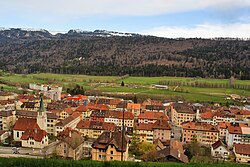
The Observatoire Astronomique de Mont-Soleil is located above the village.
History
[edit]Saint-Imier is first mentioned in 884 as cella de sancti Himerii. The municipality was formerly known by its German name St. Immer, however, that name is no longer used.[1] Its name refers to Imerius of Immertal, a 7th-century saint.
According to the legend of St. Imerius, he settled in the valley as a hermit in the late 6th or early 7th century on a piece of land that bishop Marius of Lausanne gave him as a present. In 884 a cella (probably a church, farm and monastery) was mentioned on the site. Archeological excavations around the former Church of St. Martin indicate that a village grew up around the cella around the same time. Two of the 142 graves from the church have been dated to the Early Middle Ages and the church was rebuilt at least three times before the 14th or early 15th century.[1]
In 884 the cella with its outbuildings belonged to Moutier-Grandval Abbey. In 999, the Abbey donated Saint-Imier and a number of surrounding villages to the Prince-Bishop of Basel. In 1264, the Bishop appointed Otto of Arguel (or Erguel) as the vogt over the Saint-Imier valley fief. Otto raised the valley to become a seigniory and parish of the Diocese of Basel. By the end of the 15th century, Saint-Imier included the villages of Villeret, Sonvilier, Renan and La Ferriere.[1]
Even though the physical valley was owned by the Bishop of Basel, religiously it was part of the Diocese of Lausanne. The Saint-Imier parish was probably founded in the 9th or 10th century. A village chapel was first mentioned in 968, with the parish church of St. Martin first appearing in the records in 1228. The church of St. Martin was later rebuilt in the gothic style. Another church, the collegiate church was built in the 11th century, probably under the direction of the Bishop of Basel. In 1530, Biel encouraged Saint-Imier to embrace the Protestant Reformation and convert to the new religion. The collegiate church before the parish church for the new Reformed parish. Over the following centuries, the Church of St. Martin was used less and less until it was demolished in 1828. In 1814 the town and the surrounding valley transferred from Lausanne to the Diocese of Basel. Catholic church services resumed in Saint-Imier in 1857 and in 1866 the neo-gothic Church of St. Martin was built. In 1912 a Christian Catholic church was built in the town.[1]

In 1792 Théodore Frédéric Louis Liomin, the vogt or bailiff of Saint-Imier, threw his support behind the revolutionary movement that was sweeping the region. After the 1797 French victory and the Treaty of Campo Formio, Saint-Imier became part of the French Département of Mont-Terrible. Three years later, in 1800 it became part of the Département of Haut-Rhin. After Napoleon's defeat and the Congress of Vienna, Saint-Imier was assigned to the Canton of Bern in 1815.[1]
During the 19th century the anti-authoritarian or anarchist movement gained a foothold in the region. In 1872, the Jura Federation, which had strong support in Saint-Imier, organized a congress in Saint-Imier at which the Anti-authoritarian International was founded.[1]
During the 18th century the inhabitants of the valley gradually gave up agriculture in favor of more lucrative jobs in the watch and lace-making industries. The first watch parts workshop opened in the 1720s and the industry continued to expand throughout the 19th century. By 1817 there were about 200 workers employed in either watchmaking workshops or small shops at home. The small scale workshops were replaced by large factory work, when Longines opened a factory in the town in 1867. By the end of the year, 1,600 people were employed in 47 watchmaking companies. Because the town's economy was so dependent on watchmaking, the economic crisis of the 1930s and the 1970s hit Saint-Imier hard. By the beginning of the 21st century, there were about ten watchmaking companies and the economy had diversified to include dental and medical technology and meteorology.[1]

Portions of the town were destroyed by fire in 1839, 1843 and 1856. A hospital opened in Saint-Imier in 1856. In 1874 the town was connected to the Swiss rail network. The town's infrastructure was modernized early, before 1900 it had municipal water, gas and electricity. Saint-Imier has grown into a regional education center. The town's secondary school opened in 1860, followed by a watchmaker's school in 1866. The watch-maker's school was expanded into a machinist's school in 1896 and a technical vocational school in 1961. In 1976 it became a school of engineering and in 2005 it was integrated into the Haute école Arc/Hochschule Arc. A number of other schools opened in the town including the Bernese Jura Music School (1981), a vocational and technical school (1997), and a training center for health professionals (1993).[1]
On 31 December 2009, the district of Courtelary, the municipality's former district, was dissolved. On the following day, 1 January 2010, a new district (or arrondissement administratif) of Jura bernois was created, which includes all of the former Courtelary District, as well as the former district of La Neuveville and the area around Tavannes.[2]
On 19 July 2023, hundreds of anarchists began arriving in Saint-Imier to participate in an international anarchist gathering, in celebration of the 150th anniversary of the Saint-Imier Congress. The event included lectures, workshops, concerts, film screenings, theatre plays, exhibitions and a book fair.[3] By the second day of the event, thousands of people had arrived in the town, causing logistical issues for the self-managed space.[4] The event also caused some safety problems, as its campsite was located next to train tracks that campers often crossed over in order to get to the event location, despite attempts by the event organisers to stop them. In order to guarantee safety, the Swiss Federal Railways halted all rail traffic between Saint-Imier and La Chaux-de-Fonds over the weekend, organising replacement bus services in order to maintain the public transit network.[5][6] The event would end up counting 5,000 attendees, mostly people in their early twenties, who were reportedly warmly welcomed by the town's population. Saint-Imier mayor Corentin Jeanneret reported that the event went largely smoothly, with the exception of a few cases of graffiti.[7][8][9]
Geography
[edit]
Saint-Imier has an area of 20.87 km2 (8.06 sq mi). Of this area, 49% is used for agricultural purposes, while or 40% is forested. Of the rest, 9.3% of the total is buildings or roads, and 0.7%of the total is unproductive.[10]
Of the built up area, housing and buildings made up 5.8% and transportation infrastructure made up 2.2%. Out of the forested land, 34% of the total land area is heavily forested and 6% is covered with orchards or small clusters of trees. Of the agricultural land, 1.7% is used for growing crops and 20% is pastures and 27% is used for alpine pastures.[10]
The municipality is located in the Saint-Imier valley along the Suze river and on the Biel/Bienne-La Chaux-de-Fonds road.
Coat of arms
[edit]The blazon of the municipal coat of arms is Sable two Pales Or and overall on a Bar Argent a Mullet of Five Gules.[11]
Demographics
[edit]
Saint-Imier has a population (as of December 2020[update]) of 5,156.[12] As of 2010[update], 23.9% of the population are resident foreign nationals.[13] Over the last 10 years (2000-2010) the population has changed at a rate of 4.2%. Migration accounted for 6.3%, while births and deaths accounted for -2.9%.[14]
Most of the population (as of 2000[update]) speaks French (4,049 or 84.2%) as their first language, German is the second most common (315 or 6.6%) and Italian is the third (183 or 3.8%). There are 2 people who speak Romansh.[15]
As of 2008[update], the population was 48.1% male and 51.9% female. The population was made up of 1,682 Swiss men (35.3% of the population) and 612 (12.8%) non-Swiss men. There were 1,947 Swiss women (40.8%) and 530 (11.1%) non-Swiss women.[13] Of the population in the municipality, 1,486 or about 30.9% were born in Saint-Imier and lived there in 2000. There were 1,072 or 22.3% who were born in the same canton, while 1,040 or 21.6% were born somewhere else in Switzerland, and 1,028 or 21.4% were born outside of Switzerland.[15]
As of 2010[update], children and teenagers (0–19 years old) make up 22.1% of the population, while adults (20–64 years old) make up 56.7% and seniors (over 64 years old) make up 21.2%.[14]
As of 2000[update], there were 1,842 people who were single and never married in the municipality. There were 2,242 married individuals, 447 widows or widowers and 276 individuals who are divorced.[15]
As of 2000[update], there were 916 households that consist of only one person and 86 households with five or more people. In 2000[update], a total of 2,190 apartments (78.9% of the total) were permanently occupied, while 362 apartments (13.0%) were seasonally occupied and 223 apartments (8.0%) were empty.[16] As of 2010[update], the construction rate of new housing units was 1.3 new units per 1000 residents.[14] The vacancy rate for the municipality, in 2011[update], was 4.5%.
The historical population is given in the following chart:[1][17]

Heritage sites of national significance
[edit]The Collégiale and the Longines Watch factory are listed as Swiss heritage site of national significance. The entire urban village of Saint-Imier is part of the Inventory of Swiss Heritage Sites.[18]
-
 Collégiale of Saint-Imier
 -
 Longines Watch factory


Politics
[edit]In the 2011 federal election the most popular party was the Social Democratic Party (SP) which received 26.4% of the vote. The next two most popular parties were the Swiss People's Party (SVP) (25.4%), and the FDP.The Liberals (18.2%). In the federal election, a total of 929 votes were cast, and the voter turnout was 31.6%.[19]
Economy
[edit]Saint-Imier is the hometown of the Longines watchmaking company. The Breitling watchmaking company was founded in Saint-Imier, but moved to Grenchen, Canton of Solothurn.
As of 2011[update], Saint-Imier had an unemployment rate of 3.59%. As of 2008[update], there were a total of 2,483 people employed in the municipality. Of these, there were 61 people employed in the primary economic sector and about 23 businesses involved in this sector. 1,102 people were employed in the secondary sector and there were 57 businesses in this sector. 1,320 people were employed in the tertiary sector, with 164 businesses in this sector.[14] There were 183 residents of the municipality who were employed in some capacity, of which females made up 59.0% of the workforce.
In 2008[update] there were a total of 2,069 full-time equivalent jobs. The number of jobs in the primary sector was 46, of which 42 were in agriculture and 4 were in forestry or lumber production. The number of jobs in the secondary sector was 1,024 of which 879 or (85.8%) were in manufacturing and 81 (7.9%) were in construction. The number of jobs in the tertiary sector was 999. In the tertiary sector; 184 or 18.4% were in wholesale or retail sales or the repair of motor vehicles, 29 or 2.9% were in the movement and storage of goods, 48 or 4.8% were in a hotel or restaurant, 40 or 4.0% were the insurance or financial industry, 44 or 4.4% were technical professionals or scientists, 101 or 10.1% were in education and 437 or 43.7% were in health care.[20]
In 2000[update], there were 1,624 workers who commuted into the municipality and 802 workers who commuted away. The municipality is a net importer of workers, with about 2.0 workers entering the municipality for every one leaving. About 11.3% of the workforce coming into Saint-Imier are coming from outside Switzerland.[21] Of the working population, 10.2% used public transportation to get to work, and 53.3% used a private car.[14]
Religion
[edit]From the 2000 census[update], 1,989 or 41.4% belonged to the Swiss Reformed Church, while 1,642 or 34.2% were Roman Catholic. Of the rest of the population, there were 22 members of an Orthodox church (or about 0.46% of the population), there were 17 individuals (or about 0.35% of the population) who belonged to the Christian Catholic Church, and there were 386 individuals (or about 8.03% of the population) who belonged to another Christian church. There were 161 (or about 3.35% of the population) who were Islamic. There were 4 individuals who were Buddhist, 1 person who was Hindu and 4 individuals who belonged to another church. 617 (or about 12.84% of the population) belonged to no church, are agnostic or atheist, and 156 individuals (or about 3.25% of the population) did not answer the question.[15]
Education
[edit]
In Saint-Imier about 1,696 or (35.3%) of the population have completed non-mandatory upper secondary education, and 438 or (9.1%) have completed additional higher education (either university or a Fachhochschule). Of the 438 who completed tertiary schooling, 60.5% were Swiss men, 20.5% were Swiss women, 11.0% were non-Swiss men and 8.0% were non-Swiss women.[15]
The Canton of Bern school system provides one year of non-obligatory Kindergarten, followed by six years of Primary school. This is followed by three years of obligatory lower Secondary school where the students are separated according to ability and aptitude. Following the lower Secondary students may attend additional schooling or they may enter an apprenticeship.[22]
During the 2010-11 school year, there were a total of 695 students attending classes in Saint-Imier. There were 5 kindergarten classes with a total of 100 students in the municipality. Of the kindergarten students, 27.0% were permanent or temporary residents of Switzerland (not citizens) and 33.0% have a different mother language than the classroom language. The municipality had 21 primary classes and 349 students. Of the primary students, 31.8% were permanent or temporary residents of Switzerland (not citizens) and 19.2% have a different mother language than the classroom language. During the same year, there were 13 lower secondary classes with a total of 246 students. There were 19.1% who were permanent or temporary residents of Switzerland (not citizens) and 15.9% have a different mother language than the classroom language.[23] As of 2000[update], there were 396 students in Saint-Imier who came from another municipality, while 126 residents attended schools outside the municipality.[21]
Saint-Imier is home to 2 libraries, the Haute école Arc – Ingénierie and the Bibliothèque régionale de St-Imier. There was a combined total (as of 2008[update]) of 29,145 books or other media in the libraries, and in the same year a total of 41,777 items were loaned out.[24]
Transportation
[edit]The municipality has a railway station, St-Imier. The station is located on the Biel/Bienne–La Chaux-de-Fonds line and has half-hourly service to Biel/Bienne and La Chaux-de-Fonds.
Mont Soleil can be reached with Funiculaire Saint-Imier-Mont-Soleil.
Sports
[edit]HC Sainti Bats plays in the Première Ligue, the fourth tier of Swiss hockey. Their home arena is the 3,000-seat Erguël Arena.
Notable residents
[edit]- Alain Auderset, Christian author;
- George-Emile Eberhard, watchmaker and industrialist;
- Charles Guyot, professional road racing cyclist;
- Jonathan Hirschi, racing driver;
- Raymond Künzli, professional road racing cyclist;
- Conny Perrin, professional tennis player.
References
[edit]- ^ a b c d e f g h i Saint-Imier in German, French and Italian in the online Historical Dictionary of Switzerland.
- ^ Nomenklaturen – Amtliches Gemeindeverzeichnis der Schweiz Archived 2015-11-13 at the Wayback Machine (in German) accessed 4 April 2011
- ^ Klaunzer, Peter (19 July 2023). "International anarchist gathering gets under way in Switzerland". Swissinfo. Retrieved 22 July 2023.
- ^ "St-Imier à l'heure de l'anarchisme". RTN (in French). 20 July 2023. Retrieved 22 July 2023.
- ^ "Problèmes de sécurité aux Rencontres internationales anti-autoritaires de St-Imier". RTN (in French). 21 July 2023. Retrieved 22 July 2023.
- ^ Sohlbank, Deborah (21 July 2023). "Le trafic ferroviaire coupé entre St-Imier et La Chaux-de-Fonds à cause du rassemblement anarchiste". Radio Télévision Suisse (in French). Retrieved 22 July 2023.
- ^ "Plus de 5000 libertaires ont refait le monde à St-Imier". Swissinfo (in French). 23 July 2023. Retrieved 23 July 2023.
- ^ "Plus de 5000 libertaires ont afflué aux Rencontres internationales anti-autoritaires à St-Imier". Radio Télévision Suisse (in French). 23 July 2023. Retrieved 23 July 2023.
- ^ "Afflux pacifique de milliers d'anarchistes à St-Imier (BE)". Swissinfo (in French). 22 July 2023. Retrieved 23 July 2023.
- ^ a b Swiss Federal Statistical Office-Land Use Statistics 2009 data (in German) accessed 25 March 2010
- ^ Flags of the World.com accessed 22-October-2012
- ^ "Ständige und nichtständige Wohnbevölkerung nach institutionellen Gliederungen, Geburtsort und Staatsangehörigkeit". bfs.admin.ch (in German). Swiss Federal Statistical Office - STAT-TAB. 31 December 2020. Retrieved 21 September 2021.
- ^ a b Statistical office of the Canton of Bern Archived 15 February 2012 at the Wayback Machine (in German) accessed 4 January 2012
- ^ a b c d e Swiss Federal Statistical Office accessed 22 October 2012
- ^ a b c d e STAT-TAB Datenwürfel für Thema 40.3 - 2000 Archived 2013-08-09 at the Wayback Machine (in German) accessed 2 February 2011
- ^ Swiss Federal Statistical Office STAT-TAB - Datenwürfel für Thema 09.2 - Gebäude und Wohnungen Archived 2014-09-07 at the Wayback Machine (in German) accessed 28 January 2011
- ^ Swiss Federal Statistical Office STAT-TAB Bevölkerungsentwicklung nach Region, 1850-2000 Archived 2014-09-30 at the Wayback Machine (in German) accessed 29 January 2011
- ^ "Kantonsliste A-Objekte". KGS Inventar (in German). Federal Office of Civil Protection. 2009. Archived from the original on 28 June 2010. Retrieved 25 April 2011.
- ^ Swiss Federal Statistical Office 2011 Election Archived 2013-11-14 at the Wayback Machine (in German) accessed 8 May 2012
- ^ Swiss Federal Statistical Office STAT-TAB Betriebszählung: Arbeitsstätten nach Gemeinde und NOGA 2008 (Abschnitte), Sektoren 1-3 Archived 2014-12-25 at the Wayback Machine (in German) accessed 28 January 2011
- ^ a b Swiss Federal Statistical Office - Statweb Archived 2012-08-04 at archive.today (in German) accessed 24 June 2010
- ^ EDK/CDIP/IDES (2010). Kantonale Schulstrukturen in der Schweiz und im Fürstentum Liechtenstein / Structures Scolaires Cantonales en Suisse et Dans la Principauté du Liechtenstein (PDF) (Report). Retrieved 24 June 2010.
- ^ Schuljahr 2010/11 pdf document(in German) accessed 4 January 2012
- ^ Swiss Federal Statistical Office, list of libraries Archived 2015-07-06 at the Wayback Machine (in German) accessed 14 May 2010
External links
[edit]

| International | |
|---|---|
| National | |
| Geographic | |
| Other | |

Saint-Imier
View on GrokipediaGeography and Environment
Location and Topography
Saint-Imier is a municipality in the Jura bernois administrative district of the Canton of Bern, Switzerland, positioned in the French-speaking Bernese Jura region.[6] It lies at geographic coordinates approximately 47.15°N 7.00°E.[7] The town occupies a central position in the Vallée de Saint-Imier, a north-south oriented valley within the folded Jura Mountains, flanked by ridges and plateaus characteristic of the Swiss Jura fold belt.[8] The settlement sits at an elevation of 814 meters above sea level, with surrounding terrain rising to higher altitudes that define its topography.[9] Immediately north of Saint-Imier, Mont Soleil ascends to 1,291 meters, offering panoramic views over the valley and exemplifying the undulating karst-influenced landscape of pastures, forests, and gentle slopes typical of the Jura.[10] The valley floor provides relatively flat land for urban development and agriculture, while the encircling hills support hiking trails and limit expansion, contributing to a compact municipal footprint of about 20.87 square kilometers.[11] This topography influences local accessibility, with the valley serving as a natural corridor for transportation routes connecting to nearby cities like Biel/Bienne to the east and La Chaux-de-Fonds to the west.[12] The Jura's calcareous bedrock underlies the area's hydrology, featuring streams like the Birse River and occasional sinkholes, though the immediate vicinity around Saint-Imier remains agriculturally viable without pronounced karst hazards.[13]Climate and Natural Features
Saint-Imier lies in the Vallon de Saint-Imier, a north-south oriented valley within the Swiss Jura Mountains, part of the Bernese Jura at an elevation of 814 meters above sea level.[14] The local topography consists of folded limestone plateaus and ridges characteristic of the Jura fold-and-thrust belt, formed during the Miocene as part of the Alpine orogeny, with prominent surrounding elevations including Mont Soleil at 1,097 meters and Mont Crosin.[15] The underlying geology features Jurassic and Cretaceous carbonate sequences, including limestone and marl deposits that contribute to karstic features such as sinkholes and underground drainage in the broader Jura region.[16] Vegetation in the area reflects the Jura's altitudinal gradient, with mixed deciduous and coniferous forests dominated by beech, oak, fir, spruce, and pine on lower slopes, transitioning to open pastures and meadows at higher elevations used for grazing and hay production.[17] These high Jura pastures, often above 1,000 meters, support alpine flora adapted to cooler conditions, while the valley floor features agricultural fields interspersed with hedgerows and small woodlands. The region's natural landscape also includes rivers like the Suze, ponds, and forests that provide habitats for wildlife, though human activities such as forestry and renewable energy installations— including wind turbines on Mont Crosin—have modified some areas.[18] The climate of Saint-Imier is classified as humid continental (Dfb under the Köppen system), influenced by its mid-elevation position in the Jura, resulting in colder temperatures and higher precipitation than the Swiss Plateau. Average monthly temperatures range from -1°C in January to 16°C in July, with annual means around 7°C based on nearby station data. Winters are cold with frequent snow cover due to northerly bise winds, while summers are mild and humid; annual precipitation totals approximately 1,200-1,500 mm, distributed fairly evenly but with peaks in summer thunderstorms common to the Jura.[19] Climate data from simulated historical records indicate variability, with extremes including heavy snowfall in winter and occasional fog in the valley, though long-term trends show slight warming consistent with broader Swiss patterns reported by MeteoSwiss.[20]Historical Development
Origins and Medieval Period
The origins of Saint-Imier are rooted in the legend of Imier, a hermit said to have arrived in the Vallon de Saint-Imier around 600 AD from the Ajoie region, where he cleared land and evangelized before dying circa 615 AD; his tomb purportedly became the nucleus of an early settlement and church.[21][22] However, this account lacks contemporary documentation and represents hagiographic tradition rather than verifiable history, with the saint's cult emerging later.[23] The first historical attestation of Saint-Imier appears in a 884 AD charter issued by Emperor Charles III the Fat, confirming possessions of Moutier-Grandval Abbey and referencing the "cella de sancti Himerii," interpreted as a rural chapel, farm, and possible monastic cell dedicated to Saint Imier, indicating an established cult site by the late 9th century.[22][21] Initially under Moutier-Grandval Abbey until 999 AD, the site passed to the Bishopric of Basel following a donation by King Rodolphe III of Burgundy.[22] A chapel is noted in records from 968 AD, and archaeological excavations at the former Saint-Martin church site (conducted 1986–1990) uncovered high medieval religious structures and burials, supporting early ecclesiastical presence from the 9th–10th centuries.[22] During the high and late medieval periods, Saint-Imier developed as a key parish center. The Romanesque collegiate church, likely constructed in the 11th century under Basel's episcopal authority, housed Saint Imier's relics and featured a chapter of twelve canons established before 1177, evolving from an earlier monastic foundation.[22][21] The Saint-Martin parish church is documented by 1228, possibly originating in the 9th–10th centuries.[22] Secularly, in 1264, Otton d'Arguel transferred avouerie (advocacy) rights to the Bishop of Basel, incorporating Saint-Imier into the lordship of Erguël.[22] By the late 15th century, it served as the "high parish" overseeing subordinate communities including Villeret, Sonvilier, Renan, and La Ferrière, reflecting its regional ecclesiastical and administrative prominence.[22]Industrialization and Watchmaking Emergence
Watchmaking in Saint-Imier emerged in the 18th century through the decentralized établissage system, where independent home-based artisans produced components supplied and assembled by établisseurs.[24] This cottage industry laid the groundwork for industrialization, with production in the Swiss Jura region expanding significantly from 1846 to 1873, as national output rose from 130,000 to 580,000 watches valued at 30 million francs.[24] In 1832, Auguste Agassiz founded a workshop in Saint-Imier under the name Raiguel Jeune & Cie, specializing in pocket watches through home-based labor and central assembly.[3][25] The shift to industrialized factory production began in 1866 when Ernest Francillon, Agassiz's nephew who assumed control in 1852, constructed the first centralized facility at Les Longines—named for the adjacent "longs prés" meadows—powered by water and later steam.[3][25] Inaugurated in 1867, it employed 40 workers initially and produced the firm's first complete movements, emphasizing mechanization for precision amid growing American competition from mass-produced imports in the 1860s and 1870s.[3][24] Following the 1876 Philadelphia Exhibition, technical director Jacques David's 1877 report advocated interchangeable parts and machinery inspired by U.S. methods, accelerating adoption at Longines, which reached 15,000 watches annually by 1874–1875.[25][24] By the late 19th century, Saint-Imier's economy transformed from agriculture to industry, with watch factories proliferating; Excelsior Park, founded in 1866 by Jules-Frédéric Jeanneret, industrialized under steam power in 1889.[26] Additional facilities like Droz & Cie (Montres Berna), Usine du Parc, Usine Centrale, and Rue des Roses emerged, forming five major operations by 1900 that employed over half the population in watchmaking.[26] The town's population grew tenfold within 50 years, reflecting the sector's dominance and Saint-Imier's role in Swiss exports, where by 1890 half of the nation's watches and movements originated from the Bernese Jura including Saint-Imier.[26][27]The 1872 Anti-Authoritarian Congress
The Congress of Saint-Imier, held on September 15–16, 1872, convened as a direct response to the decisions of the Hague Congress of the International Workingmen's Association (IWA), where Karl Marx and his supporters had expelled Mikhail Bakunin, James Guillaume, and other anti-authoritarians, accusing them of promoting secret societies and splitting the organization. Delegates representing the Jura Federation (centered in the Swiss Jura mountains, including Saint-Imier), along with sections from Spain, Italy, France, Belgium, and the United States, gathered to reject these expulsions and the centralizing tendencies imposed by the IWA's General Council in London. The event underscored tensions between federalist, libertarian socialists—who prioritized workers' self-organization and autonomy—and those advocating hierarchical political structures to seize state power.[28][29] Key figures included Guillaume (a Jura watchmaker and editor of the Bulletin de la Fédération Jurassienne), Adhémar Schwitzguébel (another Jura anarchist), and Italian delegates such as Carlo Cafiero and Errico Malatesta, who had recently joined the anti-authoritarian cause after the Hague. The congress affirmed the continuity of the IWA's original anti-authoritarian principles, as established in its 1864 founding statutes, while denouncing the Hague's "illegal" and "authoritarian" resolutions that dissolved autonomous sections and centralized control. Approximately 20–30 delegates participated, reflecting the grassroots, decentralized nature of the Jura movement, which drew heavily from skilled artisans like watchmakers radicalized by economic precarity and mutual aid traditions.[28][30] The congress adopted four principal resolutions, which served as the manifesto for the emerging Anti-Authoritarian International:- The first rejected the Hague decisions outright, declaring them void and calling for federations to ignore the General Council's authority.
- The second established a "Pact of Friendship, Solidarity, and Mutual Defence" among autonomous federations, emphasizing voluntary cooperation without imposed unity.
- The third outlined the proletariat's political stance: destruction of all political power through social revolution, eschewing participation in bourgeois elections or parliaments as distractions from direct economic struggle.
- The fourth reaffirmed the IWA's federalist structure, with sections retaining full autonomy and congresses serving as advisory bodies rather than legislative ones.[31][29]
Modern History and Recent Events
Throughout the 20th century, Saint-Imier's economy continued to revolve around watchmaking, with major factories such as Longines expanding production and facilities to meet growing demand for precision timepieces.[25][3] The Great Depression of the 1930s severely impacted the town's horological sector due to its heavy reliance on exports, leading to reduced output and employment across Swiss watchmaking regions including the Bernese Jura.[32] Post-World War II recovery saw firms like Usine Centrale in Saint-Imier resume operations, focusing on high-value components such as gold watch cases amid renewed international trade.[33] The quartz crisis from 1975 to 1985 devastated the Swiss watch industry, causing widespread bankruptcies and mergers; Saint-Imier, as a key production hub, experienced significant economic strain before stabilization through industry consolidation into groups like SSIH (later Swatch Group), which absorbed Longines in 1979.[34][35] By the early 21st century, Longines marked its 175th anniversary in 2007 with museum expansions in Saint-Imier, underscoring the town's enduring watchmaking heritage.[36] In recent decades, Saint-Imier has diversified beyond traditional industry, incorporating renewable energy projects such as wind farms and photovoltaic installations in the surrounding valley to support sustainable development.[37] A notable event occurred from July 20 to 23, 2023, when the town hosted the International Anti-Authoritarian Gathering, commemorating the 150th anniversary of the 1872 congress; the event attracted thousands of participants with no reported disruptions, reflecting local tolerance for its anarchist historical legacy.[38][39]Demographics and Society
Population Dynamics
The population of Saint-Imier grew rapidly during the 19th century, multiplying approximately ninefold between 1800 and 1890 as the local economy shifted from agriculture to industry, particularly lace-making and watchmaking, bolstered by mechanization and infrastructure like the 1874 railway.[40] This expansion drew migrant workers from across Switzerland, with watch factories employing over half the residents by 1900.[26] The following decades saw a peak of 7,455 inhabitants in 1900, followed by declines linked to watch industry crises in the 1930s and 1970s, reducing the figure to 4,807 by 2000.[40]| Year | Population |
|---|---|
| 1810 | 900 |
| 1850 | 2,632 |
| 1880 | 7,033 |
| 1900 | 7,455 |
| 1950 | 5,972 |
| 1970 | 6,740 |
| 1980 | 5,430 |
| 2000 | 4,807 |
Linguistic and Ethnic Composition
Saint-Imier exhibits a predominantly Francophone linguistic profile, consistent with its position in the French-speaking Bernese Jura district of the Canton of Bern. Official linguistic surveys indicate that French serves as the principal language for approximately 85.2% of residents, underscoring the municipality's alignment with the broader Romandie cultural sphere despite the canton's majority German-speaking character.[43] German follows as the second most common main language, spoken by about 7.5% of the population, while other languages, including Italian and miscellaneous others, account for the remainder, such as 1.1% and 1.5% respectively.[43] This distribution has remained stable over recent decades, with minimal shifts attributable to the region's entrenched linguistic traditions and limited internal migration pressures. Ethnically, the population is overwhelmingly of Swiss origin, with Swiss nationals comprising the majority alongside a notable foreign resident component driven by the local watchmaking industry's historical labor demands. As of December 31, 2023, foreigners represented 31.6% of the approximately 5,215 residents, totaling 1,648 individuals from 78 distinct nationalities.[44] Detailed breakdowns of foreign origins are not publicly granular at the municipal level, but patterns mirror national trends in industrial Jura communities, featuring significant contingents from Italy, Portugal, and other EU states, reflecting post-World War II guest worker influxes and subsequent family reunifications.[45] Native Swiss residents, primarily of longstanding regional stock, exhibit low ethnic diversity beyond these migratory overlays, with no substantial non-European communities altering the core demographic fabric.Social Structure and Migration Patterns
Saint-Imier's social structure reflects its industrial heritage in watchmaking and precision manufacturing, with a significant portion of the resident workforce engaged in skilled manual labor and technical roles. The local economy supports a mix of blue-collar employees in factories—predominantly Swiss nationals and EU migrants—and a smaller cadre of professionals in education, administration, and services, bolstered by institutions such as the Haute École Arc. This composition contributes to moderate income levels typical of Bernese Jura municipalities, though vulnerabilities arise from sector-specific downturns, as seen during the 1970s quartz crisis, which disrupted employment stability.[46] Migration patterns have long been tied to economic opportunities in the watch industry, drawing mass inflows of workers from neighboring regions during industrialization peaks in the 19th and early 20th centuries.[47] More recently, net migration remains positive but varies: in 2023, the municipality recorded a net loss of 52 Swiss residents offset by a gain of 9 foreign residents, yielding overall stability amid 44 births and 52 deaths.[41] By late 2024, growth accelerated with additions of 220 Swiss and 240 foreign residents, driven by job-related relocations in manufacturing and services, elevating the total population to around 5,100. Foreign residents, often from EU countries like Portugal and Italy, comprise approximately 25-30% of the populace, filling labor gaps while integrating into the French-speaking community.[44] Out-migration has historically spiked during crises, such as the quartz shock, prompting temporary outflows of both Swiss and foreign workers.[46]Governance and Politics
Municipal Administration
The municipal administration of Saint-Imier is structured around a bicameral system typical of Swiss communes, with an executive branch led by the Conseil municipal and a legislative body known as the Conseil de ville. The Conseil municipal serves as the executive organ, comprising seven members elected directly by citizens for four-year terms. Each member heads a specific department, overseeing areas such as finances, public works, education, and social services. The council is responsible for implementing policies, managing daily operations, and preparing proposals for the legislative body.[48][49] As of the 2023-2026 legislative period, the mayor (syndic) is Corentin Jeanneret of the PLR (FDP.The Liberals) party, who directs the departments of finances, general administration, and police. The vice-mayor is Josika Iles of the ARC (Alternative Radicale de Gauche) party, responsible for equipment and infrastructure. Other members include individuals handling education, health, and economic development, reflecting a multi-party composition that includes representation from PLR, ARC, and other local groups. Elections for the executive occur every four years, with the most recent in 2022 determining the current lineup.[48][50] The Conseil de ville functions as the legislative authority, approving the communal budget, accounts, and expenditures exceeding CHF 100,000, as well as ordinances and major investments. It convenes periodically to review reports from the executive and deliberate on community matters. Administrative services support these bodies through specialized departments, including general administration and police (handling resident registration, foreign police, and administrative policing), finances (tax collection and budgeting), construction and equipment, education, and social welfare. The central administration operates from the Hôtel de Ville, with public access hours typically weekdays, and the mayor holds regular open-door sessions for citizen input.[51][52][53] Annual management reports detail the administration's performance, covering financial results, project implementations, and governance transparency. For instance, the 2023 report highlighted fiscal stability and ongoing infrastructure projects amid economic pressures in the watchmaking sector. The administration emphasizes digital services via a guichet virtuel for resident requests, such as registrations and permits, streamlining interactions while maintaining direct public engagement.[54][55]Political Landscape and Voter Behavior
The political landscape in Saint-Imier features a blend of national Swiss parties and local organizations focused on regional autonomy within the canton of Bern. The municipal executive, elected in November 2022, includes a mayor from the PLR (Les Libéraux-Radicaux, a center-right liberal party) and a vice-mayor from ARC (Alternative Régionale & Communale, a local party emphasizing pragmatic, non-dogmatic policies for collective interests).[48][56] The Parti Socialiste (PS, left-wing) maintains representation in municipal bodies, reflecting competition among center-right, local autonomist, and socialist factions.[57] In cantonal elections held on March 27, 2022, the PLR secured the leading position in Saint-Imier with more than 21% of the vote share, underscoring its local strength in advocating economic liberalism and administrative efficiency.[58] At the federal level, the October 22, 2023, National Council elections revealed a more balanced contest between right-wing and left-wing forces, with voter turnout at 32.4%. The Union Démocratique du Centre (UDC/SVP, conservative-nationalist) obtained 28.2%, closely followed by the PS at 26.8%, while the PLR garnered 12.5%.[59]| Party | Vote Share (2023 Federal) |
|---|---|
| UDC (SVP) | 28.2% |
| PS | 26.8% |
| PLR (FDP) | 12.5% |
| Greens | 10.7% |
| Others (e.g., PEV, Centre) | <5% each |