Hubbry Logo
Stafne defectStafne defectMain
Open search
Stafne defect
Community hub
Stafne defect
logo
8 pages, 0 posts
0 subscribers
Be the first to start a discussion here.
Stafne defect
Stafne defect
from Wikipedia
Stafne defect
Other namesStafne's idiopathic bone cavity, Stafne bone cavity, Stafne bone cyst, lingual mandibular salivary gland depression, lingual mandibular cortical defect, latent bone cyst, and static bone cyst
Dental panoramic radiograph showing Stafne defect in the right mandible, below the inferior alveolar nerve canal (arrowed, appears on lower left of image). This x-ray was taken for an unrelated assessment of wisdom teeth, and the Stafne defect was a chance finding.
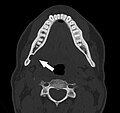
Axial computed tomograph of the same person. The Stafne defect appears as a well corticated 1 cm round defect in the medial cortex of the mandible in the right angle of the jaw (arrowed).
Coronal computed tomograph of the same person (Stafne defect arrowed).

The Stafne defect is a depression of the mandible (jawbone), most commonly located on the lingual surface (the side nearest the tongue). The Stafne defect is thought to be a normal anatomical variant, as the depression is created by ectopic salivary gland tissue associated with the submandibular gland and does not represent a pathologic lesion as such. This cavity is commonly observed on panoramic radiograph.

Classification

[edit]

It is a classed as a pseudocyst,[1] since there is no epithelial lining or fluid content. This defect is usually considered with other cysts of the jaws, since it can be mistaken for such on a radiograph.

Two classification systems were proposed to categorize Stafne bone cavity based on its depth[2] and content.[3]

Various synonyms have been used to describe this bone cavity including Stafne bone defect, lingual cortical mandibular defect, lingual mandibular bone cavity and submandibular gland defect.[4]

Signs and symptoms

[edit]

There are no symptoms,[5] and no signs can be elicited on examination. Medical imaging such as traditional radiography or computed tomography is required to demonstrate the defect. Usually the defect is unilateral, but occasionally can be bilateral.[6]

Causes

[edit]

It was originally proposed by Stafne that some parts of the submandibular gland could be trapped during mandibular ossification, causing well-circumscribed bony depression.[7] This theory is supported by the observation that ectopic salivary glands are found in the cavity.[8][9] Another hypothesis states that this bone cavity could result from the pressure exerted on the inner surface of the mandible due to the growth of sublingual or submandibular gland.[10]

Rarely, the defect can be completely surrounded by bone, and this has been theorized to be the result of entrapment of embryonic salivary gland tissue within the bone. Similar, but rarer, defects may be present in the anterior portion of the lingual surface of the mandible. These are not termed Stafne defects which specifically refers to the posterior location. The anterior defects may be associated with the sublingual salivary gland.

Diagnosis

[edit]

Stafne's defect is usually discovered by chance during routine dental radiography.[11] Radiographically, it is a well-circumscribed, monolocular, round, radiolucent defect, 1–3 cm in size, usually between the inferior alveolar nerve (IAN) and the inferior border of the posterior mandible between the molars and the angle of the jaw. It is one of the few radiolucent lesions that can occur below the IAN. The border is well corticated and it will have no effect on the surrounding structures. Computed tomography (CT) will show a shallow defect through the medial cortex of the mandible with a corticated rim and no soft tissue abnormalities, with the exception of a portion of the submandibular gland. Neoplasms, such as metastatic squamous cell carcinoma to the submandibular lymph nodes or a salivary gland tumour, could create a similar appearance but rarely have such well defined borders and can usually be palpated in the floor of the mouth or submandibular triangle of the neck as a hard mass. CT and clinical exam is typically sufficient to distinguish between this and a Stafne defect. The Stafne defect also tends to not increase in size or change in radiographic appearance over time (hence the term "static bone cyst"), and this can be used to help confirm the diagnosis.[11] Tissue biopsy is not usually indicated, but if carried out, the histopathologic appearance is usually normal salivary gland tissue. Sometimes attempted biopsy of Stafne defects reveals an empty cavity (possibly because the gland was displaced at the time of biopsy), or other contents such as blood vessels, fat, lymphoid or connective tissues. Defects of the anterior lingual mandible may require biopsy for correct diagnosis at this unusual location.[5] The radiolucent defect here may be superimposed on the lower anterior teeth and be mistaken for an odontogenic lesion. Sometimes the defect may interrupt the contour of the lower border of the mandible, and may be palpable. Sialography may be sometimes used to help demonstrate the salivary gland tissue within the bone.

Treatment

[edit]

No treatment is required,[5] but neoplastic processes (metastatic malignancy to the submandibular lymph nodes and/or salivary gland tumours) should be ruled out. This is usually done with clinical exam and imaging. Very rarely, since the defect contains salivary gland tissue, salivary gland tumors can occur within an established defect but there is likely no difference in the risk of neoplasia in salivary gland tissue at other sites.

Epidemiology

[edit]

Stafne defect is uncommon,[6] and has been reported to develop anywhere between the ages of 11 and 30 years old,[12] (although the defect is developmental, it does not seem to be present from birth, implying that the lesion develops at a later age).[5] Usually the defect is unilateral (on one side only) and most commonly occurs in men.[13]

History

[edit]

This entity was first described in 1942 by Edward C. Stafne.[14][7] Stafne bone cavity is rare and is only present in 0.17% of the general population.[4] It was previously known by many names, including static bone cyst,[15] Stafne idiopathic bone cavity,[16] and salivary gland inclusions in the mandible,[17]

An early case of Stafne's defect has been discovered in a 7th-century BC adult male individual from Klazomenai, one of the 12 cities of the Ionian League (now in modern Turkey).[18]

Additional images

[edit]

See also

[edit]

References

[edit]
Revisions and contributorsEdit on WikipediaRead on Wikipedia
from Grokipedia
The Stafne defect, also known as Stafne bone cavity or lingual mandibular bone depression, is a benign, developmental cortical depression located on the lingual surface of the , typically inferior to the and near the angle of the jaw, often containing ectopic sub or . It is not a true , lacking an epithelial lining or fluid accumulation, and results from localized bone remodeling influenced by adjacent soft tissues. First described in 1942 by the American dentist Edward C. Stafne, the defect is and typically discovered incidentally during routine dental . Its ranges from 0.1% to 0.48% in the general population, with a marked predilection for males and individuals aged 50 to 70 years, though it can occur across broader demographics. The measures 1 to 3 cm in diameter and remains stable over time, without propensity for growth or malignant transformation. Radiographically, the Stafne defect appears as a well-circumscribed, unilocular, ovoid radiolucency with sclerotic borders on panoramic or intraoral radiographs, positioned between the canal and the inferior mandibular border in the posterior region, often near the third molar area. Advanced imaging such as cone-beam computed tomography (CBCT) reveals cortical discontinuity on the lingual aspect filled with density, while (MRI) confirms the presence of or fatty content, aiding in differentiation from pathologic entities. The primary differential diagnoses include residual cysts, odontogenic keratocysts, and vascular lesions like hemangiomas, but the defect's characteristic location, lack of symptoms, and imaging stability distinguish it. Due to its innocuous nature, no intervention is required for the Stafne defect; management involves clinical observation and periodic radiographic follow-up to confirm stability and rule out mimics. Surgical exploration is rarely indicated and generally discouraged unless misdiagnosis leads to unnecessary procedures.

Definition and Classification

Definition

The Stafne defect, also known as the Stafne bone cavity or lingual mandibular bone depression, is a well-defined, corticated pit or depression on the lingual surface of the mandible. It is typically located below the mandibular canal and posterior to the third molar, commonly near the angle of the mandible. This condition represents a benign, non-progressive cavity that is often discovered incidentally during radiographic examinations. It generally measures 1-3 cm in diameter and does not expand or cause symptoms over time. On radiographs, the Stafne defect appears as a well-circumscribed, ovoid or round radiolucent , with borders that are often sclerotic but may lack clear definition in some cases. Unlike pathological entities, the Stafne defect is not a true or tumor but a developmental anomaly arising from localized .

Types and Variants

The Stafne defect, also known as Stafne bone cavity, primarily manifests in distinct morphological variants based on its anatomical location within the , with variations in size, shape, and included soft tissues. The classic posterior type represents the most prevalent form, accounting for approximately 94% of reported cases, and is typically located on the lingual surface of the posterior , inferior to the and near the third molar or angle region. This variant often appears as a well-defined, ovoid radiolucency measuring 1-3 cm in diameter, with sclerotic borders, and is more common in males aged 50-70 years. In contrast, the anterior variant is considerably rarer, comprising about 6% of cases and involving fewer than 60 documented instances since its initial description. It occurs in the symphyseal or region of the anterior , often between the canines and first premolars or crossing the midline, and is associated with ectopic tissue rather than submandibular structures. Radiographically, this form tends to be smaller (typically under 1.5 cm) and may present as unilocular or multilocular, sometimes superimposing over tooth roots, which can complicate initial identification. Buccal and other atypical variants are uncommon and deviate from the typical lingual positioning, occurring on the buccal cortex or within the mandibular ramus. These include depressions on the lateral aspect of the ascending ramus, potentially linked to tissue, as reported in isolated cases without cortical erosion. Such variants may expand or reach the buccal cortical wall without thinning it (classified as Type II in some schemes) and are prone to misdiagnosis due to their unusual location, though they share the benign nature of other forms. Variations in the contents of Stafne defects further diversify their presentation, with histological confirmation available from the minority of biopsied cases (about 12% of reviewed instances). Most commonly, posterior defects harbor submandibular tissue featuring mucous acini and ducts, while anterior ones involve sublingual glands; however, predominates in some anterior or atypical sites, and rare examples contain lymph nodes or without glandular elements. These inclusions are typically benign and non-expansile, underscoring the defect's developmental origin.

Etiology and Pathogenesis

Causes

The of Stafne defect remains uncertain, but it is widely regarded as a developmental anomaly arising during mandibular in embryonic or early postnatal stages. The primary theory posits that the defect results from the or of primordia, such as submandibular or sublingual tissue, or mesenchymal elements into the lingual cortical plate of the , leading to a localized depression without pathological tissue alteration. This process is thought to occur due to incomplete fusion in regions associated with Meckel's , creating a pseudocystic cavity filled with normal glandular or . Alternative hypotheses suggest that the defect may form through localized induced by mechanical pressure from adjacent hyperplastic or hypertrophic lobes, potentially involving prominence, though this mechanism is less supported and typically observed in older individuals. Vascular factors, such as prominent vessels contributing to cortical thinning, have also been proposed but lack robust histological confirmation. These theories emphasize a non-progressive, benign process without involvement of neoplastic or inflammatory elements. Stafne defects are distinctly non-traumatic and non-neoplastic in origin, with no established links to , , or ; histological examinations of explored cases consistently reveal normal salivary or connective tissues within the cavity, ruling out pathological causes.

Anatomical Basis

The Stafne defect manifests as a well-defined depression in the lingual cortex of the posterior , particularly in the region of the mandibular body and , where the lingual cortical is thinner than the buccal counterpart, typically measuring around 1-2 mm in thickness, which permits localized remodeling without structural compromise. This thinness of the lingual cortex in the posterior facilitates the development of cortical depressions under physiological influences. Anatomically, the defect is situated within the submandibular fossa, positioned inferior to the mylohyoid ridge—inferior attachment site of the —and inferior to the canal, with the cortical invagination frequently overlying or incorporating portions of the submandibular . The proximity to these structures underscores the defect's consistent localization between the mandibular canal superiorly and the mylohyoid groove inferiorly, often containing glandular tissue that contributes to its radiographic appearance. From an embryological perspective, the forms through of multiple centers around Meckel's , beginning in the 6th-7th week of , during which the submandibular anlage develops adjacent to the developing and may become partially entrapped or induce localized resorption as it migrates into its fossa. This developmental interplay between ossification fronts and glandular tissue migration predisposes the lingual surface to form such pits. Biomechanically, the lingual surface of the posterior exhibits vulnerability due to its thin cortex and the mechanical influences from adjacent muscle attachments, including the along the mylohyoid ridge and the anterior belly of the digastric near the lower border, which may accentuate glandular pressure leading to .

Clinical Presentation

Signs and Symptoms

Stafne defects are characteristically , presenting without pain, swelling, or any functional impairment to mastication or speech, and are most commonly identified incidentally during routine dental radiographic examinations. In a encompassing 73 documented cases, 93.15% exhibited no clinical symptoms, underscoring their benign and silent nature. These defects do not cause alterations in integrity or disrupt adjacent dental structures in the vast majority of instances. Although rare, symptomatic presentations have been reported in approximately 6.85% of cases. Such symptoms are exceptional and often prompt further investigation due to their atypicality for this condition. On , a subtle lingual cortical depression may occasionally be palpated in the posterior , particularly in defects of notable size; however, this finding is infrequently detectable owing to the thin, intact overlying mucosa that conceals the bony concavity. No tenderness or inflammatory changes are associated with in these instances. Stafne defects lack any accompanying systemic manifestations, including fever, regional , or neurological deficits, reflecting their localized anatomical origin without broader pathological involvement.

Associated Findings

Stafne defects are typically , discovered incidentally on during routine dental evaluations. Histopathological examination of Stafne defects frequently reveals ectopic submandibular tissue, , or both within the cortical depression, consisting of mucous acini and ducts (in glandular cases) that contribute to the observed. Rare complications associated with Stafne defects include persistent infection, potentially arising from adjacent periapical pathology, though the intact cortical bone covering minimizes risks of deeper infection or trauma exposure. No cases of have been documented in the literature. The overlying remains intact and normal in appearance, without evidence of ulceration, discoloration, or inflammatory changes.

Diagnosis

Imaging Characteristics

Stafne defects are typically identified as incidental findings on routine dental imaging, presenting characteristic radiographic features that distinguish them from pathological s. On panoramic radiography, the defect appears as a well-circumscribed, unilocular, ovoid or round radiolucency measuring 1-3 cm in diameter, located inferior to the and posterior to the third molar or between the first and second molars. The exhibits corticated borders with thick sclerotic margins along its entire contour and partially radiolucent internal content, without evidence of cortical expansion or . Cone-beam computed tomography (CBCT) provides detailed three-dimensional visualization of the defect as a shallow cortical invagination on the lingual aspect of the , often containing soft tissue density consistent with herniated or . The reveals a corticated rim surrounding the depression, with no involvement of the buccal cortex or displacement, and the internal structure shows heterogeneous density reflecting glandular or fatty components. Additional modalities such as (MRI) can delineate the soft tissue contents more precisely, demonstrating hyperintense signal on T1-weighted images if fatty tissue is present or continuity of the into the defect. Sialography may outline tissue within the cavity, while is occasionally used for superficial defects but is less common due to limited depth penetration. Serial imaging over time shows a stable appearance, with no growth or interval changes in the defect's size or characteristics.

Differential Diagnosis

The differential diagnosis of Stafne defect primarily involves conditions that present as well-defined mandibular radiolucencies, requiring careful to avoid misdiagnosis. Radiolucent mimics include residual cysts, odontogenic keratocysts, and ameloblastomas, which may appear as unilocular or multilocular radiolucencies but are typically distinguished from Stafne defect by the presence of cortical erosion or thinning, bone expansion, and association with nonvital teeth or root resorption. In contrast, Stafne defect maintains intact cortication without expansion or tooth involvement. Vascular lesions such as intraosseous hemangiomas or pseudoaneurysms can mimic the radiolucent appearance but are differentiated by the absence of contrast enhancement and vascular flow on CT or MRI in Stafne defect, along with its unchanging stability on serial imaging. Other bone defects, including idiopathic bone cavities or lingual mandibular bone depressions, may resemble Stafne defect radiographically but lack the inclusion of tissue, which is characteristic of Stafne and identifiable via MRI signal patterns corresponding to glandular content. In anterior variants, Stafne defect, located in the anterior , may be confused with enlargement or radicular cysts, differing in precise location (anterior mandibular body versus at the or periapical regions) and contents (salivary or muscular tissue versus inflammatory or empty cavity). Posterior variants are typically below the .

Management

Treatment Options

The management of Stafne defect primarily emphasizes a conservative approach due to its benign and nature. For confirmed cases via , no intervention is typically required, with serving as the standard strategy to avoid unnecessary procedures. Periodic radiographic monitoring may be recommended if diagnostic uncertainty persists or to assess stability over time, such as at 6-month and 2-year intervals showing no changes in typical presentations. Surgical exploration is rarely indicated and reserved for symptomatic cases, diagnostically ambiguous lesions, or those with atypical features suggesting concomitant pathologies. When performed, procedures such as or excision typically reveal normal glandular or fatty tissue, confirming the defect's non-pathologic status without further treatment needs. Non-surgical alternatives like aspiration or are not recommended, given the low risk profile and absence of cystic components. In instances involving large defects proximal to planned dental implants, careful evaluation using advanced imaging is required to assess bone integrity and guide implant placement, as the defect can pose challenges to treatment.

Prognosis and Follow-up

Stafne defects are benign, non-progressive developmental anomalies with no reported malignant potential or associated complications in the medical literature. They typically remain stable over time, with most cases showing no morphological or dimensional changes during long-term observation. Follow-up protocols emphasize conservative monitoring to confirm stability, particularly for atypical presentations such as unusual or . Periodic panoramic radiographs, such as at 6-month intervals for the first 2 years post-diagnosis, followed by imaging as clinically indicated; cone-beam computed tomography (CBCT) is reserved for cases with suspected changes in or appearance. Potential risks are minimal but include iatrogenic injury, such as nerve damage or , if the defect is undiagnosed and mistaken for a pathological during dental procedures like third molar extraction. Patients should receive reassurance regarding the incidental, nature of the defect, with education to avoid unnecessary self-treatment or worry, as no intervention alters the excellent long-term outcome.

Epidemiology

Prevalence

The prevalence of Stafne defect, also known as Stafne bone cavity, is estimated at approximately 0.1% to 0.5% in adult populations based on panoramic radiographic surveys. A 2022 meta-analysis of 355,890 individuals reported a pooled of 0.17% (95% CI: 0.14%–0.21%), with radiological studies showing a narrower range of 0.10% to 0.48%. This condition is predominantly an incidental finding in dental imaging, and it is more common in males than females. Geographic variations in prevalence are relatively consistent across regions, though reporting differences exist due to study methodologies. European studies report rates around 0.33% (95% CI: 0.19%–0.46%), while Asian studies show slightly lower figures at 0.13% (95% CI: 0.09%–0.17%); similar patterns emerge in North American (0.23%) and South American (0.28%) cohorts. A 2023 systematic review of 98 studies aggregating 465 cases confirmed comparable distribution, with 40.65% from Asia, 36.34% from the Americas, and 22.89% from Europe. Detection of Stafne defect is heavily influenced by imaging frequency, as it is typically and discovered incidentally during routine dental radiographs. Prevalence rates are higher in advanced imaging like cone-beam computed tomography (0.55%, 95% CI: 0.30%–0.80%) compared to panoramic radiographs (0.12%, 95% CI: 0.09%–0.15%), indicating potential underreporting in non-radiographic populations. Consequently, the true prevalence may exceed reported figures, particularly in underserved or low-imaging-access areas. Systematic reviews, such as a 2025 analysis of over 238,000 cases yielding 436 instances (range: 0.03%–3.55%), underscore this bias and the need for broader screening to refine estimates.

Demographic Patterns

Stafne defects demonstrate a significant predominance, with systematic reviews reporting male-to-female ratios ranging from 4:1 to 6:1, and some studies showing even higher disparities up to 11:1. This pattern may arise from anatomical variations, such as greater mandibular size in , or detection biases in radiographic evaluations more commonly performed in male patients. The condition primarily manifests in adults over 40 years of age, with mean diagnostic ages spanning 45.4 to 60.8 years across large-scale analyses; peak incidence occurs in the 50-60 age range, particularly the sixth decade. Cases in children under 20 years are exceedingly rare, with the youngest reported instance at 11 years, indicating that the defect likely develops or becomes evident post-mandibular growth completion. No robust racial or ethnic predispositions have been identified for Stafne defects, as cases are documented across diverse global populations including those from , the Americas, , and limited reports from other regions. However, the majority of published studies originate from Western countries, leading to higher reported frequencies among Caucasian individuals; where skin color data is available, approximately 91% of cases are described in white patients. Regarding risk factors, no confirmed lifestyle or genetic influences exist, though incidental detection during routine dental imaging is common, and isolated reports note occurrences in edentulous areas without establishing causality.00265-2/fulltext)

History

Discovery

The Stafne defect was first systematically described by American radiologist Edward C. Stafne in , based on radiographic examinations of patients at the . In his seminal report, Stafne identified 35 asymptomatic, well-defined radiolucencies located near the angle of the in 34 individuals, typically below the and involving the lingual cortical plate. These oval or round lesions, measuring approximately 1 to 2 cm in diameter, were described by Stafne as benign developmental bone defects possibly containing tissue, despite their radiographic similarity to cysts, though no clinical symptoms were associated with them. Although the article introduction suggests descriptions in the early , Stafne's 1942 report is the first systematic documentation. Subsequent early investigations in the provided anatomical confirmation of the defect's through surgical exploration and . In a notable , Richard and Ziskind described an aberrant inclusion of tissue within a mandibular defect (anterior variant), verified histologically following excision, which demonstrated normal structures herniating into a lingual cortical depression. This finding aligned with Stafne's observations and established the defect's benign, developmental character, distinguishing it from true cystic or neoplastic processes.

Eponym and Recognition

The Stafne defect is named after Edward C. Stafne (1894–1981), an American oral radiologist at the , in recognition of his seminal 1942 publication that described 35 cases of these mandibular cavities near the angle of the . Early descriptions used terms such as "static bone cavity," "latent bone cyst," "developmental bone defect," "idiopathic bone cavity," and "lingual mandibular bone cavity" to characterize the , reflecting uncertainty about its and its non-progressive nature. By the mid-20th century, particularly in the dental literature, the "Stafne bone defect" or "Stafne bone cavity" became standardized, emphasizing its distinct radiographic appearance and benign status. Key milestones in recognition include its differentiation from odontogenic cysts and tumors in oral pathology classifications during the 1970s and 1980s, confirming its non-neoplastic developmental origin. Systematic reviews in the further solidified its acceptance as a pseudocystic entity, integrating clinical, radiographic, and histopathological data from hundreds of cases. By the 1980s, the term was widely adopted in international and oral surgery texts, with global reports spanning , , and the . Variants, including anterior mandibular and buccal extensions, were detailed in publications from the onward, expanding the recognized morphological spectrum.

References

Add your contribution
Related Hubs
User Avatar
No comments yet.