Hubbry Logo
Straw manStraw manMain
Open search
Straw man
Community hub
Straw man
logo
8 pages, 0 posts
0 subscribers
Be the first to start a discussion here.
Contribute something
Straw man
Straw man
from Wikipedia

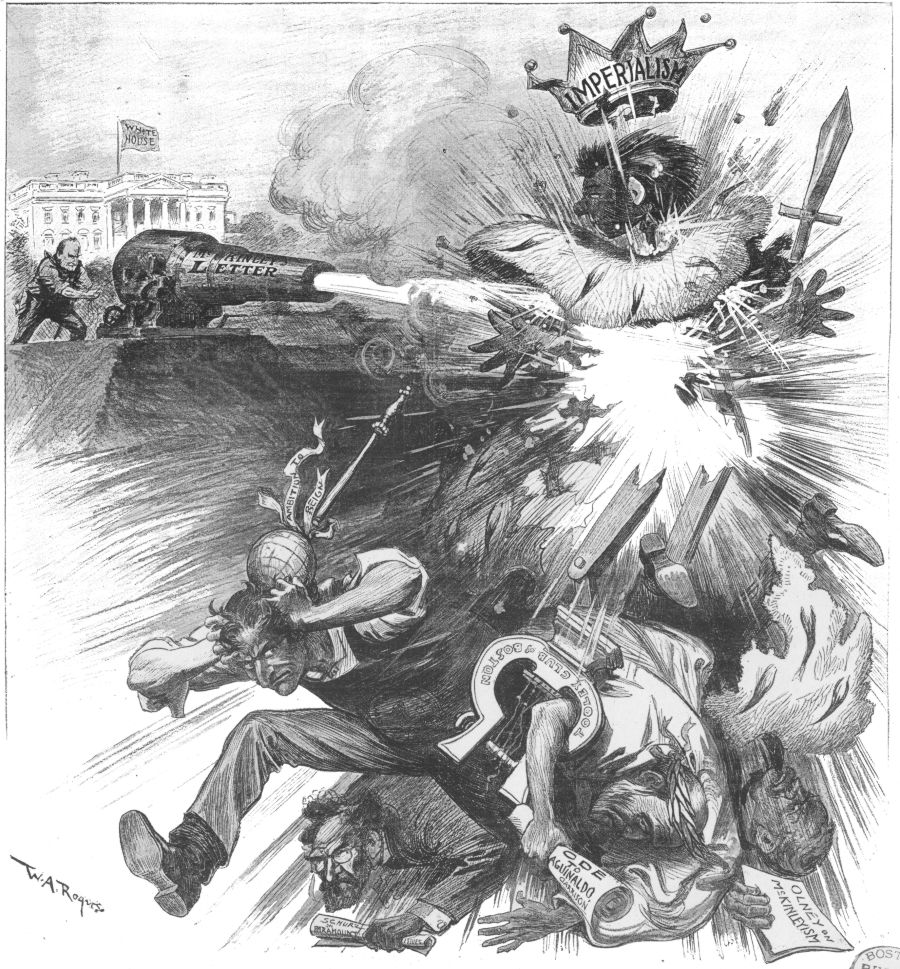
U.S. president William McKinley has shot a cannon (labeled McKinley's Letter) that has involved a "straw man" and its constructors (Carl Schurz, Oswald Garrison Villard, Richard Olney) in a great explosion. Caption: "SMASHED!", Harper's Weekly, 22 September 1900

A straw man fallacy (sometimes written as strawman) is the informal fallacy of refuting an argument different from the one actually under discussion, while not recognizing or acknowledging the distinction.[1] One who engages in this fallacy is said to be "attacking a straw man".

The typical straw man argument creates the illusion of having refuted or defeated an opponent's proposition through the covert replacement of it with a different proposition (i.e., "stand up a straw man") and the subsequent refutation of that false argument ("knock down a straw man"), instead of the opponent's proposition.[2][3] Straw man arguments have been used throughout history in polemical debate, particularly regarding highly charged emotional subjects.[4]

Straw man tactics in the United Kingdom may also be known as an Aunt Sally, after a pub game of the same name, where patrons throw sticks or battens at a post to knock off a skittle balanced on top.[5][6]

Overview

[edit]

The straw man fallacy occurs in the following pattern of argument:

  1. Person 1 asserts proposition X.
  2. Person 2 argues against a superficially similar proposition Y, as though an argument against Y were an argument against X.

This reasoning is a fallacy of relevance: it fails to address the proposition in question by misrepresenting the opposing position.

For example:

  • Quoting an opponent's words out of context—i.e., choosing quotations that misrepresent the opponent's intentions (see fallacy of quoting out of context).[3]
  • Presenting someone who defends a position poorly as the defender, then denying that person's arguments—thus giving the appearance that every upholder of that position (and thus the position itself) has been defeated.[2]
  • Oversimplifying an opponent's argument, then attacking this oversimplified version.
  • Exaggerating (sometimes grossly) an opponent's argument, then attacking this exaggerated version.

Contemporary revisions

[edit]

In 2006, Robert Talisse and Scott Aikin expanded the application and use of the straw man fallacy beyond that of previous rhetorical scholars, arguing that the straw man fallacy can take two forms: the original form that misrepresents the opponent's position, which they call the representative form; and a new form they call the selection form.

The selection form focuses on a partial and weaker (and easier to refute) representation of the opponent's position. Then the easier refutation of this weaker position is claimed to refute the opponent's complete position. They point out the similarity of the selection form to the fallacy of hasty generalization, in which the refutation of an opposing position that is weaker than the opponent's is claimed as a refutation of all opposing arguments. Because they have found significantly increased use of the selection form in modern political argumentation, they view its identification as an important new tool for the improvement of public discourse.[7]

Aikin and Casey expanded on this model in 2010, introducing a third form. Referring to the "representative form" as the classic straw man, and the "selection form" as the weak man, the third form is called the hollow man. A hollow man argument is one that is a complete fabrication, where both the viewpoint and the opponent expressing it do not in fact exist, or at the very least the arguer has never encountered them. Such arguments frequently take the form of vague phrasing such as "some say," "someone out there thinks" or similar weasel words, or it might attribute a non-existent argument to a broad movement in general, rather than an individual or organization.[8][9]

Nutpicking

[edit]

A variation on the selection form, or "weak man" argument, that combines with an ad hominem and fallacy of composition is nutpicking (or nut picking), a neologism coined by Kevin Drum.[10] A combination of "nut" (i.e., insane person) and "cherry picking", as well as a play on the word "nitpicking", nut picking refers to intentionally seeking out extremely fringe, non-representative statements from members of an opposing group and parading these as evidence of that entire group's incompetence or irrationality.[8]

Steelmanning

[edit]

A steel man argument (or steelmanning) is the opposite of a straw man argument. Steelmanning is the practice of applying the rhetorical principle of charity through addressing the strongest form of the other person's argument, even if it is not the one they explicitly presented. Creating the strongest form of the opponent's argument may involve removing flawed assumptions that could be easily refuted or developing the strongest points which counter one's own position. Developing counters to steel man arguments may produce a stronger argument for one's own position.[11]

Examples

[edit]

In a 1977 appeal of a U.S. bank robbery conviction, a prosecuting attorney said in his oral argument:[12] "I submit to you that if you can't take this evidence and find these defendants guilty on this evidence then we might as well open all the banks and say, 'Come on and get the money, boys,' because we'll never be able to convict them." This was a straw man designed to alarm the appellate judges; the chance that the precedent set by one case would literally make it impossible to convict any bank robbers is remote.

Another example of a strawman argument is U.S. president Richard Nixon's 1952 "Checkers speech".[13][14] When campaigning for vice president in 1952, Nixon was accused of having appropriated $18,000 in campaign funds for his personal use. In a televised response, based on Franklin D. Roosevelt's Fala speech, he spoke about another gift, a dog he had been given by a supporter:[13][14]

It was a little cocker spaniel dog, in a crate he had sent all the way from Texas, black and white, spotted, and our little girl Tricia, six years old, named it Checkers. And, you know, the kids, like all kids, loved the dog, and I just want to say this right now, that, regardless of what they say about it, we are going to keep it.

This was a straw man response; his critics had never criticized the dog as a gift or suggested he return it. This argument was successful at distracting many people from the funds and portraying his critics as nitpicking and heartless. Nixon received an outpouring of public support and remained on the ticket. He and Eisenhower were later elected.

Christopher Tindale presents, as an example, the following passage from a draft of a bill (HCR 74) considered by the Louisiana State Legislature in 2001:[15]

Whereas, the writings of Charles Darwin, the father of evolution, promoted the justification of racism, and his books On the Origin of Species and The Descent of Man postulate a hierarchy of superior and inferior races. ... Therefore, be it resolved that the legislature of Louisiana does hereby deplore all instances and all ideologies of racism, does hereby reject the core concepts of Darwinist ideology that certain races and classes of humans are inherently superior to others, and does hereby condemn the extent to which these philosophies have been used to justify and approve racist practices.

Tindale comments that "the portrait painted of Darwinian ideology is a caricature, one not borne out by any objective survey of the works cited." The fact that similar misrepresentations of Darwinian thinking have been used to justify and approve racist practices is beside the point: the position that the legislation is attacking and dismissing is a straw man. In subsequent debate, this error was recognized, and the eventual bill omitted all mention of Darwin and Darwinist ideology.[15] Darwin passionately opposed slavery and worked to intellectually confront the notions of "scientific racism" that were used to justify it.[16]

Throughout the 20th century, and also in the 21st century thus far,[17] there have been innumerable instances when right-wing political leaders and commentators used communism as a straw man while denouncing the proposals of centrists, moderate liberals, or even moderate conservatives. They sought to portray valid criticism of their own right-wing policies as expressions of communist ideology when in reality, most of the critics in question were not even socialists, much less communists. The use of communism as a straw man was a common and effective (though fallacious) talking point by conservative leaders in many western countries such as the United Kingdom, Germany, and most especially the United States.[18][19][20]

Etymology

[edit]

As a fallacy, the identification and name of straw man arguments are of relatively recent date, although Aristotle makes remarks that suggest a similar concern.[21] Isaac Watts writes in his Logick (1724): "They dress up the opinion of their adversary as they please, and ascribe sentiments to him which he doth not acknowledge; and when they have with a great deal of pomp attacked and confounded these images of straw of their own making, they triumph over their adversary as though they had utterly confuted his opinion."[22]

Douglas N. Walton identified "the first inclusion of it we can find in a textbook as an informal fallacy" in Stuart Chase's Guides to Straight Thinking from 1956 (p. 40).[21][15] By contrast, Hamblin's classic text Fallacies (1970) neither mentions it as a distinct type, nor even as a historical term.[21][15]

The term's origins are a matter of debate, though the usage of the term in rhetoric suggests a human figure made of straw that is easy to knock down or destroy—such as a military training dummy, scarecrow, or effigy.[23] A common but false etymology is that it refers to men who stood outside courthouses with a straw in their shoe to signal their willingness to be a false witness.[24] The Online Etymology Dictionary states that the term "man of straw" can be traced back to 1620 as "an easily refuted imaginary opponent in an argument".[25]

[edit]

Reverend William Harrison, in A Description of England (1577), complained that when men lived in houses of willow they were men of oak, but now they lived in houses of oak and had become men of willow and "a great manie altogither of straw, which is a sore alteration [i.e. a sad change]".[26] The phrase 'men of straw' appears to refer to pampered softness and a lack of character, rather than the modern meaning.

Martin Luther blames his opponents for misrepresenting his arguments in his work On the Babylonian Captivity of the Church (1520):

Latin Unattributed English translation Philadelphia Edition translation
Respondeo, id genus disputandi omnibus familiare esse, qui contra Lutherum scribunt, ut hoc asserant quod impugnant, aut fingant quod impugnent.[27] I answer that this kind of discussion is familiar to all who write against Luther, so they can assert (or: 'plant', literally: 'sow') what they attack, or pretend what they attack. My answer is, that this sort of argument is common to all those who write against Luther. They assert the very things they assail, or they set up a man of straw whom they may attack.[28][29]

In the quote, he responds to arguments of the Roman Catholic Church and clergy attempting to delegitimize his criticisms, specifically on the correct way to serve the Eucharist. The church claimed Martin Luther is arguing against serving the Eucharist according to one type of serving practice; Martin Luther states he never asserted that in his criticisms towards them and in fact they themselves are making this argument. Luther's Latin text does not use the phrase "man of straw", but it is used in a widespread early 20th century English translation of his work, the Philadelphia Edition.[30]

See also

[edit]

References

[edit]
[edit]
Revisions and contributorsEdit on WikipediaRead on Wikipedia
from Grokipedia
The , also termed the straw man argument, constitutes an informal logical error in which a debater deliberately or inadvertently distorts, exaggerates, or fabricates an aspect of an opponent's position to erect a feeble facsimile that is simpler to dismantle, thereby sidestepping engagement with the genuine contention. This tactic undermines rational discourse by substituting substantive rebuttal with an assault on an insubstantial proxy, often yielding a false sense of victory while perpetuating misunderstanding. The term evokes the imagery of a —a flimsy construct of resembling a form, readily toppled to simulate —reflecting the fallacy's essence as an easily refuted stand-in for the adversary's view. Its figurative application to argumentation emerged in the late 19th century, though analogous rhetorical maneuvers appear in ancient texts, including observations by around the 4th century BCE of debaters caricaturing rivals' stances to evade scrutiny. Early modern exemplars include Martin Luther's 1520 critiques, where he accused opponents of erecting such proxies in theological disputes. Prevalent across , , and interpersonal exchanges, the straw man exemplifies how cognitive shortcuts and incentives for persuasion can prioritize apparent dominance over truth-seeking, frequently compounding with other fallacies like to obscure causal realities in debates. Its detection demands vigilant reconstruction of original arguments from primary sources, countering distortions that empirical verification might otherwise dispel.

Definition and Characteristics

Core Definition

A straw man fallacy occurs when an arguer distorts, exaggerates, or fabricates an opponent's position to create a weaker, more vulnerable version that is easier to refute, thereby avoiding engagement with the actual argument presented. This substitutes the original claim with a or , allowing the attacker to "knock down" a hollow construct rather than addressing substantive points. The tactic undermines rational discourse by shifting focus to an implausible straw version, often misleading audiences into believing the opponent's view has been defeated. The process typically involves two steps: first, selectively quoting, oversimplifying, or inventing elements of the opponent's stance to amplify its perceived flaws; second, dismantling this altered iteration as if it represented the genuine position. For instance, if an proposes moderate regulations on an industry to mitigate environmental risks, the straw man response might claim they seek to "ban all economic activity and destroy jobs," then argue against total . This exploits cognitive shortcuts, as audiences may accept the refutation without scrutinizing the distortion. As a , the straw man facilitates in adversarial contexts like debates or public , where rigor is secondary to appearing victorious, but it erodes truth-seeking by prioritizing demolition of a proxy over of the real claim. Unlike rebuttals or valid counterexamples, which engage the argument's merits, the straw man relies on to evade , rendering it ineffective for advancing empirical understanding.

Key Identifying Features

A straw man argument is identified by the substitution of an opponent's actual position with a distorted, exaggerated, or misrepresented version that is easier to refute. This core distortion typically involves presenting the opposing view as more extreme, simplistic, or absurd than it truly is, thereby creating a weaker for attack. Key to recognition is the attack directed not at the original argument but at this fabricated proxy, which evades substantive engagement with the proponent's genuine claims. The refutation succeeds against the straw man yet fails to address the unaltered position, rendering the response logically irrelevant to the debate. Manifestations include oversimplification through , where nuanced elements are stripped away; exaggeration of implications to imply untenable extremes; or selective quoting that ignores qualifiers or . For instance, responding to a moderate proposal for regulatory oversight by decrying it as total takeover exemplifies the tactic. Such features often appear in polarized exchanges, where the misrepresented version aligns with preconceived stereotypes rather than evidence-based reconstruction. Distinguishing a straw man requires verifying alignment between the critiqued position and the opponent's stated view, often through direct quotation or paraphrasing that preserves and scope. ional deployment aims to persuade by illusion of victory, though unintentional variants may stem from miscomprehension; regardless, the logical defect persists when the assault targets an unendorsed .

Etymology and Historical Development

Origins of the Term

The term "straw man" first appeared in English in the 1590s to denote a literal or constructed from bound . This physical object served as a weak, easily toppled figure, analogous to a practice dummy in military training or a in fields. The figurative application to rhetoric evolved from the related phrase "man of straw," which by the 1620s described an imaginary or insubstantial opponent set up for easy refutation in arguments. This precursor emphasized a sham representative lacking the substance of the real position, much like a hollow effigy. One of the earliest documented uses of "straw man" itself in a debating context dates to around 1875, appearing in an 1878 issue of The Chronicle, a University of Michigan student periodical, where it referred to fabricating an implausibly weak proposition to demolish for rhetorical victory. By the , had solidified as a standard term for misrepresenting an adversary's argument to create a vulnerable , facilitating its defeat while evading the actual contention. This usage drew directly from the imagery of erecting and knocking down a flimsy straw figure, underscoring the tactic's reliance on distortion over substantive engagement.

Early Philosophical and Rhetorical References

The earliest known philosophical recognition of tactics resembling the straw man fallacy appears in the (384–322 BCE), who addressed the dangers of misrepresenting an opponent's position in argumentation. In his Topics (circa 350 BCE), specifically warned at 159b30–35 that arguers risk invalid conclusions by deliberately or inadvertently altering an adversary's thesis to make it more vulnerable to attack, thereby undermining the dialectical process aimed at truth-seeking through probable reasoning from common opinions. This observation highlights a core causal mechanism: distortion facilitates apparent victory but erodes refutation's validity, as the refuted version does not engage the original claim. 's emphasis on accurate restatement aligns with his broader framework in , where premises must reflect shared endoxa to compel assent without deception. Aristotle further elaborated on related sophistical refutations in On Sophistical Refutations (circa 348 BCE), cataloging 13 types of fallacious arguments that mimic valid syllogisms but fail due to linguistic or logical sleights, including ignoratio elenchi (). This category encompasses responses that appear to refute but sidestep the opponent's actual thesis by substituting a weaker or altered surrogate, effectively functioning as an early analogue to straw-manning by evading direct confrontation. Empirical analysis of Aristotle's examples, such as sophists who shift terms mid-argument, reveals a pattern where misrepresentation exploits audience inexperience to simulate persuasive force, a dynamic rooted in causal mismatches between stated premises and implicit concessions. In Roman rhetorical theory, explicit treatments of such were sparse, as (106–43 BCE) focused more on and style than systematic , potentially sidelining dialectical precision in favor of persuasive effect. However, (circa 35–100 CE) in implicitly critiqued misrepresentation by stressing the orator's duty to fairly portray adversaries' views to preserve credibility, warning that caricatured refutations invite suspicion and weaken judicial or deliberative appeals. These references underscore a recurring theme in early : accurate engagement with opponents' arguments as essential for causal efficacy in , distinct from mere verbal dominance.

Psychological and Cognitive Underpinnings

Cognitive Biases Enabling Straw Manning

contributes to straw man arguments by prompting individuals to interpret and reconstruct opponents' positions in ways that align with preexisting beliefs, often exaggerating or simplifying them to facilitate refutation. This bias, documented in as a systematic pattern of favoring confirmatory evidence, leads debaters to overlook nuances in rival arguments and instead amplify elements that appear vulnerable, thereby creating a distorted version easier to dismantle. For example, in political discourse, supporters of one ideology may portray as outright opposition to all social welfare, ignoring qualified stances on efficiency or targeting, as this misrepresentation reinforces their narrative of opponent extremism. Cognitive heuristics, as mental shortcuts in reasoning, further enable straw manning by allowing rapid but imprecise evaluations of complex arguments, prioritizing efficiency over accuracy. Research on argumentative identifies how these heuristics, such as availability of salient examples, cause misrepresentations by substituting readily attackable proxies for the original claim, exploiting the brain's limited capacity for deep . This mechanism is evident in debates where arguers invoke hyperbolic interpretations—e.g., equating advocacy with unrestricted border abolition—because such simplifications reduce and align with intuitive judgments rather than rigorous engagement. Motivated reasoning amplifies these effects by directing cognitive processes toward outcomes that protect or group identity, often at the expense of faithful representation. Studies of rhetorical fallacies show this involves post-hoc rationalization, where individuals fabricate or inflate weaknesses in opponents' views to minimize dissonance and maximize persuasive impact, favoring argumentative "conquest" over truth-seeking dialogue. In empirical terms, this bias manifests in heightened emotional against misrepresented positions, as seen in experimental analyses of dynamics where participants rated distorted arguments as more refutable, sustaining polarized exchanges.

Rhetorical Persuasion Dynamics

The straw man technique achieves rhetorical by constructing a distorted version of an opponent's position that is simpler and more vulnerable to refutation, thereby creating an illusion of decisive victory without engaging the original argument's merits. This distortion exploits audience tendencies toward cognitive efficiency, particularly under conditions of low motivation to scrutinize claims deeply, as supported by principles where peripheral cues like apparent ease of rebuttal influence acceptance. Empirical testing indicates that such tactics enhance perceived persuasiveness when recipients lack incentive for systematic processing, allowing the misrepresented target to be dismantled swiftly and convincingly. In group settings, straw manning fosters through in-group and out-group , portraying the opponent as irrational or extreme to solidify audience alignment with the speaker's . By amplifying fringe elements or fabricating absurd implications, it triggers emotional responses such as ridicule or outrage, bypassing logical scrutiny and leveraging to affirm preexisting views among sympathetic listeners. This dynamic is amplified in polarized discourses where audiences prioritize narrative conquest over factual accuracy, as the technique conserves mental resources while signaling rhetorical dominance. Causally, the persuasive power stems from narrative control: the attacker dictates the terms of , evading substantive rebuttals that could expose weaknesses in their own position, which in turn sustains audience deference to the reframed "win." Studies show this acceptability increases when the straw man targets an attacked argument rather than a core standpoint, making it a viable shortcut in high-stakes despite its logical flaws. However, detection rises with audience expertise or motivation, underscoring that hinges on the interplay of simplicity, emotional salience, and recipient vigilance.

Occurrences in Contemporary Discourse

Political Applications

In political discourse, the straw man fallacy manifests as a tactic to caricature opponents' policies or views, enabling debaters to assail weakened versions rather than engaging substantive arguments, which simplifies messaging for voters and media amplification. This approach thrives in polarized environments, where empirical policy nuances—such as phased or targeted —are supplanted by absolutist distortions to evoke fear or outrage. Historical precedents illustrate its longevity; during the 1952 U.S. presidential campaign, Nixon's "Checkers" speech deflected corruption allegations by portraying critics as demanding a total ban on all political contributions, whereas the actual scrutiny focused on undisclosed funds from a single donor. Contemporary applications abound in U.S. debates over , where advocates emphasizing legal vetting and criminal prioritization are often recast as seeking indiscriminate mass expulsions, ignoring proposals' stress on for long-term residents. Conversely, border security proponents face depictions as endorsing unchecked chaos, as when former President in February 2019 claimed Democrats opposed detaining any crime-committing migrants, misaligning with their actual positions favoring case-by-case enforcement. On healthcare, universal coverage initiatives are frequently straw-manned as plots for full government seizure of medical decisions, eliding hybrid models incorporating private insurers, a distortion evident in opposition to the Affordable Care Act's expansions. Gun policy exchanges similarly yield examples: restrictions on assault weapons or background checks are inflated into calls for confiscating all firearms from law-abiding owners, while stances are reduced to endorsements of unregulated arsenals for criminals. In the September 10, , presidential between and , both invoked straw men—Harris framing Trump's economic plans as solely tax cuts for billionaires without acknowledging proposed middle-class relief, and Trump depicting Harris's initiatives as inflationary detached from her stated incremental reforms. Such tactics, per rhetorical analyses, erode deliberative quality by prioritizing partisan scoring over causal evaluation of outcomes, with data from debate transcripts showing their recurrence across administrations.

Media and Cultural Narratives

outlets frequently employ arguments in political coverage by distilling nuanced positions into exaggerated or simplified caricatures that align with editorial biases. For example, opposition to expansive policies is often reframed as outright or a desire to deport all immigrants, disregarding arguments centered on , impacts, or assimilation requirements. This tactic simplifies debates for audiences, as evidenced in analyses of news framing during election cycles, where empirical reviews of show systematic to heighten conflict. Such practices are amplified by institutional left-leaning tendencies in , which studies of media content indicate lead to disproportionate scrutiny of conservative viewpoints through distorted lenses. In cultural narratives propagated via news and commentary, straw men manifest in dismissals of traditionalist critiques, portraying concerns over rapid social changes—such as curricula on topics—as blanket bigotry rather than debates over age-appropriateness or parental . A notable case involves the "war on " discourse, where media characterizations reduce complaints about secular dilutions of holiday traditions (e.g., retailers opting for "Happy Holidays") to claims of a literal on , thereby evading substantive discussion of cultural erosion. Similarly, in health care debates covered extensively post-2010, reform skeptics were routinely depicted as favoring total and abandonment, ignoring positions advocating market competition alongside safety nets. These misrepresentations foster echo chambers, with research demonstrating that partisan media consumers internalize them, perceiving opponents as more extreme than their actual stances. Entertainment media and opinion pieces extend this into broader cultural storytelling, where ideological adversaries appear as one-dimensional foils embodying traits to validate prevailing orthodoxies. For instance, fictional portrayals in films and series often render conservative characters as comically regressive or malicious simplifications of real policy advocates, reinforcing narratives that equate with . This mirrors real-world coverage patterns, as seen in 2024 presidential debate analyses, where networks highlighted candidates' mutual straw manning—e.g., inflating economic plans into doomsday scenarios—without equal emphasis on factual distortions favoring one side. Consequently, audiences encounter curated realities that prioritize persuasive distortion over accurate contention, undermining public discourse as documented in rhetorical studies of broadcast content.

Ideological and Academic Debates

In ideological debates, the straw man fallacy often serves to caricature opposing viewpoints, facilitating easier refutation at the expense of substantive engagement. For example, critics of expansive government welfare programs are frequently portrayed as desiring the total elimination of aid to the poor, disregarding nuanced proposals for work requirements or means-testing to enhance program efficacy, as seen in partisan rhetoric labeling fiscal conservatives as indifferent to human suffering. Likewise, supporters of traditional marriage definitions have been misrepresented as opposing all civil for same-sex couples, evading arguments centered on institutional stability and child-rearing outcomes rather than blanket . These distortions polarize by equating moderate positions with , a tactic prevalent in left-right clashes where empirical data on effects, such as rates exceeding 50% in some long-term programs, is sidelined. Academic discussions of the extend to examinations of its rhetorical utility and detection challenges. Experimental research demonstrates that straw man arguments gain acceptability when responding to an attack on one's own position or when embedding a weaker version alongside the original claim, with participants rating such constructs as more persuasive in simulated debates involving 200 respondents across conditions. In philosophical , scholars analyze how straw men obscure causal mechanisms, such as in debates over free-market economics where collectivists depict proponents as endorsing unchecked exploitation, ignoring first-principles defenses rooted in voluntary exchange and historical precedents like post-WWII West German recovery under market-oriented reforms achieving 8% annual GDP growth. Perceptions of distortion vary; one study of 150 participants found that while explicit straw men elicited disagreement detection in 65% of cases, implicit variants were overlooked in 40%, highlighting cognitive vulnerabilities in scholarly . Institutional biases exacerbate deployment in academia, where left-leaning majorities—evidenced by surveys showing over 80% of faculty identifying as liberal—tend to oversimplify conservative empirical claims, such as on merit-based admissions, as mere without addressing data like SAT score disparities correlating with socioeconomic mobility. Counterexamples exist, as right-leaning outlets occasionally straw man progressive environmentalism as anti-industrial Luddism, bypassing evidence-based advocacy for nuclear energy scaling documented in IPCC reports from 2022. These patterns underscore the fallacy's role in entrenching echo chambers, with meta-analyses of transcripts revealing straw men comprising up to 25% of ad hominem-adjacent responses in polarized ideological exchanges. Rigorous application demands steel-manning counterparts, yet accusations of straw manning themselves invite , as in cases where critics allege valid summarizations are distortions, complicating adjudication in journals.

Illustrative Examples

Historical Cases

During the 1858 Lincoln-Douglas senatorial debates in , repeatedly misrepresented Abraham Lincoln's positions on to portray them as extreme and untenable. Douglas argued that Lincoln's opposition to 's expansion into federal territories, as articulated in the Republican platform and Lincoln's advocacy for the Freeport Doctrine's implications, necessarily entailed immediate national abolition of and full social-political equality between whites and blacks, including endorsement of and . Lincoln countered these claims in multiple debates, emphasizing his belief in natural racial differences and opposition to immediate equality, while Douglas persisted in framing Lincoln's views as a threat to and Southern institutions. In the final debate at Alton on October 15, 1858, Lincoln explicitly accused Douglas of "fighting a man of straw" by assuming Lincoln contested to retain where it existed, rather than addressing Lincoln's actual contention that 's moral wrongness precluded its extension. A prominent mid-20th-century example emerged in Richard Nixon's defense against financial impropriety charges during the 1952 presidential campaign. On September 23, 1952, Nixon, Dwight D. Eisenhower's running mate, faced accusations from the and others of accepting $18,000 from a secret "" contributed by wealthy businessmen to cover political expenses, with implications of personal enrichment or unethical . In his televised ", viewed by an estimated 60 million Americans, Nixon acknowledged the fund but deflected by itemizing his family's frugal lifestyle—no personal profits from the fund—and emotionally insisting on retaining a gifted black-and-white puppy named for his daughter Tricia, claiming critics demanded its return despite no such demand being made. This tactic caricatured the allegations as petty attacks on family sentimentalities rather than substantive ethical lapses in , thereby evading the original charges. In the context of early 20th-century American debates following the Spanish-American War, proponents of expansion, including President , often straw-manned anti-imperialist critics as unpatriotic isolationists or sympathizers with foreign adversaries. Anti-imperialists, such as those in the Anti-Imperialist League formed in 1898, argued against annexing territories like the without consent, citing violations of and risks to republican principles, but were depicted by expansionists as opposing all national strength or favoring Spanish retention of colonies. Political cartoons from the era, including depictions of McKinley dismantling exaggerated effigies of imperial overreach, underscored this rhetorical distortion by reducing complex ethical and constitutional objections to simplistic, easily refuted caricatures of weakness.

Recent Political Instances (Post-2020)

During the September 10, 2024, presidential debate hosted by ABC News, former President invoked a straw man fallacy when discussing policy. Trump claimed that Kamala Harris's running mate, , endorsed "execution after birth," portraying late-term abortion access under law—which permits procedures up to birth in cases of maternal health risks and recorded only one third-trimester in 2022—as equivalent to infanticide, a position neither Walz nor the law supports. This misrepresentation shifted the debate from nuanced restrictions on elective late-term abortions to an indefensible extreme, easier to refute amid public opposition to post-viability procedures exceeding 80% in Gallup polls from 2023. In the October 1, 2024, vice presidential debate between Senator JD Vance and Governor , Walz deployed a straw man in defending administration actions on speech during the . When Vance criticized Harris-era of content questioning official narratives on virus origins and efficacy—evidenced by of physicians like , who later co-authored the —Walz reframed the concern as akin to "yelling 'fire' in a crowded theater," implying Vance defended imminent harm incitement rather than broader suppression of empirical debate on lab-leak hypotheses or treatment protocols like , which faced regulatory hurdles despite early studies showing potential efficacy in low-resource settings. This analogy, drawn from a 1919 case on unprotected speech, overlooked documented instances of affecting non-incendiary scientific discourse, as detailed in the 2023 releases revealing FBI pressure on platforms. Post-2020 election integrity debates have featured tactics from both sides, often amplifying partisan divides. Critics of expanded mail-in voting, citing vulnerabilities like Pennsylvania's 2020 extension of receipt deadlines without legislative consent—challenged in as violating state constitutions—were frequently caricatured by Democratic officials and media as wholesale rejectors of , ignoring targeted reforms proposed, such as voter ID requirements supported by 80% of Americans in 2022 Rasmussen polls. Conversely, some Republican narratives exaggerated Democratic positions as endorsing "open borders" tantamount to unchecked criminal influx, whereas Biden administration policies emphasized enforcement priorities amid record 2.5 million encounters at the southwest border in 2023, per Customs and Border Protection data, without eliminating legal asylum processes. These distortions, prevalent in 2022 midterms and 2024 campaigns, sidestepped causal factors like exploitation of policy gaps, as evidenced by over 100,000 "gotaways" annually since 2021.

Nutpicking and Selective Extremism

Nutpicking is a rhetorical tactic involving the selective presentation of fringe, extreme, or unrepresentative individuals or statements from a group as if they embody the typical or core position of that group, thereby enabling a straw man attack on a distorted version of the actual argument. This approach functions as a of cherry-picking, where critics deliberately highlight "nuts"—eccentric or outlier voices—to caricature and discredit broader ideologies or movements, often sourced from anonymous online comments or marginal figures rather than influential leaders or surveys of opinion. In logical terms, it commits the error of hasty generalization by treating atypical examples as normative, undermining substantive debate by avoiding engagement with predominant views supported by data, such as polling aggregates showing majority positions within groups. The tactic proliferates in polarized environments like and political commentary, where algorithms and incentives favor sensational content over representativeness. For example, during debates on immigration policy in the United States around 2019, critics of conservative positions frequently cited inflammatory posts from obscure accounts alleging extreme measures like mass deportations without , framing these as reflective of Republican mainstream thought despite surveys indicating that only a minority of party identifiers endorsed such views without legal safeguards. Similarly, in discussions of environmental activism post-2020, opponents have spotlighted instances of by radical protesters to dismiss climate consensus, ignoring that such actions represent less than 1% of global protest events tracked by databases like the Armed Conflict Location & Event Data Project. These instances illustrate how nutpicking evades causal analysis of policy merits by substituting dismissal of purported group insanity. Selective extremism complements nutpicking by systematically amplifying the most radical subsets of an ideology to imply inherent extremism in the whole, often through curated media narratives or selective quoting that omits contextual qualifiers or dissenting internal voices. This method relies on confirmation bias, where arguers filter evidence to reinforce preconceptions, as evidenced in analyses of partisan media coverage where fringe quotes receive disproportionate airtime compared to representative samples—up to 10 times more in some cable news segments per content audits from 2022 onward. Unlike genuine critique of emergent radicalization trends backed by metrics like membership growth in extremist organizations (e.g., a 2023 FBI report noting a 300% rise in domestic threat actors since 2016), selective extremism falters when it disregards empirical distributions of belief, such as ideological surveys from Pew Research showing that self-identified liberals or conservatives cluster around moderate variances rather than uniform fringes. In academic and journalistic contexts, this can perpetuate echo chambers, as sources with institutional biases may favor such portrayals to align with prevailing narratives, though rigorous fact-checking reveals the distortion when cross-referenced against comprehensive datasets.

Steel Manning as an Antidote

Steelmanning entails reconstructing an opponent's position in its strongest, most coherent formulation before attempting to refute it, thereby directly countering fallacy's tendency to and weaken arguments for easier dismissal. This approach ensures engagement with the actual merits of a viewpoint rather than a diluted proxy, fostering rebuttals that withstand if the steelmanned version holds. Originating from the philosophical —which urges interpreters to adopt the most plausible reading of a text or argument—steelmanning gained prominence through thinkers like , who in his 2013 book Intuition Pumps and Other Tools for Thinking prescribed steps such as accurately paraphrasing the opponent's claims, probing for unstated rationales, and highlighting underlying agreements to build a fortified . In practice, steelmanning disrupts the rhetorical shortcut of straw manning by demanding empirical fidelity to the source material; for instance, a debater might list explicit concessions to the opponent's , incorporate overlooked qualifiers, or infer defensible extensions based on the arguer's , all while citing originals to verify accuracy. This method not only exposes genuine flaws—if they exist—but also compels the original proponent to refine their case, as critiques targeted at an enhanced version reveal weaknesses previously obscured by ambiguity or selective emphasis. Empirical observations in settings indicate that steelmanning reduces adversarial posturing, with participants reporting heightened clarity and reduced miscommunication; a 2023 analysis of persuasive techniques noted its role in converting skeptics by demonstrating over manipulative distortion. The antidote's efficacy stems from its alignment with causal realism in argumentation: straw manning thrives on causal disconnects between stated positions and critiqued caricatures, whereas steelmanning enforces causal linkage by grounding reconstructions in verifiable propositions, often yielding more robust conclusions even if the opponent's view ultimately fails. Proponents argue it cultivates , as successfully dismantling a steelmanned provides stronger against it than toppling a straw man, which merely highlights the critic's sleight-of-hand. In polarized environments, such as post-2020 political exchanges, applying steelmanning has been credited with de-escalating echo-chamber effects by incentivizing exposure to fortified counterviews, though its success hinges on mutual adoption to prevent one-sided exploitation. Critics occasionally contend that overzealous steelmanning risks inventing not truly held, potentially inverting into a new form of , yet this underscores the need for strict adherence to textual rather than negating its core value as a straw man deterrent.

Boundaries with Legitimate Critique

A legitimate critique respects the substantive elements of an opponent's argument, addressing its core premises, implications, or logical structure without introducing distortions that fabricate weaknesses not inherent to the original position. This distinguishes it from fallacy, which substitutes a caricatured or exaggerated version for easier refutation, such as attributing unstated extremes or omitting qualifiers that strengthen the case. The boundary hinges on representational fidelity: a or summary remains valid if it captures the argument's essence accurately, even when simplified for clarity, as simplification alone does not equate to unless it materially weakens the position. Determining this boundary requires verifying whether the critique engages the actual claims presented, rather than a selectively weakened proxy. For example, extending an argument via reductio ad absurdum—deriving contradictory or implausible outcomes from its premises—constitutes legitimate analysis if the inference follows logically from the stated position, whereas fabricating premises unrelated to the original renders it a straw man. In practice, accusations of straw man demand evidence of misrepresentation, placing the burden on the claimant to show how the critique deviated from the source material, as mere disagreement with the evaluation does not suffice. Contextual factors, such as the of the original , further delineate the line: critiques that highlight genuine vulnerabilities or entailments, even if focusing on a of claims, avoid by tying rebuttals directly to verifiable elements of the position. Empirical studies indicate that audiences may tolerate mild distortions if they align with perceived prior segments of , yet such tolerance does not legitimize the tactic logically, underscoring the need for explicit linkage to the opponent's words or explicit endorsements. Thus, rigorous argumentation demands quoting or closely paraphrasing sources to disputes, ensuring critiques withstand for accuracy over interpretive charity.

Critiques and Subtleties of Application

Conditions Where Straw Manning is Debated as Valid

In rhetorical contexts, straw man arguments are occasionally defended not for logical validity but for their persuasive efficacy in public discourse, where simplifying or exaggerating an opponent's position can rally audiences by making the opposition appear more vulnerable or extreme. A 2010 study in Argumentation and Advocacy analyzed experimental data showing that participants exposed to straw man rebuttals rated the attacking argument as stronger and more convincing than direct engagements, attributing this to heightened emotional resonance and ease of comprehension among non-expert listeners. Proponents of this view, often in communication theory, argue that in high-stakes debates like politics or media, strict adherence to undistorted representation may cede ground to nuanced but unpalatable ideas, justifying the technique when the goal is influence rather than pure deduction—though critics counter that such utility undermines truth-oriented dialogue. Strategic uses in argumentation training and preparation also fuel on straw manning's acceptability, particularly when employed to probe ambiguities or elicit clarifications from opponents. By deliberately constructing an exaggerated version of a position, arguers can force refinements that reveal weaknesses or inconsistencies in the original claim, as noted in analyses of tactics where intentional acts as a diagnostic tool rather than a dishonest dodge. For example, in legal or philosophical exchanges, presenting a caricatured interpretation may prompt the proponent to disavow implications they implicitly endorse, thereby advancing the discussion; this is defended as valid when the original argument's invites multiple readings, transforming apparent into a for precision, provided the constructor acknowledges the reconstruction. Within ideological or policy debates, straw manning is contested as potentially legitimate when the distorted version captures logical extensions, historical precedents, or fringe elements genuinely affiliated with the broader position. Opponents of expansive government programs, for instance, may amplify a proposal's scope to its conceivable endpoint—such as —citing past escalations like the U.S. expanding from narcotics to broader prohibitions between 1971 and the 1980s, which ballooned incarceration rates from 300,000 to over 2 million by 2000. Advocates argue this is not mere distortion but causal realism in highlighting slippery slopes validated by empirical patterns, especially in collectivist ideologies where moderate coexists with radical advocates; detractors, however, maintain it remains fallacious unless the extension is deductively entailed, as probabilistic risks do not equate to misrepresentation. This tension is evident in critiques of environmental policies, where skeptics straw man "net zero" goals as immediate , drawing on data from Germany's , which saw energy costs rise 50% from 2010 to 2020 amid intermittent supply issues. Even in formal logic, some philosophers mitigation of straw man invalidity if the rebuttal's conclusion holds independently, invoking the argument-from- fallacy to assert that a flawed form does not disprove a true —such as warning against policy overreach by refuting an absurd variant, even if caricatured. This perspective gains traction in precautionary domains like technology ethics, where overstating risks (e.g., AI misalignment leading to existential threats) is justified by low-probability/high-impact scenarios, as articulated in risk analysis frameworks emphasizing tail-end outcomes over median cases. Empirical support includes historical analogies, like early 20th-century debates where critics exaggerated hereditarian claims to their Nazi-era extremes, correctly forewarning ethical perils despite accusations of distortion. Such cases underscore ongoing contention: while logically impure, straw manning may serve epistemic functions in averting harms when direct engagement risks underplaying systemic vectors.

Misuse in Accusations of the Fallacy

Accusations of the straw man fallacy can be misapplied when a critic accurately extends an argument's premises to their logical conclusions via , yet the response labels it as misrepresentation rather than engaging the validity of the inference. This occurs because reductio ad absurdum tests a position by demonstrating that its assumptions lead to untenable outcomes, which differs from fabricating a weaker version; mislabeling it as straw man avoids addressing whether the absurdity genuinely follows. For instance, if a philosophical claim about universal implies no grounds to condemn , highlighting that consequence is not a straw man if derived directly from the relativist's criteria, but proponents may accuse distortion to sidestep the implication. Such misuse also arises when the original position is ambiguously stated or encompasses a range of interpretations, and the critic targets a reasonable or implication that aligns with the proponent's explicit words or endorsed examples. In these cases, the serves as deflection by demanding an unattainable precision or "nuance" without clarifying the intended meaning, effectively halting . A documented pattern appears in online where vague prompts specific critiques, prompting retorts of straw manning that feel akin to dismissals, as the charge lacks substantiation of inaccuracy. In polarized ideological exchanges, particularly those involving policy implications, accusations may be overdeployed against critiques that reference empirical outcomes or statements from representative figures within a movement, even if not universal. This tactic exploits the fallacy's definition to shield core tenets from scrutiny, as seen when defenders invoke "straw man" against arguments mirroring documented positions, thereby prioritizing group cohesion over factual engagement. Empirical of transcripts, such as in discussions on effects, reveals instances where studies showing job losses (e.g., a 2019 meta- finding elasticities leading to 1-3% reductions for 10% hikes) are dismissed as straw men despite directly challenging proponents' causal claims of net benefits without trade-offs.

Strategies for Mitigation

Detection Techniques

Detecting a straw man fallacy requires scrutinizing whether an interlocutor has accurately represented the original argument before critiquing it, as the fallacy hinges on substituting a distorted version for the actual position. One primary technique involves actively listening to or reading the summary of the opponent's position and immediately comparing it to the source material; discrepancies such as added exaggerations, omitted qualifiers (e.g., "sometimes" changed to "always"), or fabricated extremes signal misrepresentation. In verbal debates, prompting the speaker to restate the target's verbatim or in their own words can expose inaccuracies, as failure to align with the original phrasing often reveals the straw man. For instance, if an arguer claims an opponent advocates a position far more radical than stated—such as equating a call for targeted fiscal restraint with total economic abolition—requesting clarification forces acknowledgment of the distortion. Written analyses benefit from direct of the original claim alongside the rebuttal, highlighting any selective editing or oversimplification that weakens the targeted view without engaging its substance. Additional indicators include assessing if the attacked version appears overly simplistic or absurd relative to the nuanced original, as straw men thrive on to evade robust defense. Cross-referencing multiple statements from the same source ensures consistency, countering cherry-picking of remarks; tools like full-text searches in speeches or documents aid this verification. Persistent clarification questions, such as "Did I claim X, or merely Y under specific conditions?", foster precision and deter evasion, though interlocutors may resist if intent is . These methods emphasize empirical fidelity to the argument's text or intent over interpretive charity alone.

Fostering Rigorous Argumentation

To foster rigorous argumentation, participants must prioritize accurate representation of opposing views, enabling genuine rather than superficial dismissal. This involves actively seeking clarification through paraphrasing the interlocutor's position and confirming its before proceeding to , which mitigates the of unintentional and ensures debates substantive claims. Such practices compel arguers to confront the actual logical structure and evidence presented, revealing true vulnerabilities or merits that might otherwise evade scrutiny. A complementary strategy is steelmanning, wherein one reconstructs the strongest plausible iteration of an adversary's argument—bolstering its premises, evidence, and implications where reasonably defensible—prior to refutation. This method elevates discourse by demanding robust rebuttals capable of withstanding enhanced scrutiny, thereby refining positions through adversarial testing and reducing reliance on rhetorical shortcuts. Unlike strawmanning, which undermines productive exchange by targeting caricatures, steelmanning cultivates resilience in ideas and encourages convergence on verifiable truths, as it aligns criticism with the principle of interpretive charity in philosophical inquiry. The adoption of these techniques yields more resilient outcomes in argumentation, including clearer identification of flawed reasoning and facilitation of consensus on empirical grounds. In contexts like debates or academic discourse, avoiding misrepresentation has been noted to enhance quality by prioritizing evidential strength over persuasive expediency, though it requires to resist the cognitive ease of weaker targets. Over time, habitual application in educational settings or public forums correlates with diminished polarization, as participants habituate to engaging core disagreements without evasion.

References

Add your contribution
Related Hubs
Contribute something
User Avatar
No comments yet.