


Community hub
Recent from talks
Contribute something
Nothing was collected or created yet.
Stuart Kauffman
View on Wikipedia
Stuart Alan Kauffman (born September 28, 1939) is an American medical doctor, theoretical biologist, and complex systems researcher who studies the origin of life on Earth. He was a professor at the University of Chicago, University of Pennsylvania, and University of Calgary. He is currently emeritus professor of biochemistry at the University of Pennsylvania and affiliate faculty at the Institute for Systems Biology. He has a number of awards including a MacArthur Fellowship and a Wiener Medal.
Key Information


He is best known for arguing that the complexity of biological systems and organisms might result as much from self-organization and far-from-equilibrium dynamics as from Darwinian natural selection, as discussed in his book Origins of Order (1993). In 1967[1] and 1969[2] he used random Boolean networks to investigate generic self-organizing properties of gene regulatory networks, proposing that cell types are dynamical attractors in gene regulatory networks and that cell differentiation can be understood as transitions between attractors. Recent evidence suggests that cell types in humans and other organisms are attractors.[3][4] In 1971 he suggested that a zygote may not be able to access all the cell type attractors in its gene regulatory network during development and that some of the developmentally inaccessible cell types might be cancer cell types.[5] This suggested the possibility of "cancer differentiation therapy". He also proposed the self-organized emergence of collectively autocatalytic sets of polymers, specifically peptides, for the origin of molecular reproduction,[6][7] which have found experimental support.[8][9]
Education and early career
[edit]Kauffman graduated from Dartmouth in 1960, was awarded the BA (Hons) by Oxford University (where he was a Marshall Scholar) in 1963, and completed a medical degree (M.D.) at the University of California, San Francisco in 1968. After completing his internship, he moved into developmental genetics of the fruit fly, holding appointments first at the University of Chicago from 1969 to 1973, the National Cancer Institute from 1973 to 1975, and then at the University of Pennsylvania from 1975 to 1994, where he rose to professor of biochemistry and biophysics.
Career
[edit]Kauffman became known through his association with the Santa Fe Institute (a non-profit research institute dedicated to the study of complex systems), where he was faculty in residence from 1986 to 1997, and through his work on models in various areas of biology. These included autocatalytic sets in origin of life research, gene regulatory networks in developmental biology, and fitness landscapes in evolutionary biology. With Marc Ballivet, Kauffman holds the founding broad biotechnology patents in combinatorial chemistry and applied molecular evolution, first issued in France in 1987,[10] in England in 1989, and later in North America.[11][12]
In 1996, with Ernst and Young, Kauffman started BiosGroup, a Santa Fe, New Mexico-based for-profit company that applied complex systems methodology to business problems. BiosGroup was acquired by NuTech Solutions in early 2003. NuTech was bought by Netezza in 2008, and later by IBM.[13][14][15]
From 2005 to 2009 Kauffman held a joint appointment at the University of Calgary in biological sciences, physics, and astronomy. He was also an adjunct professor in the Department of Philosophy at the University of Calgary. He was an iCORE (Informatics Research Circle of Excellence) chair and the director of the Institute for Biocomplexity and Informatics. Kauffman was also invited to help launch the Science and Religion initiative at Harvard Divinity School; serving as visiting professor in 2009.
In January 2009 Kauffman became a Finland Distinguished Professor (FiDiPro) at Tampere University of Technology, Department of Signal Processing. The appointment ended in December, 2012. The subject of the FiDiPro research project is the development of delayed stochastic models of genetic regulatory networks based on gene expression data at the single molecule level.
In January 2010 Kauffman joined the University of Vermont faculty where he continued his work for two years with UVM's Complex Systems Center.[16] From early 2011 to April 2013, Kauffman was a regular contributor to the NPR Blog 13.7, Cosmos and Culture,[17] with topics ranging from the life sciences, systems biology, and medicine, to spirituality, economics, and the law.[17]
In May 2013 he joined the Institute for Systems Biology, in Seattle, Washington. Following the death of his wife, Kauffman cofounded Transforming Medicine: The Elizabeth Kauffman Institute.[18]
In 2014, Kauffman with Samuli Niiranen and Gabor Vattay was issued a founding patent[19] on the poised realm (see below), an apparently new "state of matter" hovering reversibly between quantum and classical realms.[20]
In 2015, he was invited to help initiate a general a discussion on rethinking economic growth for the United Nations.[21] Around the same time, he did research with University of Oxford professor Teppo Felin.[22]
Fitness landscapes
[edit]
Kauffman's NK model defines a combinatorial phase space, consisting of every string (chosen from a given alphabet) of length . For each string in this search space, a scalar value (called the fitness) is defined. If a distance metric is defined between strings, the resulting structure is a landscape.

Fitness values are defined according to the specific incarnation of the model, but the key feature of the NK model is that the fitness of a given string is the sum of contributions from each locus in the string:


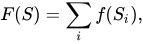
and the contribution from each locus in general depends on the value of other loci:


where are the other loci upon which the fitness of depends.

Hence, the fitness function is a mapping between strings of length K + 1 and scalars, which Weinberger's later work calls "fitness contributions". Such fitness contributions are often chosen randomly from some specified probability distribution.

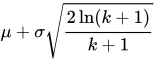
In 1991, Weinberger published a detailed analysis[23] of the case in which and the fitness contributions are chosen randomly. His analytical estimate of the number of local optima was later shown to be flawed.[citation needed] However, numerical experiments included in Weinberger's analysis support his analytical result that the expected fitness of a string is normally distributed with a mean of approximately and a variance of approximately .

![{\displaystyle {{(k+1)\sigma ^{2}} \over {N[k+1+2(k+2)\ln(k+1)]}}}](https://wikimedia.org/api/rest_v1/media/math/render/svg/2e461821193ca5fbf26506cd75bc49f338fc01c3)
Recognition and awards
[edit]Kauffman held a MacArthur Fellowship between 1987 and 1992. He also holds an Honorary Degree in Science from the University of Louvain (1997); He was awarded the Norbert Wiener Memorial Gold Medal for Cybernetics in 1973, the Gold Medal of the Accademia dei Lincei in Rome in 1990, the Trotter Prize for Information and Complexity in 2001, and the Herbert Simon award for Complex Systems in 2013. He became a Fellow of the Royal Society of Canada in 2009.
Works
[edit]Kauffman is best known for arguing that the complexity of biological systems and organisms might result as much from self-organization and far-from-equilibrium dynamics as from Darwinian natural selection in three areas of evolutionary biology, namely population dynamics, molecular evolution, and morphogenesis. With respect to molecular biology, Kauffman's structuralist approach has been criticized for ignoring the role of energy in driving biochemical reactions in cells, which can fairly be called self-catalyzing but which do not simply self-organize.[24] Some biologists and physicists working in Kauffman's area have questioned his claims about self-organization and evolution. A case in point is some comments in the 2001 book Self-Organization in Biological Systems.[25] Roger Sansom's 2011 book Ingenious Genes: How Gene Regulation Networks Evolve to Control Development is an extended criticism of Kauffman's model of self-organization in relation to gene regulatory networks.[26]
Borrowing from spin glass models in physics, Kauffman invented "N-K" fitness landscapes, which have found applications in biology[27] and economics.[28][29] In related work, Kauffman and colleagues have examined subcritical, critical, and supracritical behavior in economic systems.[30]
Kauffman's work translates his biological findings to the mind-body problem and issues in neuroscience, proposing attributes of a new "poised realm" that hovers indefinitely between quantum coherence and classicality. He published on this topic in his paper "Answering Descartes: beyond Turing".[31] With Giuseppe Longo and Maël Montévil, he wrote (January 2012) "No Entailing Laws, But Enablement in the Evolution of the Biosphere",[32] which argued that evolution is not "law entailed" like physics.

Kauffman's work is posted on Physics ArXiv, including "Beyond the Stalemate: Mind/Body, Quantum Mechanics, Free Will, Possible Panpsychism, Possible Solution to the Quantum Enigma" (October 2014)[33] and "Quantum Criticality at the Origin of Life" (February 2015).[20]
Kauffman has contributed to the emerging field of cumulative technological evolution by introducing a mathematics of the adjacent possible.[34][35]
He has published over 350 articles and 6 books: The Origins of Order (1993), At Home in the Universe (1995), Investigations (2000), Reinventing the Sacred (2008), Humanity in a Creative Universe (2016), and A World Beyond Physics (2019).
In 2016, Kauffman wrote a children's story, "Patrick, Rupert, Sly & Gus Protocells", a narrative about unprestatable niche creation in the biosphere, which was later produced as a short animated video.[36]
In 2017, exploring the concept that reality consists of both ontologically real "possibles" (res potentia) and ontologically real "actuals" (res extensa), Kauffman co-authored, with Ruth Kastner and Michael Epperson, "Taking Heisenberg's Potentia Seriously".[37]
Bibliography
[edit]- Selected articles
- Kauffman, S. A.; McCulloch, W. S. (1967). Random Nets of Formal Genes (Technical report). Quarterly Progress Report 34. Cambridge, MA: Research Laboratory of Electronics, Massachusetts Institute of Technology.
- Kauffman, Stuart (1969). "Metabolic stability and epigenesis in randomly constructed genetic nets". Journal of Theoretical Biology. 22 (3): 437–467. Bibcode:1969JThBi..22..437K. doi:10.1016/0022-5193(69)90015-0. PMID 5803332.
- Kauffman, S. A. (1971a). "Cellular Homeostasis, Epigenesis, and Replication in Randomly Aggregated Macromolecular Systems". Journal of Cybernetics. 1 (1): 71–96. doi:10.1080/01969727108545830.
- Kauffman, S. A. (1971b). "Differentiation of Malignant to Benign Cells". Journal of Theoretical Biology. 31 (3): 429–451. Bibcode:1971JThBi..31..429K. doi:10.1016/0022-5193(71)90020-8. PMID 5556142.
- Kauffman, Stuart (August 1991). "Antichaos and Adaptation" (PDF). Scientific American. 265 (2): 78–84. Bibcode:1991SciAm.265b..78K. doi:10.1038/scientificamerican0891-78. PMID 1862333. Retrieved April 28, 2015.
- Kauffman, S. A.; Johnsen, S (1991). "Co-Evolution to the Edge of Chaos: Coupled Fitness Landscapes, Poised States, and Co-Evolutionary Avalanches" (PDF). Journal of Theoretical Biology. 149 (4): 467–505. Bibcode:1991JThBi.149..467K. CiteSeerX 10.1.1.502.3299. doi:10.1016/s0022-5193(05)80094-3. PMID 2062105.
- Kauffman, Stuart (2004). "Autonomous Agents". In Barrow, John D.; Davies, Paul C. W.; Harper, Charles L. Jr. (eds.). Science and Ultimate Reality: Quantum Theory, Cosmology, and Complexity. Cambridge University Press. ISBN 978-0-521-83113-0.
- Kauffman, Stuart (2004). "Prolegomenon to a General Biology". In Dembski, William A.; Ruse, Michael (eds.). Debating Design: From Darwin to DNA. Cambridge University Press. ISBN 978-1-139-45961-7.
- Kauffman, Stuart A. (November 12, 2006). "Beyond reductionism: Reinventing The Sacred". Edge.com. Edge Foundation. Retrieved April 28, 2015.
- Hanel, R.; Kauffman, S. A.; Thurner, S. (2007). "Towards a Physics of Evolution: Critical Diversity Dynamics at the Edges of Collapse and Bursts of Diversification". Physical Review E. 76 (3) 036110. Bibcode:2007PhRvE..76c6110H. doi:10.1103/physreve.76.036110. PMID 17930309.
- Kauffman, Stuart (May 7, 2008). "Why Humanity Needs a God of Creativity". New Scientist. 198 (2655): 52–53. doi:10.1016/s0262-4079(08)61171-9. Retrieved April 28, 2015.
- Nykter, M.; Price, N. D.; Aldana, M.; Ramsey, S. A.; Kauffman, S. A.; Hood, L.; Yli-Harja, O.; Shmulevich, I. (2008). "Gene Expression Dynamics in the Macrophage Exhibit Criticality". Proc Natl Acad Sci USA. 105 (6): 1897–1900. Bibcode:2008PNAS..105.1897N. doi:10.1073/pnas.0711525105. PMC 2538855. PMID 18250330.
- Huang, S.; Hu, L.; Kauffman, S.; Zhang, W.; Shmulevich, I. (2009). "Using cell fate attractors to uncover transcriptional regulation of HL60 neutrophil differentiation". BMC Systems Biology. 3 (1): 20. doi:10.1186/1752-0509-3-20. PMC 2652435. PMID 19222862.
- Huang, S.; Kauffman, S. A. (2009). "Complex Gene Regulatory Networks - from Structure to Biological Observables: Cell Fate Determination". In Meyers, R. A. (ed.). Encyclopedia of Complexity and Systems Science. Springer. ISBN 978-0-387-75888-6.
- Kauffman, S. A. (2011). "Approaches to the Origin of Life on Earth". Life. 1 (1): 34–48. Bibcode:2011Life....1...34K. doi:10.3390/life1010034. PMC 4187126. PMID 25382055.
- Longo, G.; Montévil, M.; Kauffman, S. (January 2012). "No entailing laws, but enablement in the evolution of the biosphere". arXiv:1201.2069 [q-bio.OT].
- Kauffman, Stuart; Hill, Colin; Hood, Leroy; Huang, Sui (2014b). "Transforming Medicine: A Manifesto". Scientific American Worldview. Archived from the original on July 13, 2014. Retrieved April 28, 2015.
- Kauffman, Stuart (October 2014). "Beyond the Stalemate: Conscious Mind-Body - Quantum Mechanics - Free Will - Possible Panpsychism - Possible Interpretation of Quantum Enigma". arXiv:1410.2127 [physics.hist-ph].
- Felin, T.; Kauffman, S.; Koppl, R.; Longo, G. (December 2014). "Economic Opportunity and Evolution: Beyond Landscapes and Bounded Rationality" (PDF). Strategic Entrepreneurship Journal. 8 (4): 269–282. doi:10.1002/sej.1184. SSRN 2197512.
- Vattay, G.; Salahub, D.; Csaibai, I.; Nassmi, A.; Kauffman, S. (February 2015). "Quantum Criticality at the Origin of Life". Journal of Physics: Conference Series. 626 (1) 012023. arXiv:1502.06880. Bibcode:2015JPhCS.626a2023V. doi:10.1088/1742-6596/626/1/012023. S2CID 18439451.
- Kauffman, S. (2016). "Answering Descartes: Beyond Turing". In Cooper, S. Barry; Hodges, Andrew (eds.). The Once and Future Turing. Cambridge University Press.
- Books
- Kauffman, Stuart (1993). The Origins of Order: Self Organization and Selection in Evolution. Oxford University Press. ISBN 978-0-19-507951-7.
- Kauffman, Stuart (1995). At Home in the Universe: The Search for Laws of Self-Organization and Complexity. Oxford University Press. ISBN 978-0-19-511130-9.
- Kauffman, Stuart (2000). Investigations. Oxford University Press. ISBN 978-0-19-972894-7.
- Kauffman, Stuart (2008). Reinventing the Sacred: A New View of Science, Reason, and Religion. Basic Books. ISBN 978-0-465-00300-6.
- Kauffman, Stuart (2016). Humanity in a Creative Universe. Oxford University Press. ISBN 978-0-19-939045-8.
- Kauffman, Stuart (2019). A World Beyond Physics. Oxford University Press. ISBN 978-0-19-087133-8.
Notes
[edit]- ^ Kauffman & McCulloch 1967.
- ^ Kauffman 1969.
- ^ Huang & Kauffman 2009.
- ^ Nykter et al. 2008.
- ^ Kauffman 1971b.
- ^ Kauffman 1971a.
- ^ Kauffman 2011.
- ^ Dadon, Wagner & Ashkenasy 2008.
- ^ Dadon et al. 2012.
- ^ EP 0229046A1, "Procédé d'obtention d'ADN, ARN, peptides, polypeptides ou protéines, par une technique de recombinaison d'ADN"
- ^ US 5,723,323 "Method of identifying a stochastically-generated peptide, polypeptide, or protein having ligand binding property and compositions thereof"
- ^ CA 1339937C, "Procedure for obtaining DNA, RNA peptides, polypeptides, or proteins by recombinant DNA techniques"
- ^ "NuTech Solutions to Acquire BiosGroup's Software Development Operations". BusinessWire. February 20, 2003. Retrieved July 5, 2015.
- ^ "Netezza Corporation Acquires NuTech Solutions". BusinessWire. May 15, 2008. Retrieved July 5, 2015.
- ^ "IBM to Acquire Netezza". IBM News Room. IBM. September 20, 2010. Archived from the original on September 23, 2010. Retrieved July 5, 2015.
- ^ "Stuart Kauffman, complex systems pioneer, to join UVM faculty". Vermontbiz.com. Vermont Business Magazine. September 30, 2009. Retrieved April 28, 2015.
- ^ a b "Stuart Kauffman". NPR.org. April 26, 2013. Retrieved April 28, 2015.
- ^ Kauffman et al. 2014b.
- ^ US, "Uses of systems with degrees of freedom poised between fully quantum and fully classical states"
- ^ a b Vattay et al. 2015.
- ^ "Rethinking Economic Growth". academicimpact.un.org. May 11, 2015. Retrieved May 26, 2020.
- ^ Felin, Teppo; Kauffman, Stuart; Koppl, Roger; Longo, Giuseppe (2014). "Economic opportunity and evolution: Beyond landscapes and bounded rationality" (PDF). Strategic Entrepreneurship Journal. 8 (4): 269–282. doi:10.1002/sej.1184.
- ^ Weinberger, Edward (November 15, 1991). "Local properties of Kauffman's N-k model: A tunably rugged energy landscape". Physical Review A. 10. 44 (10): 6399–6413. Bibcode:1991PhRvA..44.6399W. doi:10.1103/physreva.44.6399. PMID 9905770.
- ^ Fox, Ronald F. (December 1993). "Review of Stuart Kauffman, The Origins of Order: Self-Organization and Selection in Evolution". Biophys. J. 65 (6): 2698–2699. Bibcode:1993BpJ....65.2698F. doi:10.1016/s0006-3495(93)81321-3. PMC 1226010.
- ^ Camazine, Scott; Deneubourg, Jean-Louis; Franks, Nigel R.; Sneyd, James; Theraulaz, Guy; Bonabeau, Eric (2001). Self-Organization in Biological Systems. Princeton Studies in Complexity. Princeton, New Jersey: Princeton University Press. pp. 88–89, 283. doi:10.2307/j.ctvzxx9tx. ISBN 0-691-01211-3. JSTOR j.ctvzxx9tx. OCLC 44876868.
- ^ Sansom, Roger (2011). Ingenious Genes: How Gene Regulation Networks Evolve To Control Development. Life and Mind: Philosophical Issues in Biology and Psychology. Cambridge, Massachusetts: MIT Press. doi:10.7551/mitpress/9780262195812.001.0001. ISBN 978-0-262-19581-2. OCLC 694600461. See also: Wray, Gregory A. (December 2012). "Adaptation and Gene Networks: Ingenious Genes: How Gene Regulation Networks Evolve to Control Development [book review]". BioScience. 62 (12): 1084–1085. doi:10.1525/bio.2012.62.12.10.
- ^ Kauffman & Johnsen 1991.
- ^ Rivkin & Siggelkow 2002.
- ^ Felin et al. 2014.
- ^ Hanel, Kauffman & Thurner 2007.
- ^ Kauffman 2016.
- ^ Longo, Montévil & Kauffman 2012.
- ^ Kauffman 2014.
- ^ Tria, F.; Loreto, V.; Servedio, V. D. P.; Strogatz, S. H. (July 2014). "The dynamics of correlated novelties". Scientific Reports. 4 (1): 5890. arXiv:1310.1953. Bibcode:2014NatSR...4.5890T. doi:10.1038/srep05890. PMC 5376195. PMID 25080941.
- ^ Monechi, Bernardo; Ruiz-Serrano, Álvaro; Tria, Francesca; Loreto, Vittorio (June 2017). "Waves of novelties in the expansion into the adjacent possible". PLoS ONE. 12 (6) e0179303. Bibcode:2017PLoSO..1279303M. doi:10.1371/journal.pone.0179303. PMC 5464662. PMID 28594909.
- ^ The story can be read here: "The Surprising True Story of Patrick S., Rupert R., Sly S., and Gus G. Protocells in Their Very Early Years" (PDF). August 16, 2016. Archived (PDF) from the original on May 27, 2020. Kauffman narrates the story in 2017 here: Archived at Ghostarchive and the Wayback Machine: "The Surprising True Story of Patrick, Rupert, Sly, and Gus". YouTube. March 10, 2017. Retrieved May 26, 2020. An animated version is here: Archived at Ghostarchive and the Wayback Machine: "The origins of life and its continuing wonder". YouTube. Science Animated. August 24, 2020.
Stuart Kauffman explains how life evolved from its earlier origins some 3,700 million years ago through the story of four protocells—Patrick, Rupert, Sly and Gus. He explains why our knowledge of the origins and early evolution of life can greatly help us understand our true place in the world.
- ^ Kastner, Ruth E.; Kauffman, Stuart; Epperson, Michael (2019). "Taking Heisenberg's Potentia Seriously". Adventures in Quantumland: Exploring Our Unseen Reality. London; Hackensack, NJ: World Scientific. pp. 223–237. arXiv:1709.03595. doi:10.1142/9781786346421_0011. ISBN 978-1-78634-641-4. OCLC 1083673555. S2CID 4882205.
References
[edit]- Dadon, Z.; Wagner, N.; Ashkenasy, G. (2008). "The Road to Non-Enzymatic Molecular Networks". Angew. Chem. Int. Ed. 47 (33): 6128–6136. Bibcode:2008ACIE...47.6128D. doi:10.1002/anie.200702552. PMID 18613152.
- Dadon, Z.; Wagner, N.; Cohen-Luria, R.; Ashkenasy, G. (2012). "Reaction Networks. Wagner and Askkenazy's (2008) results demonstrate that molecular replication need not be based on DNA or RNA template replication, still the dominant view for the origin of life". In Gale, P. A.; Steed J. W. (eds.). Supramolecular Chemistry: From Molecules to Nanomaterials. John Wiley and Sons, Ltd. ISBN 978-0-470-74640-0.
- Rivkin, J. W.; Siggelkow, N. (May–June 2002). "Organizational Sticking Points on NK Landscapes". Complexity. 7 (5): 31–43. Bibcode:2002Cmplx...7e..31R. doi:10.1002/cplx.10037. Retrieved April 28, 2015.
Further reading
[edit]- Chialvo, D. R. (2013). "Critical Brain Dynamics at Large Scale". In Plenz D.; Niebur, E.; Schuster H. G. (eds.). Criticality in Neural Systems. Vol. 1. Wiley. ISBN 978-3-527-41104-7.
- Goldstein, Jeffrey A. (2008). "Book Review of Reinventing the Sacred: A New View of Science, Reason, and Religion, by Stuart Kauffman". Emergence: Complexity & Organization. 10 (3): 117–130.
- Horgan, John (February 4, 2015). "Seeker Stuart Kauffman on Free Will, God, ESP and Other Mysteries". Scientific American. Retrieved April 28, 2015.
- MacKenzie, Dana (February 2002). "The Science of Surprise". Discover. 23 (2): 59–63.
- Paulson, Steve (November 9, 2008). "God Enough". Salon. Retrieved April 28, 2015.
External links
[edit]
- "Thinker of Untold Dreams: A Portrait of Stuart Kauffman". Vimeo.
- Archived at Ghostarchive and the Wayback Machine: "The Shape of History". YouTube. January 28, 2019. A talk at the New England Complex Systems Institute, January 28, 2019.
